


A person raises their arm during an ordinary conversation. From the elbow down it’s all bone. The other person has just asked if they’re stressed and the reply is very mild indeed: “A little.”
The scene is from Can You Tell I’m Stressed? (one of Madeline Claire Horwath’s (known professionally as Mads Horwath) 11 part comic series Picking My Skin Solves My Problems, for the Wellcome Collection in 2023). It’s a very succinct introduction to Horwath’s approach. A condition that is often hidden, misunderstood and/or shamed becomes utterly impossible to hide. Rather than present the damaged body as an object of pity, Horwath makes it the very centre of a rather absurdly mundane conversation.
The series is about dermatillomania (compulsive skin picking, a body-focused repetitive behaviour) in the language of contemporary cartooning and would quite comfortably sit within the field of graphic medicine which uses comics to tell the stories of illness, disability and psychological distress. Horwath is less interested in the medical explanation, however. Their drawings are looking at the inherent contradictions of having a condition which can be very distressing, very habitual, very difficult to explain and at times, quite darkly funny.
Making the Invisible Visible
Can You Tell I’m Stressed? shows two people having a conversation over a cup of coffee. One is saying that they pick their skin when they’re stressed and the other asks if they’re currently stressed. It’s a fairly straightforward, unremarkable exchange. The figures are drawn in thick, slightly uneven black lines against a very pale, lightly shaded background. The faces are very basic and the dialogue takes up most of the panel.
The second panel gives the visual answer. One character has an arm right down to the bone and is still in the middle of the conversation.
There’s a very deliberate imbalance in the composition. The speech balloons take up a lot of space and guide the reader through a perfectly ordinary social exchange before the visual revelation alters the meaning of it all. The panel transition is jarring but perfectly timed. You go from a perfectly normal question to an image which is utterly impossible and then you have to work out how to reconcile the two.
This is the difficulty of communicating an internal state. Anxiety isn’t necessarily visible to another person and the degree of compulsive behaviour may well be invisible until you actually see the physical manifestation of it. Horwath makes that invisibility literal in a rather extreme way (the body is pushed beyond the bounds of plausibility) while still maintaining the awkwardness of normal conversation.
The Problem With Easy Solutions
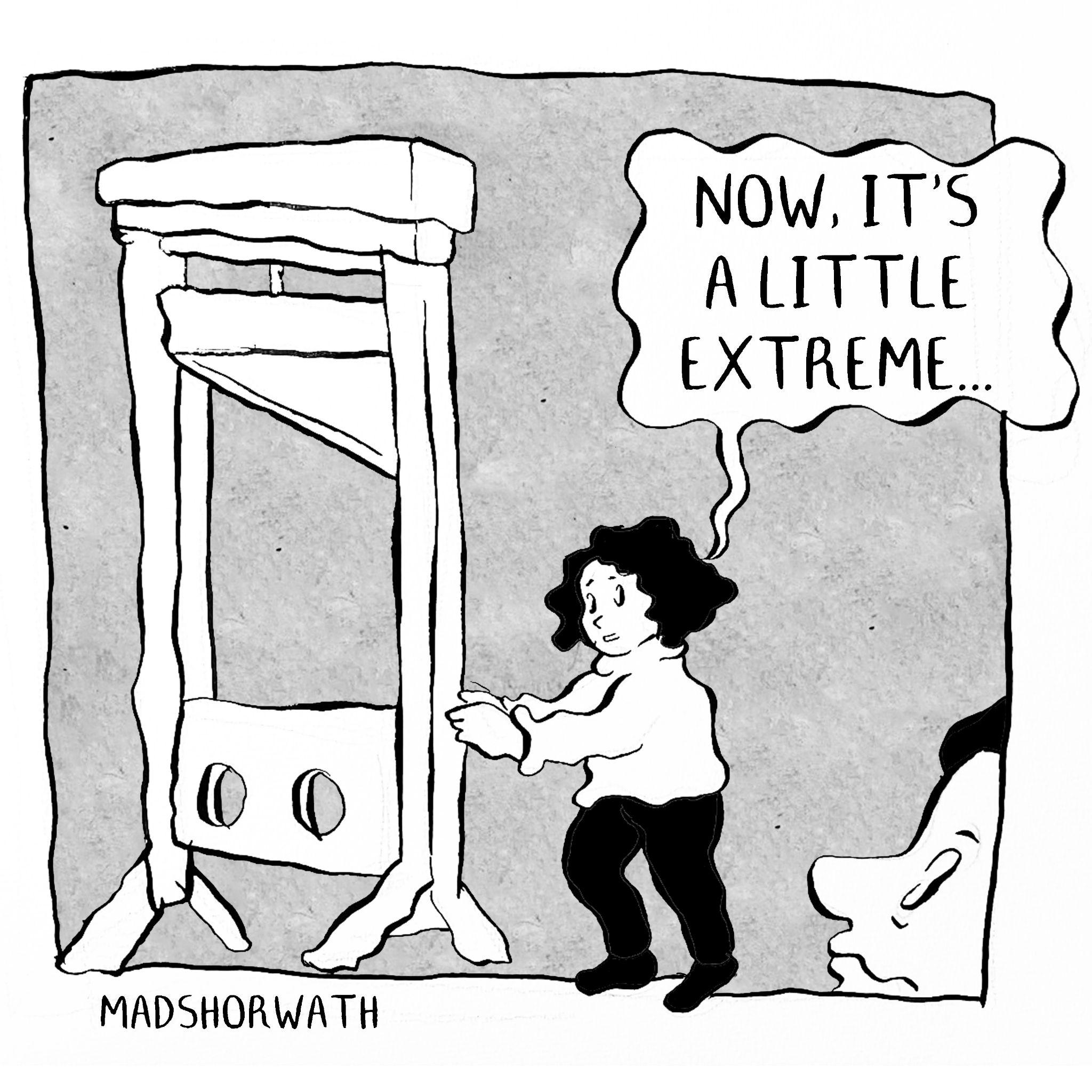
The 3 panel comic starts with one character going through the various things they’ve tried to stop picking their skin (gloves, medication, therapy, meditation). The other character says they’ve got the perfect solution. There’s a bit of suspense in the next panel as the advisor goes off to get it. The final panel shows them returning with a guillotine.
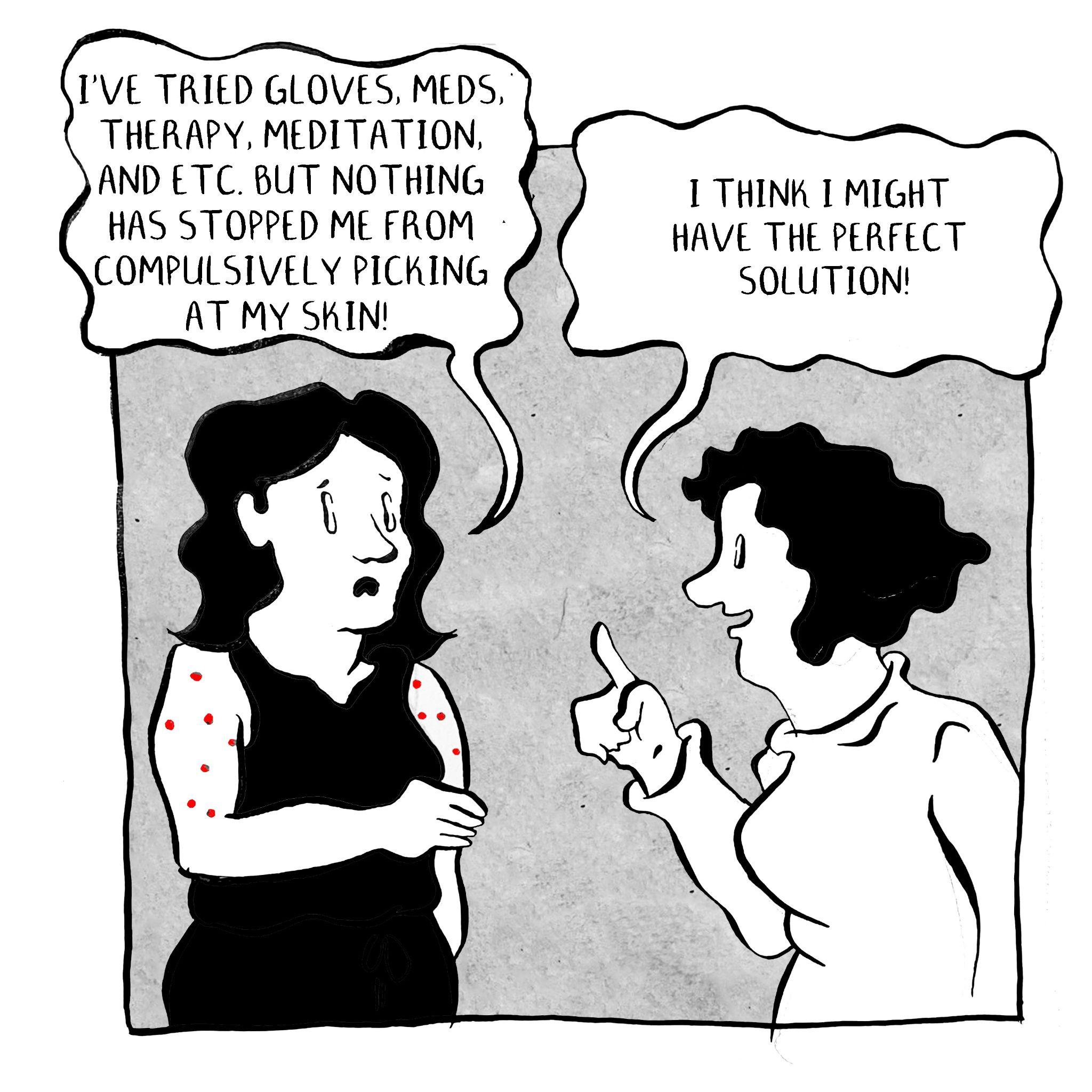
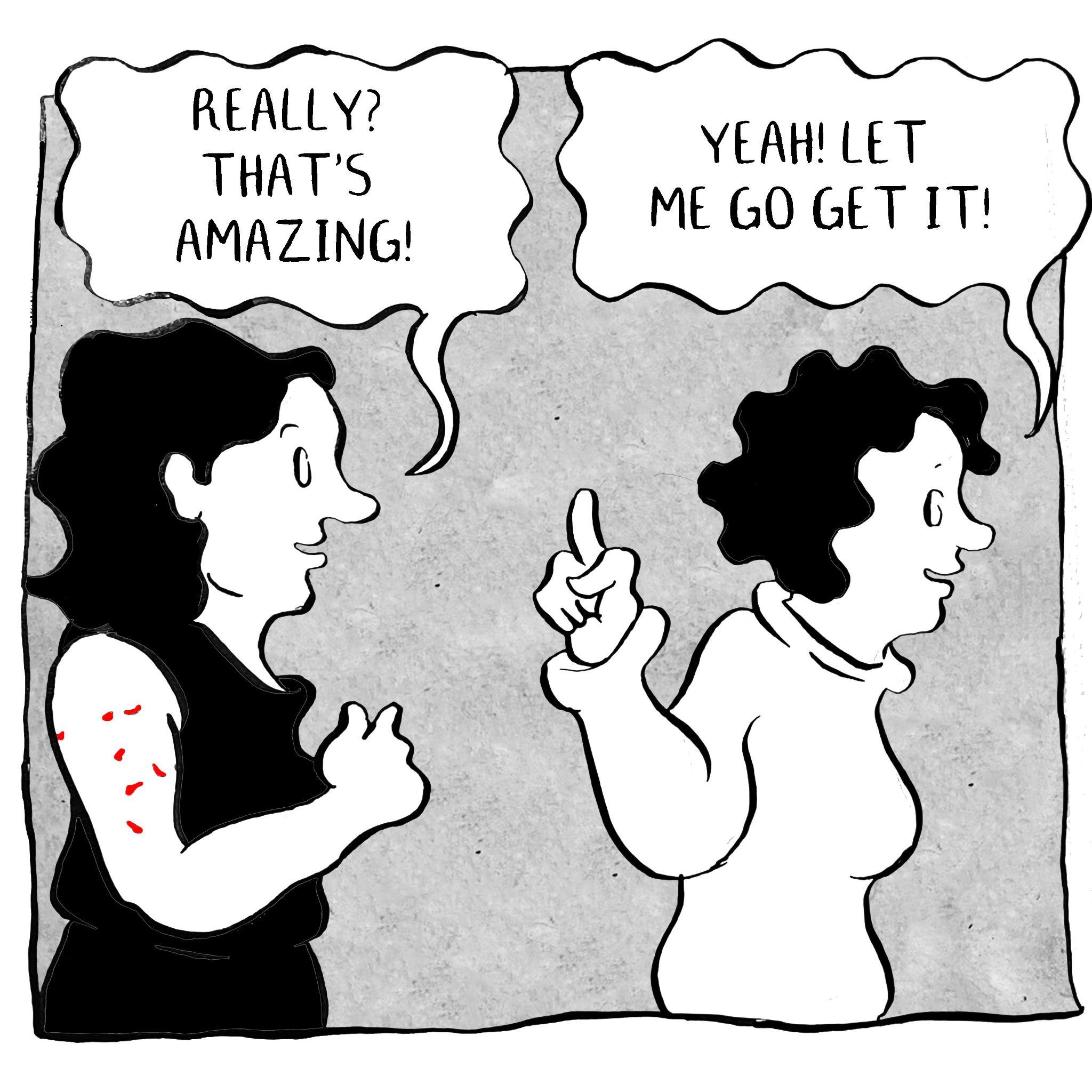
The drawing is pretty blunt, almost deliberately so. The characters are in black and white with a few small red dots on the arm of the person affected which is the only real break in the otherwise monochrome scene. Those red dots establish the condition before the dialogue goes on to explain it.
What makes it more than just a silly gag is the way it deals with the putative solution. The guillotine isn’t just an odd piece of kit. It’s the literalisation of the absurdity of treating a persistent condition as if it’s a problem that has one single answer. That answer being ‘cut it out’.
The humour is quite uncomfortable in that it highlights a very familiar social behaviour: when you see someone in distress you feel a compulsion to offer a solution. The person in need may well end up managing another person’s confidence in a rather unsuitable solution.
There’s a danger in that approach though in that the violence of the image could quite easily swamp the experience it’s meant to be about. The cartoon doesn’t however go for the suffering as the punchline. The target is the complete absurdity of the person giving the advice.
When a Walk Becomes a Journey
Walk It Off takes a similar idea much further with a longer sequence. A character who is skin picking is told that they can get their stress out by just going for a walk. They agree and go for a walk, expecting to be back very shortly.
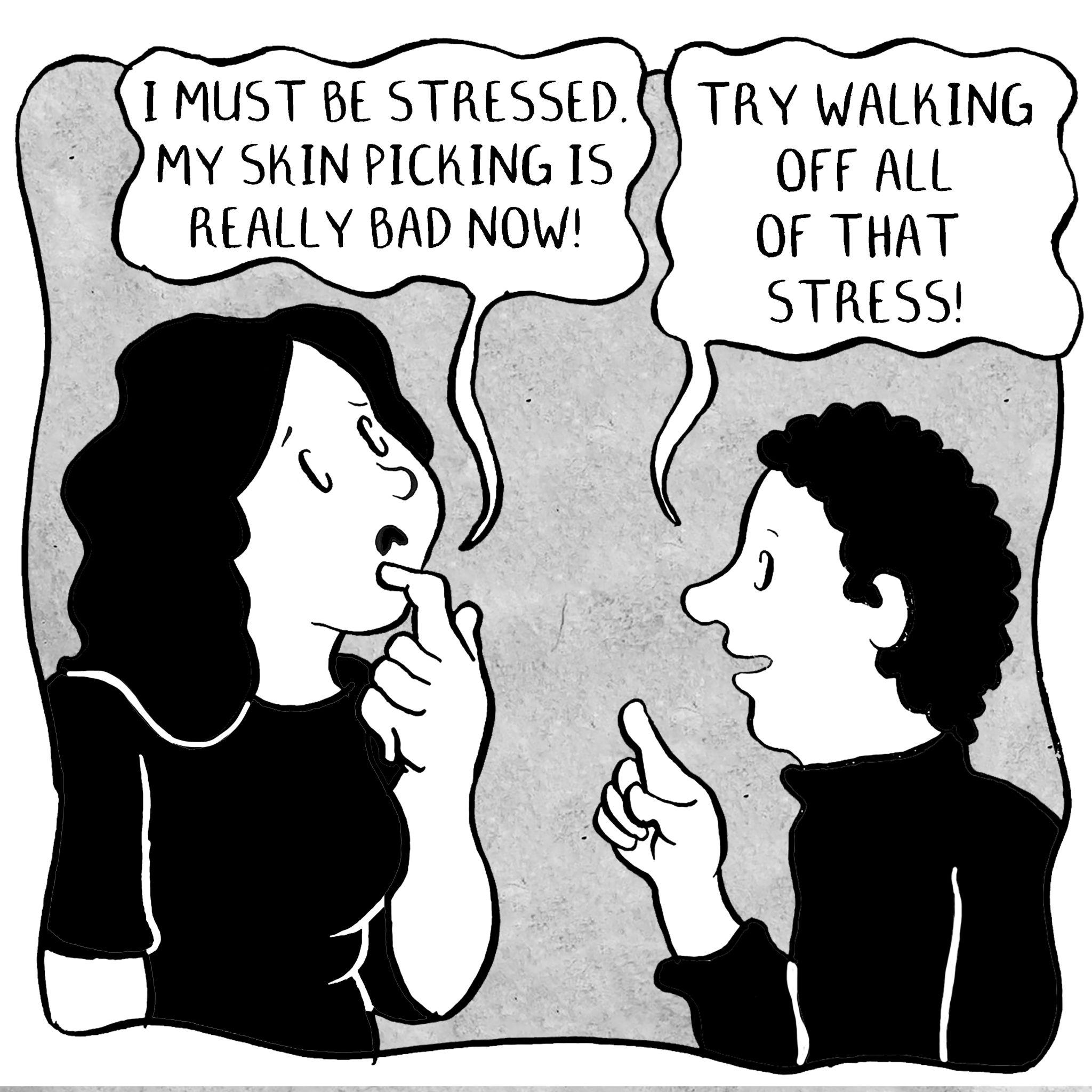
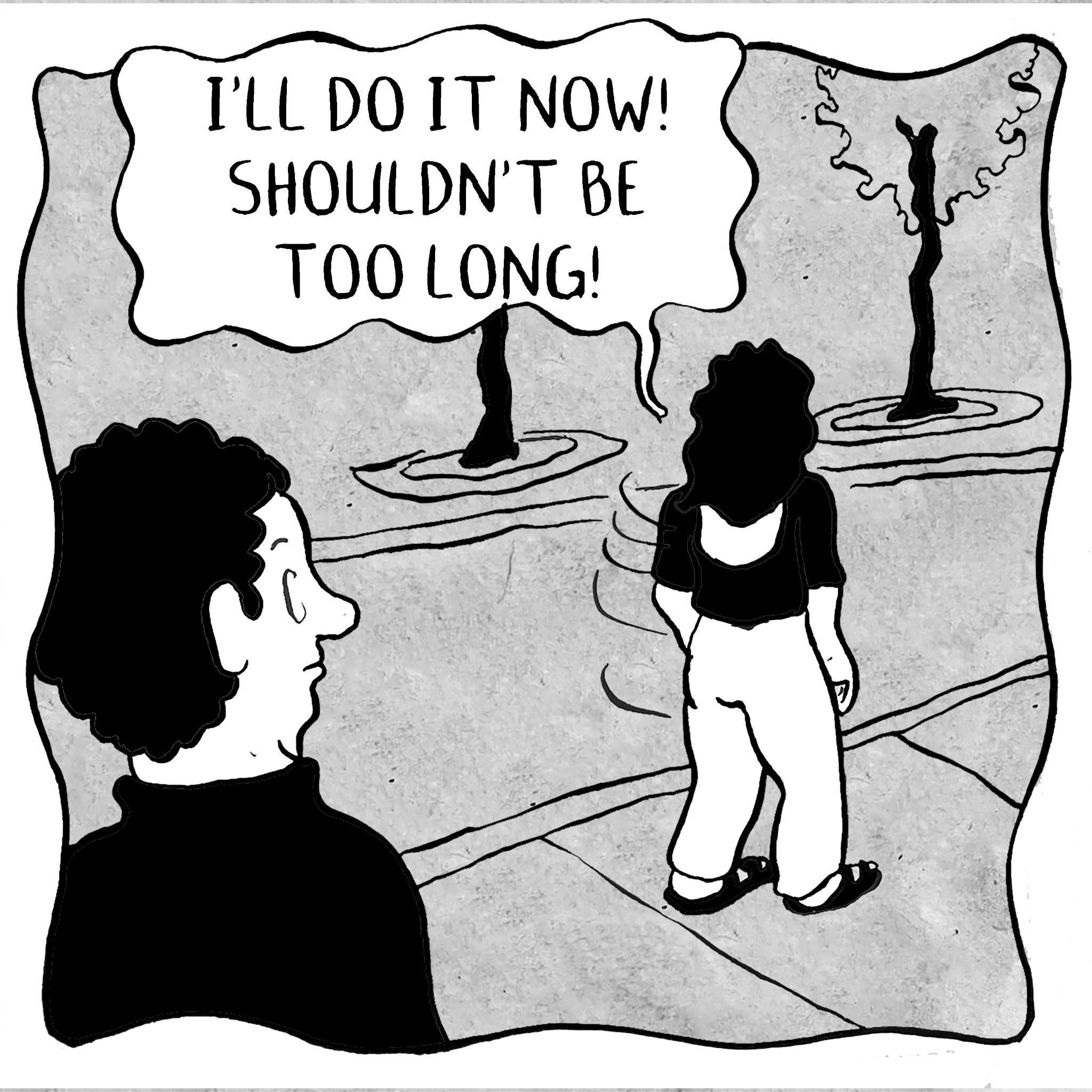
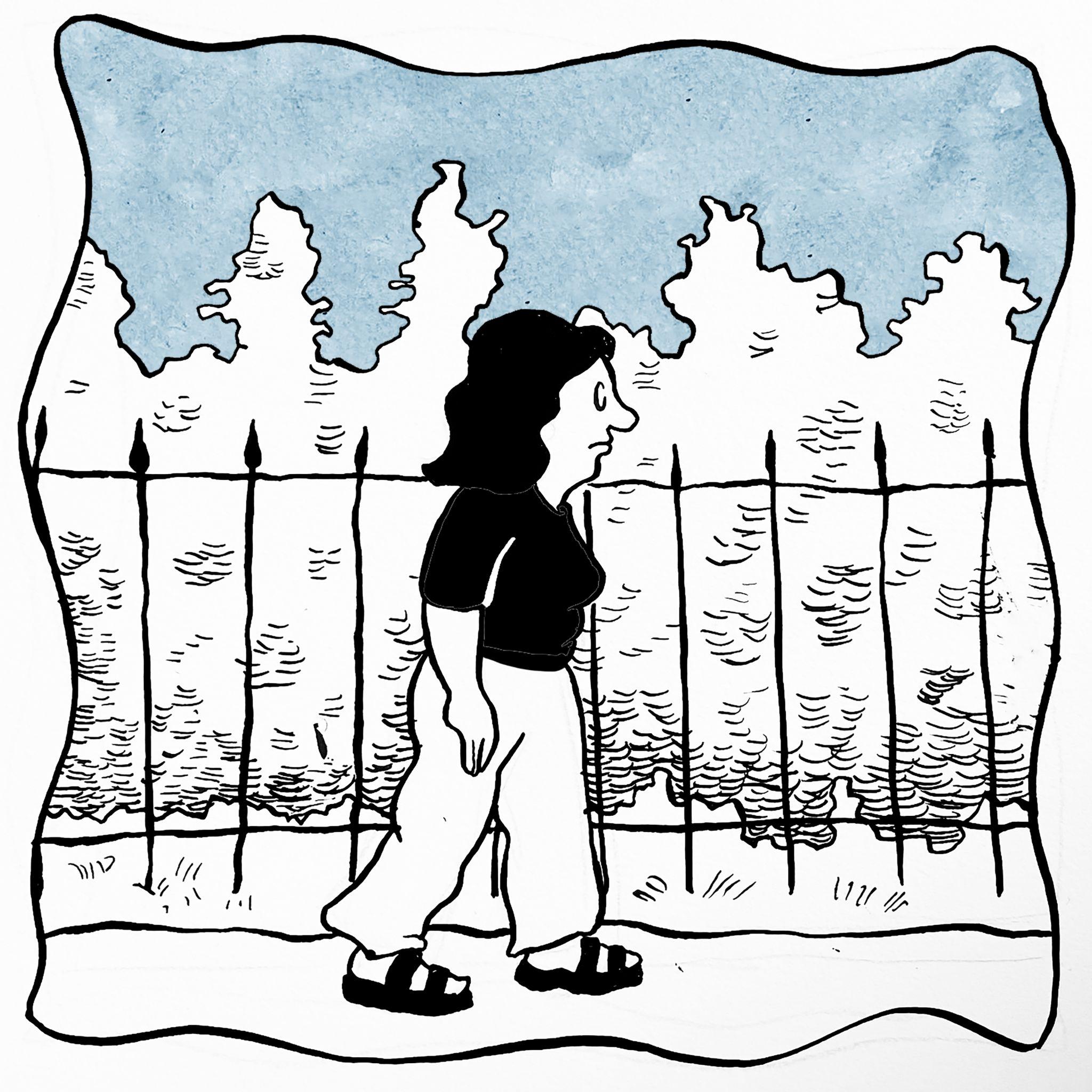
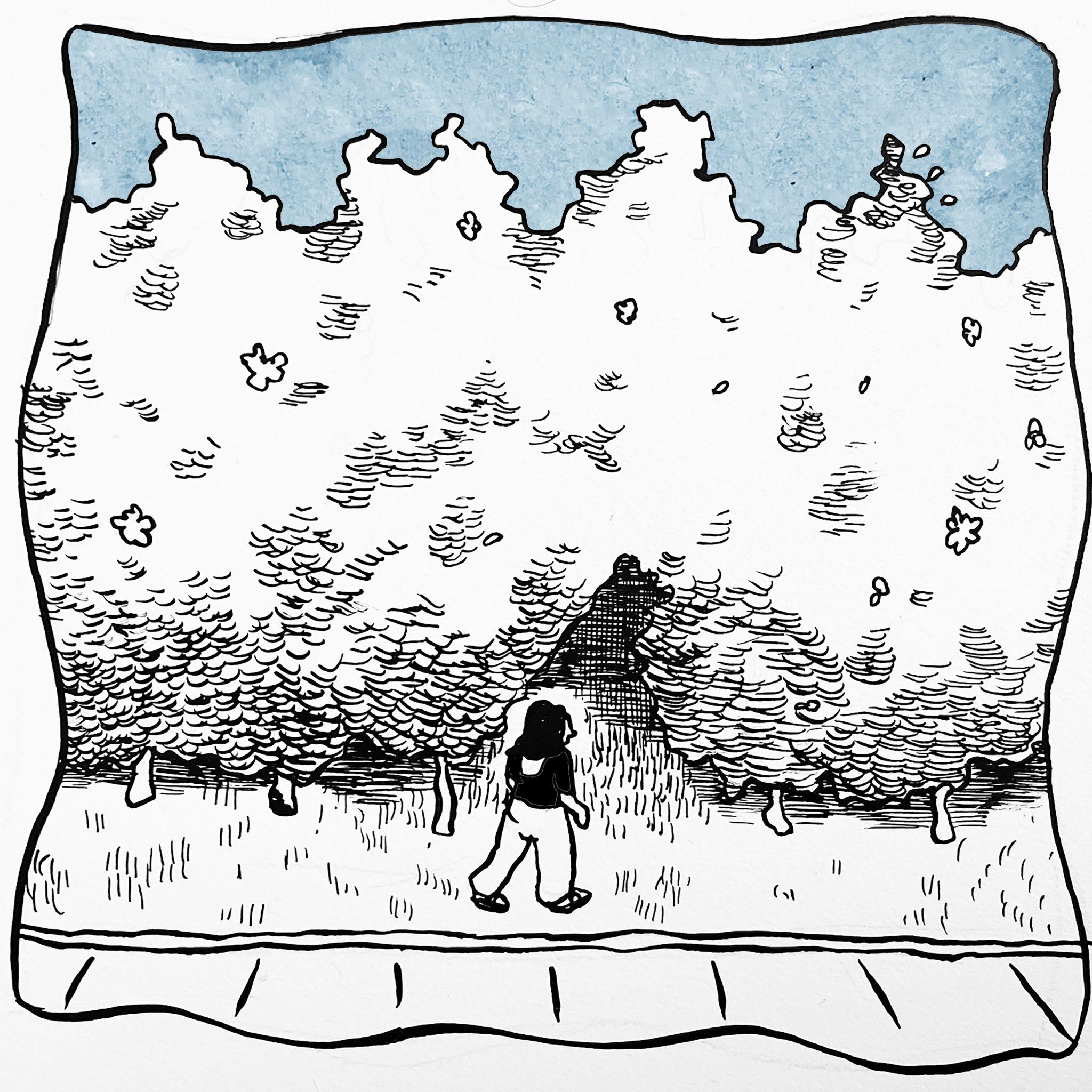
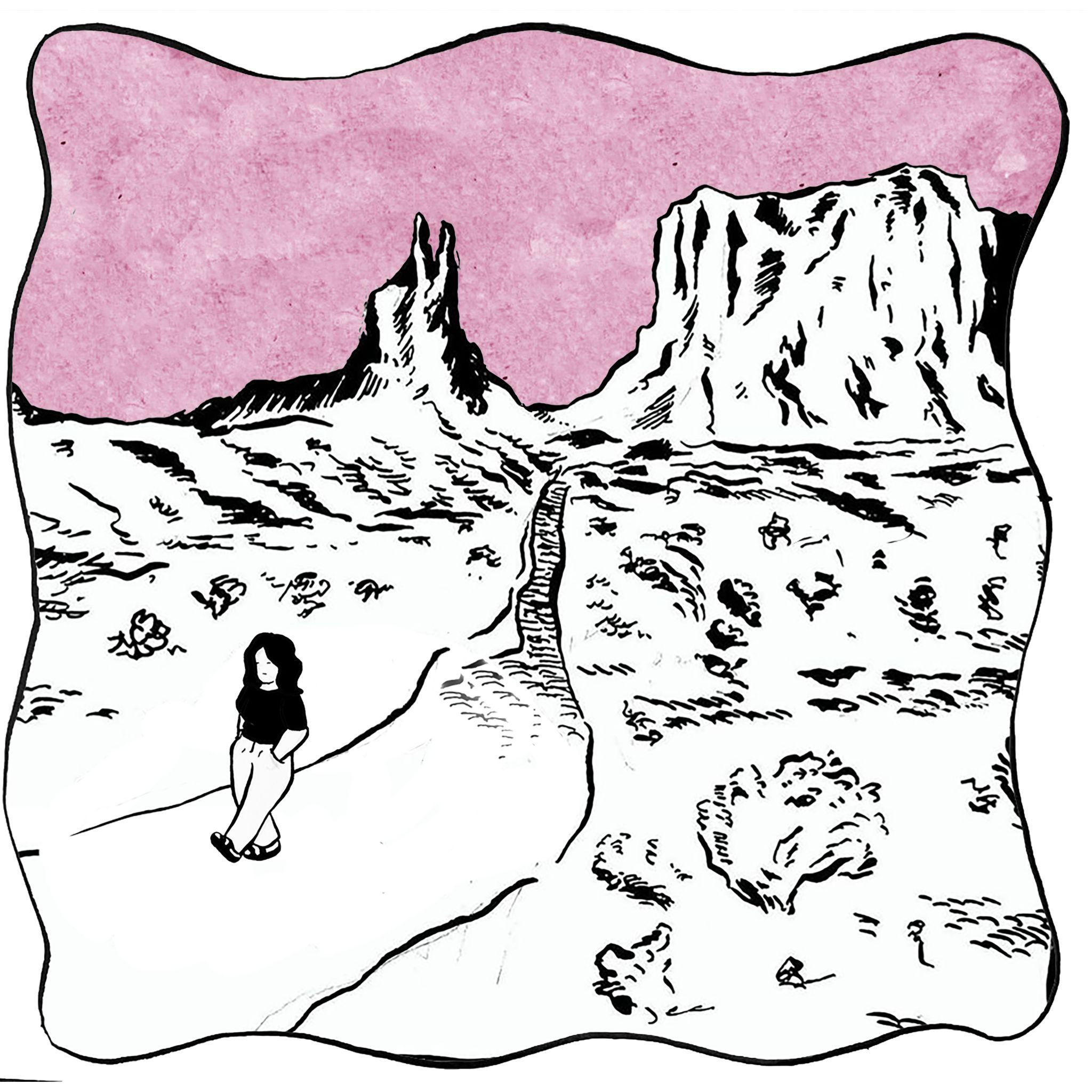
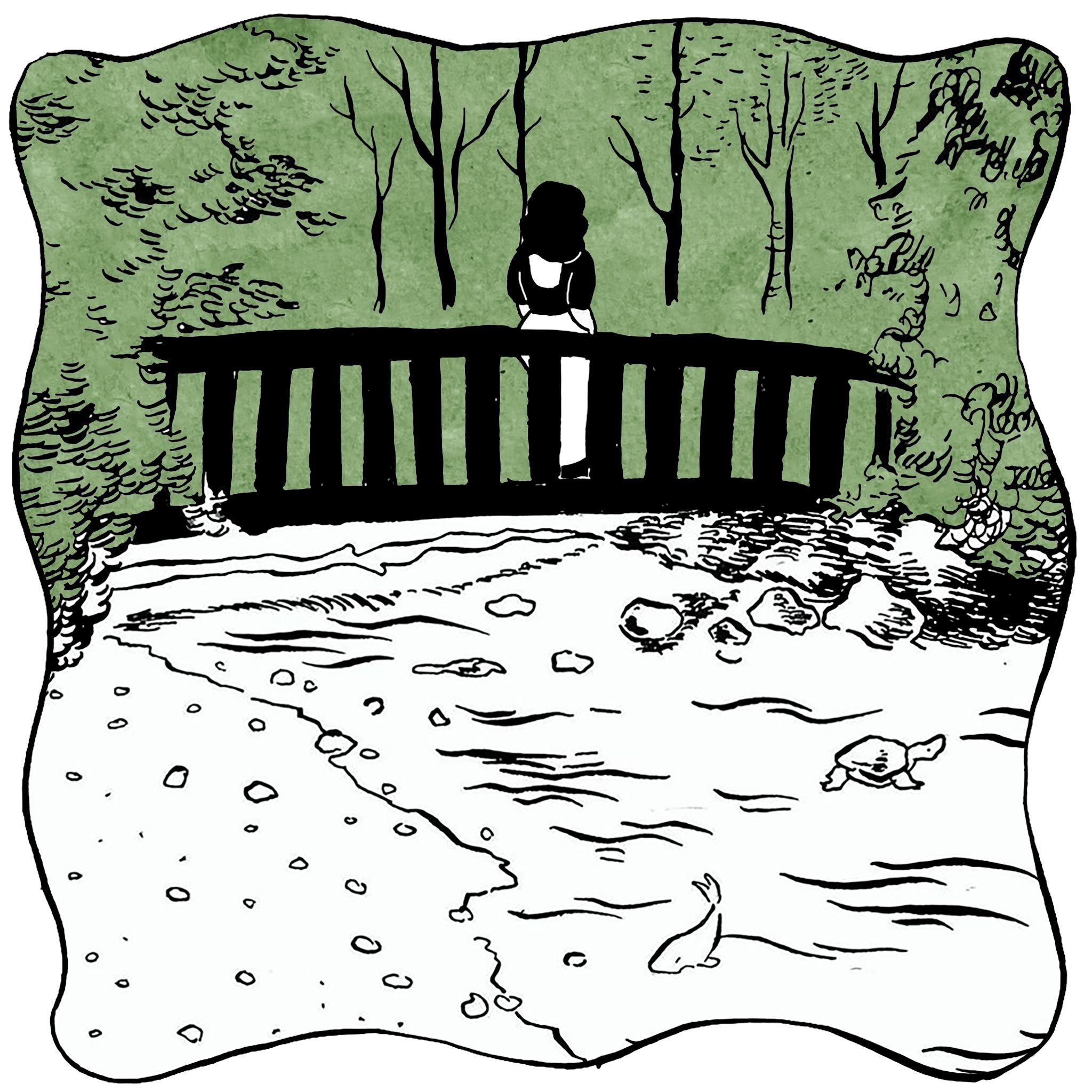
Horwath takes the character through a variety of landscapes: a path, some woodland, mountains, a bridge and then into a night-time scene. The simple suggestion of ‘get some fresh air’ becomes a very small expedition. When the character comes back it’s been three weeks.
The move from the domestic to the much more expansive outdoor journey gives the comic a different feel to it from the sudden reversals of Can You Tell I’m Stressed? and Guillotine. It’s the repetition that provides the humour. Each successive panel extends the activity which was originally just a brief and straightforward intervention.
The visual space opens up as the character moves further away from the initial conversation. The small human figure is repeatedly situated within larger environments, altering the relationship between the figure and the environment. The result is both comic and oddly melancholy: the world is vast, the scale is enormous, but the problem is still there.
This refusal to offer an easy ending is one of the series’ strengths. Horwath is happy to have a joke reveal the limitations of the advice it’s based upon.
A Body That Disappears
The last one, My Backstory, shifts the emotional tone of the series.
A lone figure walking through the landscape musing on things outside of their control (other people’s opinions, the state of the world). Skin picking is an act they can do themselves, even if it’s an act that is ultimately destructive.
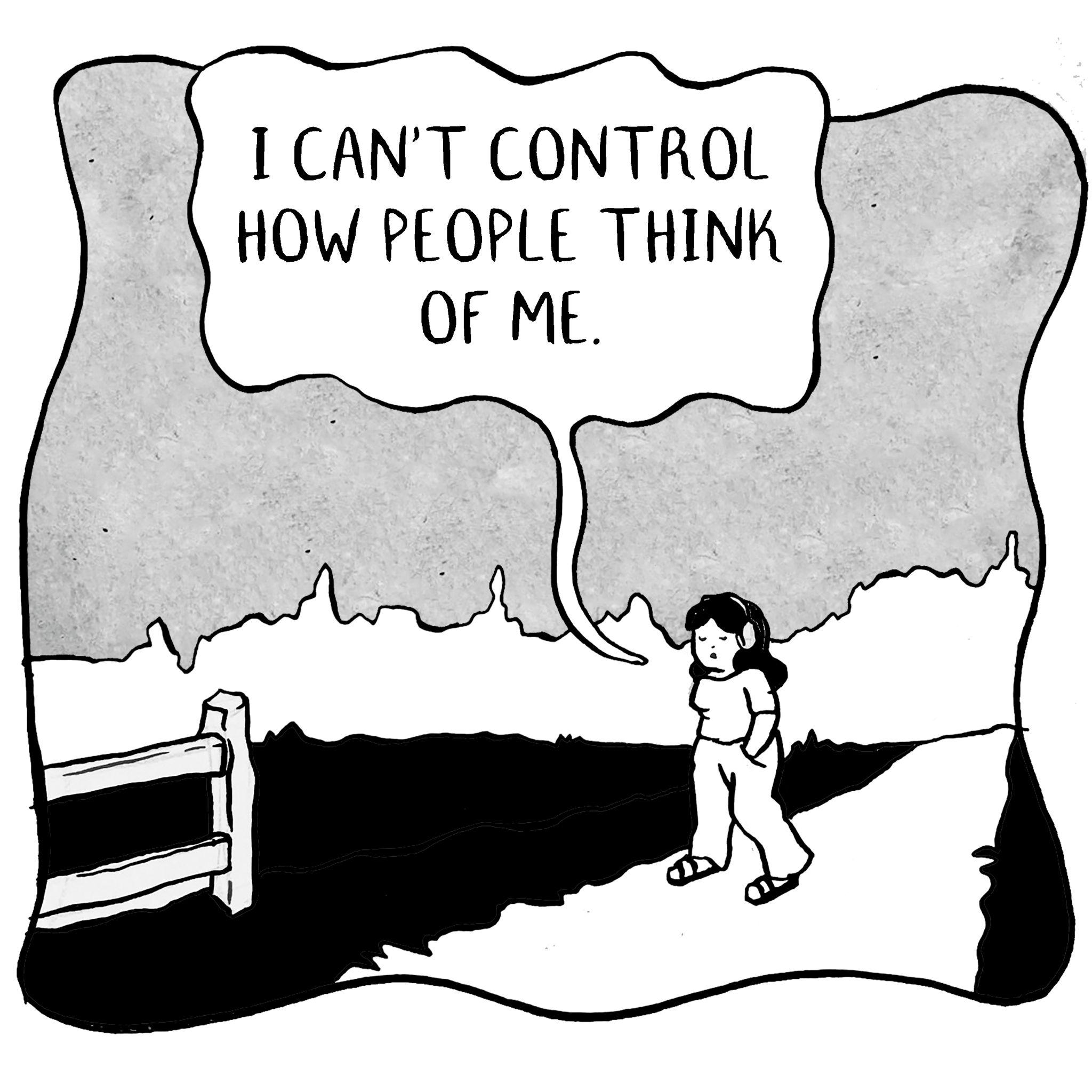
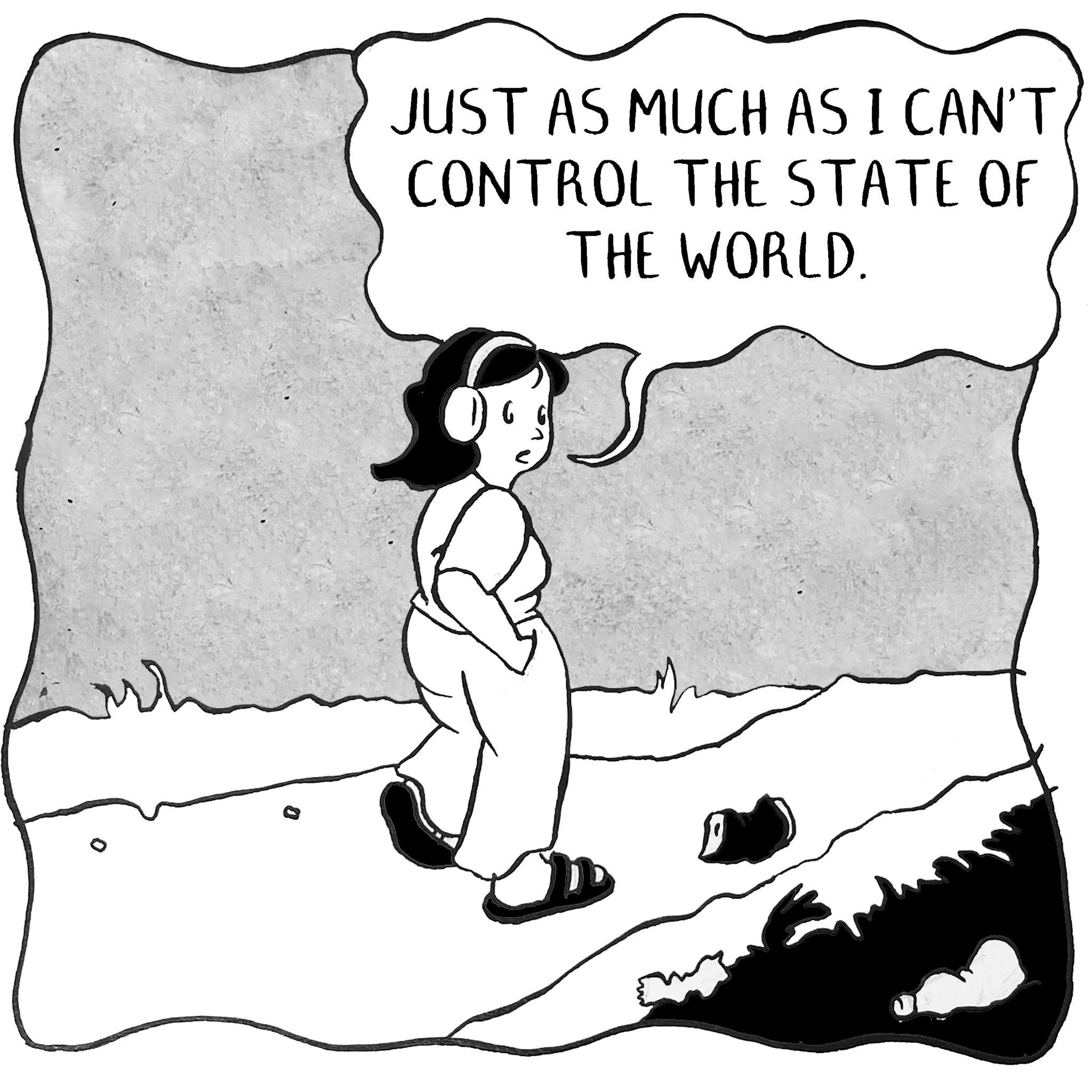
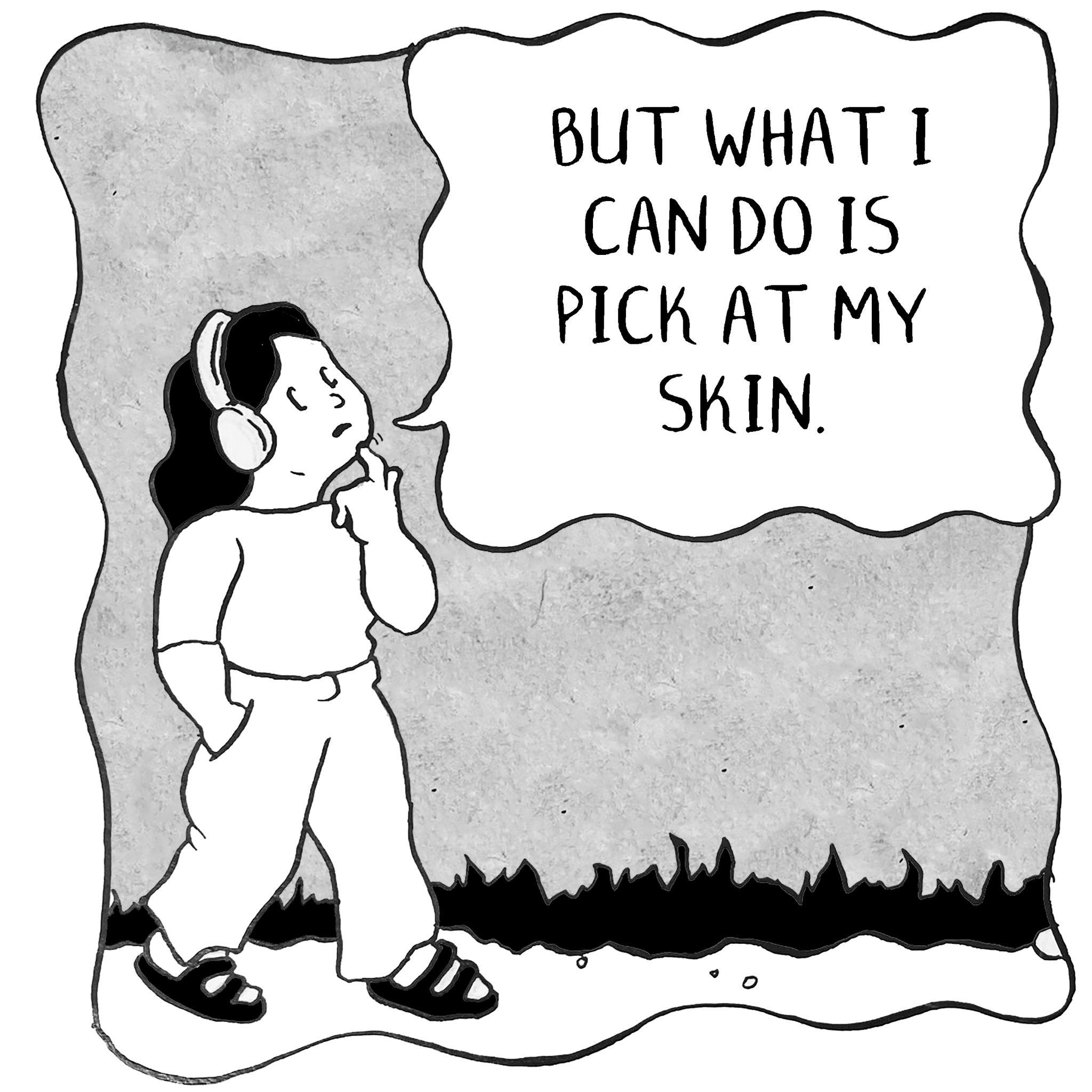
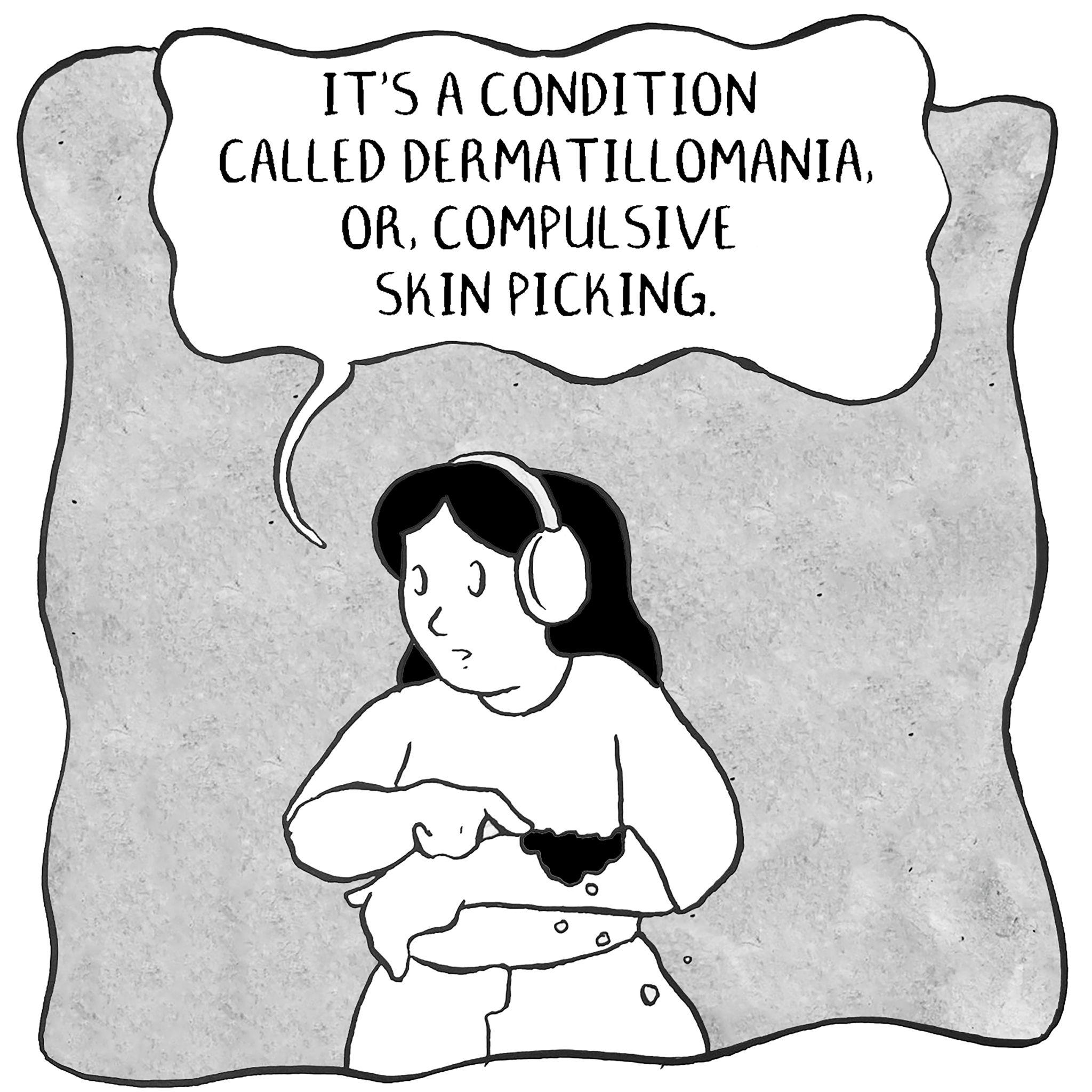
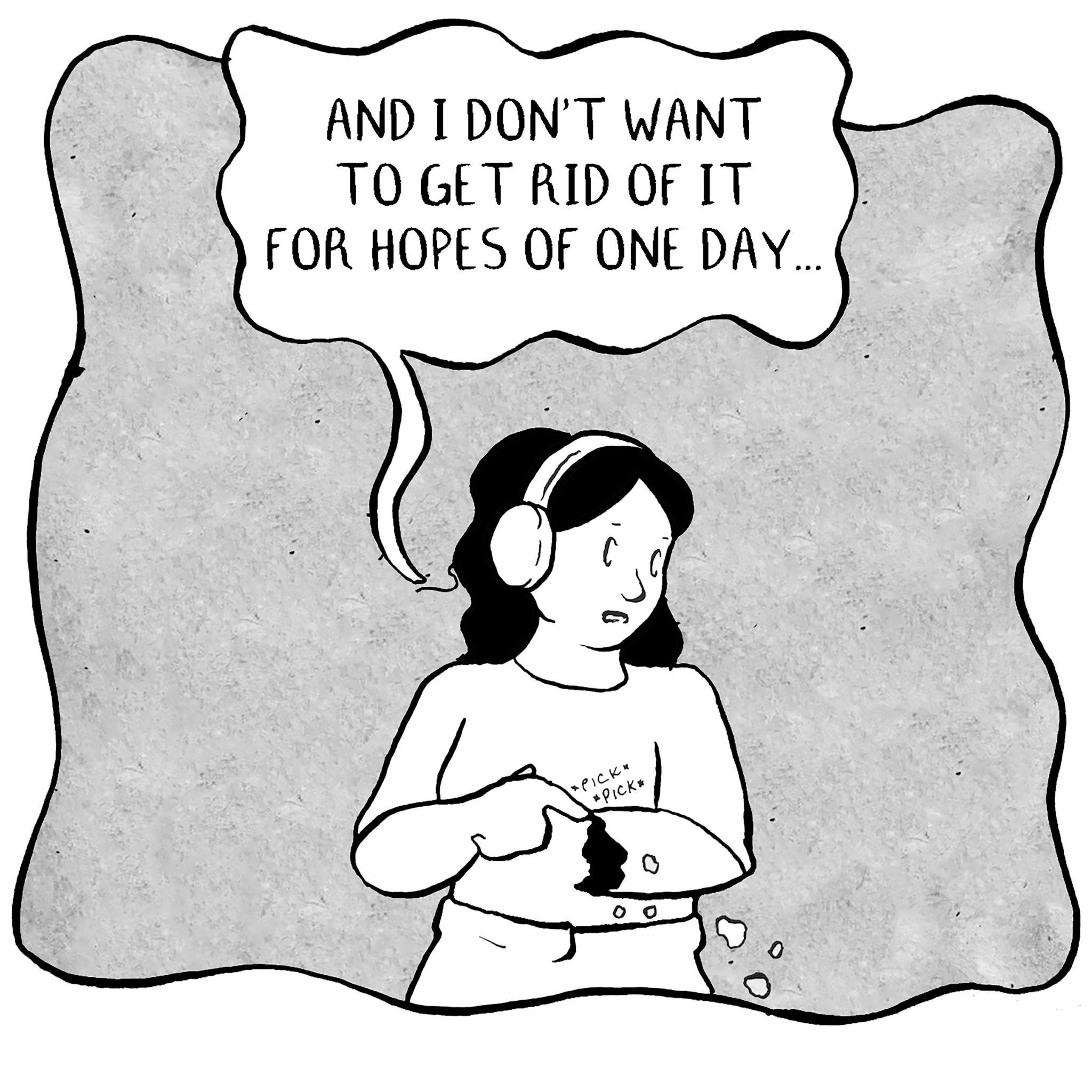
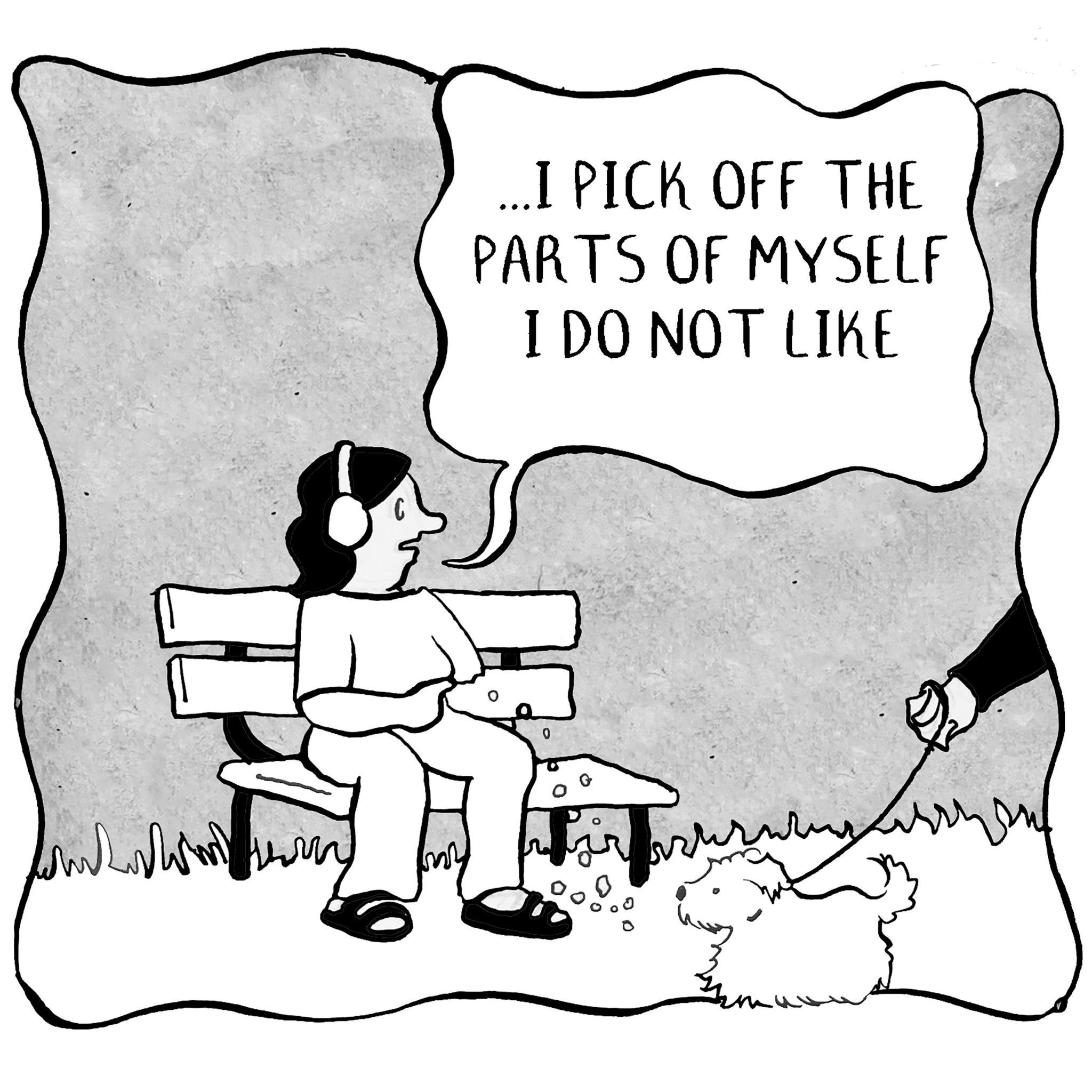
Over ten panels the character progressively strips themselves of their own body. It starts with a fairly normal gesture and then moves into an utterly impossible physical transformation. One arm goes, the figure is reduced to fragments and then those fragments are simply carried away by the wind.
Horwath’s treatment of the transformation is quite striking in that the disappearance is gradual. Each panel documents another stage in the figure’s reduction. You become used to the visual logic of the sequence as the implications of what is happening become increasingly disturbing.
Negative space takes on an ever greater significance. As the figure disappears the environment around it becomes the focal point of the composition. What starts as a narrative about a figure walking outdoors becomes a sequence of images in which the landscape is the thing that endures after the person has gone.
The ending is rather unsettling in its ambiguity. The figure envisages itself as part of the natural world and ultimately becoming something beautiful. It’s a very powerful image, but by no means one that is comforting. The desire to escape an aspect of the self which is undesirable has morphed into the fantasy of the complete erasure of the self.
This is where Horwath’s work moves furthest from the mechanics of the conventional cartoon. There is no final gag to release the tension. The same capacity for visual exaggeration that produced the exposed skeleton and the ludicrously oversized solution is now applied to a much more vulnerable thought.
Beyond the Medical Illustration
The series is firmly in the graphic medicine bracket but its real achievement is in some ways defying the expectation that comics about health should be primarily explanatory, educational or reassuring.
Horwath’s drawings work through distortion. The body is de-anatomised, advice becomes an instrument of violence and a short walk becomes an impossible journey. The distortions make the psychological experience visible without in any way attempting to render it literally.
Their approach also shows off the expressive potential of what might otherwise be described as a very casual drawing. The lines are often uneven, the figures are simplified and the backgrounds are very sparse. The emotional content of a scene can be entirely determined by the placement of a speech balloon, the decision to repeat a gesture or indeed the space between two panels.
Horwath (who studied at the MA graduate of the Royal College of Art in London, where their research explored how visual triggers elicit empathy) is part of a wider tradition of visual storytelling which is concerned with empathy and the relationship between image and emotional response. In Picking My Skin Solves My Problems that concern is present not so much in overt appeals to the viewer’s sympathy as in the invitation to recognise the inherent contradictions of an experience which might otherwise be very hard to talk about.
The series isn’t without its limitations. Some of the shorter cartoons rely on a single reversal and the meaning of the joke is pretty much established straight away. The longer pieces (Walk It Off and My Backstory in particular) give you the time to dwell on an idea and allow the emotional resonance of that idea to shift. The pace of the longer pieces gives the drawings a real depth which the more immediate jokes simply can’t achieve.
That same difference shows the breadth of Horwath’s practice. They can use the language of the single panel gag to expose an uncomfortable social assumption and then use the language of sequential storytelling to grapple with an experience which simply doesn’t lend itself to a tidy conclusion.
Ultimately Picking My Skin Solves My Problems is a distinctive example of contemporary graphic storytelling as it refuses to treat dermatillomania as a mere spectacle or to present it in the language of diagnosis. Horwath gives the condition its own visual language which is in many ways exaggerated, unsteady, occasionally grotesque and very funny.

