


Besides melody, harmony, rhythm, beat, and bass, lyrics are what make songs or music captivate listeners. And often, people wonder what it takes to be able to write lyrics that work. Especially when you know you’re not as gifted when it comes to songwriting as Bob Dylan, Paul McCartney, and Joni Mitchell. In 2026, it turns out you don’t necessarily have to be. Because AI tools for writing music lyrics can give you just the push you need.
Sometimes words won’t come. The hook sounds forced. One line sounds too cheesy. But with AI tools, you can get help with writing lyrics or even all the way to a finished track. And using them doesn’t make the creative process any less valid. A study from Berklee College found that 31% of surveyed musicians used AI to generate lyrics.
Here are five tools to choose from that keep the words flowing.
Top Five Best AI Tools for Writing Music Lyrics
Suno
Suno houses a powerful lyric workspace. One that lets users fully generate lyrics with natural-language instructions. They only have to type and describe the topic and theme of the song. Suno writes structured verses, a chorus, and a bridge. On the other hand, songwriters who have already written lyrics can paste them into the chat and have the AI enhance them. But lyric generation isn’t the only impressive part of the pipeline. It can then turn those lyrics into a complete song with vocals and production.
Key Features:
- Full control over the AI-generated lyrics
- Supports a wide range of genres, moods, and vocal styles
- AI chat for refining lines, rhymes, and sections
Pricing:
- Free Package
- Pro Package – $10 per month
- Premier Package – $30 per month
Real Use Case:
Independent songwriters can write a two-line prompt and have Suno complete unfinished verses. They can also quickly produce song demos by having the AI create a finished track before recording a commercial version.
LyricStudio
LyricStudio skips music generation entirely and pours its capabilities into songwriting. But it’s not a lyric generator. LyricStudio works more like a writing partner. The process begins with the AI asking users to define the topic and the genre. For the foundation of the lyrics, users can either start from scratch or use Verse Gen to generate the initial verse or chorus. With the provided guidelines, LyricStudio helps users develop lyrics line by line. It does so by giving smart suggestions for rhymes, phrasing, and synonyms.
Key Features:
- Built-in thesaurus and rhyme dictionary
- Supports multiple writers collaborating
- AI assistant for brainstorming
Pricing:
- Free Trial
- Pro Package – $9.99 per month
- Gold Package – $16.65 per month
Real Use Case:
LyricStudio enables duos to get over the songwriting slump. They can feed it their first verse in and explore the AI’s relevant suggestions or let Verse Gen make a complete first pass that they can edit afterward.
Udio
Udio puts emphasis on deep creative control when approaching the process of writing music lyrics. It begins with having the user describe the nature of the song in detail. That includes specifying the topic and theme. To further match the user’s vision, Udio lets them choose a specific mood and style. It then offers tools to generate the full song, including lyrics. For more adjustments, it has a built-in editor that lets songwriters revise specific lines, verses, or sections.
Key Features:
- Quick lyrics and song generation for testing musical directions
- A library of generated output for later revisiting
- Creative workspace for manually editing lyrics
Pricing:
- Free Package
- Standard Package – $10 per month
- Pro Package – $30 per month
Real Use Case:
Songwriters planning to make a moody pop track could generate breakup-themed lyrics and a song using Udio. After listening to the output, they can rewrite the verse to match their intended emotion better.
Lyrical Labs
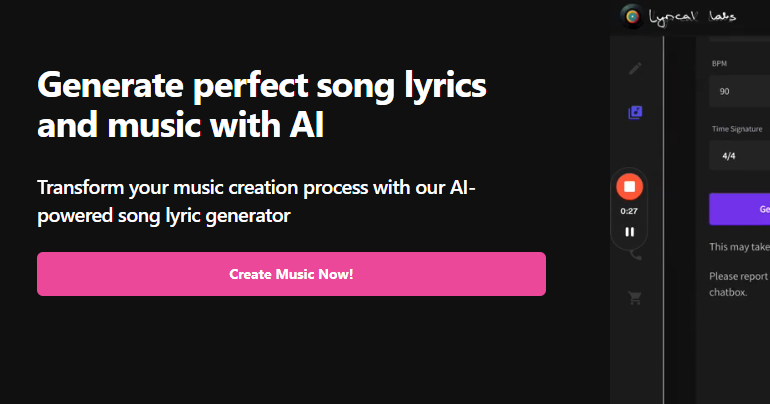
Lyrical Labs sits at the sweet spot between lyric generation and a songwriting partner. Users just need to enter a topic, genre, artist reference, and creativity level. The AI returns a full song, complete with verses, pre-chorus, chorus, bridge, and an outro. Writing Station is one of Lyrical Labs’ standout offerings. Songwriters can paste sections of the generated lyrics and input specific instructions for improvement. Like adding more detail or improving rhymes. Next line suggestions and related word search are also available.
Key Features:
- Built-in smart dictionary for finding relevant words
- Supports over 100 languages
- AI companion for chat-based back-and-forth collaboration
Pricing:
- Free Package
- Hobbyist Package – $25 per month
- Songwriter Package – $70 per month
- Professional Package – $245 per month
Real Use Case:
Lyrical Labs can help aspiring hip-hop artists write the lyrics they want. They can define the topic and genre and specify artists within modern hip-hop as inspiration. Afterward, they get a rough draft to chop up for their own bars.
MusicGPT
MusicGPT includes an AI chat workspace where users can enter prompts to generate a complete set of lyrics. To make sure the output aligns with the intended creative vision, they just need to make the instructions clear and detail what the song is about. This makes MusicGPT excel at turning a short idea, story, or mood into structured lyrics. Beyond that, the AI tool is also capable of pairing the lyrics with AI vocals and instrumentals.
Key Features:
- Broad library of AI-generated outputs for inspiration
- Turning short concepts into lyric drafts
- Supports text-to-speech workflow
Pricing:
- Free Package
- Plus Package – $11.99 per month
- Pro Package – $21.99 per month
- Ultra Package – $49.99 per month
Real Use Case:
A newbie songwriter hired to write a rushed jingle for an advertisement can make use of MusicGPT to speed up the process. They can provide the product, audience, and desired mood, then generate lyrics instantly.
Choosing the Best AI Tools for Writing Music Lyrics in 2026
With AI tools for writing music lyrics within reach, the blank page may no longer be so daunting. Suno, LyricStudio, Udio, Lyrical Labs, and Music GPT help you write a killer chorus, a catchy verse, the right number of syllables, or a way out of writer’s block.
When choosing, always put your creative goals, level of experience, and preferred workflow into consideration. More importantly, be mindful of the AI tool’s terms and conditions when planning to publish the output commercially. Because when the last line hits, AI should be treated as a songwriting partner. Not a replacement.
Are you ready to turn your lyrics into a full-blown song? Check out our guide on the must-try AI tools for music creation.

