Home Blog Page 150

Jiaxin Chen’s City in Dual Exposure: When Photography Becomes an Act of Perception

At the Photobook Cafe in Shoreditch, Jiaxin Chen’s City in Dual Exposure: Between Memory and Present, re-imagines the use of the language of Urban Photography. Through a series of illuminated panels, layered prints and other techniques the city of Hong Kong is presented as a subject of temporal collapse, rather than as a static entity. The city’s image is broken apart, put back together again, and finally, undermined.

Jiaxin Chen’s method of working destroys the idea of the photograph as a static representation. She views the photographic medium as an active surface — one in which the processes of perception, material and time come together. Using photographic experimentation (double exposure, cyanotype staining, montage, and physically manipulating) Jiaxin Chen questions the way a city can be simultaneously remembered and continuously rewritten. As such, her photographs exist somewhere between the realms of documentation and abstraction, just like the instability of memory itself.
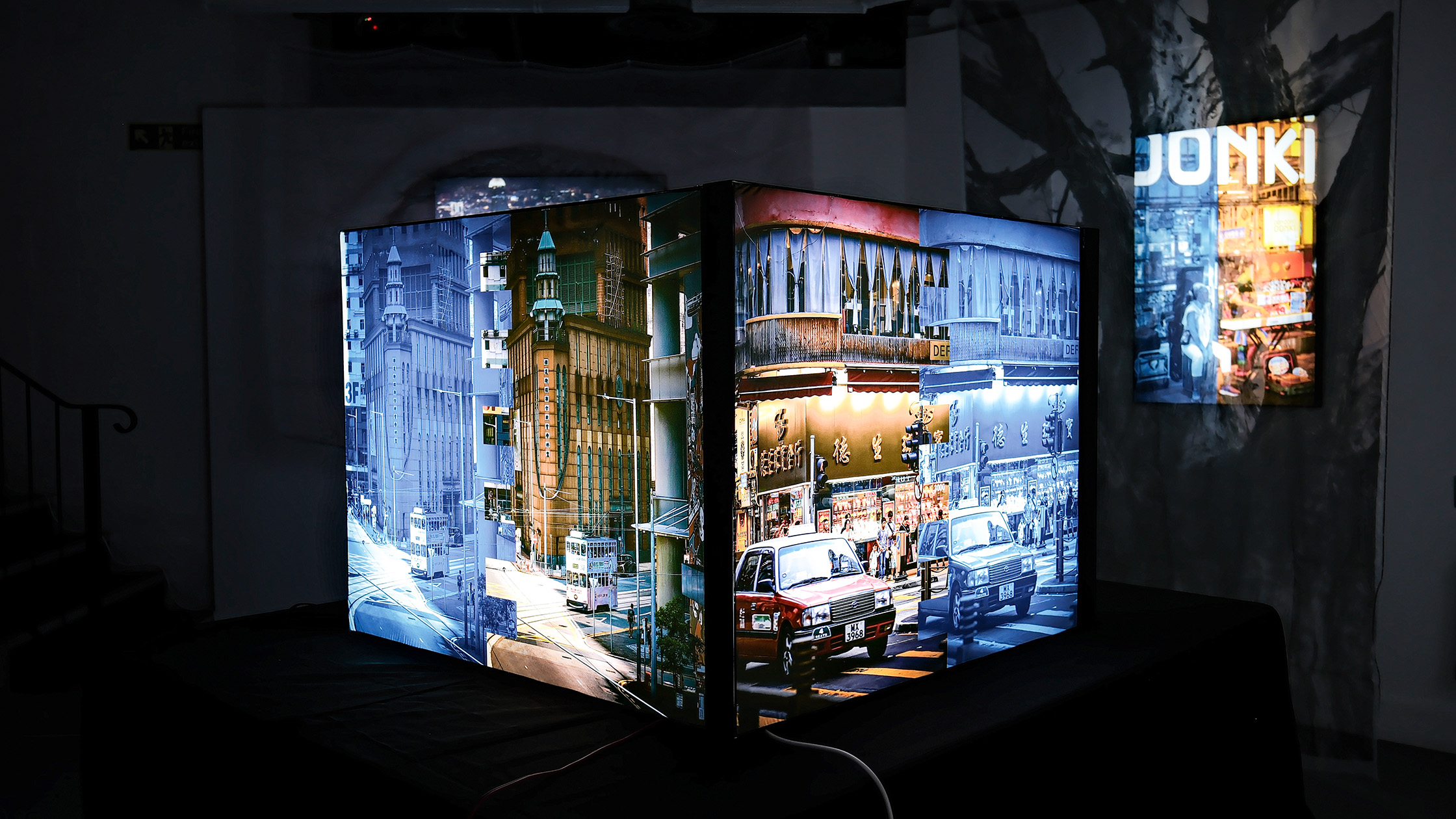
Recurring throughout her photographs are familiar fragments of Hong Kong, (the red taxi, neon signs, and mirrored tower skyscrapers), however Jiaxin Chen resists framing these fragments as icons. Rather they appear as disjointed moments, layered and re-layered, until their ability to create a coherent narrative is lost. Buildings fold over onto one another, streets move from one location to another within the confines of a single frame, and light fractures across the surface of her photographs. Jiaxin Chen’s compositions vacillate between order and chaos, and represent the fragile balance between history and speed of development in Hong Kong.

The center cube installation is the exhibitions’ most dominant feature. Each face of the cube has a densely composed photographic collage displayed in the interior of the cube. Depending upon your position in relation to the cube, you will see conflicting perspectives of the same taxi, for example, daylight on one face of the cube and nighttime on the opposite face. Light leaking through the seams of the cube eliminate all spatial reasoning and encourage the viewer to walk around it. Functionally the cube serves both as sculpture and lens, destroying the difference between photograph and space.

Jiaxin Chen’s manipulation of surface — through bending, rubbing, and layering — reinforce her dismissal of photographic purity. The cyanotype tones used in the majority of her photographs are not merely decorative; they have conceptual properties. The tones evoke both the chemical residue of early photographic chemistry and a sense of distant longing. Jiaxin Chen’s material manipulations place her in the company of photographers who are currently concerned with the physical properties of photography, yet her concern continues to be with perception rather than nostalgia.

In her statement, Chen refers to Foucault’s concept of heterotopia and Benjamin’s theory of urban simultaneity — references that underpin, rather than overwhelm, the work. Each composition exists as a heterotopic space — the meeting point of two disparate realities that exist without reconciliation. The city exists as a theater of simultaneity — progress and decline, spectacle and silence, surface and shadow. In this fluid context, the viewer encounters not a single Hong Kong, but multiple versions of Hong Kong, layered and unstable.

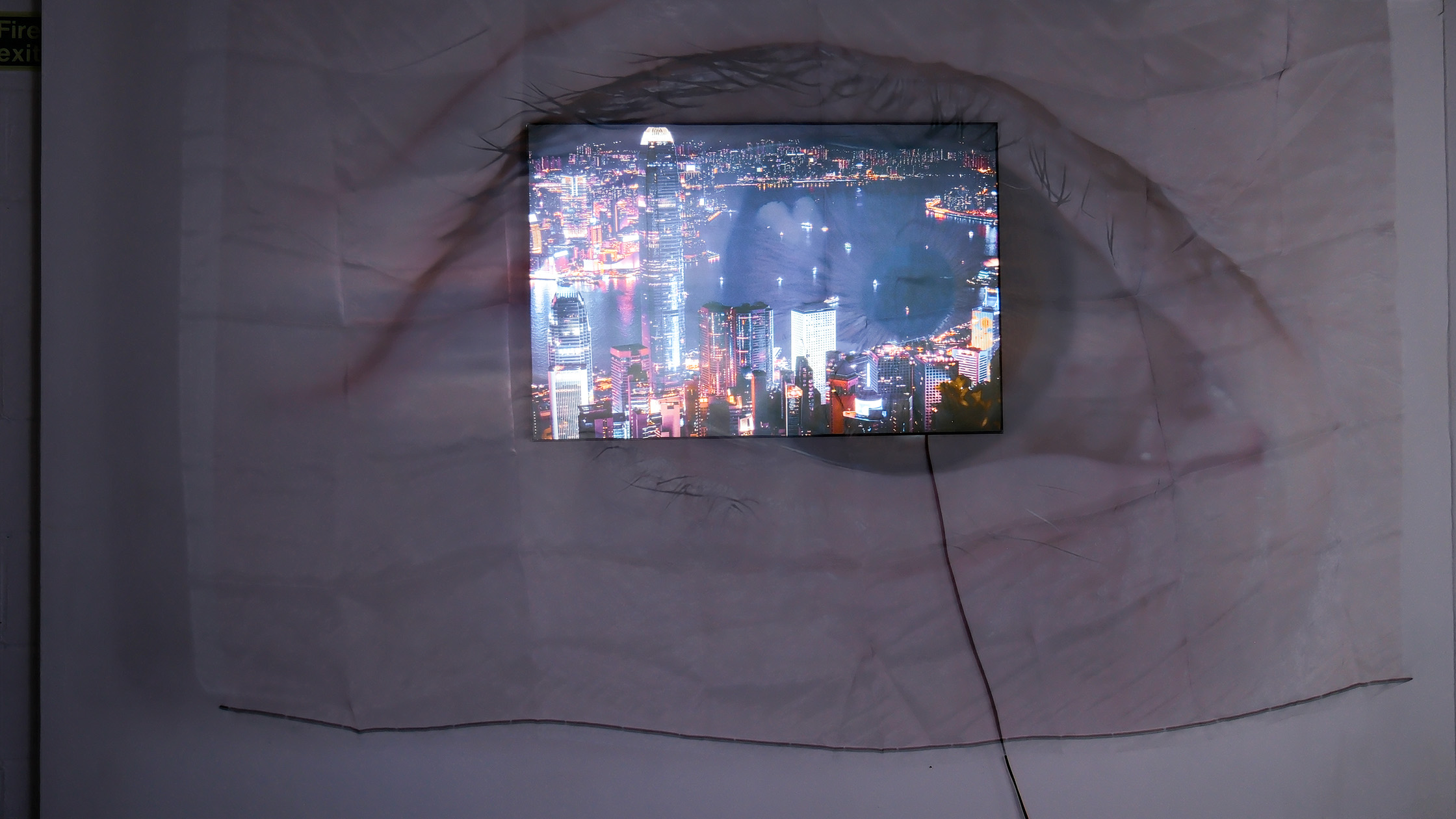
Photobook Cafe’s muted lighting heightens the effect of this environment. Each photograph emits soft light off the surrounding white walls, projecting fragmented elements of the city into the space. Reflections cascade into the space creating the viewer’s outline with the image. The soft, mutual encroachment of the viewer’s silhouette with the image, reinforces Jiaxin Chen’s concern with perception — the act of looking is a fundamental component of the work’s architecture.

DONKI is perhaps one of the most striking photographs in the show. A diptych separated by tone and temperature, DONKI presents a woman waiting in relative stillness in cool-toned cyan light on one side of the diptych, and a street performer performing amidst saturated signage on the opposing side. The juxtaposition creates an unresolvable dialogue between stasis and motion, solitude and spectacle. Here, Chen captures the rhythm of a city always moving between action and contemplation.
What sets City in Dual Exposure apart from most urban photography is its refusal to sentimentalize. Jiaxin Chen does not engage in either nostalgic reverence nor documentary neutrality. Rather, she addresses Hong Kong as a condition — a continually rewriting and revising system of images and histories. Hong Kong is neither represented as lost or found, but as forever becoming. Chen’s photographs convey the power of dissonance rather than closure, suggesting that urban memory is an active, fluid process.

In an era characterized by rapid digital reproduction and compressed urban imagery, Jiaxin Chen restores photographic depth of time and material. Her Hong Kong is not a postcard or an archive; it is a space of interference, where memories flicker in and out of focus. The exhibition invites viewers to slow down, to view the city not as spectacle, but as an accumulation — of light, of surface, of time.

Jiaxin Chen has demonstrated herself to be a serious and innovative photographer in the current landscape of contemporary photography. Her work locates itself within critical theory without succumbing to it, and maintains an awareness of form, texture, and perception. These are not photographs to glance at, but environments to be experienced — cities that continue to unfold long after the light fades.

Battlefield 6 Redsec: How to Unlock Safes

0

Locked Safes are a form of loot chest in Battlefield 6: RedSec scattered all across the map that come packed with weapons, gear, and attachments and can give you and your squad a leg up if you manage to find one, especially early in the match. To open a Locked Safe in RedSec, all you need is a Repair Tool, which also happens to be one of the iconic pieces of Battlefield gear for repairing friendly vehicles or burning through enemy armor. However, it also has a lesser-known function. A Repair Tool can tighten and loosen hex bolts, thus making it surprisingly useful for unlocking Safes in Battlefield 6: RedSec. Since Safes are bolted shut, the Repair Tool can easily bust them open to give you and your squad access to valuable loot. So, if you want to treat yourself to some high-value gear, here’s how you can unlock Safes in Battlefield 6: RedSec.

How to Unlock Safes in Battlefield 6 Redsec

As we already mentioned, to access a Locked Safe in Battlefield 6: RedSec, you’ll need a Repair Tool and since the Repair Tool is exclusive to the Engineer Class, make sure there’s an Engineer in your squad before you go Safe hunting. Once that’s sorted, unlocking a Safe in Battlefield 6: RedSec is fairly simple and all you have to do is equip the Repair Tool, aim it at the Locked Safe, and start cutting through. After a couple of seconds, the Safe will crack open, revealing all the items inside.

Locked Safes in Battlefield 6: RedSec usually contain a number of high-value items, such as rare weapons, Armor Plates, Call-In Gadgets, alongside Intel Cases that offer quick XP. You can find safes in Battlefield 6: RedSec inside buildings at major POIs across the Fort Lyndon map and they are relatively easy to spot, thus making them one of the best ways to get quality loot early with very little to no work, assuming you’re lucky enough to come across one.

11 New Songs Out Today to Listen To: Nothing, underscores, and More

There’s so much music coming out all the time that it’s hard to keep track. On those days when the influx of new tracks is particularly overwhelming, we sift through the noise to bring you a curated list of the most interesting new releases (the best of which will be added to our Best New Songs playlist). Below, check out our track roundup for Tuesday, November 4, 2025.


NOTHING – ‘cannibal world’

NOTHING are back with the announcement of their next album, a short history of decay, which is led by the frantic and intense single ‘cannibal world’.  It comes paired with a music video directed by Ben Ditto.

underscores – ‘Do It’

It’s ridiculous just how instantly catchy ‘Do It’ is. The latest single from New York-based hyperpop artist underscores puts more emphasis on the pop than the hyper, and it was written, produced, performed, mixed, and mastered by underscores, who also directed the music video.

José González – ‘Pajarito’

José González has shared a short, lovely new single, ‘Pajarito’, his first since 2022. About the track, which was written for his four-year-old son Mateo, the singer-songwriter said: “Now and then, I want to write songs that are timeless, simple, and carefree. ‘Pajarito’ is about growing up, learning things, and eventually becoming independent. As usual, there’s also an existential undertone — the meaning of life is something that can emerge gradually as one gets to know the world, more as something you discover for yourself and not necessarily something dictated from above. This one is inspired by songs like ’59th Street Bridge Song’ (Simon & Garfunkel) and ‘Río’ (Silvio Rodríguez), but also by all the children’s songs that have become part of our everyday life in recent years (Alice Tegnér, Georg Riedel, María Elena Walsh).

“This is the follow-up to Lilla Gumman (Lilla G), which I wrote when I was thinking of Laura,” he added. “Of course, I had to write a song dedicated to Mateo as well!”

deathcrash – ‘Triumph’

It’s been a while since we’ve heard from deathcrash, the slowcore/post-rock quartet whose last album was 2023’s Less. Today, they’re back with a heavy, radiant song called ‘Triumph’. “This song is about fighting the urge to drive into oncoming traffic,” the band remarked. “It marks Patrick’s return to songwriting. It shows that growing up is no ‘triumph’, but an occasionally graceful and occasionally bitter acceptance of who you are now.” Bassist Patrick Fitzgerald also co-directed the song’s video with St.Teilo.

SPELLLING – ‘Destiny Arrives’ [feat. Weyes Blood]

Weyes Blood makes a striking contribution to a new version of ‘Destiny Arrives’, from SPELLLING’s latest album Portrait of My Heart. “Weyes Blood has been a dream artist to collaborate with for a long time now,” shared. “I’m so honored to have her timeless voice on this reimagined version of ‘Destiny Arrives’. She stepped into the song so gracefully and added such an epic glow to the feeling of the song through her own lyrical contribution and very intimate interpretation of the song.” Weyes Blood added, “The strange fantastical universe Tia’s built under the moniker SPELLLING has always captivated me, and when she asked me to sing on ‘Destiny Arrives’ I was there for the ride.”

Whitney – ‘Evangeline’ [feat. Madison Cunningham]

Madison Cunningham has recently collaborated with indie folk veterans like Fleet Foxes and Andrew Bird. Today, she guests on ‘Evangeline’, the grandiose final single off the band’s imminent new album Small Talk. “The most crucial moment of writing ‘Evangeline’ came when, after weeks of failed experiments, we leaned into the theatricality of the chorus,” Julien Ehrlich recalled. “Max put midi timpanis and string pads underneath the vocals and the whole sentiment of the song clicked into place for us. In hindsight it was probably the main instance where having a producer in the room could have led us to the finish line a bit quicker but nevertheless we got there. It wasn’t until almost a year later that we had the idea to make it a duet and we are beyond grateful that we got to feature Madison Cunningham as the other half of the vocal. To say that this song is special to us is an understatement.”

Cunningham added: “I’m a genuine fan of Whitney. When the band sent me this song, it was a no brainer that I wanted to sing on it. It’s not often that I’m stopped in my tracks by a song. In fact, the sound of this whole record from front to back is staggering to me. It’s the most beautiful wall of sound where every piece is considered, and the through line is clear. My memory is colored with it being one of the easiest, most joyful sessions.”

Witch Post – ‘Twin Fawn’

Witch Post – the duo of Dylan Fraser and Alaska Reid – have shared an urgent, nostalgic song called ‘Twin Fawn’. Reid reflected, “This song is about chasing memories, or yearning for a misremembered, simpler time. It’s a love letter to Dylan and I’s differing experiences on the West Coast; coyotes, beach glass, driving home at 3am, stuck on the freeway staring at the sunset… As Witch Post, our memories become as fantastical and intertwined as twin fawns.”

Paige Kennedy – ‘Medical Emergency’

Paige Kennedy has announced a new EP, Style Over Substance – out February 6 – with the playful new single ‘Medical Emergency’. “After a life altering breakup, I was sitting in A&E with actual heart problems, feeling sorry for myself,” Kennedy explained. “My coping mechanism, has always been leaning into fantasy, silliness and comedy during dark times, which was how Medical Emergency was born. The persona in the track thinks all the nurses fancy them, and has delusions of grandeur.” They added: “Musically I was inspired by Tupac, The Cardigans and PJ Harvey. There’s an overconfidence in gangsta rap I wanted to emulate. The sound world of the song is grungy with some silly sound design elements which matches the content.”

runo plum – ‘Alley Cat’

runo plum has shared another poignant preview of her upcoming debut LP, patching, ahead of its release next week. ‘Alley Cat’ follows ‘Sickness’, ‘Halfway Up The Lawn’, and ‘Pond’. “Small talking feels like standing on the edge,” she sings as the song spirals inward.

waterbaby – ‘Beck N Call’ [feat. ttoh]

Stockholm-based artist waterbaby comfortably settles into a bouncy, slightly off-kilter piano groove on ‘Beck N Call’, her new single featuring guest rapper ttoh. It follows previous cut ‘Amiss’.

Jordana – ‘Blouse’

Jordana’s Jordanaland EP comes out on Friday, and today we get one more teaser from it, ‘Blouse’, which sparkles in its intimacy. The singer-songwriter describes it as “a song about wanting someone to realize there’s a romantic connection underneath the superficial reasons. Through a one-sided passionate intimacy, shouting into the ether, questioning if tender moments with each other could mean anything more than just a physical relationship.”

Weyes Blood and SPELLLING Team Up on New Version of ‘Destiny Arrives’

SPELLLING has enlisted Weyes Blood for a new rendition of ‘Destiny Arrives’, a highlight from her latest album Portrait of My Heart. Natalie Mering’s presence doesn’t really make itself known until the final minute or so, but it’s breathtaking. Check it out below.

“Weyes Blood has been a dream artist to collaborate with for a long time now,” SPELLLING said in a statement. “I’m so honored to have her timeless voice on this reimagined version of ‘Destiny Arrives’. She stepped into the song so gracefully and added such an epic glow to the feeling of the song through her own lyrical contribution and very intimate interpretation of the song.”

Weyes Blood added, “The strange fantastical universe Tia’s built under the moniker SPELLLING has always captivated me, and when she asked me to sing on ‘Destiny Arrives’ I was there for the ride.”

The Best Songs of October 2025

Every week, we update our Best New Songs playlist with several tracks that catch our attention, then round up the best songs of each month in this segment. Here, in alphabetical order, are the best songs of October 2025.


Anna von Hausswolff, ‘Aging Young Women’ [feat. Ethel Cain]

For the subjects of ‘Aging Young Women’, a family is a disappearing dream: not a thing of the past so much as a reminder of time’s encroaching tide. The fear that looms over it is often internalized if not totally repressed, but on top of the imposing elegance that characterizes most of album ICONOCLASTS, the Swedish musician renders it the most accessible ballad on the album, letting its flurry of possibilities echo out and fold into pop’s nascent reckoning with the complexities of motherhood. More than just a spiritually aligned presence on the song, Ethel Cain marks out the plurality of voices, singing, “In the church, when we cry/ Some fallen angels told us to keep our heads high.”

feeo, ‘Here’

It doesn’t take long for feeo, the London singer born Theodora Laird, to describe what’s happened to the city she calls ‘Here’. “The sun won’t shine/ Not the real one anyway/ Not the sun that once kissed us awake,” she sings over a lone pad that sounds, simply, like a void. As she makes her bid for saying goodbye to this place, a slightly crunchy, fingerpicked guitar opens up the song like a wind that could carry the couple away. feeo curls back into numbness, but her point, like her poetry, is crystal clear: “This place was built to last/ It wasn’t built for love.” As if to demonstrate how much she’s worn the argument, even the feeling thin, ‘Here’ is the longest track of her debut album Goodness, stretching out to seven minutes. But it’s also an absolute highlight, making you feel like feeo does: small, powerless, itching for change.

Hatchie, ‘Only One Laughing’

Hatchie not only delivers a dazzling song about finding herself in a frustrating predicament, but makes it seem like a viable solution. “The only one laughing may well be the only road out of this,” she sings on the latest single from her imminent album Liquorice. So she leans into it, trusting drummer Stella Mozgawa to help her rollick her way out of helplessness over jangly guitars while giving space to the words she most wants to be heard. “Let’s abandon all pretense if only for my amusement/ Would it make any difference when we spend all our lives reminiscing,” she sings as the lights dim; if we can’t control the truth, why bother with a filter? Why not tell it like it is and sweeten it with a laugh?

Living Hour, ‘Things Will Remain’

Before this year, I hardly took many photos; I hated being the one to take my phone out and capture a moment after it’s already passed. But the fragility of life reminded me of the relative permanence of some things, and I now carry a camera with me wherever I go. ‘Things Will Remain’, the gorgeous closing track off Living Hour’s understated new album, Internal Drone Infinity, lands somewhere between a lullaby you remember from childhood and a group photo you’ll cherish for the rest of your life. “Yearn-core” is how the Winnipeg indie rock band has described its music, and what’s more core to the longing experience than a still image? “Almost didn’t take a photo/ But I’m happy that I did,” Sam Sarty sings with a group of friends, “‘Cause it melted all around me/ When I crossed across the bridge.” It refers to a “desperate collage of ice blocks,” but superimposed, as the music drifts into the ether, is everything you might hold dear.

Oklou and FKA twigs, ‘viscus’

The ache in ‘viscus’ is subtle but palpable. It would be easy for Oklou, who sings of letting herself “get lost so deep inside me,” to let it drift into the ether for a wispy, delicate song rounding out the deluxe edition of her widely celebrated debut, choke enough. Instead, she bonded over it – chronic stomach pain, specifically – with FKA twigs, meditating on the body not just as a temple but a home we carry throughout our lives. Their voices intertwine wonderfully, but once twigs’ comes in on its own, it is purely reassuring: “I wanna find a place I feel alive/ The beating of my heart/ Is sure a place to start.” No amount of sunshine, fame, or someone else’s faith is enough to grant you that feeling, but as ‘viscus’ turns these porous thoughts over, it offers an opportunity to recenter – or better yet, restart.

Rosalía, ‘Berghain’ [feat. Björk and Yves Tumor]

‘Berghain’ was always bound to make an impression. As a new Rosalía track; as the lead single from her much-anticipated MOTOMAMI follow-up; as a more substantial collaboration with Björk (most people seemed to have forgotten that ‘oral’ happened) and a high-profile moment for enigmatic experimentalist Yves Tumor. As a song named after the famed Berlin nightclub that anchors in a dramatic string section and Rosalía’s operatic vocals before Björk sweeps in invoking “divine intervention” and Tumor repeats the phrase, “I’ll fuck you ’til you love me,” it was also bound to divide as much as it thrilled. It’s a spectacular single and a giant flex, so insane it makes little to no sense outside the framework of the album. Yet its chaotic conviction alone is enough to sell you on the concept of Lux.

Snocaps, ‘Doom’

Beneath its emotional resolve, ‘Doom’ is about a relationship hanging by a thread. Unassuming though it may start, it turns into one of the most striking songs Katie Crutchfield has written in years, trying to keep casual about “this sentimental rot” but churning out one of her biggest choruses to date. The self-titled album from her and Allison Crutchfield’s new band arrived with little fanfare, and MJ Lenderman and Brad Cook keep their contributions to a minimum. But even the song’s production, stifling rather than amplifying its simple arrangement, serves Katie’s lyrics about running out of breath: “You tell it like it is/ And you’ll suffocate/ Every sight that’s rife/ With a jet black big sky/ Emptiest night,” she sings, almost gasping for air. But she knows she’ll be just fine.

Sugar, ‘House of Dead Memories’

You can imagine Bob Mould writing ‘House of Dead Memories’ alone, ready to turn simmering frustration into another undeniably catchy alt-rock song. “There’s a limit to what I can do/ I cannot make this work on my own/ I need some help,” he sings, and allow me to stretch that metaphor to songwriting: he’s always embraced collaboration in his solo efforts, as recently as this year’s Here We Go Crazy, but there’s something to the fact that he chose this song to be the introduction to Sugar’s reunion. The band may have agreed, in one way or another, to leave the past behind, but here they are after 30 years harnessing the same chemistry as a means of moving forward. Memories don’t die, after all; they just find new places to live.

Westerman, ‘Nevermind’

Westerman hardly lets you in on the voices in his head. But he paints a kind of scene: “She fingered the muddy ground/ And sold me all the luck she’s finding/ I lingered/ As people do/ We fall into a truce that’s binding.” Through the repeated lines and chords, you can taste the exhaustion in the air, the hollowness of whatever resolution the protagonist has wrapped himself into. There was meaning, he tries to convince himself, in the words and feelings he once laid out, mushy and irrelevant as they’ve been rendered. Without filling you in on the details, perhaps even remembering much, Westerman commits the falling to memory; the dissolution of what once seemed valuable but now might as well be left to rot in the sun.

NOTHING Announce New Album, Share New Song ‘cannibal world’

Philadelphia shoegaze outfit NOTHING have announced their new album, a short history of decay. It’s set for release on February 27 via Run for Cover, and the frenetically expansive lead single ‘cannibal world’ is out today alongside a Ben Ditto-directed video. Check it out and find the album cover and tracklist below.

Following 2020’s The Great Dismal, a short history of decay marks the band’s fifth LP and first for Run for Cover. When their last album was released, frontman Domenic “Nicky” Palermo thought the group might have reached its natural conclusion, but then life happened and “the feeling of wanting to do it resurfaced,” according to a press release. They recorded the new album at the legendary Texas studio Sonic Ranch, “drinking like it was the apocalypse every night – and all day I guess, pretty much,” in Palermo’s words.

“Between the point of clarity and this overwhelming sense of honesty within myself,” Palermo reflected. “This feels like an exact full circle moment to that first record.”

a short history of decay Cover Artwork:

Nothing Album Cover

a short history of decay Tracklist:

1. never come never morning
2. cannibal world
3. a short history of decay
4. the rain don’t care
5. purple strings
6. toothless coal
7. ballet of the traitor
8. nerve scales
9. essential tremors

McQueen In Berghain: Rosalía’s Archival Confession

0

There’s nothing accidental about the way pain looks when it’s dressed in McQueen. Some stories are better told both in words and fabric, and Rosalía’s “Berghain” is one of them. Sacred Hearts hanging over a bed frame, the British Opera trailing her like intrusive thoughts, white clothing being washed as if each thread carries away memory and sin, sugar cubes slowly surrendering to heat, Davinci’s “Lady with an Ermine” watching silently, Björk appearing as a bird and a delicate witness of the passage of time, it unfolds rather like a vision than a music video. A ritual of sound and image, “Berghain” is a blend of techno and classical textures, layered in three languages over an atmosphere of tension and release. Every frame of Nicolas Mendez’s direction feels intentional, cathartic, yet emotionally charged.

McQueen’s vintage silhouettes and Jose Carayol’s styling transformed the visuals into a study of intensity, with the first glimpse being a black, belted dress with a romantic top and leather detailing from Alexander McQueen’s Fall 2002 collection. Moments later, the camera dips to the floor, revealing dark turquoise heeled sandals with beads, straps and crosses from the house’s Spring 2003 show. A grey top with an attached fringed scarf follows, a piece from Lee Alexander McQueen’s Spring 1997 Givenchy runway. The sequence closes with a white tank top, drenched in buttons, from McQueen’s Spring 2003 show, every seam alive, carrying the weight of history into the frame.

“Sein blut ist mein blut” (“His blood is my blood”) Rosalía sang, turning music into a practice of self-examination decades after Lee McQueen exposed himself through his artistry, “There’s blood beneath every layer of fabric”. Their connection feels ignited. We miss him dressing fear, desire and mortality, turning fashion into raw emotion, yet luckily she gives voice to all McQueen stood for, performing a confession all over again.

“Berghain” reminded me that fashion at its purest, can still hold soul. And maybe that’s why she chose McQueen, because both knew how to turn wounds into beauty, making art from vulnerability.

Vittoria Beltrame Launches Paper-focused Platform Carta Magna

Respected art curator and writer Vittoria Beltrame announced the launch of Carta Magna, a platform dedicated purely to to original works on paper. The platform celebrates the timeless beauty, and expressive intimacy of the paper medium.

Talking about the launch, Beltrame stated “I have been thinking about Carta Magna for at least two years, but somehow it never felt like the right moment. Now it finally is. With the support of many of the artists and galleries I’ve worked with over the past years, I believe the time has come to dedicate an entire platform to this medium.”

Carta Magna seeks to honour that legacy by offering a curated selection of drawings, ink works, and mixed-media pieces that showcase craftsmanship, and intimacy.

In addition to its online platform, Carta Magna will host intimate in-person exhibitions several times a year, offering art collectors and art enthusiasts the opportunity to experience these works firsthand. In addition, project also aims to make collecting more accessible, allowing new buyers to support artists without the prohibitive costs of larger works.

Schedule 1 Finally Releases Halloween Update

0

Schedule 1 has just dropped its Halloween update. It marks the latest step in developer Tyler’s steady rollout of patches since the March release. However, version 0.4.1 does not add any seasonal content despite the title of the update. It focuses on bringing new navigation features and optimization changes.

Also, this patch drop was supposed to happen earlier until the creator changed his mind.

“Sorry, this update is a couple of days late – I was originally planning on skipping the open beta and going straight to full release,” Tyler said, explaining his first plan. However, he later decided to give players the time for beta testing to ensure stability.

New Navigation Features in Schedule 1

As per the TVGS announcement, players can now try the new sewer system. It is located under the city. In particular, this gives another way of going around the Hyland Point. Plus, it helps in traveling while avoiding police and cartel members. However, the sewer system comes with its own challenges and risks. For instance, players will need a sewer access key to get down there. Likewise, there are two new NPCs. Specifically, they will encounter the sewer king and sewer goblin.

At the same time, the Halloween update brings enhanced vertical navigation. The game now has a ladder system. It enables greater vertical mobility across the map. Players can find them in the sewers and on many buildings around the city. This addition opens up more creative ways for evading enemies and exploring new areas.

Improvements and Bug Fixes

Tyler also highlighted that the update includes many improvements. Generally, the optimizations aim to boost frame rates by 10% to 15 %. The tweaks focus on environmental effects and excess calculations.

In the same way, there are many bug fixes. These resolve issues with pickpocketing, item slot filters, duplicate GUIDs, police global vision events, and many more.

Availability

Version 0.4.1 of Schedule 1 is now live in the game for all players. For the full patch notes, visit its official Steam page.

Looking Ahead

Many times before, the developer has said his intent to release updates more often. Now, he has promised to drop another patch before the Shrooms update. He said the next version will further fix connection issues in the multiplayer mode. It will be his focus for the following weeks. So, fans should expect it anytime soon. 

Schedule 1 is still on a roll since its successful launch, making millions in revenue.

How Unique Garments Tell Stories Beyond the Runway

Fashion has always been more than just fabric and form. It’s a silent language — a way for people to express identity, heritage, emotion, and purpose. While runways showcase trends and creative innovation, the deeper story of fashion often lives in the garments themselves. Every stitch, texture, and pattern can speak to personal histories, cultural influences, or social statements. In a world that increasingly values authenticity and meaning, unique garments have become storytellers beyond the confines of fashion shows.

The Power of Personal Narrative in Fashion

Every person wears a story. Clothing choices reveal fragments of who we are — our backgrounds, beliefs, moods, and aspirations. From a handwoven scarf passed down through generations to a jacket patched with travel memories, garments hold the power to turn the ordinary into something memorable.

Designers understand this intimately. They often draw inspiration from personal experiences or global narratives, infusing garments with layers of symbolism. What might seem like a simple color palette or embroidery motif often carries meaning connected to heritage or emotion. Fashion, when viewed this way, becomes an archive of human experience — a wearable diary that travels through time.

Beyond the Runway: Where Fashion Meets Authentic Storytelling

Runway shows capture imagination through spectacle, but they are just the beginning of a garment’s journey. The true story unfolds when these pieces enter real life — when they are worn, loved, and adapted to individual styles. It’s here, off the runway, that clothes acquire character.

A gown worn at a family wedding. A denim jacket painted by hand. A locally made dress that supports artisans. Each piece develops its own life once it becomes part of someone’s story. This transition — from the designer’s vision to the wearer’s world — is what gives fashion its emotional depth.

When clothing resonates with the person wearing it, it transforms into something far greater than a product. It becomes a medium of storytelling, connection, and identity.

The Rise of Meaningful Fashion Choices

Modern consumers are no longer satisfied with clothing that looks good — they want garments that mean something. The rise of sustainable and ethical fashion has fueled a cultural shift toward thoughtful consumption. People are increasingly asking: Who made this? What story does it tell? What impact does it have?

This shift has inspired brands and individuals alike to create fashion that values transparency and individuality. Handmade pieces, limited editions, and custom designs are all ways people reclaim meaning in their wardrobes. They bridge the gap between creativity and conscience, proving that fashion can be both beautiful and purposeful.

Custom Creations: When Clothing Becomes a Personal Story

Among all forms of personal fashion, custom garments hold a special place. They represent collaboration — a meeting point between maker and wearer. When someone designs or commissions a piece that reflects their values or experiences, the result is a unique form of self-expression.

Custom-made pieces also challenge the notion of mass production. In a world where fast fashion dominates, personalization is a quiet act of rebellion. It says, “This is mine. It has meaning. It’s part of my story.”

The Impact of Custom T-Shirts

Take custom t-shirts, for example. What was once a simple wardrobe staple has evolved into a powerful storytelling tool. Whether used for a charity event, a small business launch, or a creative personal design, custom t-shirts help individuals and communities communicate identity and purpose.

They serve as wearable messages — a way to share beliefs, support causes, or celebrate milestones. A thoughtfully designed t-shirt can connect people, mark a memory, or even start a conversation that lingers long after the fabric fades. For those exploring this form of creative expression, read more on coastalreign.com for insights into how personalized apparel can shape modern storytelling through design and craftsmanship.

Cultural Heritage in Every Thread

Beyond individual stories, garments also reflect the collective narratives of cultures and communities. Traditional attire, for example, carries the weight of generations — preserving techniques, symbols, and values through time.

A kimono, sari, or kente cloth is not merely an outfit. It is a cultural archive. The patterns, colors, and weaving techniques each carry a message — one that tells of ancestry, social standing, or regional identity. By wearing such garments today, individuals connect past and present, honoring the craftsmanship and stories of those who came before them.

As global awareness of cultural appreciation grows, designers are increasingly inspired by heritage, integrating these influences respectfully into modern designs. When done thoughtfully, this exchange celebrates diversity rather than diluting it — keeping ancient narratives alive in new, relevant forms.

Emotional Value Over Material Worth

A truly unique garment often gains value not because of its price, but because of its meaning. The memories attached to it — a graduation suit, a handmade dress from a loved one, a vintage find from a memorable trip — make it priceless.

These emotional connections remind us that clothing is not disposable. It carries sentiment, memory, and identity. This awareness fosters a more sustainable mindset, where people cherish and care for what they own rather than constantly seeking something new.

When garments become part of personal milestones, they evolve into heirlooms. They remind us of who we were, where we’ve been, and what we stood for — turning fashion into a lifelong companion rather than a fleeting trend.

Designers as Modern Storytellers

Designers today often act as narrators, using fabric as their medium and the human experience as their inspiration. Some explore political themes through avant-garde pieces, while others focus on craftsmanship rooted in community traditions. Each collection becomes a chapter in a broader dialogue about culture, identity, and progress.

Technology, too, plays a role in expanding storytelling. Digital design tools, sustainable materials, and interactive fashion experiences allow stories to unfold in innovative ways. Yet, even with all these advancements, the heart of fashion remains unchanged — it is still about connection and meaning.

Whether showcased in couture collections or everyday wear, garments continue to convey stories that words sometimes cannot. They express individuality, celebrate diversity, and create unity through shared understanding.

The Future of Storytelling in Fashion

The next era of fashion will likely blend craftsmanship, technology, and emotional depth. 3D printing, smart textiles, and digital fashion will redefine how garments are made and experienced. But the essence of storytelling will remain central.

People will continue to seek authenticity in what they wear — designs that speak to who they are and what they value. Brands that understand this shift, prioritizing narrative over novelty, will shape the fashion landscape of tomorrow.

As we move further into an age of personalization and purpose, the most celebrated garments will not necessarily be the most expensive or elaborate. They will be the ones that connect — that make us feel seen, understood, and inspired.

Conclusion: Fashion That Speaks Without Words

When we strip away trends and labels, fashion reveals its most human quality: its ability to tell stories. Unique garments go far beyond style. They speak of emotion, identity, memory, and culture. They remind us that clothing is not just about what we wear — it’s about who we are and what we want the world to know.

The runway may be where fashion begins, but it’s in everyday life where its stories truly unfold. Each garment, unique in its own right, continues to whisper tales of creativity, individuality, and connection — one thread at a time.