Throughout the week, we update our Best New Songs playlist with the new releases that caught our attention the most, be it a single leading up to the release of an album or a newly unveiled deep cut. And each Monday, we round up the best new songs released over the past week (the eligibility period begins on Monday and ends Sunday night) in this segment.
This week’s playlist features the latest single from Julien Baker’s soon-to-be-released third album, the tenderly evocative ‘Favor’, which features subtle backing vocals from her boy genius bandmates Phoebe Bridgers and Lucy Dacus. The Weather Station’s excellent fifth album came out on Friday, and latest single ‘Parking Lot’ is a testament to Tamara Lindeman’s growth as a songwriter; Miss Grit’s second EP Impostor is also out now, and the ambitious ‘Grow Up To’ served as an exciting final preview of the artist’s confident new sound. Danish punks Iceage returned with their first single for Mexican Summer, ‘The Holding Hand’, and it’s a thunderous, slow-burning epic. Philadelphia outfit Spirit of the Beehive announced a new album, ENTERTAINMENT, DEATH, with a hypnotic new single, while Hull-based five-piece Low Hummer delve into themes of cultural identity and isolation on the ethereal ‘Never Enough’.
Cyberpunk 2077 had a highly disappointing launch, mostly due to the enormous amount of glitches found in the game by players. The game felt so unfinished that even Sony pulled the plug and offered refunds to people that bought the game. CD Projekt may not have delivered the game we wanted, but at least some of the glitches turned out to be very humorous.
Netflix which currently trades at $550.79 on NASDAQ have revealed the official trailer for Sentinelle, a new drama thriller film by Julien Leclercq. The film follows a highly trained French soldier Klara, who uses her combat skills to hunt down the people who raped and hurt her sister Tania.
Sentinelle will be available on Netflix from the 5th of March.
Marketed as a children’s book, Markus Zusak’sThe Book Thief tackles World War II in Germany through the voice of Death and the eyes of a child. Sometimes, a theme can be too formidable to condense into a story meant for anyone other than young readers.
Published in 2005, the book tells of Liesel Meminger’s youth after becoming an orphan. She is adopted by the Hubermanns: kindly Hans and severe Rosa. As she grows up under their roof, she learns to read, but books can be hard to come by in Nazi Germany, so she often has to steal them. Her friend Rudy Steiner – who doesn’t hide the fact that he’s in love with her – occasionally accompanies her on these ventures, but Liesel must keep a big secret from him; Hans and Rosa agree to take in a fleeing Jewish man and hide him in their basement. Max soon becomes a good friend of Liesel’s, and he encourages her to write as well as read.
The novel is aptly narrated by Death in a somewhat sarcastic voice, but the overall effect is poignant. Zusak masterfully weaves a tale of youth, war, tragedy, hope, and loss, never losing his unwavering control over language. This is truly a book for all ages and one that readers can gain much from. Here are eleven powerful quotes from The Book Thief.
“A small fact: You are going to die.”
“I have hated words, and I have loved them, and I hope I have made them right.”
“The only thing worse than a boy who hates you: a boy that loves you.”
“It kills me sometimes, how people die.”
“I am haunted by humans.”
“I wanted to tell the book thief many things, about beauty and brutality. But what could I tell her about those things that she didn’t already know? I wanted to explain that I am constantly overestimating and underestimating the human race-that rarely do I ever simply estimate it.”
“Together, they would watch everything that was so carefully planned collapse, and they would smile at the beauty of destruction.”
“… Leisel kissed her best friend, Rudy Steiner, soft and true on his lips … He tasted like regret in the shadows of trees and in the glow of the anarchist’s suit collection. She kissed him long and soft … She did not say goodbye. She was incapable, and after a few more minutes at his side, she was able to tear herself from the ground. It amazes me what humans can do, even when streams are flowing down their faces and they stagger on…”
“A snowball in the face is surely the perfect beginning to a lasting friendship.”
“A small but noteworthy note. I’ve seen so many young men over the years who think they’re running at other young men. They are not. They are running at me.”
“The consequence of this is that I’m always finding humans at their best and worst. I see their ugly and their beauty, and I wonder how the same thing can be both.”
Kislaw, an impressive music producer of out France, released his latest single ‘Glitter’ — just over a week ago. The single is lead by Akacia’s honeyed vocals and animated by the groovy potent beat of Kislaw who dips into an exotic summer vibe. ‘Glitter’ is the first single for Kislaw in 2021 and looks to mark a promising year with its intoxicating spirit.
Popcoin ‘Talk’
Marking their first release is Popcoin, a project by duo Aaron Black and Des Martin. Their debut single ‘Talk’ is a euphonious piece that embraces a groovy bass, crisp sounding drums and dreamy-like vocals, resulting in a lush perfectionist-like production. The duo impresses mightily with their first single and will undoubtedly look to grow from it with their forthcoming releases.
I like Reptilicus. I really mean that. I don’t like it in that peculiar, ironic way that so many approach genre films with. I also don’t like it because it’s “so bad it’s good”, which is just another brand of the ironic consumer. I like Reptilicusbecause I enjoy it, wholeheartedly.
Reptilicus tells the story of a giant, prehistoric reptile brought back to life. It wreaks havoc in Copenhagen before it is sedated and (presumably) destroyed by the military. However, the monster has regenerative abilities, and its detached limb twitches at the bottom of the ocean…
Two versions of the film exist: one Danish and one American. Both of these films (and they are very different beasts) deserve a renewed evaluation, one that takes their differences and backgrounds into account. Join me as we venture through the film’s unique genesis, its complicated distribution, and the differences between its iterations – all in defence of Reptilicus.
GENESIS OF REPTILICUS
The history of Reptilicusis wild and weird, making the film’s existence a point of interest in its own right. Producer Sidney Pink had a multi-picture deal with American International Pictures (AIP) after they had distributed his 1959 science fiction epic, The Angry Red Planet: an adventure story about a mission to Mars. The film’s Danish distributor, Henrik Sandberg, convinced Pink to produce further films in Denmark. After conferring with Samuel Z. Arkoff and James H. Nicholson of AIP, it was agreed that Pink’s next film would be about a giant monster ravaging Scandinavia.
Reptilicuswas co-produced by Denmark’s Saga Studio, who held distribution rights for Scandinavia. AIP would distribute everywhere else. Danish and English versions were shot simultaneously, with the cast performing in both languages. As Sidney Pink notes in his autobiography, “if the idea sounds complicated, in actuality it was worse.” Pink would direct his version of a scene, and then the film’s Danish director, Poul Bang, would re-arrange the camera and lighting setups for his version. It was, “a stupid way to shoot a movie”, Pink said. “It would have been faster had we shot one complete picture, then shot the other version.”
The cast of Reptilicus was an eclectic group of Danish actors, many of whom were cultural icons in their home country. In particular, though his part is small in the English version, Dirch Passer (who plays a bumbling nightwatchman) was a comedy legend in Denmark. Sidney Pink had worked with Passer on The Green-Eyed Elephant (1960), a TV pilot turned Danish feature comedy Pink shot in Denmark prior to Reptilicus. In its original TV pilot format, Pink had specifically written a part for Passer after seeing him in Henrik Sandberg’s soldier comedies like Soldaterkammerater Rykker Ud(roughly translated as Soldier Comrades Move Out, 1959). Pink was so impressed with Passer that he called him back for a similar role in Reptilicus.
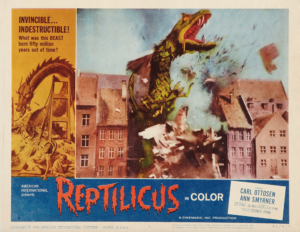
Lobby card for AIP’s release of Reptilicus.
Reptilicushas a scale that’s unprecedented for a film distributed by AIP, whose modus operandi was low-budget exploitation. Leo Bertelsen, one of the film’s financiers, was something of a Danish war hero with government connections. According to Pink, Bertelsen had been the leader of the fiercest Underground cell in Copenhagen during the Second World War; his group allegedly killed more Nazis than any other. Through Bertelsen, Pink was granted extensive access to the Danish military and navy. This was also made possible because Saga Studio’s owner, Fleming John Olsen, was a member of the majority political party in Denmark. As such, scenes in which the army battles the giant reptile were shot specifically for the production, departing from the use of military stock footage seen in many contemporary genre films, such as Invaders from Mars(1953), Beginning of the End(1957), and The Deadly Mantis(1957).
With production completed, Sidney Pink began assembling his English version. In this first cut, all of the Danish cast re-looped their lines in English except for Dirch Passer, Marlies Behrens (who plays UNESCO scientist Connie Miller) and Carl Ottosen (who plays General Mark Grayson). In fact, Sidney Pink himself dubbed Ottosen for this version.
Of course, AIP did not accept the film Pink submitted to them, and a convoluted legal battle ensued. Reports vary on who instigated it. According to Gary A. Smith’s American International Pictures: The Golden Years(2013), Sidney Pink sued AIP when they refused to distribute the picture. However, Bill Warren’s exhaustive Keep Watching the Skies! American Science Fiction Movies of the Fifties(2010) states that AIP sued Pink first for breach of contract. Warren’s account is arguably more substantial, as he refers to a Film Daily article dated 29th June 1961. The Film Daily article contains an excerpt from the suit, explaining that Sidney Pink, “agreed to produce and deliver a picture of the stated title [Reptilicus], conforming to several physical requirements, at a given date, now past, and did not perform the contracted production activities agreed upon.”
Warren goes on to explain that Pink retaliated by suing AIP and Monarch Books over the novelisation of the film – specifically because of the unauthorised use of his name, and because it was adapted without his consent. Pink also claimed that the book, which featured bizarre and overt sexual references, had subjected him to “public contempt” and ridicule.
Adding to the confusion, Sam Arkoff himself contradicts the implications of the Film Daily article. Speaking in his autobiography, Arkoff explained how he had gone to Denmark to see Pink’s cut of the film, and that he wasn’t pleased with the Danish accents: “Right now, it’s in a form of English that American audiences aren’t even going to recognise!” According to Arkoff, it was then that Pink tried to sue AIP for rejecting his cut. In both his autobiography and a 1988 interview with Tom Weaver, Arkoff explained how he’d pointed to the demands of Pink’s contract with AIP – which backs up the significance of the Film Daily article – but he stops short of talking about AIP’s own suit against Pink.
Meanwhile, Sidney Pink’s autobiography gives a broad comment that he and Sam Arkoff had “sued and countersued through the years”, and makes brief mention of his suit against AIP for the Monarch novelisation.
Irrespective of chronology, it seems all suits were settled and AIP went on to re-edit and re-dub the picture themselves for a late 1962/early 1963 release. Unfortunately, it is unlikely that we will ever see Sidney Pink’s first English version of Reptilicus.
AMERICAN INTERNATIONAL AND SAGA STUDIO: DIFFERENT BEASTS
Since its release, Reptilicushas been the target of scorn, ridicule, and derision; some of it justified, but much of it overstated. In a contemporary review, The Monthly Film Bulletin stated that, “the lame and plodding narrative is made worse by singularly bad acting.” More recently, Bill Warren has said that Reptilicusis, “an atrocity, easily one of the worst giant-monster-on-the-loose films ever made.” Critic Leonard Maltin echoed that sentiment, arguing that the film is “only good for laughs.”
However, it is important to remember that these charges were made against the AIP cut of the film. Indeed, the English version’s inclusion on Mystery Science Theater 3000’s eleventh season has likely contributed to the bad press.
It is a shame that the Danish cut is not widely available, for it is quite different – and arguably much more impressive – compared to its American counterpart. While I am sceptical that the Danish cut would totally change the current public perception (for that would require a wider reconsideration of older genre cinema), I am optimistic that if people were to see it, much of the criticism thrown at the AIP cut wouldn’t apply.
Whilst Poul Bang’s camera setups differ only slightly from Sid Pink’s, the main differences between the versions lie in entire scenes and shots that were excised by AIP. Many elements criticised in the AIP cut (most notably the special effects) appear significantly more accomplished in Saga’s version.
In the AIP cut, the monster swallows a farmer in an inexcusably poor shot. Photographs of co-writer Ib Melchior’s son were pasted over footage of Reptilicus, appearing to slide down his gullet. In the Saga version, this doesn’t happen; instead, Reptilicus crushes the farmer’s house. Saga’s version also features more footage of Reptilicus moving about – much of which is rather good. AIP cut most of it, and settled for repeating effects shots at a slower speed, which looks cheap. Perhaps most significantly, Saga’s version shows Reptilicus in flight. AIP removed this footage entirely.
The Danish cut (left) and the AIP version (right).
In terms of the story, Saga’s version is helped because of the cast’s original vocal deliveries. In hearing the actors’ actual voices, one discovers an urgency absent in the AIP cut. Moreover, Saga’s film also has more character backstory. There are light scenes of our heroes getting to know one another, which lend considerable charm. As pointed out by Kip Doto in his informative Reptilicus: The Screenplay(1999), Sid Pink did away with these scenes because he “didn’t want to be cute.” Consequently, AIP’s edition might seem more “serious”, but the characters aren’t nearly as endearing.
Saga’s version also features two musical numbers. In one of the film’s playful detours, General Grayson, Connie Miller, and Captain Brandt (Ole Wisborg) visit Tivoli Gardens in Copenhagen. While at a restaurant, they’re treated to Tivoli Nights as sung by Birthe Wilke. The song features in the AIP cut as well, but footage of Tivoli Gardens is inserted over the top. More significant is Tillicus, as sung by Dirch Passer to some enthralled children. Passer is in his comedic element here, as he leads the children around a garden singing, “Come on out, little friend, who is afraid of Tillicus!”
These songs may seem like an odd choice for a monster movie, but this might be a cultural misunderstanding. Musical numbers were a regular occurrence in several of the comedies Passer starred in. They can be seen in I Kongens Klæ’r(In the King’s Clothes, 1954, also directed by Poul Bang), Styrmand Karlsen (1958), the aforementioned Soldaterkammerater Rykker Ud, and MajorensOppasser (The Major’s Caretaker, 1964). As part of a Danish comedy mould, it makes perfect sense for them to appear in Reptilicus.
As it stands, Poul Bang and Saga’s versionis at least as good as – if not better than – many of the monster-on-the-loose films of the 1950s. It is not a perfect film, but it is enjoyable and often compelling, largely because of the charismatic ensemble cast. For Denmark’s first and (so far) only giant monster film, Saga’s Reptilicusis rather wonderful.
AIP’s Reptilicusis a different beast altogether, though I do not mean to support all of its harshest critics. While its elements can be lambasted in isolation, the sum of its parts is something else entirely. When one steps back, the English cut of Reptilicusis also something very special indeed – but for different reasons.
From a certain point of view, AIP’s Reptilicusis every element of what we perceive to be an “old monster movie” laid bare. While this author will firmly defend many of the superb science-fiction and monster films of the ‘50s and ‘60s, the AIP cut actively lives up to the negative charges made against this group of films.
The wonder of AIP’s Reptilicusis that – through its dubbed performances, expository narration, and special effects changes – the film inadvertently becomes a pitch-perfect amalgam of every genre cliché from the prior decade. It has the melodramatic performances, the shots of screaming crowds, and the orchestral swell. Although the charisma and technical accomplishment of Saga’s version are gone, the AIP version is still worthwhile because it hits all of the comfortable beats that we expect from a picture of this sort – and it does so without any irony.
Joe Dante’s marvellous Matinee (1993) features the wonderfully parodic Mant!, the film-within-a-film about a half-man, half-ant mutation. Dante affectionately peppers elements of ‘50s genre cinema into Mant!, from expository science lessons to actual samples from classic monster film soundtracks. If AIP’s Reptilicushad Joe Dante’s name above the title, we would think it a genius piece of parody. But the film is not a parody. AIP’s Reptilicus is earnest. Every line, every scream, and every special-effects shot was changed deliberately.
This means that the film’s glorious collation of familiar elements has happened naturally – or by accident. That it occurred through the most exceptional of circumstances only makes it more fascinating. For its sheer existence and inadvertently pure self-reference, the English version of Reptilicus should be celebrated.
But, in order for me to articulate what it is that makes both versions of Reptilicusso special beyond these abstract ideas, let’s dive in with further detail.
As discussed, the film’s special effects have been a barrier for many critics. Model artist Orla Høyer constructed at least two Reptilicus puppets; and while the larger of the two looks rather striking, its smaller counterpart isn’t as impressive. Another point in Saga’s favour is that this larger puppet features more prominently in the Danish cut, along with some larger-scale miniatures built to accommodate it.
No other screen monster has captured the look of European medieval dragon illustrations quite like the Danish beast. The unique nature of Reptilicus – both in terms of design and execution – makes him distinct amongst the pantheon of cinema’s great monsters. Whether or not one thinks the Reptilicus puppets look good (I happen to think they’re fine) is unimportant; nothing else like them exists.
Sketch taken from ‘The History of Four-footed Beasts and Serpents’ (1658)
That Reptilicus is shown on screen so prominently – in both versions – also stirs excitement. This is unlike several of AIP’s other efforts – like Voodoo Woman or Invasion of the Saucer Men (both 1957) – in which the monsters are seldom seen. On the contrary, Reptilicus boasts its monster. By seeing lots of it, the stakes are raised. We see the monster, and we understand how deadly the situation is.
The characters also feed into the comfortable melodrama. From the scientists in white lab coats to the stone-faced army generals, the characters in Reptilicusare perfect stereotypes of the sort that audiences expect to find in older monster films – irrespective of how often these films break from prescribed expectations. And while the Danish version frames them with humour and warmth, AIP’s dubbed dialogue pushes them into perfect parody.
My glee at the AIP cut – shortcomings firmly considered – might tempt you to read my enjoyment as the sort of ironic delight I decried earlier. However, it is anything but. I enjoy the AIP version because it is entertaining. Ultimately, that was what Sidney Pink and AIP set out to accomplish. This film was made to make a buck for AIP, and to entertain a predominantly-teenaged demographic.
Each individual element in the English cut might be flawed on its own. But, the sum of the film’s parts comes together to form an often-exciting and joyous film experience. All the way from its production history, to its fabulous title, and the film itself, Reptilicusis on its own level – for better or worse.
CONCLUSION
Ultimately, both versions of Reptilicuscan be enjoyed for how familiar they feel. It is admirable that Reptilicus meets all of the archetypical beats of ‘50s science fiction. Understandably, that won’t be the case for everybody. For this author, who enjoys watching and discussing these films day after day, Reptilicusis comforting. It’s familiar. For those who aren’t as keen on ‘50s monster pictures, Reptilicusmay well be a minor footnote. But for fans of this era of genre cinema, I urge you to give the film another go. Ultimately, Reptilicus presents a perfectly imperfect final hurrah for the previous decade’s science fiction.
I do not expect this to have changed many minds. Indeed, I do not expect you to suddenly treat Reptilicusas a masterpiece. In both its forms, the film has its flaws, and they might be enough to put off even the most ardent creature-feature aficionado. But it is hoped that this writing has offered an alternative way of looking at it. More than anything, it is hoped that readers will seek out Saga’s Danish version of the film.
Ask yourself, did you have a good time while watching it? I’m sure that a few will consider this and think, “no, I did not.” But for those who thought, “you know what? I did have fun”, hold on to that.
Reptilicusremains a fascinating part of sci-fi history, the circumstances of its genesis as strange and wonderful as the film itself. Cinema is better for it. At the very least, it was co-financed by a Nazi killer – that is something.
Long live Reptilicus.
A huge thank you to Revised Fiasco Design for creating the fabulous header image for this piece. Please visit their Instagram page to see more of their impressive work.
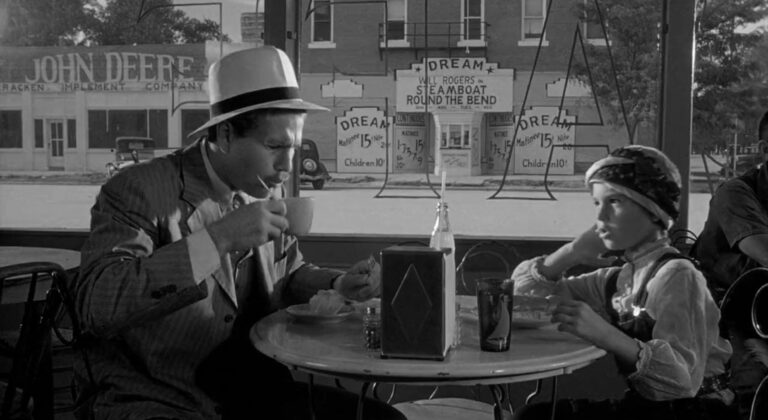
In Paper Moon, real-life father-daughter duo Ryan and Tatum O’Neal star as con-artists Moses Pray and Addie Loggins, respectively. Set in 1930s Kansas, nine-year-old Addie is orphaned after the death of her mother. Moses must take Addie to live with her relatives in Missouri, but Addie believes that he may be her father.
He tries to take her money, but she catches him in the act and makes him promise to get her $200 back. Grudgingly, he allows her to accompany him as he swindles recently widowed women into buying overpriced “special edition” bibles. Along their journey, they encounter some interesting characters, are chased by police, and have their tenuous relationship tested time and again.
Tatum O’Neal won an Academy Award for Best Supporting Actress in her role as the precocious Addie Loggins, becoming the youngest person ever to win an Oscar at age ten. The film is a nostalgic comedic delight whose characters brighten the monochrome landscapes. Here are thirteen memorable quotes from Paper Moon.
Addie Loggins: “Daddy, I need to go to the sh*thouse.”
Moses Pray: “Her name ain’t Precious.”
Trixie Delight: “Hurry up, Doctor! This baby gots to go winky-tinky!”
Addie Loggins: “Well, she ain’t my grown-up and I ain’t plannin’ no more to sit in the back. Not for no cow!”
Moses Pray: “Will you keep your voice down? And Miss Delight ain’t no cow. She’s a proper woman. She has a high school diploma. And right now she’s got to go to the bathroom, so you get on down to the car!”
Moses Pray: “You know what that is, scruples?”
Addie Loggins: “No, I don’t know what it is, but if you got it, it’s a sure bet they belong to somebody else!”
Addie Loggins: “I want my two hundred dollars.”
Moses Pray: “And his name ain’t Frank, it’s Franklin!”
Moses Pray: “We just have to keep on veering, that’s all.”
Moses Pray: “I now owe you one hundred and three dollars and seventy-two cents.”
Addie Loggins: “Seventy-four.”
Trixie Delight: “I just don’t understand it, Daddy, but this baby has got to go winky-tinky all the time.”
Addie Loggins: “But we just stopped for her to winky tink at lunch!”
Addie Loggins: “Where you from?”
Imogene: “Nowhere.”
Addie Loggins: “Well, you gotta be from somewhere.”
Moses Pray: “I told you, I don’t want you ridin’ with me no more.”
Addie Loggins: “But you still owe me two hundred dollars.”
Paris, beyond being the city of love, makes for an atmospheric and visually pleasing film setting. Whether the story involves characters falling in love, discovering something about themselves, or learning the history of France, the setting often makes the story more enjoyable for viewers and encourages characters to go exploring. Here are six great films set in Paris.
Midnight In Paris (2011)
Owen Wilson stars as a screenwriter named Gil Pender, giving an excellent dramatic performance, though still infused with his trademark comedic quirks. Accompanying Gil on his trip to Paris is his fiancé (Rachel McAdams) and her parents. He hopes to find inspiration in the city to write his first novel, even though he’s not sure he’s up to the task.
Every night, he goes for a midnight walk, but he doesn’t just walk through the Parisian streets – he finds himself travelling back through time to the 1920s, his golden age of literature. Gil meets Zelda and F. Scott Fitzgerald, Ernest Hemingway, Picasso, Gertrude Stein, and his other creative idols, all of whom seem to be awaiting his arrival, ready to give him writing advice.
Hugo (2011)
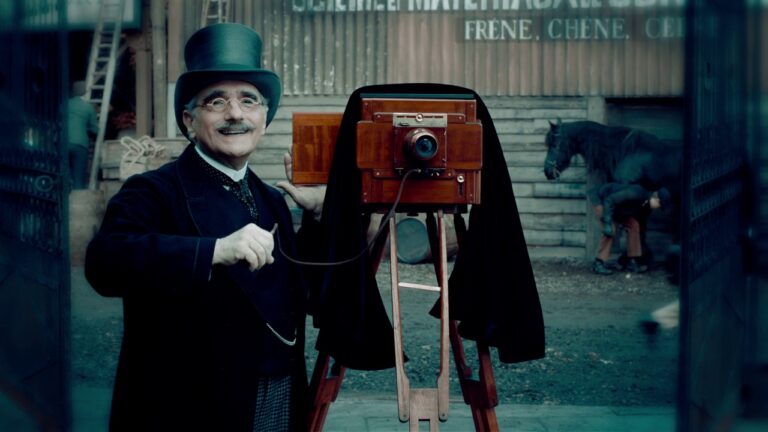
Martin Scorsese isn’t the first director one might think of for a children’s movie, but Hugo offers a story that transcends easy categorisation. The film begins as young Hugo Cabret (Asa Butterfield) is orphaned in the 1930s, left to fend for himself at a Parisian train station, where he operates the clocks after his father’s death. One of the few possessions his father (Jude Law) has left Hugo is his automaton that requires a special key to activate it.
Hugo befriends Isabelle (Chloë Grace Moretz) after stealing from her godfather’s toy store. She helps Hugo solve the mystery of his father’s automaton, which leads them on an adventure of discovery about the history of filmmaking.
Amélie (2001)
Audrey Tautou stars as the titular character in this charming French romantic comedy directed by Jean-Pierre Jeunet. Amélie is a quirky protagonist who is raised isolated from peers her age after her parents mistakenly diagnose her with a heart condition.
The film focuses on her young adulthood in Paris, where she’s surrounded by characters almost as quirky as her. A chance discovery of a box of childhood treasures in her apartment leads her on a search for their owner, which in turn leads Amélie on a search for love.
Les Misérables (2012)
Les Misérables has been made and remade for the screen many times, as well as staged for theatre productions. Many of the adaptations are worthy, but the 2012 version may be one of the most popular. Based on the classic French novel by Victor Hugo published in 1862, the story of Les Misérables follows Jean Valjean (in this movie, Hugh Jackman) as he tries to start a new life after being released from prison.
But after breaking parole, he is pursued by the ruthless policeman Javert (Russell Crowe). Valjean takes a young girl (Amanda Seyfried) into his care but can never escape Javert’s wrath. Anne Hathaway also stars in the film, a performance that earned her an Academy Award. The musical drama is guided by emotion to explore oppression, rebellion, and freedom against the backdrop of war.
Casablanca (1942)
One of the most iconic war romances of all time, Casablanca is an emotional tale of a nightclub owner named Rick (Humphrey Bogart) who helps his ex-lover escape into a better life with her husband. The story takes place during World War II, which makes the film very timely, and all the more resonant with contemporary audiences.
Though the primary story is set in Casablanca, Morocco, much of the significance behind Rick and Isla’s romance is centered around Paris. Paris becomes such an integral part of the story that it feels almost like a character, haunting them as their feelings for one another resurface.
Ratatouille (2007)
An animated film, Ratatouille tells the story of a rat who dreams of becoming a renowned French chef. He doesn’t take into consideration that humans despise rodents and would never even try a meal prepared by them.
The ideas presented within the film struck a chord with many viewers, young and old, and earned the film an Academy Award for Best Animated Feature Film.
Christopher Plummer, the Academy Award-winning actor who starred in films including TheSound of Music, All the Money in the World, and Beginners, has died at the age of 91. The Canadian actor died peacefully in his sleep at his home in Connecticut, his family confirmed.
“Chris was an extraordinary man who deeply loved and respected his profession with great old fashion manners, self deprecating humor and the music of words,” Lou Pitt, his longtime friend and manager of 46 years, said in a statement. “He was a National Treasure who deeply relished his Canadian roots. Through his art and humanity, he touched all of our hearts and his legendary life will endure for all generations to come. He will forever be with us.”
Born December 13, 1929 in Toronto, Plummer grew up in Senneville, Quebec and was inspired to pursue acting after watching Laurence Olivier’s Henry V. His portrayal of Mr. Darcy in a 1946 production of Pride and Prejudice at the High School of Montreal caught the attention of Montreal Gazette’s theatre critic Herbert Whittaker, who was also amateur stage director of the Montreal Repertory theatre and cast 18-year-old Plummer as Oedipus in Jean Cocteau’s La Machine infernale.
After moving to New York in the early ’50s, Plummer performed in numerous Canadian theatre productions and television adaptations of plays. He made his debut at the Stratford Shakespeare Festival in 1956, earning critical acclaim for his interpretation of Henry V. “From that time on my name was above the title,” he said. In 1959, he received his first Tony and Emmy nominations, for Best Actor in a Play (J.B.) and Outstanding Actor — Limited Series or a Movie (Little Moon of Alban), respectively.
Plummer’s film debut was in Sidney Lumet’s 1958 film Stage Struck, though he is best known for playing Captain John Von Trapp in 1965’s Robert Wise-directed The Sound of Music. Plummer notoriously had little respect for the film, refusing to attend the 40th anniversary cast reunion and often referring to the film as “The Sound of Mucus”, though he did eventually agree to provide commentary for a 2005 DVD release.
Plummer won an Academy Award for his performance in the 2010 film Beginners and was most recently nominated for Ridley Scott’s All The Money In The World, where he replaced Kevin Spacey in the role of J. Paul Getty. He recently co-starred in the ensemble of Rian Johnson’s Knives Out, though his final film role was for the Todd Robinson-directed war drama The Last Full Measure. His range of notable films also include The Man Who Would Be King, Waterloo, Star Trek VI, The Girl With The Dragon Tattoo, Twelve Monkeys, A Beautiful Mind, Man in the Chair, Must Love Dogs, National Treasure, Syriana and Inside Man. He also made almost 100 TV appearances, including the Emmy-winning BBC Hamlet at Elsinore, the Emmy-winning productions The Thornbirds, Nuremberg, Little Moon of Alban, as well as HBO’s Muhammad Ali’s Greatest Fight.
Plummer is survived by his wife of 53 years, actress-dancer Elaine Taylor, who was reportedly by his side at the time of his death.
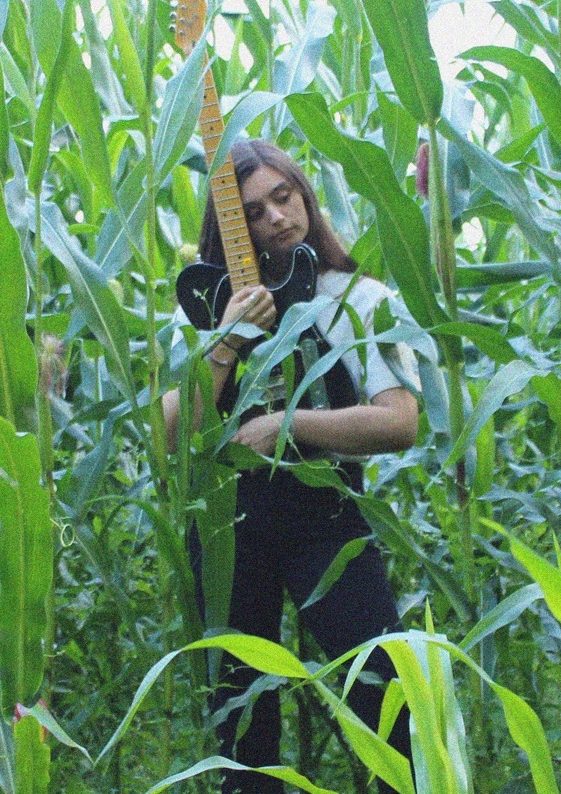
“Do you ever think of showers as like a new beginning?” 20-year-old Leeds-based songwriter Amber Strawbridge asks on the opening track of her new EP, Sometimes I Forget You’re Human Too. The project, out today via Clue Records, indeed marks a kind of new beginning for the dream-pop artist, who was born in Whitehaven, Cumbria and started making songs on GarageBand while literally bored at her grandmother’s place. After releasing a series of singles on SoundCloud as well as Isolation Tape, in her words a kind of “random release” that nevertheless allowed her to further explore her sound, her latest finds her refining her approach with help from producer Alex Greaves while retaining the lo-fi, bedroom pop charm of her early productions. Nowhere is this more evident than on opener ‘Showers’, which conjures the kind of soaring hook you’d expect from any of the big names in shoegazey alt-rock, while the title track swirls in a melodic haze and ‘Skin’ cuts through the messiness of human relationships. With the addition of live drums and gauzy layers of guitars towering above her, it sounds like watching someone beginning to open up to the immensity of the world around them as they reflect on things either lost or forgotten, but no longer completely out of view.
I’ve not done much today. I went for a walk, that was fun. I’m at my parents’ house at the minute because of lockdown.
I just noticed – what does the poster behind you say?
It says, “Animals are my friends… and I don’t eat my friends.” It’s by Bernard Shaw, who’s a really great writer.
Are you interested in veganism and animal rights?
Yeah, I mean, I’m vegan, so.
Me too actually, which is why that caught my eye. This isn’t how these interviews normally start!
Yeah, I was raised veggie, so it’s kind of always been normal to me. And then I went vegan around five years ago.
That’s really cool. And from what I understand, you also grew up in a kind of musical family and around many instruments? Do you have any early memories of being drawn to music?
My parents used to just take me to loads of different little festivals. They were just really weird hippie festivals with like, gypsy jazz, folk music, that kind of stuff. So I was just always surrounded by loads and loads of different types of – we went to, like, Austria, and went to festivals there, so I had a really good childhood in that sense. And my dad plays loads of different instruments like piano and violin. I think he just kind of let me do whatever I wanted, like I can’t even play piano or violin, but just having them there and just him playing stuff, I think it probably subconsciously affected me.
What types of music were you exposed to at the time, and what did you find yourself gravitating towards?
I feel like when everybody’s younger they kind of just listen to whatever their parents are listening to, so like, Pink Floyd, The Police, David Bowie, that kind of stuff, but also just weird folk bands who I don’t even know the name of. And I have an older brother, so then I progressed into liking what he liked, and he just liked loads of indie bands. And when I got a bit older, I just found my own niche, I guess, I went more into shoegazey kind of people.
I got my guitar because I saw Ellie [Rowsell] from Wolf Alice with her guitar and I was like, I want that. And then I just taught myself.
What was it that drew you to shoegaze?
It’s actually kind of weird, because I was listening to shoegaze before I actually knew what shoegaze was. So I was listening to bands that were probably influenced by like, Slowdive or Jesus and the Mary Chain, like bigger shoegaze people. And then I started to make music and people would come up to me and be like, “Oh, I like how you’ve got that shoegaze sound” and I was like, “What? What is shoegaze?” I didn’t even know what it was, and then I started to get more into it.
When did you go from uploading songs on SoundCloud to deciding you were going to make this EP? How did the idea of the project come about?
For this EP, I did the songs in the first lockdown, so all of them were just recorded when I came back home. And I don’t know, I think it was just like, I’d been at uni for so many months and at uni it’s just very fast-paced and like everyone’s constantly doing stuff and then when I came home, it was kind of a calmness that I could get in touch with my thoughts and everything, and I just wrote a lot.
It’s interesting that you mention that, because I’m curious about the title of the EP, Sometimes I Forget You’re Human Too. You’ve said that’s about the realization that not everyone has got it together all the time. Where did that realization come from?
I think I started writing that song at uni, because it was kind of around a time when everyone was just – I think for me, I’m always like, “Oh, I should be doing more work” or like, “I should be doing better,” like I’m quite self-critical. And I can’t put my finger on it, but just one day I was like, everybody has their own kind of faults or demons that they’re dealing with or whatever. I think it was kind of good for me to know, because the song’s kind of me reassuring myself that it’s okay if you’re not 100% amazing all the time. Because, you know, everybody else isn’t.
Do you feel that relates at all to being a perfectionist? Is that something that informs how you approach music?
It’s weird, because with songs I don’t really like to go back to them. I do them as a whole product and then I find it difficult to go back – I have a kind of flow of thoughts so I find it difficult to then get back to the same headspace that I was in when I was writing it. So I guess that would be not perfectionism, but I just think in day-to-day life I’m quite a perfectionist. I just like to achieve things. [laughs] I’m just like, “Oh, I can’t watch TV because I should be doing this, which is more productive,” that kind of thing.
To change the subject a little bit, throughout the EP, I noticed there are a lot of references to water, from ‘Showers’ to ‘Summer’, where you sing about hanging by the lakes, and of course the closing track, ‘Safer at Sea’. And I know you grew up in a coastal town as well.
Yeah, that’s where I’m at.
Was there any particular reason you found yourself returning to that kind of imagery?
You know what, I’ve never thought about that, so that’s a good point. It wasn’t a conscious decision, maybe subconsciously. Maybe it’s just a safe space or what I’m used to, maybe, or have always been surrounded by. I live by the coast, and then I also like 10 minutes out of the Lake District. And I guess in a way, because I came home from uni which is like a city, which is the opposite of my hometown, coming back from somewhere that’s busy and just big lights and all that kind of stuff to, like, nature, maybe I was just reconnecting with that. But it wasn’t deliberate.
To get to ‘Safer at Sea’ specifically, which stands out to me lyrically. It feels like quite a vulnerable moment on the record. Do you remember what was going through your mind while writing that song?
I think what it was was, I started writing it during lockdown and there was just lots of things happening. There was something to do with the refugee crisis and like, one of the MPs said something really just horrible. And I was just so angry about it, and I think the line “safer at sea” – it’s kind of like there’s these people who are like, “We’re gonna travel across the sea to try and come to a safe space,” and then they’ve been met with horrible bigotry and it just contradicts what they’re hoping for. So the sea in the middle is like the safe space when there’s not that, and none of society. And then I just kind of thought, maybe everyone’s safer at sea, like there’s no racism, sexism, anything, it’s just peaceful. And then in the verses, I was kind of expressing how I feel a bit distant from society sometimes.
Could you talk more about that feeling?
I think it’s when things like that happen, like when I hear somebody say something that I just do not understand at all, I just don’t understand how people like that can exist. And then because you live in a bubble, like I live with people who are on the same wavelength and we all have kind of similar opinions, I think it’s easy to get trapped in the thought that everyone thinks like you, whereas if you watch the news you can easily see that not everything’s the same.
That’s interesting, it sounds like you feel strongly about injustice in general, and maybe that relates back to veganism as well?
Yeah, definitely. During the time I was writing, it was the comment about the refugees that really pissed me off, but the thing as a whole is like, you know, if everybody was vegan, if everybody wasn’t racist or xenophobic, it would just be a better place. And obviously, that’s not what it is at the minute, so the sea is kind of a better place. I think that’s what I meant at the time.
I know you recently put together a band – do you have any plans that you’re excited about in the coming months or anything that you’re working on currently?
Well, my band is just going to be my live band, so I’m still gonna do everything myself and record it all myself. But I really, really wanna do gigs, that’s my main thing. I’ve got a catalog of songs now that are ready, so hopefully that will happen soon.
This interview has been edited and condensed for clarity and length.