Gaming and iGaming are fusing into one hybrid entertainment model. This shift is not a niche trend. It is a clear market direction.
Players now expect social features in every digital product. They already use voice chat, party systems, leaderboards, and creator communities in mainstream games. They want the same connected experience in casino products.
That is why multiplayer iGaming is becoming inevitable.
TL;DR
Online gambling is moving from solo sessions to social sessions. Slots were designed for individual play in the first online era, but player behavior has changed. Modern users want community, shared moments, and live interaction. The next wave is social-first iGaming: multiplayer slots, group competitions, live chat, and creator-driven game rooms.
What does “gaming and iGaming fusion” mean?
It means iGaming products now borrow the strongest mechanics from modern gaming:
real-time multiplayer interaction
persistent identity and social profiles
progression loops and community events
spectating, sharing, and creator participation
At the same time, gaming products are adding monetization systems that look more like iGaming economics. The two categories are converging around one core idea: interactive entertainment with social engagement. This is the direction platforms like Gamwiz are building for.
Why is multiplayer iGaming inevitable?
1. Player behavior has changed
Users no longer want isolated digital experiences. They want to play with friends, compare outcomes, and react together in real time.
2. Social products retain users longer
Multiplayer systems build stronger retention loops than solitary products. Chat, team goals, and social competition increase repeat sessions.
3. Community lowers friction
When gameplay is visible and shared, it feels less hidden. Social context can reduce stigma and normalize participation as entertainment.
4. Content creators need social surfaces
Streaming and short-form video thrive on interaction. Multiplayer iGaming creates moments that are easier to share, discuss, and replay.
5. The younger audience expects live features
Newer digital-native users are conditioned by online gaming culture. For them, solo-only formats feel outdated.
Slots became solitary. That era is ending.
Historically, gambling was social. People gathered, watched each other play, celebrated wins, and reacted to losses together. Social energy was part of the product.
Online slots scaled access, but they also removed that shared layer. The result was convenience with less community.
Now the market is correcting that gap. Multiplayer slot rooms, shared bonus events, and community-led formats are restoring the social side of gambling.
Solitary slots vs social multiplayer slots
Why this matters for stigma
The old model framed gambling as a private activity done alone. The new model frames gambling as a social entertainment experience.
That shift matters.
When products are community-led, transparent, and moderated, users see them closer to mainstream digital entertainment. This does not remove the need for responsible gambling controls. It makes those controls easier to communicate and adopt in shared environments.
What responsible multiplayer iGaming should include
A social-first future still needs strong protection standards:
clear spend limits and time controls
visible responsible-play reminders
anti-harassment moderation and reporting
transparent odds communication
tools for self-exclusion and cooldown periods
The best hybrid products will combine high engagement with strong user safety.
The direction is clear: hybrid by default
The next generation of successful platforms will not separate gaming and iGaming as rigid categories. They will combine both.
Expect to see:
multiplayer-first casino products
live social lobbies and events
creator-integrated game loops
progression systems that reward participation, not only outcomes
In short, this is the evolution of online gambling. It is moving back to its roots as a social experience, now powered by modern gaming infrastructure.
FAQ
Is multiplayer iGaming just a trend?
No. It reflects a long-term shift in user expectations across digital entertainment. Social interaction is now a default expectation, not a bonus feature.
Why are solitary slots losing relevance?
They can still perform, but they offer less community value. Multiplayer formats create stronger engagement through social presence, group energy, and shared milestones.
Can social iGaming reduce gambling stigma?
It can help. Products that are visible, moderated, and community-based often feel less isolated and more like standard entertainment.
What is a hybrid gaming + iGaming platform?
It is a platform that combines game-style social systems, progression mechanics, and live interaction with iGaming products such as slots and casino experiences.
A new digital archive is making thousands of mysterious ancient Chinese emblematic symbols accessible to anyone with an internet connection.
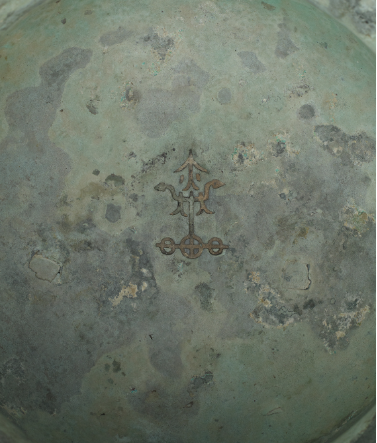
Yuwei Zhou, a PhD candidate in the Department of East Asian Languages and Civilizations, is spending three months at Taiwan’s Academia Sinica helping to complete a groundbreaking database of clan emblems—highly pictorial emblem glyphs found on mortuary bronze vessels from the Shang dynasty (c. 1300-1046 BCE). These emblems make use of design strategies such as symmetry, mirroring, and inversion. At first glance, they can seem more like images or even contemporary logos than written language. But that visual impression can be misleading: despite their pictorial appearance, these emblems played a specific and meaningful role in the ancient world, one that scholars are still working to fully understand.
Ritual grain server (yu) with masks (taotie), dragons, and cicadas. Inscribed on the bottom of the interior, Yi Che 亦車 (“Yi-Chariot”). Collection of the Smithsonian National Museum of Asian Art https://asia.si.edu/explore-art-culture/collections/search/edanmdm:fsg_F1941.8/
More than 8,000 bronze vessels bearing these emblems have been discovered across northern China during the Shang dynasty, yet scholars have debated their meaning for over a millennium. Chinese antiquarians as early as the Song dynasty (960-1279 CE) believed they represented ancient clan names, Later scholars expanded this view, suggesting that the emblems may also have referred to official titles, personal names, or even markers of military alliances. Some researchers have gone further, hypothesizing that the symbols represent an early form of Chinese writing—possibly predating the oracle bone inscriptions discovered at the archaeological site of Yinxu. Yet the relationship between the two remains unresolved.
“The fact that these bronze symbols coexist—at the same sites and during the same period—with the earliest known form of Chinese writing, the oracle bone inscriptions, is striking,” Zhou notes. “This suggests that rather than representing an earlier phase of writing, the emblem glyphs may have served a different purpose altogether—perhaps addressing a different audience or operating as a distinct form of visual communication.”
Zhou’s research takes a more novel approach. Instead of treating the emblems as a mysterious language waiting to be decoded, she focuses on where and how they were used. Noticing that these symbols appear almost exclusively on bronzes placed in tombs, Zhou asks a broader question: how do these symbols relate to the mortuary practices in ancient China? What role did they play in the mortuary ritual process? She applies statistical methods to understand their cultural significance through distribution patterns and archaeological context. Her findings reveal a striking concentration: more than 60 percent of late Shang emblem glyphs come from the late Shang capital at Yinxu, Anyang.
“The concentration of emblem glyphs at Yinxu is no coincidence,” Zhou says. “On the one hand, we have to account for archaeological bias: excavations at Yinxu have been underway for nearly a century, while work at many other sites began much later. On the other hand, the evidence itself matters. With its large-scale monumental architecture, developed urban infrastructure, royal mausoleums, and diverse cultural remains, Yinxu was, by any measure, a major metropolitan center in late Shang China.”
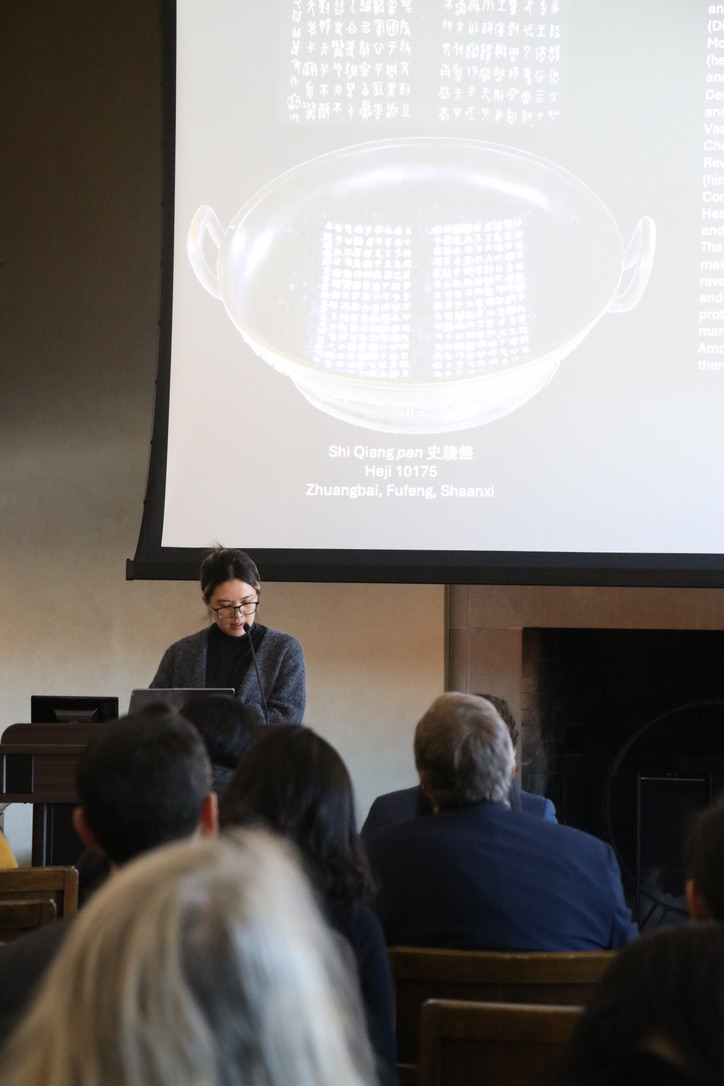
Yuwei Zhou presents her research on early Chinese bronze inscriptions during an academic lecture
The new database, in development since 2017, breaks down each emblem into smaller, recognizable parts—similar to how a Chinese dictionary organizes characters. Users with no background in ancient scripts can search and compare emblems simply by clicking visual icons. This database is linked to a bigger database of Chinese characters. Eventually, this tool will allow users to trace how individual characters look like in oracle bone inscriptions, bronze inscriptions, and bamboo strips. Together, it gives users a sense of how Chinese writings evolve into the modern Chinese characters we now use every day.
The project represents a new frontier in making specialized archaeological research accessible to students, educators, and anyone interested in the history of Chinese writing. For Zhou, it’s also central to her dissertation research on how these emblem glyphs function in the deathscapes in Yinxu.
“The dead don’t bury themselves—the living do,” Zhou says. “These emblem glyphs may have played a unique role in mortuary rituals, from acts of gifting and commemoration to the negotiation of identity and social relationships among the living. They may have helped structure how memory, status, and belonging were expressed at moments of loss.”
As Zhou explains, the use of these symbols wove writing-like forms into a dynamic relationship between the living and the dead that was distinctive to late Shang China. Understanding how the emblems functioned helps illuminate the many roles that writing—and writing-like visual systems—played in the earliest stages of their development.
At a time when U.S.-China relations dominate headlines, this project addresses a critical gap in American cultural literacy about early Chinese civilization. The database makes 3,000 years of Chinese visual culture accessible to American educators, students, and museums without specialized language skills, allowing institutions like the Metropolitan Museum of Art and the Smithsonian to finally provide meaningful context for thousands of Chinese bronze vessels in their collections. The project demonstrates that productive U.S.-China academic collaboration continues even amid political tensions, building the cultural understanding Americans need to engage effectively with a nation shaping the 21st century alongside the United States.
The research sheds new light on Yinxu, designated a UNESCO World Heritage Site in 2006 and considered one of China’s most important archaeological sites. The site marks both the last capital of the Shang dynasty and the birthplace of scientific archaeology in China.
The New Pornographers have shared ‘Spooky Action’, the latest single from their forthcoming album The Former Site Of. The relatively understated tune follows previous cuts ‘Votive’ and ‘Pure Sticker Shock’. Give it a listen below.
The National’s Matt Berninger and Rosanne Cash have shared a cover of the Velvet Underground’s ‘Who Loves The Sun’ for Hulu’s dramedy series Sunny Nights. Listen to their take on the Loaded opener below.
“I’ve been a Trent O’Donnell fan for a long time,” Berninger said in a statement. “We became good friends when he cast my brother, Tom, in an episode of his show No Activity, and we’ve had a close, creative bond ever since. When he asked me to cover the Velvet Underground for Sunny Nights, I immediately thought of it as a duet with Rose and John [Leventhal] . We recorded it in their Chelsea brownstone last summer. John did most of the work while Rose and I drank chardonnay in the garden in the sun.”
Sunny Nights launched on Australian streamer Stan in late December and arrives on Huly March 11. Matt Berninger released his most recent album, Get Sunk, last year.
The camera catches Buck Meek hanging onto a fence, illuminating the boundary between him and total darkness, which even his black suit seems to be blending into. On the cover of his new album The Mirror, the Big Thief guitarist is glancing back as if meeting his reflection in the lens, his shoulder obscuring his expression just enough: it’s not clear whether he’s startled, running away from something, or trying to break on through. Perhaps he’s heading to the “the tunnel underneath the road” that he finds on ‘Demon’, “a place I go to sing with echo, echo, echo” – a natural magic further filtered by the voices that tune into it throughout the record, a choir that includes Adrianne Lenker, Germaine Dunes, Staci Foster, and Jolie Holland, and bordering the electronic world fashioned by his Big Thief bandmate and producer James Krivchenia. But just like he sings of trying to write a song that is not for others on ‘Heart in the Mirror’, he’s aware of the dark side of his soul being exposed while learning to foster something good and even divine out of it rather than projecting it outward. “My demon is my darkness, and my darkness is my angel,” he professes, “I taught him how to read, now I’m teaching him to write.” The Mirror bears the fruit.
We caught up with Buck Meek to talk about kissing, fast cars, natural disasters, and other inspirations behind his new album, The Mirror.
Death
This sounds like a heavy place to start, but I think it’s worth noting that the first time you allude to it on The Mirror, it’s in this joyfully spiritual way on ‘Gasoline’. It does take different forms later on the record, but that lightheartedness feels intentional as a starting place.
That resonates for sure. I’m just starting to experience real death in my life, with people that are close to me. My grandmother passed away a couple of years ago. The first song I wrote for the album was ‘Outta Body’, which was processing the grief of her passing away. She was a really brilliant woman. She was a professor, and I had a lot of conversations with her about books, and also about my songs. She had read, like, every book in the world. I was really missing conversations with her, and I wrote that song as this fantasy world that I’d built around being able to communicate with her after death. The thing I love about songs is you can create a world that defies physical reality, and you can live inside of that world – and almost believe it, for a moment, especially while you’re writing it. Hopefully that translates to the listener, but to me, the most valuable thing is just living in that space as I write the song. I almost believed it: I was talking with her, and she was winking at me through the screen, through Ingrid Bergman.
I think that set me off in a direction with this album, creating my own relationship with death a little bit. The whole industrial complex of religion is, to some degree, built around this idea of security in the afterlife. It’s one of the only things that we really don’t know and understand, so in a way, it’s this idea of magic that ties it all together, too. The ways that we all deal with that is really beautiful. I’m just trying to deal with it my own way throughout the record.
For you, do songs come out of that relationship that don’t immediately live in a fantastical realm? Do you feel the urge to write from a raw, non-magical place before twisting it in that direction?
I love songs that do both. Often those are my favorite songs to sing, the ones that start from a place of brutal honesty or confession, or do something that’s really simple but objectively true. In the writing process, whenever I feel myself limited by that, I allow myself to bend reality. That can be really exciting, and it often loops back to truth. Truth isn’t limited to objective truth, necessarily – emotional truth can be much more abstract than reality. But I think the combination is my fav.
Poison
I think that speaks to the latest single, ‘Can I Mend It?’, and the track that precedes it on the record, ‘Pretty Flowers’, which starts from a raw emotional place where the poison is a kind of meanness or anger, and then you bend reality to look at it through the lens of metaphor.
It’s so easy to forget that line between life and death and become numb to it, until you have a near-death experience or a death in your family – whatever reminder snaps you back into the awareness that the line is so thin. Our survival is so precious, and everything we’ve built in society is just there to attempt to protect us from death. Being aware of it makes me feel more alive, and in the songwriting process, that feels inspiring. It helps me prioritize what really matters in a song, weirdly. I like to approach a song as fighting for your life a little bit. Every word counts to the point of survival, at least in this abstract creative space.
My dog Ringo, she’s a little husky dog. We were in the mountains where we were living, and she had found this rattlesnake head. We found her crying like crazy; she was whelping, and there was this rattlesnake head that had been severed, with its huge fangs, this rattlesnake blood. We grabbed her and put her in the car, but she had grabbed this rattlesnake, because she was so obsessed with it, but also so disturbed by it. She’d brought the rattlesnake into the car, and the rattlesnake went under the car chair. She couldn’t get to it, and she started going crazy. She was making sounds I’d never heard before; it was really scary. I thought she had been bitten by this rattlesnake, or it was dead and she bit it but the poison was still active. I’d looked it up on my phone, and it said if a dog bites a dead rattlesnake – if it hasn’t been dead for long, the poison’s still active.
It turned out she was fine. The rattlesnake poison had completely dried up. Nonetheless, little moments like these wake me up to what really matters. And also the absurdity [laughs] of this idea that we’re secure – that feeds back into the process and the songs.
In the mountains up there, the spring has so many wild flowers, and there’s this one called the Datura. It looks like a beautiful white wedding gown. It’s super poisonous if your dog eats it. Where I was writing, there was a big Datura in the yard I was looking at, and that’s when I wrote the line for ‘Pretty Flowers’. But I did change the name of it to Jimson, which is another poisonous flower, because it worked better in the melodic rhythm. I guess that’s an example of starting with – Ringo didn’t actually eat the poison flower; she ate a rattlesnake. But there was a poison flower in my yard, which was a Datura, but I changed it to Jimson.
I did want to lean into that line about poison, because I feel like it also reflects the demons that you confront through the record. Over the years, have you found yourself more or less cautious of things like madness, darkness, and spite seeping into your songs? Is it sometimes necessary to lock them out?
I think locking them out creates a stigma, and then they grow and rear their head in other ways. For me, songs are a good way to practice letting them out, and it’s a very forgiving environment because it’s just my own head. But it’s also an externalization of whatever demons it allows me to look at and let them go. I think as a younger songwriter, I would avoid it for whatever reasons. With this record especially, I really tried to let it fly.
“Teaching him to write,” which is a really lovely way that you put it on ‘Demon’.
Thank you. Just trying to get to the bottom of it, because usually beneath those fears, there’s something very sweet or vulnerable. Vocalizing or expressing it often will get beneath to the root of those fears.
Do you feel like there’s a risk of romanticizing the darkness as a muse?
Definitely. It’s a huge problem in the world. I don’t mean to romanticize it, just trying to find the middle ground with it – to not romanticize it, but also to not suppress it, which creates other problems. Giving it a voice and listening to it, but not following it into the darkness, necessarily.
Kissing
There’s the obvious fact that your new band opening your solo tour is called Kisser, although kissing is also a motif throughout The Mirror, from ‘Gasoline’ to ‘Heart in the Mirror’ to ‘Outta Body’. Looking at those songs, it’s almost like the thread is that the kissing becomes increasiblysurreal.
I didn’t really think of that. What lines are you referring to with it becoming more abstract? That’s cool.
There’s kissing a person, and then inanimate objects, and finally that line you alluded to: “Ingrid Bergman kissing on the silver screen/ Am I crazy or did shе just wink at me?”
Oh, yeah. Kissing is the best. We all love kissing. It’s such an important form of communication without words. I realized as I was writing that there’s a lot of themes of communication in these songs. There are a lot of love songs on the album, but they also trace different phases of relationships, different types of relationships, romantic and familial and friendships. Communication is such an essential part of a relationship, and words are such powerful tools, but there are limitations to them. When we’re in love or we feel really close to someone, there’s a lot more communication happening beyond our words. And kissing is such a funny one because it looks like we’re talking, in a way, just very close to the point where we can’t even talk. It’s such a hilarious, unanimous example of how, when words fail us, we can kiss each other. [laughs]
In regards to what you said before, it showing up in different ways on the album, both literally kissing my wife and also kissing fruit, that sense of longing to the point where you can’t contain yourself any longer, to kiss something – ‘Kiss the Mirror’, which is another song that isn’t on this record. I used to kiss my mirror as a kid, we probably all did, whether we’re willing to admit it or not. With every song, I tried to push into the things I was afraid to say, the things that were scary or vulnerable to say. A lot of those lines are examples of that – it’s a little scary to say, “I’m gonna kiss fruit bread, and kiss bread, and kiss the carpet.” In a song, it feels kinda dumb. But also, as soon as I said it, it felt really empowering. And then that reenergizes the whole process.
Do you feel like part of tackling that fear has to do with reconnecting with your child self? Is that something that came up for you?
Yeah, definitely. Which is kind of the inverse of some of those fears and demons I’m talking about on these songs. Trying to relinquish the programming of self-consciousness that’s forced upon us as adults. Especially as a songwriter and musician, which is this competitive environment, like a sport to some degree, even with the press. Even within the music community itself, there is this form of competition and judgment that really has nothing to do with music at all. And that creates stigma and fears, and to counterbalance that, connecting with the child is an intuitive, instinctual process. It’s kind of the antidote for that.
Fast cars
The cabin where we were living when I was writing these songs and recording them is in the mountains, surrounded by all these twisty roads everywhere. But a lot of the mountain range is also alongside the San Fernando Valley of Los Angeles – you’ve probably heard the term “valley girl.” It’s basically this endless suburb of immigrant communities and mechanic shops for every possible type of car you can imagine – every hot rod, every subtle variety of specialty car shop. There’s this incredible culture of valley teenagers with these crazy hot rod race cars in the suburbs. On the weekends – and late at night, at three in the morning – they take the race cars up into the mountains and they race and drive around. There’s all these beautiful vistas up there that look out over the city, and they park their cars and make out, to bring it back to kissing. Often, as you’re going home, you’ll come around the corner and your headlights will flash on this beautiful Camaro with two teenagers making out on the side of it. Every single day, you’re seeing these scenes of American romance, just like the movies. But it’s real – it’s just these 19-year-old kids trying to find a sense of freedom, literally rising above the city. And you hear it constantly, too. These cars are really loud. It’s a weird juxtaposition: this peaceful place with birds and stuff, and then race cars all the time.
I just find that kind of thing inspiring, and it has nothing to do with the songs directly, but I put it in this list because the songs themselves and the album and the recording – all of these constructs we build around our ideas are just little analogues for our lives as a whole. Of course, I could determine specific inspirations for songs and life experience that is being reflected in the songs literally, but really, what it all is is just a filter for my life, the day-to-day. Even the players that are on the album are just a small part of a much bigger community of musicians around the world that have influenced me over the years, that I’ve played directly and indirectly. It’s all being fed into the music. We have a decisive moment where we choose a word, a melody, a chord, a player, a band, a microphone, a level in the mix, a song title, an album title, but these are all just little symbols in a construct we’re building around something that’s so much bigger and impossible to capture. The kids in their cars were just part of that fabric, I guess.
The way you talked about the noise piercing through the quiet of the landscape also made me think of the experimentation on the album and how it counteracts its organic elements.
I love that. I love the balance of extremes in general, and we definitely put a lot of intention into creating this balance of organic recording of a rock and roll band in a room playing instruments, with this parallel world of electronic instruments that was more ambient and less defined; more of a texture, an unpredictable synthetic world that was running parallel to the band – and also, to a huge extent, being triggered by the band. James Krivchenia was using the band as sources for his modular synthesizers and his programs. We weren’t even hearing it happening, so we were just playing our songs, and unbeknownst to us, there’s all this electronic music being created in parallel.
Natural disasters
They say the four seasons in California are floods, earthquakes, fires, and landslides. The Santa Ana winds come every year, which are these super fast, 100mph winds, and if a single match goes down, the whole mountain range goes on fire. That strips away all the root systems, so as soon as it rains, there’s all these floods in the spring. There’s no roots to hold the mud, so there’s mudslides everywhere. There was a big mudslide a couple of years ago, right around the time my grandmother passed away. There’s only three roads that go into the canyon, and all three of them had mudslides, so the whole canyon was shut down. We were all trapped in there. Suddenly, it was the most peaceful day I’d ever seen in the canyon. There were no cars, and there were these huge mudslides everywhere. School was cancelled, and all these little kids were playing in the mud, sliding around their butts in the mud. It was super fun. It slowed everybody down, I guess.
The fires were happening as we were recording the album. Just over the hill, there was this giant fire in Malibu. And shortly after this album, Topanga burned in the Palisades burns. That fire came just a hundred yards to the house where we recorded. It’s terrible when these disasters happen, of course; it uproots families and destroys homes. But at the same time, I definitely saw it bring a community together in a way I’d never seen before. There was literally a gang of surfers that banded together to help the firefighters put out spotfires. The relief that comes after from people coming together is really beautiful.
It’s also a healthy reminder that we’re not meant to live there in the first place. These mountains are young and pretty chaotic; the people that lived here before us, the Chumash people, were nomadic, so they could move around the fires, pick up camp and scoot up there, get out of the way. But building these permanent structures makes no sense. It’s just a matter of time they’re gonna go down. All of these things are inspirations to me when writing, again, just to remind me of the thin line, this idea of security and stability, and the truth of how fragile it all really is.
Boundaries
If there’s a line that sums up the whole album, it’s “The line between us all is thin.”
This is a big one. The wide concept of boundaries was something I was thinking about a lot while writing the album, and also in my life, regardless of songwriting. The inherent boundary of our body and our own consciousness being isolated, and all of the ways in which we try to reach out beyond that boundary to communicate with others. That line is very static in one way – we have a body – but also it’s really fluid in other ways. There’s a lot of relativity there. Even with sound, for instance, we can produce sound which leaves the boundary and suddenly is reflecting off of all the surfaces in the space and literally combining with other sounds. That’s just one example of how these boundaries are being bent constantly.
The mirror is this strange aspect of that, too. It’s a physical boundary, an extremely reflective dense surface, but it also reflects us back to ourselves. There’s objectivity there, but there’s also so much relativity, because there’s perception, and our perception is so biased. All of the ways we’re seeing ourselves through filters of whatever we’ve been taught to see ourselves. There’s so many contradictions in the idea of a mirror. Also, the mirror of a relationship, having yourself reflected back to you through their perception. Their ability to see you in ways you can’t see yourself, just like a mirror, and how that can be really challenging – but also, we’re somehow incentivized to look into that mirror. Maybe love is in some way a reward system for that, this form of incentive to continue to look at yourself in the mirror through another. Maybe because otherwise we’ll die, or we’ll completely lose touch with ourselves and any kind of objective reality.
In regards to my own relationship with boundaries, I think socially, as a younger person, I would often compromise my own boundaries to please others a lot. In the moment, I would see that as a way to make other people happy. I was pleasing others because I didn’t want to inconvenience them or hurt them, but in the long run, it’s actually more damaging. To not be fully honest with my own truth in the long run is not serving anyone. That’s been a big lesson for me over the years, to try to set healthy boundaries for myself and show up for my relationships with total honesty about my own truth. That’s a lifelong process, but I was thinking about that, and songs like ‘God Knows Why’ are a more direct exploration of that.
How do you experience the tension between how you’re perceived and how you see yourself when it comes to releasing music?
It’s something that you’re hyperaware of as someone who’s going on stage and sings songs. The whole nature of that medium is being perceived. You’re putting artifacts into the world that, as soon as you release them into the world, are suddenly beyond your control. They’re in the minds of others. It’s like your kids are sneaking out at night, getting up to things you have no idea about. That’s scary at first, but I think that’s also one of the things I love about making music. It’s definitely been a process to really embody my own confidence and decisiveness in creating something for myself. As I say in the song ‘Heart in the Mirror’, writing a song for me, really for me, which is a question I have to ask myself with every word of a song: Am I writing this for me or am I writing this for others? Am I writing this for the critics, for my friends? Am I writing this out of fear for others, or am I writing it for myself?
Not that there’s a hard rule – sometimes I write a song for others, but at least I want to be aware of it. Maybe I’m getting better at that. The truth is that if I’m writing something really for myself, that comes from a real confidence, then I really don’t care at all what other people think about it. I have no problem. Everybody is going to feel differently about it, and as long as I feel clear about it, that’s enough. That’s one of my primary filters, at this point, for when a song is done.
Outside of music, is the difference between mere perception and being seen something that’s become tangible to you?
Our lives are defined by that to a huge degree. Every time we leave the house, it’s this balance of being seen and your own self-perception. As I get older, I think I’m learning to really embody my own truth and offer that to the world, even just socially, when I go to the grocery store or whatever. Accepting the discrepancies – trying to accept myself for who I really am, because actually just being that is more generous. It gives people the ability to respond to who I really am instead of this whole ruse.
One more question on boundaries: Is there a point where, maybe you know who’s singing or playing a part in the recording, but that boundary between the sound and its origin sort of dissipates?
Yes. Part of the magic of making music is that those boundaries disappear through sound. You’re literally combining people’s voices and instruments, and then it’s this alchemical process that adds up to something greater than the sum of its parts. It becomes something completely new. I think our survival instinct has tuned our ears to have hyperawareness of frequency – it provides this environment to really hear how the overtones of everyone’s voices and instruments, the way they’re manipulated in a mix, is creating new resonances and EQ curves, all kinds of sympathetic frequencies that weren’t there before. I love how the human ear has developed to the point to actually perceive all of that, to a huge degree at least.
Do you mind sharing one memory of this kind of alchemical reaction happening on the new record?
Totally. Let me think. [pauses] Whenever we recorded background vocals with Adrianne Lenker and Germaine Dunes and Staci Foster – they recorded on a bunch of songs, but I think it was on the song ‘Gasoline’ that they each take a verse. In the room, of course, when they were recording, I could hear all their voices independently, and they sound like themselves. But then somehow, because they were blending with each other and blending with me, finding this little pocket within my voice, it’s often hard for me to determine which is which when I listen back. I can’t tell if it’s Adrianne or Germaine or Staci; all of their voices kind of became one. Maybe because even though they were taking turns singing, it was this moment of unity where they were all singing with me and so tuned into my voice that they were kind of adapting their own vocal cords to that.
It almost sounds like one person sang the part, which often happens – some of my best friends are identical twins: Adam and David Moss, they have a band called the Brother Brothers where they sing in harmony. It’s crazy because their voices are almost identical. Of course, they do have their own character, but especially when they sing, it’s impossible to tell the difference. It sounds like one person singing with two voices. I think there’s a lot of examples of that on the record.
Durak (Fool) card game
This is just a game that we played every night, almost, at the session while we were recording. It was a way to blow off steam at the end of working really hard all day long. Durak is a Russian game where there’s only one loser per round, and that loser is the fool. It’s a game of attack and defense that goes in a circle. The object of the game is to basically get rid of all your cards and the last person with any cards on the table is the fool. There’s a lot of disadvantages for the fool, like they get attacked first. The only right they have is that they’re the ones to decide if you play another round. If you lose the game, it’s your choice if you keep playing another round and have the chance to relinquish your title, because the rounds move pretty quickly.
You end up playing really late into the night, because nobody wants to go to bed as the Durak. You could be the Durak for years until you play another game, so you end up playing till four in the morning. It was just a way to create some adrenaline in the evening. I feel like games like that are analogues for war, to some degree, for all the little dynamics of human nature playing out: strategy, cunningness, building spontaneous allegiances to team up against other people. It’s a very safe space where you can practice all these survival instincts. Bringing it back to that idea of survival and the line between life and death, in the very safe space of a card game, is always an inspiration.
Did it mess with your sleep schedule at all?
It was a bit self-regulating. Because we had two weeks booked straight, everyone was somewhat aware of needing to get some sleep, so even the Durak would call it for the night, knowing that they could relinquish their title the next day. But the last night, when we were done with the record, we played until really late into the night.
This interview has been edited and condensed for clarity and length.
In today’s competitive legal market, having a strong online presence is essential for attracting clients. Off-page SEO for Lawyers focuses on strategies beyond your website that improve search engine authority, credibility, and visibility. While on-page SEO optimizes your website content, off-page techniques show Google and potential clients that your law firm is trustworthy and authoritative. Implementing proven off-page tactics helps law firms rank higher, attract targeted leads, and build a lasting digital reputation. Understanding and leveraging these strategies is crucial for law firms aiming to stand out online and grow their practice efficiently.
What is Off-page SEO for Lawyers?
Off-page SEO refers to actions taken outside of your website to boost search rankings and online credibility. For law firms, this includes building high-quality backlinks, managing online reviews, engaging on social media, and creating citations in legal directories. Off-page SEO for Lawyers enhances your website’s authority, signaling to search engines that your firm is reliable and reputable. These strategies complement on-page SEO and help ensure your law firm is recognized as an authoritative source in the legal industry.
The Importance of Off-page SEO in Legal Marketing
Trust and credibility are essential in the legal profession. Off-page SEO helps law firms establish authority by earning backlinks from authoritative sources, gaining positive reviews, and creating social proof. These factors not only improve rankings on Google but also encourage potential clients to choose your firm over competitors. Effective off-page SEO for lawyers builds relationships, increases visibility, and positions your firm as a trusted legal resource, ultimately driving more client inquiries.
Link Building Strategies for Lawyers
Backlinks remain a critical element of off-page SEO. High-quality backlinks from reputable legal websites, blogs, and directories indicate to Google that your content is credible. Strategies such as guest posting on authoritative platforms, participating in legal forums, and securing mentions in online publications are highly effective. Off-page SEO for Lawyers relies on these strategies to increase domain authority, boost rankings, and generate targeted referral traffic to your law firm’s website.
Leveraging Online Reviews and Testimonials
Client reviews play a vital role in establishing trust and improving search engine rankings. Positive reviews on Google, Avvo, Yelp, and other platforms enhance credibility and attract prospective clients. Off-page SEO for Lawyers involves actively requesting reviews, responding to client feedback professionally, and managing your firm’s online reputation. High-quality reviews not only influence rankings but also encourage potential clients to contact your firm, boosting conversion rates.
Social Media Engagement for Law Firms
Social media platforms are powerful tools for expanding your reach and engaging with potential clients. Sharing informative content, legal tips, and case studies increases traffic and generates backlinks. Off-page SEO for Lawyers incorporates social media marketing to strengthen brand visibility, demonstrate expertise, and enhance audience engagement. Active social media profiles also contribute to your firm’s overall online authority and help attract new clients.
Legal Directories and Citations
Citations in reputable legal directories are an effective off-page SEO strategy. Platforms such as Avvo, Justia, Lawyers.com, and local directories increase visibility and credibility. Off-page SEO for Lawyers ensures that your NAP (Name, Address, Phone) information is consistent across all listings. Accurate citations improve search rankings, drive referral traffic, and enhance your law firm’s trustworthiness for both Google and potential clients.
Measuring the Impact of Off-page SEO
Tracking the success of off-page SEO efforts is essential for law firms. Metrics like domain authority, referral traffic, quality of backlinks, and search rankings provide insights into performance. Off-page SEO for Lawyers requires ongoing monitoring and adjustments to maintain authority and visibility. By analyzing these metrics, firms can refine strategies, focus on high-performing tactics, and continuously grow their online presence and client acquisition.
FAQS
1: How long does it take to see results from off-page SEO?
Typically, law firms notice improvements in domain authority, backlinks, and search rankings within 3–6 months of consistent implementation.
2.Can small law firms benefit from off-page SEO?
Yes. Targeted off-page SEO strategies like local citations, link building, and review management can help smaller firms compete with larger competitors effectively.
3: What types of backlinks are most valuable for lawyers?
High-authority backlinks from legal publications, blogs, news sites, and relevant directories are most effective in boosting rankings.
4: How important are online reviews for off-page SEO?
Extremely important. Reviews influence local search rankings, establish trust, and encourage prospective clients to contact your law firm.
5: Can off-page SEO replace on-page SEO?
No. Off-page SEO complements on-page SEO. Both are necessary for a comprehensive strategy that maximizes visibility, authority, and lead generation.
Conclusion
Off-page SEO for Lawyers is essential for building authority, credibility, and visibility in the competitive legal market. By implementing strategies such as link building, social media engagement, managing reviews, and creating directory citations, law firms can improve search engine rankings and attract qualified leads. A well-executed off-page SEO plan positions your firm as a trusted authority, helping convert website visitors into clients. Law firms that invest in professional off-page SEO strategies are better positioned for long-term growth, stronger online presence, and sustained client acquisition.
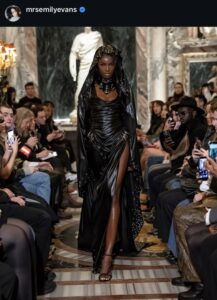
If London Fashion Week is usually a polite murmur of good taste and better PR, Di Petsa arrived like a soaked siren, dripping symbolism all over the runway and daring everyone to feel something. Preferably desire, but intimidation will also do.
For Fall 2026, Dimitra Petsa went back home for inspiration. Not geographically, but mythologically. To a past that’s always described vaguely enough to feel unquestionable. As with every myth worth recycling, Medusa’s story exists in multiple versions. The one currently having a cultural renaissance goes like this: Medusa, the only mortal of the three Gorgons, essentially the mermaids of their era, was raped by Poseidon in Athena’s temple. Since gods rarely face consequences, and Athena couldn’t exactly pick a fight with the sea’s favorite son, Medusa received a new hairstyle instead. Enter the snakes. Half a look could turn you to stone.
Some say Perseus killed her. Some insist her blood could either heal or destroy. Others believe Pegasus was born from her severed neck. What everyone seems to agree on is this: Medusa became so terrifying that she transformed into a symbol of protection. Fear weaponized and desire redirected. “She’s scary but she is this mother figure. I think there’s something just very interesting about her harnessing her female rage, I realized that perhaps I myself had been working with some self-imposed limitations or fears. I wanted to be more empowered in my own design and allow myself to experiment,” Petsa told Vogue.
Somewhere between all the mythology, the show made its point. It doubled as a very relaxed demonstration of how many different directions her made-to-measure work can take. Sheer draped gowns, skin-shredding fabrics, fitted bodices, high collars, and skin-baring menswear, all held tightly onto the brand’s familiar sensuality. Not that anyone needed reminding, those sculptural bottles of Ples’Jour lube placed on every seat did the job well before the guests did.
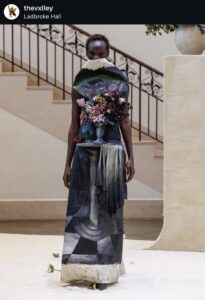
At London fashion week, sculpting is fashion’s not-so-distant cousin, and floristry is Daniel del Valle’s best friend, maybe baking too, if we’re being generous. Thevxlley’s debut (spelled cryptically for what is, ultimately, the valley), was the natural result. Very original, rooted, and could honestly double as an art exhibition. Whether it’s really wearable is still up to discussion (I’d happily do it, for the record).
The collection was named ‘The Narcissist’ and it was in no rush. The preparation was three years long, and it showed, in the best way possible. Daniel del Valle is a small town guy, a small town near Andalusia’s Seville kind of guy. At 19, he landed in London and survived the classic restaurant grind, until he floated into the florist world with Paul Thomas Flowers, a luxury staple where arranging blooms meets high-end London. At some point he worked with Michaela Stark, underwear that literally bends bodies, (which shows too), before going solo.
With the first note of the grand piano echoing, sitting in a corner of a delicate room at the Ladbroke Hall, what looked more like sculptures than garments started coming down the runway. The opening bodice could pass for armor, if armor wore ribbons and sculpted flowers, a tip of the hat to his grandmother, the one who handed him a needle as a kid. Then came bodices made entirely from little pots, mosaics with a vase here, an ashtray there. At some point, my eyes landed on what I swear were pain de mie, those very French loaves of bread with the impossibly soft crust. Not sure I nailed the category, but bread it was, a piece made in collaboration with his father, a baker back home, of course. This was exactly the moment I thought it couldn’t get any wilder, but boy, was I wrong.
What followed was a trio of silhouettes that could have been urns. The first was ceramic, in a blue-and-white floral pattern that instantly took me to a Greek island. The second was covered in snail shells, taking me from a tropical forest to a Parisian diner. The third took me back to the first. It was structured like a wooden crinoline with tiny vases nestling in its gaps, each blooming with its own flowers, some practically blue-and-white doppelgängers. Seven looks later, and a dress had its very own table. Guess what was on it…
Most of these pieces made me question whether they could survive off the model, but Del Valle cleared it with Vogue, “Ideally, I see the pieces in a gallery space or a museum. I know it’s a fashion collection, but I consider the pieces as sculptures, not garments. And when I designed them, I was also thinking how they would work as an object, not just as clothes.”
How Australians choose to enjoy their leisure time varies greatly depending on their attitude to life and where they might mix socially. Drinks parties aren’t for everyone, mixing and having to endure small talk to keep up appearances. For many, being able to relax in one’s own space is the perfect remedy to forget about life’s stresses, without going anywhere near an alcohol bottle.
Recreational smoking, having obtained quality products from a licensed shop, sometimes online, so that location is no barrier to the enjoyment, is something that is far less taboo than it was to previous generations. Specialist products, such as the quality Bongs Australia produces, are particularly popular among the smoking fraternity, for several sound reasons.
A bong is usually used to smoke cannabis. It consists of a vertical chamber partially filled with water, a bowl where the material is placed, and a stem that connects the bowl to the water chamber. When the material is ignited, and the user inhales through the mouthpiece, smoke is drawn down through the stem, bubbles through the water, and then rises into the main chamber before being inhaled. This cools the smoke and filters out some heavier particles, with the smoke losing some heat and sometimes depositing a portion of ash and residue in the liquid, with many smokers perceiving this as making the experience smoother compared to those who smoke using dry pipes. The cooling effect created by water filtration makes it a particularly popular device, as it feels less harsh on the throat compared to smoke drawn directly from a dry pipe or hand-rolled product, with the bubbling process reducing the immediate heat sensation, adding smoothness.
The partial trapping of heavier particles, such as ash, results in fewer solid particles reaching the mouth. Over time, residue builds up in the water, which reinforces the idea that some material has been filtered out, with bongs allowing smoke to accumulate in the chamber before inhalation. This can create a more concentrated inhalation compared to devices that produce smaller, continuous draws. Some users prefer this because it provides them with a stronger effect in a shorter time. However, it should be noted that stronger inhalations may also increase exposure to harmful substances in a shorter period.
The variety of materials and designs is seen as an attraction of a bong, such as glass, acrylic, and ceramic, with them coming in many different shapes and sizes. Some users enjoy the craftsmanship or aesthetic appeal of glass models, particularly those with intricate designs or added features like percolators. Some buyers see the appeal of a bong in its functionality as well as being a collectable, with design preferences playing a significant role in purchase decisions. Compared to disposable smoking products, bongs are reusable devices, meaning that once purchased, they can be maintained and cleaned repeatedly, making them a sound investment.
Bongs can make the smoking experience smoother and more enjoyable, while using a device that is also visually attractive, which adds to owning one.
Sculpture has a particular kind of presence that many other art forms don’t, occupying space, casting shadows and requesting attention from all angles. Here are six sculptors whose work will help nurture your appreciation for the artistic practice:
Born in Rome to Iraqi artists,Jaber carves in Carrara marble, the same material Michelangelo used, but with very different goals. His figures are distorted, fragmented and deliberately damaged. With the body being used as a metaphor for socio-political dynamics, Jaber’s work tells stories of violence and the fragility of the human form.
Personett earned her MFA in sculpture from the New York Academy of Art and studied stone carving through a residency in Carrara, Italy,before building her career as a portrait sculptor in Brooklyn. She now teaches at the Lyme Academy of Fine Arts. Her figurative work – frequently heads and carefully positioned figures – possesses real psychological density.
Trained at Grand Central Atelier in New York, Dufour has an impressive list of large-scale public commissions behind her, including portrait sculptures for the National Museum of African American History and Culture at the Smithsonian and a bust for UC Berkeley. Dufour has a particular gift for capturing raw human expression in three dimensions: forehead wrinkles, the specific tension around the eyes in a moment of grief or longing. Her goal is to achieve balance between “the physical and philosophical, form and concept” in her artwork.
A Hong Kong-based sculptor best known for his porcelain works, Tsang merges realist technique with a surrealist imagination, crafting human faces contorted into extreme expressions or bowls that appear to liquefy at their edges. He was a police officer for over a decade before leaving to work in ceramics full time, and has said that the darkness he encountered on the force left an indelible mark on his creative perspective.
Andrea Blasich @andreblasichsculpture For nearly thirty years, Blasich worked as a sculptor in the film industry,creating character maquettes for DreamWorks, Pixar, Disney and Sony, with credits including Brave and Spider-Man: Into the Spider-Verse. Born and trained in Milan, he credits classical masters like Michelangelo and Bernini as inspirations, and his personal sculptures carry that same attention to form and weight.
Conn is a figurative sculptor based in Oxfordshire, known for her bronze and bronze resin work, and was selected as the only UK sculptor for Sculpture by the Sea 2025 at Bondi Beach in Australia.She came to sculpture relatively late, discovering it after a period of significant personal difficulty, and went on to complete nearly a decade of academic art education including studies at Central Saint Martins.