After a long hiatus, the third season of HBO hit Euphoria is finally here, more than four years after the second installment concluded. The kids have grown up, but their lives are more chaotic than ever.
The new episodes received mixed reviews from critics and some fan backlash over a few shocking scenes. Could this mean this is the show’s final hurrah, or are more episodes arriving somewhere down the line? Here’s what we know so far.
Euphoria Season 4 Release Date
At the time of writing, HBO hasn’t made any official statements about Euphoria’s future. Given the huge break between seasons, however, as well as the fact that many of the actors in the cast have blown up in the meantime, more episodes seem unlikely.
A dark and provocative drama, Euphoria initially follows a group of high school students navigating addiction, trauma, identity, love, and self-destruction. At the centre of the action is Rue, a teenage drug addict fresh out of rehab. The show explores the lives of her peers, each dealing with their own set of problems.
The third season picks up after a time jump, with the characters navigating early adulthood. That said, things aren’t much better. Rue is now deeply entangled in drug trafficking, trying to repay a massive debt. Her life is dangerous, with stability nowhere within reach.
Elsewhere, Cassie and Nate are engaged, but their relationship is still toxic, with the latter trying to make it as an OnlyFans model. Lexi is a production assistant, Maddy a talent manager, and Jules has become a sugar baby in New York. The vibe is even darker, previewing a season that will push the characters to new extremes.
While there’s not a lot of hope for Euphoria season 4, the current installment still has seven episodes to go. You can catch them weekly on HBO Max.
Are There Other Shows Like Euphoria?
If you like Euphoria, shows with similar vibes include Elite, Skins, Riverdale, Girls, Sex Education, and Shameless.
Last summer, Waxahatchee covered This Is Lorelei’s ‘Where’s Your Love Now?’ during Brad Cook’s Newport Folk Fest aftershow, and it’s become a staple of her live show. Now, the long-awaited studio version of the cover has arrived as part of Box for Buddy, Box for Star (Super Deluxe), which arrives Friday and includes collaborations with MJ Lenderman, Snail Mail, and Power Snatch. Listen to the gorgeous rendition, which features backing from Nate Amos himself, below.
“I’m honored to be included in this re-record project as the album Box for Buddy, Box for Star has meant so much to me these last few years,” Katie Crutchfield said in a press release. “I think Nate is one of the best songwriters of this moment, making music that feels current and timeless and also somehow ahead of a curve. When I heard ‘Where’s Your Love Now?’ I thought it was one of the best songs I’ve ever heard. I am so happy to have covered it and happy to finally share it.”
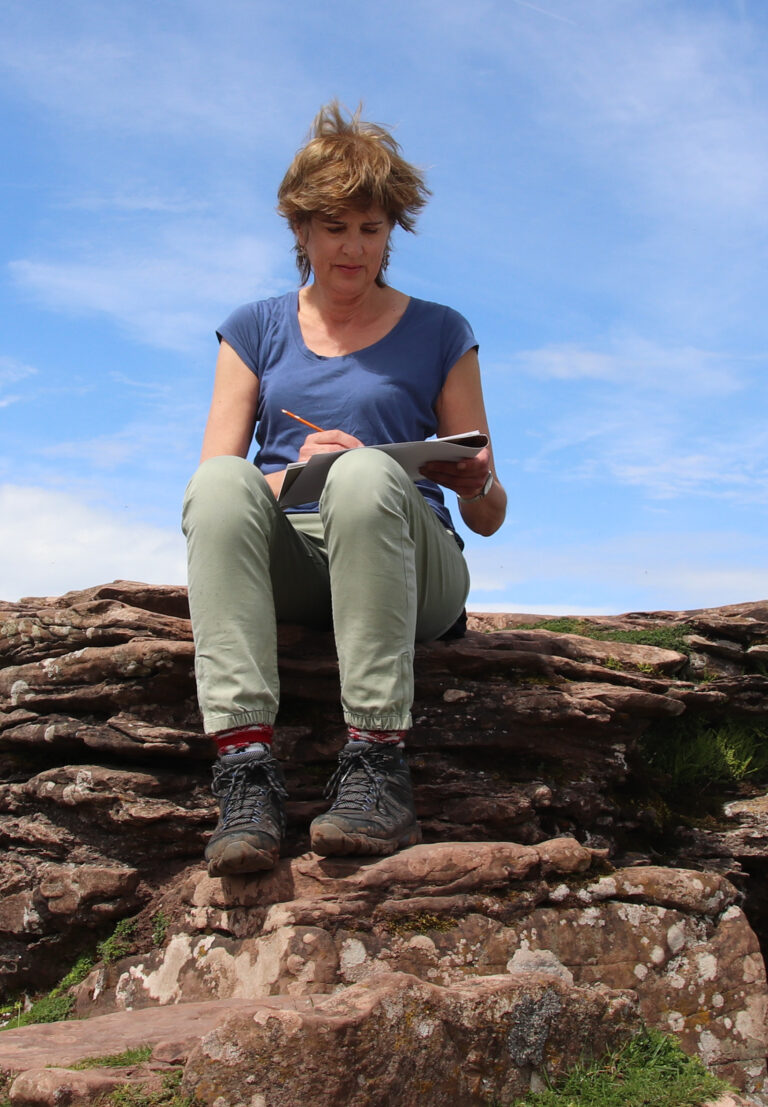
Emma Stibbon was born in 1962 in Münster, Germany. She studied for her Fine Art BA at Goldsmiths, University of London, and completed an MA in Research Fine Art at the University of the West of England, Bristol.
Stibbon’s research has led her to undertake residencies including Artist Placement in Antarctica, organised by the Scott Polar Research Institute; the Arctic Circle.org expedition to Svalbard in the High Arctic; Josef and Anni Albers Foundation, Connecticut; Artist in Residence at Hawai‘i Volcanoes National Park; Artist in Residence at Death Valley National Park and to document receding glaciers in Ecuador with Project Pressure. She was elected Royal Academician in 2013, while in 2018 she was awarded an Honorary Doctor of Letters from the University of Bristol. In 2019, she was awarded the Queen Sonja of Norway Print Award, Svalbard, High Arctic.
Stibbon’s first large-scale exhibition at a major UK institution opened at Towner, Eastbourne in 2024, later touring to The Burton at Bideford. It was exhibited at Cristea Roberts Gallery in October 2025. In this exhibition, the artist’s monumental watercolours, drawings and site-specific installations brought audiences to the frontlines of climate change, connecting vanishing polar ice and surging sea-levels with the alarming rate of erosion taking place on UK coastlines.
Her work is held in numerous private and public collections including the British Museum, London; National Museums Liverpool, Liverpool; Victoria and Albert Museum, London; Bristol City Museum and Art Gallery, Bristol; Pallant House Gallery, Chichester; the Fitzwilliam Museum, Cambridge; and Royal Academy of Arts, London.
Emma Stibbon lives and works in Bristol, England.
Your work sits somewhere between art, fieldwork and environmental record. When you look back, was there a point where those things came together into a clear sense of what you were doing?
I’m interested in landscapes undergoing transition and change and I almost always start my projects with walking and drawing out in the field. Being out in the elements and experiencing that physical, visceral feeling of being in a place is essential to my work back in the studio.
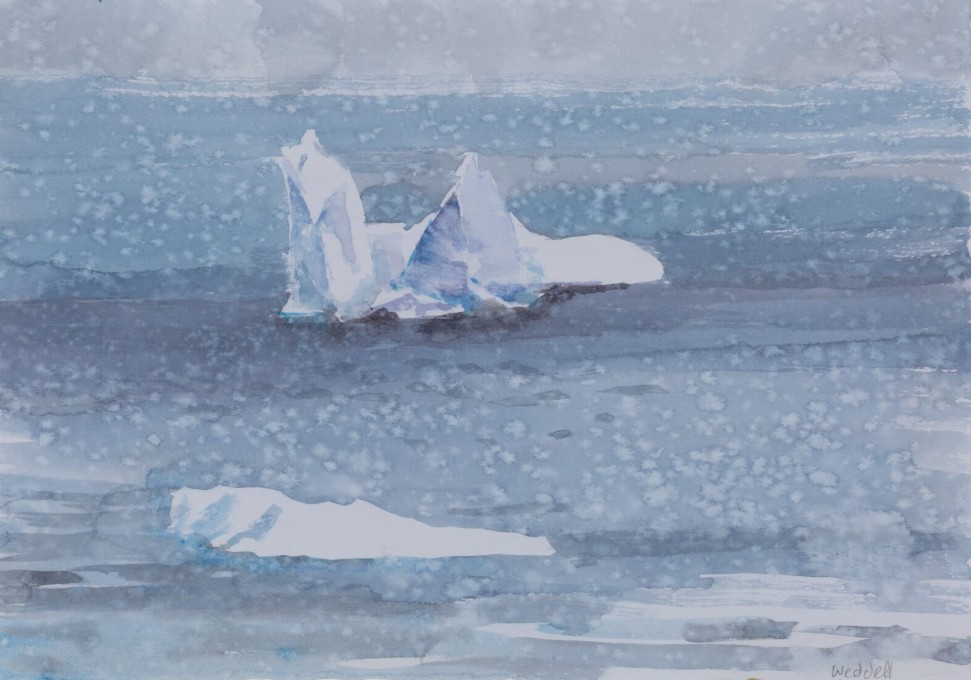
Rather than a single point I think my recognition of the sheer scale of environmental change has been incremental. We are living through a time of unprecedented change due to climate warming and many sites I have worked from are changing beyond recognition in my own lifetime – I can clearly see that. In particular, I’ve been preoccupied with glaciers and Polar ice for some time now, and visiting both the Arctic and Antarctica has been life changing. Witnessing the incredible beauty and wonder of ice sheets and glaciers is incredible but this of course is set against the knowledge of what is happening with climate warming. I feel a commitment to communicating that in my work.
Your work alongside geologists and scientists informs your art. What does each side of that exchange give the other, and has a scientific perspective ever pushed back on or changed what you thought you were seeing?
When I’m preparing for a project, I often seek out expertise from specialists who are looking at aspects of climate impact, usually in the earth sciences. It’s incredibly helpful to learn from their profound knowledge and gives me insight into the dynamic forces that drive change in the landscape so I can begin to identify features when I’m out in the field. For example, when I was looking at the impact of sea level rise on coastal retreat for my Melting Ice | Rising Tides project, I was assisted by geohazards Professor Dylan Rood from Imperial College London. Dylan has studied the rates of retreat at the field sites in Sussex and north Devon, where I wanted to site the work in response to the two exhibition tour venues, Towner Eastbourne and the Burton, Bideford. Dylan had carried out cosmic dating measurements a few years prior at both sites, so he had very clear data showing significant increase in cliff retreat over a very short timescale linked to rising sea levels and storm events. In geological terms this is remarkable and terrifying. I think we both realised that there was value in the dialogue around art and science – we had a lively gallery discussion during the London show at Cristea Roberts and Dylan contributed to a short film that I made alongside the show.
Melting Ice / Rising Tides makes an explicit link between vanishing polar ice and the accelerating erosion of UK coastlines. Was that connection something that arrived gradually through the fieldwork, or did it snap into focus at a particular moment?
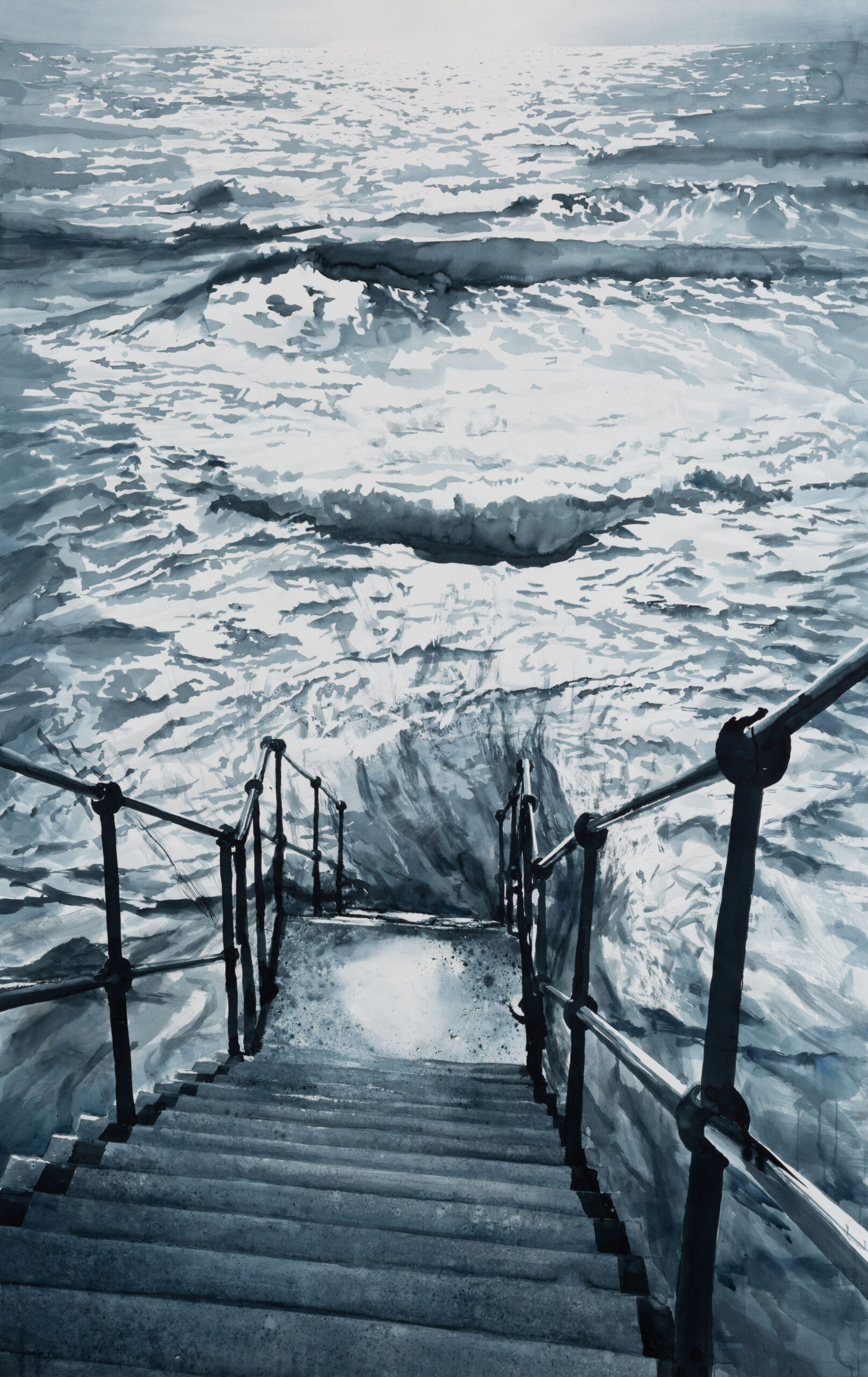
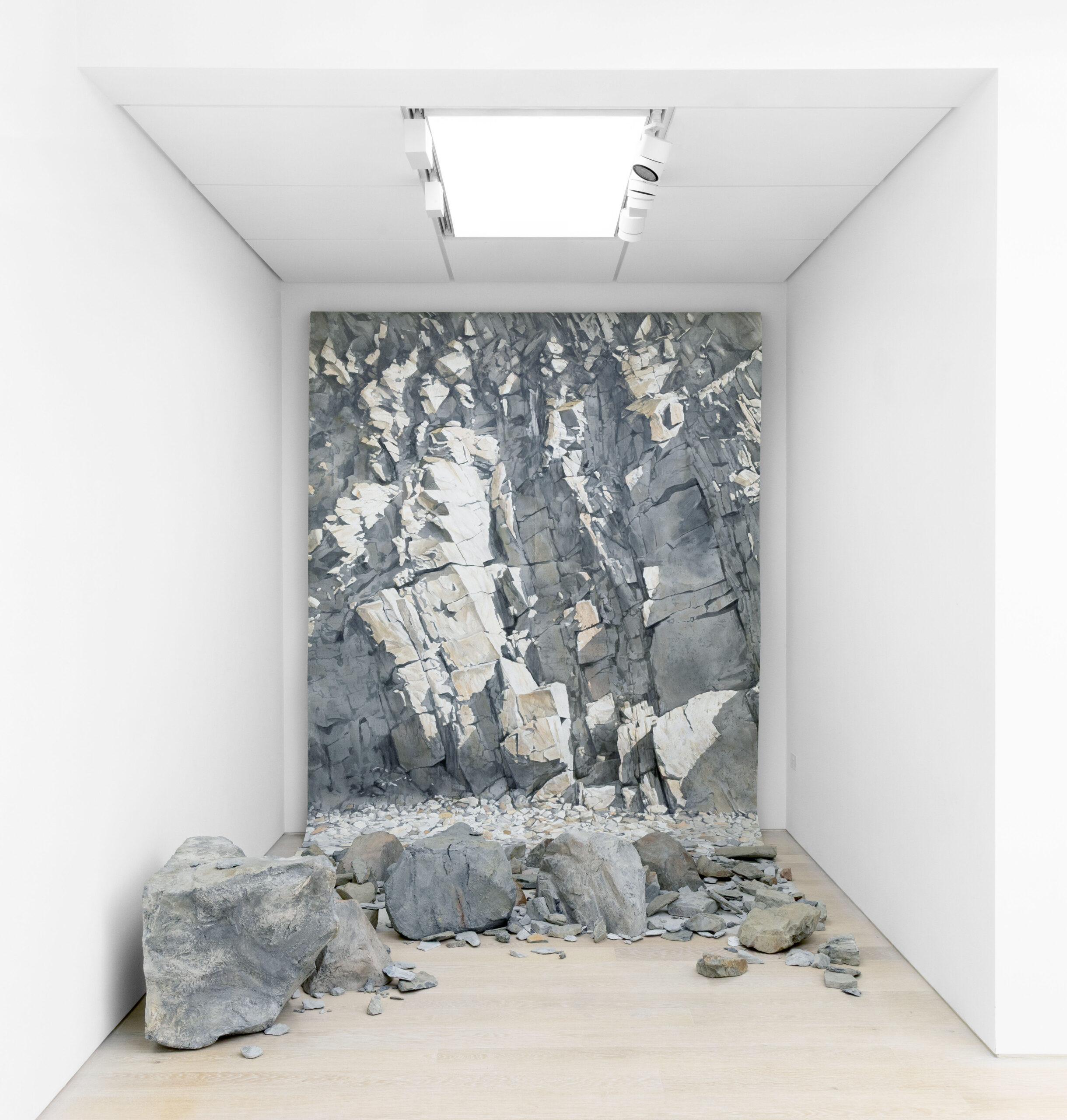
The invitation to show at Towner Eastbourne prompted me to think about the gallery’s situation adjacent to the Sussex coastline. These iconic chalk cliffs are undergoing rapid erosion accelerated by rising sea levels. I wanted to connect this very immediate location to the gallery with the seemingly remote events of polar ice sheet melt caused by global warming so that visitors could consider how interrelated our actions are on what is happening. Similarly when the exhibition toured to the Burton at Bideford, situated on the north Devon coastline, I made a large installation that represented a section of Bideford Bay. I think walking the sections of coastline and observing many of the cliff falls and erosion informed the work. There were several erosion events during my research period such as the closure of the Hope Gap steps that happened due to a storm surge that undermined the foundation of the steps.
Rock Fall, Bideford Bay, 2025 North Devon sourced pigments and rocks, paper and mixed media 320 x 270 x 270 cm Installation view of Rock Fall, Bideford Bay, 2025, in Emma Stibbon: Melting Ice | Rising Tides at Cristea Roberts Gallery, London, 2025. Courtesy Cristea Roberts Gallery, London. Photo: Sam Roberts.
In 2018 you retraced Turner’s Alpine route and drew the same mountain scenery he had recorded, finding that the glaciers dramatically diminished. What was it like to hold his image and your image of the same place in your mind simultaneously?
I have visited the Chamonix, Mont Blanc region several times now and it is salutary to see how quickly the glaciers there are retreating. In 2018 I contributed to a BBC Radio 3 programme In Search of the Sublime that traced Turner’s Alpine tour of 1802. You can see in his St Gothard and Mont Blanc Sketchbook a watercolour of the Glacier du Bois below the Mer de Glace. In Turner’s day the glacier reached down to the valley floor, now the Glacier du Bois has completely retreated. The artist’s representations of glaciers are now important records that document the extent of change, which was of course pre photography.
You describe your impulse to draw as a desire to ‘act as a witness.’ In environments where a camera could document everything in a fraction of a second, what does the slowness of drawing do that photography cannot?
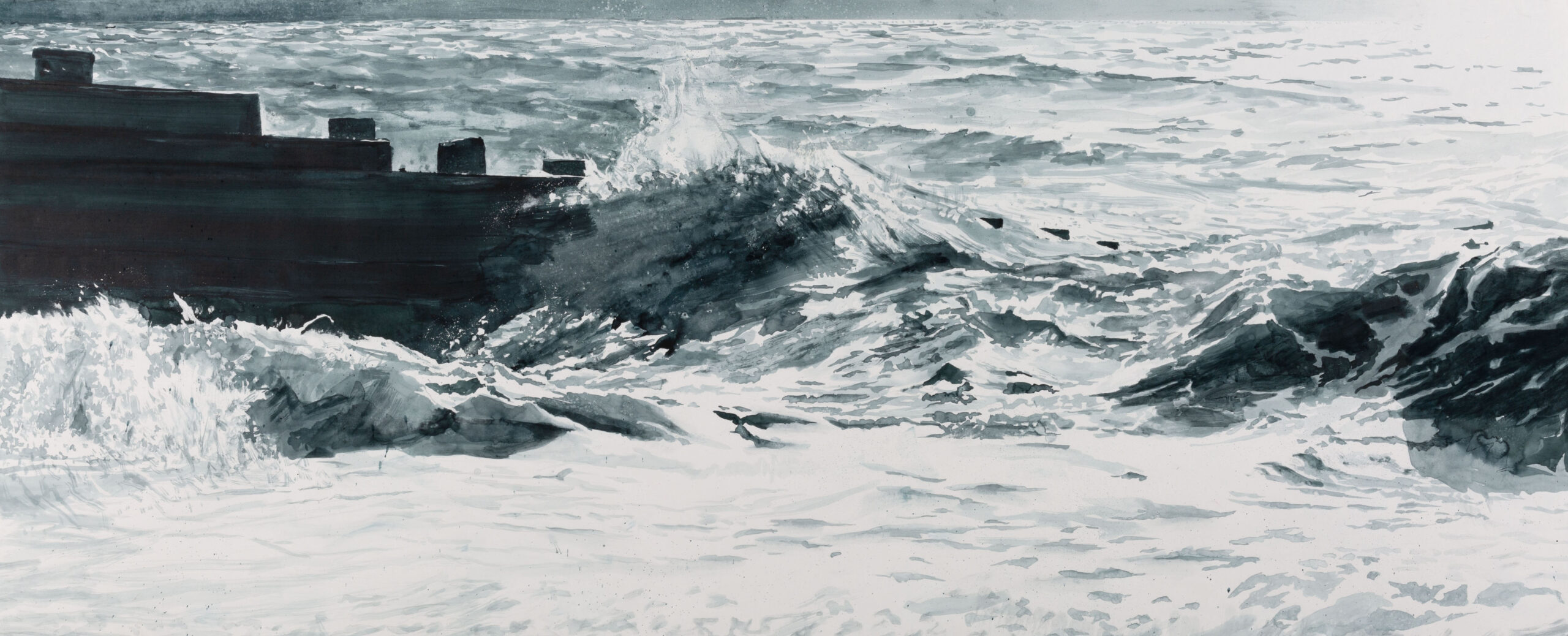
I’m increasingly aware that I am witnessing these events in my lifetime and I feel compelled to try to capture something of that in my sketchbook drawings. There is the immediate challenge of being out in the elements, that can imprint itself into the media with rain spots or even ice. The natural phenomena of constantly changing skies and mood of weather also adds urgency to getting it down on the page. I use my digital camera extensively but I find drawing makes me slow down my observation and scrutinise what I’m looking at. It is often an emotional, physical thing – the relationship between mark, process and idea are inextricably linked. Perhaps this is due to the temporality of making a drawing; when I draw I have enormous recall, unlike photography the act of drawing somehow imprints it on my memory.
Eastbourne, Sea Groyne 2023 Ink and sea salt on paper 102.5 × 249 cm
Is there a landscape you’ve visited that has stayed with you more than any other?
Yes, Antarctica.
How do you feel about the word “activist” in relation to your work?
I’m unsure whether I make “activist” work – primarily I am responding to the wonder and beauty of the planet. I think when you are confronted with a single piece of my work, you could read it as an iceberg, a toppling cliff or a breaking wave. But I am compelled to represent the changes I am witnessing and by juxtaposing these in the gallery I want to set up a narrative for the viewer to communicate the precarious state of ice sheets and glaciers across the globe and the profound effect the effects of warming is having on flooding and sea level rise. As an artist, I feel working from landscape is very relevant. We are living through a period of rapid change and with the many impacts of human induced climate warming, I am committed to communicating that.
A few months into the new year, is there any artwork you have found particularly inspiring lately?
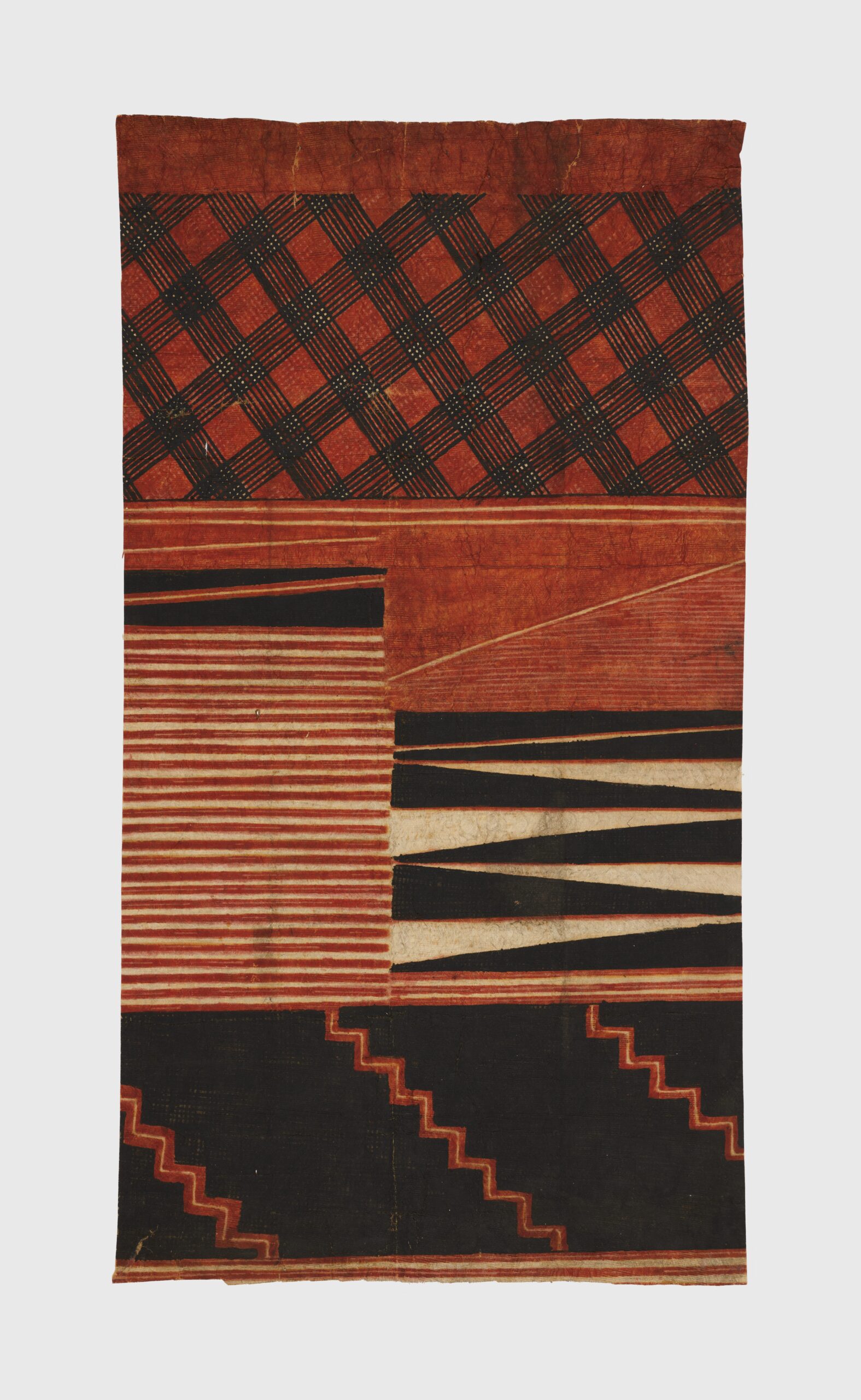
I recently visited the British Museum’s A Kingdom Crossing Oceans exhibition that had a beautiful Kapa made from mulberry bark on display – this is a ceremonial loin-cloth decorated with natural sienna pigment. When I was an artist in residence on Big Island, Hawai’i in 2016 I learnt about Animism, a Hawaiian spirit-based faith where all material phenomena have agency, not only humans, but animals, plants and rocks – even shadows can embody a presence. I like the idea that the substance of a place holds its memory in its physical entity. That experience of being in a landscape where volcanic, elemental forces are at work is chastening, it’s a salutary reminder of our ever-changing environment. Despite our devastating impact on the planet we are fairly powerless in the face of nature. We should take notice.
Emma Stibbon’s work Hope Gap is currently on show in Cromer, as a large reproduced outdoor installation. On view from Spring 2026, it is displayed as part of the Towner 2026 Bigger Picture. The artist’s work is also currently displayed in the group show Sublime Landscapes. For more, listen to Emma Stibbon’s BBC Radio 3 Sunday Feature, In Search of the Sublime, here.
Zendaya fans, be ready to part ways for a little while. The actress is apparently carving out a little time away from it all once 2026 wraps up. But don’t you worry, five new movies will keep you busy this year, and reruns are always on the table if you need them. A24’s ‘The Drama’ from April 3, ‘Euphoria’ Season 3 from April 12, Christopher Nolan’s ‘The Odyssey’ on July 17, ‘Spider-Man: Brand New Day’ on July 31 and ‘Dune: Part Three on December 18. Not much breathing room, especially if you top it all off with co-designing a collection.
On, the Swiss company that makes sneakers you might only forgive for athletes, plus the almost obligatory sportswear, has had the duo under its sleeve for quite some time now. Zendaya signed on as a brand ambassador back in 2024, and of course, Law Roach comes as part of the package. A couple of creative short films and shoe drops later, the sportswear brand makes a push into fashion, and it’s not the first one to do so. Good thing the team has grown.
A Spike Jonze short film revealed a 7-piece collection. A midi skirt that could possibly behave like a mini, at least from one side, a two-tone windbreaker and coach’s jacket, parachute pants for the chilly days and bermuda shorts for the warmer ones, a tank top to go with, and of course, a new take on On’s Cloudnova, the Cloudnova Moon. Available in four shades, and I can’t imagine choosing one. But then again, I’m not who it’s made for. For a brand built purely on performance, that skirt is an experiment, and the duo ensures it’s seen.
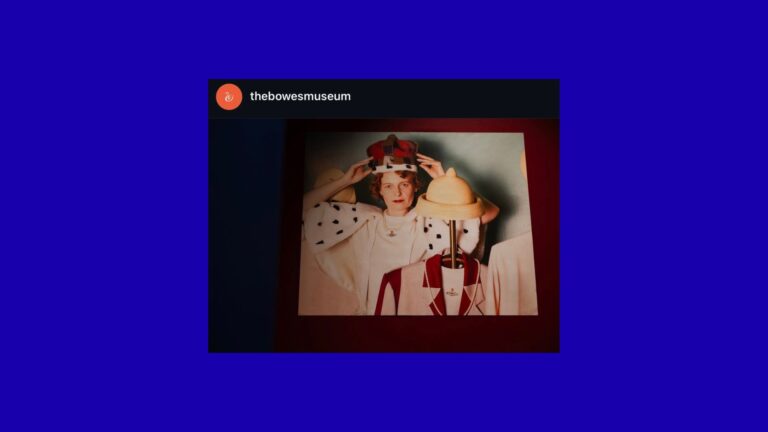
Who speaks for Vivienne Westwood today? The brand, the halls of museums, or the obsessive few with enough material to out-archive the above? At the Bowes Museum, it’s all in plain sight. Really. Peter Smithson and a few notoriously secretive collectors just let nearly 40 ensembles, solo garments, shoes, accessories, and editorial ephemera decorate the museum’s Fashion and Textiles gallery. With curator Rachel Whitworth lending a firm hand, the handover now goes by the name of ‘Vivienne Westwood: Rebel – Storyteller – Visionary,’ and it’ll hold onto it until September 6.
Rebel for the politics and punk culture, storyteller for the narratives corsetry and tartan carried, and visionary because decades later, we’re still glued to them. The retrospective, though, focuses on the early 1980s to 2000s, following her early partnership with Malcolm McLaren and into the era where a pirate jacket still had the power to challenge what fashion could be. Not that Bowes is new to this, Westwood herself has walked these galleries before. By now, they sure know how to host her work.
Remember when Westwood showed the English upper class a fun time with the ‘Harris Tweed’ A/W 1987 collection? That crown you think of, that comfortably rested on top of her head while pedaling around the city, was one of Smithson’s first buys. You can see the rest for yourself. Crinolines (first introduced in Spring 1986), tailoring, checks, and one too many corsets.
In 1988, Westwood appeared on Wogan, interviewed by Sue Lawley as models, including Sara Stockbridge, walked out in her designs and the audience laughed along. Ten-year-old Smithson wasn’t in on the joke. The realization came a few years later in Manchester, when a man walked out of a store in a tartan suit and bondage trousers, completely at ease. Once the red canopy and yellow lettering came into focus, it was obvious. “At that moment, I looked at her and thought, it’s Westwood. She’s the one I’ve been admiring all along,” he tells The Guardian. Bet that wouldn’t get a laugh today.
The Rock & Roll Hall of Fame has announced its class of 2026. Oasis, Phil Collins, Wu-Tang Clan, Joy Division/New Order, Sade, Iron Maiden, Billy Idol, and Luther Vandross are this year’s inductees. The induction ceremony will take place on November 14 in Los Angeles.
The Hall of Fame announced the nominated acts back in February. Jeff Buckley, Lauryn Hill, INXS, Melissa Etheridge, Pink, and Shakira are among those who didn’t make the cut. With the exception of Wu-Tang Clan and Luther Vandross, every other inductee had been nominated for induction before. Phil Collins is already in the Hall of Fame as a member of Genesis.
The Rock Hall’s Early Influence Award will be handed out to MC Lyte and Queen Latifah, Celia Cruz, Fela Kuti, and Gram Parsons. The recipients of the Musical Excellence Award are producers Rick Rubin, Arif Mardin, and Jimmy Miller, and Philly soul songwriter Linda Creed. The Ahmet Ertegun Award, which goes to behind-the-scenes figures, is going to the late Ed Sullivan.
Artificial Intelligence (AI) continues to redefine the digital landscape with tools that have caused a shift in content creation. One specific area where this technology is predominant is the digital marketplace. Nowadays, e-commerce stores, social media shops, and online brands leveragetools to improveproduct images with AI.
Whether it is for boosting sales or simply enhancing publication materials, these AI-powered apps transform how creators and businesses approach visual content. That said, for those who want smarter ways to elevate their visuals, here are five amazing tools to improve product images with AI.
Top Five Tools to Improve Product Images with AI
1. Simfa
Image Credit: Simfa
Simfa is a well-rounded option for those who want to enhance product images efficiently. At the forefront, it features a product enhancer that integrates cutting-edge AI systems to produce high-quality product photos. In particular, this includes a wide variety of backgrounds and graphic elements. Simfa also has a background remover tool. It allows users to place their products instantly in a different scenario. Aside from these product image enhancers, Simfa also has a description creator that generates SEO-optimized product descriptions. This set of creative tools streamlines and enhances product-related tasks, highlighting how Simfa offers beyond just visual improvements.
2. Pebblely
Image Credit: Pebblely
Boring images can negatively affect a brand’s credibility. Pebblely focuses on solving that problem by using AI to transform product images into market-ready assets. This option also specializes in creating various backgrounds for products. Users can leverage this either by inputting prompts or accessing the app’s library of more than 100 templates. With its automated adjustment of shadows and reflections, creators are sure to get product images that are suitable for all channels, marketplaces, and platforms.
3. Flair.ai
Image Credit: Flair.ai
Flair.ai positions itself as an AI-driven content creation platform for creating branded visuals. Supporting various asset categories like beauty, consumer packaged goods, jewelry, fashion models, furniture, technology, handbags, and food, this tool delivers content for every business need. More specifically, it is ideal for generating product images, short AI-generated videos, and custom AI models. Flair.ai even provides a suite of editing tools for further photo enhancements.
4. Photoroom
Image Credit: Photoroom
Another multi-purpose AI tool for product images is Photoroom. Its features include but are not limited to product staging, virtual model, ghost mannequin, flat lay, and product beautifier. Photoroom can be used for creating product listings, scaling catalogues and ads, achieving multichannel image optimization, and increasing brand visibility. In the same way, it caters to various types of product photography, such as food, skincare, jewelry, clothing, furniture, and more. Automation is also one of Photoroom’s strengths, as it features batch editing, bulk resizing, and marketplace API.
5. Claid.ai
Image Credit: Claid.ai
Claid.ai delivers realistic product and fashion photos. Using trained AI, it is capable of enhancing art, e-commerce imagery, faces, and texture. Its collection of tools includes an image expander, color changer, background remover, and various AI asset generators. Aside from automatically adjusting lights and shadows, it accurately preserves product details for the best possible results. Moreover, Claid.ai is often used for creating high-converting product visuals for multiple purposes.
Why Use Tools to Improve Product Images with AI
AI tools for improving product images not only offer convenience but are also game-changers. Traditional workflows for accomplishing such tasks take hours, require expensive software, and demand technical expertise. Subsequently, these creative tools that integrate smart technology eliminate those barriers.
Here are a few reasons why it is worth switching to AI tools:
High-quality results in an easier workflow
Preserves product details
Consistency in product images
Broader visual variations without additional shoots
Meets industry standards
This streamlining enables creators to focus on growing the business rather than being stuck in time-consuming tasks.
Selecting Tools to Improve Product Images with AI
With these AI-driven toolkits, enhancing product images is now more accessible for everyone. However, choosing the best one can be tough. The choice can depend on the creative needs, such as consistency, efficiency, and variation. For this reason, choosing the best tools to improve product images with AI requires users to prioritize the option that blends all the essentials.
Among the apps on the list, Simfa stands out as the all-in-one solution that can complement every workflow. It also helps create stunning visuals that drive engagement and sales. More importantly, Simfa produces eye-catching product images that help every creator gain a competitive edge.
Wondering what all the available Pokémon in Pokémon Champions are? Season 1 of Pokémon Champions has officially kicked off, and we’re starting to see what the game actually has to offer, especially when it comes to the creatures you can take into battle. In a nutshell, Pokémon Champions is a strategy game where you build a team of six and take it into 3v3 or 4v4 matches against other players using classic mechanics like types, abilities, and moves.
There’s no traditional story or exploration here, and you simply need to outthink your opponent until one side is left standing by the moves you make each turn and the Pokémon you bring into battle. Because you’re picking your team (and Pokémon) before every match, the roster ends up mattering quite a bit. So to help you get a better sense of your options, here are all the Pokémon currently available in Pokémon Champions.
Pokémon Champions: All the Pokémon You Can Use Right Now
As you’d expect from a battle-centric Pokémon game, Pokémon Champions pulls in Pokémon from across generations that you can recruit, train, and use in team-based PvP matches.
At launch, Pokémon Champions features a roster of 187 Pokémon, along with 56 Mega Evolutions that can change how teams are built and played. Here is every Pokémon in Pokémon Champions, including regional forms, ordered by their National Pokédex number:
All Available Pokémon in Pokémon Champions
#
Name
Type
0003
Venusaur
Grass/Poison
0006
Charizard
Fire/Flying
0009
Blastoise
Water
0015
Beedrill
Bug/Poison
0018
Pidgeot
Normal/Flying
0024
Arbok
Poison
0025
Pikachu
Electric
0026
Raichu
Electric
0026
Alolan Raichu
Electric/Psychic
0036
Clefable
Fairy
0038
Ninetales
Fire
0038
Alolan Ninetales
Ice/Fairy
0059
Arcanine
Fire
0059
Hisuian Arcanine
Fire/Rock
0065
Alakazam
Psychic
0068
Machamp
Fighting
0071
Victreebel
Grass/Poison
0080
Slowbro
Water/Psychic
0080
Galarian Slowbro
Poison/Psychic
0094
Gengar
Ghost/Poison
0115
Kangaskhan
Normal
0121
Starmie
Water/Psychic
0127
Pinsir
Bug
0128
Tauros
Normal
0128
Paldean Tauros
Fighting
0128
Paldean Tauros
Fighting/Fire
0128
Paldean Tauros
Fighting/Water
0130
Gyarados
Water/Flying
0132
Ditto
Normal
0134
Vaporeon
Water
0135
Jolteon
Electric
0136
Flareon
Fire
0142
Aerodactyl
Rock/Flying
0143
Snorlax
Normal
0149
Dragonite
Dragon/Flying
0154
Meganium
Grass
0157
Typhlosion
Fire
0157
Hisuian Typhlosion
Fire/Ghost
0160
Feraligatr
Water
0168
Ariados
Bug/Poison
0181
Ampharos
Electric
0184
Azumarill
Water/Fairy
0186
Politoed
Water
0196
Espeon
Psychic
0197
Umbreon
Dark
0199
Slowking
Water/Psychic
0199
Galarian Slowking
Psychic/Poison
0205
Forretress
Bug/Steel
0208
Steelix
Steel/Ground
0212
Scizor
Bug/Steel
0214
Heracross
Bug/Fighting
0227
Skarmory
Steel/Flying
0229
Houndoom
Dark/Fire
0248
Tyranitar
Rock/Dark
0279
Pelipper
Water/Flying
0282
Gardevoir
Psychic/Fairy
0302
Sableye
Dark/Ghost
0306
Aggron
Steel/Rock
0308
Medicham
Fighting/Psychic
0310
Manectric
Electric
0319
Sharpedo
Water/Dark
0323
Camerupt
Fire/Ground
0324
Torkoal
Fire
0334
Altaria
Dragon/Flying
0350
Milotic
Water
0351
Castform
Normal
0354
Banette
Ghost
0358
Chimecho
Psychic
0359
Absol
Dark
0362
Glalie
Ice
0389
Torterra
Grass/Ground
0392
Infernape
Fire/Fighting
0395
Empoleon
Water/Steel
0405
Luxray
Electric
0407
Roserade
Grass/Poison
0409
Rampardos
Rock
0411
Bastiodon
Rock/Steel
0428
Lopunny
Normal
0442
Spiritomb
Ghost/Dark
0445
Garchomp
Dragon/Ground
0448
Lucario
Fighting/Steel
0450
Hippowdon
Ground
0454
Toxicroak
Poison/Fighting
0460
Abomasnow
Grass/Ice
0461
Weavile
Dark/Ice
0464
Rhyperior
Ground/Rock
0470
Leafeon
Grass
0471
Glaceon
Ice
0472
Gliscor
Ground/Flying
0473
Mamoswine
Ice/Ground
0475
Gallade
Psychic/Fighting
0478
Froslass
Ice/Ghost
0479
Rotom
Electric/Ghost
0497
Serperior
Grass
0500
Emboar
Fire/Fighting
0503
Samurott
Water
0503
Hisuian Samurott
Water/Dark
0505
Watchog
Normal
0510
Liepard
Dark
0512
Simisage
Grass
0514
Simisear
Fire
0516
Simipour
Water
0530
Excadrill
Ground/Steel
0531
Audino
Normal
0534
Conkeldurr
Fighting
0547
Whimsicott
Grass/Fairy
0553
Krookodile
Ground/Dark
0563
Cofagrigus
Ghost
0569
Garbodor
Poison
0571
Zoroark
Dark
0571
Hisuian Zoroark
Normal/Ghost
0579
Reuniclus
Psychic
0584
Vanilluxe
Ice
0587
Emolga
Electric/Flying
0609
Chandelure
Ghost/Fire
0614
Beartic
Ice
0618
Stunfisk
Ground/Electric
0618
Galarian Stunfisk
Ground/Steel
0623
Golurk
Ground/Ghost
0635
Hydreigon
Dark/Dragon
0637
Volcarona
Bug/Fire
0652
Chesnaught
Grass/Fighting
0655
Delphox
Fire/Psychic
0658
Greninja
Water/Dark
0660
Diggersby
Normal/Ground
0663
Talonflame
Fire/Flying
0666
Vivillon
Bug/Flying
0671
Florges
Fairy
0675
Pangoro
Fighting/Dark
0676
Furfrou
Normal
0678
Meowstic
Psychic
0681
Aegislash
Steel/Ghost
0683
Aromatisse
Fairy
0685
Slurpuff
Fairy
0693
Clawitzer
Water
0695
Heliolisk
Electric/Normal
0697
Tyrantrum
Rock/Dragon
0699
Aurorus
Rock/Ice
0700
Sylveon
Fairy
0701
Hawlucha
Fighting/Flying
0702
Dedenne
Electric/Fairy
0706
Goodra
Dragon
0707
Klefki
Steel/Fairy
0709
Trevenant
Ghost/Grass
0711
Gourgeist
Ghost/Grass
0713
Avalugg
Ice
0713
Hisuian Avalugg
Ice/Rock
0715
Noivern
Flying/Dragon
0724
Decidueye
Grass/Ghost
0724
Hisuian Decidueye
Grass/Fighting
0727
Incineroar
Fire/Dark
0730
Primarina
Water/Fairy
0733
Toucannon
Normal/Flying
0740
Crabominable
Fighting/Ice
0745
Lycanroc
Rock
0748
Toxapex
Poison/Water
0750
Mudsdale
Ground
0752
Araquanid
Water/Bug
0758
Salazzle
Poison/Fire
0763
Tsareena
Grass
0765
Oranguru
Normal/Psychic
0766
Passimian
Fighting
0778
Mimikyu
Ghost/Fairy
0780
Drampa
Normal/Dragon
0784
Kommo-o
Dragon/Fighting
0823
Corviknight
Flying/Steel
0841
Flapple
Grass/Dragon
0842
Appletun
Grass/Dragon
0844
Sandaconda
Ground
0855
Polteageist
Ghost
0858
Hatterene
Psychic/Fairy
0866
Mr. Rime
Ice/Psychic
0867
Runerigus
Ground/Ghost
0869
Alcremie
Fairy
0877
Morpeko
Electric/Dark
0887
Dragapult
Dragon/Ghost
0899
Wyrdeer
Normal/Psychic
0900
Kleavor
Bug/Rock
0902
Basculegion
Water/Ghost
0903
Sneasler
Fighting/Poison
0908
Meowscarada
Grass/Dark
0911
Skeledirge
Fire/Ghost
0914
Quaquaval
Water/Fighting
0925
Maushold
Normal
0934
Garganacl
Rock
0936
Armarouge
Fire/Psychic
0937
Ceruledge
Fire/Ghost
0939
Bellibolt
Electric
0952
Scovillain
Grass/Fire
0956
Espathra
Psychic
0959
Tinkaton
Fairy/Steel
0964
Palafin
Water
0968
Orthworm
Steel
0970
Glimmora
Rock/Poison
0981
Farigiraf
Normal/Psychic
0983
Kingambit
Dark/Steel
1013
Sinistcha
Grass/Ghost
1018
Archaludon
Steel/Dragon
1019
Hydrapple
Grass/Dragon
Apart from all the base Pokémon listed above, Pokémon Champions also includes Mega Evolutions, but these are treated as alternate battle forms rather than separate entries, so they don’t appear in the main table. So, here’s a complete list of all Mega Evolutions currently available in the game:
All Mega Evolutions in Pokémon Champions
Pokémon
Type
Mega Venusaur
Grass/Poison
Mega Charizard X
Fire/Dragon
Mega Charizard Y
Fire/Flying
Mega Blastoise
Water
Mega Beedrill
Bug/Poison
Mega Pidgeot
Normal/Flying
Mega Clefable
Fairy/Flying
Mega Alakazam
Psychic
Mega Victreebel
Grass/Poison
Mega Slowbro
Water/Psychic
Mega Gengar
Ghost/Poison
Mega Kangaskhan
Normal
Mega Starmie
Water/Psychic
Mega Pinsir
Bug/Flying
Mega Gyarados
Water/Dark
Mega Aerodactyl
Rock/Flying
Mega Dragonite
Dragon/Flying
Mega Meganium
Grass/Fairy
Mega Feraligatr
Water/Dragon
Mega Ampharos
Electric/Dragon
Mega Steelix
Steel/Ground
Mega Scizor
Bug/Steel
Mega Heracross
Bug/Fighting
Mega Skarmory
Steel/Flying
Mega Houndoom
Dark/Fire
Mega Tyranitar
Rock/Dark
Mega Gardevoir
Psychic/Fairy
Mega Sableye
Dark/Ghost
Mega Aggron
Steel
Mega Medicham
Fighting/Psychic
Mega Manectric
Electric
Mega Sharpedo
Water/Dark
Mega Camerupt
Fire/Ground
Mega Altaria
Dragon/Fairy
Mega Banette
Ghost
Mega Chimecho
Psychic/Steel
Mega Absol
Dark
Mega Glalie
Ice
Mega Lopunny
Normal/Fighting
Mega Garchomp
Dragon/Ground
Mega Lucario
Fighting/Steel
Mega Abomasnow
Grass/Ice
Mega Gallade
Psychic/Fighting
Mega Froslass
Ice/Ghost
Mega Emboar
Fire/Fighting
Mega Excadrill
Ground/Steel
Mega Audino
Normal/Fairy
Mega Chandelure
Ghost/Fire
Mega Golurk
Ground/Ghost
Mega Chesnaught
Grass/Fighting
Mega Delphox
Fire/Psychic
Mega Greninja
Water/Dark
Mega Floette
Fairy
Mega Meowstic
Psychic
Mega Hawlucha
Fighting/Flying
Mega Crabominable
Fighting/Ice
Mega Drampa
Normal/Dragon
Mega Scovillain
Grass/Fire
Mega Glimmora
Rock/Poison
And that’s about all the Pokémon currently available in Pokémon Champions. For more gaming news and guides, be sure to check out our gaming page!
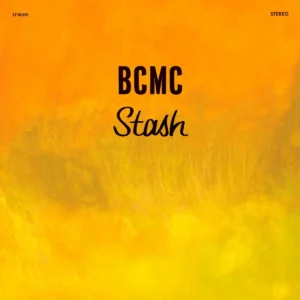
Bill MacKay and Cooper Crain are prepping their sophomore album as BCMC. Stash, the follow-up to 2023’s Foreign Smokes, is slated to arrive on June 26 via Drag City. Lead single ‘Kaleidosmoke’ is a bleary yet enticingly chromatic psychedelic excursion that takes hints from Floyd, Deep Purple, and Iron Butterfly. Check it out below.
Stash was tracked onto 8-track tape by Crain and Greg Norman at Electrical Audio and Sweat Loge Studio. It was then mixed at Sweat Loge Studio by Crain and MacKay to 2-track tape.
Canada’s Truck Violence have announced their sophomore album and first for their new label home, The Flenser. The weathervane is my body, the follow-up to Violence, is due for release on June 26 (via Mothland in Canada). Listening to the harrowing lead single ‘New Jesus’, the band’s signing to The Flenser, also home to Chat Pile – almost too obvious a comparison, given their shared roots in noise rock and post-hardcore – makes complete sense. Check it out below.
“‘New Jesus’ is a rant about the blatant fascistic slide occurring both to the south of our border and on screen,” Truck Violence’s Karsyn Henderson explained in a statement. “It is loosely about the ABC—Trump settlement and the post-January 6th election fraud cases. The lack of any broader moral compulsions beyond centralizing power on the political right has led to a culture of post-truth, where there is no reward in accuracy unless it leads to an augmenting of one’s political capital, which it rarely does. This is as destructive in politics as it is in art. There is surprising apathy among young people in regards to this slide, who believe the acquisition of power and the subsequent lording over that occurs, is merely nature, essentially; what will happen, will happen. With these lines of thinking, you find more people sympathetic to this mode, if it is both natural and inevitable, why not acclimate and reap the rewards. Why not join the fascist grift, degenerate art through tiktok, etc…”
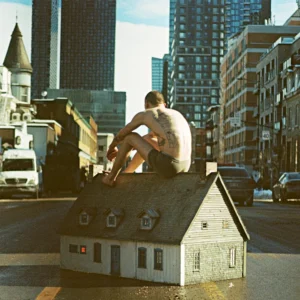
The band shot the new album’s cover on film on Avenue du Parc in Montréal. Henderson expounded on the themes behind the LP:
The body is as capricious as ever, felt everywhere and in everyone to varying degrees. It is young and reaching for consolation that cannot be found. Shriek some more, says this record, but do so together. Shriek your honesty just as your fellow does unto you. The weathervane moves to every whim of the world, a world of people, things and actions. There is no guiding principle that would calm the mind, and yet it is our duty to cobble something together, an abode and a bed, a long table and an open room swept by many feet.
It is how we know beauty, because we are inadequate enough to suffer. Every attempt is a failure, but in the failure there is proof. In the awkward moaning and imperfect jangling of strings, we fail and so we create beauty. This record is a uniquely human composition, one which yells in many forms. What surrounds it and speaks more than it is the perfect, reverent silence.
The weathervane is my body Cover Artwork:
The weathervane is my body Tracklist:
1. My dog would fuck the air
2. Jaundiced and reaching for a mother
3. Compelled by Christy
4. House caught fire
5. New Jesus
6. Your name, It’s walking
7. Stomach as a tower and the globules descending
8. Gerard, be quiet
9. Kindly, wash yourself