Home Blog Page 59

King Princess Covers Geese’s ‘Au Pays Du Cocaine’ for BBC Radio 1

King Princess delivered a rendition of Geese’s ‘Au Pays Du Cocaine’ during her appearance on BBC Radio 1 yesterday (January 27), calling it “such a lesbian anthem.” Watch it below.

She added of her song pick: “‘You can change and still choose me’? I don’t know. Ask some of your lesbian friends what that means. It’s just such a beautiful song. It really represents what it’s like to be in love right now, like a song about two people wanting freedom and wanting to be individuals and yet are actively choosing to stay together and that feels super present but also extremely queer.”

Geese made their SNL debut last weekend, performing ‘Au Pays Du Cocaine’ as well as ‘Trinidad’.

From the sacred to the streets: the art of Pareshkumar Kakadiya

0

The sacred has always been a part of art history, taking us back to before the Renaissance and potentially to the Ice Age, with the Lion-man of Hohlenstein-Stadel sculpture, which may have been one of the earliest references to greater powers and deities. 

While in Western art history, this often takes the form of the Gods of Ancient Rome and Greece, followed by representations of Christianity, the art of Pareshkumar Kakadiya offers a different perspective we don’t often see in the UK – that of the spiritual side of Hinduism. 

When we see a swan, we think of the myth of Leda and the Swan, Zeus’ seduction of the Spartan Queen, depicted by many Renaissance artists, including Leonardo da Vinci and Michelangelo. However, in Kakadiya’s hands, he paints the Hindu mother goddess, Brahmani Maa, floating on a swan, blessing those below her with her divine light. Much as we might see in a 15th- or 16th-century depiction of the Virgin. While we can see similarities with Western art, the narrative is completely different. A narrative many UK audiences won’t be familiar with. 

The artist also demonstrates technical skill in painting in relief, as seen in his depiction of Radha and Krishna, the great love story at the centre of Hinduism. 

Radha and Krishna. Copyright Pareshkumar Kakadiya

Beyond the spiritual, I’m also drawn to his scenes of India painted on murals and wood. Whether that be capturing the hubbub of Mumbai with an auto-rickshaw speeding between market stalls, or children engaging in an impromptu game of street cricket. Both are part of the authentic experience of visiting India, and should be on the list of any visitor to witness. Just as LS Lowry captured people walking to work in factories under grey skies, Kakadiya captures the dynamism and vibrancy of India.

His portraits capture the emotions of his sitters, whether through paintings or drawings. The coloured pencil drawings of spiritual leaders have a strong smokiness, similar to the sfumato effect made famous by Leonardo, and they also reminded me of the work of British artist Curtis Holder and the recognition that pencil artists are now receiving after being sidelined for decades. 

He’s equally skilled at capturing a likeness in oil painting, and a sepia-toned self-portrait of his younger self shows a faraway look in his eyes, as if he’s daydreaming or recalling a moment from his past. 

There’s no shortage of ambition in Kakadiya’s practice, and he’s always up for a challenge, as demonstrated by his awards across different mediums, and a world record for the largest bubble wrap painting. 

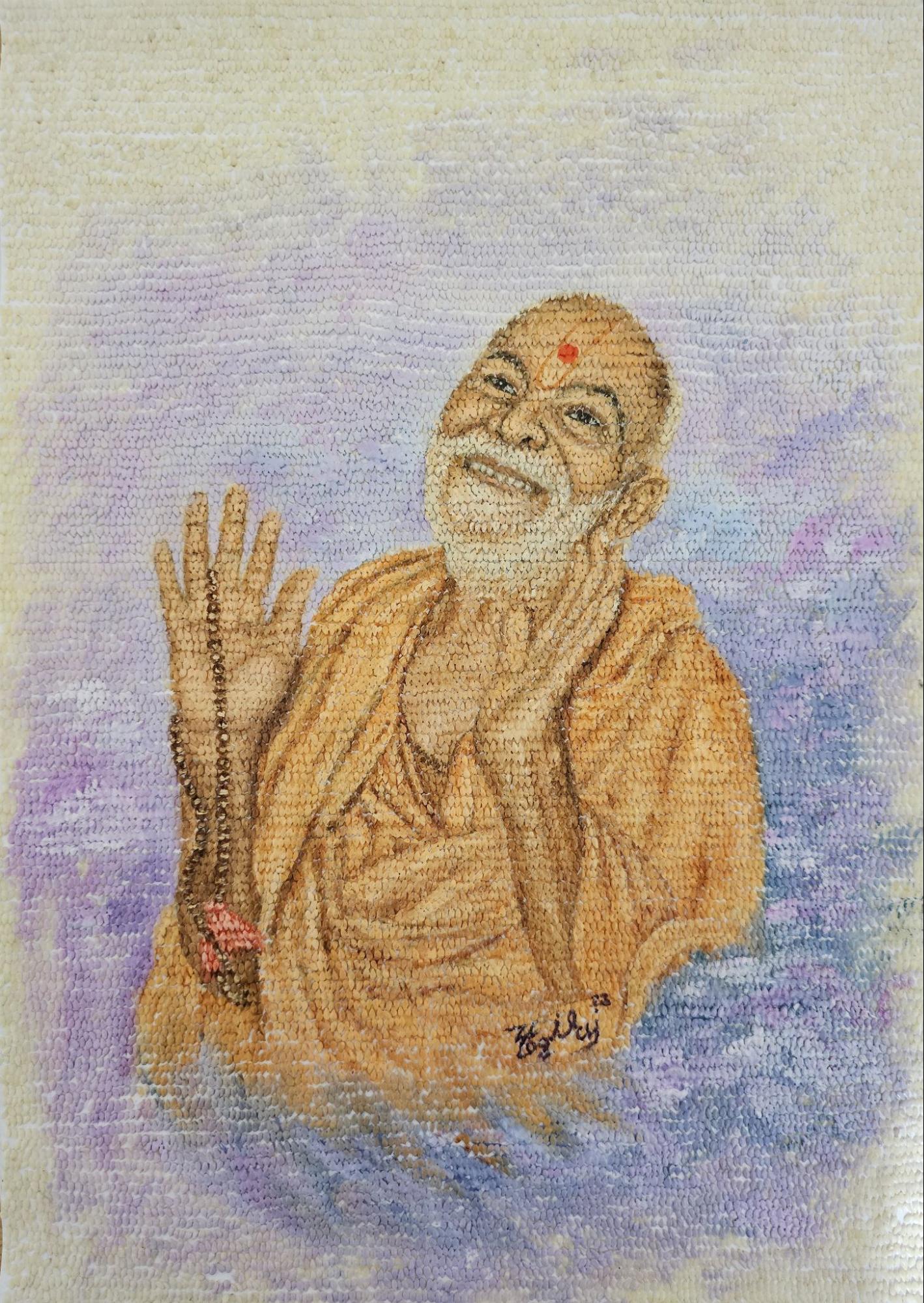
The sesame seed portrait of Yogiji Maharaj. Copyright Pareshkumar Kakadiya

His ambition is evident in his portrait of Yogiji Maharaj, in which individual sesame seeds were painstakingly affixed to the surface to create a richly textured work. It makes you want to run your fingers across the surface, the way we feel when we look at the impasto painting of the likes of Vincent Van Gogh or Frank Auerbach. The sesame seeds also hold significance in Hinduism, symbolising immortality, purification, and ancestral connection. Displayed at the BAPS Shri Swaminarayan Mandir in Neasden, North London, it demonstrated both his commitments to creating unique artworks and imbuing them with spiritual reverence.

His strength lies in drawing on his Indian heritage and painting in both historical and contemporary styles. It allows him to incorporate Western techniques while remaining true to the spiritual and personal roots that tether him to his home country and to develop as an artist in the UK. 

More information on Paresh Kakadiya may be found on his website and Instagram.

Why Canada is the New Frontier for International Gaming Operators

0

International gaming companies are increasingly opting for Canada for simple reasons. Here, the rules are set by the provinces, not by a single center. This makes it clear how to enter the market and what is required for this. Ontario showed how it works when it launched a regulated online system in 2022. Foreign companies were able to apply openly, without complicated schemes. This reduced risks and helped to better plan work.

Canada also has a good internet connection, and almost everyone has a smartphone. This is important for online platforms, because people easily access sites from their phones. Companies often study the market not at random. They read open data and see what users write. To do this, they use gaming platforms such as Spinbara, where you can read guides and news without playing or spending money.

Key factors driving expansion

Canada is a convenient place for business. Everything here works according to clear rules. They don’t change suddenly. Each province is responsible for its own decisions. This makes it easy for companies to think ahead and plan what to do next.

Look at Alberta. When the authorities there clearly said how to work with sports betting and what reports need to be submitted, business immediately picked up. Companies understood the rules, entered the market and began to work legally. Without confusion and unnecessary problems. That is why other regions often look to Alberta and take its approach as a basis.

The same story is with online casinos in Alberta. From the very beginning, it was said directly: you can work, but the rules must be followed. Everything is honest and clear. The state controls the process, and people have access to services. This is very important for companies, because they know what to expect and can calmly make plans.

Canadians are already used to online payments and digital services. Over 27 million people play various games. The state, together with colleges, even trains future specialists for this industry. This shows that the development of this direction is taken seriously and for the long term.

Why international operators are moving into Canada

Canada has become visible to international gaming companies because it is clear here how demand is moving into the permitted framework. Ontario was the first to show this. When the province opened a regulated iGaming market in 2022, people quickly started using it. Activity increased, and the system was able to track everything according to the rules.

What exactly attracts companies to Canada:

  • Clear rules. The provinces openly explain what is allowed and how the system works.
  • The example of Ontario. The regulated market has shown that licenses and control can work without chaos.
  • The growth of sports betting. After the change in the law, people received more permitted options.
  • Games with live dealers. They work only according to technical requirements and under supervision.
  • Real control. Regulators fine companies if they break the rules.

Canada is interesting not because of order. There is demand here, but it is directed in a permitted direction. It gives companies an understanding of how to work today and plan for the future.

Future Trends in the Industry

Technology continues to shape the development of gaming in Canada. Companies are testing virtual and augmented reality to understand how access to games and their format are changing. Interest in these solutions is growing, so many are starting with small tests.

Mobile phones remain the main way to play. Most users choose smartphones, so developers are focusing on simple designs, fast startup, and stable operation. As mobile networks develop, this trend will continue.

Esports is also gradually growing. In Canada, local tournaments and competitions are held that gather spectators and support from sponsors not related to gambling.

Particular attention is paid to the environment. Companies are reviewing energy consumption and server operations to reduce costs.

Rules also change, and provinces update them regularly. Those who follow these changes can more easily adapt to new conditions.

New technologies These tools allow companies to test new types of interaction, such as immersive game spaces and different ways users move through platforms
Mobile gaming Mobile-first development influences how games are built, with shorter sessions, clearer navigation, and features designed for one-hand use
Esports growth Esports creates opportunities outside traditional gaming revenue, such as media rights, merchandise, and event partnerships
Environmental focus Efficient infrastructure helps companies lower long-term operating costs and meet investor expectations related to sustainability

Canada draws international platforms because the system is easy to understand. Responsibilities are divided, and the requirements are defined. Provincial oversight allows room to adapt. The experience of Ontario and Alberta proves that regulation can work in a reliable way.

Why Regulation Is Becoming a Core Part of Healthcare Workplace Culture

If you work in healthcare, you’ve probably noticed the not-so-subtle change in recent years. Conversations that once centered only on productivity, staffing gaps, or patient throughput now leave space for accountability, documentation, ethics, and data stewardship (if you haven’t noticed… well, it’s safe to say you’re working in the wrong place).

That change hasn’t happened because your superiors had a change of heart and decided to treat everyone better. It also hasn’t happened by pure happenstance. Regulation—often blamed for friction and paperwork—is what is helping reshape healthcare workplace culture in ways that are healthier, more transparent, and more sustainable.

This may sound counterintuitive. Regulation doesn’t exactly scream inspiration. But in practice, it has nudged healthcare organizations toward clearer expectations, safer decision-making, and cultures where trust actually has room to grow.

Regulation as Culture, Not Just Compliance

For a long time, regulation lived in a separate mental box. Legal teams handled it and leadership worried about audits. Everyone else tried not to trip over it. That model no longer holds up.

Today, regulation shapes nearly everything in a workplace, from how teams communicate to how they escalate concerns and handle patient data, as well as how they assess risk. Done well, it’s a shared operating system that makes everyone work and feel better.

You see it in how incident reporting gets normalized instead of punished. You hear it when leadership speaks plainly about mistakes instead of burying them. And you also feel it when policies actually align with how work happens on the floor.

And that’s culture.

Accountability Builds Trust

All healthcare professionals operate in stressful, often high-stakes environments. So trust between colleagues and leadership (as well as patients) is essential; it’s what keeps systems from breaking under pressure. Regulation reinforces that trust when leaders treat accountability as a collective responsibility rather than a disciplinary threat.

Organizations that embrace regulatory expectations tend to clarify roles and decision rights earlier. That clarity is important. According to a report from The Joint Commission, communication failures are a leading contributor to sentinel events. Strong compliance frameworks force organizations to confront those gaps head-on, not after harm occurs.

So yes, regulation introduces oversight. But it also reduces ambiguity. And ambiguity is where burnout and moral injury love to hide.

Leadership Sets the Tone (Always)

Culture follows leadership behavior, not mission statements. When leaders frame compliance as “legal stuff,” teams respond with minimal effort and quiet workarounds. When leaders treat it as a foundation for patient safety and ethical care, people lean in.

You see the difference in how issues get reported. In psychologically safe environments, often reinforced by clear regulatory processes, staff report concerns earlier and more often. That aligns with what AHRQ has found repeatedly: organizations with strong safety cultures experience fewer adverse events over time, even when reporting initially increases.

Data Responsibility Is a Cultural Skill Now

Healthcare runs on data. Patient records, device data, AI-supported diagnostics, workforce analytics, it’s all connected. Regulation has forced organizations to take data responsibility seriously, not just from a security standpoint, but from an ethical one.

HIPAA compliance may be table stakes, but expectations now stretch further. Patients expect transparency. Staff expect guardrails. And regulators expect governance that keeps pace with innovation.

This is why healthcare compliance and regulatory support is less about reacting to rules and more about designing systems that allow innovation without cutting corners. In practice, this kind of work often requires outside support that’s deeply familiar with healthcare operations;. Axiom is a good example of such support: not as abstract legal advisors, but as partners who understand how healthcare actually operates (and how fragile trust can be when systems fail).

Risk Awareness Without Fear

Risk-aware cultures don’t freeze. They adapt. Regulation, when embedded properly, helps teams identify risk earlier and respond faster without panic. That’s a cultural advantage.

Instead of treating audits as threats, resilient organizations use them as diagnostics. Instead of hiding near-misses, they analyze patterns. And instead of assuming “we’ve always done it this way,” they ask whether legacy processes still meet ethical and regulatory expectations.

That mindset matters as healthcare faces staffing shortages, digital transformation, and increased public scrutiny.

Why This Change Isn’t Reversible

Healthcare culture won’t return to a pre-regulatory mindset. Patients demand accountability. Employees expect ethical leadership. Regulators respond to real harm with real consequences. According to IBM’s 2023 Cost of a Data Breach Report, healthcare remains the most expensive industry for breaches, averaging over $10 million. That’s per one incident. Numbers like that don’t just affect balance sheets; they affect everything and, as a result, reshape internal priorities.

So regulation becomes part of how teams train, collaborate, and innovate. Not because they love rules. Because the cost of ignoring them, both culturally and operationally, is too high.


A. G. Cook Shares Charli XCX-Starring Video for New Single ‘Residue’

A. G. Cook created the score for Charli XCX‘s BRAT mockumentary The Moment, which just premiered at Sundance Film Festival. (It currently holds a 53 on Metacritic.) He’s been rolling out singles from the soundtrack, and today he’s shared ‘Residue’, which comes with a video from director Aidan Zamiri featuring Charli and fellow cast member Kylie Jenner. Check it out below.

Miss Grit Announces New Album ‘Under My Umbrella’, Shares New Single ‘Stranger’

Miss Grit has announced a new album, Under My Umbrella, arriving April 24 via Mute. The follow-up to 2023’s Follow the Cyborg is led by the ethereal new single ‘Stranger’, which was co-produced with their their longtime engineer, Aron Kobayashi Ritch of Momma. Check it out and find the LP’s cover art and tracklist below.

Under My Umbrella includes the previously unveiled track ‘Tourist Mind’. It took shape after Margaret Sohn returned from an intense touring schedule, working on it mostly in their Queens apartment. “I tried not to edit too much or force a moment to happen,” they explained. “It feels truer to myself, and more of a representation of what is actually coming out of me.”

Collaborators on the record include Sae Heum Han (mmph), bassist Margaux Bouchegnies (Margaux), singer Eva Liu (Mui Zyu), producer Luciano Rossi (Mui Zyu), drummer Preston Fulks (Momma), and violinist Zachary Mezzo (Catcher). “Usually collaboration is a little bit hard for me – there has to be a deeper connection there,” Sohn said. “But really trusting the people I was working with to put their fingerprint on the music, and them also being close friends, was liberating.”

Revisit our Artist Spotlight interview with Miss Grit.

Under My Umbrella Cover Artwork:

Miss Grit_Under My Umbrella_1080.

Under My Umbrella Tracklist:

1. Tourist Mind
2. Mind Disaster
3. Won’t Count On You
4. It Feels Like
5. Where Is My Head
6. Stranger
7. You Will Change
8. Overflow
9. Waste Me

Pluribus Season 2: Cast, Rumours & Release Date

0

Apple TV+ original series Pluribus had the entire internet in a chokehold for a hot minute. The show, coming from the same creator behind Breaking Bad, premiered in late 2025 and was met with acclaim from critics and viewers alike.

The fact that Pluribus relied on weekly releases worked in its favour, keeping it in the collective conversation for longer. For a couple of months, it was the “it show” everyone wanted to chat about. But with season 1 in the rearview mirror, do we have a follow-up to look forward to?

Pluribus Season 2 Release Date

Let’s get the good news out of the way first: Pluribus season 2 is definitely happening. Unfortunately, it seems like fans will have to wait a while to tune in.

According to creator Vince Gilligan, the next episodes are in the works, but there’s no definite timeline for when they’ll hit streaming. “We’re working on it. It takes us a while. I would love to go faster if I could,” he said.

Without much else to rely on, it’s hard to estimate when the second season will arrive. While we’re keeping our fingers crossed for a late 2026 premiere, 2027 looks more likely.

Pluribus Cast

  • Rhea Seehorn as Carol Sturka
  • Karolina Wydra as Zosia
  • Carlos-Manuel Vesga as Manousos Oviedo
  • Miriam Shor as Helen L. Umstead
  • Samba Schutte as Koumba Diabaté
  • Menik Gooneratne as Laxmi
  • Darinka Arones as Kusimayu

What Could Happen in Pluribus Season 2?

If you haven’t seen Pluribus yet, we recommend going into the show completely blind for maximum enjoyment. Light spoilers follow, so consider yourself warned.

The science-fiction drama imagines a world radically transformed by an alien-origin virus. It triggers a global outbreak that turns nearly all of humanity into a hive mind called the “Others.” While the Others are seemingly benevolent, they absorb individual will and replace it with a collective consciousness.

At the centre of the story is Carol, one of only a handful of people who are immune to the Joining and retain their individuality. As the Others spread, she refuses to give up her autonomy. By the end of the first season, she even procures a weapon that might help her hold on to what makes her unique, though using it would come with huge downsides.

Pluribus season 2 will likely continue to follow Carol’s journey. With a powerful weapon at her disposal, there are many moral dilemmas to contemplate. Additionally, the Others will keep pushing for her to give in. It will be interesting to what strategies they might employ to sway her.

Are There Other Shows Like Pluribus?

Given the concept of the series, it’s tricky to find something that scratches the same itch. Thankfully, not impossible. If you’re into intriguing sci-fi concepts, we recommend checking out Black Mirror, Severance, Fringe, Orphan Black, and Westworld.

Three Mural Artists Transforming City Walls

Modern muralism emerged from New York City’s graffiti boom of the 1960s and 70s, though its roots as a powerful political communication tool stretch back to 1920s Mexico. What began as underground street art, often unsanctioned and rebellious, has gradually transformed into something cities around the world actively celebrate and commission. Once confined to abandoned buildings, murals now proudly dominate skylines from Berlin to Buenos Aires and are recognised as vital contributions to the urban landscape. Today, Our Culture highlights three mural artists whose large-scale works are certainly worth your attention.

Patrícia Mariano

Portuguese fine arts painter and muralist Patrícia Mariano took an unconventional path to her practice. With a background in architecture and journalism, she’s a self-taught artist who didn’t discover her true calling until age 30, when she realised her dream was to have her own studio and paint full-time. Working in what she calls “imagined realism,” Mariano creates intriguing murals that blend surrealist style with metaphorical imagery, often centering portraits of women. Her striking mural “Calypso,” created for Galeria de Arte Urbana’s Festival MURO 2025, has been nominated for Best Mural in the World by Street Art Cities.


View this post on Instagram


A post shared by Patrícia Mariano (@apatmariano)

Fintan Magee

Sydney-based muralist Fintan Magee creates large-scale social realist paintings that tackle themes of migration, the environmental crisis and inequality. Born in 1985 to an architect mother and sculptor father, Magee was exposed early to the political murals of his father’s native Northern Ireland. This influence shaped his belief in the power of public art to communicate viewpoints and unite communities. His figurative work, which carries a surprising softness influenced by children’s books and the Low Brow art movement, now appears on walls across the globe from London to Buenos Aires to Kyiv.


View this post on Instagram


A post shared by Fintan Magee (@fintan_magee)

INTI

Taking his name from the Incan sun god, Chilean artist INTI creates murals that feel like fever dreams of South American culture. His work frequently blends Chilean symbolism into strange, dizzying characters rendered in bright colours and executed with meticulous technical control. Active since 1996, INTI uses street art to express political statements, celebrating Latin culture while acknowledging Chile’s turbulent recent past. His massive murals now appear across continents, from his native Valparaíso to Belgium, India and beyond. Aside from murals, INTI has recently been exploring bronze sculpture.


View this post on Instagram


A post shared by INTI (@inti.artist)


Hijack Season 3: Cast, Rumours & Release Date

0

Apple TV+ thriller Hijack is back with season 2, following Idris Elba’s character in another tense situation. One could argue that having a business negotiator caught in a high-stakes scenario is unlikely to happen twice. While that’s valid, it doesn’t make the series any less enjoyable.

In fact, Hijack is just as entertaining as ever. Plus, if you tune in for one episode, we can almost guarantee you’ll be seated for all. Before long, you’ll also ask yourself whether a third installment might be possible. Here’s what we know so far.

Hijack Season 3 Release Date

At the time of writing, there’s no news about a potential Hijack season 3. That doesn’t mean it’s not happening. The second season premiered in mid-January, so an announcement could come somewhere down the line.

When asked about the show’s future, creator Jim Field Smith didn’t provide any information about what’s to come, but seemed open to the idea.

“Could Sam Nelson find himself having another of the worst days of his life? I’m sure he could. He seems to be a guy that stumbles into bad luck, and I love working with Idris, and whether it was more of this show or something else, I’m sure the collaboration will lead to more,” he said.

As long as the stars align, a third installment could arrive in late 2027 or early 2028.

Hijack Cast

  • Idris Elba as Sam Nelson
  • Christine Adams as Marsha Smith-Nelson
  • Max Beesley as DI Daniel O’Farrel
  • Archie Panjabi as DCI Zahra Gahfoor
  • Clare-Hope Ashitey as Olivia Thatcher
  • Jasmine Bayes as Mei Tan
  • Albrecht Schuch as Freddie
  • Christian Näthe as Otto Weber

What Could Happen in Hijack Season 3?

Hijack revolves around Sam Nelson, a corporate business negotiator who becomes embroiled in hostage crises. Each season unfolds over the course of a tense journey, where Sam must use his skills to protect innocent lives. It delivers action, drama, and mounting pressure, as the events basically unravel in real time.

Season 1 takes place aboard an airplane during a seven-hour journey from Dubai to London. Shortly after takeoff, a group of armed hijackers threaten the passengers and crew to seize control of the aircraft. Nelson, one of the passengers, is thrust into the role of de-facto negotiator. Since a follow-up is currently airing, it’s safe to say he survives the ordeal.

The second season shifts the setting to the Berlin underground transit system. Once again, a crisis unfolds, and Nelson is at the centre of the action. We won’t spoil anything, especially as only two episodes are out so far, but there’s a twist that will make you question everyone’s motives.

If Hijack season 3 becomes reality, we’re guessing it will follow Nelson in another dangerous situation. Until then, the second season rolls out weekly, with the finale scheduled for early March.

Are There Other Shows Like Hijack?

If you like Hijack, you’re probably into thrillers that keep you on the edge of the seat. We recommend checking out 24, Lost, Yellowjackets, The Night Manager, His & Hers, and Run Away.

Hytale: How to Get Cindercloth Scraps for Adamantite Gear

0

As you start moving into higher-tier crafting in Hytale, Cindercloth Scraps begin to matter pretty quickly. Cindercloth Scraps are a type of crafting material in Hytale used for higher-tier gear and upgrades, including adamantite weapons and armour, along with a few progression-related upgrades. However, Cindercloth Scraps don’t come from regular enemies or early biomes; instead dropping from a specific type of enemy found in volcanic environments that aren’t accessible from the starting zones. So before you spend too much time farming the wrong areas, here’s how to get Cindercloth Scraps in Hytale.

Hytale: How to Get Cindercloth Scraps for Adamantite Gear

Cindercloth Scraps drop from fire-based skeletal enemies like Incandescent Skeleton Fighters, which wield black bones and flaming swords, and Incandescent Skeleton Mages found in volcanic regions of the map. To get Cindercloth Scraps in Hytale, you’ll need to travel to volcanic biomes, where these enemies spawn. The most reliable place to farm Cindercloth Scraps is the Devastated Lands and you can reach this area by travelling far north through snowy and tundra areas, or by heading south through desert regions.

Once you’re there, simply start killing Incandescent Skeleton Fighters, as these are the ones that drop Cindercloth Scraps. They tend to spawn in groups and combat can get messy fast. That said, you can kill them easily with thorium or cobalt gear and use a shield to deal with groups without taking too much damage.

You’ll need several Cindercloth Scraps for crafting various Adamantite gear, so it’s worth stocking up on food and repair kits before you head out. Additionally, you can find Cindercloth Scraps early in the underground areas of the starting zone. If you haven’t been to this area yet, work your way through deep underground caves or follow natural chasms downward until you start seeing embers in the air, volcanic rock, and large pools of lava. The regular skeletons down here are replaced by incandescent variants, which drop Cindercloth Scraps instead of linen.

For more gaming news and guides, be sure to check out our gaming page!