Every year, the shows come and go, London, Paris, Milan, and every year, the rest of us spend the following months watching those looks trickle down into our everyday lives. It’s a process that used to take years. Now, it takes weeks. The gap between high-end runway and high-street rail has never been smaller, and party season is where that shift feels most electric.
How Catwalk Trends Actually Reach Us
The runway has always functioned as a mood board for the masses. Designers set the tone; everyone else interprets it. What once filtered down slowly, through magazine editorials, then department store buyers, then the rest of us, now moves at a pace driven by social media and fast trend cycles.
Streetwear is a perfect example. What started as a subcultural expression, rooted in skate culture, music, and urban identity, eventually landed on some of the most prestigious runways in the world. From there, it became a wardrobe staple: oversized silhouettes, graphic tees, chunky trainers. You’ve probably worn some version of it without thinking twice.
Boho chic followed a similar path. Flowing fabrics, earthy tones, and layered textures moved from festival fields to fashion weeks and back again. Minimalism did the opposite, born from a design philosophy that rejected excess, it became one of the most commercially successful aesthetics of the last decade. Clean lines, neutral palettes, nothing superfluous. Both have had their catwalk moments, and both have shaped what we reach for every morning.
What This Season’s Shows Are Telling Us
Party season tends to be where trends get their most dramatic outing. And this year, there’s a clear story being told: it’s about contrast. Dressed-up meets casual. Polished meets relaxed.
Pointed toe heels are having a serious moment. They’ve been creeping back into runway collections for a couple of seasons now, and they’ve fully landed. Long, sleek, slightly retro, they instantly sharpen any outfit and do something a block heel simply can’t. Pair them with tailored trousers or a slip skirt, and you’ve got the evening sorted.
Here’s the interesting twist, though: jeans are coming with them. Denim at a party used to feel like a compromise. Not anymore. The catwalks have been sending out dark-wash, straight-leg and wide-leg styles styled with satin tops, embellished jackets, and, yes, those pointed toe heels. It’s the kind of outfit that looks effortless but clearly isn’t, which is precisely the point.
The Styles to Know This Party Season
Elevated minimalism is a strong thread running through this season. Think monochrome dressing, clean silhouettes, and fabric that does the heavy lifting. One quality piece, a well-cut blazer, a fluid column dress, rather than lots of competing elements.
Boho with an edge is also making its way into after-dark dressing. Velvet, fringing, and rich jewel tones give the aesthetic a moodier, more party-ready feel than its summer counterpart. Layer up, stack your jewellery, and lean into texture.
Streetwear-informed glamour sits at the other end of the spectrum but is just as relevant. Oversized silhouettes styled against sleek accessories, pointed toe heels included, create that deliberate contrast that feels very now. Relaxed on top, sharp at the bottom.
The Real Takeaway
What the catwalk gives us is permission. Permission to wear jeans to a party. To swap the stiletto for something more architectural. To mix genres, references, and decades without it looking like a mistake.
The best party season outfits aren’t the ones that follow trends to the letter, they’re the ones that understand what’s in the air and make it their own. Pointed toe heels and jeans? Absolutely. A velvet blazer with wide-leg trousers? Yes. Minimalist dressing with one bold accessory? Even better.
The runway starts the conversation. Your wardrobe finishes it.
Australian players have plenty of options these days, and most of them blur together after a while. Mafia Casino stands out with a proposition that’s easy to read: AUD banking, pokies from proven providers, live tables, and a welcome bonus of 100% up to $500 plus 50 free spins. Ten-plus payment methods on the banking side, including POLi and Bitcoin. The game catalogue covers slots, table games, live dealers, and video poker. What follows is what’s actually there.
Bonuses and Promotions at Mafia Casino Australia
The welcome offer at Mafia Casino Australia is a 100% deposit match up to $500, with 50 free spins on selected pokies. Wagering requirements apply, and the eligible games are specified in the terms. Readable as these things go.
The ongoing promotions calendar has some substance to it:
Weekly Reload Bonus: 50% match on deposits up to $250 every week;
Cashback Mondays: 15% back on losses from the previous week;
Friday Free Spins: up to 30 spins on selected titles with a qualifying deposit;
Loyalty Points: earned on every wager, redeemable for cash or rewards;
VIP Program: tiered perks covering priority withdrawals and a personal account manager;
Refer a Friend: $50 credited per successful referral.
The cashback and reload combination is the part worth paying attention to for regular players. One covers the losses, the other tops up the deposits. Not a bad arrangement for players who log in at this online casino Australia regularly.
Games at Mafia Casino
Mafia Online Casino runs a catalogue across four main categories. For any Australian online casino player who came for the pokies, there’s plenty, but the table and live sections are worth a look too.
Pokies
Classic 3-reel machines, 5-reel video pokies, bonus rounds, free spins, multipliers, and progressives. Mega Moolah from Microgaming is in the mix, which puts a genuine progressive jackpot on the table. Region-themed slots for the Australian market round it out.
Table Games and Video Poker
Blackjack, roulette, and baccarat run across multiple variants. European Roulette and Classic Blackjack are both available. Video poker covers Jacks or Better and Deuces Wild, for players who prefer something with a skill component. Betting ranges sit across different budgets.
Live Casino
Professional dealers, HD streams, real-time play. Blackjack, roulette, and baccarat with multiple camera angles. For Australian players after the land-based feel from a browser, this section does the job.
Banking at This Australian Online Casino
Ten payment methods. This online casino Australia covers the options Aussie players actually use: POLi sits in the list alongside PayPal, Visa, Mastercard, Skrill, Neteller, ecoPayz, bank transfer, Bitcoin, and Ethereum.
Payment Method
Min Deposit
Max Deposit
Min Withdrawal
Max Withdrawal
Visa / Mastercard
$20
$5,000
$50
$2,500
PayPal
$20
$5,000
$50
$2,500
POLi
$20
$5,000
N/A
N/A
Skrill / Neteller
$30
$5,000
$50
$2,500
Bank Transfer
$50
$10,000
$100
$5,000
Bitcoin / Ethereum
$20
$10,000
$50
$5,000
Withdrawals clear in 24 to 48 hours. VIP members get priority processing and higher limits.
Licensing and Security at Mafia Casino
Mafia Casino holds a valid gambling licence and runs SSL encryption across transactions. TST Labs certification covers game fairness. GambleAware and Norton are both present. For any Australian online casino, these are the markers worth checking before a first deposit.
FAQ
What is the welcome bonus at Mafia Casino?
New players at Mafia Casino Australia get a 100% deposit match up to $500 plus 50 free spins on selected slots. Wagering requirements apply — current terms are on the promotions page.
What payment methods does the casino accept?
Visa, Mastercard, PayPal, POLi, Skrill, Neteller, ecoPayz, bank transfer, Bitcoin, and Ethereum. Minimum deposit is $20 for most methods, $30 for e-wallets, $50 for bank transfer.
How long do withdrawals take at Mafia Online Casino?
Standard processing is 24 to 48 hours. VIP members receive priority handling as part of the loyalty program.
Does the site work on mobile?
Yes. Mafia Casino runs in mobile browsers on iOS and Android, full functionality, no app required.
Developers can now access innovative tools that make what used to be gruntwork much lighter. There areAI tools for coding faster. But that came with a caveat. AI-generated code is landing in repos faster than any human team can responsibly review it. Code reviews take up around6 hours per week of a developer’s time. And that was years ago. So developers might say they now have to keep up and manually handle pull requests (PR) at a rapid pace. But no, because there are also AI tools for code reviews.
The market is now filled withAI tools for such a task. And no, they don’t just nitpick semicolons. They explain logic, identify hidden risks, recommend improvements, and even understand the wider codebase. That said, don’t waste your time on exhaustive lists. This roundup gives you the must-haves that genuinely catch real bugs and help shorten review cycles without sacrificing quality. All before they hit production.
Top Five Best AI Tools for Code Reviews
CodeRabbit
CodeRabbit is one of the most widely installed AI tools for code reviews on GitHub and GitLab. And it earned the spot. Running over 40 linters and security scanners alongside its own LLM reasoning, it cuts the time needed for manual code reviews. This is achieved by providing PR summaries, walkthroughs, and an architectural diagram. Through the chat interface, users can train CodeRabbit’s AI agent using natural language to understand rules and style guides for better reviews.
Key Features:
Automating code reviews with comprehensive and contextual feedback
Makes sure every code line is merge-ready
Customizing coding guidelines and overall workflow
Pricing:
Free Trial
Pro Package – $30 per month/user
Pro Plus Package – $60 per month/user
Enterprise Package – Custom Pricing
Real Use Case:
Tech companyTrivago adopted CodeRabbit to make code reviews more consistent and thorough. Thanks to its automated first reviews, even issues a human reviewer would miss were found. Trivago’s teams established a higher baseline for code quality.
Graphite
Image Credit: Graphite
Another strong AI code review platform is Graphite. Its specialty is stacked pull requests. It allows developers to split big changes into small, reviewable chunks to speed up reviews. This tool also comes with a chat companion. By asking questions, users get help summarizing code changes, identifying potential problems, and understanding large pull requests much more quickly. What’s more, Graphite offers a dedicated PR page that highlights changes, comments, and history to enable smarter actions.
Key Features:
CLI and VS Code extension
Automatically generating PR summaries
Unified inbox for every PR and review request
Pricing:
Free Package
Starter Package – $25 per month/user
Team Package – $50 per month/user
Enterprise Package – Custom Pricing
Real Use Case:
Graphite’s stacked pull request workflow was adopted byShopify. It allowed it to break down large changes and work more iteratively and collaboratively. With quicker review processes and much safer code changes, Shopify modernized its development workflow.
GitHub Copilot
GitHub Copilot provides a code review tool as part of its development workflow offerings. Users can assign it as a reviewer on PRs to read the diff, apply any custom instructions, and post line-level comments. All before requesting a human review. This works on both human and AI-written code. Like Graphite, GitHub Copilot supports a stacked pull request workflow. A built-in pull requests inbox is also available for managing pull requests in one place.
Key Features:
AI-powered, ready-to-apply changes for every commit
Automating inline PR comments
Supports repository-level custom instructions
Pricing:
Free Trial
Pro Package – $10 per month/user
Pro+ Package – $39 per month/user
Max Package – $100 per month/user
Real Use Case:
Startups can tap into GitHub Copilot to review newly submitted pull requests. It’s capable of quickly identifying common issues. This allows teams to spend more time discussing design decisions. No more routine corrections.
Qodo
Image Credit: Qodo
Reviewing code at the same pace as AI writes code. That’s what makes Qodo part of this list. It’s equipped with specialized review agents. AI Assistants that pull reasoning based on the full codebase context. That means it can identify bugs, rule violations, and requirements gaps. Qodo pairs this with the ability to generate test cases that validate proposed changes. Developers can also set rules to apply specific team coding standards to achieve utmost consistency.
Key Features:
Dedicated review intelligence for guided changes, suggestions, and solutions
Speeding up code review along with actionable insights
Stores every code diff, comment, discussion, and resolved problems
Pricing:
Free Trial
Pro Team Package – Custom Pricing
Enterprise Package – Custom Pricing
Real Use Case:
Qodo helped Tourism companyTUI provide reliable travel experiences at scale. It did so by ensuring code lines met compliance, performance, and security standards across its software platforms.
Greptile
Greptile stands out because it reviews code with repository-wide context. Not just analyzing the files changed in a pull request. Full codebase review before merge. With Trex, its AI agent, it can trace multi-file logical bugs, security risks, style violations, and missed edge cases. It can also deliver feedback that better reflects how changes affect the application as a whole. Through set rules or by reading PR comments, Greptile understands a developer’s coding standards in every review.
Key Features:
Seamless syncing with GitHub and GitLab
Supports multiple programming languages
Performing a high signal-to-noise review
Pricing:
Free Package
Pro Package – $30 per month/seat
Enterprise Package – Custom Pricing
Real Use Case:
Finance software platforms likeBrex used Greptile to improve code reviews in their 8-year-old monorepo. With the tool’s codebase-aware insights, its engineers were able to identify meaningful issues earlier and merge faster.
Choosing the Most Powerful AI Tools for Code Reviews in 2026
CodeRabbit, Graphite, GitHub Copilot, Qodo, and Greptile replace the exhausting first pass. The part where most review time actually goes. When picking, consider your failure mode. CodeRabbit for narrative clarity. Graphite for stacked-PR speed. GitHub Copilot for frictionless adoption inside a stack you already pay for. Qodo for testing gaps. Greptile for monorepo complexity.
Why settle for manual code reviews when the market already offers powerful AI tools for code reviews? Given that code generation is moving much faster with AI, adopting the counterpart is necessary. Adopt one tool first, then scale based on results.
If you liked this article, you can find more ways to streamline coding tasks with our guide on thetop AI tools for debugging code.
Earlier this week, Shearwater released the closing track and final preview of their latest album, The New World, revealing its biggest surprise. If you’ve looked at the tracklist, you’ll already be expecting Laurie Anderson’s voice to take you on some kind of journey, even if you have to wait well over a minute for it to creep up on you. Listening to my promo copy for the first time, I was thrown totally off guard, but the guest appearance made sense as soon as I realized who it was; Anderson helped inspire fragments of the last Loma record, including the title, How Will I Live Without a Body?, as Jonathan Meiburg explained to me in an interview a couple of years back. “Hey buddy,” she begins on ‘You and Your Dog’. “It’s sure been a long time.”
It has, indeed, been quite some time since Shearwater – currently a trio comprising Meiburg, his Loma bandmate Dan Duszynski, and Emily Lee – put out a new record. In the four years since The Great Awakening, Meiburg has been traveling, researching his next book, and participating in collaborative projects, making space for his musical and scientific work to intersect and seep into the next Shearwater record. Despite being the band’s first crowdfunded release after six albums with Sub Pop and Matador Records, the result is their most ambitious and rich-sounding effort to date, brimming with curious instrumentation as alive to their environment as the sounds of ravens, blackbirds, and coyotes that are folded into the mix. It urges you to pay more attention, ultimately suggesting there’s no better way to be heard than to step back and let someone else – a stranger, an animal, a new, soon-to-be-old friend – do the talking.
We caught up with Shearwater’s Jonathan Meiburg to talk about Antarctica, Laurie Anderson, Yuquot, and other inspirations behind their new album, The New World.
The Once and Future Life of Antarctica
In terms of the timeline, there’s some overlap between you working on The New World and this book called The Once and Future Life of Antarctica. I don’t know what stage the book is currently at, but I’m curious how you saw the projects bleeding into each other, and whether you can see those threads more clearly now.
Very much so. For the past decade now, I have been working on music and book projects simultaneously, and they inevitably overlap. My first book, A Most Remarkable Creature, had to do with the natural history of South America and these strange birds called caracaras that live there, and the people who live with them. As part of research these books, you end up having to go places, and then the places bring you images and sounds and thoughts. On our last album, The Great Awakening, I included some recordings that I’d made in Guyana as part of research for that book. They are some of my favorite moments on that record. There’s a toucan solo in the middle of the song ‘Aqaba’, and there’s a recording of howler monkeysat the end of the song ‘Xenarthran’. To me, those are some of the best integrations of field recordings that I’d made up to that point in music, because they seemed to be not just background for the music; they were part of the music itself.
I wanted to expand on that in the new album. The new album coincided with my work in this book, called The Secret Land: The Once and Future Life of Antarctica, which I’m now in the confusing middle of. But there was a lot of fieldwork for that as well, in Tasmania, in Oman, in Chile, and then in Antarctica itself, where I spent two months this past year. That yielded not only the cover images for the album, but also many of the field recordings you hear throughout it. With The Great Awakening, because it was made during the pandemic, everything felt very heavy and very still in a kind of oppressive way, and I think some of that comes out in that album. But now, it seems that everything’s lurched into motion, and like a river and flood, it’s both very beautiful and also frightening. I think that’s reflected in the music.
When you’re contemplating the Antarctic, it’s a place that’s been a center of change on our planet for quite a long time – it’s really been driving the climate and the life of our world, which is part of the subject of my book. I wanted to write a book about Antarctica that was not about penguins, seals, whales, polar explorers, and melting ice sheets. I wanted to talk about everything else, because there are so many other things to talk about when you talk about life in Antarctica. My hope is to reveal that in a way that’s delightful and surprising to readers, and so the music flowed from those thoughts and those energies.
I have to say that the last time we talked was the catalyst for me to at least become curious about birdwatching. A lot of times when I reach for my phone these days, it’s to open the Merlin Bird ID app.
Oh, it’s great. More than anything, I think that that app has helped to make people more aware of a part of the world that was always there, that they weren’t necessarily paying attention to. And that’s really the fun of watching or looking at the natural world, whether it’s birds or mammals. It’s remembering the thing that the internet wants you to forget, which is that we are not the only story on this planet. There’s a much older story that we were a part of, and if you look carefully, you can start to see its outlines. So much of our own misery is caused by being too focused on ourselves. And these things provide a wonderful, instant way of getting outside your own mind, thinking about the perspective of other living things, and over a longer time scale than just a human life.
Dandysounds Studio in Dripping Springs, TX
That’s where we begin. Dandysounds Studio is in Dripping Springs, Texas, which is about 45 minutes west of Austin, out in the Texas Hill Country, and it’s where we made all of the previous record. The studio is in Dan Duszynski’shouse out there, which is a fascinating house that was built by the landlords out of rammed earth, so the walls are really thick. It has a peculiar sound to it that I think is very beautiful. There’s a lot of land surrounding it. There are animals, there’s a lot of wildlife if it’s been raining. It’s a very wild-feeling place, and it’s kind of our home studio in that the Loma records were mostly made there, the last Shearwater record, and this one began its life there. It’s a place exploration and experimentation, just making sounds without thinking too hard about what they’re going to become, because I like to begin with sound and then move towards the words with songs rather than the other way around.
It has the comfortable feeling of home; it also has the problems of home, in that you can be too comfortable. So, once we worked there for several weeks, beginning the sketches and outlines of songs – this is a difference in process now, compared to the way it used to be when we worked in the analog realm, in that rather than making a demo and then basically redoing the demo with better equipment, or when you’d learn the song a bit better, these things kind of accrete on top of each other within a session, like geological layers. Somewhere down there at the bottom of the session file is the original – you’re feeling out the song, but it may have changed tempo, every single thing you did may have been replaced, or there may be a few elements that remain, all the way from the very first attempt at the song to the end. Which I think is wonderful, because it lets you keep some of the things that were entrancing about a demo if you liked it, rather than the time-honored and futile process of chasing the demo, where you try to recapture something that was good about your initial performance, which is kind of intrinsically impossible for some reason.
I’ve wandered off into the field here – Dandysounds, it almost feels as if time has stopped out there, as if the same day happens over and over and over again. The same rhythm of the day happens over and over again. The dogs go out, you feed the dogs, you get to work, you have some breakfast, you go back to work again. The outside world really doesn’t intrude very much except when you go to the grocery store. And that’s a wonderful place, sort of a petri dish. On the other hand, the risk of it is that if you become too accustomed to that process, you don’t ever finish anything; you just begin lots of things. This time, because we could actually move around, we started then to take the record to other places, all three of us, me and Dan and Emily.
Emily Lee, I should say, is the third member of the Shearwater team, as of now; she and I and Dan have been the trio at the heart of it for the last two albums. And Emily is an excellent keyboard player, but what I really love her participation in the band because she has really good judgment, so she often ends up assuming a sort of producer role. Which makes her somewhat invisible in the final product, but she’s actually extremely present. It’s just that you don’t realize that the reason she’s present is because she’s helped to make so many different decisions about when something is right, about when something can be improved.
Since the last Loma record also took shape there, did you find that The New World was influenced by Loma in a particular way, or like the boundaries were clearer?
I don’t know. Were you influenced by the version of yourself from last year?
Right.
You pick things up and put things down along the way in life. Certainly, there were approaches that we refined or discovered on the Loma record The New World. It’s like, these were the people who were there, this is the experience you were all having together, and in looking through a scrapbook you’re like, “Oh man, I forgot my hair was that long.” [laughs] You didn’t notice these things because they were happening to you and they were happening day by day.
But I will say that, for me, there’s a break right after the Shearwater record called Jet Plane and Oxbow, which we did with Danny Reisch, who mixed the new record, to the first Loma record, which was the next project I worked on after Shearwater had toured with Cross Record, which was Dan Duszynski and Emily Cross, and the three of us are Loma – I suggested to them during that tour that we make a record together. If you listen to those two records back to back, they’re just so different, and that’s one of the artistic – I don’t want to say feats, because that seems overblown, but I’m just so proud of the difference between those two records. One is so big, so hi-fi, so extroverted, and the Loma record sounds like it’s got dirt and hair all over it, seems much more, sort of, inward and mysterious. I felt like I had discovered something important by working on that record, especially, and trying to bring those two paths in line with one another, I think, has been the project of the last few albums.
Figure 8 Studio in Brooklyn, NY
Similarly to what you described with Emily, you look at the credits and realize Shahzad Ismaily, who owns the studio, forms a lot of the record’s rhythmic backbone, but I’m sure his influence stretches way beyond what’s written in the credits.
Shahzad is fascinating. If you look at musicians playing now who know Shahzad, it seems like everyone you meet, because Shahzad, I think, kind of prides himself on this being this nexus point between many different scenes, many different communities of musicians. And his studio, Figure 8 in Brooklyn, reflects this, in that there’s an upstairs studio and a downstairs studio, and a little break room out the front. Everyone’s always flowing through these spaces, including, at the time, Shahzad’s mom, who’s since passed, and his daughter. It felt like people were always coming and going; sometimes you’ll be working in the control room in the upstairs studio, and then somebody will just pop up from the stairs from the downstairs studio who’s been working on something, and you’ll say, “Come and listen to this.”
Just as an example of how Shahzad is, we were about to pack up for, I think it was the second session we did at Figure 8. We never worked there for very long, just for three or four days at a time, but they were always intensely productive days. But before the second time we went there, Shahzad called and said, [in a low, calm voice] “So, I just wanted you to know that, there’s these Malian musicians from – do you know what a ngoniis?” And I was like, “Yeah, it’s thought of as the precursor of the banjo, it’s like a spike loop thing.” He’s like, “Yeah, well, they’re in this ensemble called Ngoni Ba, and some of the members aren’t here, but they’re going to be playing here next week, and I think they’re looking for some gigs, and I wondered if you would like them to play on your record.” [laughs] I was like, “The answer is yes, Shahzad. They’re gonna be so good that I’m not sure that we can hang, but no matter what, we’ll certainly learn something incredible from that experience.”
Shahzad is bold enough to suggest this, and also receptive to however that might turn out. So we arrived the next day, set all our stuff up, started working, and then three of them [Mamadou Kouyate, Moctar Kouyate, and Mahamadou Tounkara] showed up. We had extended a few sections of some songs to try to give them some room in which to work with a tempo, essentially. I thought, “I really don’t want to include this if it just doesn’t mesh.” But they very patiently sat down, listened, conferred, and then went in and started playing against these tracks, and the stuff they did was wonderful. It changed the songs completely, and I just remember the hair standing up on the back of my neck, thinking, “Wow, this is suddenly becoming something beyond what I ever imagined it could be.” That was a really stunning moment, and that’s the kind of thing that happens at Figure 8.
I wouldn’t work there if I wanted to shut out the entire world, because there’s just so much energy flowing through it. But that’s a wonderful place to add all kinds of decorations, pursue avenues that you might not have considered with the songs, play with some wonderful old bits of studio gear that are legendary in one way or another. And it just changes your sense of what’s possible. I felt like the record really became more three-dimensional at that point, because there were so many other energies flowing into it. And Shahzad himself we also hired to work for a couple of days. And Shahzad can play lots of different instruments, so we just squeezed him like a sponge and said, “How about playing on this song? How about you play drums here? How about bass? How about synthesizer?” Which left us with a lot of editing to do, because he works very fast and has lots of ideas all the time. But if you then have the patience to then sit and work through that, it’s just magical, the stuff that he produces and the way that he plays.
I really thought that the album the color saturation on the album became much more intense at Figure 8. And that’s where we worked with not just the guys from Ngoni Ba, but also Firaz Zriek, who played qanun. He was recording with a Palestinian music ensemble in the downstairs studio. Lia Pikus came in and played cello; we had a lot of fun putting her through the Leslie speaker. And then, of course, Doug Wieselman, who plays clarinet and saxophone on the album, was also recorded there.
I have say, I’ve spoken with several musicians who’ve worked with Shahzad, and I think it’s the first time someone has attempted an impression of him in any way. [laughter] It also gives me a stronger sense of the relationship between the space and and him as a multi-instrumentalist and producer.
Yeah, the space somehow reflects who Shahzad is in this very curious way. I really love him and feel, like many people do, like he’s my friend now. I’m hoping that he’s gonna work with us on this project that I’ve got coming up where I’ve assembled this big ensemble to perform the last two Talk Talk records. That’s been a process running in the background for years now, and I think it may finally come to fruition in 2029. But we really bonded over this because Shahzad really loves those records, too. And if you have that as a foundation for what you like in music, it’s very easy to communicate.
I don’t think I have anything else that specific to look forward to in 2029, but there we go.
It gives you some faith that there will be a 2029, doesn’t it? Like, “I’ve got that coming up, the world won’t be a smoking hole in the ground at that point. It can’t be because we have to play these shows.”
The Shelter in London, UK
Shahzad was also the one who brought together The Shelter Collective in the summer of 2024.
He did, yes. That was a session that he invited me to be part of with Peni Candra Rini,the incredible Indonesian singer. And I just said yes, because it sounded interesting. I was living in Germany at the time, so it wasn’t very far. That was just an extraordinary couple of days, and that was in Leo Abrahams’ studio called The Shelter, which is in Hackney in London. So I got to meet Leo in his capacity as an engineer, quasi-producer, although Shahzad was producing that session, and this ensemble of just extraordinarily talented people: Seb Rockford playing drums, Alabaster de Plume playing saxophone, Shahzad. I mostly played banjo, I think, in that session, and then sometimes guitar or piano. Steve Jones – not the one from the Sex Pistols – and there were others, too.
It was a really intense moment of making these improvisations. I’ve not done anything like that in a long time, and Pei is a force of nature. She is just so extraordinary as a performer. She can invent entire songs on the spot, including lyrics. And she seems to contain several different… entities, I guess I would say. Sometimes she can sound like an absolute demon from hell, and then sometimes she can sing the most beautiful, bird-like, delicate melodies. She just has incredible control over her voice.
That was how I was introduced to Leo Abrahams, and I asked Leo if he would like to work on the record as well. He had some time, so we booked in with him. Emily and I traveled out to work with Leo; Dan stayed back in the US. But the three of us were sitting in Leo’s studio, which is almost the opposite of Shahzad’s studio in that it’s like a library – it’s this beautiful, sacred feeling space that you feel that nothing will intrude here, but it’s also very tidy, unlike the Dandysounds environment. It was a really good place to be overanalytical about the songs. Leo helped us with many things, but especially that, going, “Okay, you’ve got all this material. How are we going to sculpt this into something more coherent that has a single through line? Are the sounds correct?”
Leo’s worked with Brian Eno quite a bit, and I felt that you could sense some of his influence in the way that Leo works, which is a little more intellectual, which is exactly what we needed at that time to get these songs under control. Start figuring out what was important, what was needed, what wasn’t needed, what might need to be replaced. So that was where we really edited and shaped the songs. And Leo, even though he’s a fantastic musician – he’s a really distinctive and interesting guitar player – he never inserted himself. You had to practically pull on him to get him to play on the record. He was always more interested in what you might do. I felt like I made a friend there, too.
Do you remember a certain detail that you really scrutinized together?
Piano sounds are a big deal to me, for some reason, I don’t even really know why. It just really bugs me when pianos don’t sound exactly right. Leo had a beautiful piano in his studio that I knew had the right sound for these two songs that I’d put a piano at Shahzad’s on, and it just wasn’t quite the right attack on that piano to mean the thing that I wanted it to mean. We ended up replacing some of those tracks with Leo’s piano. There are tracks on the record that have three or four different pianos on them; not that you’d notice, it’s just that sometimes even between sections in songs, there’ll be a different piano.
The saxophonist Travis Laplante
I know you worked with him on the David Bowie Berlin Trilogy tribute, which was a big undertaking.
The last live performance that Shearwater did was in 2018, working with WNYC’s New Sounds program in New York to stage a three-night reconstruction of David Bowie’s Berlin trilogy of Low, Heroes, and Lodger. We did it live in this place called the Winter Garden Atrium at Brookfield Place, which is this very fancy, complicated shopping mall under the World Trade Center that’s connected to that insane Calatrava train station/shopping area that they built. But it’s a weird space to perform in, because there are all these palm trees, and there’s all this big glassed-in area behind you. But it’s big, and I think we had more than 6,000 people come to see it. Then it was recorded, and it was broadcast multiple times on WNYC after we mixed it. The ensemble was the Jet Plane and Oxbow-era Shearwater, plus some more guests, including Ed Rodriguez from Deerhoof, who was our Robert Fripp/Adrian Belew stand-in, because he’s just an absolute wizard on the electric guitar. Eliot Krimsky, who played synths, and Jamie Stewart, who I split vocal duties with because I didn’t want there to be one Bowie. You know, you can’t be David Bowie, so I thought by actually splitting the singing, even within the songs, that helped to diffuse that energy a bit.
Tthe big iconic saxophone parts on those records, like in ‘Subterraneans’ and the instrumental ‘Neuköln’ on Heroes – that’s all Bowie playing sax. So Travis, in a way, also had to be Bowie. I’ll confess that I never really have liked the saxophone all that much, but Travis is changing my mind. He is such an expressive and interesting and beautiful player. He has a tenor saxophone quartet called Battle Trance, who’ve made some really beautiful records. One called Blade of Love, in particular, I can recommend. He can play almost Ornette Coleman-style jazz stuff, really far out. But also, he released a record recently that I absolutely love called Estuary that’s just single notes sustained for a really long period of time. It’s incredibly beautiful.
He’s one of my favorite musicians, and he has such a purity of intent about him. He’s just such a kind, open person, and you hear that in how he plays. I would say he’s had a big influence on me, musically, even though he does not play in The New World. But we were able to get Doug Wieselman, who’s been around for forever and played with everybody – I met him through Laurie Anderson. The other saxophone player, Walter Nichols, isa friend of Dan’s; we used a recording that he’d made with Dan that never was used for anything as part of one of our songs. And then, of course, my friend Peter Lettre came in to play upright bass on a couple of songs, and he brought his 14-year-old son, Henry, who is learning to play the saxophone, so Henry had his first recording session ever with us. There’s a song called ‘The High Ranges’ that has both Doug playing in a sort of Ethiopian style and Henry playing in his first take of his first recording session ever at the same time. They’re so different it almost sounds like two different instruments, and it’s one of my favorite moments on the record.
Henry was so sweet. He had his saxophone with him, and I said, “Okay, let’s just set you up in here, and here’s a microphone, here’s some headphones. We’re gonna play the track back to you, just play along in the key, do anything you like, and don’t worry because you can’t screw up.” And he just stared at me for a minute and said, “You mean… I shouldn’t screw up?” [laughs] And then we let him go and we were just listening. It was like, “Oh, he’s doing really well.” He got to the end of the take, and we’re like, “That’s great. I’m sure there’s stuff we can use in there.” I made sure I paid him for the session, his first recording session. I was so happy about that.
Laurie Anderson
You said you met Doug through Laurie Anderson, who we talked about her as an inspiration in the context of the last Loma record. How did she actually come on board for ‘You and Your Dog’? What’s the story there?
Over the last 10 years, Laurie has slowly become my fairy godmother, and I don’t understand how that happened exactly, but she invited me to be the science advisor on this giant project she worked on for many years called ARK, which was eventually staged in Manchester. But “science advisor” went by the wayside pretty quickly, and then I became part of the story working group, and then I was in it as a performer at one point. She was going to have multiple characters; she got rid of that idea. Then I appeared as an AI illustration in the show at a few places, and, along with the rest of the story group, helped shape the piece in one way or another.
But the result of all that was that I was at a lot of meetings, virtual and in person, with Laurie and her team over several years, including the more than a month in Manchester putting on the show. And I really got to know her, got to know her associates, got to see her working, and really working things out up until the last minute, which I hadn’t realized was how she works. But she is ready to revise things in major ways at the very, very end of the process. If you watch several of her shows over time, you see that it’s not exactly that she’s recycling material, it’s more that she’s constantly refining this thing, even as it’s moving underneath and around her, and so you’ll see pieces from past pieces that work their way into new ones, in different contexts so they mean something different. She’s very good at assembling all of these different fragments that she’s created over time and using that as a sort of a vocabulary to make something new.
I was really inspired by watching her fearlessness in this process. She just doesn’t give up on a thing until she feels that it is right, and it doesn’t matter what that takes. She’ll also entertain any idea, but she’s good at throwing them out, too. It’s like, “Well, what if we had an orchestra doing this? What if we had a choir? What if we did it in a skyscraper? What if it’s underwater?” The most outrageous ideas get thrown out pretty quickly, but she does consider them. And I just really loved that kind of limitless feeling that she has in her imagination, in how she conceives what a performance should be.
But then also, it’s not just her. Even though when you watch a show that she’s doing, she’s often manipulating the video, the levels of various different tracks that she’s playing – she’s playing, she’s singing, she’s dancing sometimes; it’s incredible the amount of things she can do by herself. But still, she has a team around her of people who are intensely creative and pragmatic and are able to make these things work. Anytime you see something that looks big and complicated, there’s almost always a team of people behind it, even if they’re not the face of it. And when I think about the team that we managed to assemble for this album – gosh, if you could get all those people on a stage or on a production, it’d be blazing. I’m so proud of the people who we managed to assemble to work on it.
I also saw that she blurbed your first book, A Most Remarkable Creature.
She did. I was introduced to her through a mutual friend and had met her a few times before that, but after she read the book, it was sort of like a calling card. I just feel very lucky to have gotten to know her and work with her and be inspired by her. I mean, she’s almost 80, and she’s touring in Europe right now with a big band. She just does not stop. And that’s really inspiring.
So, what was the seed for ‘You and Your Dog’?
The final track on the album came from a little piano phrase that I made up just idly while I was waiting for Dan to get something ready in the studio in Texas. I just made a track that was just that piano figure over and over, and we started adding to it and putting more little elements in it. I love that it just sort of sits there in this one state that is changing, but it’s also always the same at the same time. I tried singing over it, and I was just bored with what I was coming up with. I really didn’t like the sound of my voice, I didn’t like the melodies I had in mind. I just sat there with this piece, and while I was working with Laurie in Manchester on the ARK project, I was listening to her constantly, refining the the text of that show. I thought, “Maybe I could get Laurie to read something over this. But read what?”
So I tried some different quotes from things, and then I wrote out this little story. I thought, “I bet she’d sound really good reading this story.” I sent it to her and I said, “Look, I don’t like the sound of my own voice doing this, but I would love it if you would do it.” She said, “I’d be happy to.” So then a couple months later, she did two takes of the story and sent it to us. I was back in Texas with Dan doing some editing on the record, and the takes were interesting because they were very different. They came from completely different emotional places. One of them seemed sort of more cold and removed, and the other was much more emotional. And we ended up combining the two into the narrative as you hear it on that song.
I love that she just appears next to you when you’ve been listening to about a minute and a half of music, and it’s like, “Hey buddy.” [laughs] She’s just standing right next to you. And then she tells you this story. Because you trust her voice. It’s just a voice that you believe in, whether you know who she is or not. You trust her to lead you somewhere. And the place that she leads you to in this song is a bit unsettling. And then the record sort of drops you off there in this really long, long, long fade. It’s a that we recorded at Leo’s, which is a hurdy-gurdy – you know how you’re turning this little crank that makes contact with some strings to make this sound? Well, that’s just the sound of the crank, with the strings muted. It’s this tiny little sound that seems it’s very close to you and seems to be almost inside your ear; one you might imagine while you’re falling asleep or something. And then some coyotes appear there at the very end that we recorded in Los Angeles where we were mixing the record.
The combination of takes creates a really interesting contrast, because you hear this voice that’s warm in its familiarity, almost sentimental, but then also unsettling.
Like a curdled memory or something, or maybe a clearer one. I felt when we were done with that track, and as it was shaping up, that this is really something special, and I couldn’t think of where else you would put it. You’d have to put it at the end of the record. Anytime you’re working on a project, it’s always helpful to know what the beginning is and what the end is, and so we knew at that point, as we were assembling the record, that we’re working towards that moment.
Did she tell you anything about the story or did you just record it?
No. She said later, “Reading it, I felt like this was almost like a memory I had, like this is something that had actually happened to me.” But I was just thrilled that it worked. I tried to write it to her strike zone, and she really hit it out of the park.
Yuquot, Nootka Island, British Columbia
Yuquot is a village on the southern tip of Nootka Island, and it’s a fascinating place for many reasons. There’s not enough time to get into it now, but it is the place where Captain Cook, James Cook, called in and first met First Nations people in North America, on the west coast. When his ships arrived, they came into this little cove called called Friendly Cove, because the people there were very friendly to them, but what they saw was extraordinary. They saw these multi-story wooden buildings, totem poles, and all the features of the material culture that is so extraordinary in that region. You had these two people looking at each other, and of course, it didn’t turn out very well for First Nations people, Native American people, this contact with Europeans. But this was the very first moment of that, and it happened right there.
When you go there, It’s an extraordinary place. It has a feeling that I’ve never felt anywhere else. There’s a broad green lawn, these big hedges of blackberry that are absolutely crammed with bumblebees and birds. There’s a well – you have to lift the lid if you want to fill up on some water, and the well seems somehow to be glowing? I don’t understand this, it seemed to be glowing with blue light. I know this is an optical illusion of some kind, but at the same time, it’s what you see. And it’s at the southern end of a thing called the Nootka Trail, which is a beautiful multi-day trail that runs down the west coast of the island through old-growth forest. There’s still only one family that lives there now, because the people who used to live there were mostly coerced into moving further inland several decades ago, but there is still one family remaining there.
There’s also a shrine that gets called the Whaler’s Shrine that used to be on the island. It’s really fascinating and eerie – ritual objects that were part of a ritual related to catching whales, which people there used to do; they used to hunt whales from canoes on the sea, if you can imagine this. And they’re not in the style that you associate with Pacific Northwest people. They seem much older and wilder and more rough-hewn, and I don’t know when they come from, I don’t know how old they are, but this had been removed from there and put in a museum in the U.S. a long time ago, and it had just been returned to the island at the time that I visited. They didn’t know exactly how they were going to handle it, but it was being housed in the church there, which is closed. And just knowing that that was there, this “much too little, much too late, but still nonetheless present attempt at a kind of cultural restitution or restoration – it was very moving.
The thought of this place as a as this contact point on which the hinge of human history turned in that part of the world – it’s still working on me, and it’s part of why I wanted to use the title The New World. I’m not the first to use that title for something, but in this case, there’s the new world that we’re entering now, a world of conflict and turmoil and digital muck encrusting itself all over everything. But what happened in the so-called New World – there was this contact between groups of people who’d been separate for a long time, and all of the energy that was unleashed by that confrontation. That’s not all fitted in the album, of course, but it’s present. It’s what I was thinking.
You said it’s still working on you. How so?
The project of the books and the records both is an attempt to catch a glimpse of where we really are. That’s the thing that I wish more people spent time thinking about: what it really means to be living on Earth, what Earth is, what it means to be a living thing. What the other living things here are doing. Because this vanishes from your mind the moment you open your phone – or really the moment you wake up, most of the time. It’s hard to bend your mind towards it. I’m not saying that other people are ignorant and I’m enlightened or anything like that. It’s just, as a human being, you build a world in your mind and you interact with it, and it has more or less a relationship to the world that’s actually here.
If there’s one thing I would like to do in my life, I would like to have the world in my mind reflect more of the world that there actually is, as much as I can. The feeling that I had at Yuquot, the things that I saw deep below the sea, on the ice shelves. The things I see every day – coyotes in Central Park – that are parallel to this human world that we’re so preoccupied with, are the things that make reality clearer to me. And if there’s something that I would like my work to do ultimately, it would be to offer that. If I’ve had that experience, also offer it to someone else.
This interview has been edited and condensed for clarity and length.
Shearwater’s The New World is out July 31 via Polyborus.
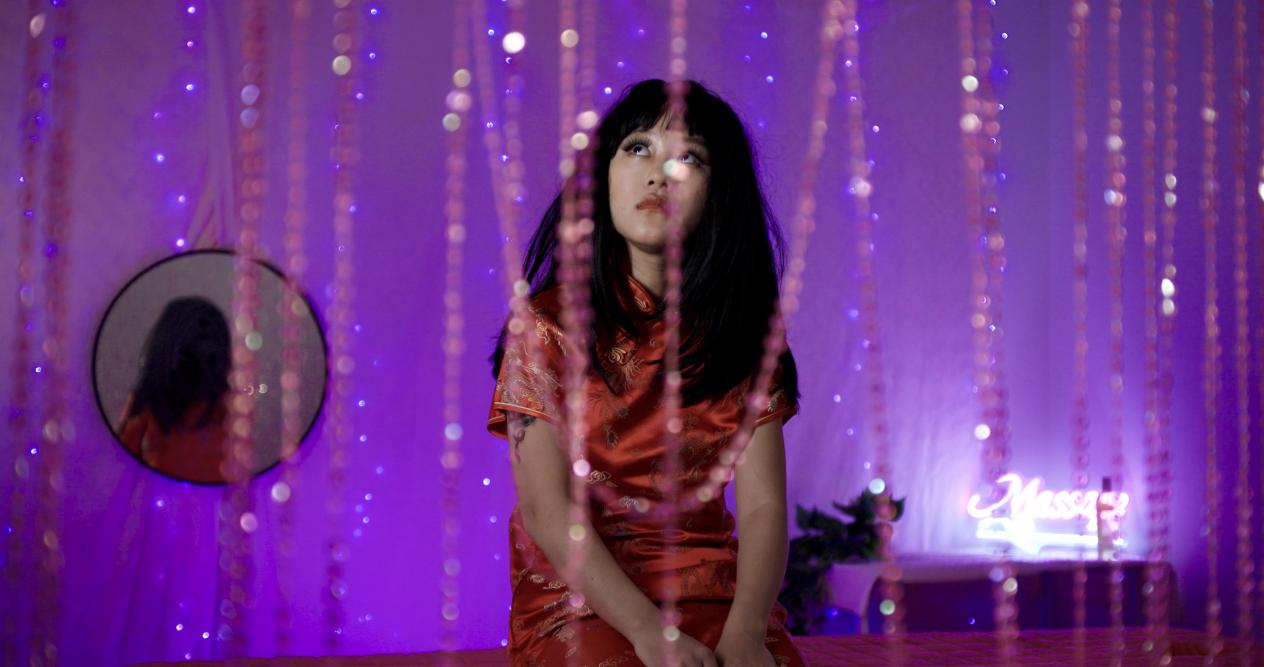
Can someone still determine how she will be seen when she cannot fully understand the language being used to describe her? In Ke Zhang’s Massage Baby!(2026), mistranslation is not simply an obstacle to communication but a structure of power. Words pass among a Chinese woman working in massage, a Mandarin-speaking interpreter, and an English-speaking director. Information is reduced, delayed, or withheld. The woman before the camera becomes visible while remaining partly excluded from the image being built around her.
The film was presented from July 18 to 20 in B*O/D&Y, an international group exhibition at Gallery 46 in London. Produced by SPIRA9 ART and bringing together forty artists from a range of backgrounds, the exhibition considered how bodies are continually reshaped by technology, ecology, memory, and social systems. Its central concept was the glitch: not merely a mechanical failure, but a rupture through which a previously hidden structure can suddenly appear.
Within this expansive group exhibition, Zhang’s work warranted particular attention because it translated the glitch from an abstract technological concept into a concrete social experience. In her film, malfunction occurs across translation, performance, and unequal access to information—where a woman’s lived body begins to separate from the image the camera manufactures for her. Massage Baby! engages several of the exhibition’s central concerns at once, including the body, technology, and systems of power. Yet it never reduces the body to a symbol. Instead, it reveals how a body is interpreted, adjusted, and remade within the specific relations of a film production.
This inquiry also resonated with the curatorial framework of B*O/D&Y at Gallery 46, an independent East London art venue presenting emerging and international artists across moving image, performance, installation, and interdisciplinary forms. By locating the exhibition’s concept of the glitch within translation, labour, and unequal access to information, Massage Baby! expanded its investigation of the mediated body beyond technological malfunction, connecting its London presentation to questions shaped by Chinese diasporic life in New York.
Ke Zhang (KEKEZ) is a New York-based Chinese moving-image artist, filmmaker, and performer who received her MFA from Columbia University School of the Arts. Her practice examines how women understand and present their bodies under the pressures of labor, intimacy, migration, and spectatorship. She has developed an approach that might be described as embodied documentary-fiction, combining sustained observation, reconstructed situations, composite characters, and the artist’s own physical presence. The body is both her subject and her instrument of research; through it, the ethics of representation become visible.
The character construction in Massage Baby! epitomises the strengths of this artistic methodology. Coco, the film’s central protagonist, is not a carbon copy of any single real individual. Instead, through long-form interviews and sustained immersive engagement with Chinese massage workers in New York, Ke Zhang distils the collective linguistic habits, bodily demeanours, labour rhythms and affective dispositions shared within this community. She synthesises and refashions these elements into a fictional archetype, which she performs herself.
This creative practice is anchored in rigorous ethical self-reflexivity. Ke Zhang rejects the false sense of authenticity conferred by an omniscient viewpoint, as well as the presumptuous ventriloquism that speaks over marginalised labour communities. Drawing upon their shared diasporic Chinese cultural roots to forge empathetic rapport, she remains sharply cognisant of the class and discursive disparities separating her own positional identity from these service labourers. By sidestepping the pervasive documentary pitfall of appropriating the lived experiences of the Other, her figures strike a delicate balance between archetypal authenticity and restrained artistic mediation.
In the staged interview at the center of the film, Coco speaks in regionally accented Mandarin about work, intimacy, and life in New York. English conversations around her disclose the director’s intentions, judgments, and production arrangements, but Coco can access only part of this information through an interpreter. Translation becomes both assistance and control. It enables her participation while determining how much she is allowed to know.
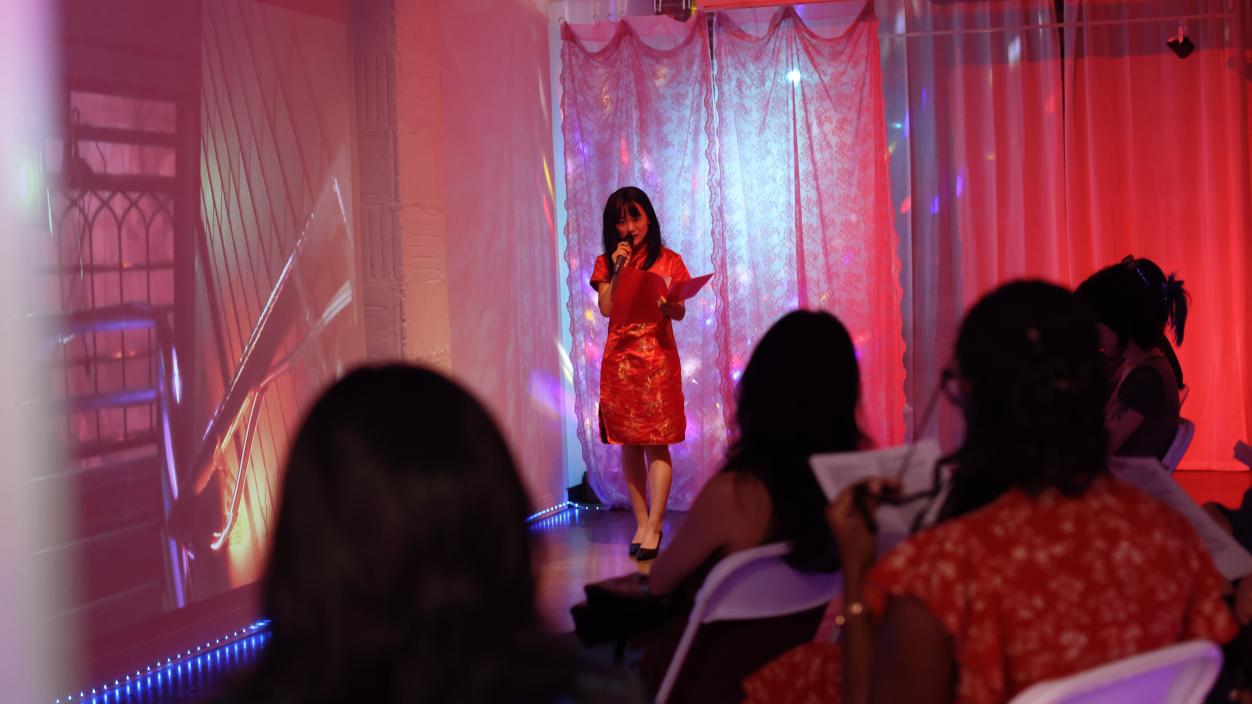
Still from Massage Baby! (2026), directed by and featuring Ke Zhang. Courtesy of the artist.
Yet Coco is never a passive subject who simply submits to the lens. She openly expresses discomfort with the clothes and shoes selected by the crew and worries that certain styling choices will not make her look good on camera. Although she ultimately wears the uncomfortable shoes because the production requires it, her compliance does not erase her objection. She also arrives wearing a wig of her own choosing, actively attempting to shape the image in which she will appear.
These details give Coco a restless, shifting energy. She resists, complains, compromises, and styles herself. She does not reject visibility; she struggles over the terms on which she will become visible. The wig, costume, and shoes are therefore more than styling. They become a site of negotiation between Coco and the production team. Aware that the camera is evaluating her and that her image will enter other people’s field of vision, she repeatedly tries to adjust the outcome from within the conditions imposed upon her.
This agency, however, does not place her on equal terms with the camera. Coco can object to a costume, alter her appearance, or produce emotions and gestures beyond the director’s expectations. What she cannot determine is which images will survive the edit, how her words will be translated, or through what narrative structure the audience will come to know her. The camera is not omnipotent, but it retains a position of structural authority: it controls framing, editing, and the distribution of information, ultimately deciding what the audience may see and what remains outside the image.
This contradiction is the film’s central force. Coco’s resistance is real, and so is the power of the camera. Neither cancels the other; they remain in collision throughout the production. Zhang neither fixes Coco as a victim awaiting sympathy nor packages her as a woman who easily achieves liberation. Resistance, desire, vanity, discomfort, and compromise coexist, allowing Coco to retain a complexity that no single political position can contain.
The structure gives the work a distinctly feminist argument. Simone de Beauvoir’s account of womanhood as socially produced, later extended by Judith Butler’s theory of gender as an effect of repeated acts, becomes tangible in the daily gestures of service labor: posture, tone, dress, availability, restraint, and the management of another person’s comfort.
Coco is neither a transparent victim nor a simple emblem of empowerment. She adjusts her behavior in response to her surroundings and decides how much to disclose. Femininity emerges both as a disciplined form of labor and as a bodily repertoire that can be used strategically. Zhang asks not what a woman essentially is, but how a female body becomes legible—intimate, compliant, desirable, foreign, or available—within a particular economy of images.
The film also complicates the division between the person who looks and the woman made into an image. Laura Mulvey’s influential critique of the cinematic gaze describes a visual order that arranges women for spectatorship. Zhang enters both sides of that order: as director, she constructs the image; as Coco, she gives her own body over to it.
This dual position does not erase the difference between artist and represented subject. It keeps that difference visible, preventing empathy from becoming an alibi for appropriating someone else’s experience. Zhang’s performance is persuasive because it sustains several contradictory states at once: self-aware yet exposed, playful and defiant yet guarded, conscious of the camera but unable to master everything taking place beyond the boundary of her language.
This internal tension between bodily negotiation and structural power runs through Ke Zhang’s wider body of work. In If Longing Has a Color, It Must Be Sino-Red (2024), the massage room and cross-cultural visual dissonance stage Asian femininity as a performative transaction shaped by the Western cinematic gaze. In Pas de deux (2022), the spatial confinement of a rehabilitation hospital turns physical vulnerability into an inquiry into diminished autonomy. Across these works, Zhang repeatedly tests documentary observation through performance, spatial restriction, and her own embodied presence, making lived experience central not only to their subjects but also to the formal construction of her moving-image practice.
Ke Zhang further extends this inquiry through cross-disciplinary performance. In Jen Liu’s TIME TRAVELER IN D-BLOCK (2026), she portrays an Asian female figure moving between ancient and contemporary worlds. Through precise shifts in gesture, posture, and physical bearing, Zhang gives bodily form to diasporic histories, digital gig labour, and persistent structures of gendered constraint, further developing her exploration of the body as both an expressive medium and a site shaped by social power.
Massage Baby! premiered at Accent Sisters in New York on March 29, 2026, as part of Watched Intimacies, a solo screening and artist conversation devoted to Zhang’s work. The event prompted discussion of her use of mockumentary and her distrust of documentary’s claims to authenticity. Four days after the Gallery 46 exhibition closed, Flohaus Gallery presented Repeat After Her on July 24, a solo event combining a screening of Massage Baby!, a new live performance developed in response to the film, and an artist talk. The format placed the film and a live response in the same programme, extending its questions about translated speech and embodied repetition into a live setting.
Ke Zhang performing Repeat After Her at Flohaus Gallery, New York, July 24, 2026. Photo by Annie Chen
As Massage Baby! moved from New York to London, it entered another layer of translation. Experiences gathered from Chinese women in New York were brought into a British exhibition context by an artist whose own practice has been shaped across China and the United States. Diaspora here is not a stable identity carried intact from one country to another. It is continually produced through migration, labor, linguistic dependence, and repeated acts of interpretation. The work’s movement between cultural contexts does not eliminate distance; it multiplies the places where the body can be misunderstood, renamed, and remade.
Set against the bold, unmitigated artistic expressions on view elsewhere in the exhibition, Ke Zhang’s rendering of the “glitch” carries subtle yet searing sharpness: incomplete translations, garments donned reluctantly, self-directed styling alterations, and the powerlessness to govern one’s own narrative. These minor ruptures embedded within ordinary daily life lay bare the core contradictions at the intersection of the body, language, identity and power.
All told, through her original creative methodology of embodied documentary-fiction, Ke Zhang reframes corporeal tensions and linguistic fractures into a fully formed, distinctive artistic lexicon. The core critical weight of her practice lies in its dual perspective: it affirms women’s vivid subjective vitality without diminishing the potency of individual resistance and self-staging, while adopting a lucid, restrained viewpoint to examine the structural power systems that discipline and delineate female bodies throughout image production and cross-cultural dissemination. Her oeuvre offers an indispensable speculative model for contemporary artistic production centred on Asian women’s corporeal imagery and identity politics.
Rachel Chinouriri has announced her second album, I think I spoke too soon. The follow-up to 2024’s What a Devastating Turn of Events is set for release on October 16 via Parlophone/Atlas Artists. Today, she’s shared the sparkling lead single ‘One song away from crying’, alongside a Dora Paphides-directed video. Check it out below.
“‘One song away from crying’ is about the precipice of a night out where you know you need to leave and have to make a decision,” Chinouriri explained in a statement. “It’s a deeper decision because it’s less about the night itself but more about a reflection of a deeper internal conflict with your self value that you haven’t looked at yet.”
“My core thing is you can change who you are at any moment and you can forgive yourself at any moment,” she added. “And I think forgiving yourself is the first step in becoming a better person.”
Chinouriri will go on tour in support of the record, beginning in Los Angeles on August 26. She’ll also perform at Olivia Rodrigo’s inaugural Daisy Chain Fields Festival, which takes place in California next month.
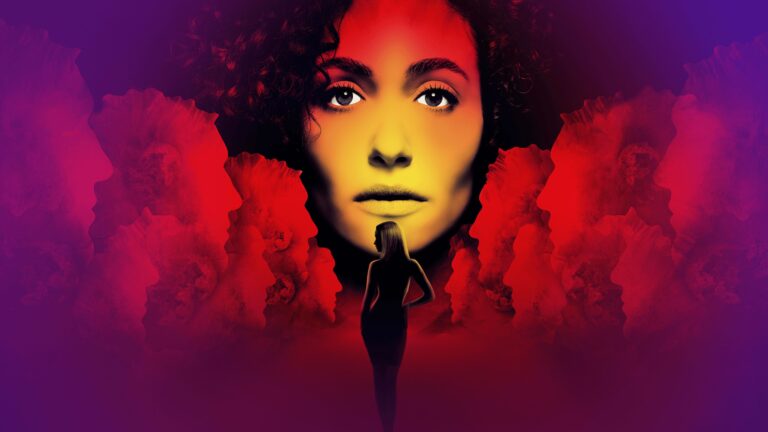
A new thriller is generating serious buzz online. Furious, available on Disney+ in the UK, stars Emmy Rossum as an FBI agent pursuing a calculating female serial killer. It’s the kind of premise that’s hard to resist, especially if you like shows that keep you on the edge of your seat.
Created by Elizabeth Meriwether, also responsible for New Girl, The Dropout, andDying for Sex, Furious will grab you from the very first scene. With a perfect 100% critic score on Rotten Tomatoes, it’s sure to make a cultural impact. But does that guarantee a season 2? Here’s what we know so far.
Furious Season 2 Release Date
At the time of writing, there’s no official news available about Furious season 2. The show premiered recently, so an announcement could come somewhere down the line.
That said, it likely depends on how the season 1 story wraps up and how many people tune in. For now, all we can do is wait and see. If the show gets a follow-up, new episodes could arrive in 2027.
Furious Cast
Emmy Rossum as Alice Black
Lola Petticrew as Catherine
Quincy Tyler Bernstine as Nora
Scoot McNairy as Danny
Jake Lacy as Marshall
Rob Yang as Frank Choi
Rob Delaney as Oliver Charles
Steve Way as Alden
What Is Furious About?
Furious is about two women on opposite sides of the law whose lives become increasingly intertwined.
The thriller centres on Alice, a former NYPD homicide detective. Now working in a low-profile FBI position, Alice is frustrated by how often cases involving exploited women are dismissed. When what appears to be a wealthy man’s accidental overdose is revealed to be a carefully staged murder, she knows there’s more going on.
Turns out, the victim has ties to an influential network, and his death is connected to other suspicious killings. Alice becomes convinced that a serial killer is targeting powerful men who have escaped justice for years.
Unlike most crime dramas, Furious introduces its killer, Catherine, early. The series develops an uneasy psychological connection between the two women. Their pursuit becomes a battle of ideology, with each recognising parts of herself in the other.
While Furious season 2 is not a sure thing yet, you can catch season 1 episodes weekly on Disney+. The finale arrives on August 31.
Are There Other Shows Like Furious?
If you’re enjoying Furious, shows with similar vibes include Killing Eve, The Fall, Hannibal, Mindhunter, Luther, Maximum Pleasure Guaranteed, and Black Bird.
A well-organized casino lobby makes navigation smooth, especially when it offers features like favourites tabs and “New” rows. Browsing is even clearer with lane markers such as category labels beside familiar tools like the Spinboss shelf system. By scanning Spinboss Casino for these kinds of labels, players can orient themselves quickly and focus on the games they want most.
Exploring a large game lobby online can sometimes feel busy at first glance, so tools that group or highlight games are especially valuable. These lobbies typically present broad selections, making shelves and tabs essential for breaking content into manageable portions. In most casino layouts, the favourites tab acts as a one-click spot for your preferred picks, keeping those games accessible every time you visit. “New releases” or “Recently played” sections are additional methods to keep discovery and convenience on the home screen, letting repeat visitors find their way with minimal effort. As you move between features, these clear categories ensure all titles are grouped logically, so the user experience feels tidy instead of overwhelming.
The design logic behind rows and tabs is to cut down browsing time and avoid endless scrolling, which enhances session flow each time you log in. A well-marked “New” row helps regulars spot the latest additions, while still keeping common filters like themes or features at their fingertips. Labelling is not only about marketing—these markers function as signposts that enable users to jump from a broad survey of available games to a precise shortlist with minimal distraction. In Spinboss Casino, the impact of this system can be described as a repeatable tool: category tags and favourites keep your interests in view, while broad shelves promote browsing at every stage.
Understanding lobby shelves and how rows improve flow
Rows like “New releases” and “Favourites” are structured to make decisions fast, without memorizing the entire catalogue. When you add a game to your favourites, it joins a curated shelf, meaning you do not have to go hunting for your preferred picks every time. The rows often update in response to user activity or as new titles launch, adapting flexibly to your evolving interests. At the same time, recently played shelves provide an automatic shortcut, allowing you to pick up right where you stopped on your last visit. It’s this layering of convenience—new, saved, recently played—that shapes a personalized, responsive browsing journey in every session.
Labels such as “Trending,” “Popular,” or provider name groupings further break down content so that specific styles or familiar studios stand out. In the case of Spinboss Casino, these provider rows and feature tags organize the experience around both preferences and curiosity, minimizing time spent scrolling. While some titles may appear in more than one row, this crossover is deliberate so discovery and routine browsing remain intertwined. Rows merge with conventional search bars to optimize the pace of exploration, letting you build routines while still uncovering something new. Menu changes or refreshed orderings are common, which means even a familiar lobby can reveal a new pattern or surprise each time you log in.
How categories and provider tags shape navigation
Broad category labels allow many games to fit under multiple themes, such as a slot being marked as both “Jackpot” and “Fantasy,” which creates flexible routes through the library. Provider tags show games from the same developer together, giving fans of a particular style an immediate way to spot their favorites. This sorting system means players are not limited to only one method of finding a title; category, provider, and shelf tabs all overlap, supporting fluid, habit-driven browsing. Descriptions of this lobby often point to these layered tags as useful markers, since they let each user adapt the structure according to their own style of play. Whether building a session around new arrivals or diving back into a personalized row, these logic-driven paths make exploration available from every angle.
Some players rely on category tags combined with filters like mechanics or volatility, while others use saved lists as their home base during each visit. With labels and rows updating as the collection evolves, the result is a customizable, evolving environment that stays responsive to both trends and individual habits. Spinboss Casino employs these navigation systems so users can experience structured, yet flexible, browsing without unnecessary steps. Instead of ending abruptly or reaching a conclusion, the lobby’s labels and rows serve as ongoing cues for what’s fresh, favored, or worth a closer look as preferences shift over time.
When I recommend a site for a first-time player, I look for longevity. Las Vegas USA Online Casino has been operating since 1999. In the offshore world, a 25-year track record is the ultimate badge of trust. It means they have survived regulatory shifts and paid out players through every economic cycle.
The platform runs on Spinlogic Gaming software and carries CDS certification, providing a layer of independent dispute resolution that is hard to find elsewhere. The library is stocked with fan favorites like Cash Bandits 3, Aztec’s Millions, Megasaur, Blazing Horse, Bass Baggin’ Bounty, and Fortunate Buddha.
The welcome offer is exceptionally strong. By registering with the code ‘LASVEGAS20’, you receive a $20 free chip in your account before making a deposit. The first-deposit bonus is a massive 400% match up to $500, claimed with the bonus code 400BONUS for a minimum bet of $25. What keeps me loyal to Vegas USA is the daily reload structure. Use the code VEGAS100 to get up to $3,000 back every day. Additionally, there is a crypto bonus offered three times a week that provides up to a 250% match for crypto deposits.
Visa, Mastercard, and Discover all accept deposits starting at $25. Lightning Bitcoin starts at just $5, which is the lowest barrier to entry on this list. When it is time to cash out, Bitcoin withdrawals take about two business days with a $100 minimum. Checks and bank wires are also available.
If you are asking me which site I would send a first-time player looking for a TN online casino real money with no deposit bonus and instant payout to, Las Vegas USA is the clear choice. The history, the daily bonuses, and the low Lightning Bitcoin entry point make it the easiest recommendation on this list.
Miami Club Casino
Miami Club started in 2012 and has quietly and reliably operated since then. It shares the same operator, Deckmedia N.V., as Vegas USA Casino. The casino is powered by Wager Gaming Technology, , which is different from the Spinlogic titles from some other casinos in the Deckmedia group. Its official site also says its games undergo independent monthly fairness audits by Certified Fair Gambling.
The bonus structure is slightly different from Las Vegas USA, which is actually a nice change of pace. You don’t get a massive single deposit match. Instead, you get a 100% match up to $100 on your first eight deposits. That is an $800 total welcome package, and it is cashable. It auto-applies when you deposit $25 or more with no code needed.
Banking is solid. Cards work with a $25 minimum deposit. For crypto, you can deposit with Bitcoin, Lightning Bitcoin from $5, Ethereum, Tether, Bitcoin Cash, or Litecoin, while Neosurf is also available as a deposit method. When it is time to withdraw, Bitcoin has a $100 minimum and a $2,500 weekly maximum, with the casino listing a 48-hour processing time and no fee. Ethereum is also available for withdrawals, although the current banking page does not specify its payout limits or processing time.
Slots Plus Casino
Slots Plus has been online since 2002 and, as the name implies, it is built almost entirely around slots. The library runs over 300 titles on Spinlogic Gaming software.
The welcome bonus follows the same pattern as Vegas USA, starting with a $20 free no-deposit bonus using code SLOTS20. For those ready to deposit, Slots Plus offers a 400% bonus up to $500 on the first deposit with code 400BONUS. However, the daily reload is where Slots Plus truly separates itself from the rest. Instead of the 100% daily bonus you get at Vegas USA, Slots Plus has a 150% daily bonus up to $3,000 using code 150BONUS.
There is also a dedicated Lightning Bitcoin promo of a 50% bonus up to $250, available on three deposits per day using code BOLT50. Withdrawals work the same way as the other Spinlogic sites through Bitcoin, bank wire, or courier check.
Everygame Casino
Everygame is the oldest name here by far. This site, which has been under the Intertops name since 1996 before it rebranded in 2001, offers a sportsbook, poker room, and two separate casino platforms, Casino Red and Casino Classic, under a single login.
Casino Red offers a 125% up to $1,000 first deposit bonus, which requires a minimum deposit of $20 with the bonus code SIGNUP1000. The real attraction is their “Rookie Raise” welcome package, which offers value on four consecutive deposits and a fifth, stand-alone $55 no-deposit bonus that brings the package to $5,555.
Banking-wise, Everygame supports cards, e-wallets like Payz and MuchBetter, bank wire, check by courier, and crypto including Bitcoin Lightning. Minimum withdrawals are $100 for crypto and $150 for fiat methods, and their own help center is upfront that crypto withdrawals move fastest, generally near-instant once released.
Decode Casino
Decode is the newcomer, launched in 2024 under the same ownership group as Miami Club. The current welcome bundle pairs a 111% match with a $111 free chip released once the match clears, coupon DECODE111 followed by FREE111DECODE, $25 minimum deposit. Two alternate codes run alongside it, EASY25CODE for a straight 400% match and 250CASH for 250% plus 50 free spins, both at a minimum deposit of $25 and both carrying a disclosed 35x wagering requirement per the casino’s own FAQ.
Standard deposit bonuses elsewhere on the site run 30x, while no-deposit and free-spin bonuses jump to 60x with a cashout cap of 5x the bonus amount. Decode also runs a 25% instant cashback offer with no bonus attached and a 10x playthrough, requested through live chat within 48 hours of a losing deposit.
For banking, Decode accepts Visa, Mastercard, Discover, Diners Club, e-wallets, bank transfers, and crypto, including Bitcoin and Litecoin. Per their own site, withdrawals begin processing 48 hours after you request them, run on business days only, and speed varies by method. E-wallets clear in minutes to a couple of hours, cards in 1–3 business days, and bank transfers in 1–5.
Frequently asked questions
Is there a legal real money online casino for Tennessee players in 2026?
Not an authorized state entity. Tennessee has not approved online casino gaming, so the only available real money slots and table games in Tennessee are available via offshore operators such as the five listed here.
Is real-money online casino play actually illegal for a Tennessee resident?
Tennessee Code Title 39, Chapter 17, Part 5 criminalizes real-money online casino gambling by the player specifically. That is a real, current statute, separate from the state’s sweepstakes ban and separate from its licensed sports betting law.
What is the minimum age to gamble in Tennessee?
21, set by the Tennessee Sports Wagering Council’s own rules and enforced through ID verification across the state’s licensed sportsbooks.
Responsible Gambling
Bonuses and banking are exactly where it is easiest to lose track of yourself. Decide what you are willing to spend before you deposit anything, and treat that number as fixed regardless of how a session is going. All five of these operators offer some combination of deposit limits, time-outs, and self-exclusion tools in their account settings. Set them up before you start playing. If you are worried about your own play or someone else’s, the National Council on Problem Gambling helpline (1-800-522-4700) is free, confidential, and available by call or text at any hour.
Conclusion
Tennessee’s legislature is yet to open a legal market for real-money iGaming. For now, the only way to play real-money online casino Tennessee players can try is through the offshore route. Of the five sites I reviewed, Las Vegas USA Casino is where I would start. The 25-year track record, the $20 no-deposit chip, the 400% welcome bonus, and the daily reload structure make it the most complete package for a first-time offshore player looking for a TN online casino real money with no deposit bonus and instant payout. Start with the $20 no-deposit chip before deciding whether the 400% match is worth funding.
While The Big Bang Theory might have ended back in 2019, the story seems to be far from over. The franchise has only gotten bigger since, with spin-offs Young Sheldon and Georgie & Mandy’s First Marriage keeping longtime viewers immersed in the sitcom’s universe.
Now, another series has joined the fray. Stuart Fails to Save the Universe, streaming on HBO Max, follows a bunch of secondary characters from the original. It also has an ambitious concept that might draw in new fans. But is it enough to guarantee a second season? Here’s what we know so far.
Stuart Fails to Save the Universe Season 2 Release Date
At the time of writing, there’s no official news available about a potential Stuart Fails to Save the Universe season 2.
That said, only one episode has come out so far. If viewership numbers are good, there’s no reason why a second installment shouldn’t happen. The franchise continues to be popular, and cameos from the original cast might be enough to keep veteran fans coming back for more.
If all goes well, the series could return with a sophomore season in 2027.
Stuart Fails to Save the Universe Cast
Kevin Sussman as Stuart Bloom
Lauren Lapkus as Denise
Brian Posehn as Bert Kibbler
John Ross Bowie as Barry Kripke
Ryan Cartwright as Kyle
Josh Brener as Trevor
Tommy Walker as Gary
What Is Stuart Fails to Save the Universe About?
Expecting another cozy sitcom set around the comic book shop? Stuart Fails to Save the Universe takes a different approach, leaning heavily into science fiction.
The story begins when Stuart accidentally breaks an experimental device built by Sheldon and Leonard. What should have been another embarrassing mishap spirals into catastrophe as the machine tears open reality itself, unleashing a multiverse Armageddon. Stuart is reluctantly tasked with putting everything back together.
He’s not the only original character making a comeback. The sitcom also features Stuart’s girlfriend Denise, geologist Bert, and Barry Kripke. They travel between strange realities, searching for a way to repair the damage. Each universe they visit offers a twisted variation of the world. Some are humorous, others bleak. You might also see alternate versions of beloved characters, which adds to the show’s zany premise.
While Stuart Fails to Save the Universe season 2 isn’t a sure thing yet, season 1 episodes keep rolling weekly on HBO Max. The finale will arrive in late September.
Are There Other Shows Like Stuart Fails to Save the Universe?
If you like Stuart Fails to Save the Universe and have already seen The Big Bang Theory, you might like Future Man, Legends of Tomorrow, Pluribus, or Resident Alien.