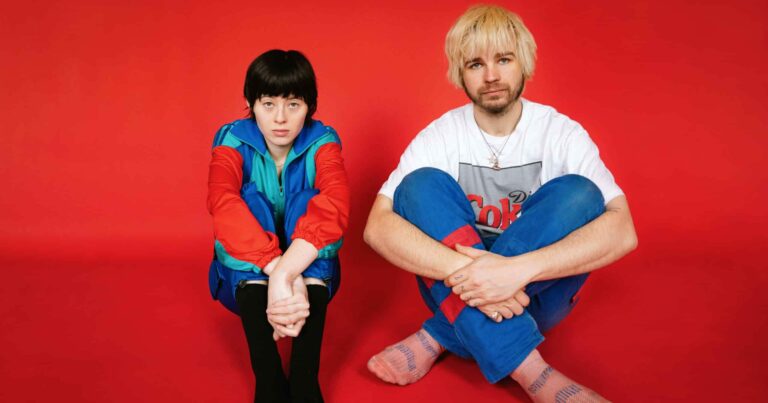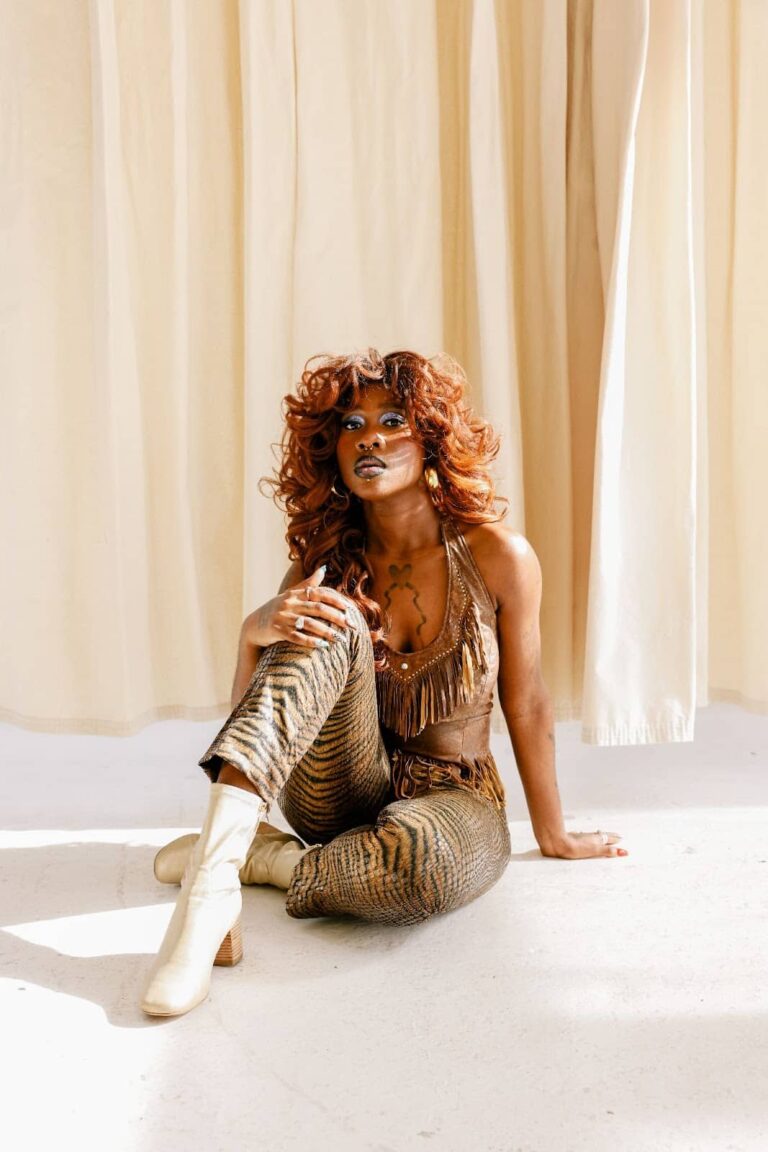
Kara Jackson is a 23-year-old singer-songwriter and poet who was born and raised in Oak Park, Illinois, a small community 10 miles west of Chicago. After taking piano lessons at the age of 5, she taught herself how to play guitar before discovering her passion for poetry in high school, becoming the National Youth Poet Laureate in 2019. That same year, Jackson self-released a stripped-back EP called A Song for Every Chamber of the Heart, which will be followed this Friday by her debut full-length, Why Does the Earth Give Us People to Love?. With help from a group of musicians including NNAMDÏ, Sen Morimoto, and KAINA, Jackson fleshed out the demos she recorded in her childhood bedroom in the early days of the pandemic into a candid, tender, and audacious collection of songs that confront overwhelming emotions around grief and love without smoothing them over. But the loneliness in her music is a rare kind – one that nurtures her internal contradictions, finding ways to be humorous and playful and fierce as a means of sustaining, if not warding off, suffering. In its honest specificity, you’re reminded of the things we share – all worth the light of day.
We caught up with Kara Jackson for the latest edition of our Artist Spotlight series to talk about her earliest musical memories, the ideas behind Why Does the Earth Give Us People to Love?, usefulness, and more.
Could you share some early musical memories that you hold dear?
I had a very musical upbringing. My parents both really loved music, and my dad especially was always playing something. I feel like some of my favorite memories, and some of the earliest memories I have just being immersed in music, are honestly just being in the house and getting up and cleaning on the weekends. [laughs] My mom would always play soul music, and we had this speaker growing up, so I knew if I heard Stevie Wonder or something it was time to get up and help. I don’t remember a time not listening to music; even when I was a baby, my mom told me that they couldn’t get me to go to sleep without listening to something. They’d play this radio station and play jazz – my dad is a huge is a real jazz connoisseur. I’ve heard a lot of stories growing up about me going to the jazz showcase as a baby and being picked up by jazz legends. And being obsessed with Sonny Rollins, like I wouldn’t let people play anything else.
Do you feel like your love of music and writing developed kind of separately, and when did they start to intertwine?
I feel like, in a lot of ways, they’ve always been intertwined. I’ve always loved language. I didn’t know about the poetic form in a formal way growing up, it wasn’t until I was older, just through school, reading poets. In high school, I joined my spoken word club, I started doing slam poetry, so that’s when I got explicitly into writing poems. I grew up with people like Jim Croce, too, so I think even before I had the language to articulate that I love language, I knew the way that these people I was listening to were saying things and the conviction they had with their words was something that I aspired to.
The growth from your 2019 EP A Song for Every Chamber of the Heart to Why Does the Earth Give Us People to Love? is evident, but I’m curious what the steps were to building on that ambition and musicality. Was it mostly an intuitive or an intentional process?
I think some of it was definitely intuitive. My EP kind of acts as a skeleton to some of my upcoming work, but in a lot of ways, working on my debut album, I was really intentional about the language and intentional about making a statement and the fact that I could write – it really was important for me to communicate that through my work. I felt frustrated by how my EP wasn’t really demonstrating that in the way that I wanted to. But I think it was mostly fear, and that’s why I feel like some of it was intuitive with my debut album, because I just wanted it to feel like myself. With my EP, while it does feel like me in a lot of ways, I think when I was younger I was really scared to not make something that maybe wasn’t going to be popular, or not make something that people could understand. I think that I was afraid of being too idiosyncratic or just weird. [laughs] When I was working on my debut album, I kind of had addressed those fears through just the process of growing up and liking myself more. I was more intent on making something that felt like a true representation of myself and the variation that I think makes me, me.
I feel like the collaborative aspect of it is also a part of that intuitive process. You worked with your friends NNAMDÏ, Sen Morimoto, and KAINA on the album. How do you feel that sense of community ended up seeping through the songs?
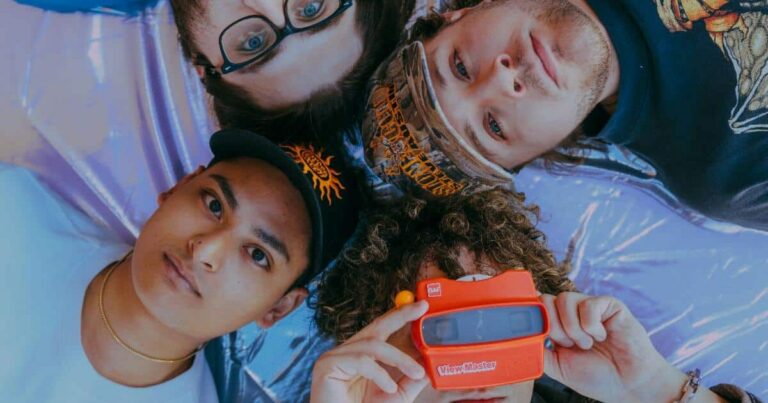
Something that really struck me about listening to the album for the first in a really long time yesterday, especially with the title track, I felt like there was no one else who could have helped me convey those feelings better than those people, my friends. Considering so much of the album is grappling with interpersonal experience and intimacy in general, I feel like it only made sense to bring in these people who know me so well to help me articulate those feelings. I feel like some of the intuitiveness literally comes from how we approached making the album, because once we recorded my guitar tracks and the vocals, Sen, Nnamdi, KAINA, and I just would sit in with the songs as they were, the most stripped down version, and we would really organically build on them. That’s how you had moments like the song ‘rat’, where we had an engine revving through the song – that’s Sen’s car. That was just from us being like, “Let’s go outside, take a break really, quickly, and just like record this.” It’s almost childlike, like we were just pressing buttons sometimes, and that shines through in the album, the organic way that we all bounce off of each other.
As a title, Why Does the Earth Give Us People to Love? is such a disarming and direct question to frame the subject of grief, because to me, it gives weight to both the gift and the implied taking of it, and the senseless yearning that persists through both. Did it ever feel too heavy of a way to introduce or sum up the album?
There wasn’t really an alternative title, because I felt like the question in the title track was just the title to me. I don’t think I knew it going into the project, but once I really had the song done, I couldn’t think of something else to name it. I’ve been joking about how long my album title is, because of course my album title is so long. [laughs] It just feels very characteristic to me. I think it is a heavy question to lead with, but it’s also the question that’s driving the whole album. The more I worked on it, the more I understood how, while the title track is its own ode to my friend Maya, who passed away, I think when you take it out of the context of that song, the question remains relevant to all of the songs.
The more I worked on the project, I understood the question to be really what was driving so much of my work in general: this curiosity around humanity, and really why we act the way that we act, and why, at the end of the day, as individualistic of a culture we have come to know and nurture, there’s still so much of a drive for love. People want love and they want to be around each other. You can think you’re like the best person in the world, but at the end of the day, even the best person sometimes wants another person. Even the most independent, fierce person wants to love someone. I think that’s as much of a dig on other people – a song like ‘dickhead blues’ – as it is on myself, too. As invincible as you can sometimes feel, there is still that question of love, and there is still that vulnerability inherent in knowing that that’s what makes us human. So it is a heavy question, but I’m someone, I guess, who is dealing with a lot of heaviness in general, so I wasn’t so much concerned with the weight of it. It just made sense to me.
There’s another open-ended question that struck me on ‘no fun/party’, which is, “Isn’t that just love? A will to destruct.” It made me think about the way we, as writers or just human beings, tend toward love as the natural conclusion or explanation for things that don’t really make sense – even when we’re talking about destruction.
For me, another part of that is this tension between love and destruction – or even loving someone being the pursuit of maybe destroying yourself. I also think of the dichotomy of grief and love, and how there’s a duality there as well. I feel like you can’t really properly grieve without love and vice versa, and the way that they’re entangled also feels similar to this entanglement of love and destruction, because grief really destroys you in the same way that love does. I feel like that’s definitely what I was grappling with as well, that cyclical nature of loving someone, and also the person having to leave – whether it’s in the capacity of, “I’m dumping you,” or leaving this physical earth. It leaves you, sometimes, just destroyed.
I’m intentionally trying to bring grief into my work as something that I feel like people don’t talk about enough and are afraid to talk about. In the West, we don’t really have a culture surrounding grief. The culture of individualism necessitates grief being obscured and to grieve really singularly, as opposed to an experience that should be collective. It becomes a series of missed work days or whatever. I think if we invite grief into our lives and we invite love into our lives, it forces us to be more aware of the person next to us. Because through grief, you learn so much about how fragile and small we all are. The grace that you want when you’re grieving is a grace that everyone deserves. It is really important for me, especially as a black woman, to articulate my grief and be very unapologetic about it, because I think it’s so necessary in a time where people really put their heads down and grieve by themselves. I think it’s really important for that process to become a collective one, and for us to really take care of one another as we grieve a very weird and dark time.
To your point, I feel like it’s obscured, but it’s also structured in a weird way. In art, grief and sadness around love are expected, but they’re often expressed in a non-singular, conventional way. That’s one of the things your music avoids. I’m thinking of ‘free’, which is a song about letting go, and it’s seven minutes long. How is the length of the song connected to its subject matter? Did you feel the need to stretch it out?
I don’t know if going into it I knew it was going to be so long. I’m very inspired by people like Joanna Newsom. I love short songs that are really good, but I also love long songs that make you work for it, and I definitely wanted to have a middle ground with my debut album. But I think your question actually makes me learn something about ‘free’, because in a lot of ways, thinking about it right now, ‘free’ in its length is really representative of how long it takes you to actually get over something. Also, sometimes a part of freeing yourself is telling yourself you’re free even before you actually are. As much as it is a declaration of freedom, it takes me a really long time to actually say, “I am free,” and really meaning it with conviction in the song itself. I say it at the beginning of the song, but there’s a sense that I’m still getting over it.
Especially on the songs ‘dickhead blues’ and ‘brain’, you grapple with the idea of being worthy and deserving of a certain kind of love. But you also specifically use the word “useful” in a way that’s really potent. What has usefulness, as a personal trait, come to mean for you?
I feel like “useful” is a word that I’m still grappling with, even when I sing this song. I’m not always married to that word anymore the older I get – in terms of why I want to be useful, or trying to unlearn the idea that you have to have a purpose in order to be deserving of care. Especially as a black woman, the idea that I have to be useful to someone else is something that I grapple with a lot of the time. But in ‘dickhead blues’, it really was an affirmation in terms of, also, what I do; for me, reminding myself that I’m useful also comes from reminding myself that the work that I’m doing is meaningful.
I think it’s important that ‘therapy’ and ‘pawnshop’ follow ‘dickhead blues’ in terms of these questions of worth and usefulness. “All that glitters is not gold” is definitely an element of ‘pawnshop’. I’m someone who buys things second-hand a lot, so I was playing off the idea that you can go into a pawnshop and buy something that’s really used, but you can also get something that is second-hand but is just as good as something that’s brand new. I feel like throughout the album, I’m really trying to contend with how, just because someone else may think that you don’t have worth or you may not deserve something, they don’t get the final say in terms of what your value is. Value is very subjective in that way. I think what makes me useful is so different, too, depending on who I’m even talking to. I don’t want to have to do anything to be worthy of love. I feel like sometimes I’m useful to people without doing anything at all. Even offering this album up to people – maybe that’s not enough to save someone’s life literally, but even though it’s small gestures of writing a song, it’s useful enough.
This interview has been edited and condensed for clarity and length.
Kara Jackson’s Why Does the Earth Give Us People to Love? is out April 14 via September Recordings.