

A slot release rarely deserves to be read as a piece of visual culture, yet Habanero’s Shogun’s Land invites exactly that kind of attention. Released into a market saturated with Japanese-themed reels, the game stands out less for its mechanics than for the care with which it assembles a recognisable visual grammar borrowed from Edo-era painting, ukiyo-e print design, and classical Shinto iconography. The reels serve as a small stage on which samurai helmets, folding fans, koi, cherry blossoms, and golden dragons take turns appearing, each carrying centuries of accumulated meaning long before any spin is triggered. For a reader coming from the arts, the game is most interesting as a compressed visual essay on how Japanese symbols travel into modern entertainment design and still retain a surprising amount of their original charge.
The review that follows treats Shogun’s Land primarily as a cultural artefact rather than a technical product. Habanero’s art direction leans into a familiar palette of ink black, vermilion, imperial gold, and pale cherry pink, a combination that will be instantly recognisable to anyone who has spent time in front of an Utagawa Hiroshige landscape or a Tokugawa-era folding screen. What follows is a reading of the symbols, the palette, and the spatial grammar that organises the game, with attention to what each element meant in its original Japanese-art context before it was lifted onto a modern reel. The rest of this review focuses on what the game is quietly citing and how well those citations hold up against the source material.
The Shogun as Figure and as Myth
The shogun sits at the symbolic centre of the game in the same way the figure sits at the centre of Japan’s cultural memory. Historically, the title belonged to the hereditary military ruler who held real authority in Japan from 1192 through 1868, and it is the Tokugawa line, which governed the country across the entire Edo period from 1603 to 1868, that most people picture when the word is used today. Habanero’s art department treats the shogun less as a specific historical individual than as an archetype, rendered in a highly stylised portrait that foregrounds the distinctive horned kabuto helmet, the lacquered face guard, and the heavy silk robes of formal audience dress. This is the shogun of Kurosawa films, of late Edo woodblock prints, and of contemporary illustrated histories, rather than the shogun of a specific political moment, and the reel design leans consciously into that mythic simplification. The effect is less a historical portrait and more a visual shorthand, a cue that tells the viewer this world runs on feudal hierarchy and martial ritual without demanding any further explanation.
Ukiyo-e Echoes in the Symbol Set
The symbol set is where the game most clearly shows its debt to ukiyo-e, the woodblock tradition that dominated Japanese printed imagery from the mid seventeenth century through the end of the nineteenth. Three masters still define the popular image of that tradition. Katsushika Hokusai, whose Great Wave off Kanagawa remains one of the most reproduced images in world art, established the dynamic, almost graphic-novel use of line and empty space that contemporary slot artists continue to imitate. Utagawa Hiroshige’s travel landscapes taught a generation of illustrators how to compress the atmosphere into a few flat planes of colour. Kitagawa Utamaro’s bijin-ga portraits, which focused on women of the pleasure quarters, refined a language of elongated proportions and expressive line that still shows up in the rendering of the game’s female attendant figure. None of this is accidental. The designers are drawing on a lineage that ukiyo-e galleries across Europe and North America have spent the last decade repositioning as serious fine art rather than popular ephemera, and the game benefits from that slow cultural rehabilitation.
Wabi-Sabi and the Quiet Spaces Between Spins
Wabi-sabi, the aesthetic philosophy that finds beauty in transience, imperfection, and the natural cycles of decay, turns up in Shogun’s Land in ways that may surprise readers who expect only maximalist gilt-and-red chinoiserie from a casino-adjacent product. The background panel sits in a soft wash of muted tones rather than the expected saturated colour field, and the small architectural details visible behind the reels, a worn wooden frame, a weathered tile edge, a slightly off-centre paper lantern, read as deliberate nods to the wabi principle of refined restraint. The game’s overall rhythm supports the reading as well, with quieter idle animations and a subdued soundscape of koto and shakuhachi rather than the percussive fanfare that Western themed slots typically default to. None of this makes the game itself a work of contemplative art, but it does suggest that the design team studied the source material with more attention than the genre demands, and that studied restraint is one of the qualities that gives the game its appeal for a culture-magazine audience.
Image by Daniel Asher
The Cherry Blossom, Impermanence, and the Reel
Cherry blossoms drift across the screen at regular intervals, a visual motif so familiar that it can easily be dismissed as decoration. That reading would miss the weight the image carries in Japanese art. Sakura has functioned since the Heian period as the central symbol of mono not aware, the bittersweet awareness of how quickly beauty passes, and the motif was canonised by court poets long before it became a decorative staple of spring tourism posters. Contemporary Japanese cinema continues to rework the same meaning. The recent reissue cycles around Yasujiro Ozu’s quiet domestic films, which have circulated widely in 2024 and 2025 through new Blu-ray editions and revival screenings, have reminded audiences how much of that director’s work turns on a single falling petal or a family photograph left behind. Shogun’s Land is not doing anything as delicate as an Ozu cut, but its use of cherry petals as a transition element between bonus rounds is clearly borrowing a vocabulary the Japanese visual tradition has been refining for well over a thousand years.
Torii Gates, Mount Fuji, and the Grammar of Place
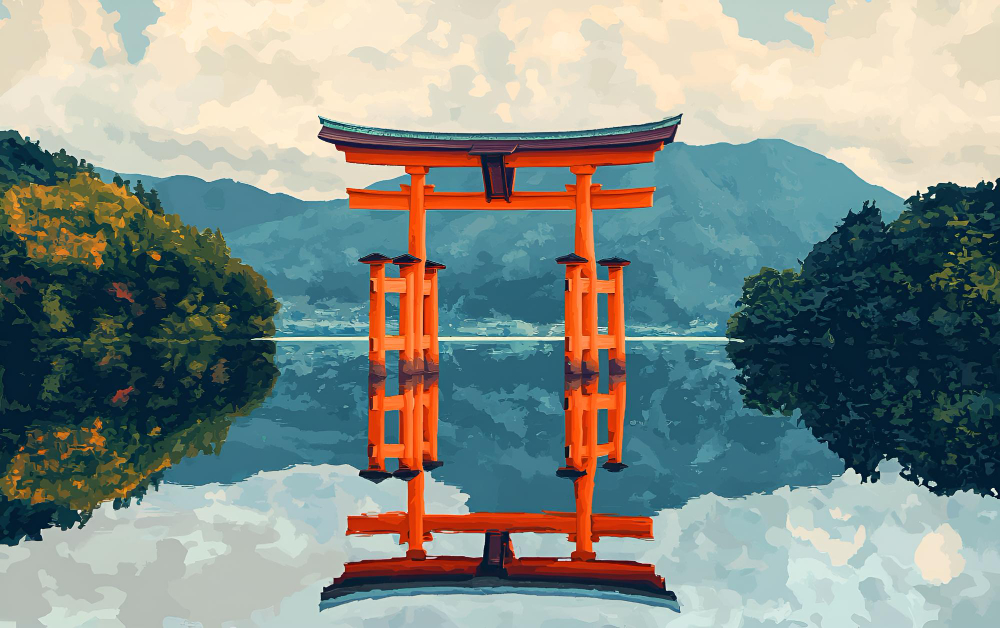
The background set design does a lot of quiet work. A torii gate, the vermilion frame that marks the boundary between ordinary space and the sacred grounds of a Shinto shrine, appears in miniature behind one of the reel strips, functioning less as a literal location cue and more as a promise of threshold and passage. Mount Fuji rises in muted grey behind another panel, drawing on a centuries-old pictorial convention that ukiyo-e masters used to anchor a scene without crowding it. Readers interested in the depth of that pictorial tradition will find the Metropolitan Museum’s survey of Edo art a useful companion to the game’s imagery, because the essay lays out how the 1615 to 1868 window produced the specific combination of urban print culture, formal painting, and decorative design that the reel set is compressing into a small animated frame. Placed in that context, the background becomes less a generic Asian pastiche and more a clearly traceable citation of known pictorial conventions that the original audiences of Edo woodblocks would have read in seconds.
Reading the Symbols: A Cultural Key
The table below matches six of the game’s recurring visual elements to their meaning in classical Japanese art, offering a simple cultural key for readers who want to understand what each image was doing in its original context before it was lifted onto a modern reel. As a visual reference, Shogun’s Land slot free play is useful because it shows those same motifs in motion, making it easier to see how the game arranges classical symbols into a compact decorative language.
| Reel Symbol | Origin in Edo/Sengoku Culture | Traditional Meaning |
| Horned kabuto helmet | Samurai armour, Sengoku and Edo eras | Martial authority and clan identity |
| Cherry blossom | Heian court poetry into Edo painting | Impermanence and mono no aware |
| Koi fish | Folk tales and Edo woodblock prints | Perseverance and upward striving |
| Folding fan | Ukiyo-e courtesan portraits | Refinement and nonverbal communication |
| Golden dragon | Shared East Asian iconography in Edo art | Power and imperial sanction |
| Torii gate | Shinto shrine architecture | Passage from ordinary to sacred space |
None of these readings change the mathematics of the reels, but they do change how a cultural reader experiences the game’s visual field. Once the symbols are grouped with their original meanings, the surface becomes denser and the design choices behind the symbol selection start to look intentional rather than arbitrary.
The Colour Palette as Historical Citation
The palette that runs through Shogun’s Land is not invented. Ink black, vermilion red, imperial gold, and a restrained pale pink are the same four notes that dominated the printed posters, folding screens, and painted scrolls of the late Edo period, and the combination had specific cultural roles. Ink and vermilion carried the weight of official seals and temple calligraphy. Gold leaf flagged either courtly decoration or the highest level of merchant-class display. The pale pink, barely saturated, signalled cherry season and the brief windows of the year associated with formal outdoor viewing. Habanero’s art team has chosen to stay inside that restricted palette rather than opening it up to the full spectrum most mobile-first slot releases default to, and the restraint gives the game’s overall screen a slightly older, more considered feel than its direct competitors. The effect is closer to a museum gift-shop reproduction than to a neon Las Vegas signboard, and that positioning is what makes the game legible as a cultural object rather than a purely commercial one.
Image by Margaux Lenoir
Motifs Featured in the Game
The game’s visual program leans on a familiar set of Japanese motifs. Each carries centuries of pictorial convention that predate the reels by several hundred years.
- The horned samurai helmet, adapted from real Sengoku-era kabuto and visible across Edo painted portraits of warlords.
- The folded silk fan, a standing emblem of refinement that appears frequently in Utamaro’s bijin-ga portraits of women of the pleasure quarters.
- Cherry blossom petals, the central symbol of impermanence in Japanese poetry and a recurring transition element in the game’s animations.
- The koi fish, associated in folk tales with perseverance and the legendary transformation into a dragon after ascending a waterfall.
- The golden dragon, a pan East Asian symbol of power that entered Japanese visual culture through imported Chinese pictorial conventions during the medieval period.
- The torii gate, the vermilion threshold that marks the entrance to a Shinto shrine and functions as a compact symbol of sacred passage.
- Distant Mount Fuji, positioned in the background in the same quiet compositional role it plays in Hokusai’s and Hiroshige’s landscape prints.
Together, these motifs build an unmistakably Japanese visual atmosphere without relying on the orientalist shortcuts that have long plagued Western attempts at similar themes. The restraint is what allows the game to be read seriously at all from a culture-magazine perspective.
Cinema, Exhibitions, and Where Japanese Aesthetics Sit in 2026
Japanese aesthetics are having an unusually strong moment in the wider culture right now. Major museum programmes during 2024 and 2025 featured substantial ukiyo-e loans in London and New York, and the long slow revival of mid-century Japanese cinema has continued to gather momentum on streaming platforms dedicated to art film. For readers interested in the cinematic side of that revival, a careful reading of Ozu from the archives of Our Culture Mag is a useful companion piece, because it lays out how the same aesthetic sensibilities that run through classical Japanese painting also shaped the quiet, observational grammar of postwar Japanese film. Shogun’s Land lives at a much more commercial register than any of that, but it is working with the same visual vocabulary, and the fact that contemporary entertainment design reaches instinctively for ukiyo-e composition when it wants to evoke Japan is itself a small piece of evidence that the tradition has genuinely entered the global visual canon.
Where the Game Falls Short as a Cultural Object
A review written for a culture magazine would be incomplete without flagging the places where the game’s cultural fluency thins. The symbol set is Japanese, but the bonus round language and pay-table screen revert to the generic conventions of the slot genre, which sits awkwardly against the careful pictorial surface. The calligraphy that appears in menu headers is ornamental rather than legible, and a viewer fluent in Japanese will recognise that the brush strokes function as decoration rather than communication. The female attendant figure, rendered in a style that deliberately echoes Utamaro, risks reducing the rich tradition of bijin-ga to a single stock character, a flattening that thoughtful contemporary Japanese cultural critics have begun to push back on. None of these are dealbreakers, but they do mean the game sits closer to the tradition of tasteful pastiche than to genuine citation. A reader who approaches it as a compressed visual essay will find a lot to think about; a reader who approaches it expecting a coherent cultural statement will find the surface more considered than the substance.
A Final Note on Symbols and Attention
What makes Shogun’s Land worth the attention of a culture-focused reader is not any single symbol or any single design decision. It is the way the game concentrates a recognisable tradition into a small animated field that most of its players will glance at for a few minutes at a time. That compression is itself a contemporary art problem, the same one that museum designers confront when they have to condense a hundred years of Edo production into a single introductory wall label. The game solves that problem imperfectly, sometimes elegantly and sometimes clumsily, but the attempt is legible and occasionally rewarding. Readers who approach it as a short encounter with Japanese visual vocabulary, rather than as a long-form experience, will find more pictorial depth than the format suggests, and the imagery will stay with them longer than the session did.
Frequently Asked Questions
What makes Shogun’s Land worth reviewing from an art and culture perspective?
The game’s visual program draws heavily on classical Japanese pictorial conventions, particularly ukiyo-e composition, Edo-era colour palettes, and established Shinto iconography, which makes it a compact study of how those traditions travel into contemporary entertainment design.
Are the Japanese symbols in the game historically accurate?
Most of the core symbols, including the kabuto helmet, the torii gate, the koi, and the cherry blossom, carry meanings that track closely with their historical uses in Edo and earlier Japanese visual culture. The treatment is stylised and compressed, but the underlying references are legitimate rather than invented.
Which historical period does the game primarily reference?
The visual world borrows most clearly from the Edo period, which ran from 1603 to 1868, with occasional visual cues drawn from earlier Sengoku-era military imagery, particularly in the armour and helmet design of the shogun figure.
How does Shogun’s Land compare to other Japanese-themed entertainment design?
It sits toward the more restrained end of the spectrum. The palette stays close to traditional Edo colour conventions, the soundtrack leans on koto and shakuhachi rather than generic orchestral fanfare, and the design avoids the heavier orientalist shortcuts that still mar many similar products.
Is the cultural presentation in the game respectful of the source tradition?
It is respectful in the sense that the designers clearly studied the source material, but it is also commercial and inevitably flattens some of the tradition’s complexity. A culturally attentive reader will find the references legible and the overall treatment more thoughtful than most, though not free of the usual compressions of genre work.

