


The tension between the individual and systems has long been the theme for Lila Rui Lan. Through photography, collage, moving images and interactive installation, she enters the topic from various angles in combination with different media — from offering straightforward, intimate glimpses of her private life to envisioning alternative human-technology relationships. The distinctive aesthetic addresses the absurd context we are situated in, which stages those existential issues people encounter yet skip. A body of works masked with lighthearted humour that slowly navigates people to the shadowy side. Lila’s works underpin the connections among individuals, collectives, technologies, as well as the system that associates with all, searching for a sustainable independence of the single among the interdependence of the multiple. These installations attempt to open up a conversation with whoever is experiencing them, question after question, always concluding with openness — as doubts, confusion, scepticism, criticism, or frustration.
To understand the mind behind installations composed of layered concepts, Lila’s photography and collage works are the place to begin, where colours bloom and where information is reconstructed. In 84/Eighty-four, the bitter memories of her grandfather’s birthday are reterritorialised in palette, revealing an individual life caught by the tide of its era. Every image speaks for a perspective of the old man whose weeping face is brutally copied and pasted for all — he is everyone who shares the socio-political context. Yet this series is more of a narrative with a complete end.
Shaping Shapes is a project with physical collages. The work reflects on the centralised composition of photography from commercial magazines and transforms these images into a metaphor of the segregated society, where the central figure or object is removed, with its outline remaining, leaving only the background/context. Lila sought among all materials of context to construct new content, a new subject. Outlines of cut-out pieces overlay into a new outline, filled with skies, trees, pure colours, and shadows. It foregrounds the potential to overturn dominant narratives and the possibilities in what has been blurred into mere context. It introduces a freedom to collage the world, inviting a reflection of “what if.”
The trace of the visual characteristics shaped through photography and collage practice can also be found in Lila’s interactive works. The interactive medium fulfils another dimension of her practice: to connect through experiential dialogue. A form — with highly saturated colours, mapped by scattered zigzag paths of attention, where the systematic structure is borrowed directly from the mechanisms of our social-cultural system yet transformed into a space for contemplation — that is capable of containing her expanding philosophical universe of abundance.
Her interactive installations transform the human-system relationship into embodied experiences. First hooked by striking playfulness, you engage with these works with curiosity, anticipating a trophy, joy, or simply fun. A game, that is the first impression for most people. As the “game” starts, you are immediately stripped of what you brought from the external world. What remains under the spotlight are questions that urge you toward self-reflection or interrogation. The experience is brutal in a way, as you are set to confront yourself in a trap full of why questions. What is unpleasant but interesting is that, as you start to follow it, thinking “right, why?” — these works further inquire why you are here doing what they told you to think. Suddenly, time is out, you realise it is a “game,” but is it just a game? Two works in particular exemplify this.
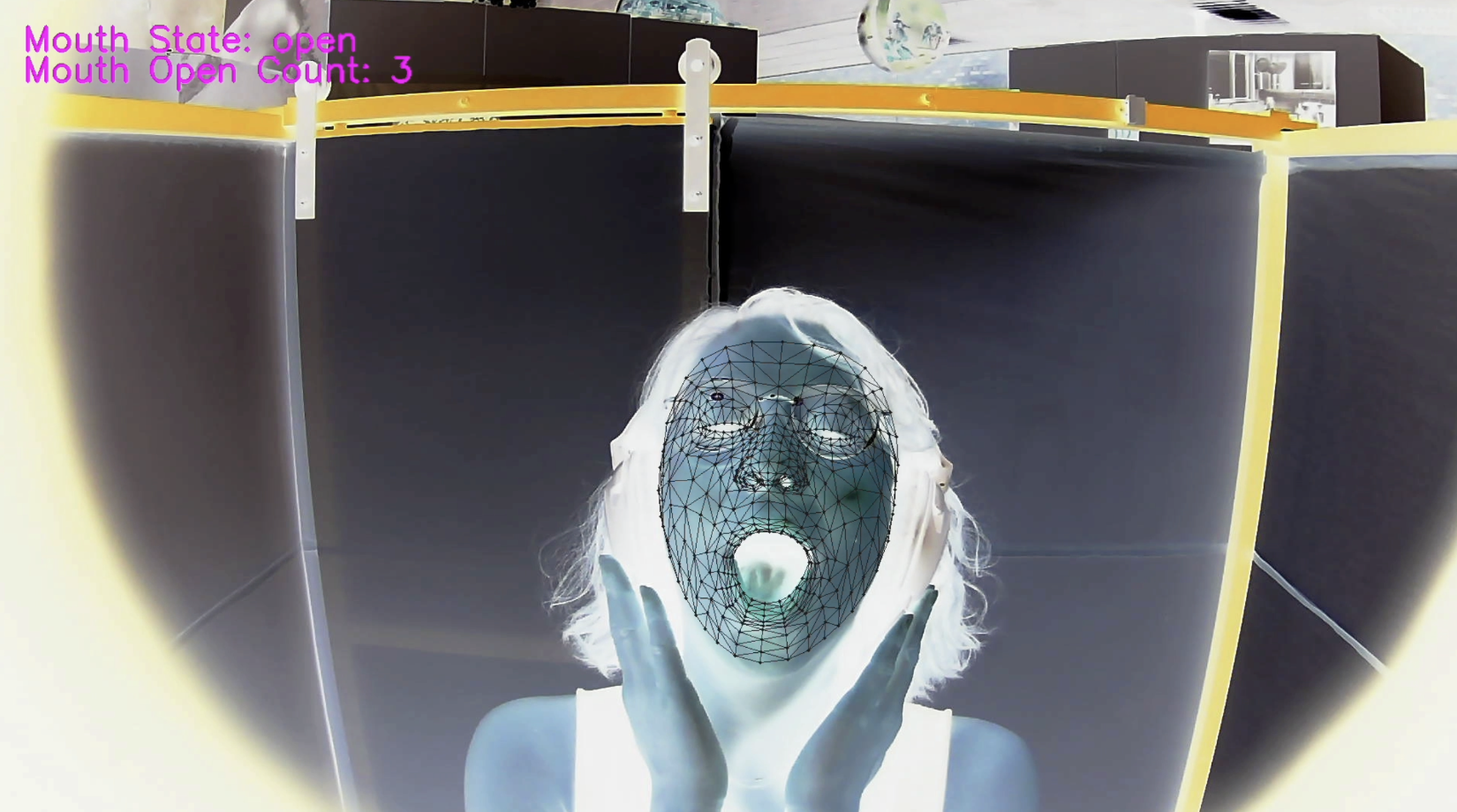
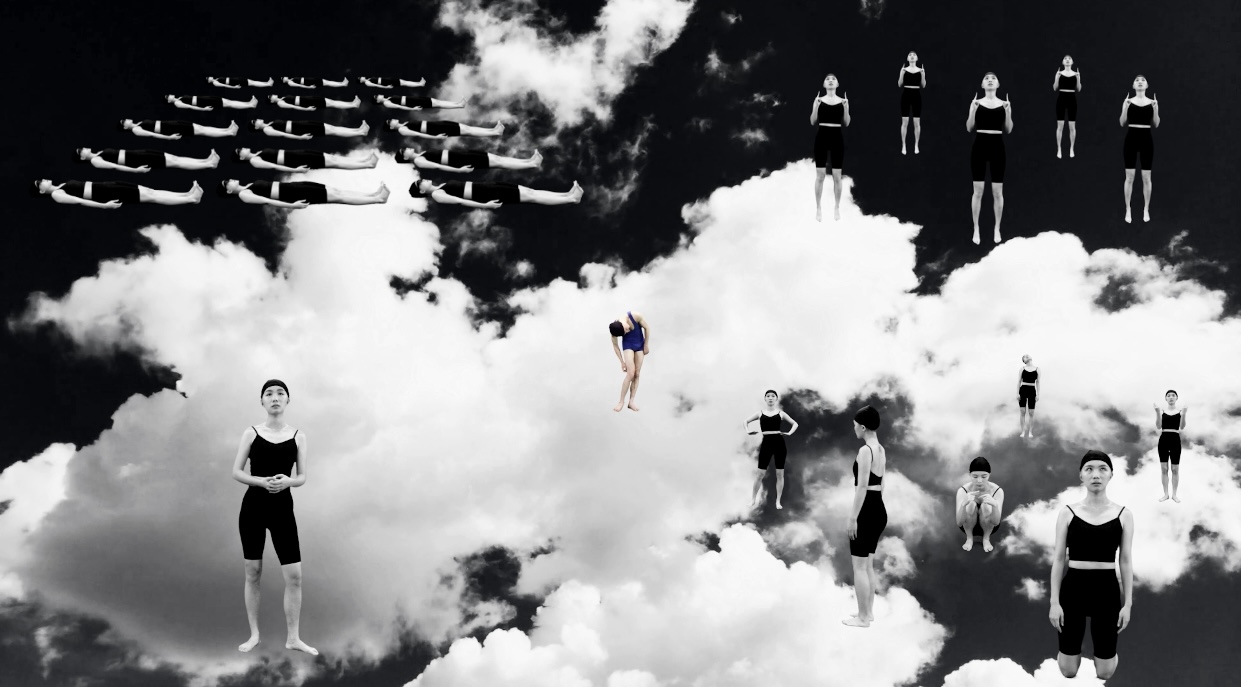
Kill Heroes is originally a moving image work with an emphasis on the inner workings of an individual, a gradually disciplined entity that liberates the suppressed character inside through recovery training; in the end, the disciplinary impacts dissolve, and the text emerges: “Heroes killed.” It shows the evolution of the artist’s concept, from individual to shared tension with the system as a collective.
From afar, the ultramarine blue skeleton half-hidden behind semi-transparent fabric and a printed board of a swimmer figure exiting the installation with head drooped down, together with the title Kill Heroes, prompts visitors with a first question: “Who are the heroes?” Inside the cubic space of the installation, audiences first register themselves with a rough headshot, then are asked to perform particular motions: 15 times mouth-open-close, 10 times hand-raising. What awaits is a series of questions regarding their motive, the surveilling space, the obedience, and the discomfort they are experiencing in that moment. People leave with a lasting discomfort, perplexed by the phantom of the 3 minutes they gave to the work. This work spotlights the act of casually granting access to our data within the gamified systems of the crowded internet, which in turn appropriates this free data to influence our behaviours and choices while making us believe they are our own. The emotional side-effect — a trick played by the artist to convert philosophical and political reflections into a sensualised experience.
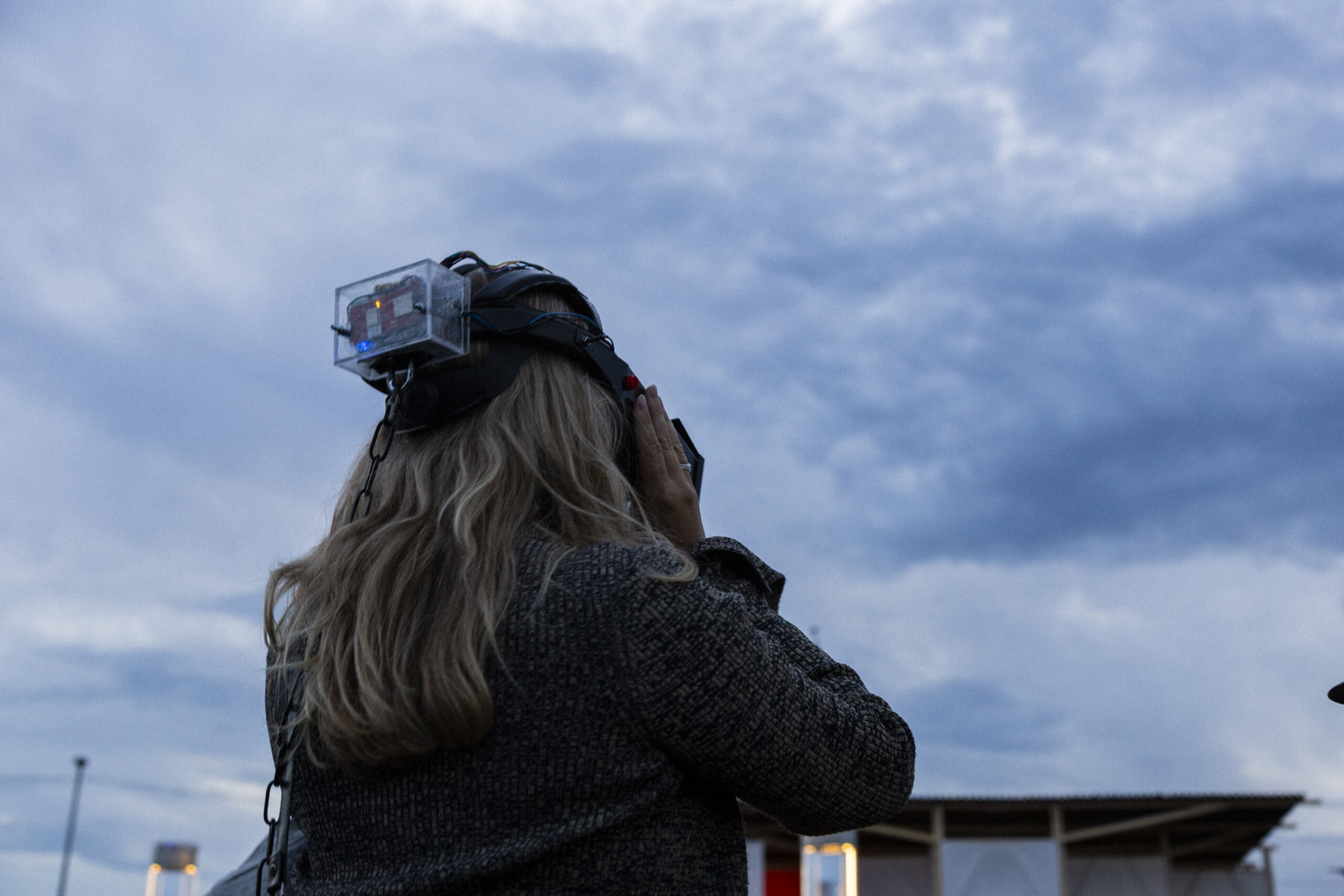
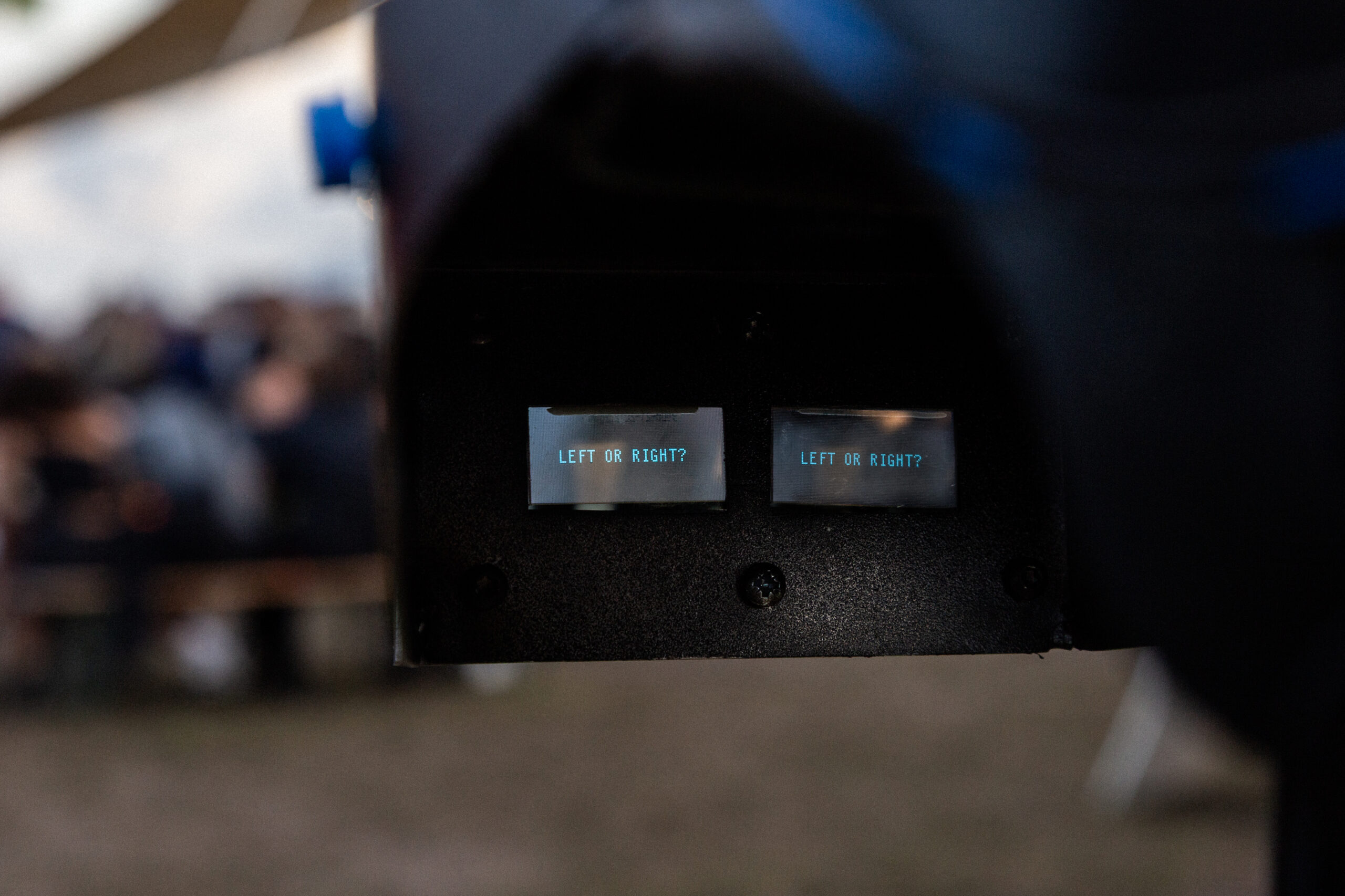
The decision-making process of the individual is touched implicitly in Kill Heroes, which then manifests in Left or Right?. An interactive installation in collaboration with artist Natascha Christina Petersen for O-day festival. In Left or Right?, questions become the only key to proceed through the experience: AR glasses with a chunky design — exposed colourful electronic wire and a long heavy chain at the back — navigate visitors with questions overlaying on reality. By hitting the arcade button on the side, visitors turn left or right accordingly within the space framed by towering columns.
Lila’s practice is not simply a one-way transmission of ideas, but a dialogue built up brick by brick through questions. There is no conclusion, solution, or answer handed over at the end of each work. These works lead to a door that encourages us to see, to inquire, and to understand ourselves and the associated world. Each work is a branching system that unfolds one perspective of her thematic topic, constituting a diverse but coherent conceptual system. Lila’s methodological collage of philosophical thought and embodied experience, humour and seriousness, game and surveillance system, contributes to a general aesthetic of absurdity that bounces back the phenomenal images of reality. An analogy comes to me that could be a good summary of Lila’s practice: a ton of cotton — illusory light but heavy substantially. What would be the next bomb of questions for us?

