

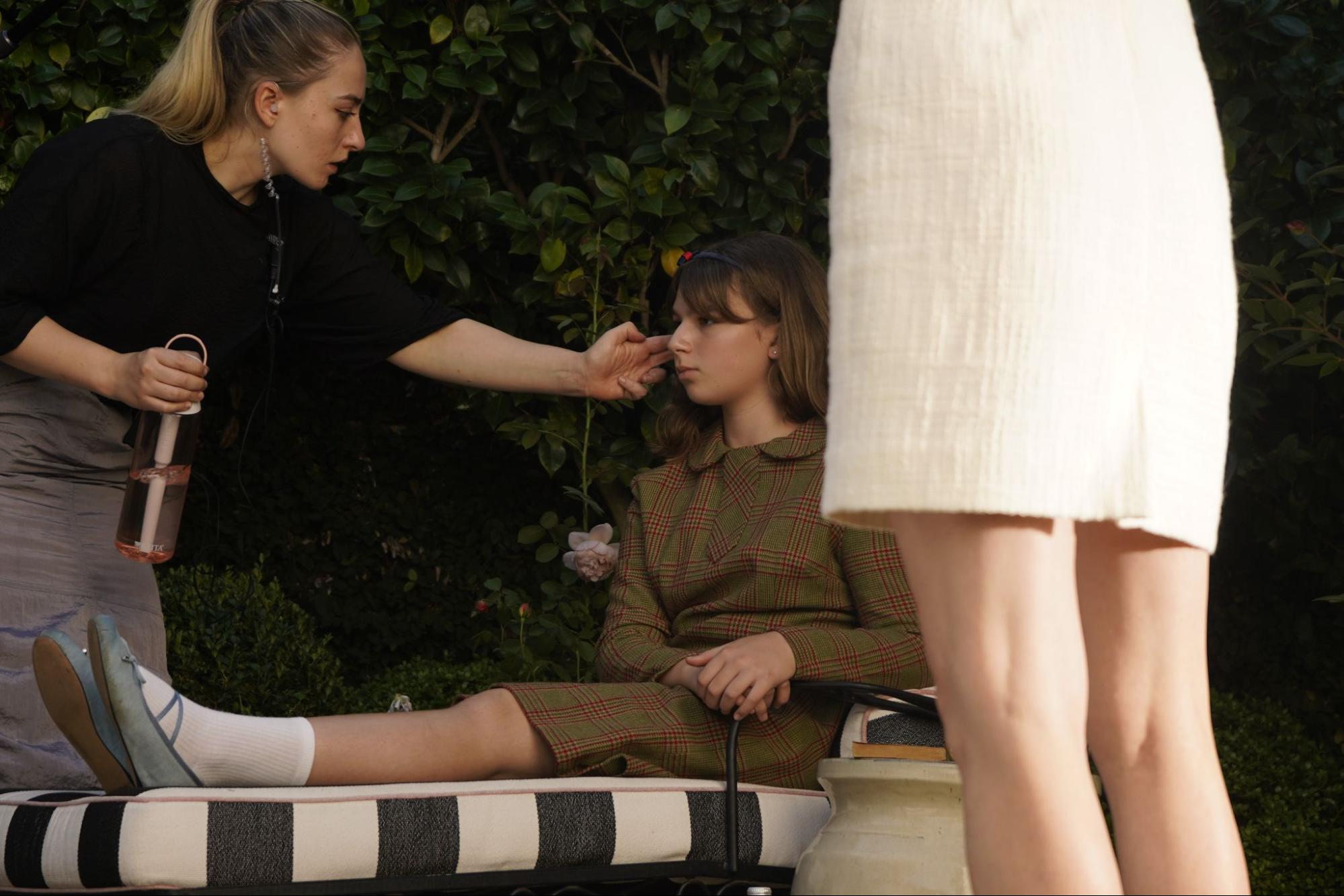
From a silent matriarchal society in 2071 to a darkroom borrowed from a war photojournalist, the AFI-trained designer is among a new generation of production designers being asked to build cinematic worlds for which no reference exists — and she has a method for doing it.
Across the independent film circuit, speculative and genre work has surged. Festivals from Fantasia to Sundance increasingly platform near-futures, alternate histories, and invented worlds. The shift has placed a particular kind of demand on production designers: how do you build a world for which no reference image exists?
Elli Kypriadis has spent the past year answering that question.
Song of Silence, a speculative drama set in 2071 among a mute, ritualistic matriarchal community following a global war, asked her to invent every register of a civilisation from scratch — the textiles, the tools, the ritual objects, the surfaces left behind by a culture that has stopped speaking. The film has since screened at Fantasia International Film Festival, Dances With Films New York, Cinequest, and AFI Fest, earned a nomination from the Television Academy Foundation, and now has a dedicated listing on MUBI.
It is one of three festival-recognised shorts Kypriadis has designed in the months since completing her MFA in Production Design at the AFI Conservatory in Los Angeles in August 2025. Alongside Coiled Serpent and a slate of commercial work — including a major Rakuten Viki campaign featuring Will Poulter — she has built a body of recent work that puts her at the centre of independent cinema’s speculative turn.
She has a working theory about how the job gets done.
“A film’s world is held together by its things,” she says. “The objects in a room have already lived through something by the time the camera arrives. If you choose them well, the audience feels that before they can name it.”
Worlds Without Reference
When the world doesn’t exist, every object that goes into it is a decision about how that civilisation operates. Speculative production design, in this sense, is a form of writing.
“When the world doesn’t exist, every object you place in it is a decision about how that civilisation eats, mourns, prays, remembers,” Kypriadis says. “You are essentially writing — but three dimensionally, through the objects.”
It is the part of the work she loves most. Song of Silence required her to invent the visual logic of a society that communicates without language — what its tools look like when there is no oral tradition to pass down their making, what its rituals look like when they have replaced speech as the binding social act. Coiled Serpent, her other recent festival short, posed similarly invented questions.
The discipline, she suggests, is becoming central to how independent cinema works. “There’s a real appetite right now for stories that take audiences somewhere they haven’t been,” she says. “But the worlds have to feel inhabited. If they don’t, the genre falls apart.”
The other half of Kypriadis’ method is the opposite move: not inventing a world, but recognising one.
The clearest illustration came on an independent short film set in a photographer’s darkroom in 1997. Kypriadis could have built the room from scratch — but what she wanted was the lived weight of one. She found it through social media: a war photojournalist in the San Fernando Valley had kept his original working darkroom intact, every enlarger, chemical tray, and roll of tape in place for decades. The owner agreed to let the production borrow the equipment.
“What we got was the sense that the room had a life and a purpose before we walked into it with a camera,” she says. “Each object had a history. The room had archaeology.”
It is a phrase she returns to often — the archaeology of a room. The work of a production designer, in her view, is partly invention and partly literacy: the ability to read the residue of what has happened in a space, and to render that residue legible to a camera. Speculative work asks one register of that skill. Realism asks another.
Kypriadis’ interest in objects predates film. At the University of Bristol, where she earned a BA in Theatre and Performance Studies after a foundational diploma in Art & Design and 3D Design at the Manchester School of Art, she was trained first in the language of scenography — the idea that every object on stage is a deliberate signal to an audience.
“Theatre teaches you that a chair isn’t just a chair,” she says. “It’s the chair this character chose. Or something completely different, a car seat, a wall. You learn very early to look at objects the way an audience will.”
Her early film credits ran across British production — work distributed globally on Hulu and Disney+, BFI-funded short films, and commercial content for Bentley Motors. The MFA at AFI brought her to Los Angeles, where the same instinct now operates at American scale.
The same thinking carries into Kypriadis’ commercial work. Recently, she served as production designer on a major Rakuten Viki campaign featuring Will Poulter. Earlier in 2026 she designed promotional content for Amazon Music Live, shot a commercial for the nutrition and wellness brand Yazio, and contributed production design across a slate of short films and campaigns including work for Marvel.
It was her commercial work that brought her an invitation to join the Art Directors Guild (IATSE Local 800) — formal recognition from the union representing the production designers, art directors, scenic artists, and illustrators working at the top of American film and television.
“A thirty-second spot still has a world,” she says. “It is smaller, and it has to do its work faster, but the question is the same. Do the objects in this frame add up to a place the audience can believe? If they do, you have earned the next thirty seconds.”
Kypriadis is now turning toward feature-length work, particularly with independent and emerging directors — the form, she suggests, best suited to the kind of immersive world-building she has been practising at shorter scales. With speculative and genre cinema continuing to gain ground in the independent space, the demand for designers who can invent at that level is likely to grow.
What stays the same is the love of the work itself.
“I don’t think the love of building worlds wears off. If anything it gets bigger. There are so many worlds I haven’t built yet.”

