

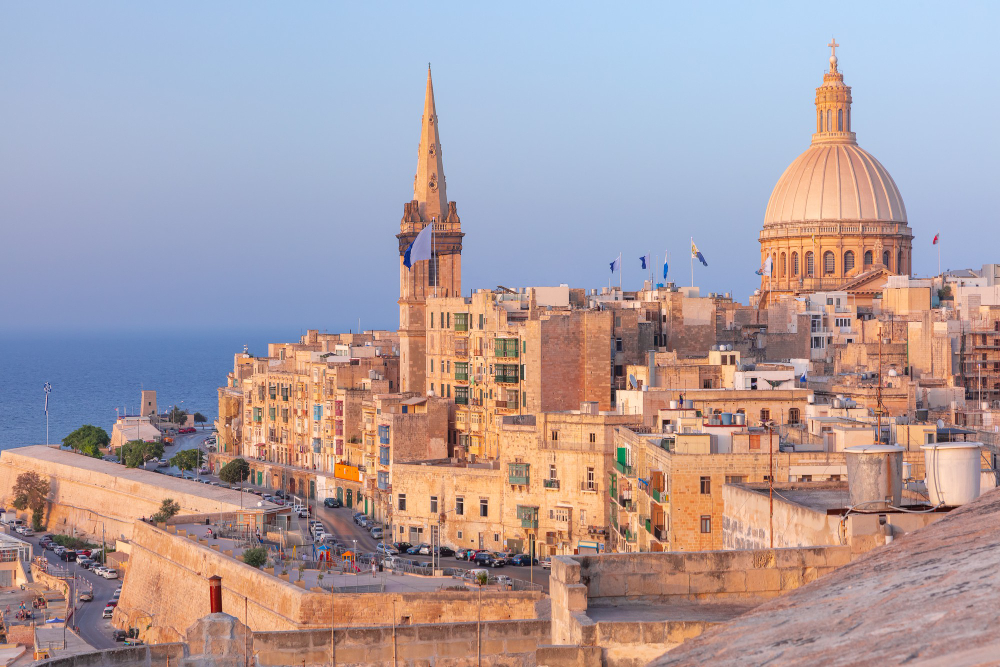
Malta occupies a peculiar position in the European cultural imagination. An archipelago smaller than most capital-city suburbs, it has accumulated more UNESCO heritage density per square kilometre than almost anywhere else on the continent, hosted one of Europe’s most celebrated Capital of Culture programmes in 2018, and built a contemporary arts infrastructure that punches well above what its population of half a million would suggest. Valletta’s limestone grid holds Baroque cathedrals, a Renzo Piano parliament building, and a growing network of independent galleries and performance spaces that draw residency artists from across Europe. Outside the fortified walls, the Malta Carnival, Notte Bianca, and the international jazz and film festivals create a cultural calendar that runs for most of the year. What is less discussed in arts-and-culture circles, but increasingly relevant to how Malta funds that calendar, is the island’s parallel role as Europe’s most established hub for licensed digital entertainment operators, a sector that contributes a significant share of the economy and employs thousands of creative, technical, and compliance professionals who live alongside the artistic community.
That dual identity matters because Europe’s cultural-funding conversation is changing. Public arts budgets across the continent face pressure from competing fiscal priorities, and the countries that sustain cultural investment most effectively are often the ones that have found non-traditional revenue streams to supplement government grants. Malta’s digital-entertainment licensing sector generates direct tax revenue, supports a professional-services ecosystem, and creates a population of well-paid expatriate workers who consume local culture, rent studio space, buy gallery tickets, and attend festivals. Understanding how that economic layer interacts with the cultural one is not a detour from the arts story. It is part of it.
Malta’s licensing framework has also shaped consumer access in other European markets. Finnish users, for instance, rely on directories that compile mga kasinot to identify operators that hold Malta-issued licences and offer Finnish-language service. As Finland prepares to open its own licensed market in 2027, Malta-licensed operators are among the early applicants, carrying compliance practices refined over two decades of cross-border European operation.
Valletta’s Cultural Renaissance and the 2018 Legacy
When Valletta was named European Capital of Culture for 2018, the programme delivered more than 400 events and brought 1,500 artists from across the world to a city whose permanent population sits around 6,000. The programme was transformative not because of its scale, which was modest by London or Berlin standards, but because of its density. Every fortified street, every repurposed chapel, and every waterfront promenade became a venue. The Design Cluster, housed in a converted bakery complex, opened as a permanent co-working and exhibition space for creative entrepreneurs. The National Community Art Museum launched in a former residential building to make contemporary art accessible beyond the established gallery circuit. The 2018 programme ended, but its infrastructure stayed. Valletta today has more cultural venues per resident than at any point in its 450-year history, and the annual calendar has expanded to fill them. The Malta Arts Council disbursed 5.4 million euros through funding programmes in 2024, a figure that reflects both government commitment and the economic capacity to sustain it.
How Malta Funds Its Arts Through an Unusual Economic Mix
Malta’s economy is unusual among European microstates because it has diversified beyond tourism and financial services into sectors that generate high-value employment and steady tax revenue. The digital-entertainment licensing sector, which has been operating for over two decades, employs more than 10,000 full-time workers on the island, the majority of whom are expatriates drawn from across Europe. Those workers contribute to the local economy through housing demand, consumer spending, and participation in cultural life. The tax revenue generated by licensed operators flows into the general budget, from which arts and culture funding is drawn. This does not mean that the licensing sector directly funds the Malta Carnival, but it means that the fiscal base that supports public arts spending is broader than it would be if Malta relied solely on tourism and financial services. The Arts Council’s 5.4 million euro disbursement in 2024, the Design Cluster’s operations, and the subsidised studio-space programmes for emerging artists all depend on a tax base that the licensing sector helps sustain.
The Expatriate Creative Community and Cross-Pollination
One of the less obvious cultural effects of Malta’s licensing sector is the expatriate community it has created. Thousands of young professionals from Sweden, Finland, the UK, Germany, and Southern Europe have relocated to Malta for technology and compliance roles, and many of them bring creative interests and spending habits that feed into the local arts scene. Gallery openings in Valletta draw a noticeably international crowd. The independent music scene has grown in tandem with the expatriate population. Studio-space demand in the Sliema and St Julian’s corridor has risen as creative freelancers working adjacent to the tech sector look for workspace that doubles as exhibition space. The cross-pollination is informal rather than programmatic, but it is real. Malta’s contemporary arts ecosystem benefits from an audience that is more internationally diverse, more digitally literate, and more accustomed to paying for cultural experiences than the resident population alone could provide.
The Festival Calendar and What Sustains It
Malta’s cultural calendar is dense relative to the island’s size. Notte Bianca, held annually in Valletta, transforms the capital into an open-air gallery and performance space for one evening, drawing tens of thousands of visitors into streets that are normally quiet after dark. The Malta International Jazz Festival runs on the Grand Harbour waterfront. The Valletta Film Festival showcases Mediterranean and international cinema in venues that range from converted warehouses to open-air courtyards. The Malta Carnival, one of Europe’s oldest, fills the streets of Valletta and Floriana with floats, costumes, and satirical performances every February. Each of these events requires sponsorship, venue infrastructure, and audience. The sponsorship comes partly from government grants and partly from private-sector partners, including firms in the licensing and technology sectors. The venue infrastructure was expanded during and after the 2018 programme. The audience is sustained by a combination of local residents, tourists, and the expatriate professional community that the island’s tech and licensing sectors have attracted.
How European Capital of Culture 2031 Is Shaping Malta’s Next Chapter
Malta is already looking ahead to its next major cultural milestone. The selection process for European Capital of Culture 2031 shortlist in Malta saw Victoria, on the island of Gozo, shortlisted by a panel of independent experts in November 2025. The candidate has until summer 2026 to complete its application, with a final selection expected in September 2026. If Victoria is designated, the programme would bring a second wave of cultural infrastructure investment to the archipelago, this time focused on Gozo’s rural landscapes and smaller-scale creative community, and would extend the legacy of Valletta 2018 into the next decade.
The Mediterranean Creative Corridor: Malta, Sicily, and Tunisia
Malta’s cultural identity has always been shaped by its position between Europe and North Africa, and the contemporary arts scene reflects that geography. Collaborative projects between Maltese, Sicilian, and Tunisian artists have grown in frequency over the past five years, supported by EU cross-border cultural funds and by the physical proximity that makes a Valletta-Palermo or Valletta-Tunis trip shorter than a train ride from London to Edinburgh. The Mediterranean Creative Corridor, a loose network of artist residencies, gallery exchanges, and festival co-productions, has started to function as a distinct cultural zone that sits outside the Northern European art-market mainstream. For emerging artists, the corridor offers lower living costs, studio availability, and access to audiences that value craft traditions alongside contemporary practice. Malta sits at the geographic and logistical centre of that network, and its cultural infrastructure, built up through the 2018 programme and sustained by the broader economy, makes it the natural hub.
Music Touring and Malta’s Place on the European Circuit
Live music touring across Europe has recovered strongly since 2022, and Malta has started to appear on routing schedules that would have bypassed the island a decade ago. Recent coverage of major global tour announcements spanning Europe illustrates the scale of European touring in 2026, with artists routing through dozens of cities across the continent. Malta’s venues cannot compete with arena-scale stops, but the island’s mid-size spaces, such as the Mediterranean Conference Centre and the Granaries open-air venue in Floriana, have started to attract artists looking for intimate European dates that sit between the major-city runs.
Digital Culture, Streaming, and the Blurred Line Between Art and Tech
Malta’s dual identity as a cultural destination and a technology hub creates an environment where the boundaries between art and technology are unusually porous. Digital artists, VR experience designers, and interactive-media creators have found Malta appealing for the same reasons that technology firms did: a compact English-speaking environment with EU membership, reliable infrastructure, and a cost base lower than London, Berlin, or Amsterdam. The Arts Council’s Creative Industries Platform, launched to give creative entrepreneurs the skills and support needed to launch a business, sits at the intersection of these two worlds. It serves fashion designers and filmmakers alongside app developers and digital-media producers, and the shared workspace model encourages cross-disciplinary collaboration. The result is a creative ecosystem that does not draw hard lines between the cultural and the commercial, which is increasingly how the most interesting work in European arts is being produced.
What Malta’s Cultural Economy Tells Us About Sustaining the Arts
The broader lesson from Malta’s experience is that cultural sustainability depends on economic breadth. Islands and small states that rely on a single revenue source find it difficult to maintain arts funding when that source contracts. Malta has avoided that trap by building an economy that includes tourism, financial services, digital entertainment licensing, and a growing technology sector, each of which contributes to the tax base and to the professional community that supports cultural institutions. The 2018 Capital of Culture programme demonstrated that a small city can punch above its weight when infrastructure investment and audience demand align. The 2031 candidacy suggests that the model is replicable on Gozo, with different scale and different emphasis but the same underlying logic. For arts-and-culture audiences elsewhere in Europe, Malta offers a case study in how a place with limited space and limited population can build a cultural ecosystem that is internationally relevant, economically sustainable, and continuously evolving. The answer is not just government funding or private patronage. It is the combination of both, sustained by an economy diverse enough to keep the money flowing even when individual sectors cycle.

