

Screens are no longer tied to specific functions or places. We move between them constantly — at home, in transit, in waiting rooms, hotels, offices, cafes, and public spaces. They shape how we consume information, communicate, and experience culture. Increasingly, they also shape how we encounter art.
The growing presence of screens in everyday life is changing the role of digital art itself. Media works are no longer limited to museums, festivals, or temporary installations shown for a fixed audience and a fixed period of time. Instead, they can exist as part of everyday visual environments — integrated into the spaces people already inhabit throughout the day. CIFRA expands the ways digital works circulate and are experienced, allowing media art to become less event-based and more continuous: something encountered casually, repeatedly, and alongside daily routines.
CIFRA is building a different kind of infrastructure for digital art, creating new ways for it to exist beyond the traditional exhibition cycle. Bringing together artists, curators, institutions, and audiences within one ecosystem, the platform combines access to works with curated selections, editorial framing, and long-term visibility. Moving across formats including video art, sound works, AI-based practices, audio art, and other forms of contemporary media art, CIFRA approaches digital culture as an evolving environment. Works that can be discovered gradually, revisited over time, and experienced in different contexts and ways of perception.
CIFRA operates as a curatorial environment shaped by human expertise instead of algorithmic recommendation. Audience participation and discovery are structured through public playlists, editorial pathways, and guided explorations, encouraging more intentional engagement with works, practices, and histories and moving away from passive scrolling.
The platform has an international Artistic Vision Council bringing together leading figures in media art and digital culture, including Olga Shishko, Lev Manovich, Daniela Arriado, David Elliott, Christiane Paul, Oliver Grau, and Martin Honzik, who help shape the platform’s editorial direction and seasonal programming.
Encountering media art no longer necessarily requires entering a museum or waiting for a major event. It can happen at home, during moments of transit, through personal devices, or within shared environments that people move through every day. In this sense, digital art is becoming less isolated from daily experience and more integrated into the visual language of contemporary life itself.
Central to CIFRA are curated playlists that connect works through shared themes, atmospheres, and artistic approaches. The playlist below, curated by Olga Shishko, Chair of Artistic Vision Council, brings together works from CIFRA that reflect on mythology as a form of knowledge and explore how contemporary artists reinterpret relationships between technology, nature, identity, and perception.
Mariano Sardón, The Wall of Gazes
Created through an experiment conducted in Buenos Aires, the work tracks the eye movements of viewers observing portraits of other people. Sardón reveals the areas that escape perception — the “blind spots” in human observation. The piece reflects on the limitations of visual knowledge and suggests that understanding another person requires more than sight alone.
Sergey Kishchenko, The Duck Test
Set within the ruins of an industrial factory, the performance film follows the figure of the Duck Man moving through a landscape marked by labor, destruction, and transformation. Soil mixed with sweat, oil, and blood becomes a symbolic terrain where identity is unstable and constantly shifting. The work explores mythic cycles of creation and collapse.
Angelika Markul, Deadly Charm of Snakes
The film combines mythology, politics, beauty, and violence through the symbol of the snake. Referencing both the political atmosphere of the Trump era and ancient representations of feminine power, the work explores fear, aggression, and the enduring force of nature.
Almagul Menlibaeva, Steppen Barocco
Focusing on female identity in Central Asia, the work follows seven women whose connection to natural forces establishes continuity with ancestral memory, spirits, and the landscape of the steppe.
Giuliana Cunéaz, Quantum Vacuum
Set within a virtual environment performed by an actor, the work merges ritualistic and religious references with digital space, creating a hybrid environment between spirituality and technology.
Bjørn Melhus, Auto Center Drive
Using reconstructed voices of cultural icons including James Dean, Janis Joplin, Marilyn Monroe, Elvis Presley, and Jim Morrison, the work recontextualizes familiar figures from popular culture and examines how media continues to shape collective memory.
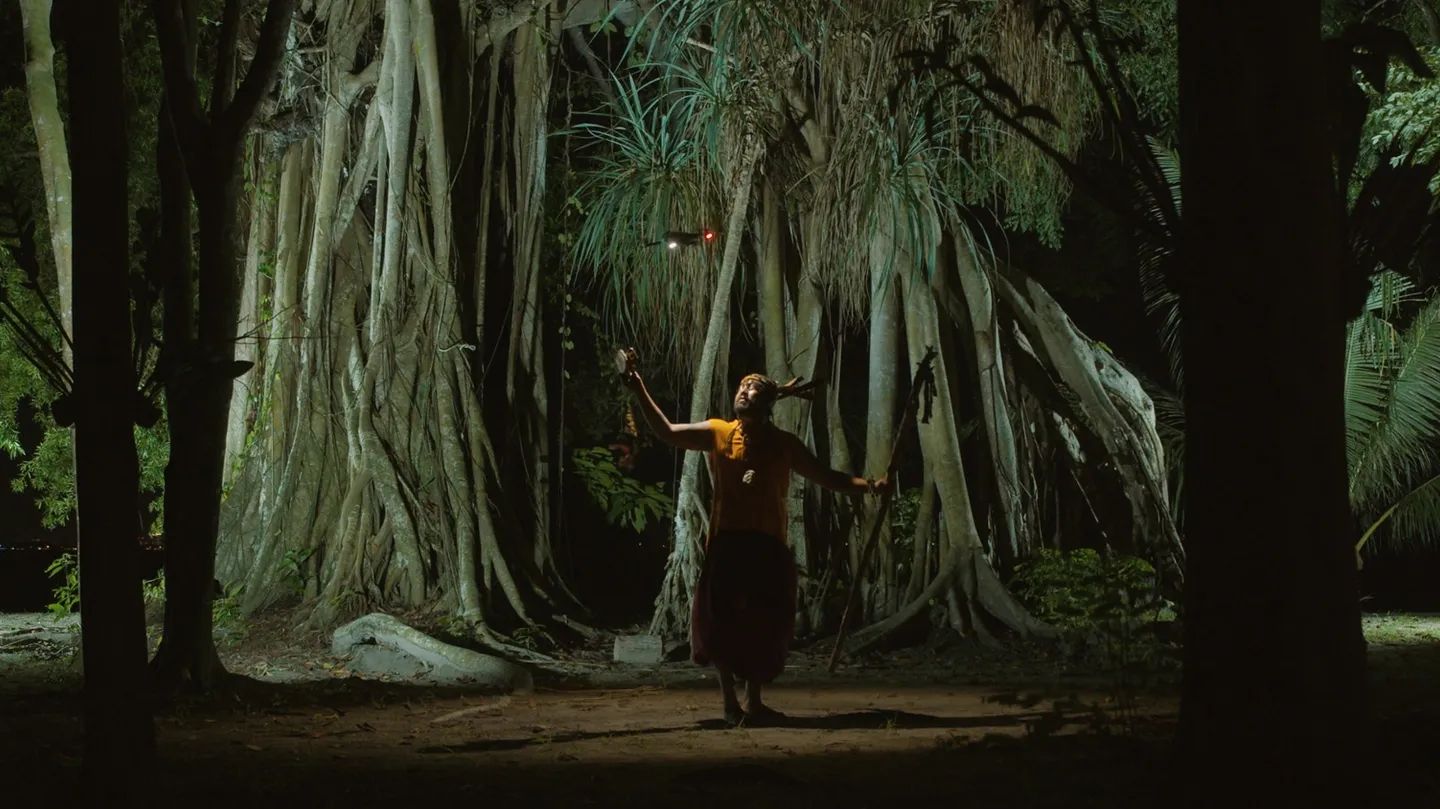
Chen Zhou, The Story of Nanka Gulu and Iron Hawk
The film follows a drone that escapes from a factory in search of ancient wisdom. After being adopted and renamed by Nanka Gulu, the machine gradually reconnects with nature, reflecting on technological alienation and the human desire to return to the natural world.
Bjørn Melhus, Sugar
In a post-apocalyptic future, the humanoid robot SUGAR attempts to restore human touch and emotional connection. Encountering a man isolated in an underground techno-environment, the robot tries to lead him outside, raising questions about self-awareness and isolation in contemporary capitalist society.
Alexandra Dementyeva, Alien Space
Combining imagery of aliens, robots, and television culture, the installation explores how myths evolve within technologically driven societies. The work imagines “space” as a symbolic realm populated by new gods and fictional beings, questioning the boundaries between imagination, media, and belief.

