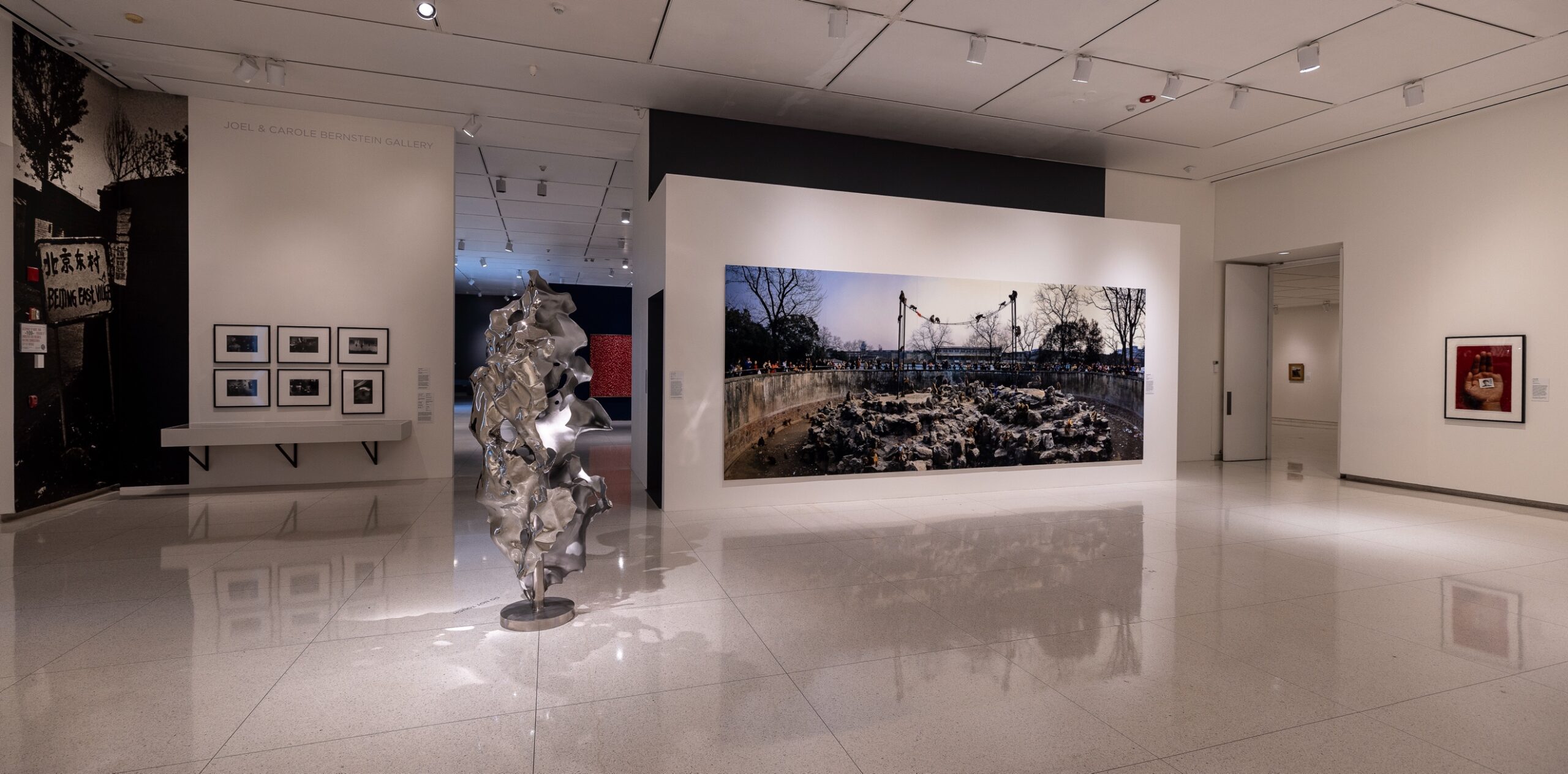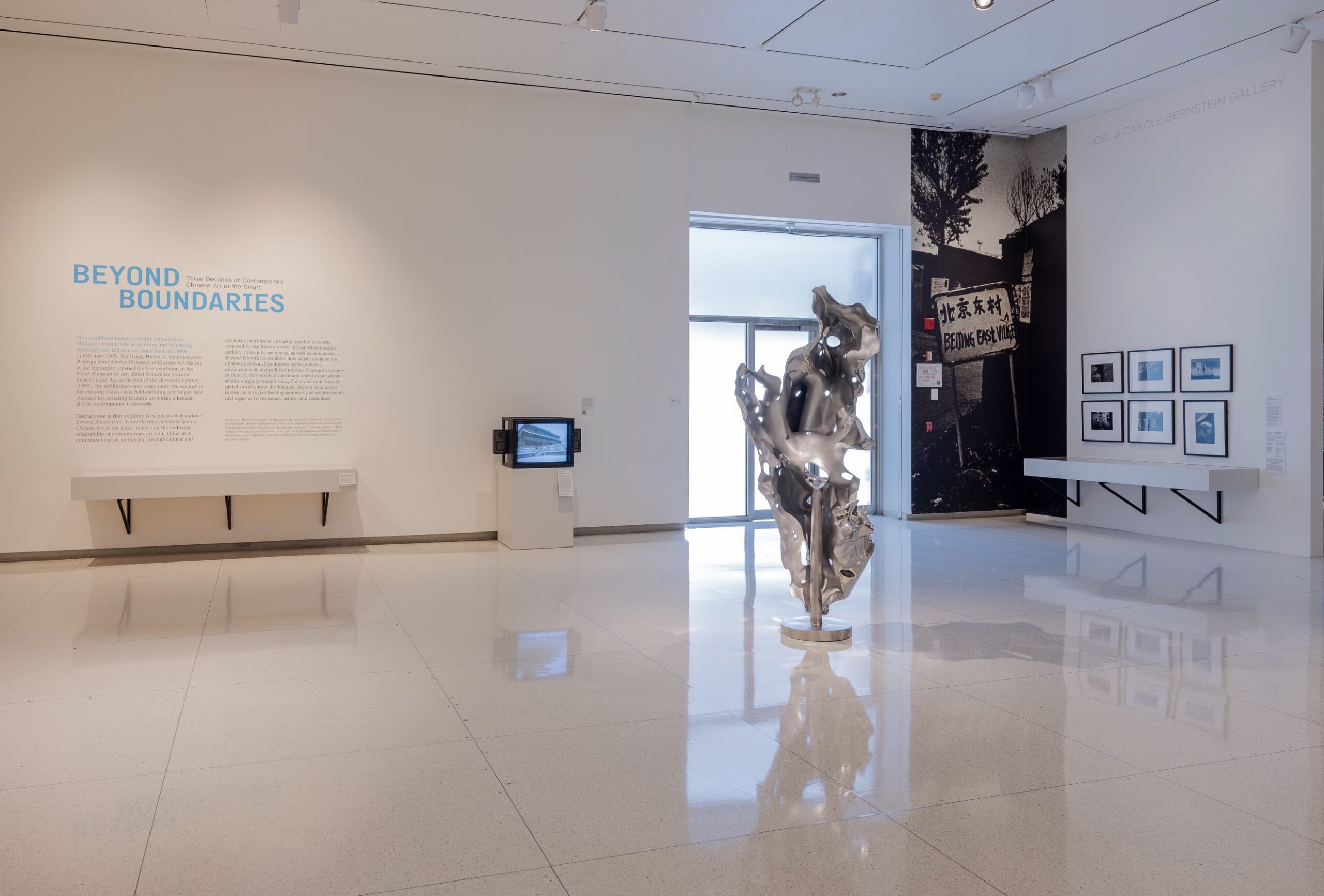
This April, one of the most significant exhibitions, Beyond Boundaries: Three Decades of Contemporary Chinese Art, took place at the Smart Museum on the University of Chicago campus. It was conceived as a response to art historian Wu Hung’s first exhibition at the same venue, Transience: Chinese Experimental Art at the End of the Twentieth Century (1999). The exhibition brings together three generations of contemporary Chinese artists to explore and reflect on the dynamic, ever-changing landscape of Chinese art.
In this group show, artists including Ai Weiwei, Rongrong, Mo Yi, Song Yongping, Wang Wei, Lu Yang, and Magicfeifei engage with history and society in ways that create a vision of China as chaotic, rapidly changing, sarcastic, and emotionally charged.
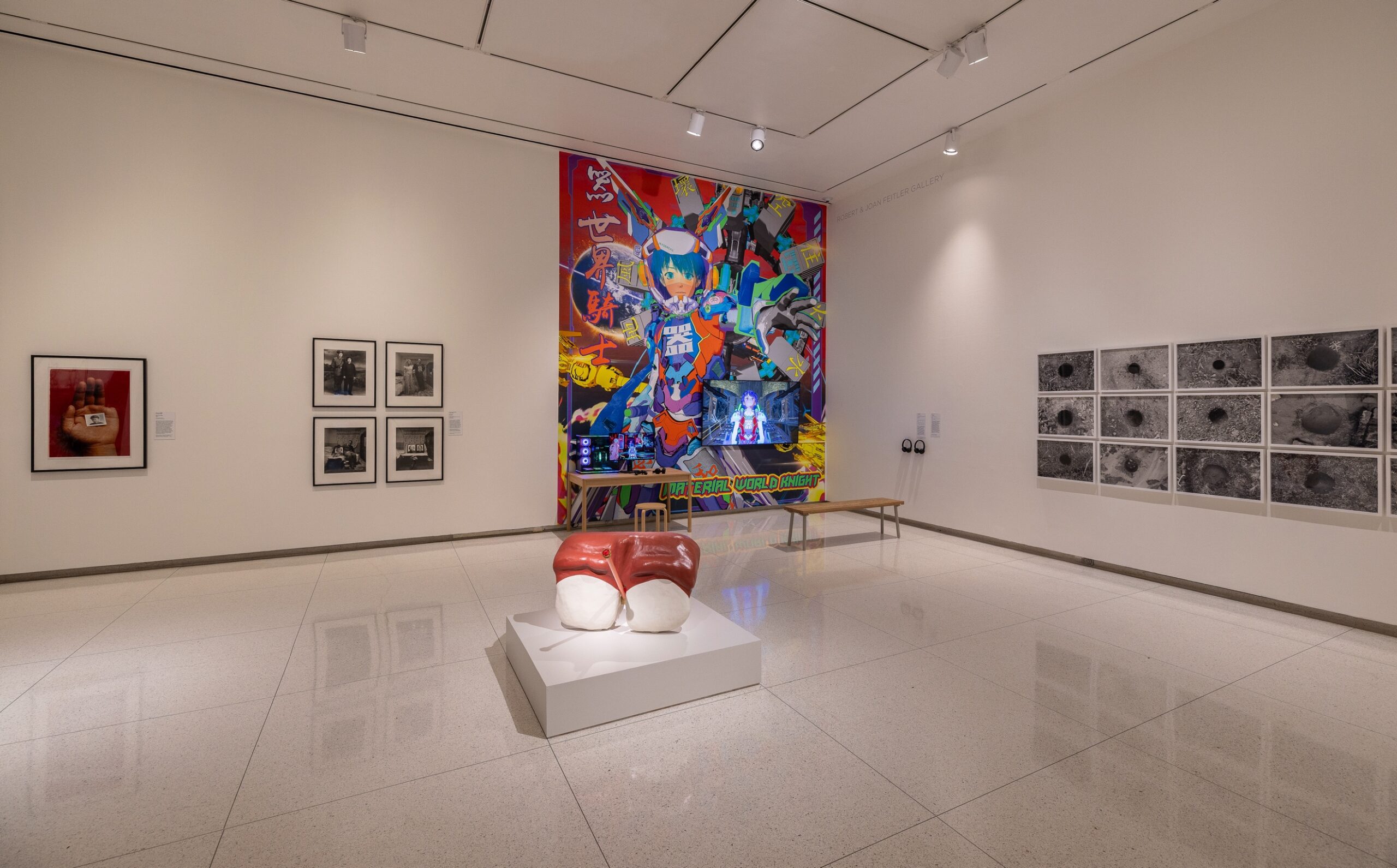
The exhibition begins with a glass shelf displaying Ai Weiwei’s Black Gray White-covered books with Rong Rong’s black and white film photography of performance art in Beijing East Village, alongside Zhan Wang’s Ornamental Rock, a stainless-steel sculpture shaped like a traditional Chinese garden rock. These works lead the audience into a larger space where Magicfeifei’s Toothgap and Magicwand stand on central plinths, with Lu Yang’s The Great Adventure of Material World, an interactive animation, behind them. Through content and materiality, viewers can discern the different periods in which each work was created. The heavy stainless-steel sculpture references Chinese architectural tradition while humorously responding to Western expectations: a traditional “Ornamental Rock” rendered in an extreme, polished Western material. Similar humor is evident in Magicfeifei’s works, though she employs a different strategy.
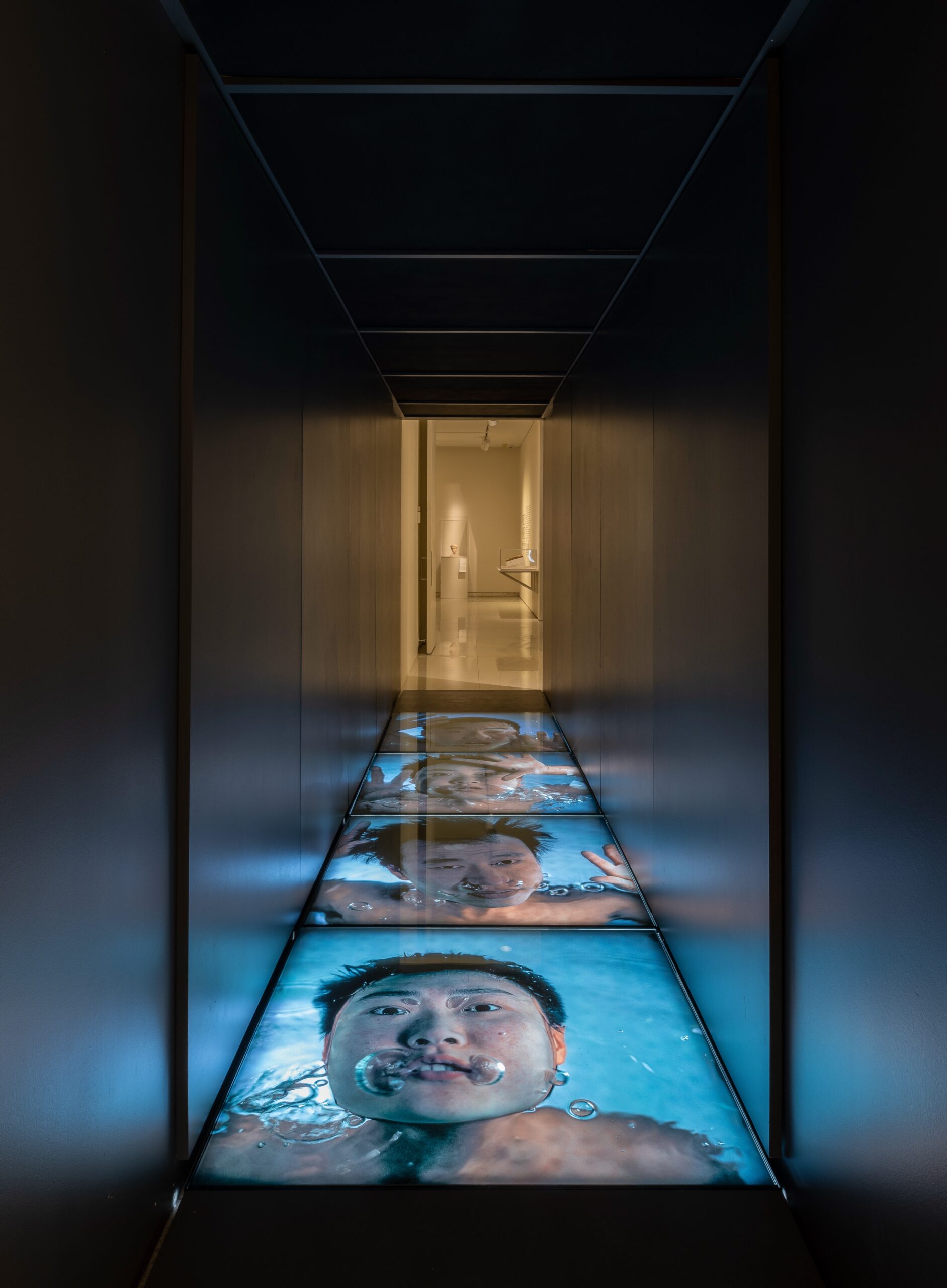
Magicfeifei is a Chicago-based artist whose work has been featured by the Chicago Reader and Sixty Inches From Center. Her recent solo exhibition, Emancipation Park, was also well received. She uses humour and sarcasm to engage audiences in a manner that recalls stand-up comedy, but unlike a comedian seeking to satisfy the crowd, she does not allow laughter to become an easy escape. Instead, she harnesses humour and cuteness to make viewers laugh while directing their attention towards the reality behind what amuses them.
In Toothgap and Magicwand, qualities conventionally understood as flaws are magically transformed into self-supporting structures, both physically and metaphorically. The exaggerated gap between teeth becomes not a defect to conceal but a form to celebrate. The cuteness in her work resonates with Lu Yang’s interactive animation, both drawing influence from Japanese animation culture since the 1980s, after China’s economic reform. Magicfeifei incorporates the visual language of Japanese pop culture into her own artistic expression, exaggerating “flaws” defined by patriarchal standards until they become indiscernible, compelling viewers to confront them. Unlike Ai Weiwei’s confrontational provocative gestures, Magicfeifei relies on “soft” power to engage audiences, the cuteness is as serious as seriousness itself.
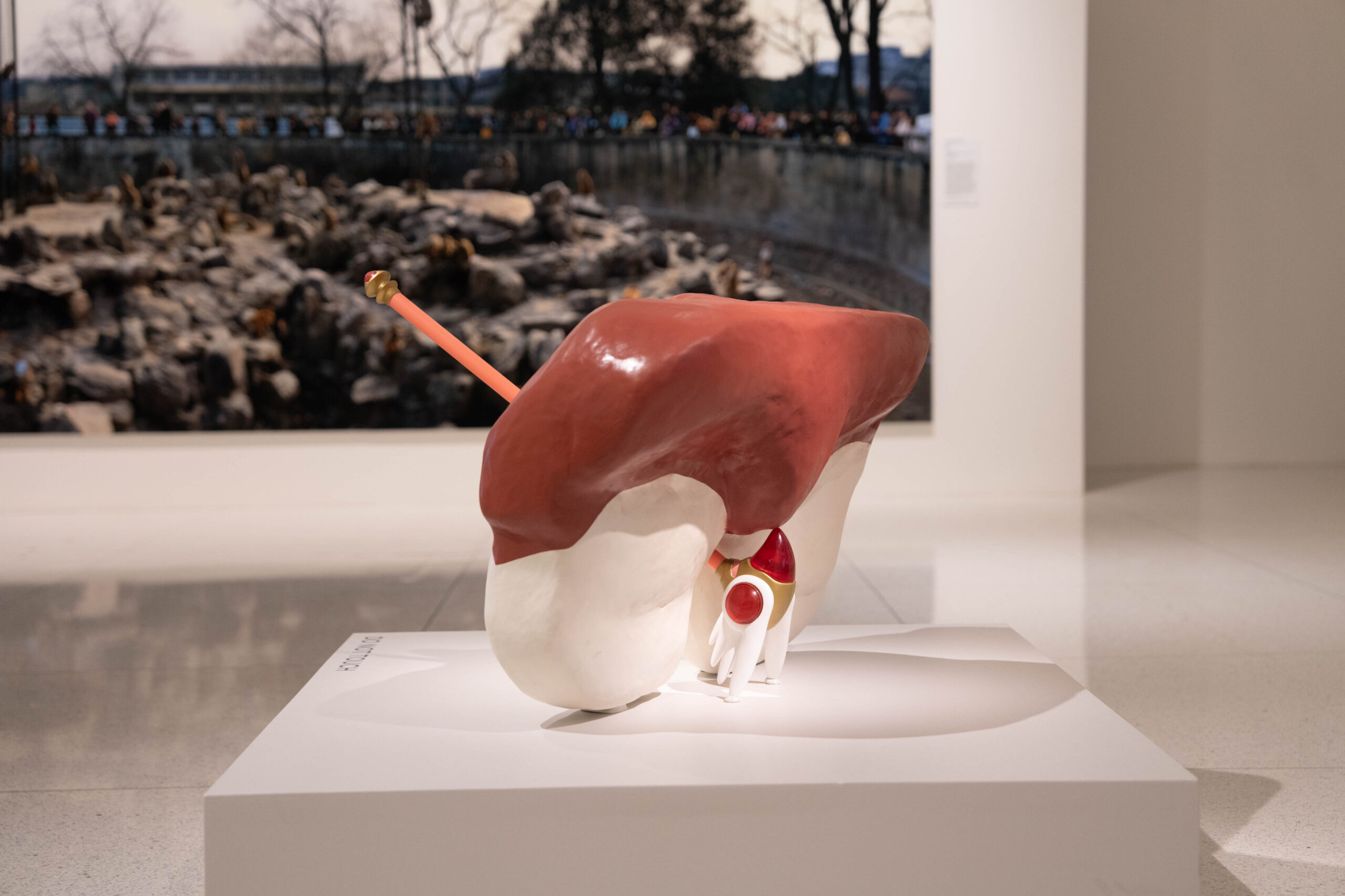
Photo by Faye Yingfei Liang
Magicfeifei also challenges stereotypes of “Chinese art” in the Western canon in Toothgap and Magicwand. When overtly political, click-bait content is absent, viewers must consider the rapidly changing social and cultural context of China and its contemporary cultural influences. The challenge lies in resisting the expectation that Chinese artists produce solemn, serious-looking work, a notion still prevalent in the Western imagination. As she stated during her artist talk at the Smart Museum, she does not wish to be labeled merely a “diaspora artist” if that implies conforming to Western expectations; rather, she aspires to be an artist who makes the institution nervous.
The exhibition, Beyond Boundaries: Three Decades of Contemporary Chinese Art, succeeds in offering a diverse and contemporary perspective on artistic practice in China. Rather than presenting a singular narrative, it reveals a multiplicity of voices, generations, and artistic strategies. As a response to Transience twenty years later, it is both a reflection and a continuation, inviting audiences to revisit fleeting moments, environments, and actions while considering how they resonate in the present.