

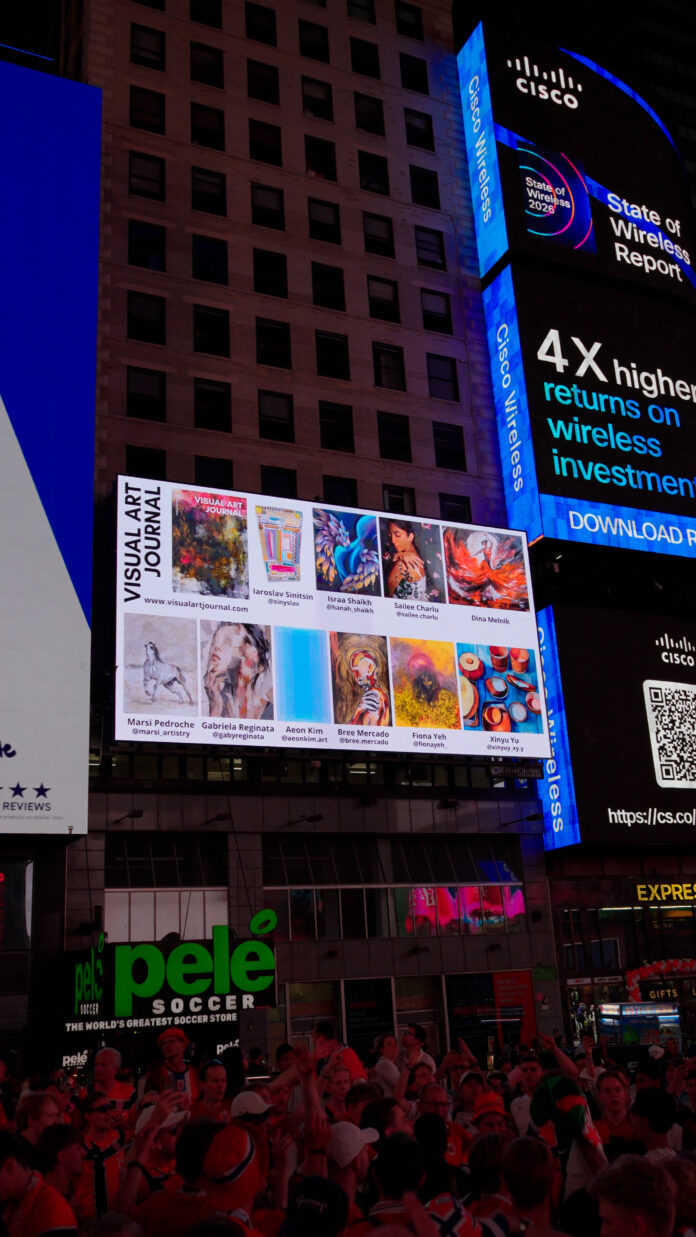
On June 21, 2026, Phoenix-based artist and designer Xinyu Yu presented Afternoon in Visual Art Journal’s Twenty-First Times Square Billboard Showcase, bringing her watercolor-and-pencil work to one of New York’s most visible public screens.
The day-long presentation brought together contemporary artists from around the world, placing their work amid the constant movement and visual intensity of Times Square.Surrounded by advertising, architecture, traffic, and pedestrians moving through Midtown Manhattan, each participating work entered a setting where images are usually designed to be seen quickly and at scale.
For Yu, the showcase created a new context for Afternoon. Originally made through watercolor and pencil, the work appeared on a large digital billboard, allowing a hand-rendered painting to take on a new life in public space. The presentation moved the work beyond the intimate conditions often associated with works on paper and placed it before viewers who may have come across it unexpectedly while passing through the city.
Afternoon centers on a closely arranged group of vessels and rounded forms set against a saturated blue field. Warm reds, oranges, browns, and pale-yellow surfaces create a dense field of color, while pencil outlines remain visible across the composition. The work’s cropped edges and overlapping forms give the image a compact, carefully organized structure that holds together even when viewed at a larger scale.
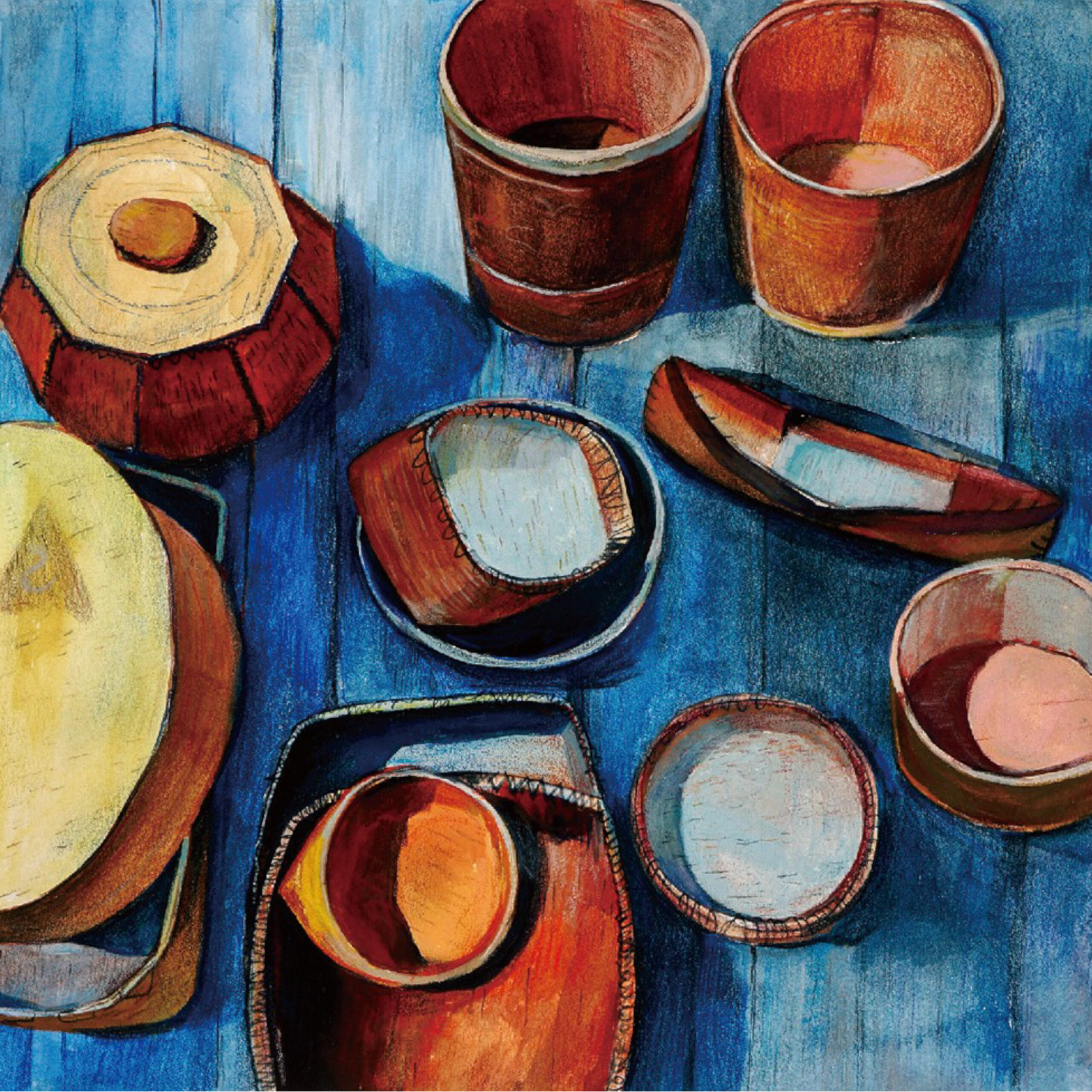
Those formal qualities proved surprisingly effective on a large public screen.Against the brightness and visual activity of Times Square, Afternoon offered a concentrated composition built through color, contour, and repetition. Its rounded vessels and contrasting blue ground created an image that could register quickly, while its visible pencil work and layered watercolor retained the sense of a painting made through close attention.
Yu’s participation also reflects the way her practice moves between fine art and design. Born and raised in China, she began with training in ink painting, watercolor, and oil painting before studying interior design at Pratt Institute and sustainable design at the University of Pennsylvania. Now based in Arizona, she continues to work across artistic and design-based approaches, with a particular interest in color, material, structure, and emotion.
Presented in the highly public setting of Times Square, Afternoon reflects ideas that have shaped Yu’s practice for years. Familiar objects become a way to explore color, rhythm, and emotional atmosphere rather than simple description. Her background in both painting and design gives these compositions a careful sense of structure while leaving room for intuition and spontaneity. As a result, everyday subjects take on an unexpectedly reflective quality.
For Yu, painting is less about recording what she sees than about expressing an emotional response to it.
In Afternoon, that approach appears through the relationship between familiar forms and the image’s more expressive use of color. The vessels remain recognizable, yet their arrangement is driven as much by visual rhythm and contrast as by description.
Times Square Billboard Showcase offered Yu a public platform outside the conventional gallery setting. The project placed contemporary work into a site shaped by constant motion and broad public access, where viewers encounter artworks under conditions very different from those of a gallery or museum.
By placing contemporary painting within one of New York’s most recognizable public spaces, the showcase also became part of the city’s broader cultural landscape. Rather than remaining confined to galleries or museums, works such as Afternoon entered the everyday visual experience of Times Square, where art exists alongside architecture, advertising, and the constant movement of urban life. In this setting, the painting became not only an exhibited work but also a temporary part of the city’s evolving visual culture.
Even on a large digital screen, Afternoon retained the qualities that define Yu’s painting practice: visible pencil marks, layered washes of watercolor, and carefully balanced forms. Rather than losing its intimacy, the work demonstrated how a quiet painting could hold its own within one of the world’s most visually saturated public spaces.
Presented amid the constant motion of Times Square, Afternoon showed that a quietly observed painting could command attention without relying on spectacle.

