

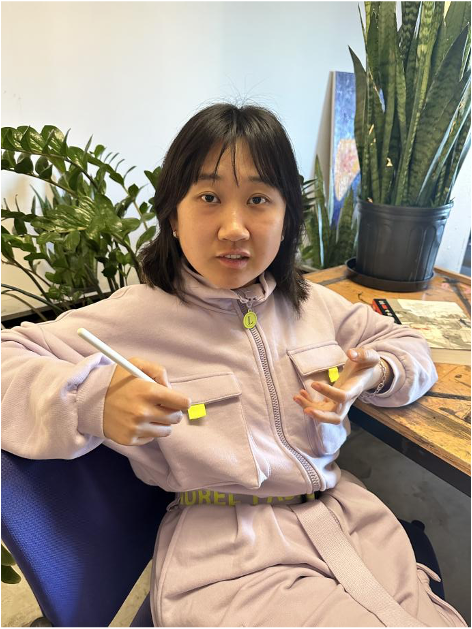
Milwaukee based illustrator Yuanyuan Zhou builds a distinctive visual world through vibrant color, stylized figures, and richly narrative scenes. Zhou has long been interested in the subtle yet enduring connections between people and the rhythms of everyday life: how a cup of tea can connect land and culture, how a plant can carry historical memory, and how an everyday custom can become a way for humans to engage with the natural world.
Looking through Zhou’s work, one rarely encounters grand theatrical gestures or scenes driven by dramatic conflict. Instead, the momentum of her storytelling comes from quieter moments unfolding through everyday life: the relaxed expression of a stranger in a café, the ways people gather and interact at a market, or the small rituals of making tea and preparing food. Such observations of the real world form the most immediate source material for her characters.
The figures in Zhou’s work bear a highly recognizable personal signature. Their bodies are gently exaggerated and their contours simplified, while subtle emotional nuances remain visible in their eyes and expressions. They possess the warmth and approachability of characters from a fairy tale without drifting into pure fantasy. Rather, they function as parallel reflections of the real world, carrying traces of the places and cultures from which they emerge. In scenes inspired by neighborhood tea houses in Türkiye, for example, people simply sit together and talk. Nothing overtly dramatic occurs, yet the atmosphere and texture of local life are preserved in their entirety.
Color, in Zhou’s hands, is more than a device for attracting attention. Highly saturated hues give her images an exuberant sense of life, yet restrained compositions keep that intensity in balance, preventing the work from becoming visually overwhelming. She also adapts her visual language to the demands of each subject. In observational scenes of everyday urban life, contours may be crisp and decisive, accompanied by abundant detail. When working with subjects rooted in cultures and places farther afield, she may soften or remove those hard edges, shifting the emphasis toward material texture and atmosphere.
This flexibility is also informed by her engagement with a wide range of media. Alongside digital illustration, her hands-on experience with RISO printing, bookbinding, and GIF animation continually introduces a tactile sensibility into her digital work. For Zhou, style is not a fixed template but an expressive tool—one that serves the story and changes with the subject at hand.
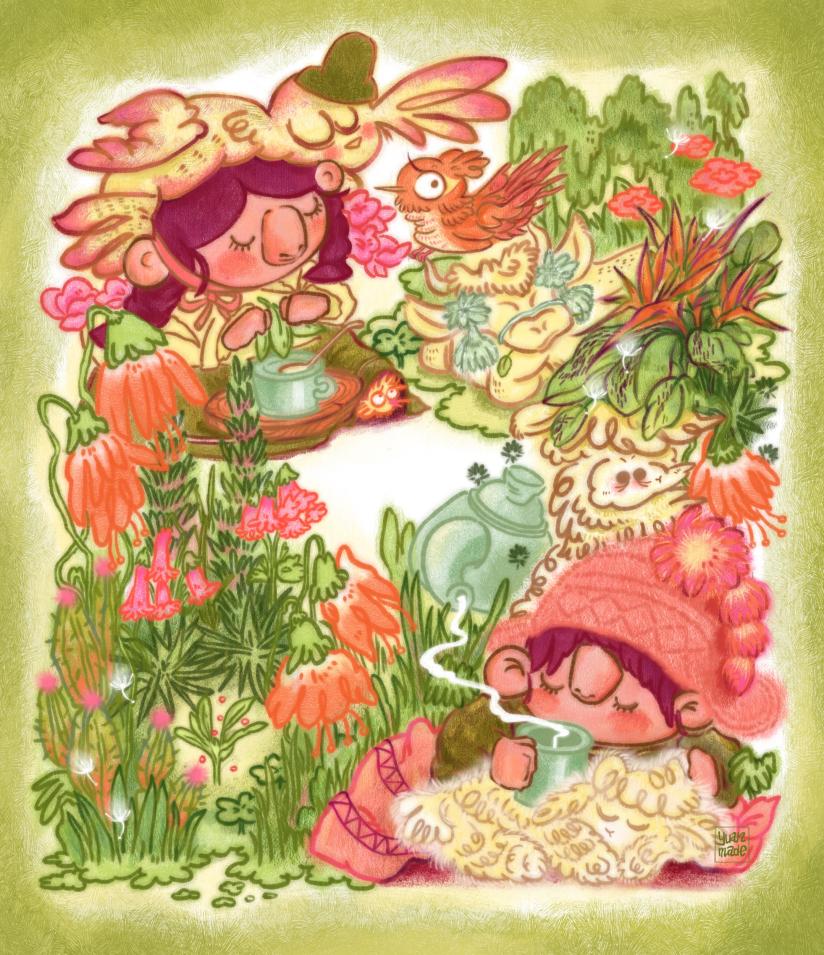
Her recent personal practice has increasingly centered on herbs, plants, and flowers, a body of work whose origins, once again, can be traced back to the ordinary rituals of eating and drinking.
Freshly Picked! began with something as simple as a tea recipe. As the project developed, Zhou’s attention gradually moved beyond the recipe itself toward an entire cycle of life: seeds germinate, plants grow, people harvest and prepare them, and they eventually become part of food, social interaction, and everyday ritual. Rather than turning the work into a botanical catalogue, Zhou employs a multi-scene composition in which harvesting, food preparation, gathering, and tea drinking unfold as miniature narratives scattered throughout the image.
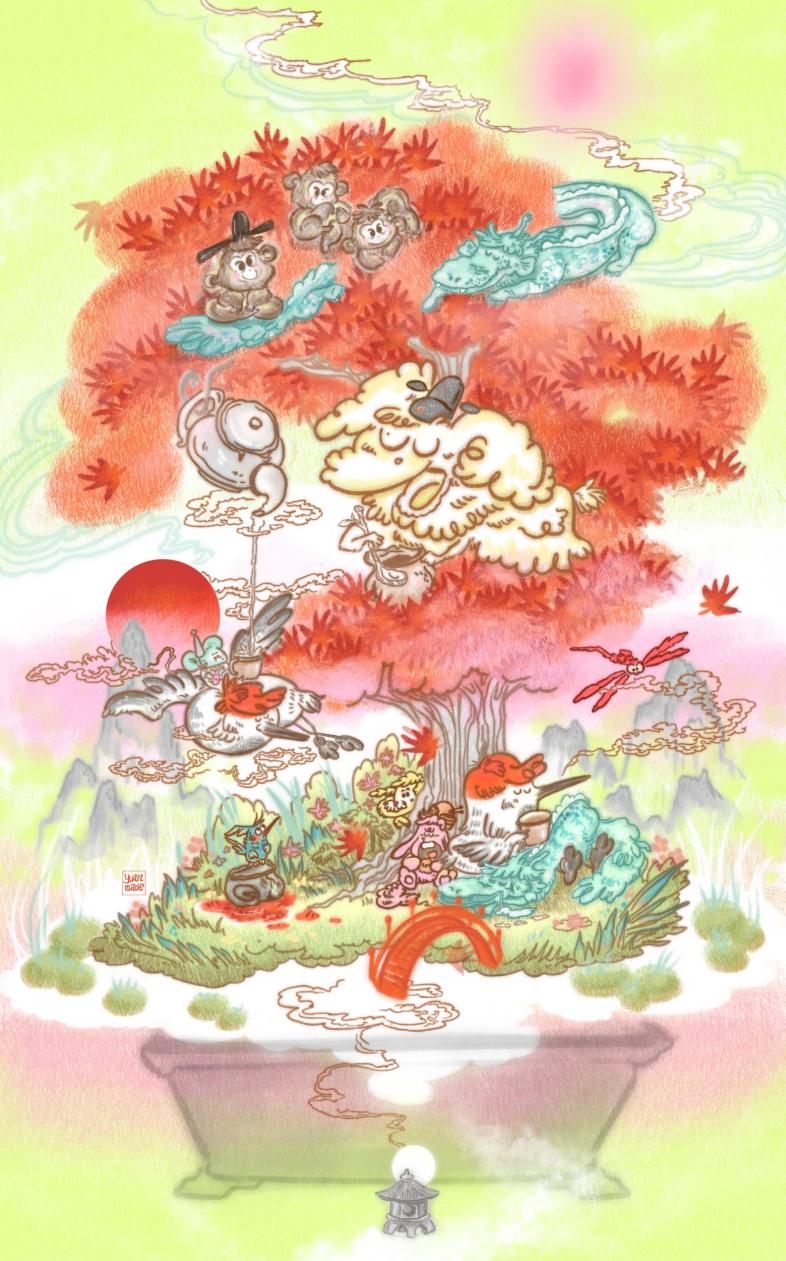
If Freshly Picked! looks inward to uncover the poetry embedded in everyday food rituals, Mate de Coca extends outward into a more complex exploration of cross-cultural understanding. The work grew out of Zhou’s own travels in Peru. The meaning of coca tea can shift dramatically depending on its cultural context. Rather than reducing the plant through the assumptions of an outsider, Zhou deliberately sets aside preconceived ideas in order to understand what coca means within local communities—as a gift from nature deeply rooted in everyday life and Indigenous traditions.
On the canvas, Zhou uses images to create spaces for cultural dialogue. Beyond the studio, her parallel roles as an educator and juror allow her to return the experience she has accumulated through her own practice to the wider artistic community. These roles do not compete for her attention; instead, they form an interconnected cycle in which each continually nourishes the others. Teaching prompts her to revisit and articulate her own creative process, while reviewing the work of emerging artists continually broadens her perspective on the field, feeding new insights back into her own artistic thinking.
As an AICAD Teaching Fellow at the Milwaukee Institute of Art & Design (MIAD), while also having taught at the Pennsylvania College of Art & Design (PCAD) and MICA Open Studies, Zhou’s teaching extends far beyond technical instruction. Drawing on firsthand experience with international commissions, gallery exhibitions, and public-facing projects—including her ongoing editorial work for The Guardian US, her solo exhibition Fresh at iidrr: Gallery in New York, she gives emerging artists a practical understanding of the profession: how to preserve an individual artistic voice within the constraints of commercial assignments, and how to build a sustainable long-term creative career. At the same time, the process of translating her experience into teaching gives Zhou an opportunity to reconsider the decisions and compromises that have shaped her own path.
Her frequent participation as a portfolio reviewer and juror has opened another window onto the contemporary illustration landscape. Through roles including Milwaukee National Portfolio Day Reviewer, 40th Anniversary Artscape Artist Market Juror, and PCAD Junior Student Portfolio Review Juror, Zhou has encountered the work of numerous emerging artists. For her, jurying is not about measuring every artist against a single standard or simply selecting winners. It is about protecting the plurality of artistic expression. Encountering the fresh ideas of younger generations allows her to recognize new currents within the field while simultaneously reconsidering the boundaries of her own practice—a process of continuous artistic renewal.
If teaching and jurying provide a path of inward reflection, exhibitions and international commissions propel Zhou’s practice outward, beyond the white cube of the gallery and into editorial pages and public spaces.
Her exhibition practice spans solo presentations, institutional group exhibitions, and public art. Her 2024 solo exhibition Fresh at iidrr: Gallery in New York brought together a body of work reflecting a particular stage in her artistic development. That same year, she participated in Dreams at Home, a MICA faculty group exhibition in Maryland, as well as Everyone Deserves Art at the Delaplaine Arts Center.
Zhou’s ongoing commissions for The Guardian US form an important part of her editorial illustration practice. Her contributions have ranged from title and spot illustrations for food features to a series of illustrations for Radical Thinking, as well as the title illustration for the social commentary feature The Lousiest CEOs of 2022. Through these projects, she uses images to engage with contemporary issues while balancing journalistic immediacy, the seriousness of the subject matter, and her own artistic language.
Beyond The Guardian, Zhou created a series of illustrations for The Enterprising Farmer for Full Bleed Magazine, developing a visual narrative around the relationships between agriculture, land, and people. She has also produced commissioned illustration for the independent publication Cake Zine, contributing her visual voice to independent editorial culture.
This sustained practice has also brought Zhou recognition across the international illustration community. Her accolades include Creative Quarterly CQ74 Runners-up, the iJungle 2024 Merit Award, and LICC 2024 Official Selection. She also received the 2024 PCAD Faculty Research and Practice Professional Development Grant, providing institutional support for the continued development of her creative practice.
Zhou exemplifies the multifaceted possibilities for contemporary illustrators: she responds to public‑interest themes through commercial commissions, pursues in‑depth cultural reflection in her personal work, and gives back to the industry through jury practice. Rejecting exoticized cross‑cultural narratives, she draws upon universal everyday experiences such as food and plants to foster empathy and understanding through imagery. Moving forward, she will keep exploring the cultural depth embedded in natural motifs and further expand the intellectual boundaries of illustration as a medium.

