Home Blog Page 10

Beck Shares Video for New Song ‘Ride Lonesome’

Beck has returned with a new single, ‘Ride Lonesome’. Marking his first original music since 2023, the laid-back track was mixed by Nigel Godrich. Check it out below, along with Beck’s just-announced tour dates.

Beck 2026 Tour Dates:

Sep 16 Vancouver, British Columbia – Queen Elizabeth Theatre
Sep 18 Woodinville, WA – Chateau Ste. Michelle
Sep 19 Portland, OR – Keller Auditorium
Sep 22 Santa Barbara, CA – Santa Barbara Bowl
Sep 23 Los Angeles, CA – Greek Theatre
Sep 25 San Francisco, CA – The Masonic
Sep 26 San Francisco, CA – The Masonic
Oct 1 Morrison, CO – Red Rocks Amphitheatre
Oct 3 Omaha, NE – Steelhouse Omaha
Oct 4 Kansas City, MO – Uptown Theater
Oct 6 Milwaukee, WI – Landmark Credit Union Live
Oct 7 Minneapolis, MN – Orpheum Theatre
Oct 9 Chicago, IL – The Auditorium
Oct 12 Detroit, MI – Fox Theatre
Oct 14 Toronto, Ontario – Massey Hall
Oct 15 Toronto, Ontario – Massey Hall
Oct 17 Boston, MA – MGM Music Hall at Fenway
Oct 18 Philadelphia, PA – The Met
Oct 22 Brooklyn, NY – Brooklyn Paramount
Oct 23 Brooklyn, NY – Brooklyn Paramount
Oct 25 Washington, D.C. The Anthem
Oct 27 Durham, NC – Durham Performing Arts Center
Oct 28 Asheville, NC – Thomas Wolfe Auditorium
Oct 30 Atlanta, GA – Coca-Cola Roxy
Oct 31 Nashville, TN – The Truth

Modest Mouse Announce New Album ‘An Eraser and a Maze’, Share New Single

Modest Mouse have announced their first new album in five years. An Eraser and a Maze marks the band’s first release on Glacial Pace Recordings, the longtime imprint of lead singer Isaac Brock, after over two decades on Epic Records. Following 2021’s The Golden Casket, it’s set for release on June 5. Check out the exuberant lead single, ‘Picking Dragon’s Pockets’, below, and scroll down for the album cover and tracklist.

An Eraser and a Maze was produced by Brock, with additional production by Jackknife Lee (U2, The Killers), Suzy Shinn (Weezer), and Justin Raisin (Charli xcx, Kim Gordon, Lil Yachty). The group began working on it immediately following 2021’s The Golden Casket, initially coming up with six songs that Brock considered releasing with his side project, Ugly Casanova, before deciding to expand the collection, which includes the previously released track ‘Look How Far’.

“For this one, I turned off my filter and just let it all happen,” Brock explained in a statement. “Even though every goddamn musician says that when they put out a record. I mean, go ahead and listen to the three-minute mark of any interview between a musician and Terry Gross …” He added, “Thoughts, emotions, feelings, all that stuff … you’re like the soup, and it’s not always easy to pick out the ingredients. I don’t dwell on things much. I don’t grieve much. I’m not sure I’m a person. I feel like I should have more feelings than I do. But then, you know, I’ll sing stuff. And I’m like, Oh, there it is. Oh — it’s in there.”

An Eraser and a Maze Cover Artwork:

An Eraser and a Maze cover

An Eraser and a Maze Tracklist:

1. Picking Dragon’s Pockets
2. Remember Yourself
3. Life’s A Dream
4. Third Side Of The Moon
5. Dogbed in Heaven/Give It A Skeleton
6. Interlude
7. I Can’t Talk Right Now
8. Speak ‘N Spell (Or Not)
9. Rotten Fruit (feat. Justin Raisin)
10. Knocked Down By Waves
11. Absolutely Necessary Never
12. Song About Nothing
13. Stoner Party
14. Look How Far
15. Impossible Somedays

Artist Interview: Carly Glovinski

Carly Glovinski (b. 1981, Dover, New Hampshire) makes work rooted in observations of her surrounding environment, and a curiosity about natural and human-made systems. The elements of time and place are often embedded in work that embraces a slip in perception and employs a wide range of materials. Glovinski lives and works in Maine, where she tends to an ongoing living work, Wild Knoll Foundation Garden.

Her installation, Almanac, is on view at Mass MoCA through 2026. Her three-story mosaic, Opelske, is on permanent view in the Boston Seaport. She has been awarded residencies at Shoals Marine Lab in 2025, Kenyon College in 2024, Surf Point Foundation in 2021, and the Canterbury Shaker Village in 2020, and grants from the New Hampshire Charitable Foundation, the Berkshire Taconic Community Foundation, and the Blanche Colman Trust.

Her work has been included in numerous group exhibitions both nationally and internationally and has been published or reviewed in publications including, The Boston Globe, Two Coats of Paint, Colossal, New American Paintings, ArtMaze Magazine, and Hyperallergic, and is held in the collections of Farnsworth Art Museum, Colby Museum of Art, Fidelity Corporation, and Cleveland Clinic, among others. She received her BFA from Boston University in 2003.

How did you first come to gardening, and when did it start feeding directly into your art practice?

I have always been into gardening. Growing up, my parents did a lot of landscaping in their yard and I was always going with them to nurseries and wanting to be involved in that. I spent most of my early adulthood without much greenspace. Later, I was dabbling and playing around in my tiny little backyard space — just kind of winging it. I actually came to start entwining my art practice with it around 2019, when I was invited to make a work about time for a show and I started pressing flowers, thinking of a pressed flower as an interesting thing to make a big shaped painting of, and also an interesting way to think about marking time, maybe seasonally and emotionally.

It wasn’t until I went to do my artist residency at Surf Point and had the idea for Wild Knoll Foundation Garden (Wild Knoll) as a project that I was bit by the garden bug — like, vampire bit. I think of this garden project as a “living work”. In order to make it successful, I had to learn how to garden and immerse myself in that world. It’s now both a literal and symbolic foundation for much of my work.

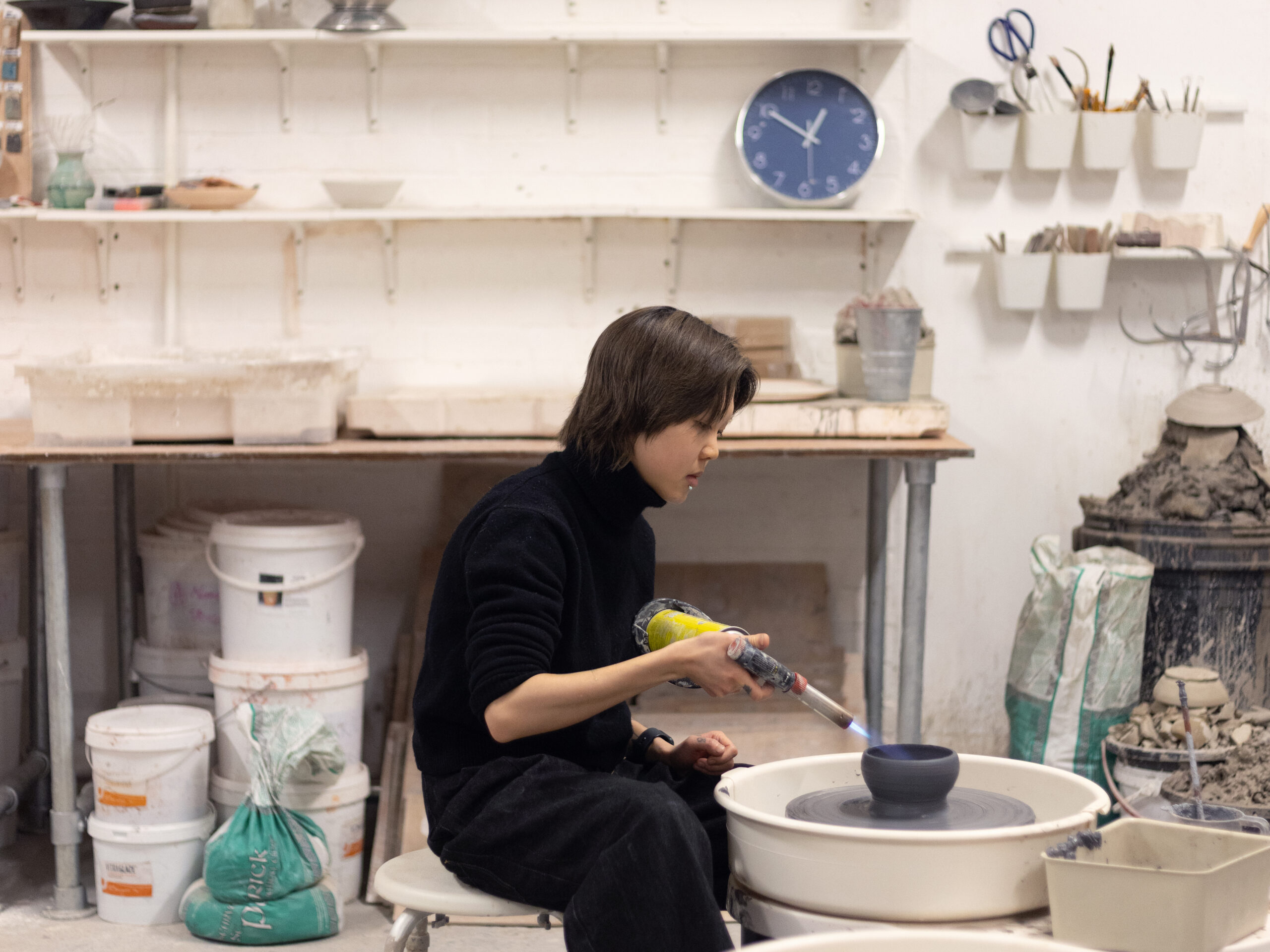
Carly Glovinski in her studio. Photo credit: Michael Winter

Your three current large-scale works — Almanac, Opelske, and Wild Knoll Foundation Garden — are each rooted in specific places across New England, but they’re intertwined. What connects them, and did that relationship emerge organically or was it something you planned from the start?

Almanac and Opelske could not have happened if I had not started Wild Knoll and let it lead.

Opelske, Almanac, and the Wild Knoll Foundation Garden are three deeply intertwined projects that merge my roles as both artist and gardener. Together, they reflect years of inquiry into the materiality of flowers — what they mean as living things, symbols, specimens, and objects of care.

These pieces draw inspiration from the writings of Celia Thaxter and May Sarton, two fellow New Englanders a century apart who similarly kept the tending of a garden central to their creative work and life.

The imagery in Opelske, my first public artwork, began as real flowers from Wild Knoll Foundation Garden at Surf Point that were pressed and made into paintings. Many of the original paintings are a part of my work, Almanac, at Mass MoCA. Then, with the help of the amazing team at Artaic, we translated them into hundreds of thousands of glass tiles using their unique design and fabrication process.

The pressed flowers grown and tended at Wild Knoll became source material for Almanac, my largest painted pressed flower work to date — spanning 100 feet at MASS MoCA. Organised chronologically by bloom time, Almanac is both a botanical calendar and a visual record of the New England growing season. There is no way I would have been able to really understand the succession of flowers if I did not actually grow them. It explores flowers not only as delicate symbols of memory — gifts given in moments of joy and grief — but also as crucial ecological agents supporting pollinators and plant lifecycles. To press a flower, I’ve come to realise, is to hold space for both.

While these projects each live in their own places — gallery, city stairwell, garden bed — they are intimately connected. One could not have happened without the others. They share not only material lineage (flower to press to paint to tile) but also a unified practice of observation, care, and attention.

Carly Glovinski
Almanac, 2024, Installation view
Acrylic on Mylar
On view at Mass MoCA
Courtesy of the artist and Morgan Lehman Gallery
Photo Credit: Julia Featheringill

Opelske in the Boston Seaport brings together a three-story mosaic and a pollinator garden in a very urban, high-footfall environment. How do you think about the relationship between the physical artwork and the living garden?

Yes! For the first time in a work, I got to wear BOTH hats — Artist and Gardener.

Opelske was created as a walkable, layered experience — a floral stairway that invites people to slow down and reflect, encouraging a mindful community that cares for each other and nature. The site is situated with a park above and flows down to the harbour below. I loved the idea of creating a pollinator pathway of all native plants that linked these two spaces, and supported ecosystems beyond just us humans. Choosing native perennial plants that are made to thrive in Boston’s climate means they also will require less maintenance once established, and I think provide an important environmental education point to the piece. Over the years, I hope to be able to divide the plants as they outgrow their containers and share with community gardens in the area.

The title of the work is borrowed from Celia Thaxter’s An Island Garden (1894), which follows a year of her caring for her cherished garden. In it, there is this passage, “The Norwegians have a pretty and significant word, “Opelske,” which they use in speaking of the care of flowers. It means literally “loving up” or cherishing them into health and vigor.” As soon as I came across this word, I knew it was just right. It reflects both the sentiment and physical space for the work, as you literally ascend the stairs.


Opelske. Photo Credit: Julia Featheringill
Opelske. Photo credit: Julia Featheringill

Wild Knoll Foundation Garden at Surf Point sits on the site of a house that no longer exists. What drew you to that kind of haunted ground, and did working there teach you anything new about what the intersections of gardening and art?

I don’t know how else to describe it other than this site had a vibe. Even all overgrown with a big blank slab where the house once stood, it had a story that I wanted to know. It was encountering this site that started everything. It introduced me to the work of May Sarton, a writer who lived and worked here for decades. In 2021, while I was at the art residency Surf Point, on the York Maine oceanfront, I encountered the overgrown foundation site of the house where she lived and worked for decades Learning this and seeing the overgrown plants, I wanted to know more, so I immediately read her journal-style book, The House by the Sea. This book revealed her as an avid gardener and reading the passages she wrote about her day to life of writing and tending her garden on that very spot in 1973 opened a portal for me, and connected some kind of missing link.

For me, reading that book on the spot where it was written, galvanised the idea that gardening is so much the same as making art in the way I was accustomed to — going to my studio, showing up and being curious — labouring with care, and persistence to nurture the work into the world.

I had the idea to honour the concept by creating a house of flowers, according to the scale of the original, finding blueprints and building the garden beds to same scale of the rooms. At the same time, I began rehabbing the overgrown terrace gardens. That was 4 years ago. This garden is where I grew the majority of the flowers you see here. It is where I learned to pay attention to plants, to really look.

Beyond the many parallels between maintaining a studio practice, tending to this garden has taught me the value of gardens as social infrastructure. I don’t think I would have been able to experience that connection as fully if I was just gardening in my backyard.  This garden has literally grown a community up with it. My tending it is just one piece. But now that the garden is established, it has become a dynamic, evolving place for community engagement, events, plant sales, and collaborative art installations.

Wild Knoll Foundation Garden

You spent time this summer as artist-in-residence working directly in Celia Thaxter’s recreated Island Garden. Thaxter was herself a writer who documented her garden obsessively. Did being in that space change how you approached the studio, or shift anything in the new paintings?

Yes — it really did cement my return to painting, and this multi-generational conversation I feel like I am having with both Celia and May. Celia Thaxter’s garden on Appledore Island, five miles off the Maine coast. You can actually see the island across the ocean from where Wild Knoll is. Best known through Thaxter’s book An Island Garden (1894), the historic flower garden has long stood as a sanctuary for creative life, and her artist friends that she invited to hang out and work from the garden made paintings that still have big art historical significance. Childe Hassam’s painting of her garden hangs in the MET today. It was a huge privilege to work directly from the reconstructed garden beds, making plein air paintings for the first time while also participating in its care. It feels silly to say now, but it was the first time I actually sat down and made a painting directly from a garden.  Back in my studio, working from pictures and sketches, I realised I wanted to be making paintings about the experience of making a garden, not just the place itself. That shift has felt hugely important to me and the trajectory of my work. Considering why I am returning to paintings on canvas for the first time in 20 years — I think I had to make a garden first, so that experience and the ongoing tending could become the subject matter.

Carly Glovinski Community Day Bouquet , 2026 Acrylic on dyed canvas 50×40 inches Courtesy of the artist Photo credit: Michael Winters

The upcoming Morgan Lehman exhibition moves between very different surfaces, including canvas, herbarium paper and dibond. What drives the choice of material?

Originally trained as a painter, I’ve developed a multidisciplinary approach that embraces a lot of different materials and processes. I’m always asking how materials can carry meaning, or be actors. Because I am interested in how attention reshapes understanding, often, my material choices enable slight perceptual slips — things that look familiar but become other upon closer inspection. The choice of material can often be inseparable from the meaning of the work itself. This is certainly true in the case of the use of herbarium paper as a surface in several of the works in the show. This paper, used to archive pressed plant specimens in botanical research, has been siloed in the science world — but it is an ideal art paper too, and at its “regulation” size and weight plus the conceptual connect to my pressed flower work — it’s right up my alley, and a great example of how I use materials to imbue an additional layer of connection in my work.

Carly Glovinski Herbarium – Viola, 2026 Acrylic and graphite on duralar, mounted on herbarium paper 16.5h x 11.5w inches (paper size) 18.5hx13.5w inches (Framed) Courtesy of the artist Photo credit: Julia Featheringill

You’ve described gardening as a radical act of care. What, in your view, makes it radical?

Gardening can feel quiet, even private — but framed differently, it’s a deeply radical act of care because it resists many of the dominant logics shaping contemporary life — it takes a long view. You commit to the land and the surrounding ecosystem. You plant without immediate return. You tend without guarantees. That attention — seasonal, cyclical, patient — is a refusal of urgency that runs counter to the urgency and pace we are used to.

It’s also an act of reciprocity rather than control. You’re not imposing order so much as participating in a system of soil, insects, weather, and decay. Care moves in multiple directions: you tend the garden, and the garden sustains you — materially, psychologically, ecologically. That mutual dependence pushes against the idea that humans stand apart from or above nature.

Gardening becomes radical, too, in how it reclaims agency at a small scale. In a world where many systems feel abstract or inaccessible, tending a plot of land — whether a backyard, a windowsill, or a public garden — is a way of making tangible change. You are directly shaping a living system, however small, and witnessing its effects.

There’s also a social dimension. Gardens can function as sites of collective care and knowledge-sharing — spaces where skills, stories, seeds, and labour circulate outside of purely transactional systems. In that sense, they quietly model alternative economies rooted in generosity, stewardship, and interdependence.

Carly Glovinski
Wild Knoll Burning Hearts, 2025
Acrylic on canvas
24×18 inches
Courtesy of the artist
Photo credit: Julia Featheringill

Do you currently have a favourite flower?

Ugh! So hard. I have a lot of favourites. Nasturtiums probably take first. I love collecting the the seeds and those lilypad shape leaves, and how the flowers look when they are pressed. Plus, they are edible!

The Key to Guilt-Free Spending Starts with Your Checking Account

Spending money should not feel like a constant internal debate. Yet for many people, even small purchases come with a sense of hesitation or regret. A coffee, a meal out, a quick online order. These moments seem minor, but they often trigger a cycle of spending followed by second-guessing.

The issue is not always how much you spend. It is often how your money is structured. When there is no clear system, every purchase feels uncertain. That is where your checking account can make a difference.

Why Spending Often Feels Guilty

Guilt around spending usually comes from a lack of clarity. When you are unsure what you can safely spend, even reasonable purchases can feel like mistakes. This uncertainty builds over time and makes everyday decisions harder than they need to be.

Another common issue is mixing needs and wants in the same pool of money. When your rent, groceries, and entertainment funds all sit in one account, it becomes difficult to tell what is actually available for discretionary use. This creates hesitation, even when you can afford to spend.

Emotional habits also play a role. People often spend to cope with stress or to reward themselves after a long day. These purchases are not always planned, which can lead to regret later. Without a system in place, it is easy to fall into this pattern.

How Your Checking Account Shapes Your Spending Experience

Your checking account is more than a place where money sits. It directly affects how you think about spending. When you can clearly see your available balance, it becomes easier to make confident decisions.

At the same time, easy access can lead to quick spending. Cards linked to your account and mobile payments remove friction, which makes impulse purchases more likely. This is not always a bad thing, but it does require structure.

Many people find that switching to a more intentional setup, such as using a free online checking account designed for everyday use, helps create a clearer boundary between spending and saving. This small shift can reduce uncertainty and make financial decisions feel more controlled.

The Core Idea: Separate Spending from Everything Else

The simplest way to reduce guilt is to separate your spending money from everything else. This approach creates a clear line between what is safe to use and what should remain untouched.

Start by defining a specific amount that you can spend each week or month without concern. This becomes your discretionary budget. Once this number is set, you no longer have to question every purchase.

It is also important to keep essential expenses separate. Bills, rent, and other fixed costs should not compete with daily spending. By protecting these funds, you remove the risk of accidentally using money that is already committed.

Creating a dedicated spending account can bring this system together. It acts as a controlled space where spending is allowed, but within limits that you have already defined.

How to Set Up Your Checking Account for Guilt-Free Spending

Setting up your account structure does not have to be complicated. In fact, the simpler it is, the more effective it tends to be.

Using multiple accounts is a practical starting point. One account can handle bills and essential expenses, while another is used for everyday spending. This separation provides instant clarity and reduces mental effort.

Automation can take this a step further. When your income arrives, you can automatically transfer a set amount into your spending account. This ensures that your budget is followed without constant attention.

It is also important to choose a spending limit that feels realistic. If the amount is too restrictive, it may lead to frustration and overspending later. A balanced approach allows you to enjoy your money while staying in control.

Lifestyle Habits That Support Guilt-Free Spending

Structure creates the foundation, but habits reinforce it. Small actions can make a big difference over time.

Checking your balance before making a purchase is one of the simplest habits to build. It takes only a few seconds but adds a layer of awareness that can prevent unnecessary spending.

Planning for small pleasures is equally important. Coffee, dining out, or entertainment should not feel like mistakes. When these are included in your budget, they become part of a balanced lifestyle rather than a source of guilt.

Avoiding all or nothing thinking also helps. You do not need to cut out all non essential spending to be financially responsible. A flexible approach is more sustainable and easier to maintain.

Common Mistakes That Create Spending Guilt

Many people unintentionally create stress by keeping all their money in one account. This setup makes it difficult to distinguish between spending money and funds meant for other purposes.

Another common mistake is failing to define clear limits. Without a set amount for discretionary spending, every purchase becomes a decision point, which can lead to fatigue and inconsistency.

Ignoring small purchases is also a factor. These expenses often seem insignificant, but they add up quickly and can create confusion about where your money is going.

Over restricting yourself can have the opposite effect of what you want. When spending feels too limited, it can lead to periods of overspending as a form of release.

Tools That Make Guilt-Free Spending Easier

Modern banking tools can support your system and make it easier to stay on track. Mobile apps provide real time access to your balance, which helps you stay aware of your spending.

Notifications and alerts can also be useful. They keep you informed of transactions and help you notice patterns as they develop.

Simple budgeting features can give you a clear view of how your money is being used. These tools do not replace good habits, but they make it easier to maintain them.

Conclusion

Guilt-free spending is not about spending less. It is about spending with clarity and intention. When your checking account is structured in a way that supports your lifestyle, decisions become easier and more consistent.

By separating funds, setting limits, and building simple habits, you can create a system that allows you to enjoy your money without second guessing every choice. Over time, this approach leads to greater confidence and a more balanced financial life.

Have You Seen Hailey Bieber in Saint Laurent Lately?

0

I know you’ve seen Hailey Bieber in that orange vintage Dior mini dress, Coachella’s been unavoidable, but have you seen her in tangerine? And if your brain files this under “color,” that’s on you. Anthony Vaccarello’s latest Saint Laurent campaign, Tangerine Temptation, is not so much about shades as it is about atmosphere, and Nadia Lee Cohen’s slightly overcooked lens makes sure of that.

Saint Laurent Spring 2026 campaign starring Hailey Bieber
@ysl via Instagram

Remember those ‘80s-inspired, glossy, lacy, and sporty pieces from his Resort 2026 collection? That’s exactly what Hailey Bieber is seen wearing here. She’s in one of those paper-thin windbreakers, paired with lace-trimmed shorts that feel closer to lingerie than anything else. There are also one-pieces built on the same logic, styled with an almost alarmingly oversized bow at the back, just enough to exaggerate the silhouette for the camera, and that two-tone blue swimsuit everyone went crazy over, the one that looks like it was pulled straight from a ‘70s catalogue.

Saint Laurent Spring 2026 campaign starring Hailey Bieber
@ysl via Instagram

That throwback feeling carries straight into the (very cinematic) shots. People online have been comparing it to a house tour, the model moving through vintage interiors, then suddenly just a few steps away from a pool. The house itself leans heavily Californian, in that very sunset-friendly, slightly out-of-time way. Think leather P.A.R.I.S. slingback pumps kicked up in front of a TV someone, somewhere, would absolutely fight to archive.

Book Review: Sophie Mackintosh, ‘Permanence’

0

Can paradise last forever? In a contained environment, can something sacred and stolen stretch to something longer? Or are those moments glimpses of a reality that, teased, out, could never realistically work? 

These questions run through Permanence, Sophie Mackintosh’s newest novel, which, despite its persuasiveness of such a thing’s futility, is a hell of a lot cheerier than her most recent book, 2023’s Cursed Bread, where hysteria and conspiracy grips an entire town due to poisoned food. In Permanence, Clara and Francis wake up in an unnamed town, able to carry out their affair in the midst of other adulterers, with the domesticity they had yearned for previously. If they cause harm, physical or emotional, they’re whisked back to the real world—Francis has a wife and a child, Clara has an AWOL roommate. It’s Severance meets The Good Place for cheaters, and makes for a playful and often sweet novel about relationships, time, and devotion.

Mackintosh’s newest dreamy landscape is the town of impermanence, where baristas know regulars’ orders, one can work for gold coins (Clara and Francis gently farm, as if they were in Stardew Valley) to supply endless picnics with fresh bread and pouring wine. A newspaper reads, Breaking News: You Deserve to Be Happy! They meet shop owners who have been there for much longer than Clara and Francis, and neighbors who show them the ropes. But they’ve brought themselves to this Eden, and their struggles clash—Clara, reasonably upset she can’t live fully in the real world with him, and Francis, who is trying to mend his dual life (does his child miss him when he’s in this place?). After an argument, they’re forced back into reality, where they can only return by genuinely wishing, I would give anything to go back.

The city is miraculous, but unforgiving—each time they return, the pavement is a little more cracked, the cafe is closed. “Be good,” Clara tells herself after noticing a cigarette burn on a table, a slightly breezier chill in the air. “They did not need a city of unrelenting sunlight, of glittering fountains. It was better to live here… where he was the shining thing who made all else fall into place.” This rudimentary thinking obviously leads to more despair; Clara keeps bringing up their relationship’s lack of stability, which makes Francis moody.

At one point, Clara thinks, “Don’t ruin what you have been given,” but the city of impermanence seems more like torture, or a hard lesson in accepting their previous lives, like a visit to a prison as a child to see how messed up you could turn out if you don’t follow the rules. Francis wants Clara to enjoy what they have, and Clara wants Francis to hold her fully in his arms, to return to the real world convinced that they can be together and to leave his family. But it’s clear, as they harm themselves with more violence—extending their stays in reality—that this was just an exercise in futility.

Clara and Francis get the clarity they desperately seek, and it wouldn’t be a spoiler to say they permanently return to their regular lives, wishing only faintly that they could see each other again. In a way, it might have helped them—without the excursion, they’d spend the rest of their lives wondering what it’d be like with the other, if everything could’ve turned out different. Now, they know. Maybe they even understood from the start they were on borrowed time.


Permanence is out now.

Pucci Spring 2026 Wants You in a Cave at Dawn

0

If classic Pucci belonged to Capri’s dolce vita, the newer version edges toward something older, rougher, Sicilian. Emilio Pucci has been here before, the Mezzogiorno, the mosaics, that 1956 image inside the Villa Romana del Casale that always finds its way back to the top of fashion’s archive. Under Camille Miceli, postcard history stays put. The reference point isn’t the pattern anymore, it’s the atmosphere.

Pucci 2026 runway show in Syracuse, Italy
@emiliopucci via Instagram

Grotta dei Cordari, the location of choice, is part of the ancient quarries outside Syracuse, a landscape already marked in the time of early Greek presence in Sicily. Cut deep into limestone, the space feels less constructed than revealed, as if the earth itself was opened and left that way. At a later point, it briefly held rope-making activity, a fleeting human layer against something far more enduring.

Pucci 2026 runway show in Syracuse, Italy
@emiliopucci via Instagram

The collection was titled ‘Alba,’ Italian for dawn, Miceli-an for three very different ways of seeing the first light of the day. The designer drew inspiration from what we all just thought of, the Mediterranean’s warmest colors, Etna-tinted reds, oranges, and pinks we’ve all agreed to romanticise first thing in the morning. “It’s a genuine celebration of that pure vitality, of that irresistible desire for joy and lightness. Each dawn invites hope, vitality and the chance to see the world with a new outlook,” she told WWD. Then there’s the after-party sunrise, the one that signals a very good night rather than a new day. And then there’s the artificially serious one, like Olafur Eliasson’s 2003 Tate Modern sun, where daylight becomes installation.

Pucci 2026 runway show in Syracuse, Italy
@emiliopucci via Instagram

Which makes perfect sense once you see the woman on the runway. She grew up in Sicily, where she first learned to read nature, color, and patterns, before moving through Morocco, Paris, and New York, each adding a different layer to her understanding of bohemian aesthetics, until she landed in Berlin’s raves, where all those references began to dissolve into each other, in my head, at least. Picture Fiamme prints, geometrical shapes, fringes, stone embellishments, knits, sheer lurex, gladiator sandals, and black leather belts. It’s a lot, but never randomly so.

Grimes’ New Album: Everything We Know So Far

Grimes is teasing a new album. In a feature with Interview magazine, the musician said she has a new album on the way called Psy Opera. Here’s everything we know so far.

How long has it been since Grimes’ last album?

Grimes released her most recent album, Miss Anthropocene, in 2020. Though she signed to Columbia Records the following year, she only put out a few one-off singles before departing the label. She also remixed tracks by Magdalena Bay and Aespa. Last year, she unveiled the Miss Anthropocene demo ‘idgaf’, as well as a new song, ‘Artificial Angel’, via her own label, Nazgul Recording LLC.

What else has Grimes worked on since Miss Anthropocene?

In the Interview feature, Grimes told science-fiction author Nnedi Okorafor that she “totally quit music a couple years ago” with the intention of being a stay-at-home mom. “I couldn’t listen to music without getting PTSD,” she said. “I was only interested in writing and reading. I started writing poetry, and then someone was like, ‘Can you write a rap for this K-pop artist?’ I started writing the rap and I was like, ‘This is too good. I’m keeping this because it’s crazy.’ But then we had a problem for eight months where I was just a white rapper… Luckily we moved past that.”

She also said that one of her “side quests” is working on a documentary about “machine consciousness” called First Contact, clarifying she doesn’t use generative AI in her own music.

Will AI be a theme on the new album?

Grimes did admit that for one of the songs on Psy Opera, ‘DeepSeek’, she employed the Chinese AI model of the same name for help writing lyrics. As for how it might be framed as central theme on the album, the musician had this to say: “I was thinking about how everyone is like, ‘We’re building gods,'” Grimes said of the writing process. “I’m like, ‘Why do you automatically assume you’re so much lesser? You’re literally responsible for creating AI. You’re abdicating so much self-esteem and pride and responsibility and agency when you act like whatever AI is, no one has a hand in it.’ And I was getting emotional because we might really go extinct, for a number of reasons. Human life is very frail and time is very long. But I’d hope, if we had good relations with AI, they would take our DNA and make more of us when things get more hospitable.”

Has a release date been announced?

Grimes hasn’t shared any other details about the album’s release.

Has Grimes released any singles from the album?

No. But during her surprise during Cobrah’s Weekend 1 Coachella set earlier this month, she did debut a new collab song called ‘Sign From God’.

This post will be updated…

X-Design Alternatives

0

No matter how advanced or convenient a creative tool can be, there will always come a point when it stops being new. For instance, people become interested in X-Design alternatives. It is not because the app failed. They search for other options, as templates become too familiar, workflows feel repetitive, and ideas outpace the features. Slowly, users realize that what once worked as a powerful tool now starts to feel limiting. In other words, the urge to explore choices comes from growth.

Thankfully, there is no shortage of options today. Take a look at these alternatives to X-Design (now known as Zawa) that reshape how creative work gets done, aligning with where creators are now.

Best X-Design Alternatives in 2026

Simfa

With creative growth in mind, Simfa brings content creation to the next level. It gives a more efficient and refreshed approach. Whether it is for product visuals, digital marketing, branding, or pure entertainment, this app is useful for optimizing creative campaigns and creating brand identity.

Simfa is equipped with features for generating AI images, AI outfit swaps and face swaps, enhancing products, upscaling images, creating descriptions, bulk pricing, updating SEO Meta, removing backgrounds, and color grading.  

Pricing

  • Free Access
  • Starter Package – $15 per month
  • Plus Package – $23 a month
  • Simfa+ Package – $99 per month
  • Enterprise Package – Customizable

Krea

Krea functions as a creative AI suite built for both beginners and professionals. With a very simple interface, creators who use this tool can jump straight to the action without going through dry tutorials.

Among its offerings are AI image and video generation, AI image and video enhancements, AI fine-tuning, AI 3D generation, and file management.

Pricing

  • Free Access
  • Basic Package – $9 a month
  • Pro Package – $35 per month
  • Max Package – $70 – $165 a month
  • Business Package – $50 – $2,850 per month
  • Enterprise Package – Customizable

Playground

Designing anything like an expert is made easier by Playground. This platform is an AI image generator and editor. From inputting prompts to exploring numerous templates, it allows users to produce visuals for logos, social media posts, marketing materials, products, and more.

Aside from over 20 templates, Playground delivers image tools that help remove backgrounds, generate logos, generate mockups, and convert files.

Pricing

  • Free Access
  • Pro Package – $15 a month
  • Pro Plus Package – $45 per month

Mujo AI

Mujo AI caters to creators who require AI image generation and visual content creation tools. Designed for brands, e-commerce teams, and casual users, this tool uses AI models to provide campaign creatives, photoshoots, product photos, and other visual content.

Its main features include an AI photoshoot, an AI agent for e‑commerce listing content, an AI design editor for product images, and an AI copywriting editor for product listings.

Pricing

  • Free Access
  • Start Package – $12 a month
  • Basic Package – $28 per month
  • Pro Package – $49 a month
  • Creator Package – $101 per month

Flair.ai

Another web-based option is Flair.ai. It positions itself as an AI-driven content creation platform for designing product photoshoots, videos, marketing, advertising, and content. This app even allows real-time collaboration with teams.

Flair.ai. includes capabilities such as generating bulk content, model photography, product videos, marketing content, and several image tools.

Pricing

  • Free Access
  • Pro Package – $8 a month
  • Pro Plus Package – $26 per month
  • Scale Package – $38 – $138 per month
  • Enterprise Package – Customizable

Final Notes

Outgrowing a tool is part of the creative process. It is like a favorite shirt from five years ago — it is still nice, but no longer fits. As ideas evolve, the tools and how they are used should evolve too. And with so many X-Design alternatives available on the digital market, creators are no longer limited to a single way of creating.

In the process of veering away from a setup that feels restrictive, a creative tool like Simfa is essential. This app not only shows new ways to create but also introduces enhanced automation and AI systems that offer a fresh take on creative workflows.

The 37th Art Shopping Fair Opens at the Louvre, Reinforcing Its Role as a Global Platform for Contemporary Art

0

From April 10 to 12, 2026, the 37th edition of Art Shopping opened at the Carrousel du Louvre in Paris, welcoming more than 20,000 collectors and art enthusiasts across three days. With over 150 artists and galleries from more than 50 countries, the fair once again confirmed its place as one of the most important open art fairs in the world.

To exhibit at the Louvre is to make a statement that no other address in the world can replicate. As the most visited museum on earth, welcoming over 9 million visitors each year, the Louvre carries a cultural gravity that transforms every work displayed within its reach. For the artists and designers of the 37th Art Shopping, this was not merely a venue — it was a declaration of arrival on the world stage.

Since its founding, Art Shopping has remained committed to a singular vision: to make original contemporary art accessible, and to give artists from every background the opportunity to be seen. Over 37 consecutive editions, the fair has introduced more than 10,000 artists to international audiences. This spring edition brought together participants from over 50 countries, including France, Germany, the United Kingdom, the United States, Canada, Italy, Austria, Portugal, Spain, Belgium, the Netherlands, Sweden, Norway, Greece, Japan, South Korea, India, Turkey, Brazil, Chile, Colombia, Mexico, Romania, Argentina, and China.

“I wanted to make art accessible and allow artists to meet the public — and vice versa. We’re not focused on a specific genre, but rather on identity and creative spirit. Artists need an audience to discover their works. The universe is bubbling right now — it’s very creative, very emerging, with many young artists.”

Myriam Annonay Castanet, Founder and Director, Art Shopping

Among the participants, 21 selected artists and designers, chosen through a jury review process, presented their works at booths B66 and B34. Working across digital illustration, screen print, fiber art, leather craft, mixed media, and digital painting, their works spanned themes of memory, identity, technology, and the natural world.

Participating artists include: Kaiyuan Chen (Glimmer), Yumei Feng (Shaping the Infinite), Hanyong Yang (Be Water), Xiaoyun Chen (Joy), Anqi Ni (Quiet Bloom), Zoe Ze Zhou (Hair from You), Renjia Wang (Mapping Gan Da Ying), Lifei Wang (Through Gravity), Yujia Ke (After the Light), Yingjie Li (Symphony of the Unseen and the Digital Pulse), Suwenjing Li (Shed or Tree), Xin Wei (Whispers of the Misty Peaks), Siyuan Teng (Nourishing Chaos), Kedi Zhang (Nocturnal Botanica), Zhiyong Wang (Redrawing Time), Bilan Liu (After the Dream, A Soft Light), Wei Kang (Happiness), Chujun Yang (Forest Spirit of Breath), Jingyi Wang (Before the New Year Dinner), Peng Zheng (Vernal Sky), and Qian Jiang (The Garden of Synthetic Eden).

Their collective presence made undeniable what the art world has been sensing for years: the global center of artistic gravity is shifting. From fiber art of inherited grief to Renaissance-scale meditations on artificial intelligence; from leather footwear rooted in Eastern philosophy to bold reimaginings of ancient ink painting — these works did not seek to explain a cultural identity to an outside audience. They simply occupied the Louvre, fully and on their own terms.

Gallery directors, institutional curators, and private collectors from across the globe arrived at booths not as observers of a foreign tradition, but as participants in a shared dialogue. What unfolded was not a presentation of difference, but an exchange of perspectives—where ideas of memory, identity, and technology resonated across cultures. In this space, the works did not ask to be interpreted through a single lens; instead, they invited engagement, recognition, and connection. The conversation was no longer about origin, but about presence—situated firmly within a global contemporary discourse that belongs to all.

Exhibition Information

Dates      April 10–12, 2026

Venue     Carrousel du Louvre, 99 Rue de Rivoli, 75001 Paris

Hours     Fri Apr 10: 7:00–10:00 pm (Invitation Only)   •   Sat Apr 11: 11:00 am–8:00 pm   •   Sun Apr 12: 11:00 am–7:00 pm

Website  salon-artshopping-expo.com