Phoebe Bridgers has surprise dropped her much-anticipated new album Punisher a day earlier than its schedule release date.
The singer, who has been using her platform to speak out against systemic racism in the wake of ongoing protests following the killing of George Floyd, took to social media, writing: “I’m not pushing the record until things go back to “normal” because I don’t think they should. Here it is a little early. Abolish the police. Hope you like it.”
Bridgers recently put on a quarantine live show for DIYsolation, which served as a fundraiser for The Bail Project, an organization helping protestors get out of jail. All profits from merchandise sales were also donated to the organization. Punisher follows her 2017 debut Stranger in the Alps.
I’m not pushing the record until things go back to “normal” because I don’t think they should. Here it is a little early. Abolish the police. Hope you like it.https://t.co/vmwERN0SOm
Dame Vera Lynn, the British singer and “Forces’ Sweetheart” whose song ‘We’ll Meet Again’ helped raise morale in World War II, has died at the age 103.
The singer’s family, who was with her when she died at her East Sussex home, confirmed the news on Thursday morning (June 18), the BBC reports. “The family are deeply saddened to announce the passing of one of Britain’s best-loved entertainers at the age of 103,” a statement said.
Lynn was born in 1917 in East Ham, on the outskirts of London, and began performing at the age of seven. She released her debut solo recording, ‘Up the Wooden Hill to Bedfordshire’, in 1936, while she was working at an East End shipping company. During the second world war, Lynn hosted a popular radio program called ‘Sincerely Yours’ and toured for troops across Egypt and India, which earned her the nickname “the Forces’ Sweetheart.”
The singer’s most popular song was ‘We’ll Meet Again’, released in 1939 and written by Ross Parker and Hughie Charles, which became the defining song of the British campaign and a symbol of hope for departing soldiers. Some of her other hits include ‘There’ll Be Bluebirds Over’, ‘There’ll Always Be an England’, and ‘Auf Wiederseh’n Sweetheart’, which reached No. 1 in the US.
In 2009, Lynn became the oldest living artist to get a top 40 album in the UK with her greatest hits compilation We’ll Meet Again: The Very Best of Vera Lynn. In 2018, she received the Lifetime Achievement Award at the Classic Brit Awards.
Arca has unveiled a new single titled ‘Mequetrefe’ from her upcoming album KiCK i, to be released on July 17 via XL. Listen to it below.
The title is derived from a word colloquially used in Spanish as a derogatory term for a man, which the Venezuelan artist has reclaimed for her new song. In a statement, Arca explained that the song is about “the tenderness behind expressing who you are without shame, and the confidence and bravery it requires, because expression of gender-nonconforming self-states in a public space can often result in static within your environment.”
Arca previously shared the singles ‘Time’ and ‘Nonbinary’. More recently, she joined forces with Shygirl for the Bandcamp-exclusive single ‘unconditional’, whose proceeds went to Black Lives Matter and Inquest UK. Shygirl is also set to appear on KiCK i, which will feature contributions from the likes of Björk, SOPHIE, and Rosalía.
Rising TikTok star Ashnikko has shared a new track featuring Grimes titled ‘Cry’. The new release from the North Carolina pop star, whose real name is Ashton Casey, is accompanied by a CGI-animated, anime-inspired music video directed by Mike Anderson. Check it out below.
According to a press release, the video “depicts Ashnikko and Grimes mutating and metamorphosing into a demon alter ego of Ashnikko stalking her prey as the two sing ‘this could get gruesome’—the aftermath of a brutal betrayal.”
“This is the winter of my discontent/ Everything else is irrelevant/ Are you trying to make me cry?” Grimes sings on the chorus, referencing a famous speech from Shakespeare’s Richard III.
Ashnikko rose to prominence last year with her hit ‘STUPID’ feat. Yung Baby Tate, taken from her Hi, It’s Me EP. Grimes’ latest full-length album was this year’s Miss Anthropocene.
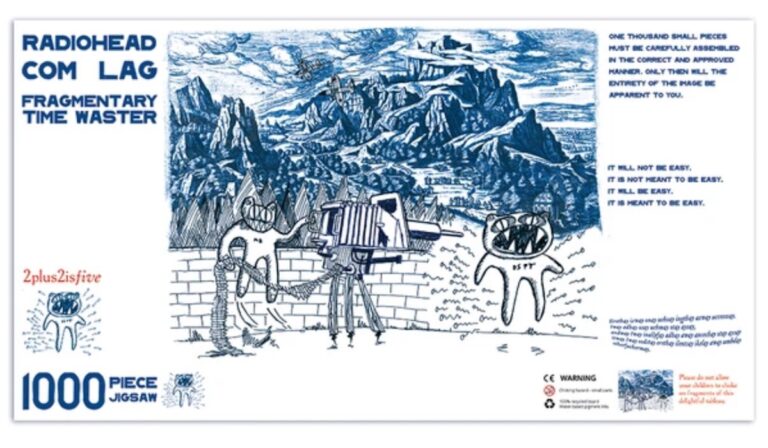
Over the past few months, Radiohead have found different ways to keep fans busy during quarantine, from running a weekly concert series to releasing new music. Now, they’ve unveiled a 1000-piece jigsaw puzzle called ‘Fragmentary Time Waster’, based on the artwork of their 2004 Com Lag (2plus2isfive) compilation EP.
“Bored? Got nothing to do? Fed up? Nothing on the TV. No way! What you gonna do? Gonna get a jigsaw innit,” reads the tongue-in-cheek ad poster for the new merch. “Tell me more, tell me more! A Radiohead jigsaw. Has it got loads and loads of pieces? A thousand. Is it really difficult and will it take ages? I reckon so, yeah. Sounds great! Is it affordable? Depends on your finances. Is there a chance you could still be bored after completing it? Yeah probably. Sounds amazing!!!”
If you needed another reason to head to the WASTE website and pre-order the jigsaw puzzle, which is priced at $35 (£29.99), the new merch item is also environmentally friendly. It’s made from 100% recycled material with the pieces housed in a cotton bag, while the image is printed on an FSC paper source using water-based inks.
Hannah Georgas, a superb Canadian singer-songwriter, has released her new single Dreams. The song comes before Georgas’ new album All That Emotion, which has been produced by The National’s Aaron Dessner. The song itself is a majestic piece that slowly draws you in — making it a true ear-pleaser.
Talking about the featured song Dreams, Georgas states: “In my past, I have let my insecurities play into relationships and have pushed people away because I have felt like I’m not deserving of love. This song explores the idea of breaking down those barriers of insecurity and being more open.”
The article was contributed by Isabelle Foster. She works as a freelance journalist and technical writer. Concurrently she serves as an educational consultant and a senior writer at PapersOwl, one of the biggest online education platforms.
Writing a dissertation requires much time, expertise, and mental resources. Therefore, when the time comes, you may find yourself at loss to know how you can fulfill such a responsible mission as dissertation writing. Still, despite the stress, anxiety, self-doubt, and panic you may experience during the writing process, your dissertation is guaranteed to give you a lot of pleasant moments. The joy of discovery, ability to deal with challenges, and putting your expertise, resourcefulness, and knowledge to the test are only some of the bright moments you’re going to experience once you get down to writing one of the most important papers in your academic career. And though we can’t save you from making mistakes, we can offer some useful tips on how to write a dissertation more successfully and less stressfully. Check them out below.
Getting Started
With a big piece of work like a dissertation, you can save yourself a lot of time and bother by asking some questions.
Who is my dissertation supervisor? You should realize that you’ll need to spend much time communicating with your supervisor who acts as your mentor, academic consultant, and, ideally, your friend. He or she is the first person you should contact in the event of any difficulties or misunderstanding. So, you want to make sure you’re comfortable with your supervisor.
When is the final deadline?Procrastination is one of the worst enemies of students. Though there may be times when you feel like your schedule is falling apart, don’t let anything get in the way of your writing process. To submit your paper on time, always keep the final deadline in mind.
How is my dissertation structured? The structure of your dissertation may vary depending on your project, academic discipline, and even your educational institution. So, you need to familiarize yourself with the guidelines for writing a dissertation exactly in your field.
What types of sources should I use? The dissertation guide developed by your university will also provide information on what sources are considered appropriate for your project, as well as detailed instructions on how to cite them.
Choosing a Topic
It’s safe to say that choosing a dissertation topic can be as daunting as writing itself. Therefore, you need to select something that will sustain your interest and grip your imagination. Otherwise, you’ll get bored soon and won’t be able to adopt an effective approach to researching and writing.
The topic should also be manageable. So, avoid picking a problem that other researchers have spent many years trying to solve.
It’s also a good idea to start by thinking about the modules on your course. Is there an area of research that posed some interesting questions or that you really enjoyed studying? When thinking, write down some interesting ideas or tentative research questions that you would like to develop in your dissertation.
Create a Proposal
Once you decide on your topic. It is about time you got down to writing your proposal. Proposing to do a research study, we need to tell the reader what it is that we want to research. The main sections of your dissertation include:
Literature review. The idea behind academic empirical research is that no matter what topic you’re going to develop, chances are there have been plenty of people who already researched it. It’s also through reading relevant literature on a chosen topic can you know what has been done on your topic so far. And it’s only through reviewing relevant literature can you decide on a specific area to focus on.
Research study. Once you’re done with your literature review, you can define your research study.
Data collection instruments. Decide whether you need qualitative or quantitative data or both for your research and outline this on your data collection instruments section.
Planned data analysis. In planned data analysis section, you need to clearly describe what you’re going to do to convince your readers that you’re capable of handling available data properly.
Research ethics. You may want to devote a separate section to research ethics. This can be a simple formality or a real key consideration for your proposal.
Planning. Sometimes, you might need to put a planning chapter into your proposal. Here, you need to indicate a clear time planning for various steps involved in your paper.
Write and Revise
As the wise say, don’t put off until tomorrow what you can do today. Start writing immediately. Make it your rule to write at least 2000 words per week if you don’t want the writing process to last forever.
Once you’re finished with each section, go back and revise what you’ve written. Keep in mind that the sections should serve a particular purpose, but at the same time, link well with each other.
Hopefully, today’s article will help you put together a successful dissertation that, in its turn, will help you move forward in your academic career.
Though the term “virtual reality” still sounds like something that we all will have one day, this future is just around the corner. In very deed, virtual reality technology is applied to app development, and in this insightful review, we’ll demonstrate in what industries VR technology has already been adopted and share some tips on how to properly build content for VR mobile apps.
Let’s start with the basics. VR means a simulated environment that imitates physical presence in the reality. To immerse oneself in a VR world, a user should obtain a stereoscopic Head Mounted Display and a smartphone. You can find more information on how to build VR apps in this article. It’s a comprehensive guide with lots of superb tips to follow. Now, we are going to discuss what particular industries have already started using VR technology.
Overview of The Main Industries That Are Already Using VR Technology
You know that the modern world is constantly evolving and technology is also not bogged down. Very soon, VR will be everywhere. The below-listed industries have already started using VR benefits.
Traveling
The Ascape VR app is the best example that demonstrates the use of VR in this industry. The app enables users to go on VR tours to absolutely any world city. You can see monuments, visit cafes, museums, entertainment options virtually! Apps like this allow you to properly plan your future trips. But if you can’t travel at the moment, such apps are a superb solution to entertain yourself when you are made to stay at home in a post-pandemic world.
Real estate
VR is widely used in this niche. Moreover, it helps push up sales. It is used to organize 3D tours to demonstrate real estate properties to customers. This technology allows the representatives of this industry to sell apartments or houses faster because it provides a fully immersive experience. Simply put, when seeing the object that is offered for sale, customers feel as if they are inside the building.
Automotive industry
Ford has already started using VR technology to create 3D tours for their clients. This is a superb chance to test vehicles before you see them in real life. Overall, it’s a worthy solution for testing vehicles online and choosing the right car that will suit your needs best of all.
Education
It goes without saying that students of various higher educational establishments remember the material faster if they experience it instead of just reading. In such a scenario, the use of VR apps might be the best solution! Educational VR mobile apps enable academicians to immerse themselves in the culture of other countries, study the body, organize virtual trips, and much more!
Though VR technology gradually becomes more and more popular, it is still in the early stages of development. Very soon, VR mobile apps will grow into something incredible!
Tips on Building Content for Mobile Apps Based on VR
In fact, there are only two ways of developing content for VR apps. So let’s take a closer look at each of them.
Making a 360-degree video
This is probably the easiest way to create VR content. In this case, only a camera is needed to create top-notch content. To make a 360-degree video, you only need to have a 360-degree spherical camera. When choosing the tool, you should make sure it can capture videos of the highest quality. When shooting, you should keep the camera in a still position. A lot depends on the type of video that you want to shoot. In this case, there are a few solutions for you:
You can place a camera on a tripod;
You can mount the camera on a cameraman;
You can use drones to create footage.
However, you should bear in mind that the equipment will be visible in the footage. So you should hide it at the editing stage.
3D Animation
It is safe to say that 3D animation allows users to show something that is impossible to capture in the real world. 3D animation enables users to click on certain buttons and move around in a virtual world. Moreover, 3D animation allows users to take a closer look at some things as if they do in real life.
For creating 3D models, you need to buy a camera that can be affixed to your tablet. It works like a 3D scanner that can capture everything that happens in the real world and if necessary, it can transform content in 3D models. The Structure Sensor is the most effective tool to use in this case. Unreal Design or Unity are used for creating interior design or game development. But in such a scenario, you also need to have an Android-based device, a headset and Google VR SDK.
Moreover, if you want to build simple 3D environments, you can also use such tools as Maya, Blender, 3DMax, LightWave, Houdini or Cinema 4D.
Here are the main forms of 3D graphics:
3D modelling;
Stereoscopic 3D effects;
Computer animation;
Product design;
Graphic and motion design;
Visual effects.
Though this technology is at the pinnacle of success today, it is still not perfect. There are new challenges ahead. Nevertheless, the growing interest in VR opportunities means that all tech issues that may occur while developing apps or building content for them may very soon be solved.
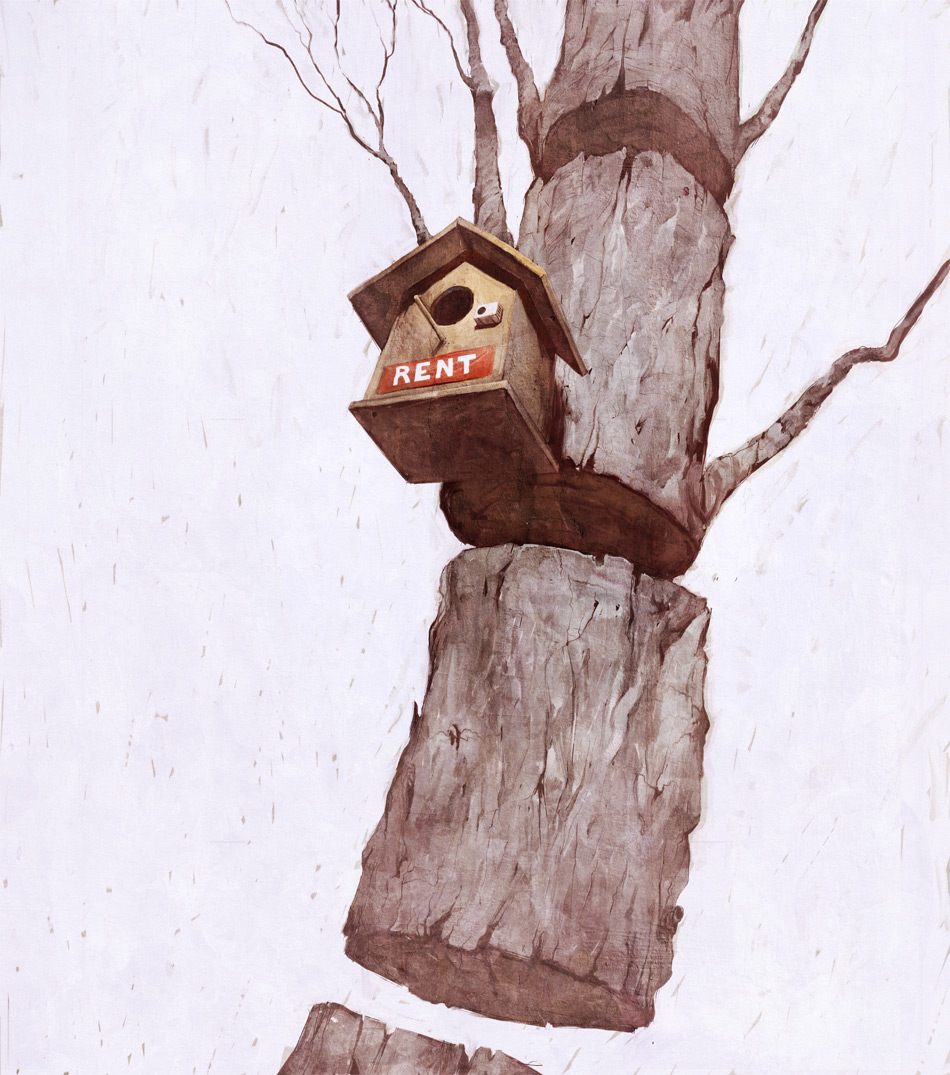
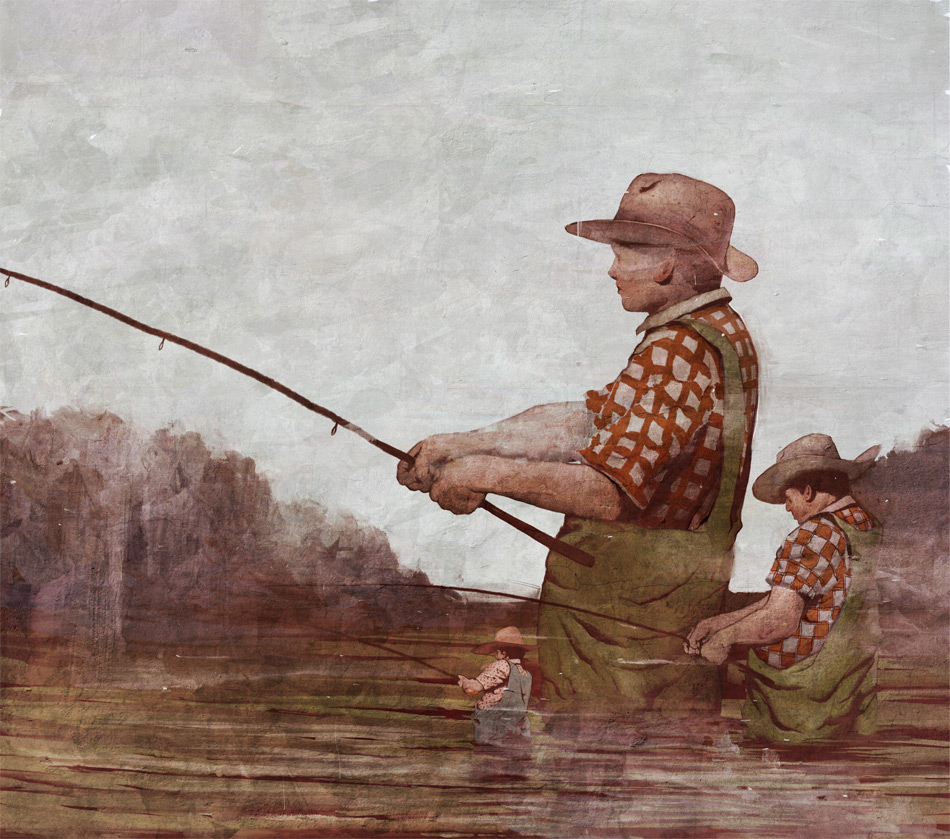
Mikhail Vyrtsev, a Russian illustrator and artist, has over the years has created some superb, comedic-like illustrations that showcase not just his technical talent but also his thoughts and witty side.
Little under two decades ago, video gaming was often still regarded as something of a niche activity. It was typically viewed as the realm of PC and console gamers, and not particularly as a social activity. Then the mobile technology boom came, connecting people in ways that were never previously imagined, instantly turning video games into a hobby that everyone could enjoy, especially with platforms like Dailygame.
With more than 2.5 billion people worldwide playing mobile games in 2019 and almost $70 billion in revenue generated, gaming is no longer a niche industry aimed at a specific group of people. The target audience for games developers is now quite literally everyone, everywhere around the world. If you’re playing one of the latest top games from Toronto or Tallahassee, there’s a good chance someone else in Tibet or Timbuktu might be too.
Let’s take a look at some of the most popular mobile games around today, after which we’ll conclude with some brief thoughts about how to choose a genre of gaming that suits your preferences.
The Sims
This game is already considered classic in the life simulation category, as it has a very long history of development. The game imitates nearly every aspect of life engaging a vast number of players. Sims statistics show that players are mostly women and that this game has the power to simulate human interactions and help in everyday life as well. The Sims has many versions, among which, The Sims 3 and The Sims 4, which let the players choose from and play how they want.
Fortnite
Arguably one of the biggest reasons for the success of Fortnite, aside from the addictive battle royale styled gameplay, comes with the fact you can play this game on quite literally anything. Even more impressive, you can jump from playing Fortnite on PC or console, and still have all the same assets available when playing from your mobile device. Access to so much cross-platform, cross-play action for such a sophisticated multi-player game; that’s just cool.
Poker
As one of the fastest growing online poker sites in the industry, 888 Poker boasts one of the most innovative and cutting edge mobile gaming platforms around. Designed entirely around the appeal of playing poker anytime and from any location, gamers can choose from a wide selection of instant cash games, sit and go tournaments, and even lay down their virtual chips in competitive scheduled tournaments, all from their preferred mobile device. Note: When the fun stops, stop.
Minecraft
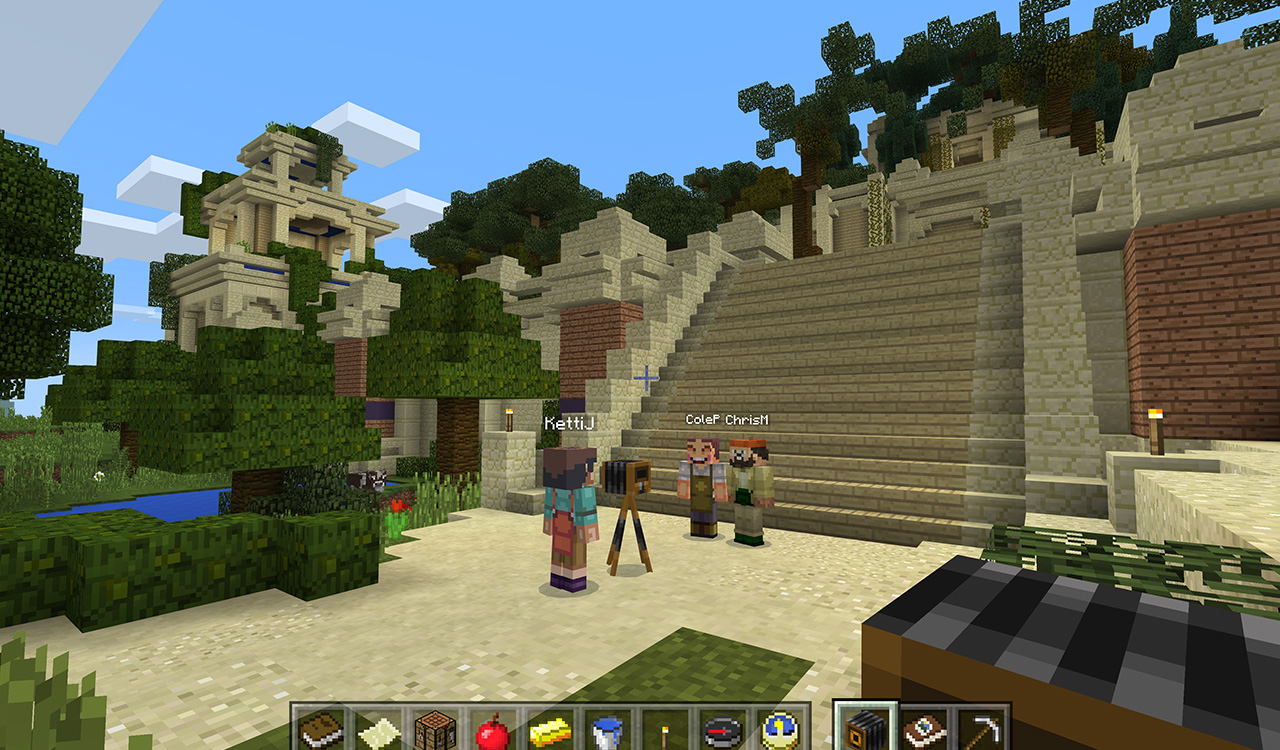
Sometimes it’s hard to imagine that Minecraft was first released late in 2011, and that it’s kicking around still with such blocky graphical popularity. However, it’s fair to say the secret is in the sandbox gameplay that never gets old, leaving all the creativity and fun entirely in the hands of the players themselves. Even playing from a mobile device, the only limits to what can be built and crafted based around your own imagination.
Hades Star
Insofar as niches in gaming go, few have enjoyed quite the longevity as those based around conquering galaxies. There have been grand strategies themed around space exploration and empire building since the early 1980’s, therefore it’s no surprise to find Hades Star having become so popular on mobile heading into the 2020’s. Build your fleet, battle alien races and forge your own stellar empire; either on your own or in collaboration with other players.
Pokémon GO
Instantly becoming a worldwide smash when it launched in 2016, Pokémon GO became one of the most successful mobile games of all time, surpassing the one billion downloads mark in 2019. Based around augmented reality (AR) technology and gameplay interaction with real world locations, players can hunt for their favourite Pokémon characters, not to mention try a variety of other side-games and activities, thanks to regular updates from the developers.
Stardew Valley
If your first glance at Stardew Valley leads to thinking this is just a cute looking farming RPG, you’d be ever so wrong. Sure, the heart of the game is based around rural activities like growing crops and raising livestock, yet there’s a profound amount of depth to the game that includes all manner of crafting, interaction with NPC players, budding romances and even starting your own virtual family. Relax, kick back and play this endless game at your own pace.
Choosing your genre
For the most part, choosing which kind of game to play is entirely down to personal preference. Mostly we’re influenced by other forms of entertainment, such as music, movies, and literature, when delving into the genres of gaming we’ll tend to enjoy the most. That said, we can sometimes be drawn into gaming genres we might not have previously considered, simply because they offer more appealing levels of social engagement and interaction.
The best way to narrow things down first and foremost is to decide whether you prefer playing alone or with others. This will help choose whether your gaming experience is single-player and focused entirely on your own in-game activity, or alternatively, the shared multi-player experience in which you either compete against or collaborate with other players. Both have their own pros and cons, depending on what you’re looking for.
Many games are labelled by genre, which will give you some indication of what to expect. FPS will instantly tell you the game is a “First-Person Shooter” and violent action is the core activity. If you’re looking for something a little more thoughtful and mentally challenging, perhaps look for the puzzle or adventure genres, where exploration and solving problems give you something to think about.
Finally, and given that many games these days feature an overlapping mixture of genres, you could just dive straight into something you might never have considered playing before. They say that variety is the spice of life, which is certainly true given the huge variety of gaming options available to mobile users these days. You never know, you might just find yourself enjoying a genre of gaming you’d never considered before.