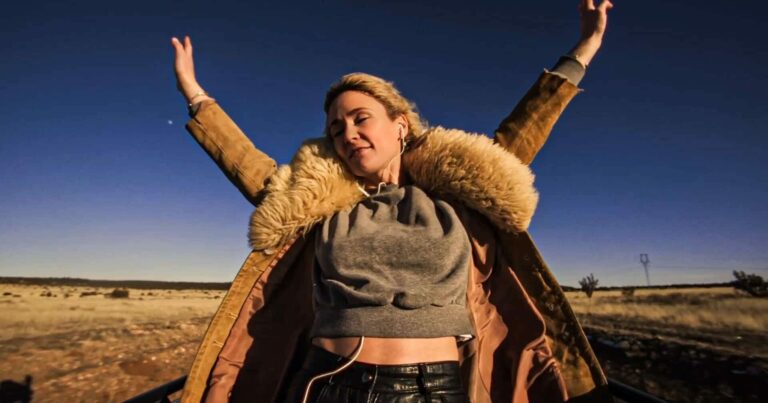
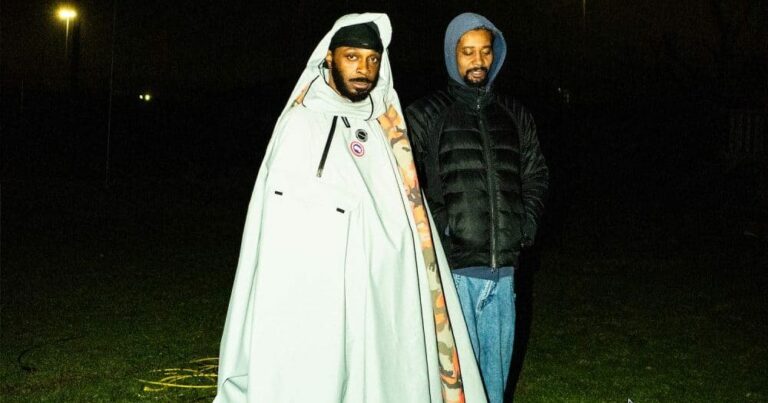
Esther Rose has released the title track from her forthcoming album, Safe to Run, which is out April 21 on New West Records. A duet with Alynda Segarra of Hurray for the Riff Raff, the track follows the record’s lead single ‘Chet Baker’. Check it out via the Rett Rogers-directed video below.
Safe to Run, the follow-up to 2021’s How Many Times, was produced by Ross Farbe. “Sonically, Ross and I threw every idea we had on this song and it absorbed everything as if it were just this mega-powerful container,” Rose said of ‘Safe to Run’ in a statement. “We built so many layers into the outro. I love Ross’s counter-melody on the Mellotron and the high-pitched 1-note synth drone which he refers to as ‘the angels.’ Nick Cohon, of Bay Area death metal band Cormorant, brought the doom by arranging the ascending guitar outro. It was so meaningful to collaborate with Alynda Segarra and to hear the song start to fly. Alynda’s voice is this expertly tuned muscle; when they sing, you feel everything.”
Have you ever thought, what’s the difference between live and online casino? Well, this article will hopefully answer all of your questions. It can be confusing to differentiate between the two, but luckily, we are here to help.
Whichever you decide to enjoy, you can play Griffon casino live games anytime, anywhere – as long as you have a stable internet connection.
Keep reading to find out more…
Authentic or electronic?
A live casino game offers the chance to play with a live dealer, who will deal the cards in front of you, so you can see the action taking place in real-time, from the comfort of your own home. Or, if you are playing Roulette, you can see the wheel spinning on screen. Whereas online casino games, which aren’t live, use a Random Number Generator (RNG) to deal the cards, or to select a number/colour the wheel will land on.
Communication
In a live casino game, you will be playing against other players from across the world, where you can message them in the live chat box. Online casino games typically don’t allow you to communicate with other players, but in the live casino environment, you’re able to interact with the rest of your table.
Game selection
Both variations of game play offer a range of games, however online casinos do usually offer more than live casino games. This is because they can have a large amount of versions of one particular game; for example Blackjack could have up to ten different variations. Live casinos tend to have less games, this is mainly due to the fact that they require a live dealer who has had professional training to host the game.
Game experience
Both variations of casinos have a lot of games for you to consider, but they offer a different kind of gaming experience. So typically, online casinos have games that offer a solitary experience. This means the games will focus on a singular player. On the other hand, you have live casino games which offer a multiplayer experience, this is because a single game can cater to multiple players all at once. Plus, you don’t have to wait for a space at the table like you would in a land-based venue!
Relaxed gaming style
Despite the differences, both of these game types do offer one similarity –they both offer a more relaxed approach to gaming. If you attend a land-based casino you would most likely dress to impress, whereas when you play online you don’t have to worry about a dress code!
Do remember, whichever way you prefer to play, you should always set budget limits and make sure you are betting with money that you can afford to lose.
So, which type of gaming style do you prefer?
Do you like to play online casino games, with a RNG, or are you someone who likes to virtually sit at the casino table? Or, if you are new to both gaming types, is there one you prefer the sound of and will likely try first?
—
Gambling can be addictive, please play responsibly.
Whether you have recently started a business or you are looking for ways to make an existing one more efficient, you could benefit from outsourcing services. Choosing to outsource aspects of your business you don’t have expertise in is an efficient way to grow a business successfully. Read on to find out more about the most common services you can outsource in your business.
Customer Services
When it comes to building a successful brand, nothing could be more important than customer service. The point of contact between customers and the company is a chance to develop a relationship and build brand loyalty, but only if you resolve queries efficiently and successfully.
Some companies use in-house customer service solutions, which is fine if you operate a smaller business and have the right staff available, but as the business grows, you will find that outsourcing customer services is a good way to manage large volumes and maintain standards.
Marketing Services
Every business needs a marketing solution to get its products in front of the right customers, but not every business has the best personnel in place. Outsourcing your marketing department is an excellent way to develop marketing practices that work for your business and your industry.
Digital marketing is an excellent example. Digital marketing includes digital advertising, content marketing, SEO, and social media marketing. Of course, anyone can learn these technologies and strategies, but it is sometimes better to partner with a professional for faster overall results.
HR Services
Human resources are necessary for hiring and firing employees, managing timekeeping, and ensuring that business regulations are updated. Traditionally, HR services were kept in-house; businesses hired HR employees with degrees and relevant industry experience for their staff.
Nowadays, hr support can be outsourced, allowing you to save on staff costs such as training. Outsourced HR support is an excellent way for SML businesses to save money and build more efficiency into their business model. Outsourced HR services are comprehensive and reliable.
IT Services
In the past, businesses needed an in-house IT team to service the network and reduce downtime associated with technical issues. IT teams were an essential element of any office. Without an effective IT team, a business could lose significant sums of money and its reputation.
The world has moved on from the days of IT teams in the direction of managed service providers. MSPs are cloud-based services with several advantages. An MSP gives business access to a larger pool of IT professionals, available 24/7 to keep your system operational.
Admin Services
A business requires a wide range of skills and attributes to be successful, but while some of your employees are bound to have administration skills, it can be beneficial to outsource and automate some of the more mundane tasks and utilize the full skillset of your paid employees.
Admin services you might consider outsourcing include financing, contractor management, recruitment, regulations, and marketing operations. Don’t be afraid to partner with an admin support service to make your business resilient and successful until you find an admin team.
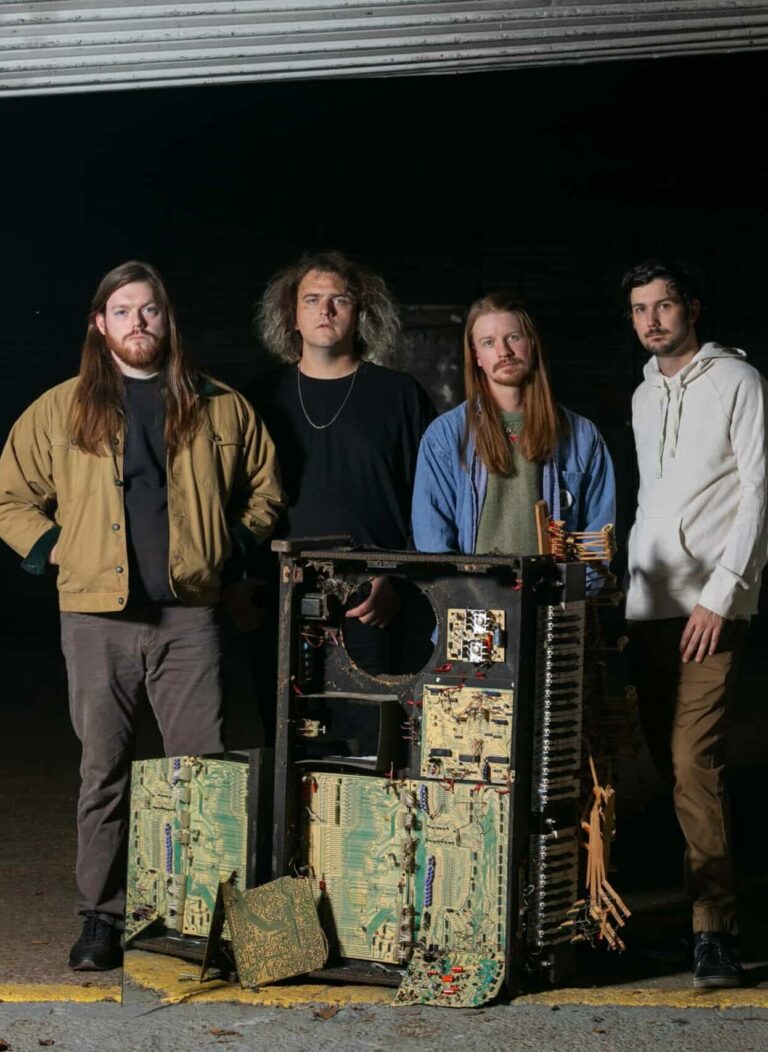
MSPAINT is the Hattiesburg, Mississippi quartet composed of vocalist Deedee, bassist Randy Riley, synth player Nick Panella, and drummer Quinn Mackey. Having met each other through the local punk and hardcore scenes, they decided to form a band based on a simple premise: making music with no guitars. The irony was that most of them had previously occupied the role of the guitar player; the challenge was not having it sound like any rock band ditching guitars on their post-apocalyptic eighth album. After making waves with their self-titled EP in March 2020, they’ve now come through with their remarkable debut full-length, Post-American, co-produced by Militarie Gun‘s Ian Shelton, which does away with preconceptions around hardcore by blending elements of synth-punk, hip-hop, metal, and straight-up pop. Though brimming with grim, dystopian imagery that’s meant to hold a mirror up to society, it’s an infectious, invigorating album that maintains hope for a future that feels just as possible – not looming on the horizon so much as hovering at the edges of the reality we live in. MSPAINT don’t shy away from critiquing the power structures that bind us, but when they look ahead at what’s next, the question is met with way more than anger.
We caught up with MSPAINT’s Deedee and Quinn Mackey for the latest edition of our Artist Spotlight series to talk about being from Hattiesburg, the band’s collaborative process, working with Ian Shelton, and more.
How important do you think being from Mississippi and Hattiesburg specifically is to understanding your identity as a band, both from a musical and a political standpoint? How would you begin to talk about that background with someone who’s not ingrained in it?
Deedee: I don’t think we surround ourselves with politics in general. It’s definitely a part of our lives, because it’s impossible for it not to be. But I think that living in Mississippi is something that you’re always just aware of, in the sense of, all the history books point back to Mississippi as the genesis of slavery and the most heinous form of it. Αnd I think that perspective is important – what’s important about it is, when you can conceptualize America being just the emulation of the other cultures that have been either brought here by immigrants or people that came here all against their will, music is the same way. You drive into Mississippi and on the sign, it says, “Birthplace of America’s music.” And there’s a lot that comes with that. It’s not quite as simple as, we just have some good musicians here and everybody copied us. Most people escaped slavery and went on to perpetuate music in other places. The education system in Mississippi is very bad, it’s one of the worst in the country, but the education behind the music is pretty available. I was always interested in the history of it more than the music early on, and it always points you back to people that were slaves that played music that either people thought were good enough to where they didn’t have to work and performed or people that escaped and then perpetuated that Mississippi style of blues in other places. That was always integrated into it, and it’s something that, as white musicians that are in a space to be subversive or in a space that pays homage to progress as a genre in whatever way, I think is important to recognize.
It’s cool living in Hattiesburg, because it is seemingly a blue dot in the middle of a red state, looking at it politically. We’re fortunate to be in a city that validates the arts and has always had a DIY scene. There’s potential for other shit to happen here, you just have to manifest it yourself. As far as it relating to the band, I don’t think it was until people started comparing it to elements of hip-pop that it was something that people around us were like, “What do you all think about that?” I feel like I’ve incorporated that into every band I’ve been in, maybe in different ways. People’s perceptions of it is important and valid, but it’s also like, there was no intent behind MSPAINT, and that is just a fact. We did all of this just for fun on a whim, and people supported it and backed it. We took those opportunities and took those people into account, and we just moved how we move. The bottom line is to try to be the best person you can be, because then you’re gonna be the best band you can be. You can’t be a good artist and not work on yourself, that’s not how that works. And maybe that’s a quality of Mississippi, and maybe that’s just the quality of our environment in general.
But being from Mississippi, the reality of it is that we get to see a lot of really good musicians play all the time. I love every band in Hattiesburg because people take the music part of it seriously. And that’s a quality that exists in other places and communities, but it’s built into the culture here. If you’re gonna do art, if you’re gonna do music, try to be the best person doing it.
Quinn Mackey: For me, there’s a church on like every corner in Mississippi, so that’s always really forced on you. I actually learned to play music in church, and as I grew older I was finding more flaws in theologies and moving away from the church, and then music became a way for me to get perspectives on other cultures and interact with different subcultures. I was really into hardcore and metal when I was young, and then I kind of moved away from it and got into blues and jazz and even jam bands. Those are really popular down here, and electronic music. I’ve always really liked the music more than the culture, but it’s cool to see how everybody interacts with it very culturally.
You said there was no intent behind MSPAINT – apart from that shared background, what was it that drew you together as a group, as collaborators or just friends?
QM: I feel like we were really just all friends, like you said. Playing music in Hattiesburg is very close-knit, so we just all knew each other’s bands and played with each other at shows. I was in a band with Nick, I filled in on drums with Deedee’s band sometimes and played with Randy in that band. We just all like knew each other and were like, “Let’s start a band without guitar.”
Take me back to the moment where you made that decision.
D: I just came up to Nick and Quinn and was like, “We should start a band.” And in my mind I’m thinking, no guitars. And then Quinn’s like, “Yeah, but we should do it with no guitars.” It was one of those moments where it’s like, we should have had this conversation years ago. It was that the kind of interaction where it’s just so simple and pure. None of that was real thought, it was like: maybe this is what we’ll do, we’ll go on tour, it’ll be fun for everybody. It wasn’t: drop our demo, quarantine hit, and this band be the most popular band that any of us have been in. Going back to the moment when we actually formed and when we realized that this was going to be something that we had to effectively shape our lives around, those were two separate occurrences.
During the time it took to hone in the songs, did it become clearer to you when something feels finished or you shouldn’t mess with it any longer?
D: My perspective of when a song is done and everyone else’s perspective of the song was done is pretty different. It’s a constant balance of being uncompromising and collaborative – you want to get all the ideas in there, but you also got to know when to be like, “The emotional pull from this part for me is really doing something.”
QM: We’ll edit a song into the ground, and Ian [Shelton] actually kind of made fun of us for that. We just like so many different things that we were like, “I just want to keep changing the song and see if I can get it exactly how I want.” And you gotta have a moment where you’re like, “This is how it’s gonna be.” That’s always been really hard for me and Nick especially – every band we’ve been in has been like that, so it’s nice to have be working with Ian and Deedee being like, “This is really good, let’s move on to the next thing.”
D: It’s such a cool interaction, especially with Nick because he studied jazz and he went to school for music. He sees these limitless possibilities, but he also knows what works. It’s like, we know the rules so we know how to break them, but we also have to know when to adhere to them. I feel like a lot of things that we talk about musically, and just as people, is knowing when to use your ego, knowing when to feel invincible about a decision and feel like you’re really doing something with the right intent, and then having moments to sit back and trust everybody else. That’s hard – navigating that will be hard forever.
Can you talk more about how Ian came in and shaped that dynamic?
Deedee: I introduced myself to him at the Convulse Fest and we stayed in touch. I just loved Militarie Gun – I was like, “This is like hardcore Modest Mouse to me.” He was gonna do a song with us, and I sent him the album. He sort of kind of saw that we could do better if we had maybe some other tools and somebody to help us do it. Because we were totally ready and satisfied with what we had done on our own. It was a definite guerrilla warfare-type recording where we’ve been tracking shit kind of not in order, just kind of editing on the fly. But Ian just came to me and was straight-up, and I really appreciated that. From that point on, it was like, “We’re down to do this, but you gotta come to Hattiesburg.” Complicate it just a little bit, do a little bit extra. And he was willing to do that. He came down, and he really met us where we needed him to meet us. Flying out to Los Angeles to record just sounds fake for people here. That’s not an opportunity that seems real. Weneeded a sense of camaraderie there, of like, “You’re someone who just really wants to help us out.” And that’s what it was.
Like Quinn was saying, me and him think similarly about trimming the fat, it doesn’t have to be all the way pretty. It’s just got to get the ideas across. So that element helped establish maybe some more confidence in the parts we already had. Like, “You can change it if you want, but that is good. That is a good song.” Ian captured that moment, and the songs that we wrote with him were him and Nick kind of getting into the meat of some ideas. ‘Delete It’ and another song called ‘Free from the Sun’ were the two that are on the album that we did with him, and those just came straight out. He challenged the band in a way where he got the best out of us for that moment.
We talk about bands wearing their influences on their sleeves, but what’s more interesting is how you wear your hearts on your sleeves – and you sing about it, too. Are you intentional about vulnerability being at the forefront of your music?
For me, everything surrounding the band was very emotionally charged. Everybody had individual life things going on, but in combination with lockdown – some people have been on lockdown their entire lives, they don’t leave the house already. I was not one of those people though. I had to realign myself with my surroundings and shit, and that came with starting this band, because the love we were being shown on the internet and people calling me and being stoked for us throughout the entire pandemic – I’m so grateful to have been present for that and been in a place where I’m really digesting this, in a place that I can fully feel it.
In this band, we’ve never shied away from – if somebody’s like, “Hey, man, you’ve been kind of quiet, you alright?” and they’re like “Nothing,” you’re like, “Oh, buddy…” That feeling of, we’re about to talk about everything. It’s something that we get up for, in a sense of, it’s not fun to do all the time, but we always step up as a band. The music element of it is something that’s fun and easy – it’s everything else that we got to get better at. It’s, like, all the intangibles that come with traveling. I’m just very realistic – you know, people have needs, and you’re in a relationship with them in a band. You gotta really tap into what people need. That is an element that is seemingly just lost, in some ways. One of my favorite things about this band is that we started it with the intent of being like, “Let’s tap in as people. If we got something we want to talk about, let’s talk about it.” Whether it’s something that’s bothering you or you’re really proud of everybody about – we try to do it both ways, where we try to gas each other up as much as we critique and try to have a dialogue about shit.
For me, lyrically, most of my inspiration came from, like, motivational speeches. When an athlete is accepting an award, I always thought it was interesting how they’re so emotional, and they’re maybe not used to being vulnerable in those moments. But they always are talking about everybody else – in that moment, it’s like they can perceive how grateful they are for all these people when this whole moment has kind of been about them and their accomplishments. As a kid, I grew up playing sports, but that was something I always kept with me: the knowledge that as much work and as much talent a single person has, it takes a whole community of people to really impact some shit. To me, Hattiesburg bands have always had an emotional component to them, but I feel like we just brought it into our band inner band lives as well. Around the pandemic, having the band carried us through it, in a sense of giving us some hope. I was feeling so charged and so much positive energy during such a gloomy time. Maybe it’s the Catholic guilt ingrained in me, but I just want to pay it back.
This interview has been edited and condensed for clarity and length.
Unknown Mortal Orchestra have released ‘Meshuggah’, the final preview of their forthcoming album V. It follows the previously shared offerings ‘Layla’ and ‘Nadja’, which were both accompanied by Vira Lata-directed videos. Take a listen below.
V is slated for release on March 17 via Jagjaguwar.
JPEFGAMIA and Danny Brown have announced their long-teased collaborative LP, Scaring the Hoes. Though the album does net yet have a release date, the rapper have previewed it with the lead single ‘Lean Beef Patty’, which JPEGMAFIA produced. Check it out below.
Jpegmafia released his most recent solo effort, LP!, in 2021. Danny Brown’s latest album, uknowhatimsayin¿, dropped in 2019.
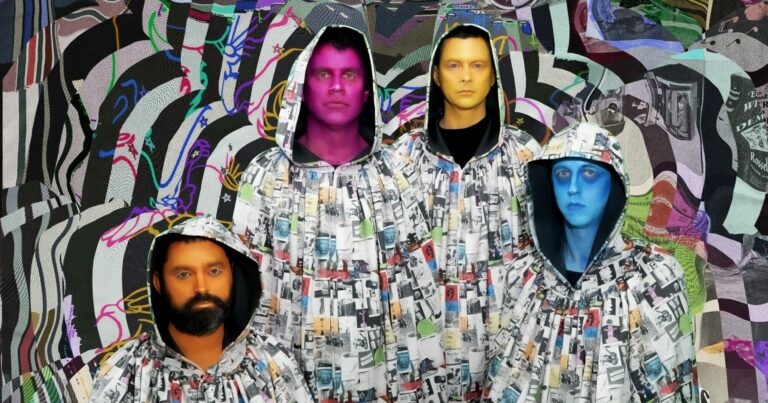
Animal Collective have announced a reissue of their debut album, Spirit They’re Gone, Spirit They’ve Vanished. Out May 12 via Domino, the new edition features remastered audio, new artwork by Abby and Dave Portner, and the A Night at Mr. Raindrop’s Holistic Supermarket EP, which contains five previously unreleased tracks, including a rendition of Fleetwood Mac’s ‘Dreams’ recorded during the same era and mixed by Animal Collective’s Deakin. Today, they band has shared two songs, ‘Chocolate Girl (Remastered 2023)’ and the previously unheard ‘Untitled 1’. Take a listen below.
Since the first part of the fourth season of You dropped on Netflix last month, I’ve been dying to talk about it. And now that the second part was just released on Thursday, I’m ready to talk about it.
Compared to the third season’s lacklustre storylines, the fourth season of You has more twists and turns than a rollercoaster. However, before we get into the fourth season, let’s recap what we know about the series. Netflix’s psychological thriller focuses on Joe Goldberg (Penn Badgley), a former bookstore manager from New York, who turns to stalking and ultimately murdering after developing extreme obsessions. Since the first season in New York, Joe has left multiple bodies in his wake before constantly attempting to reinvent himself and move around the world to escape his past.
An ever-present inner monologue by Joe is intertwined with the story, which is equal parts sardonic and disturbing. Despite his murderous tendencies, Joe fancies himself a saviour of sorts and ally to the feminist cause. Throughout his monologue, he maintains his goodness and that the murders he commits are justified. Though the series is sometimes a soapy thriller, it focuses on the psyche of a man lying to himself.
The series can also be described as a dark comedy that spans the spectrum of camp to satire. It pokes fun at toxic masculinity in a sardonic way, as it emphasizes the hypocrisy of a man claiming to be a good person committing murder. Further, Joe’s disdain for everything around him spills into his hilariously unreliable narration. In the third season, for instance, it’s his disdain for married life and early parenthood. In the latest season, the power and privilege of London’s young elitists have Joe frustrated.
Balancing Joe’s villainy is a series of strong female leads, including Tati Gabrielle (who plays local librarian and Joe’s obsession Marianne in the third season), Charlotte Richie (who plays art gallery director and Joe’s love interest Kate in the latest season), as well as Jenna Ortega (also from Netflix’s Wednesday) in a minor role during the second season.
Taking a page out of Netflix’s book, this review of the latest season will also be divided into two parts. Let’s start with the first part of season four, which was an enjoyable change in the status quo. Please be warned that huge spoilers are ahead, in both parts of the fourth season.
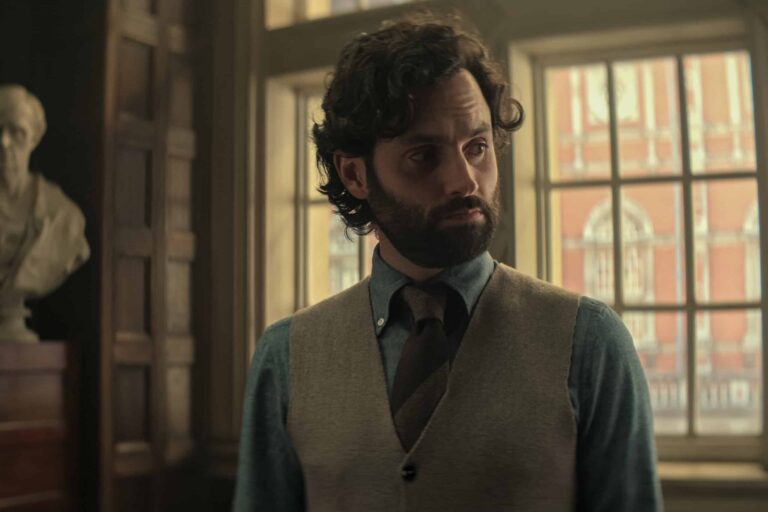
The beginning of the fourth season sees Joe escaping to Europe to find Marianne. Eventually, Joe settles down in London as Professor Jonathan Moore, a well-to-do literature professor at a prestigious university. As always, he opts to redefine himself once again and turn over a new leaf.
The first half of the season largely focuses on a murder mystery involving the Eat the Rich Killer, a serial killer targeting members of London’s wealthy young socialite community that Joe has fallen into, thanks to his persona as Moore. Further, Joe finds himself being stalked by the Eat the Rich Killer, who is aware of his past and has taken an interest in him.
What was most interesting – and perhaps most divisive – about the first half of the season is the change in the status quo. Now, Joe was the one being watched. I suppose Joe wasn’t the only one who attempted to reinvent himself. What began as a thrilling satire about a man whose toxic masculinity prompted him to become a serial killer has now become a Dexter-esque vigilante show as the killer (Joe) attempts to find another killer.
The finale of the first half of the season leads to the reveal of the identity of the Eat the Rich Killer: Rhys Montrose (Ed Speelers), a rags-to-riches author who maintains disdain for the elite. The murderous author finds kinship with Joe whom he considers his equal. However, this changes when Joe finds out that Rhys was the killer. Now, Rhys opts to murder Joe by trapping him in a cellar set ablaze – which, of course, Joe survives. The first half of the season ends with Joe watching his new nemesis announce his candidacy for mayor, aware that he might be the only person who knows the truth about him.
This leads us into the second half of the season, which unearths a twist that turns the entire first half of the season on its head. But more on that soon. The second half began with Joe trying to catch Rhys. In the process, he’s essentially caught in the middle of a battle between Rhys and Tom Lockwood (Greg Kinnear), the shady powerful father of Kate, as both want the other one dead. As the second half of the season progresses, Rhys reveals to Joe that he has kidnapped Marianne to force Joe’s hand in killing Tom. This culminates with Joe finally killing Rhys, the killer. Or so we thought.
As it turns out, during the entirety of the season, Joe imagined his interactions with Rhys, including the fact that Rhys was the Eat the Rich Killer. It’s revealed that Joe was the killer all along and Joe was the one who kidnapped Marianne. Yes, Joe did kill Rhys. But he killed the real Rhys, who had no idea who Joe was and was innocent. While the twist is completely reminiscent of Fight Club, it also essentially reversed the work of the first season in changing the premise of the series. The series reverted back to focusing on Joe coming to terms with the fact that he is a murderer.
After Joe and Kate reunite in the season finale, he starts to confess to her his past (though it’s unclear how much he divulged to her. Did he tell her that he was responsible for murdering some of her friends? That part was unclear.
However, the season appropriately concluded with the duo returning to New York. Kate had inherited her father’s company, and Joe apparently uses some of his newfound wealth to buy a bookstore (perhaps the same one he worked at in season one). This ending was compelling as both Joe and the series as a whole returned to their roots in New York.
Relying on an outsider to try and nab a Cheltenham Festival winner isn’t exactly something Willie Mullins is very used to. The Closutton handler has dominated the Prestbury Park meeting for years, racking up a record 88 winners and securing nine Leading Trainer titles thus far in his glittering career — including in each of the last four years.
With an historic 10 victories across the four days last March, you wouldn’t need a racing tip to tell you that the Irishman is the heavy favourite to defend his top trainer accolade this year. And his contingent is just as frightening as ever, with 12 favourites across the board and almost 20 horses in the top three of the betting for the 14 Grade 1s at the time of writing.
It’s not just short-priced favourites who land the spoils for Mullins, however. The Nice Guy won the Albert Bartlett Novices’ Hurdle from a cool 18/1 on the final day last year, while Ferny Hallow and Burning Victory won the Triumph Hurdle and Champion Bumper from 11/1 and 12/1 in 2020 and Al Boum Photo secured the trainer his first Gold Cup success from 12/1 in 2019.
Mullins also enjoyed a massive 50/1 winner from Eglantine Du Seuil four years ago, so let’s take a look at three of his outsiders that could be worth keeping an eye on this year. Read on to find out more.
Dads Lad – Grand Annual Challenge Cup Handicap Chase
The best value odds are often found in the Festival’s nine handicap contests, with the allocated weights theoretically supposed to make the races fairer, and Dads Lad looks like a good each-way shout in the Grand Annual Challenge Cup Handicap Chase at a general 14/1.
The eight-year-old was heavily raced in 2022, appearing 10 times between April and November. He hasn’t been seen since, but he picked up four wins in that time — most notably in a Handicap Chase in October over course and distance.
He might need good ground, but if the bookies are paying four places for the two-mile affair and Dads Lad shows up ready and raring to go, 14/1 is not to be scoffed at.
Fact To File – Champion Bumper
Mullins loves the Champion Bumper, with 11 wins since the flat race’s inception in 1992 and four victories in the last five years. He’s won the two-mile and half a furlong contest with long shots in the past too, with Ferny Hallow (11/1), Relegate (25/1), Champagne Fever (16/1) and Briar Hill (25/1) all big-price winners in the last decade or so.
His best chance this year is second favourite It’s For Me (9/2), but he still has 14-odd entries at the time of writing and any of them could win what is often a wide-open affair. The one we’ve picked out is Fact To File at around 12/1. The JP McManus-owned horse won over 2m4f at Leopardstown in December, but was a beaten favourite back at the Dublin track for a Grade 2 last month.
The horse who beat him that day, A Dream To Share, has since been bought by McManus and is the favourite for the Bumper. However, they are both planned to run and 12/1 odds for Fact To File are again worthy of an each-way bet as he was around just two lengths behind A Dream To Share last time.
Shewearsitwell – Pertemps Network Final Handicap Hurdle
Shewearsitwell still has a couple of entries at this point, coming in as a 14/1 shot for the Grade 1 Mares’ Hurdle. But the betting suggests that the eight-year-old is more likely to line up for the Pertemps Network Final Handicap Hurdle at slightly shorter odds of 12/1.
The Closutton Racing Club-owned mare reappeared at Punchestown in November after a 76-day break and won a Pertemps Network qualifier over three miles by a neck from My Immortal before stepping down in trip at Leopardstown and winning a Grade 3 Mares Hurdle over 2m4f by over four lengths clear of Queens Brook.
She was still running on well to take the lead in the final stages of that trip over this year’s three-mile distance, so she shouldn’t have a problem with a half-mile step back in trip.
Art School Girlfriend, the moniker of Polly Mackey, has announced her sophomore album, Soft Landing. Set for release on August 4 via Fiction Records, the LP will include the previously shared track ‘A Place to Lie’, as well as a new single called ‘Close to the Clouds’. Check it out and find the album artwork and tracklist below.
“’Close to the Clouds’ is about looking back on my twenties with some kind of wistful hindsight. I wanted it to embody the energy of the music I spent a lot of my teenage years and early twenties listening to,” Mackey explained in a statement. “It’s about reflecting on the winding path to contentment, having finally figured out how to find it.” “The album title Soft Landing is taken from these lyrics, and this track represents a lot of the record’s themes: reflection, joy, coming of age.
Soft Landing will follow Mackey’s 2021 debut Is It Light Where You Are. “By the time it was out in the world, I felt unattached to it,” she said. “This new record truly feels like my debut.”
Soft Landing Cover Artwork:
Soft Landing Tracklist:
1. A Place To Lie
2. Close To The Clouds
3. Real Life
4. Waves
5. Blue Sky feat. Tony Njoku
6. The Weeks
7. Laugh My Head Off
8. Out There
9. Heaven Hanging Low
10. How Do You Do It
11. Too Bright