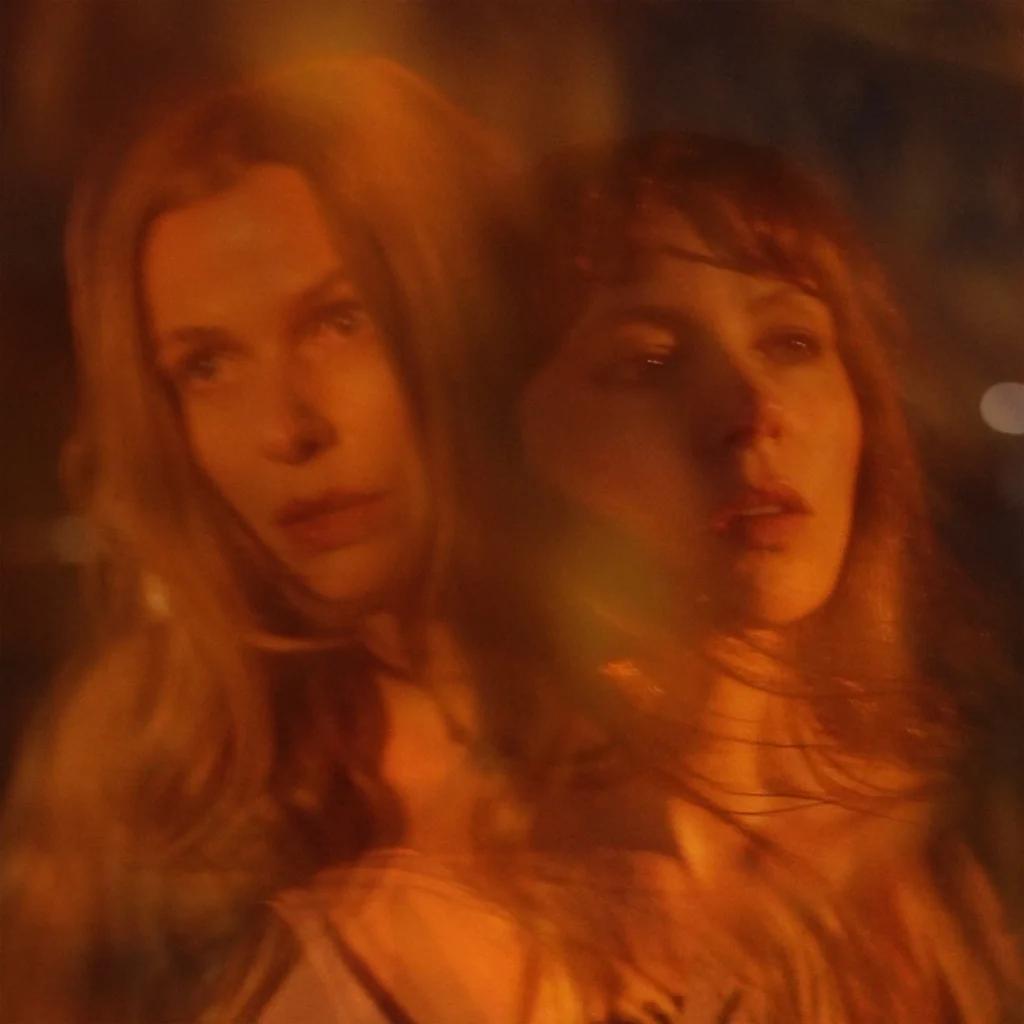
Purple Pilgrims – the New Zealand-based dream-pop duo comprising sisters Clementine and Valentine Nixon – have announced a new album, Given to the Night. It’s set to arrive on November 23 via AD 93. Check out the mesmerizing lead single ‘Innocence Lost’ below.
Opening up about the new song, the duo said in a statement:
It often feels like our songs are little messages from our futures selves, communications from the other side of things. The meaning tends to reveal itself with time. This song was very much that.
Heartbreak is an ultimate inevitability of love – the discomfort in trying to accept that duality, and the idea that even at one’s lowest ebb, it’s still possible to maintain a spark of hope, an endless fascination with life. Night as a metaphor in various guises appears throughout Given to the Night – in this song nighttime feels abundant with magic, mystery, possibility – albeit coloured with sorrow.
‘Innocence Lost’ is a smoldering spark of hope in the darkness, the feeling that although it’s pitch-black there might be something glowing just beyond, out of view.
While crafting the new record, the sisters deleted social media and retreated into the woods of their native New Zealand. The title can be read in two ways, according to the duo: “Being taken by, or being inclined towards nighttime, preferring its blurry cloak of shadows to the harsh light of day; or giving oneself up to night, in sacrifice, letting go of fear and melting into the darkness.”
Given to the Night Cover Artwork:
Given to the Night Tracklist:
1. Innocence Lost
2. Outside
3. Look to the Moon
4. Angel (Passing through this Scene)
5. Love Arrived
6. Echo
7. Wherever You Go, There You Are
8. Receive
9. Windows
10. Universal Love
11. Unseen
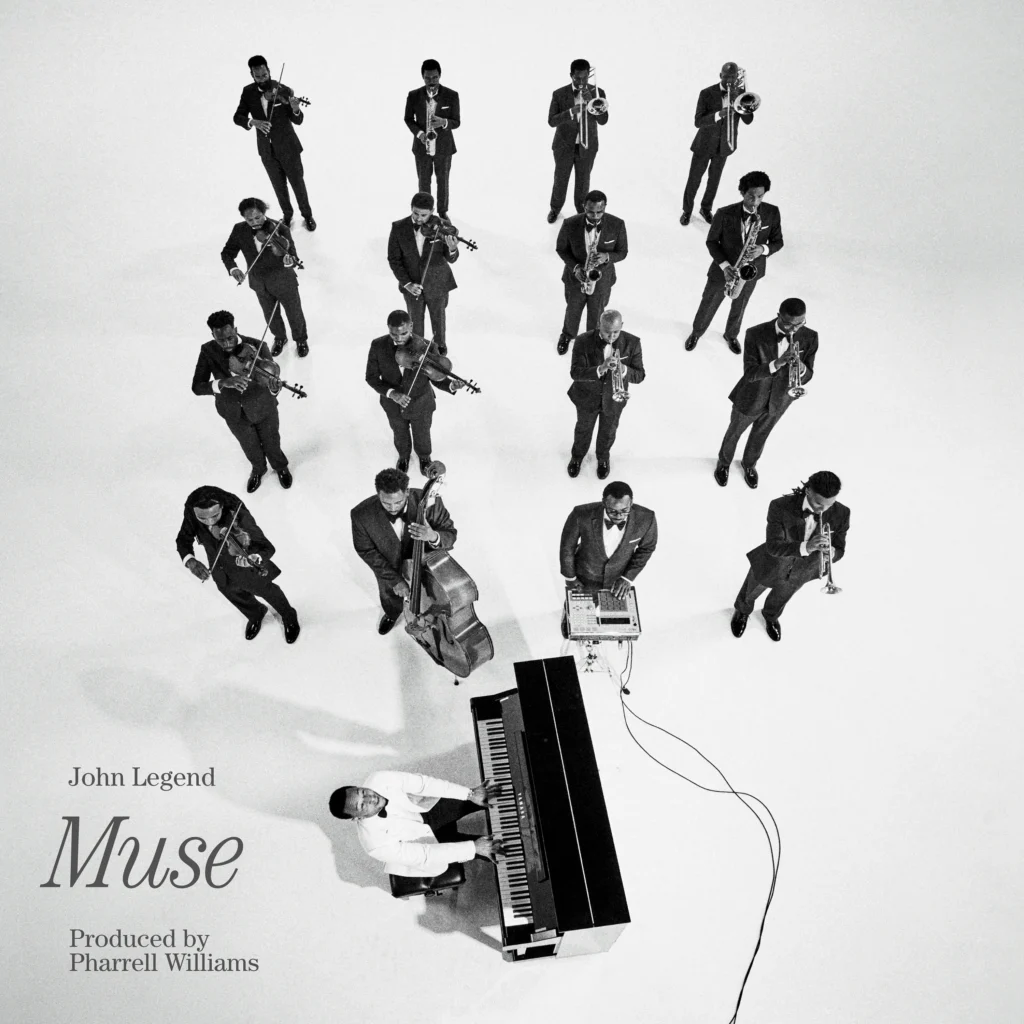
John Legend is about to follow up his Sufjan Stevens-produced 2024 LP My Favorite Dream with a new one produced entirely by Pharrell Williams. Muse is set for release on October 23 via Republic Records, and the lead single ‘Daylight’ is out now. Give it a listen below.
“I think my repertoire has always been very diverse, but the piano-driven ballads have gotten the most traction throughout my career,” Legend reflected in a press release. “I wanted to shake up the formula and do something fresh and new.” He continued: “There are plenty of artists who get to a point in their career where they don’t make anything new. We can just play the hits; we can stay in our comfort zone. But I believe it’s important to keep the mindset that I have to continue to prove myself. I wanted this album to have that sense of urgency — to feel like something that needed to be made and is fully worthy of my audience’s attention.”
The new album took shape after Legend appeared on Let God Sort ‘Em Out, the 2026 LP by Clipse, who deliver Muse‘s sole guest feature. “When Pharrell called me, I thought, let’s do this,” Legend recalled. “A lot of people would have imagined we’d done something like this already, but we hadn’t. It felt past due.”
He added, “Pharrell’s idea from the beginning was that we would create something with all of these classic, cinematic elements, this Black James Bond aesthetic, but with a modern backbeat at its foundation. You can hear traces of me and traces of him, but it sounds like something new for the both of us. The combination of me and Pharrell, on paper, I think, is a good idea. And the execution is even better.”
Muse Cover Artwork:
Muse Tracklist:
1. Muse [feat. Pharrell Williams]
2. Pray For Ya
3. Her Introduction
4. Her [feat. Pharrell Williams]
5. Daylight
6. Get Back [feat. Pharrell Williams]
7. Are You OK? [feat. Pharrell Williams]
8. Under The Bridge Introduction
9. Under The Bridge
10. Next Time [feat. Pharrell Williams]
11. Bodies On The Floor – Taps Introduction
12. Bodies On The Floor [feat. Clipse]
13. Doing Me
14. Fireflies [feat. Pharrell Williams]
15. Everything
16. Sail Off
In contemporary glass practice, technical complexity is only one measure of significance. Equally important is an artist’s ability to bring material, process and lived experience into a meaningful relationship. For artists at the beginning of their professional careers, this relationship is rarely fully formed from the outset. It develops through sustained practice, as technical decisions acquire conceptual purpose and the behaviour of the material begins to redirect the work. Gao Yanjie’s practice over the past two years reflects such a development. Drawing on familiar motifs, including greenhouse plants, sweets and seeds, she uses enlargement, fragmentation and reassembly to translate family relationships, sensory memory and the tensions of personal growth into glass. From Greenhouse Plants to Sweet Teeth and Fumble, her work reveals a gradual shift from readily legible symbolism towards a more integrated material language.
Gao graduated with first-class honours from the University of Sunderland’s BA (Hons) Artist Designer Maker: Glass and Ceramics programme. Working primarily in blown glass, she has developed a strong foundation in hot-glass processes. Studio experience, specialist courses and exhibitions in China, the United Kingdom and the United States have also introduced her to different working methods and studio cultures. More importantly, these experiences have encouraged her to move beyond technique as an end in itself and to consider glassmaking as a means of examining personal experience, uncertainty and constraint.
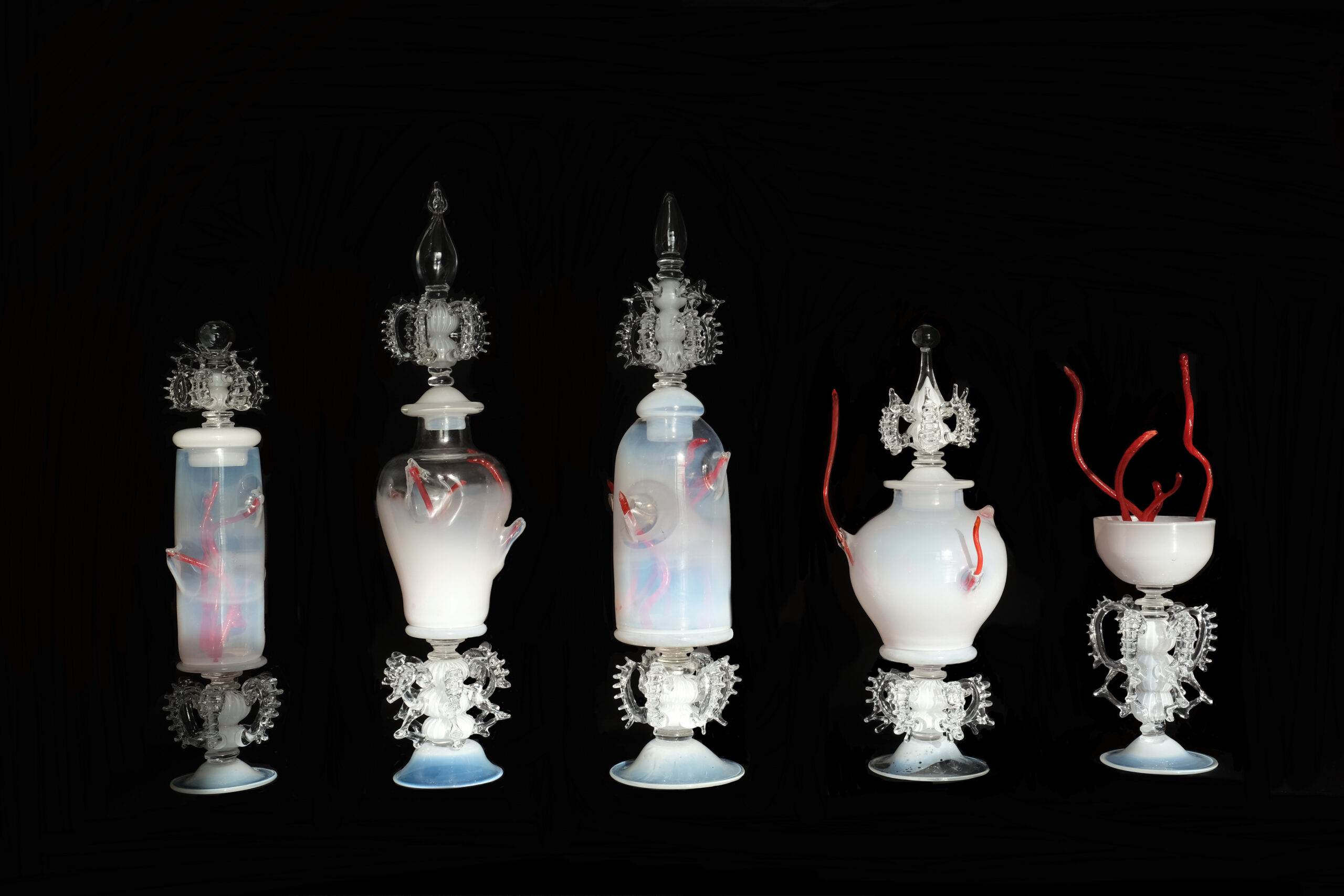
Greenhouse Plants (2025) is an early instance of Gao translating her experience of family relationships into the language of glass. Comprising five blown-glass sculptures, the series places red, plant-like forms within vessels that both host and contain them. This relationship gives material expression to the coexistence of care, expectation and constraint within family life. Although the red forms appear to press against or extend beyond imposed boundaries, they remain physically and visually connected to the vessels around them. This ambivalence prevents the work from becoming a straightforward narrative of confinement followed by escape. Rather than rejecting family ties, Gao considers how an individual might renegotiate personal boundaries without relinquishing emotional connection. Independence emerges not as a decisive rupture but as an ongoing negotiation between attachment and autonomy, shaped both within and against inherited structures.
Greenhouse Plants (2025). Blown and coldworked glass with cane work. Five pieces. Dimensions (H × W): 47 × 10 cm, 55 × 13 cm, 42 × 16 cm, 57 × 18 cm and 39 × 13 cm.
The optical properties of the opal glass reinforce this tension. As light is transmitted, diffused or obstructed, the visibility of the internal red forms changes according to the viewer’s position. Their partial concealment gives visual form to pressures within intimate relationships that may be strongly felt without being immediately visible. At this stage in Gao’s practice, the correspondence between vessel, plant and family structure remains relatively explicit. Even so, Greenhouse Plants establishes a concern that continues through her later work: internal growth unsettles external order, while established glassmaking processes are adapted to articulate personal experience.
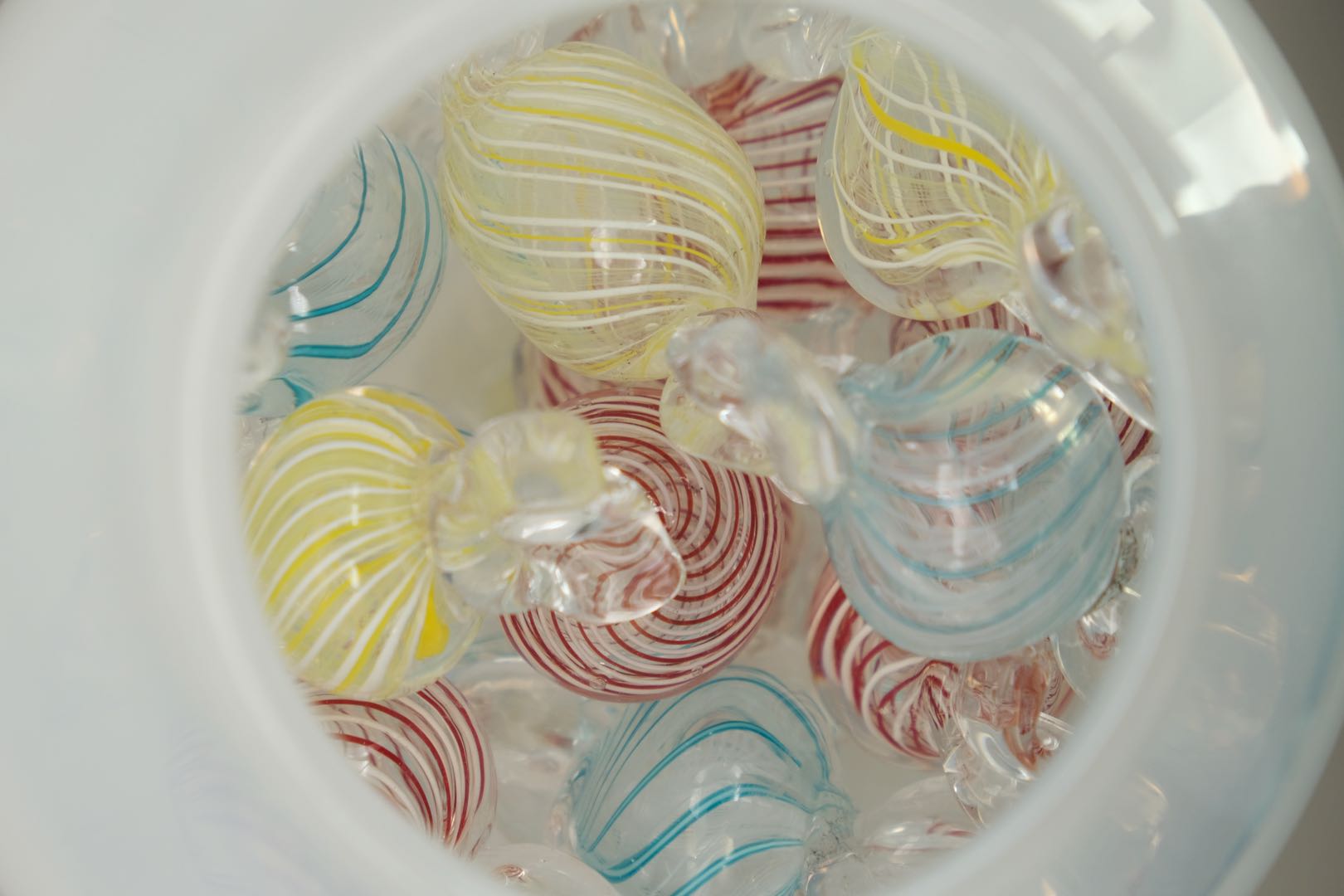
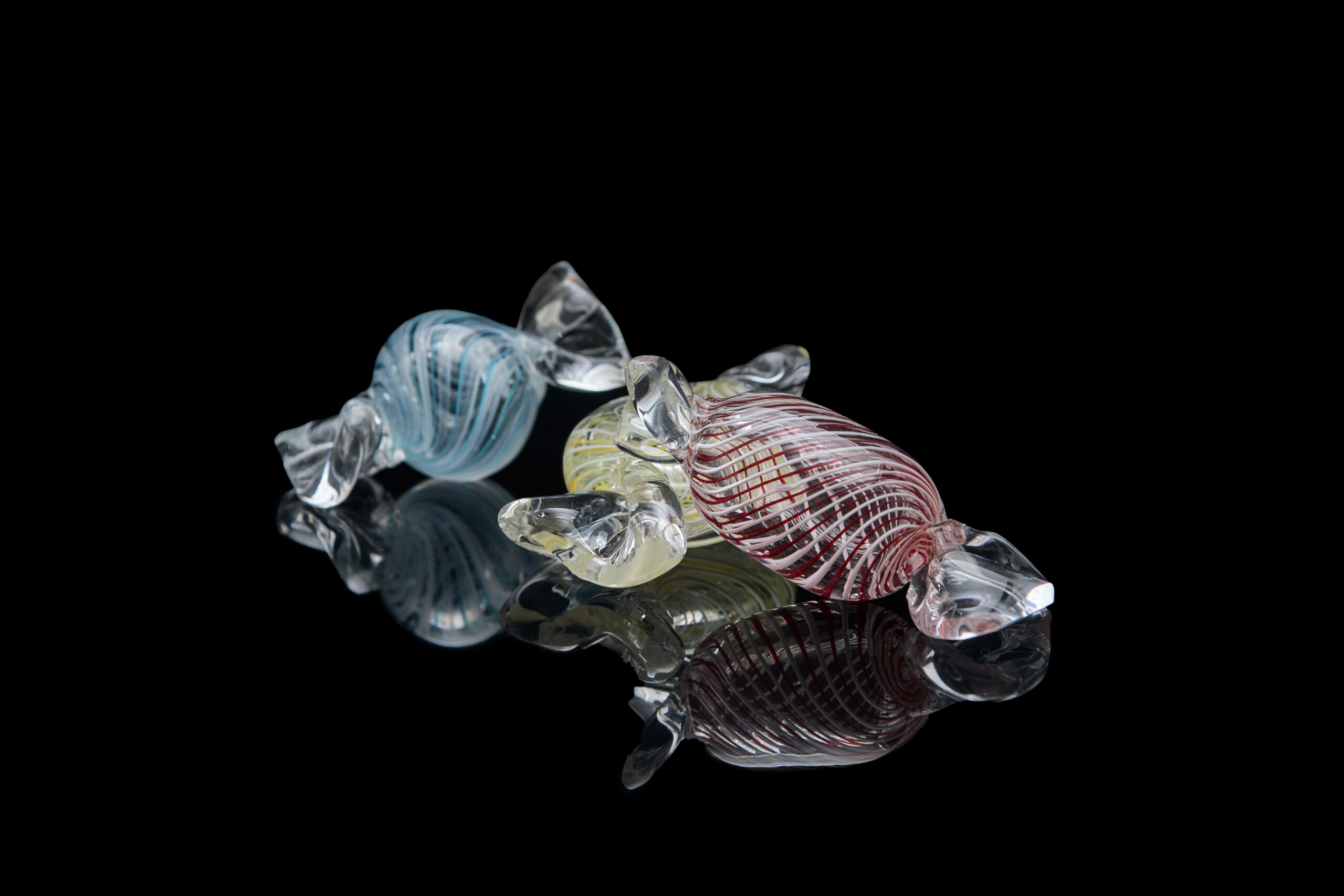
In Sweet Teeth (2026), Gao turns from family relationships towards sensory memory and the emotional associations of sweetness. The work draws on childhood memories of sweet jars and the intense anticipation attached to their contents. Rather than reproducing particular confectionery, she isolates remembered qualities such as saturated colour, gloss, rounded forms and spiral patterns, then reconstructs them in glass. Filigrana cane creates the swirling linear detail, allowing technique to operate not merely as ornament but as a material equivalent of attraction, repetition and craving.
Sweet Teeth (2026). Blown and coldworked glass with filigrana cane. Three pieces, each approximately 7 × 3 cm.
In this work, sweets are associated with the direct pleasure of childhood, but they also suggest the adult use of sweetness as a temporary source of comfort under pressure. The series therefore occupies an unstable position between pleasure and dependence, gratification and excess. A seemingly light-hearted memory acquires a more ambivalent psychological character. Glass is particularly effective in sustaining this ambiguity. Its colour and lustre invite visual desire, while its hardness and fragility resist the softness, taste and consumption ordinarily associated with confectionery.
Compared with Greenhouse Plants, Sweet Teeth relies less heavily on the symbolic opposition between an enclosing vessel and the form held within it. Instead, colour, reflected light, pattern and scale act more directly on sensory recognition. The work marks an important transition in Gao’s practice because material effects begin to carry emotional meaning in their own right. At the same time, the series reveals a difficulty that remains productive rather than fully resolved. Its vivid colours and intricate surfaces can draw attention towards decorative appeal, potentially obscuring the less comfortable themes of dependence and psychological compensation. This tension identifies the work as transitional. Gao is beginning to use material qualities as carriers of affect while still developing a structure capable of binding personal memory, process and concept more tightly together.
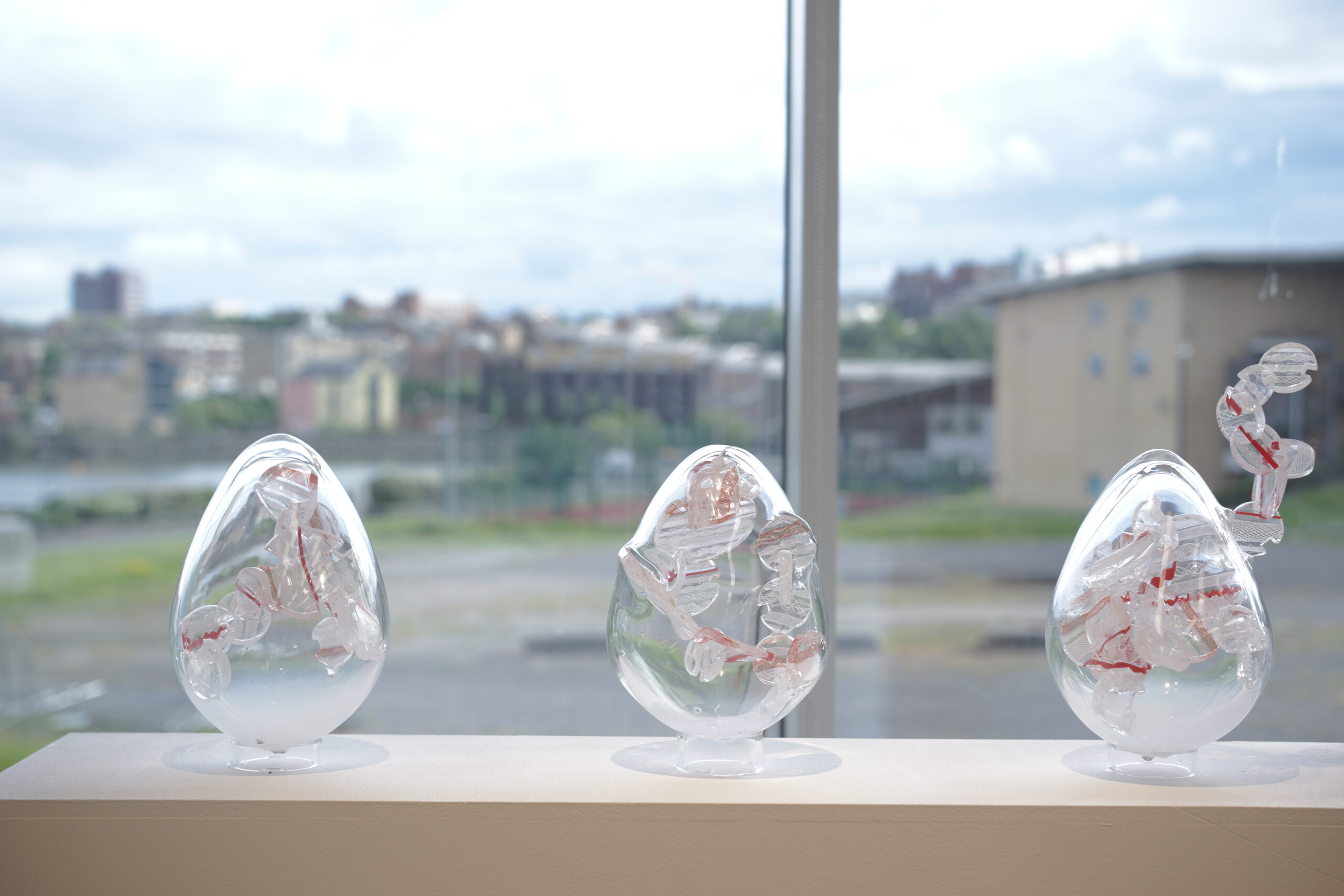
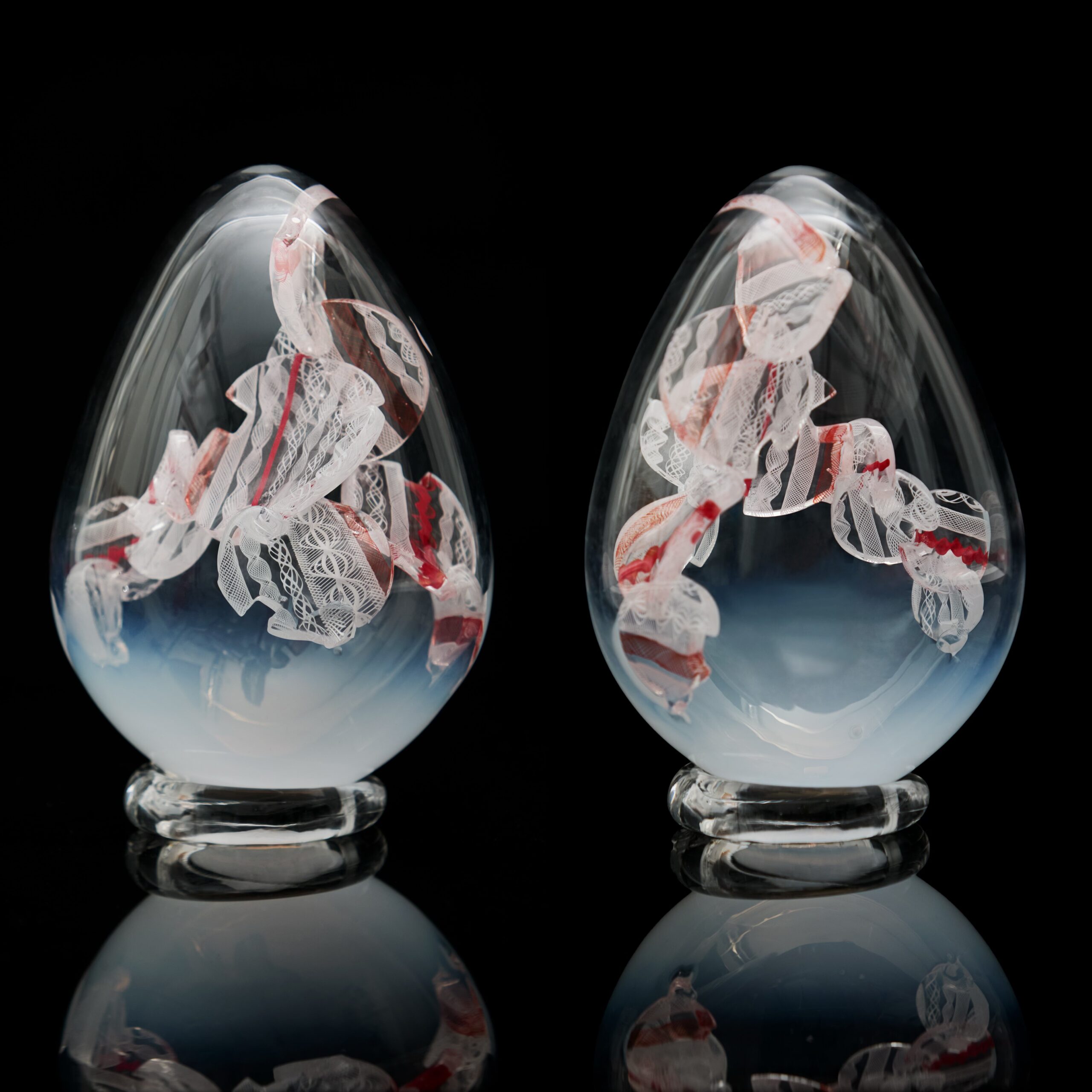
In Fumble (2026), Gao moves away from the comparatively direct symbolism of her earlier work and towards an approach structured through process. The three seed-like sculptures combine blown forms with digitally modelled and waterjet-cut components. Although these methods establish a degree of precision, the final structures remain subject to temperature, timing and the changing viscosity of glass during hot assembly. The work therefore develops through negotiation between planning and material response rather than through the straightforward execution of a predetermined design.
Fumble (2026). Blown and coldworked glass with filigrana cane and waterjet-cut components. Three pieces, each approximately 35 × 20 cm.
The visible variations between the components are not simply technical imperfections. They record the practical judgements required as digital design is translated into hot glass. Gao’s role shifts from executing a fixed model to responding to the material as the work develops. Technical control remains important, but it becomes conditional rather than absolute.
Seen alongside Greenhouse Plants and Sweet Teeth, Fumble marks a change in where meaning is located. Greenhouse Plants uses the recognisable relationship between vessel and plant to address care and constraint, while Sweet Teeth relies on colour, lustre and pattern to activate sensory memory. In Fumble, meaning emerges more directly through designing, cutting, heating and joining. Process no longer serves only to realise an image but becomes a means of testing and revising the artist’s original intentions.
It would therefore be premature, and critically unhelpful, to define Gao’s practice through a settled signature style. More significant at this stage is the changing relationship she establishes between experience and material. In the earlier works, established glass techniques organise form, colour and imagery. In Fumble, risk, irreversibility and the resistance of hot glass to predetermined plans become part of the work’s content. Technical skill is no longer presented primarily as evidence of mastery. It becomes a means of testing an idea and discovering its limits.
This trajectory is still developing. Some of the symbolic relationships remain explicit, and the interpretation of family, childhood and growth continues to be guided by the artist’s stated narratives. A future challenge will be to retain the specificity of lived experience while allowing greater interpretative space for both material and viewer. Nevertheless, the methodological shift visible in Fumble is substantial. Gao no longer treats glass simply as a medium through which a predetermined subject is communicated. She increasingly allows its physical properties, risks and transformations to redirect the work. Her practice occupies a productive space between inherited craft knowledge and contemporary artistic enquiry, in which technique, memory, judgement and contingency jointly determine how meaning takes form.
Film and television. Stage plays. Digital media. Audio broadcasts. All of these bank on a script. The foundational guide that actors, directors, and producers use to bring a production to life. In fact, theLos Angeles Film School says scriptwriting shapes character development, plot, and dialogue. But it’s not exactly an easy feat to accomplish. Because the stakes are different. You’re writing something that will eventually be spoken, acted out, or matched with visuals. Considering this, you might want to give AI tools for scriptwriting a shot.
Aside from being daunting, scriptwriting can also be time-consuming. Not to mention, you’d usually be working with deadlines. With theAI tools on this list, you can receive help in developing scenes, organizing a script, researching ideas, polishing a draft, or writing an entire script.
Top Five Best AI Tools for Scriptwriting
Sudowrite
Sudowrite is one of the strongest picks for creative writing, especially prose. In detail, it offers AI-powered features for planning, writing, and editing. These tools can help with character development, plot arc, scene description, story pacing, and worldbuilding. But if writers use Sudowrite to its full potential, its narrative AI, Muse, can actually remove the need to adapt outputs to script format manually. Write a detailed prompt about the specifics of a project. Muse instantly writes the script, complete with dialogue, structure, action lines, and sluglines.
Key Features:
Exploring dialogue and different creative directions
Built-in AI writing assistant for improving work or script generation
Developing scenes and story ideas
Pricing:
Free Trial
Hobby & Student Package – $19 per month
Professional Package – $29 per month
Max Package – $59 per month
Real Use Case:
Scriptwriters with a strong premise but only a few completed scenes could use Sudowrite. They can turn to its dedicated AI tools to brainstorm the second act and test different scene directions. Or use Muse to continue the scene entirely in screenplay format.
Arc Studio
Image Credit: Arc Studio
Arc Studio positions itself as an entry point for outlining, writing, and editing scripts. One of its highlights is professional formatting. That means Arc Studio automatically formats a script to Hollywood industry standards. There’s also a digital whiteboard where scriptwriters can track story elements. Like characters, locations, and storylines. It also serves as a place for building story structures. As for the smart tools, users can access AI-assisted research, proofreading, suggestions, and tone adjustments.
Key Features:
Automatic backups and draft history
Offline mode and cross-device flexibility
Dedicated tool for real-time collaboration
Pricing:
Free Package
Essentials Package – $69 per year
Pro Package – $99 per year
Real Use Case:
Arc Studio allows writers developing a historical drama to research locations and period details. Then use the digital whiteboard to track which storylines still need attention. All without leaving the app and re-reading the whole draft.
Laper
Image Credit: Laper
Laper takes a screenplay-first approach. At its core, it has AI-powered tools that can work within the specific scene, character, beat, range, or other context the writer selects. At the same time, its structure tools turn multiple story elements into a clearer visual map of the screenplay. What’s more, there’s an AI Script Doctor that can inspect the draft and diagnose issues with character motivation, pacing, structure, and scene-level concerns. Users then receive prioritized notes that guide revisions.
Key Features:
Real-time script collaboration
Dedicated AI assistant for identifying script issues
Targeted revisions without taking over the writing process
Pricing:
Free Package
Senior Package – $20 per month
Elite Package – $60 per month
Master – $100 per month
Legend – $400 per month
Real Use Case:
Screenwriters working on a 90-page drama can ask Laper to inspect the relevant scenes and screenplay structure. This makes it easier to pinpoint where the pressure drops and find ways to prevent parts from losing momentum.
WriterDuet
WriterDuet is built as professional scriptwriting software. Looking closer, it combines screenplay tools with AI-powered services. To be more specific, it offers ScreenplayProof. This AI-powered tool polishes scripts. It analyzes a script for formatting, grammar, and spelling problems. It does so without altering character dialogue or a writer’s voice. But before this AI addition, WriterDuet was and still is regarded for cloud-based collaboration. It lets two or more writers write and edit the same script simultaneously.
Key Features:
Memory and history for revisions and edits
Auto-fill previous locations for faster writing
Stageplay, comics, and podcast templates
Pricing:
Free Trial
Plus Package – $9.99 per month
Pro Package – $11.99 per month
Premium Package – $13.99 per month
Real Use Case:
WriterDuet helps writing teams split scenes for a television pilot script. With the tool, they can work in the same document at the same time. They can also run the draft through ScreenplayProof before submitting it to producers.
Squibler
Squibler leans more toward automated scene-by-scene drafting or full script generation. It offers two scriptwriting options. The AI script generator and the AI script maker. The former focuses on full-on generation, while the latter adds formatting and editing. Both share overlapping features that help with scriptwriting. These tools work by having the user define the concept, characters, genre, setting, tone, scene directions, and the central conflict. Squibler returns with a script draft with proper action lines, formatting, natural dialogue, and scene headings.
Key Features:
Generating screenplay drafts from concepts
Supports different genres and themes
AI-assisted revisions and adjustments
Pricing:
Free Package
Plus Package – $29.99 per month
Pro Package – $89.99 per month
Real Use Case:
Aspiring filmmakers with a strong concept but no scriptwriting background can leverage Squibler. They can describe their story’s premise, characters, and genre. The tool can then generate an initial script structure in proper format.
Choosing the Essential AI Tools for Scriptwriting in 2026
Where you’re stuck determines which tool actually helps. At the same time, consider the format you’re writing for and the gap you’re filling. Sudowrite and Squibler are for those who want automated scripts with lighter editing afterward. Arc Studio caters to scriptwriters who need AI-assisted research within a dedicated screenwriting environment. Laper helps those who need script analysis and improvements. WriterDuet is ideal for collaboration and AI-powered proofreading.
No audio or visual media succeed just because they feature prominent personalities, iconic voices, flashy visuals, or big-budget productions. Scripts are what essentially drive them. And for scriptwriters, AI tools for scriptwriting can provide a useful push without taking the creative wheel completely.
The allure of an exclusive night out goes beyond just a place; it’s about a feeling. It’s that moment you step past the velvet rope into a world made just for a specific experience, where every detail is designed to make you feel like you’re part of something special. The secrets of exclusive experiences aren’t just about who gets in, but about what happens once you’re inside. It’s a mix of atmosphere, service, and an intangible vibe that turns a simple evening into a lasting memory.
What Makes a Venue Exclusive?
People often misunderstand exclusivity, thinking it’s just about rejection. But it’s more subtle than a strict door policy. A truly exclusive venue builds its identity by carefully choosing what it offers. This starts with the guest list and dress code, which aren’t just rules, but tools to shape the energy of the room. By setting a standard, the venue makes sure everyone there is looking for a similar, high-quality experience.
Reputation and location also play big roles. A hidden entrance, a desirable address, or a history of hosting important guests all add to a venue’s mystique. This isn’t something that happens overnight. It comes from consistently delivering on a promise of quality, privacy, and top-notch service, creating a buzz that marketing alone can’t replicate. The goal isn’t to keep people out, but to create an environment so appealing that people are eager to get in.
The Perks of a Polished Atmosphere
Once you’re inside, the atmosphere is everything. The best venues know they’re selling a sensory experience. This includes everything from the sound and lighting design to how clean the restrooms are. A polished atmosphere shows value and respect for the guest. The layout is designed to encourage people to socialize, while also offering private spots for quiet conversations. High-end sound systems deliver music clearly, not just loudly, and lighting sets the mood, changing throughout the night to guide the energy.
These details are part of the latest luxury hospitality trends that focus on creating immersive environments. Whether you’re at a high-energy dance club or looking for a premier strip club near me in Las Vegas, the quality of the environment is what makes the night special. A commitment to a polished atmosphere shows that the venue cares about your experience from the moment you walk in until you leave.
VIP Treatment: More Than Just a Table
In an exclusive setting, VIP treatment goes far beyond a reserved table and a bottle of spirits. It’s about personalized, proactive service that makes you feel like the most important person in the room. This starts with a dedicated host who manages your experience, making sure your group has everything it needs without ever having to ask.
True VIP service is smooth. Drinks are refilled before they’re empty, requests are handled discreetly and efficiently, and the staff is trained to anticipate needs. Bottle service becomes a form of entertainment, with a presentation that adds to the spectacle of the night. This level of attention removes all hassle from the experience, letting you and your guests focus solely on enjoying yourselves. It’s a feeling of being completely taken care of, which is the ultimate luxury.
Guest Guidance in High-End Spaces
The staff at an elite venue are more than just employees; they represent the brand and shape the guest experience. From the security at the door to the servers and hosts inside, every team member is trained to be professional, discreet, and attentive. Their job isn’t just to enforce rules, but to guide guests toward a positive and safe experience.
A well-trained team can calm potential issues before they start, manage the flow of people to prevent uncomfortable crowding, and provide helpful information with a welcoming attitude. Their confidence and competence set the tone for the entire venue. When guests see that the staff is in control and dedicated to their well-being, they feel more comfortable and secure, allowing them to relax and fully immerse themselves in the night.
Crafting Memorable Moments
Ultimately, any exclusive venue aims to create moments guests will remember and share, much like the exclusive music series launched by Remy Martin. This happens by combining all the elements — atmosphere, service, and curation — to create a unique story for the evening. Sometimes these moments are planned, like a surprise performance from a world-class DJ or a themed event that transforms the space.
Other times, memorable moments are spontaneous, born from the perfect alignment of great music, an energetic crowd, and impeccable service. The best venues create a platform where these moments can happen naturally. By focusing on creating an exceptional and seamless experience, they give guests the freedom to create their own stories, turning a night out into a benchmark against which all future nights are measured.
Hannah Cole is a Nashville-based artist who grew up in Covington, Louisiana. When she was six years old, her parents noticed she was musically inclined and enrolled her in piano lessons. While the support of a few elders was crucial to her musical upbringing in a small town, Cole was introduced to a competitive new world upon moving to Nashville, where she attended a songwriting program at Belmont University. She met people who grew up seeing way more bands than her, even played in them, including her longtime collaborator and partner Josef Kuhn. Following a series of EPs, beginning with 2022’s Cradle, the pair wrote and recorded Cole’s debut album, Switchbacks, at their home studio over the last two years. Even as an amalgamation of influences that includes Bully, Alex G, and Cocteau Twins – not to mention the heavier shoegaze bands the record’s mixer Sonny Diperri has worked with, from My Bloody Valentine to Julie – it conjures a well-defined, multidimensional sound most artists don’t arrive at until several LPs into their career, each song dynamically peppered with distinctive details. On Switchbacks, Cole peers into the future while treasuring the ecstatic moments of creativity on which it may depend, acknowledging that the promise of success is as fuzzy as memory itself.
We caught up with Hannah Cole for this edition of our Artist Spotlight interview series to talk about her earliest musical memories, the making of Switchbacks, going backwards to move forward, and more.
I was listening back to Cradle, and I realized enough time has passed since that EP that there’s a whole new Phoebe Bridgers album to be listening to while “laying face down” in bed, as you sing on ‘Guard Dog’. That record feels really joyful, not “ironically optimistic,” and I feel like you could say the same about Switchbacks, for all its heaviness.
Thank you, that makes me really happy. That’s really what I wanted, because when I’m writing music, I think about, “How do you capture the complexities of life – the fact that two things can be true at once?” That’s always something I’m trying to capture, this 360 view of something, because no thing is just one-sided; no thing is this black-and-white experience. I think with Switchbacks, there was this element of me trying to see the beauty in kind of an ugly thing.
When you think back on previous attempts at songwriting, do you feel like you were leaning more towards one side?
Yeah, for sure. Right now, I’m 25, about to be 26, and I feel like my brain is just now developed or almost fully developed. [laughs] I feel as though I see life in that not-so-black-and-white way. When I started putting out music, I was so young – even though it was just six years ago – and I don’t think I was as mature as I am now. But I look back and think that at that age, that’s kind of how you see the world. Someone hurts you, and you just hate them and think they’re a horrible person and evil, or this bad thing happens to you, and suddenly your whole life is horrible and nothing is going right. Or on the opposite end, you love someone, and you’re only in love, and it’s perfect.
It’s fun to actually have captured those things when I was younger, because that’s how you think when you’re growing up in your early 20s or late teens. Now, my eyes are just open to the world a little bit more. I’ve experienced different social dynamics and understood that if I am this person who can experience the pendulum swing of my life, my emotions, the way I feel about people, and the way people feel about me… it sounds obvious, but sometimes we get so in our own heads that we forget everyone else is just like us. All of us have this very complex world within us, and it’s important to be able to recognize that in yourself and other people.
Part of why I wanted to bring up ‘Guard Dog’, even though it’s an old song, is because you sing about wanting to hold your younger self. I feel like that’s a good segue into talking about the new record, because there was a moment in the process where you started watching videos of yourself as a kid playing piano and singing. Could you talk about the kind of memories and feelings that were unlocked?
There are so many layers to it. With ‘Guard Dog’, it’s interesting because in that song I talk about going back and wanting to hold my younger self, console her, and be like, “It’s okay, I know something now that I didn’t know back then.” On Switchbacks, it’s this thing of, “Oh wow, I knew so much back then, or I had so much confidence back then that I actually am lacking now.” There’s this sense of confidence you have as a kid that you lose a little bit, when you become an adult – when you take the rose-colored glasses off and either see the world for what it is or feel judgment or outside eyes on you for things that you’re supposed to be creative and free with. Music obviously is that thing for me where, when I was a kid, there’s videos of me at piano recitals, just getting up and singing so loud. [laughs] I’m not some child prodigy or anything, but it was just so funny because I was looking at these videos and I was like, “Wow, I look like I’m having so much fun.”
I’m so lucky that I had a piano teacher who was very encouraging of me writing and being very free and creative on the piano. I wasn’t one of those kids that could read all the sheet music and play all the classical music. It wasn’t natural for me, but I think my piano teacher saw a side of me that needed to break free of something. She was like, “You know what? I’m gonna teach you chords, and we’re gonna teach you songs that you hear on the radio, you can write songs. You can just have a little bit more creative freedom.” I thought about that, too, when making the record – not only just performing without fear, but also creating without fear.
When I was making this record, especially before I had more of a team and everything was on the up, things were looking pretty bleak for a second. I was like, “Is this even worth it? Am I really meant to be doing this? Are people really gonna hear this?” In Nashville, too, there’s so many people doing music, and you go on social media now, it almost feels like everyone is posting videos of them singing and doing music. I’m like, “Who cares about what I have to say?” [laughs] In asking myself those questions and experiencing all of those thoughts, I was like, “Oh, maybe this is the perspective people are curious about.”
I feel like there’s a thread on the record of having to go backwards in order to go forwards. On the record, it’s more so a memory from a few years ago of making music in this cabin in Asheville with my partner – making music just for fun, having a really fun time, and not being worried about being commercially successful, just doing it because it’s fun. I learned on this record that you often have to go back into memories or the past in order to go forward.
How long were you taking lessons? I know you started playing when you were six, but I’m curious how things developed until you moved to Nashville.
I did not grow up in a musical family at all. I really just started taking lessons because my neighbor took piano lessons and I thought she was super cool. And I always loved music. My mom likes to tell me that when I was in the womb, she would play music and I would [mimes fetal punching movements]. I loved to dance; my favorite song was ‘Hey Ya!’ by Outkast. So they knew I was musically inclined, but they were like, “What should we do about this?” When my neighbor was taking piano lessons, I was like, “Okay, that’s gotta be me.”
I really didn’t love it at first. I think I just have a thing about not loving when people tell me what to do [laughs] or that I have to do something. Being told you have to do this creative thing just feels contradictory to me. Even from a young age, I was like, “Okay, this is supposed to be fun – why do I have homework? Why do I have homework for music?” Obviously, to learn anything you need to practice, and I did practice, but I didn’t necessarily enjoy it. I would sit there with my piano teacher and just be like, “I don’t know if this is for me.”
I got a microphone for maybe my tenth birthday. Years had gone by, and I think somewhere in between there I had stopped taking lessons, but knew enough to play around here and there. Then I started watching videos on YouTube and learning by ear how to play songs that I liked on the radio or on CDs my parents had. I think my parents were like, “Oh, she’s pretty good at singing,” so they called my piano teacher back up, and we started doing lessons again. She was like, “I really hear potential in you, and I want to teach you chords. I’m not gonna make you read sheet music. You’re gonna learn chords. You can do whatever you want. I’m gonna sing with you, and we’re gonna do this in a completely different way.” We would sing together, and I learned how to harmonize.
I didn’t grow up playing in bands. I played with a couple of other piano students before, but I would only do recitals two times a year. I won some local singing competition – keep in mind, I’m from Covington, Louisiana, which is a small town outside of New Orleans. Are there the best singers in the world there? Maybe not, so maybe I didn’t have the toughest competition in the world, but I won this singing competition when I was 12. The prize was that I got to write a song and have it recorded, and then it was gonna be played on the radio. That was my first actual song that I wrote, and then I just fell in love with writing songs, of course. After that, I was going through the awkward teenage years, and I was like, “I’m not gonna do this for real. No one I know in Louisiana has done this.” It was so unfamiliar to me that I didn’t even know you could go to a city where people write songs for their job every day. I didn’t know that.
I actually went to a studio once to try to get singing lessons, and this guy, I don’t know if he thought I was not very good or something, but he said, “I don’t know if you’re ready to record stuff” – which, he was correct, I was a kid! But he said, “Are you familiar with the recording process at all?” I said no, not at all. That was my first introduction to Pro Tools and a DAW in general. I knew about GarageBand, but seeing how it looked in a studio, I thought it was really cool that this guy was like, “You should have an introduction to this.” I really fell in love with that side of music as well.
Later on in high school, I ended up getting a little Scarlett interface. I didn’t really know what to do. I was watching a lot of videos, my dad was trying to help me – he knows nothing about music at all – I’m like, “What is this thing? How do I use it?” My dad was like, “I don’t know, I’m pretty sure this is what you’re supposed to have.” [laughs] That was fun to figure out in high school. I would just record covers and songs that I’d written on GarageBand, and that was my introduction to recording.
It wasn’t until I toured Belmont University, where I ended up going to college, that I saw there was a songwriting program. There was also music business, and I was like, “Oh, this is my thing, I should probably do this.” But I was still kind of unsure. I auditioned for the program and got in. From there, I just wrote a bunch of songs, went to class, met a lot of people, and was exposed to a lot of different types of music in college that I was just not really exposed to in high school. I didn’t even play with a band until I was 21.
When you were getting into recording and songwriting by yourself, do you remember craving being in a band at the time? Or was it more so later on, when you met other people that grew up in places with bigger music scenes, that you wondered what that might have been like?
Yeah, I think it really wasn’t until I was exposed to that in college that I was like, “That is something I want to do.” It wasn’t even until I first played with a band that I was like, “This is so awesome, and I don’t like being alone on stage.” Especially with the band I have now – people that I really trust, who are always so prepared, so kind, and so excited about the music – that’s when it feels the best to play with a band. In Nashville, everyone plays in each other’s bands, so sometimes it’s hard to land on people who want to play with you, like your music a lot, and want to experience that. I feel like so many people I know have so many years on me in terms of performing with a band and playing live or playing shows in general. I feel like I’ve just now gotten the hang of it, honestly. It takes a really long time to feel comfortable, and I still don’t feel all the way comfortable.
When you realized that it was a viable career path and that it was possible, were you set on following it no matter what?
I think it truly goes back and forth. There are moments when I have so much confidence that this is what I am absolutely meant to do. At my core, I’m like, “I know that I’m good at this,” and I feel that from other people, too. But there’s always that questioning in my mind every now and then. In music, there are so many high highs and low lows that it’s kind of impossible for me personally to have this consistent thought of, “I am a thousand percent meant to be doing this.” There are days that I feel that, and then there are days that I don’t. Going into college, I probably had a little bit more blind optimism, like, “I’m gonna be fine, this is gonna be easy!” [laughs]
“Ironically optimistic”?
Yeah, exactly! I was just like, “I’m great.” Of course, looking back, I’m like, “Wow, those are some of the worst songs I’ve ever written.” Thank God they have you writing so much in college – you get all of the horrible songs out of the way. But at my core, I know that music is always gonna be the thing that makes me the happiest, so in that case, I’m meant to do it. But I can’t say for sure – just because I’m meant to be doing it doesn’t mean that it’s gonna happen for me. That’s kind of where my head is at.
Do you feel like you got more out of the business or songwriting lessons in college? What was it like trying to balance those things?
With the songwriting thing, I know a lot of people leave a program being like, “Okay, that was a waste.” But for me, it really was the repetition of writing so much, and then finally having a teacher be like, “Okay, I think this song is a perfect song,” where I felt like, “Oh, I’ve cracked this code.” Or just learning little lessons over time – like in a song, maybe you should show instead of tell, use specific imagery, don’t use cliché phrases. Little rules like that were really helpful, along with the sheer repetition of writing so much. Having the music business background gave me a good general awareness, although I do think you really don’t know until you’re actually experiencing the industry firsthand. Meeting so many people that also did music really helped me a lot.
Jos and I met in audio engineering class, and we became friends and shared this bond over music that we really liked. I think meeting other people that I could see were kind of on the same level as me, in terms of either what we were making at the time or what we liked, you kind of see the people that you know you’re gonna work with. There’s a lot that I don’t love about living in an entertainment city or a music city, but there are pros and cons to almost everyone doing the same thing as you – to know that you’re always meeting at least a couple people that are at the same point in their musical journey as you that you can rise together with: that’s the goal.
How do you feel like that experience changed your relationship to your hometown?
I really love my hometown. I love Louisiana. I love New Orleans. I know I grew up a little bit outside of New Orleans, but I was always in New Orleans, and I think what’s cool about a city like that is that there is music everywhere, but not everyone is trying to do it as a career. When I’m walking down the streets of New Orleans and I see people playing drums on the street or playing trumpet, you can hear jazz bands playing in restaurants and bars – seeing people do something that is so joyful and just makes them happy is really inspiring. I think Nashville isn’t even the most uppity, entertainment-buzzy place. LA is probably a little bit more intense when it comes to that, or maybe New York. But Nashville can still feel a little bit competitive, or a little bit inauthentic or network-y. I think that I’m so lucky to have grown up in a place that wasn’t like that at all. Being here makes me appreciate my hometown so much, but also, I couldn’t imagine being there forever. I don’t think that music as a career could work from there. But going back there feels like this break from the music industry scene.
Tying this to record, there’s a lyrical juxtaposition between ‘MMA’ and ‘Give’, where you sing about cutting and pasting magazines into a poster, and then actually seeing yourself in a poster – the difference between idolizing to projecting, in a way.
I’m so glad that you pointed that out, because actually, that connection between those lyrics is something I hadn’t even really thought about until a couple months ago. I was talking about it with Jos, and I was like, “Oh!” Sometimes you’ll write songs, and your brain will think of things or make connections before you even try to. With ‘MMA’, that lyric was me showing almost this manifestation of something – I think back to making vision boards with my sisters, cutting up magazines, putting them on a poster board, and kind of planning out this vision for your future, your dreams, and your goals. And with ‘Give’ being like, “I actually see myself on this poster.” I see myself; I can see myself becoming the thing I’ve always wanted to be, and I’m getting closer to that. I see myself doing that, but there’s still this barrier there, not only in terms of reaching the goal, but seeing my real self; remembering that me on a poster isn’t necessarily me. There’s still that barrier between me – the real me – and this kind of star, I guess.
Was there a kind of vision board for Switchbacks, when you were starting to conceptualize it?
Honestly, not at first. I think it’s actually quite helpful to do that when it comes to music making. I did that more so on the visual side of things, which I think reflects the music very well in terms of this almost fever-dream type of visual. I feel like ‘MMA’ was the first song that we made that set the standard for the rest of the record. Even that crazy snare or the jingle bells – I think that was the first song where I realized that I wanted each song on the record to have at least a couple of distinguishable elements. So that was kind of the vision that I didn’t fully realize until making probably ‘MMA’.
You talked about seeing your real self, which I think also relates to this theme of how you’re perceived or misperceived externally in the scene. ‘Mechanical Bull’ is a song that really wrestles with that.
Especially with what we did production-wise, I did want that song to feel almost like I was being muffled a little bit. Even with the image of a mechanical bull: not only is it alluding to Western/Nashville culture, but also I think there’s an interesting perspective shift in that song where I’m like, “I don’t wanna be the bull. I’m gonna ride the bull. I’m gonna grab the bull by the horns,” which is a thing, but then you realize it’s mechanical, and there’s someone else that’s actually controlling this behind the scenes. Sometimes, no matter what you do, how hard you try, or how much control you think you have, a lot of times you just are not in control of the way that people see you.
As a woman in the music industry, that’s just the personal experience I’ve had, where there’s a lot of accepting and moving on, which kind of sucks. There’s a lot of, “Damn, I have to accept that that person thinks that about me.” This person doesn’t think that I write my own songs, or they don’t think that I play any instruments, or they don’t think that I’m an equal to my partner who also does music. But I have to put that energy back into the music, let the music speak for itself, and accept that – it’s weird, you can accept something and also advocate for yourself and rebel against something. I wanted to portray this complexity of doing the same thing as my partner, having the same job and same career, but being perceived by men in the industry as “the girl” or “the girlfriend,” which has happened multiple times.
The word “muffled” feels true for that kind of acceptance, too. Your voice being effected on that song speaks to this point that you’re getting across, but it also comes into contrast with a song like ‘Mosquito Hawk’, where your voice is really clean and unfiltered. You really tap into that almost childlike purity that we were talking about. You’re playing the piano, you’re stretching the song out, and it’s this almost contained picture of two musicians creating.
I remember that song being one of the first ones that I wrote for the record, actually. But we didn’t land on the full production or anything until much later. I want to say it was one of the last ones that we ended up finishing. I really wanted to make something with that song where people had to stop and slow down for a second. For myself, where I was at in life was that I needed to kind of stop and remember this beautiful moment that made me fall in love with music again, and understand the connection between romance and music, and how there is this kind of love story with anything that you’re passionate about. What’s interesting to me about the record is that a lot of the songs can be listened to almost as relationship songs. You can go back and be like, “Oh, that sounds like it could be about a toxic relationship,” like in ‘MMA’, never knowing when to leave. I started to realize the connection between my personal romantic relationship and my relationship to music, and how with anything that you’re in love with, or anyone that you’re in love with, you have to accept the changes and the peaks and valleys of a person or of the thing that you love the most.
With ‘Mosquito Hawk’, I wanted to make this beautiful, slowcore anthem for myself. I think what’s super beautiful about that song is the reverse tape that you hear in the beginning, and also before the last chorus there’s this intentional reverse tape sound, because it’s supposed to signify me going backwards into this memory.
There’s almost this cycle of falling in and out of love with music, from the moment you started playing piano to this memory of making music in Asheville. What do you see as the common thread there? Is it the same story that’s bound to happen over and over again, or does it keep changing in some way?
I think that this falling in and out of love with music is something everyone can relate to in whatever they are passionate about. I think that’s a common theme of life. There’s this constant death and rebirth, almost. That is how it feels a lot of the time to do music, and to pursue success in general, but especially in music. I think you can experience this as a kid: that eerily beautiful feeling of being really nervous going on a stage, performing, feeling a dopamine rush and like it’s the happiest you’ve ever been, and then coming off stage and experiencing the emptiness.
I think you can see that across not only this record, but across any artist’s journey. You constantly have to reinvent or change your way of thinking, but also experience this trippy feeling – for me personally, an example is I opened for this band called Silversun Pickups last year. Those were the biggest shows I’ve played, I think. I remember going on stage and being like, “Wow, this is awesome,” this high of people telling you you’re awesome, telling you you’re special, and clapping for you. You try to soak in those moments, and then I go home and it’s like, “Okay, time to do my laundry, go babysit, go grocery shopping” – doing things that are good, but the normal things start to feel like, “Where’s that rush of excitement?” It can also can be this long phase where it’s like, “Ugh, I feel like I’m so bad at this, and no one’s ever gonna care” for months at a time. Then you have three months of rolling out an album, and you feel all the exciting things. There’s just this huge pendulum swing when it comes to the way that I feel about making music.
I think the record makes the slowing-down part sound equally beautiful and joyful in some ways. I think about the opening title track that slows down and then picks itself up, almost like a car losing speed while driving up a mountain range. That’s the feeling, but you’re still soaking in the beautiful view.
I really appreciate you picking up on these details, because it is so intentional. Even pairing that with words like “I’m ready to go home.” It’s like, I’m ready to feel that feeling of being home, back to a time that was simple, joyful, and slow.
Could you single out a memory of making this record that felt really joyful or encapsulates it in some way?
In general, it’s so nice being in kind of a bubble with my partner and collaborator, Jos. What’s interesting about this time around making this record was that it was actually quite challenging. We’re very close, and we’re very honest. Sometimes when you’re honest, even if you say it in the most graceful way, it still can be like, “Oh!” [laughs] I want to say making ‘Give’ was pretty euphoric. I remember us putting the microphone out in the hallway, and Jos and I did these crazy, funny background vocals for the song – making this weird voice, I don’t even know what you’d call it. I was trying to sing in my deepest man voice, and we were singing together.
We went back into the studio, and our friend Henry was playing guitar, and I just remember cracking up laughing and having so much fun. Jos says something in the beginning of ‘Give’ – I don’t know if you can hear, there’s a little bit of talking in the beginning. You shouldn’t be able to hear what he’s saying, but he says something about his fingers being sweaty or something, and we kept it on the track. That would be crazy to make it clear, but it’s like a personal inside joke that we included in the record.
It took so long that the memory’s a little blurry, but one thing that stood out to me in general was the way that Jos is such a selfless collaborator – someone who really wants to make an artist shine, and their voice shine, and their ideas shine. I’m really grateful that Jos is not a selfish collaborator or producer by any means. I think there are a lot of people or producers in the music industry that take the reins and don’t let them go. This was one of the first times where I felt like I was confident enough to voice my ideas across the whole record, and he just accepted all of them fully and was like, “This record’s gonna sound like you.” I couldn’t do it without Jos, but I think he would say the same thing about me. Having it be such a collaborative process was not only so beautiful for regaining my own confidence in myself, but making something so special with someone you love so much is also just a really awesome thing.
This interview has been edited and condensed for clarity and length.
Lancaster, Pennsylvania group American Motors have announced their second album, Functional Music. The follow-up to 2024’s Content is set for release on November 6 via The Ghost Is Clear/Expert Work/Vina. Check out the pummeling, hypnotic lead single ‘No Horses’ below.
The band reunited with the legendary J Robbins at his Magpie Cage studio in Baltimore to make Functional Music. “Making the first record, we established a conceptual framework to work inside of,” vocalist-guitarist Dustin White explained in a press release. “This time we’re adding more detail inside that framework, and pushing against it slightly. We made some bigger swings in a few spots, but still just did what we do, which is basically whatever Alex [Steward] and I find interesting. We’re still interested in experimenting with empty space and repetition. Working with J again was an absolute dream, and no band I’ve been in has managed to release a second LP while still continuing to function as a band, so this feels like a major accomplishment. It’s a little more interior to the exterior of the first LP. It’s a society, and we’re just living in it.”
Last year, Radiohead played their first shows in seven years. They took the form of a series of multi-show residencies in European cities, and today, they’ve announced both a Japan and Australia residency set for 2027. The 21-show itinerary will take place in four cities next May and June. Registration for tickets is available now at the band’s website, which states no additional dates will be announced. (During this year’s Summer Sonic festival in Japan, a teaser featuring old Radiohead footage with the words “Tokyo 2027” appeared on screen. However, no Tokyo dates have been revealed.)
“Every year we’re going to do a different continent, and we’re going to do 20 shows each year,” guitarist Ed O’Brien toldRolling Stone last March. “No more, no less.”
The Glen Powell sports comedy Chad Powers is back with season 2, and it’s even kookier than you remember. Not only that, but the show somehow manages to spin a heartwarming narrative from a premise that seems ridiculous at first glance.
This new batch of episodes leaves plenty of story threads in the air, so fans are already wondering whether a follow-up is on the way. Here’s what we know so far.
Chad Powers Season 3 Release Date
At the time of writing, no official news is available about a potential Chad Powers season 3.
The show, available on Disney+ in the UK, ends its second season on several cliffhangers. We’re keeping our fingers crossed that it will wrap things up on its own terms. A renewal may ultimately depend on how many people tune in.
If all goes well, new episodes could arrive in late 2027.
Chad Powers Cast
Glen Powell as Russ Holliday
Perry Mattfeld as Ricky Hudson
Quentin Plair as Coach Byrd
Wynn Everett as Tricia
Frankie Rodriguez as Danny Cruz
Steve Zahn as Jake Hudson
What Is Chad Powers About?
Chad Powers follows Russ Holliday, a former college-football quarterback. His promising career imploded but he’s set on making a comeback. Desperate, he reinvents himself as the goofy Chad Powers, using an elaborate disguise. He joins the South Georgia Catfish, aiming to keep his real identity a secret.
Before long, Chad becomes an important part of the Catfish. He also befriends his teammates and develops a close relationship with assistant coach Ricky. The problem? The better Chad gets, the more eyes on him, and the more likely it is for someone to figure out Russ’s ruse.
In season 2, backup quarterback Gerry becomes increasingly obsessed with exposing Chad. By the time the finale rolls around, he blackmails Russ into losing an important game. We won’t go into spoiler territory, but this scheme puts Russ/Chad into a tricky situation. Russ and Ricky also grow closer.
Ryan Reynolds has come a long way since making his acting debut in Canadian teen drama Hillside in the early ‘90s. He went on to become one of the most recognisable faces in Hollywood thanks to beloved romantic comedies and his memorable turn as Deadpool.
Moreover, Reynolds is a successful entrepreneur building a bona fide business empire. His net worth should be substantial by now, right? Here’s what we know about the actor’s earnings.
A big chunk of it is thanks to his lucrative film career. Reynolds started in television. He followed Hillside with a string of other roles before landing sitcom Two Guys and a Girl in 1998, which put him on the map. His first major film breakthrough came with Van Wilder in 2002, where he played the titular character.
During the 2000s, Reynolds proved that he could move beyond comedy. He appeared in movies like Blade: Trinity, The Amityville Horror, Waiting…, Just Friends, and Smokin’ Aces. Near the end of the decade, he embraced rom-coms with Definitely, Maybe and The Proposal.
The same year The Proposal came out, the actor first played Wade Wilson/Deadpool in X-Men Origins: Wolverine. Although the film was poorly received, Reynolds remained determined to make a proper Deadpool movie. A string of hits and misses followed. The list includes Buried, Green Lantern, The Change-Up, A Million Ways to Die in the West, and Self/less.
The actor’s career took a turn in 2016 with the first Deadpool movie. Reynolds not only starred but became involved in getting the project made and shaping its irreverent tone. He reprised the character in Deadpool 2 and Deadpool & Wolverine. The latter was briefly the highest-grossing R-rated movie ever before The Odyssey surpassed it earlier this year.
Following Deadpool, Reynolds redirected his attention toward blockbusters. During the last decade, you might have seen him in The Hitman’s Bodyguard, Pokémon Detective Pikachu, 6 Underground, Free Guy, Red Notice,The Adam Project, and IF. On the TV side, he appears in docuseries Welcome to Wrexham, which he also co-created.
Besides acting, Reynolds co-founded production/marketing agency Maximum Effort and invested in Aviation Gin and Mint Mobile, among others. Alongside Rob McElhenney, he bought football club Wrexham AFC. All in all, he’s just as busy as a businessman as he is an actor.
Ryan Reynolds Salary
While entertainment salaries are generally kept under wraps, Reynolds is one of the highest-paid actors around.
He gave up much of his Deadpool salary to get the movie made. That move proved wise, since the sequels brought him more than $20 million each in base pay, plus a percentage of the profits. Depending on a movie’s budget, it’s safe to assume that Reynolds’ fee revolves around that number now.
Ryan Reynolds Highest Grossing Movies
While hiring Reynolds doesn’t come cheap, he gets people to the cinema. Deadpool & Wolverine made an impressive $1.338 billion at the box office, with the first two Deadpool movies also earning big. Action comedy Pokémon Detective Pikachu was another hit with $433 million.
This year, fans can catch Reynolds in Mayday, now streaming on Apple TV. He’ll also reprise his role as Deadpool in the highly anticipated Avengers: Doomsday. Next up, he will voice a character in Animal Friends and appear in fantasy adventure film Eloise.