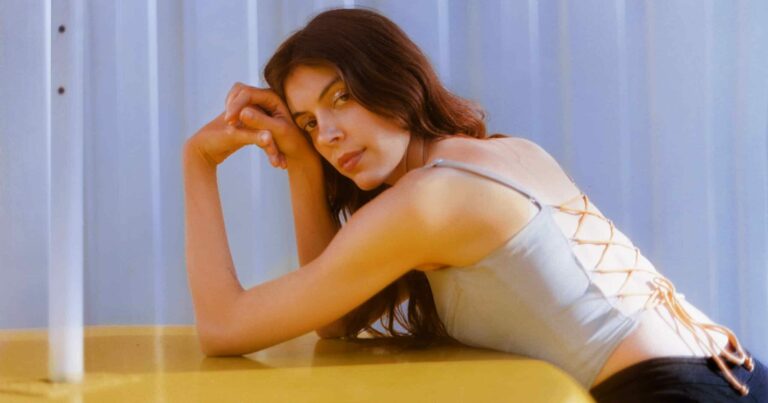
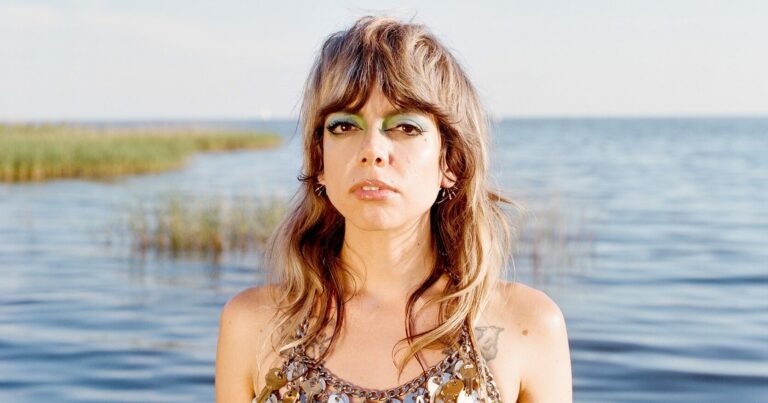
La Luz’s Shana Cleveland has unveiled a new single, ‘A Ghost’, alongside an accompanying video. It’s taken from her new solo album Manzanita, which was announced with the track ‘Faces in the Firelight’. Check out the Vice Cooler-directed visual for ‘A Ghost’ below.
“I never really gave pregnancy and childbirth very much thought, and when I did become pregnant I was surprised by how much of a psychedelic experience it was,” Cleveland said of the new song in a press release. “A subtitle for this album could be: ‘What to Expect When You Are Open to the Mysteries of the Universe.’ When I sat outside the house looking out across the field, the chemistry and shape of my body constantly changing, I understood that I was no different than the plants and animals around me.”
Debby Friday has shared another single from GOOD LUCK, her first LP for Sub Pop. Following ‘SO HARD TO TELL’, which we named our Song of the Week, ‘I GOT IT’ features Chris Vargas of Uñas and arrives with a self-directed music video. Check it out below.
“This track is a ‘Get in the Uber, Bitch!’ ode to nightlife, purgatory, and club rats everywhere,” Debby Friday said in a statement. “Uñas and I had been wanting to collab for a while and this was a case of right vibe, right time.”
Death Valley Girls have unveiled ‘Magic Powers’, the third offering from their upcoming full-length Islands in the Sky. It follows previous singles ‘Sunday’ and ‘What Are the Odds’. Check it out below.
Discussing the new song, the band’s Bonnie Bloomgarden said in a statement: “I was walking down the street, and all of the sudden it dawned on me that almost all the things that kids bullied me about, or I got in trouble for in school, or was told would make me never amount to anything, were actually my magic powers! My voice isn’t too high, or funny, it’s how I cast my spells! I’m not a bad student, I love learning, and being a seeker! And I’m not a crazy person with weird ideas, that will never fit into society, I’m a witch, and I have magic powers!”
Ducks Ltd. have teamed up with Mo Troper and Ratboys’ Julia Steiner for a cover of the Feelies’ 1991 track ‘Invitation’. It’s the latest installment of their series The Sincerest Form of Flattery, which has seen them tackling the Cure’s ‘In Between Days’ with Jane Inc. and the Jesus and Mary Chain’s ‘Head On’ with illuminati hotties’ Sarah Tudzin. Take a listen below.
Talking about the cover, the band’s Tom McGreevy said in a statement:
In Toronto, it’s a really big thing on Halloween for bands to do cover sets where they dress up as the band they are covering. This year, Evan [Lewis] and a group of people who have all played in Ducks at one point or another got together to do a Feelies cover set and they were amazing! So good in fact that I immediately wanted to preserve their excellent cover band for posterity while also insinuating myself in the end result! It was a real family affair, with Paul Erlichman (who sometimes plays in our live band and does the string arrangements on our records), Katie Ryan(who used to play bass in our touring band) and the incomparable Kurt Marble (who used to be our live drummer) all playing on it. Another big part of what appealed about doing this cover was putting together a new vocal arrangement for the choruses, and so we got two artists who we really love to help us out with that, the Julia Steiner of Ratboys and Portland power pop icon Mo Troper. They’re both so good and have such distinct voices and it is super exciting to get to hear them on this song that I think about all the time. Feelies forever!
The Tallest Man on Earth has announced his first album of original songs in four years. Henry St., the follow-up to 2019’s I Love You. It’s a Fever Dream., comes out April 14 via ANTI-. Today’s announcement comes with the release of a new single called ‘Every Little Heart’. Check out its Jeroen Dankers–directed video below, along with the album’s cover art and tracklist.
Produced by Sylvan Esso’s Nick Sanborn, Henry St. features contributions from Ryan Gustafson (guitar, lap steel, ukulele), TJ Maiani (drums), CJ Camerieri (trumpet, French horn), Phil Cook (piano, organ), Rob Moose, yMusic (strings), and Adam Schatz (saxophone).
“Henry St. is the most playful, most me album yet, because it covers so many of the different noises in my head,” Kristian Matsson said in a statement. “When you overthink things, you get further away from your original ideas. And God knows I overthink things when I’m by myself.” The time in isolation also brought him some newfound peace of mind. “Having been away from it taught me that making music and performing is what I’m doing for the rest of my life, and I’m so grateful for it. It has given me new confidence and playfulness. This is what I do. It’s unconditional.”
Last year, the Tallest Man on Earth released the covers collection Too Late for Edelweiss.
Henry St. Cover Artwork:
Henry St. Tracklist:
1. Bless You
2. Looking for Love
3. Every Little Heart
4. Slowly Rivers Turn
5. Major League
6. Henry Street
7. In Your Garden Still
8. Goodbye (Goodbye Lonesome)
9. Italy
10. New Religion
11. Foothills
Westerman has announced a new album called An Inbuilt Fault. It’s set to arrive on May 5 via Partisan. Today, the London-born, Athens, Greece-based artist has shared the record’s lead single ‘CSI: Petralona’, which was co-produced by Westerman and James Krivchenia of Big Thief. Listen to it below, and scroll down for An Inbuilt Fault‘s cover artwork (by Bráulio Amado) and tracklist.
Speaking about ‘CSI: Petralona’, Westerman said in a statement: “I had the riff for the song and left it lying around with a bunch of other bits and pieces. A friend told me that Tom Waits has this image of having a musical junk drawer of old parts that you haven’t found anything to do with. It came from there. I went to Greece for a month to scope out if I wanted to move here, and a friend encouraged me to write about this strange day I had there. The lyrics were immediate. It’s presented on the album as it was first written. It’s the most autobiographical song on the record.”
An Inbuilt Fault will follow Westerman’s 2020 debut Your Hero Is Not Dead. It includes the previously released single ‘Idol; RE-Run’.
An Inbuilt Fault Cover Artwork:
An Inbuilt Fault Tracklist:
1. Give
2. Idol; RE-run
3. I, Catullus
4. CSI Petralona
5. Help Didn’t Help At All
6. A Lens Turning
7. Take
8. An Inbuilt Fault
9. Pilot Was A Dancer
Beyoncé has announced a world tour in support of her latest album, Renaissance. It will be her first tour since co-headlining the On the Run II Tour with Jay-Z in 2018, and her first solo tour since the 2016 Formation World Tour in support of Lemonade. The singer will kick off the European and UK leg of the tour in May before heading to the US and Canada, with shows extending through late September. Check out the list of dates below.
Earlier this month, Beyoncé performed her first proper concert in five years at the opening of Atlantis the Royal, a new luxury hotel in Dubai.
May 10 Stockholm, Sweden – Friends Arena
May 14 Brussels, Belgium – Baudoin Stadium
May 17 Cardiff, Wales – Principality Stadium
May 20 Edinburgh, Scotland – Murrayfield
May 23 Sunderland, England – Stadium of Light
May 26 Paris, France – Stade de France
May 29 London, England – Tottenham Hotspur
May 30 London, England – Tottenham Hotspur
Jun 6 Lyon, France – Groupama Stadium
Jun 8 Barcelona, Spain – Olympic Stadium
Jun 11 Marseille, France – Orange Velodrome
Jun 15 Cologne, Germany – Rheinenergiestadion
Jun 17 Amsterdam, Netherlands – JC Arena
Jun 21 Hamburg, Germany – Volksparkstadion
Jun 24 Frankfurt, Germany – Deutsche Bank Park
Jun 27 Warsaw, Poland – PGE Nardowy
Jul 8 Toronto, Ontario – Rogers Centre
Jul 9 Toronto, Ontario – Rogers Centre
Jul 12 Philadelphia, PA – Lincoln Financial Field
Jul 15 Nashville, NY – Nissan Stadium
Jul 17 Louisville, KY – Cardinal Stadium
Jul 20 Minneapolis, MN – Huntington Bank Stadium
Jul 22 Chicago, IL – Soldier Field
Jul 26 Detroit, MI – Ford Field
Jul 29 East Rutherford, NJ – MetLife Stadium
Jul 30 East Rutherford, NJ – MetLife Stadium
Aug 1 Foxborough, MA – Gillette Stadium
Aug 3 Pittsburgh, PA – Heinz Stadium
Aug 5 Washington, DC – FedEx Field
Aug 9 Charlotte, NC – Bank of America Stadium
Aug 11 Atlanta, GA – Mercedes Benz Stadium
Aug 16 Tampa, FL – Raymond James Stadium
Aug 18 Miami, FL – Hard Rock Stadium
Aug 21 St Louis, MO – Dome at America’s Center
Aug 24 Glendale, AZ – State Farm Stadium
Aug 26 Las Vegas, NV – Allegiant Stadium
Aug 30 San Francisco, CA – Levi’s Stadium
Sep 2 Inglewood, CA – SoFi Stadium
Sep 11 Vancouver, British Columbia – BC Place
Sep 13 Seattle, WA – Lumen Field
Sep 18 Kansas City, MO – Arrowhead Stadium
Sep 21 Dallas, TX – AT&T Stadium
Sep 23 Houston, TX – NRG Stadium
Sep 27 New Orleans, LA – Caesars Superdome
The nominees for the Rock & Roll Hall of Fame’s Class of 2023 have been revealed. The White Stripes, Missy Elliott, Sheryl Crow, Warren Zevon, Cyndi Lauper, George Michael, Willie Nelson, and (packaged together) Joy Division/New Order are among the first-time nominees, while Kate Bush, Iron Maiden, Soundgarden, the Spinners, A Tribe Called Quest, and Rage Against the Machine have also been nominated.
This is the fourth nomination for Kate Bush and the Spinners, and the second for Soundgarden, Iron Maiden, and A Tribe Called Quest. Rage Against the Machine are nominated for the fifth time after being up for induction in 2018, 2019, 2021, and 2022.
This week, The Los Angeles Times reported that Billy Joel wrote a letter urging the Rock Hall nominating committee to nominate Zevon, who has been eligible since 1994. Missy Elliott and the White Stripes are being nominated in their first year of eligibility.
“This remarkable list of Nominees reflects the diverse artists and music that the Rock & Roll Hall of Fame honors and celebrates,” John Sykes, Chairman of the Rock & Roll Hall of Fame Foundation, said in a statement. “These artists have created their own sounds that have impacted generations and influenced countless others that have followed in their footsteps.”
This year’s Rock & Roll Hall of Fame inductees will be announced in May, with the induction ceremony set to take place in the fall.
Petite Noir has announced MotherFather, his first new LP since the 2018 visual album La Maison Noir. It’s out April 14 via ROYA/Warp, and today, the Congolese artist has previewed it with the single ‘Blurry’, which features Sampa the Great and comes with a video directed by Hector Aponysus. Check it out below and scroll down for the album’s cover artwork and tracklist.
“‘Blurry’ is a song about growth in love,” Petite Noir explained in a statement. “Being ready to take that next step whether it means being together or apart. Sometimes the best thing you can do is just move forward with your life solo. Choosing you above all.”
Sampa the Great added: “I felt so honoured to be able to work with Petite Noir. I’ve looked up to him and his music for a while and I’m truly inspired by his courage in paving the way for alternative musicians in Africa who feel like they don’t fit into one genre or one style.”
Of the album, which is subtitled The darkness is comforting sometimes, Petite Noir said: “It’s about going through the darkness. But it’s also about rebirth – because the dark times are needed for us to grow.”
MotherFather Cover Artwork:
MotherFather Tracklist:
1. 777
2. Blurry [feat. Sampa the Great]
3. Numbers
4. Concrete Jungle
5. Skit
6. Finding Paradise
7. Simple Things [feat. Theo Croker]
8. Best One
9. Love Is War
10. Play
On her sophomore album, Gena Rose Bruce makes it clear – to herself more than anyone – that she doesn’t want to waste any more time. “Too many times you let life go by/ Well now’s the time to take the wheel and drive,” she sings on the single ‘Foolishly in Love’. The Melbourne-based singer-songwriter released her first EP, Mad Love, back in 2015, before coming through with her debut album, Can’t Make You Love Me, in 2019. But during lockdown, when Bruce was living in a small apartment with a grieving partner, the frustration of not being able to fully live up to her creative ambitions led her down a dark path. Deep Is the Way, which arrived on Friday, finds her embracing songwriting with a new sense of purpose, fortitude, and indeed, depth. Working once again with producer Tim Harvey, Bruce widens her musical scope and is able to balance emotional complexity and vulnerability, taking ownership of her desires while letting whatever conflicts arise play out rather than forcing a way through them. Even without any real answers, she stands firm in her pursuit of honesty: “All these questions will lead us to the truth,” she sings on ‘Harsh Light, “And our love will hold true.”
We caught up with Gena Rose Bruce for this edition of our Artist Spotlight interview series to talk about collaborating with Bill Callahan, her headspace going into Deep Is the Day, being a dreamer, and more.
I wanted to start by asking about your collaboration with Bill Callahan. What was it like sending lyrics back and forth without really having any prior contact?
It was kind of perfect for my personality, I think, because it just felt like we really were able take our time and think about what we were sending each other. Maybe if I was in a room with Bill Callahan, I might have just been either so nervous or trying to please him, like, of course I like that because he suggested that. But having time to actually sit with what he had sent over lyrically, I could be like, “Oh, actually, that’s not right,” or, “That is right.” I think it gave that space where it felt like I didn’t need to know him as a person or anything, we were just strictly there to write the music in the song, and for me personally that made me more confident with it all. I felt like I could be really honest and kind of more brave as well with what I was sending him, because I didn’t have to see his face when he read it. [laughs] I really enjoyed that experience. And I think during lockdown, it just was fun to try new things, because I don’t think I would have done that previously.
What perspective do you feel like he ultimately brought to the songs, and did your approach to songwriting shift at all as a result of your correspondence?
He definitely pushed me as a songwriter. In the past, I might have maybe accepted things, like, “Yeah, that will do, I’m happy with that.” But he kind of goes, “We’re happy with it, but let’s keep going.” He’s like, you know when it’s too much, when you’ve overkilled a song, but that’s like a perfect place to be because then you can always bring it back. But to stop when things are good – you’ve just got to keep going, which I kind of applied then to some of the other songs on my album. I went back to all the ones I thought had finished and, like, wrote a new bridge and added verses. It wasn’t perfecting a song, it was more just playing with the song. And I find he’s really good with metaphors. He’s really poetic with his lyrics, and I’m a little bit more conversational, I think, with my lyrics. So it was really cool to see what he would come back with and made me think a little bit more poetically in what I’m trying to say as well.
I hear that approach in the album, of almost stretching out the songs a bit. But you also leave space for the production to bring out the subtleties of emotion that you’re describing, and part of that is through the use of electronics. What led you in that direction on songs like ‘Misery and Misfortune’?
I always hear kind of melodies going on, but I’ve never really wanted to put a lot of other vocals on my tracks. Especially with ‘Misery and Misfortune’, those backing vocals were the synth. I’m a huge fan of Weyes Blood, so all her synths really inspired me. She was on my reference for every song, as well as Electric Lighthouse Orchestra. I just like weird sounds on songs that don’t really make sense, and my producer, Tim Harvey, is really good with that kind of production as well. I feel like we tried all the weirdest sounds we could find, it’s something really fun to just have sounds from everywhere. And emotionally, I think it works because a lot of my songs emotionally feel all over the place sometimes.
Do you tend to analyze your own lyrics or your music? Working that way with Bill Callahan, I assume that puts you in a position where you’re maybe forced to sit down and look at the song in a more critical light, but I’m curious if that’s something that’s part of your process in general.
I totally do it. It kind of comes in stages – I think when I’m originally writing, I’ll just write whatever comes out, but when I get in with the band or production kicks in, it’s like weird certain words just don’t sound right against a type of instrument. I feel like that’s my number one thing in songwriting, the lyrics, so I’m always trying to make them come out as clear as they can be. Often when I get in the room with Tim, we then do analyze it, because sometimes they’re very personal, and it’s important to decide what you want to share. So we always do check everything and make sure that I’m comfortable with that, or we’ll just find a different way to say it that’s not going to hurt anyone [laughs] or not going to hurt myself.
‘Deep Is the Way’ seems to encapsulate a lot of what you were grappling with during the pandemic, this heavy fog that many of us were faced with. But you also see a way out. At what point in the process did those hopeful realizations come to you?
It’s interesting, I think me as a songwriter is someone who I almost aspire to be. The songwriter me is like a good friend, so they’re always seeing the best outcome in the hard situations. I didn’t feel personally that I was in a super positive place, but I think the writer in me could kind of see past that. It’s like this weird brain switch when I’m writing, I’m just so in that world. Every time I listen to music, I realize the music that I love always makes me feel good while I’m listening to it. And there’s some music I listen to that I really want to love, but it puts me in a mood where I don’t feel good. And I think it’s just really important to me that I want my music to make people feel – not necessarily positive, but to feel like there’s always hope, if that doesn’t sound too cheesy. Even when I feel like things could never get better, I’m stuck in a bad place, I do want to always believe that you can get out of it.
There’s a beautiful simplicity in the way you describe sadness, too: “Just like the sun/Sadness is real/ Just like the sun/ It’s going away.” I read that the title and the sentiment of the song were also inspired by your love of gardening. Can you talk about that?
Yeah, gardening’s really helped with my mental health, to be honest. It’s more just about being in nature, actually getting your hands dirty and touching soil – there’s something really grounding about that, and that really helped me feel connected again to myself, caring for something. It’s hard to say how it came in into my music, but I think when I started gardening, I started writing, and it helped me be more of a grounded person. When I’m not connecting to myself, I just can’t write, I’m not in a good place, so it really helped me find myself.
Throughout the album, there’s this tension between darkness and light, hope and despair, reckless love and deep love. Which of these ended up being the hardest to write about?
I do find it hard to write about the darkness, because I have to maybe go to places that I don’t always want to go to. And it’s the hardest parts to share as well – I guess a lot of the time, the people around me might not have known what I was going through, and having to share that is just a little bit harder. That would have been the most personally challenging to write about. But love is a hard thing to write about too, and from a technical point as well, to not make it sound cliche or anything. I only really could say that I found love within this new album, so it was like my first shot at writing about love.
What about different expressions of love, like the recklessness of ‘Foolishly in Love’ and ‘I’m Not Made to Love Only You’? Was that different from the more grounded songs?
The more reckless songs, like ‘Foolishly in Love’ and ‘I’m Not Made to Love Only You’, they just felt like songs that I really needed to write because they’re conversations that are pretty hard to have with people. It’s not something you want to share always to a lot of people, but I think it’s something that I really question a lot, and I’m always someone who’s kind of questioning everything. I was at a stage where I was – I’m in this relationship, we’re married now, so it’s like everything was coming together and I was just kind of panicking about really what it is that I want, and what I see love as. It was just a confusing time for me, but it was really necessary because I think I got a lot of clarity out of writing those songs. They’re questions that don’t always really need answers, so it was almost more about processing all those thoughts.
After having that clarity, were you tempted to go back and reshape a song like ‘I’m Not Made to Love Only You’ – or even just retitle it, because that frames the song in a specific way?
Totally. I made the decision, though, to keep the title. I just don’t believe that people should be always even held necessarily accountable for what they express, because it is just thoughts and processing everything running through you. I don’t know what I believe all the time, I’m always changing what I want, and I don’t necessarily think anyone is made to love one other person. I feel like that’s a statement that I really do believe, and I guess I never wanted it to be interpreted as unfaithfulness, because I’m not really talking about that. I think that’s what I was more scared of.
Looking back at the making Deep Is the Way, what does it mean for you to be true – to yourself, to others, or to your ambitions as an artist? Is that something you’re still questioning?
Yeah, definitely. I think that keeps changing as well, but I just think honesty is one of the most valuable things we can give to each other. Just being able to question those deeper things and having a safe place to share them. As an artist, I really just want to come across as honest, and also a friend – for me, music feels like I’m hanging out with a friend, and I would love that to be the same with my music, that people feel like they’re not alone. And I think that’s why honesty is important, because they all come hand in hand – to be a friend, to be honest, to not feel alone.
Where does your relationship with music as a friend stand at the moment?
I feel like recently, amazing. I kind of fall in and out of love with music all the time. I’ve had times in my life where, I write music, and then when I’m listening to it, it kind of brings something up in me where I’m like, “I don’t want to do this anymore.” But I think now I understand why I’m obsessed with music and having music around always, because I honestly feel like there’s people out there writing stuff that is exactly what I feel and we need to hear. I definitely am more conscious of what I’m listening to and how it’s affecting me.
You sing about dreams and dreaming of a bright future, but also the negative effects that can have. Do you still feel like a dreamer, and what does that mean for you right now?
Yeah, definitely. I think it’s something I’m really understanding about who I am as well, that I am a dreamer. And as I get older and things become more financially hard and there’s so much going on in life in general, I think I’ve had to really understand what it is and why I’m dreaming, and what I value in my dreams. I’m not going to lie, my dream is to be a musician, and I think I have to really understand why I want to be a musician and pull myself out of that sometimes. Because sometimes I’ll get to a point where I’m determining my happiness upon my dreams – I don’t think it should determine how happy you are, how much your dreams are coming true and how much they’re not. I think it should be something separate. And for a lot of years I would let this dream of mine – if it wasn’t going well, then other aspects of my life weren’t going well. I’m definitely trying to still be a dreamer, but trying to be a bit more grounded at the same time.
I think I’ve tried to learn to love the dreaming rather than the dream. That’s actually the most amazing part of it, and I never want to give that up. I’ve definitely thought about it and tried, maybe for like a little bit, and it’s just not worth it, when you don’t have that, the dreaming of the dream. [laughs] It’s like, I don’t even want the dream – I just always want to be dreaming. Because that’s actually a safe place, that’s in your control, and that’s up to you. But the dream – you’re never going to really be able to control that.
This interview has been edited and condensed for clarity and length.