

The Balkans have always been a place where history speaks louder than diplomatic formulas. This is a region of nations with strong memories, distinct identities, and characters that resist being reduced to simple narratives. It is no coincidence that, over the centuries, the Balkans have so often been seen as a space of tensions, dividing lines, and conflict.
And that is precisely why a gesture made through culture carries particular weight today.
At a time when the world once again appears confused, fragmented by confrontation and increasingly unable to sustain a calm conversation, musicians from three Balkan countries are pointing towards another possible path. Not through political slogans. Not through declarations. But through the language that begins where words so often fail.
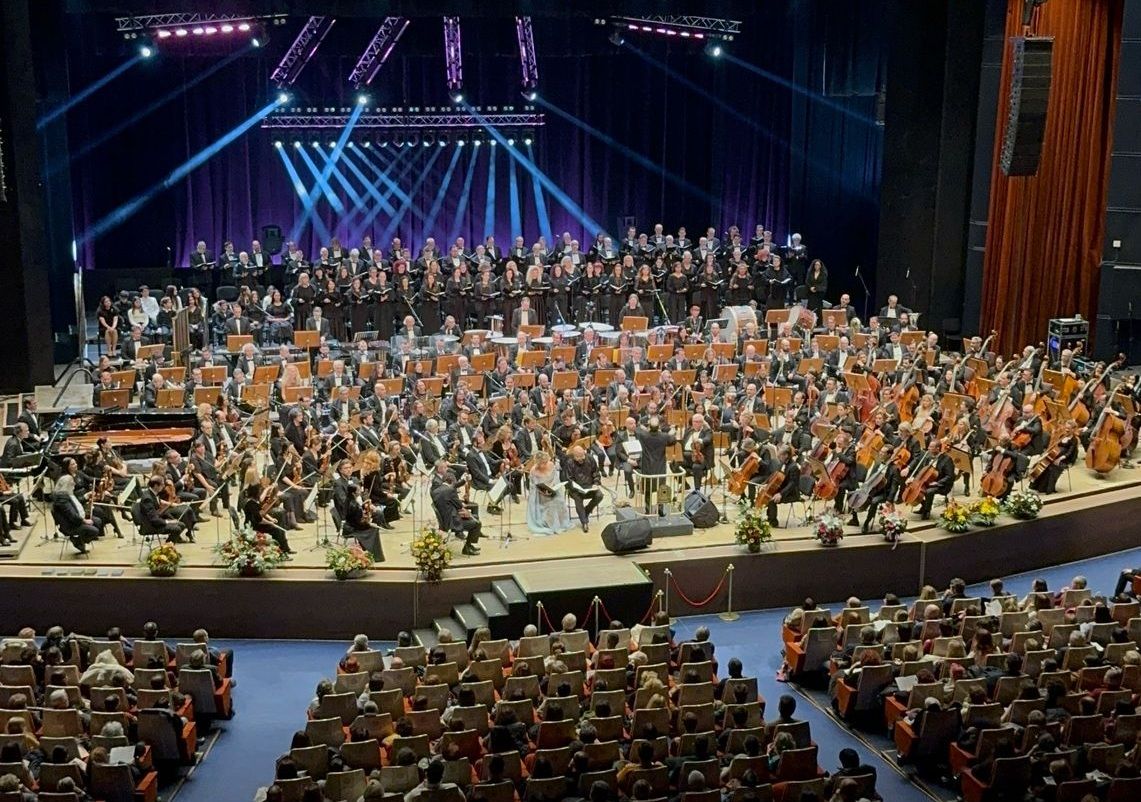
Initiated by conductor Nayden Todorov, three state orchestras — the Sofia Philharmonic from Bulgaria, the Philharmonic of the Republic of North Macedonia, and the Thessaloniki State Symphony Orchestra from Greece — came together last year on one stage in Sofia under the sign of one simple, yet difficult word: Together. The project later continued in Thessaloniki. Now, on 20 June, this cultural line between the three countries will reach its third stop: Skopje.
Perhaps it is no coincidence that such an initiative comes precisely from Nayden Todorov. During his time as Bulgaria’s Minister of Culture, in a period of exceptional public and political turbulence, he had the opportunity to witness at close range the destructive force of division — not as an abstract concept, but as a reality that weakens institutions, societies, and human bonds. At the same time, as one of the prominent cultural leaders in the region, he understands the opposite force just as clearly: the power of unity around meaning, around culture, and around a future that cannot be built by isolated voices.
Under his baton, nearly 240 musicians will perform one of the most powerful and instantly recognisable works of the twentieth century: Carl Orff’s Carmina Burana.
The choice is not accidental. At the centre of this work stands the image of the Wheel of Fortune — forever turning, unpredictable, merciless in its rises and falls. Yet this concert carries another message as well: fate is not only something that happens to us. Sometimes it is also a direction that people choose for themselves.
If the Balkans have too often been a place from which divisions begin, today the same region can also offer a different story — one of coexistence, respect for difference, and a shared gaze towards the future.
On 20 June in Skopje, three orchestras, three countries, and hundreds of musicians will not simply perform Carmina Burana. They will stand behind an idea: that culture does not erase history, but it can offer it a more dignified horizon.

