

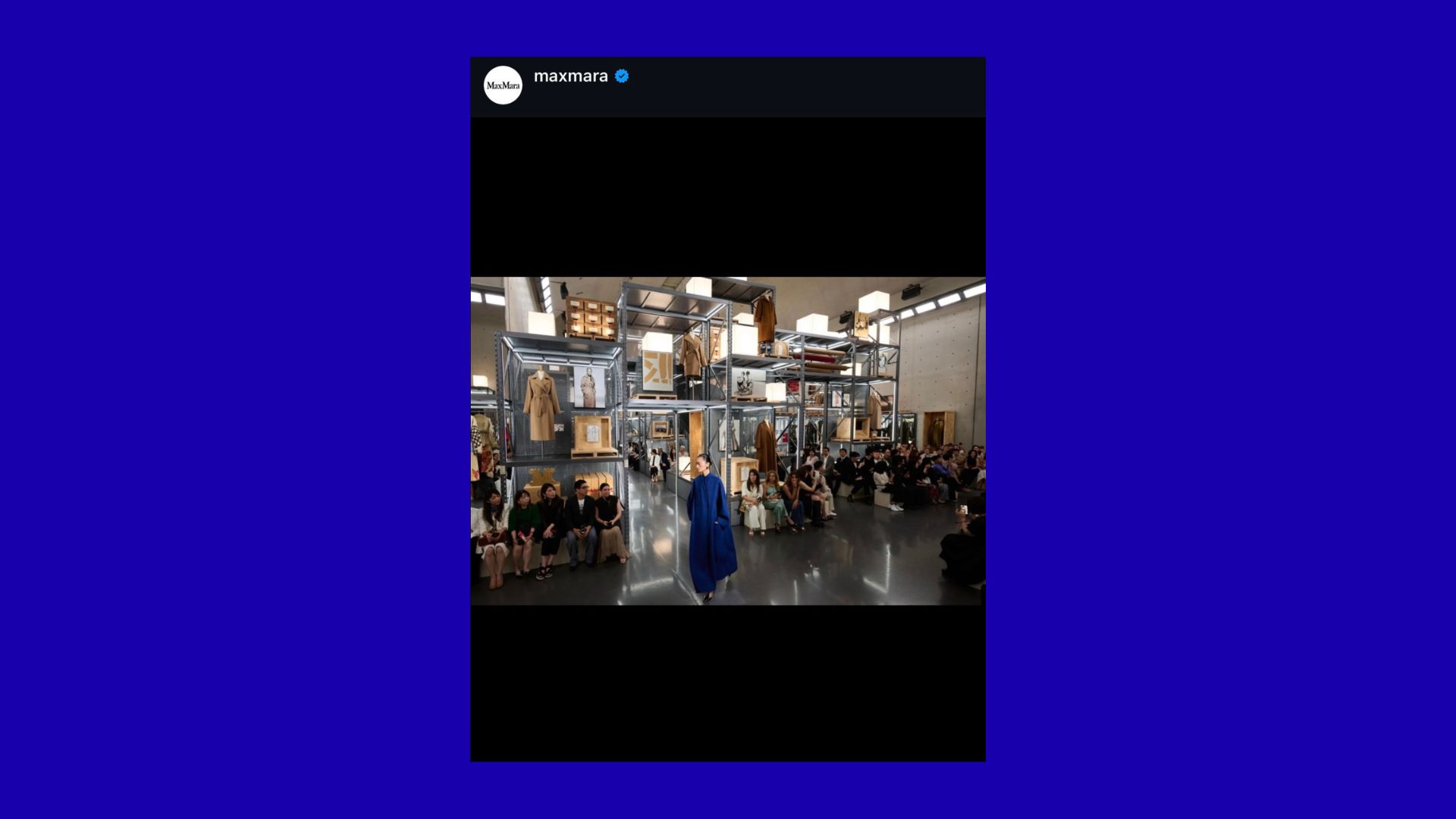
“New York may be the city that never sleeps, but Shanghai doesn’t even sit down,” said Ian Griffiths in a preview, quoting, of course, New Yorker’s Patricia Marx. Fashion keeps finding reasons to look east, and the city is more than happy to oblige. Take it from Glenn Martens’ recent detour, or Ian Griffiths, who, after nearly four decades at Max Mara, still manages to find new (and long) ways to sell the same idea.
“Max Mara, for me, has always been a metropolitan phenomenon. I wanted to show it in a city because after 75 years, that’s what Max Mara is about: it’s about urban chic, it’s about a woman who really wants or needs to engage with a city. Modernity doesn’t have to be Euro-centric or Western-centric—I wanted to explore the concept of modernity, and that’s what makes Shanghai unique: its rich culture and fusion of styles. The city changes so rapidly, which is why it’s modern—it’s about knocking things down and starting again,” the designer told Harper’s Bazaar.

And the city’s Long Museum, better known for its private art collection, got to play host, both to the runway and a new exhibition held within its concrete walls. Curated by Olivier Saillard and titled The Max!, it captured the spirit of the label Achille Maramotti launched in 1951 and its 75-year-long history through archival material sourced from the Biblioteca e Archivio d’Impresa, founded in 2003. Photos trace back to atelier floors, sewing machines to early tailoring, and sketches to ideas that have lost little of their appeal.
Going by Kinetic Chic, the collection moves, quite literally, through Asian references and an all-Asian model lineup. Picture Max Mara-fied quilting details on outerwear, sash-inspired belts cinching urban silhouettes, cheongsam-like dresses with sequins dangling from their hems, and a heavy use of red. In China, red isn’t treated lightly. Rooted in the ancient five elements theory, it sits somewhere between fire, the sun, and an abundance of luck, joy and vitality.
Conveniently enough, in any city inhabited by a Max Mara woman, red is never hard to find. It sits on stop signs, traffic lights, sale signage, fast-food chains, and the list goes on. Having pictured that urban landscape, we move back to the collection: tailored suits, hooded blazers, Bauhaus-leaning graphic patterns, and even sequined overalls, a recurring theme, just for good measure. The icons, coats and bags included, were not to be skipped. Neither by Griffiths nor by the show’s guests, including Katie Holmes and Maude Apatow, who later found them again at the museum shop, briefly rebranded as a Max Mara boutique.

