

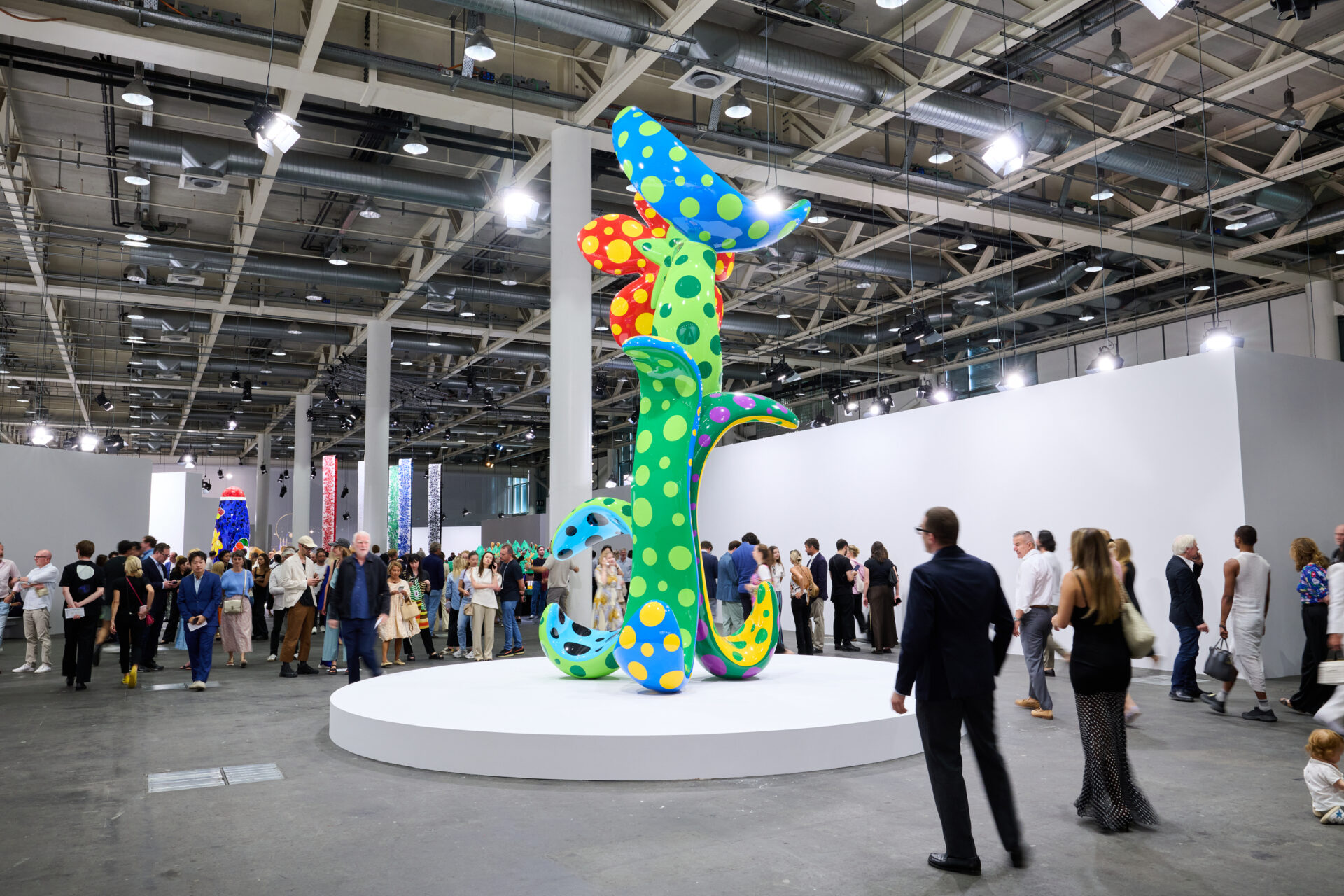
Art Basel has a pull like no other art fair in the world. It unites gallerists, artists, curators and anyone with a thirst for weird, lovely, mind-boggling art — there’s a real zest to the whole project. Certainly, the trade side is serious business: at the 2026 edition alone, 290 galleries from 43 countries sold work to collectors from over 100 countries, with individual sales running from five figures into the tens of millions. But beyond the price tags, Art Basel is a joyful, deeply thoughtful exploration of various artistic forms, from Zero10’s digital edge to the sprawling creative scale of Unlimited. It’s a world unlike anything you’ve seen before.
Here are five fascinating facts about the history of Art Basel.
1. It’s A 70s Invention
Art Basel was born in 1970, dreamed up by three Basel gallerists — Ernst Beyeler, Trudl Bruckner, and Balz Hilt — who wanted to build something for dealers, artists and collectors alike. Interestingly, the fair was partly a direct response to Kunstmarkt Köln (today’s Art Cologne), which had launched three years earlier but only allowed German galleries to take part. Basel’s founders craved something more international from the start. That ambition paid off quickly, with the very first edition bringing together 90 galleries and 30 publishers from 10 countries, and pulling in more than 16,000 visitors.
2. It spotted future art stars before they were famous
The 1980s marked an era when Art Basel really grew up, expanding its identity with new sectors like Art Forum, Film & Video and Perspective, reflecting how contemporary art was venturing into new media. Launched in 1979 to showcase young, largely unknown artists, Perspective’s lineup included names like Tony Cragg, Julian Opie, and the duo Peter Fischli and David Weiss — all of whom would go on to become major figures in the contemporary art world. In other words, decades before they were museum staples, Art Basel had already placed a bet on them.
3. It used its platform to fight the AIDS crisis
By the early 1990s, Art Basel was using its influence for social impact. In 1991, the fair opened with Art Against AIDS, a benefit initiative that rallied galleries and artists around the fight against the epidemic at a time when the crisis was devastating communities worldwide and public response was lagging. This wasn’t an isolated gesture, though. The Canadian art collective General Idea had already created one of the era’s most iconic images for the cause a few years earlier, reworking Robert Indiana’s famous LOVE design so the letters spelled AIDS — an artistic piece that went on to appear on posters, stamps and public billboards across Europe and North America.
4. It created a sector with no booths, just space
In 2000, Art Basel took a step no other fair had tried before; it built an entire section with no booths at all. Housed in the newly constructed 16,000-square meter Hall 1, Unlimited was designed for art that couldn’t fit inside a normal fair stand. This included room-sized installations, colossal sculptures, wall-length paintings, video projections and live performances. Fascinatingly, the whole hall is curated as a single, continuous exhibition, so visitors walk through it more like a museum than a trade show. It’s since become one of the fair’s signature draws, hosting everything from a giant Ai Weiwei house-shaped installation to Yayoi Kusama‘s immersive mirrored environments.
5. It’s grown into an impressively global project
What started as one fair in one Swiss city has become a worldwide project. Art Basel expanded to Hong Kong in 2013, bringing it into the Asian art market, and later to Paris in 2022. Most recently, it made its Middle East debut with Art Basel Qatar, held in Doha in February 2026, marking its fifth flagship fair overall. The inaugural Qatar edition drew more than 17,000 visitors and brought together 87 galleries from 31 countries and territories, including 15 exhibiting with Art Basel for the very first time.

