UsingAI tools in academic fields is often deemed controversial. But there’s no denying it’s been a go-to for many.86% of students were found using AI in their studies during the recent survey of the Digital Education Council. Another report suggests that51% or researchers use AI. However, the full acceptance of AI tools for academic writing is still up for debate. Because many say that over-reliance on them can lead to academic dishonesty and block a person’s personal growth and skill development.
Academic writing is more than putting words on a page. Reviewing literature. Verifying evidence. Organizing arguments. Polishing language. All entails countless hours before a final draft is reached. And this alone highlights what AI tools for academic writing are for. They’re assistive tools. Not replacements.
In this guide, you’ll find the best AI tools. Options that can help discover credible sources, improve academic language, summarize complex studies, and streamline the writing process. All without replacing critical thinking.
Top Five Best AI Tools for Academic Writing
PaperPal
PaperPal is purpose-built for academic and scientific writing. As an all-around tool, academics can use it to research, write, and edit more efficiently. It features a suite of AI tools. Like the essay writer, grammar checker, plagiarism checker, paraphrazer, summarizer, proofreader, translator, citation generator, and lots more. Each one contributes to faster writing without sacrificing accuracy or academic voice. PaperPal’s models are also trained on published research articles. So users can expect it to understand the conventions in scholarly publishing.
Key Features:
Supports translation in over 50 languages
Reference discovery from more than 250 million research articles
Over 30 readiness checks for confident manuscript submission
Pricing:
Free Package
Prime Package – $11.58 per month
Real Use Case:
A PhD student preparing a manuscript for submission can use PaperPal. It can instantly improve clarity, grammar, and structure. This allows for a more polished writing before peer review. It also helps meet the professional standards expected by academic publishers.
ChatGPT
ChatGPT works as a highly advanced chatbot. And that positions it as one of the multipurpose AI tools for academic writing. It helps users brainstorm topics, organize ideas, explain difficult concepts, and make structured outlines. Not just serve as a replacement for original research. Since the work is done through conversations, it can also reduce writers’ cognitive load and heighten control during the writing process.
Key Features:
Creating outlines for essays and dissertations
Draft refinement before final writing
Conversational approach for researching and understanding complex concepts
Pricing:
Free Plan
Go Package – $8 per month
Plus Package – $20 per month
Pro Package – $100 per month
Real Use Case:
ChatGPT can help students try to polish a position paper before submission. As a chatbot, users can ask it to play “devil’s advocate” for testing arguments. This makes it easier to find weak spots in the logic.
Perplexity AI
Image Credit: Perplexity AI
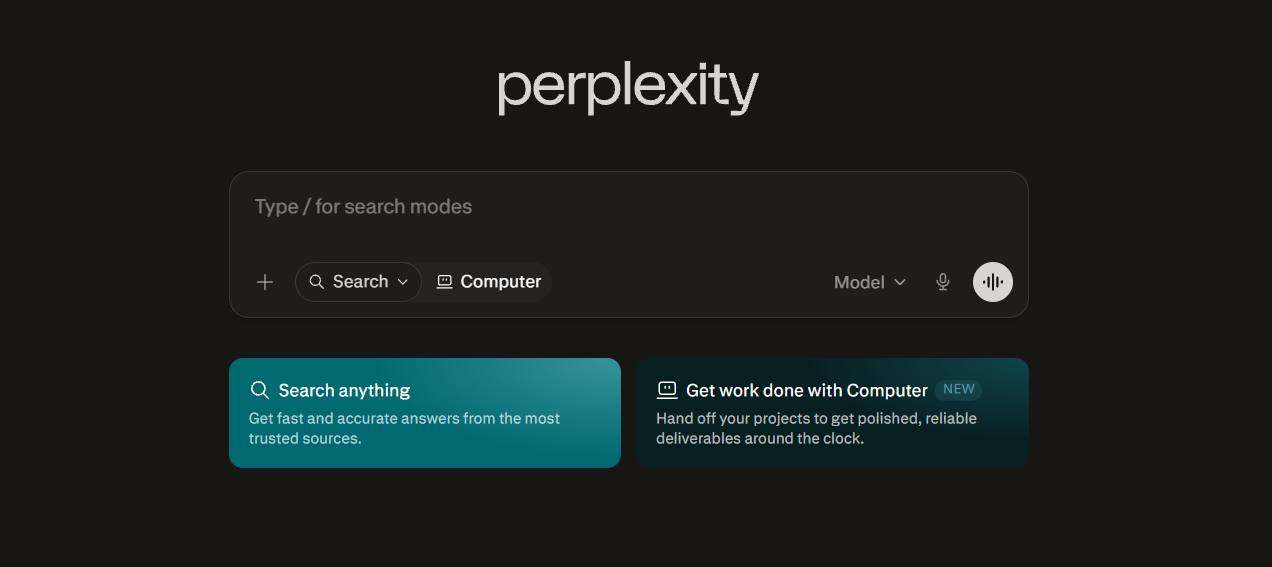
In academic writing, Perplexity AI is an ideal research assistant. It merges conversational search with source-backed answers. As an AI-powered answer engine, this option provides academics with aggregated information and reliable references. As such, Perplexity AI cuts the need for time-consuming webpage search. It speeds up early-stage literature review and material summarization.
Key Features:
Building an outline or research plan for an academic paper
Cross-checking information across multiple references
Updated developments in academic topics
Pricing:
Free Package
Pro Package – $20 per month
Real Use Case:
Students trying to earn a master’s degree can benefit from Perplexity AI when meeting deadlines for a thesis. This tool helps locate recent studies and compare study findings. It allows master’s students to complete a literature review with efficiency.
Grammarly
Image Credit: Grammarly
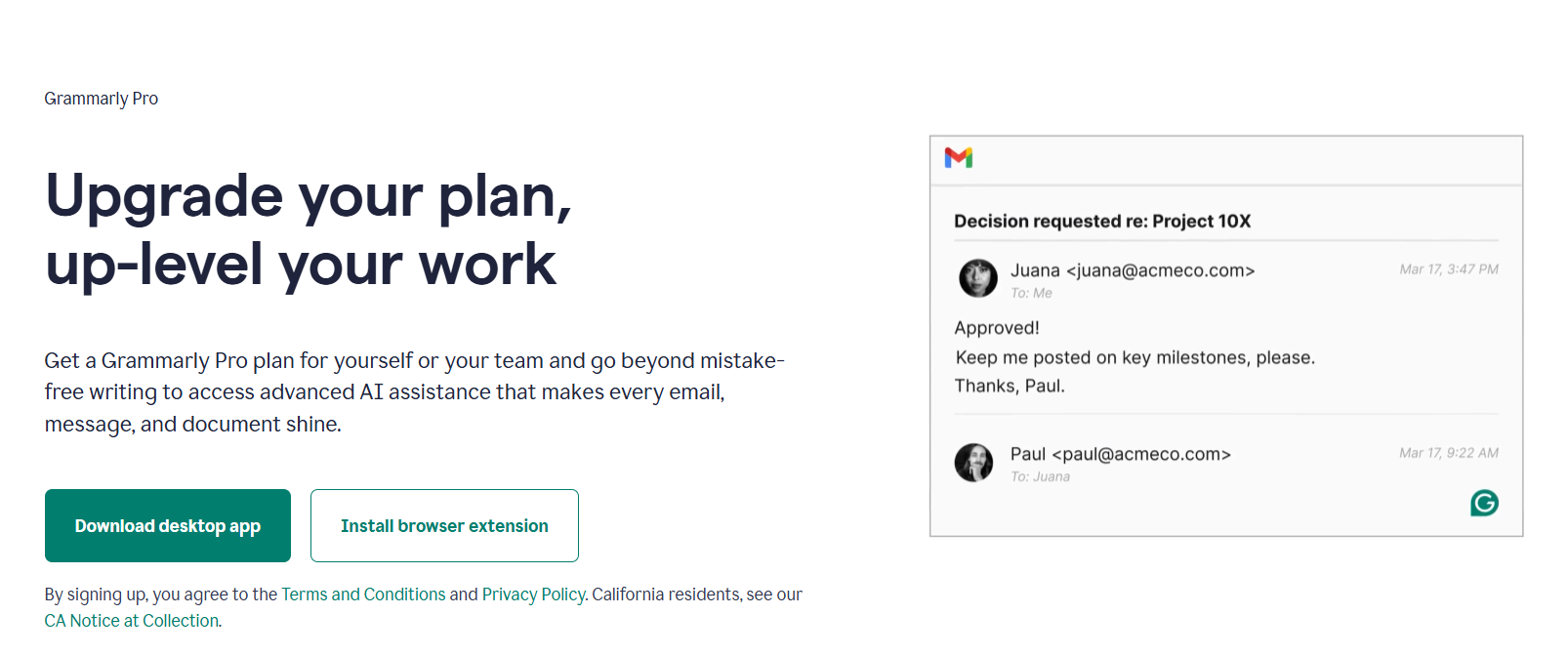
Grammarly started out as a basic grammar and spelling checker. But that was over 10 years ago. Now, it’s one of the most popular AI tools for academic writing. A reliableAI writing assistant. More than just improving clarity, grammar, and readability, it now offers a smart writing assistant, a plagiarism checker, an AI detector, a humanizer, a paraphraser, and more. All in all, Grammarly delivers advanced writing support, combined with AI agents, for brainstorming, stronger arguments, and predicting reader response.
Key Features:
Real-time support in over 25 languages
Precise grammar, punctuation, and spelling checker
Matching writing tone for different audiences
Pricing:
Free Package
Plus Package – $30 per month
Enterprise Package – Customizable
Real Use Case:
Grammarly can help overcome a proofreader’s illusion. After exhausting the mind writing for hours, a student can use this tool to correct errors, adjust tone, and improve overall writing clarity.
Consensus
Image Credit: Consensus
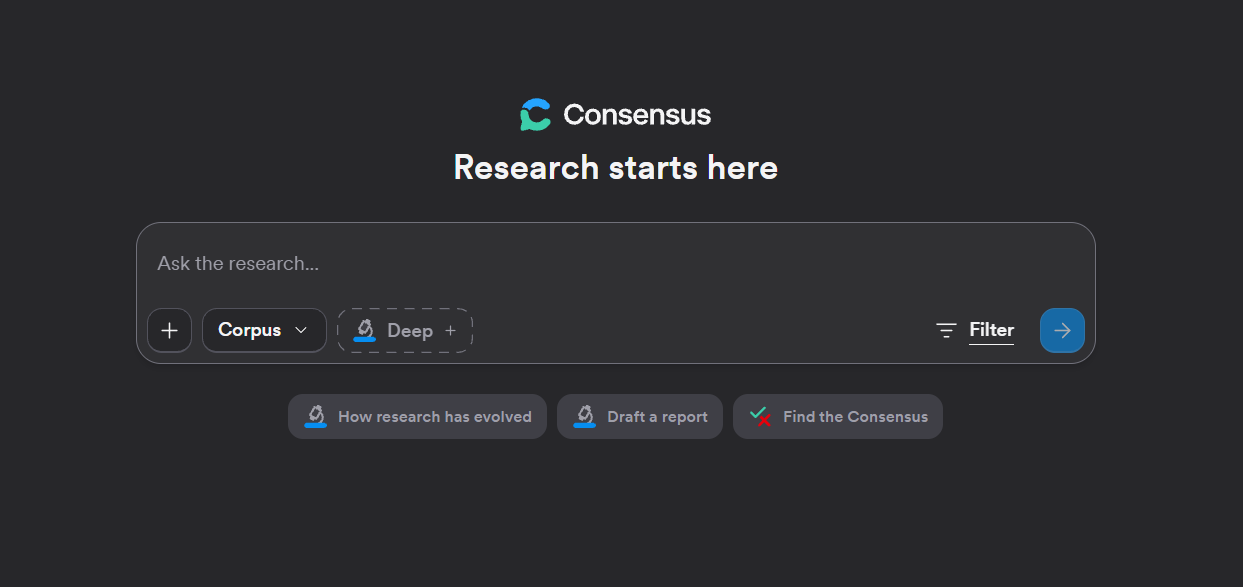
Like Perplexity AI, Consensus is an AI-powered academic search engine. It’s made specifically around peer-reviewed research papers. This makes it particularly valuable for evidence-based writing. In practice, it helps academics find factual resources. None of those fabricated ones or AI hallucinations. The standout capability is summarizing multiple studies with links to the actual references. It works as a reliable companion when supporting arguments with credible sources.
Key Features:
Synthesizing information from different resources
Research answers through published studies
Fact-based academic writing
Pricing:
Free Package
Pro Package – $20 per month
Deep Package – $65 per month
Real Use Case:
College students in medical courses can produce evidence-based essays with Consensus. Like a paper investigating the effectiveness of a medical intervention. By citing peer-reviewed findings, they can support their arguments and avoid unsupported claims.
Choosing the Smartest AI Tools for Academic Writing in 2026
The market is full of AI writing tools. But many would notice that most of the options are tailored for general works ormarketing content. They fall short in academic prose and other scholarly writing standards.
But with these five AI tools for academic writing, you’re assured to access assistance in brainstorming, researching, structuring, refining, and rewriting. From finding credible evidence to polishing manuscripts, PaperPal, ChatGPT, Perplexity AI, Grammarly, and Consensus optimize the entire process.
At this point, it all boils down to responsible use. Submitting AI-generated outputs as the final work ruins their purpose. Again, they’re meant to assist. These tools help academics spend less time on repetitive tasks.
James Ellis Ford used to be one half of Simian Mobile Disco, and you might know him as a producer behind records by Arctic Monkeys, Florence + the Machine, Fontaines D.C., and more. Today, he announces his signing to Domino Records and the release of a new album, Lost in Another World, on August 14. Listen to the hypnotic new single ‘Overtones’ below.
Ford made the album over two weeks in early 2025 while he was in the hospital between rounds of chemotherapy following a diagnosis of myeloid leukemia (AML), an aggressive cancer of the white blood cells. Sereen, his wife, bought him a fold-away IKEA bedside table to put some synths on; staff at the hospital got used to taking his blood pressure while he was laying down tracks. “There was no filter,” Ford recalled. “I just sang the first thing that came into my head into the laptop.”
“It was a pep talk; I was telling myself I was going to be OK,” he continued. “It was one way of dealing with the existential dread I felt. It gave me the ammunition to fight the experience and was a distraction from it.”
Earlier this year, Ford executive produced the War Child benefit compilation HELP(2).
Lost in Another World Cover Artwork:
Lost in Another World Tracklist:
1. Overtones
2. People Just Don’t Know
3. ‘Til Our Days Are Gone
4. Here Today
5. Parallel Dimension
6. Silver Lining
7. I Believe In You
8. This Too Shall Pass
9. Homesick For Another World
10. The Ever After
11. Did You Ever Want To Go To Your Own Funeral?
12. This Will All Be A Memory Soon
Ada Lea has announced a new EP, the end is a wave, which will arrive August 12 on Saddle Creek. The seven-track EP will follow last year’s when i paint my masterpiece, and it’s led by ‘copycat’. Check out a video for it below.
The new single’s dancey beat adds an interesting flavour to Alexandra Levy’s intimate palette, but, having recently read Elena Ferrante’s My Brilliant Friend, I’m just as drawn to the subject matter. “On Friendship: In 2020, I’d just finished reading The Neapolitan Quartet (by Elena Ferrante),” Levy shared in a statement. “Lila and Lenu’s relationship felt like some of the close and maybe slightly unhealthy friendships in my life at the time. In the case of the quartet, Lenu is defined by Lila, her Brilliant Friend. Lenu is preoccupied by what Lila is doing, thinking… whom she’s loving. Lenu mythologizes her, and in so doing diminishes herself and her work. Through the four books we come to feel that Lila is truly special and Lenu is just orbiting her. Everything seems a result of some proximity to Lila. Lila was always the source, never Lenu alone. But toward the end of the quartet, there’s a shift in Lenu as she reflects back on her life with Lila. So I wrote the ‘copycat’ song about that moment.”
Reflecting on the EP, she added: “For this EP, I wanted to combine songs that were cut from when i paint my masterpiece, as well as the ones I’d recorded a million years ago when I was just a child. It was to test their fragility. How would they behave next to the other? The old and the new? The brave and the haunted? The impression and the finely sculpted. I also decided to mix three of the songs myself (was it a mistake? you tell me…I says). I’ve been thinking of the kind of artist I’d like to be, and how I’d like to see all artists treated. I am most at home when I am creating and performing, it is what I was born to do. These worlds are opposites. 12th house and 6th, 4th & 10th, the story goes on. I can imagine a future where artists are supported by UBI and they do what they want. A kind of welfare for the serious artists that are not afraid to play. It serves the betterment of society to support artists this way. I know there are others out there, like me, that feel little purpose in their life when they’re not working toward making things. But it’s also near to impossible to make things when you are fighting to protect your energy at every turn, feeling burnt out.”
After a bit of a wait, Marvel animated series X-Men ’97 is back with season 2. It serves as both a nostalgic continuation and a modern reimagining of the original animated series that aired in the ‘90s.
So far, the show has been a success. Showered with praise from critics and audiences alike, it stands out thanks to its emotional storytelling and willingness to tackle difficult subjects. Does that mean that more installments are on the way? Here’s what we know so far.
X-Men ’97 Season 3 Release Date
X-Men ’97 fans don’t have to worry: the animated series has already been renewed for season 3 and season 4. In even better news, you probably won’t have to wait another two years to get your next fix.
“Luckily, the production problems won’t occur again. There was a huge gap of time between [season] one and two. They’ve learned their lessons, so with [seasons] three and four, that won’t happen again… That was a one-off,” producer Larry Houston said in an interview.
Reading between the lines, there’s a good chance that X-Men ’97 season 3 will arrive sometime in summer 2027.
X-Men ’97 Cast
Ross Marquand as Professor X
Matthew Waterson as Magneto
Ray Chase as Cyclops
Jennifer Hale as Jean Grey
Alison Sealy-Smith as Storm
Cal Dodd as Wolverine
Lenore Zann as Rogue
George Buza as Beast
What Is X-Men ’97 About?
X-Men ‘97 continues the story of X-Men: The Animated Series. The show kicks off in the absence of Professor Charles Xavier, as the X-Men struggle to carry on his dream of peaceful coexistence between humans and mutants. They face escalating prejudice and powerful new enemies.
In season 2, the X-Men are divided across multiple eras. Part of the team navigates ancient Egypt during Apocalypse’s rise to power, while others must survive a distant future where his influence has reshaped civilisation. Meanwhile, those still in the present day struggle to bring their teammates home. Apocalypse looks to be the season’s primary villain, and you can expect additional mutant teams to enter the fold.
As for X-Men ’97 season 3, it’s a little too early to speculate. However, it’s safe to assume that it will continue the saga, delivering equal parts action and moving character arcs. Until then, season 2 episodes drop weekly on Disney+. The finale will arrive on August 12.
Are There Other Shows Like X-Men ’97?
If you’re enjoying X-Men ’97, similar shows include Your Friendly Neighborhood Spider-Man, WandaVision, Eyes of Wakanda, Castlevania, andInvincible.
The Apple TV dystopian sci-fi series Silo is back with its third season. It promises to reveal an origin story set centuries earlier, while also continuing the saga of the people living underground.
Ever since it premiered, the show has been receiving good reviews from critics, with the audience at large also praising it for its tense atmosphere. Does that mean that a fourth season might be on the horizon? Here’s what we know so far.
Silo Season 4 Release Date
As far as Silo’s future is concerned, we have good news and bad news. The good news is that the show has already been renewed for another season. The bad news is that season 4 will be the show’s last.
That said, it’s always good when a series ends on its own terms, so you can expect a sense of closure. Based on the previous release schedule, Silo season 4 is likely to arrive in summer 2027.
Silo Cast
Rebecca Ferguson as Juliette Nichols
Common as Robert Sims
Harriet Walter as Martha Walker
Chinaza Uche as Paul Billings
Avi Nash as Lukas Kyle
Alexandria Riley as Camille Sims
Shane McRae as Knox
Remmie Milner as Shirley Campbell
Jessica Henwick as Helen Drew
Ashley Zukerman as Daniel Keene
What Is Silo About?
Based on the Silo book series by Hugh Howey, the dystopian drama is set in a massive underground bunker. There, the last people on Earth believe they are surviving a toxic apocalypse.
Generations have lived inside the silo under strict rules. Questioning the past, or even expressing a desire to go outside, is considered a serious crime. When engineer Juliette Nichols begins to investigate a series of mysterious deaths, she uncovers secrets that challenge everything the silo’s residents think they know.
If you need a refresher, the second season finale jumped into the past. That story will continue in season 3, which follows parallel timelines. In the present, it grapples with the aftermath of the rebellion and Juliette facing a new threat. In the past, a congressman and a journalist uncover the conspiracy that ultimately led to the creation of the silo system.
Looks like the show is already building toward its endgame. However, it might be a while before all is revealed.
“There are mysteries every season, and pretty much all the mysteries are answered by the end of season 4. We wanted to make sure that we answered enough by the end of season 3 that the audience didn’t feel like they were being strung along,” showrunner Graham Yost said in an interview.
Until Silo season 4 rolls along, catch season 3 episodes weekly on Apple TV. The finale drops September 4.
Are There Other Shows Like Silo?
If you like Silo, you might also enjoy Paradise, available on Disney+. The show kicks off as a mystery and reveals itself to be a sci-fi epic about a group of people living in an underground bunker. Other shows with similar vibes include The Expanse, Fallout, and Snowpiercer.
knitting is a Montreal band composed of frontperson Mischa Dempsey, guitarist/engineer Sarah Harris, bassist Piper Curtis, and drummer Andy Mulcair. Though conceived as a homespun experiment to be heard by a few friends, Dempsey’s self-titled tape, uploaded on Bandcamp in May 2021, quickly pushed knitting past its solo project origins, introducing a grunge-slacker fusion the quartet would refine on their debut album, Some Kind of Heaven. For their second LP, they chose not to book time at a studio and instead built out Dempsey’s liminal, existential songs gradually and at times laboriously, with Harris helming the engineering as they split sessions between Montreal and St. John’s. Spontaneous and experimental as it often was, the process has the effect of not only streamlining their sound but, as the record progresses, unclouding Dempsey’s fraught lyrics; “I’m trying everything to reach/ Another version of me beneath/ Layers of static and latency,” they sing on ‘Sunrise’, yet spend most of the record peeling them off. By the final track, a single layer of guitar and synth accompanies them. Listening to knitting with your eyes closed, the repressed self becomes easily accessible and unalone, ready to unfurl.
We caught up with knitting for the latest edition of our Artist Spotlight series to talk about their earlist musical memories, making Souvenir, time capsules, and more.
Souvenir begins with ‘I Want to Remember Everything’, so I was wondering if you could maybe start by sharing some of your earliest memories of music resonating with you in a particular way.
Mischa Dempsey: Yeah, totally. My parents both really like listening to music. They lived in Toronto in the ’80s and ’90s, where there was a lot of really good stuff going on, and my dad was always making mixtapes of punk songs. Then he would put on, like, a classical song, just mishmash things up a lot. But we listened to a lot of punk and punk-adjacent stuff, specifically English punk from the ’70s and ’80s. One of my earliest memories of listening to songs in the car was the band Shonen Knife from Japan – they have a lot of child-appropriate songs, because they’re always singing songs about, like, an animal. They have a song called ‘Flying Jelly Attack’, so I remember that was on a cassette that we had in the car when I was a really little kid, and it’s awesome.
Sarah Harris: I think my musical influence was probably from my uncle, my mom’s youngest brother, because he’s quite a bit younger than her, closer to my age. He used to babysit us and had a bunch of CDs that I really liked, a lot of early 2000s alternative, and also a lot of David Bowie. Those two things really resonated with me. I’m talking Cake, Eels, POTUS, The Rise and Fall of Ziggy Stardust and the Spiders from Mars.
Was there a world of music you started discovering on your own at one point, that felt private or separate from what your family was listening to?
MD: I have a really clear memory of going and downloading probably most of The Beatles’ discography track by track using YouTube to MP3 when I was, like, 13 or something. The Beatles were playing in my house as a kid growing up, but a select number of songs, so that was funny. And then definitely got into LimeWire, thanks to my dad showing me how to use LimeWire, which was awesome. Downloading tracks there, and then I think later, like when I was maybe more in my early teens, just trying to see what was free on Bandcamp, or whatever the free songs or the $1 songs you could get on iTunes. I remember – and this is probably where my attention span got absolutely shot – I would listen to about 10 seconds of a song, decide if I liked it or not, and want to download it or buy it with my iTunes gift card.SH: Buying a song with iTunes was sick, but I used to only buy pop on iTunes. My iTunes library is, like, 2008, 2009 pop hits. I’m talking the best songs ever made. And then for more obscure music, my friend’s dad had a really baller iTunes library, so I would take my iPod over to their house and fill it up with whatever I wanted from his library because it was this huge thing. And I had a friend in high school who used to give USB sticks with files to each other, so I discovered a lot of music that way.
Mischa, what were the songs you were purchasing on iTunes with your gift card?
MD: I have pretty clear memories of seeing the Broken Social Scene album cover with the buildings on it [the self-titled LP] on iTunes, and by my 10-second metric, being like, “I don’t want to buy this, unfortunately.” But it’s funny to have that album cover in my memory. I don’t actually remember what I bought. I might have bought a couple of songs by the band Metric around that time. I was gonna say I could check, but it’s probably all on my parents’ computer still.
There’s a lot of reappreciation for bands like Broken Social Scene and Metric, especially as inspirations for how musical collectives work. Do you remember getting curious about how bands like that work?
SH: For me, I wouldn’t say those kinds of bands were inspirational in that way, but I’m just gonna bring the convo to the film School of Rock. We’ve talked about this a lot in our friend group – Mischa and other friends a similar age to us – all share that after watching School of Rock, all we could think about was being in a rock band. That’s probably the main thing that really tipped the scales for me wanting to be in a rock band. Just watching that movie over and over again with my siblings, and I used to make my brother jam with me. He liked it, but he didn’t like it as much as me.
MD: I definitely feel that. Similarly, a movie also got me really motivated. I actually went to a rock camp for girls when I was like 11, and they did a movie screening of a documentary about one of the first rock camps in Oregon. It was run by a bunch of the people who did a lot of the alternative and indie rock in the ’90s on the West Coast, like Sleater-Kinney. I don’t remember who else was there, but it was a lot of people who were in that scene around that time. So, I saw that movie and really desperately wanted to go to Rock Camp.
When you started jamming with others, how much stock did you put in the idea of being in a band as teenagers? How did that change over time?
MD: I feel like as soon as I knew I wanted to be in a band, I knew that’s what I wanted to do with my life. It sounds funny, and maybe I didn’t know why I wanted it to be a career, but it was all-consuming and I wanted to go all-in pretty much as soon as I started because it was just really awesome. I always liked playing music as a kid. I played in school bands and stuff, and there’s something really satisfying about linking up with other people and playing music together. It just does something crazy to my brain thinking about playing in a band.
SH: Yeah, similar for me. It’s pretty much all I wanted to do. I would always write songs with friends at parties in high school and have a laugh. Most of my social life was playing music. If my younger self or the teenager who knew what I was doing now, it would be a pretty happy moment. But now, I look at what I’m doing as an adult, and I’m just like, “Hmm.” [laughs] But we go on, and we love it.
What were you thinking, Mischa?
MD: If I’m actually being real about how much I knew about stuff when I was a kid, if I knew that we were in a band and we were going on tour and all this stuff, I’d be like, “That’s amazing!” But seeing it from our point of view now, where probably 50% of what I do is just sit and reply to emails and apply for grants – but you don’t see that kind of stuff as a kid.
SH: You’re like, “Whatever, I don’t even know what an email is.
MD: “My mom will drive me, who cares?”
Another song that harks back to your younger self is ‘Gift Horse’, which references this time capsule that you found in your parents’ house. Had you forgotten about it when you found it?
MD: I think it was actually the last idea for lyrics that I came up with – not necessarily the last lyrics that I finished, because a lot of them we finished in the studio together. But it was the last idea I had for a song, and I was looking for something to fit in with other themes on the album. I was home at Christmas and had already been thinking about what other perspectives I could explore. My mom recently gutted my childhood bedroom and turned it into her walk-in closet, which looks awesome. I’m glad she did that, it’s a way better use of her space, but she dumped a pile of my stuff in one of the other spare bedrooms, and it was there. It’s not even a beautiful time capsule – it’s literally a plastic ice cream container with a piece of tape on the top of it. But I remember making it because there was a kids’ magazine that was like, “Make a time capsule!” There was a sheet that you could pull out and fill everything out on, and then a list of items to put inside of it. I think I put it away in 2008 or 2009. They said, “Do not open until 2014,” and I was like, that day is never gonna happen, that is so far away, there’s no way that much time will pass. I kept peeking in because I couldn’t wait sometimes.
SH: And then you forgot about it till 2026.
MD: [laughs] Yeah, literally.
Sarah, did you have one of those?
SH: Not formally, but I am, unfortunately, sort of a hoarder. I have a chest at my parents’ house that’s full of mementos and stuff from when I was younger, stuff I wouldn’t keep now. Like, if my band name was on a T-shirt, I have a bunch of those T-shirts that are child-sized, and I would never wear. Just various little bits of junk.
After putting out and touring Some Kind of Heaven, did you take any kind of break to recalibrate before going into the new record?
MD: There’s usually a small period of recalibration over the winter holidays, usually because there’s around a month or two that we don’t really jam or play shows between December and January. We toured in November of that year, and then we did some shows in December, and then, yeah, took a break. So I feel like there is some natural pause, but then pretty much right after that, we got right back into writing songs.
SH: It kind of feels like we did a lot of touring for Some Kind of Heaven, but we really didn’t. We did a US tour, a Europe tour, and a few Canadian festivals, because we did so much touring before that record even came out, just on the legs of the self-released tape that Mischa did before the full band came together. And now we’re kind of resetting the structure of how we operate and being a little bit more intentional with timing as we grow the project. There’s a lot of administrative stuff that goes down to get the album out, so I feel like that’s naturally a time to break from the creative stuff, but we got back to it pretty soon.
I know that a lot of the songs come to life in the jam space, or even on the way to the jam space. Given your schedules, how do you make the most of being there?
MD: We had really limited time to jam for this album. Sarah lives in St. John’s, Newfoundland for part of the year, so we did maybe three jams with all of us before she went back, and that definitely influenced the direction of a lot of the songs. And then even between when she left and when we went to record, there was still only about three months, and we were aiming to get twelve songs together for that time. Specifically for writing, we were trying to be intentional about the time that we took and the time that we spent in the space. We mostly focused on Andy, our drummer’s parts, because that was the part that we absolutely had to get done first. We mostly tried to nail down the structures and the feelings of the songs before we actually fully fleshed them out. But I don’t know if we necessarily have a very unique working process; I just think that we’re all being pulled in different directions and do as much as we can with the time that we have, trying to make our different schedules work together.
SH: I feel like we weren’t necessarily ready to start making the next record, but we knew that we wanted to. Working with that impulse, we just started pushing it into being, even though, like Mischa said, we weren’t all in the same place. I think that’s a decently common way of working as a working band – doing some stuff remotely, or a mismash. The intention was just to be there and do it.
Ready emotionally or creatively?
SH: I mean, Mischa did a lot of the pre-writing alone. So I feel like that was one particular creative space that you can speak to. And then, once we got into the process of recording for this particular record, I feel like a lot of it was, like I said, just showing up and starting to do the work. Then you find creativity within being there, but a lot of the time, it did feel like a bit of a slog, to be honest. But then once we got into the groove, there were moments of spontaneous creativity that resulted in some nice stuff. I think the lesson from this one for me, at least, was just put it in the calendar and get there.
MD: I think when we say we weren’t necessarily ready, we just did not have enough time to prepare before we went into the studio. Which ended up creating pockets of creativity, but it definitely did mean that our point of entry of getting to those places was a little bit slower, because we were also still kind of figuring stuff out as we were going. But I’m also kind of a perfectionist and feel anxious or worried about not being ready enough sometimes, even if I’m showing up to the studio and having no lyrics for a song. That happened a couple of times.
I definitely felt like I was trying to grasp straws or things out of thin air a little bit when I was writing for this record. I was being pulled in a lot of directions, is maybe a better way of saying it, because we were also booking stuff in Europe, trying to apply for funding for that, trying to write this record, and do all this stuff. It was also a lesson in not trying to take on too many different things at once, or trying to find ways to delegate tasks or plan. But at the same time, it was also just good to kind of just get it done, because if you are waiting for the right time to start a project, you’re always putting it off instead of just seizing the time that you do actually have and can actually make work on a project.
SH: It kind of came together once we got the deadline from our record label. We finally figured out the release date, and then they were like, “We have to have everything by this date.” And then we were just like, “Okay, we can work with that.” The whole reason we were able to work on it so much without being prepared before we went into the studio is because we did everything at my studio in Montreal, where we could just have as much time as we wanted to do as much work as we wanted. It was weeks and weeks of working on it bit by bit, putting together something that we were happy with and proud of, whereas the last record was more just like, “We booked a studio and made a record!”
MD: It was definitely a lot harder, or a lot more work, to get it done.
SH: A quote from my favorite experimental musician and thinker, Brian Eno: “Inspiration has to find you working.”
I feel like the record benefits a lot from that, texturally and in terms of the experimentation. Sarah, how did engineering the record afford you a different perspective on the album and maybe the band as a whole? Apart from the skills and experience you gained, were you able to zoom out a little bit?
SH: Probably one of the things I’m most proud of on this record is the drum sound. I think the drums sound really good, because first of all, Andy, our drummer, got really into tuning his drums and changing the heads, making them sound exactly how he wants them to sound. And he hits the drums a certain way – really hard. Then I mic’d them up with microphones that were really nice, which we were using at this studio we rented for a couple of days with my friend James Benoit, who co-engineered those sessions. If we weren’t happy with the way something was sounding, there wasn’t tension with another engineer or someone else in the room. I was just like, “No, I’m not stoked with how this sounds, we’re gonna move that mic a little bit, or tune the drum a little.” Just taking care of every little thing as it comes up without feeling tension with another engineer or feeling like you’re overstepping on someone else’s role. I think it’s super helpful in terms of having creative autonomy over the project.
In terms of the rest of the production, we used a few techniques and instruments I’ve been using in my studio to make other kinds of music. There’s a synthesizer we used a bunch called the Yamaha Motif; we used the piano sounds on that keyboard for at least ‘Sequel’, and maybe a couple of other songs. I feel like Mischa and I got into a groove of working together where I could potentially play a role of encouraging or potentially ordering them to do something, just to kind of force it out. At one point, I got pretty picky with it and just started editing everything in a very strict way – not to get rid of the human nuances, but just to tighten up all the recording that we got. I feel like we were all really happy with the result, and there’s no way to be happy with a result better than to just do it yourself and not be afraid to try something, click undo if it doesn’t work, and just go on impulse in a flow state.
I read that there was a part of ‘Here Comes’ that was written, and then you came up with the rest of it on the spot. Do you have that “throw it at the wall and see what sticks” kind of attitude to working together?
MD: It’s like that thing in The Artist’s Way where you have to quiet your inner censor so that you can actually pursue the ideas that come to you instead of shooting them down, actually following up on them. I don’t know if necessarily all of the ideas that I came up with were good ideas; some of them definitely died before they even made it to the studio, and then some of them died afterwards. But I think, especially with the timeline of being like, “Okay, we have to write twelve songs, and we’re gonna record in July, and it’s March right now,” I was almost like, “I have to follow most of these leads as far as they can go and just see what happens with them.” I wouldn’t say it was necessarily a hugely impulsive writing process, but definitely tried to be less precious with the songs.
Do you feel like you’re both less precious when there is someone else around as opposed to being alone?
SH: I think the pressure of having someone else there makes me want to come up with something that I would be happy with if that was the final thing, more than if I was alone where you could get into a habit of just being like, “This is just a draft,” and move on before you find it to be acceptable as the final product. Whereas when we were working together, the two of us, like when I did my guitar parts, for the vast majority, Mischa was just sitting there watching me. [laughs] I would get onto something, and then once it started to get a bit more developed, we’d start to talk about how to finalize it. By the end of the stint of working on that part, we have something we’re both happy with, then we can move on. Whereas if I was alone, I might just fuck around for the whole song and just do ideas, but not a final product.
MD: But I think that’s kind of the nice thing about working together: one person can throw something at the wall, and the other person maybe will hear something different than you’re hearing in what you’re doing. You have a little bit more room to do something that can be a bit more random without also having to edit yourself at the same time.
SH: Or if there’s a happy accident that you see as a mistake, the other person might be like, “Actually, that’s sick, let’s move forward with that.”
Do you mind sharing one thing that inspires you about each other, be it musically or as friends?
SH: Yeah, I’ll go first. I think Mischa has an insatiable drive to do the music, do the shows, do everything – and it definitely is what keeps the band moving in a forward direction. Just having passion to keep the project moving forward. I think it’s why we’re here today.
MD: I think Sarah has really good powers of discernment and editing, and just the ability to make decisions and think about things in a bigger picture way, like why we would make certain decisions. I really respect and appreciate that big picture thinking and almost having a taste of which direction things should go in.
This interview has been edited and condensed for clarity and length.
Ask most designers what slows down early-stage work, and they won’t say rendering quality. A good visualization has never been easier to produce. What they’ll describe instead is the loop: a client wants the living room in warmer oak instead of grey, or the façade in brick rather than bare render. Each of those is a small change. Each one, historically, meant re-rendering, re-shooting a mood board, or rebuilding a scene from scratch.
That gap between “small change to ask for” and “large amount of work to produce” is where a lot of design hours quietly disappear. It’s also where the current generation of prompt-driven AI image editors is landing, and why the tools worth paying attention to aren’t the ones promising the most photorealistic single image. They’re the ones that let you change one thing without breaking everything else.
In short: the useful shift for designers isn’t better renders. It’s the ability to make a targeted, plain-language edit to part of a visual, keep the rest consistent, and do it fast enough to iterate live with a client. That collapses the cost of exploring options across every design discipline, from interiors to landscape to the street.
What actually changed: local edits, not fresh rolls
Early text-to-image tools treated every prompt as a new roll of the dice. You’d get something nice, ask for one adjustment, and the whole image would regenerate, often losing the parts you liked. That’s fine when you want novelty. It’s painful when you have a scheme a client already approved and you just want to test a variant.
The meaningful change is that editing moved from “regenerate the whole thing” to “change the region I named and leave the rest alone.” Google DeepMind’s Gemini image model is one of the systems that made this kind of consistent, prompt-based local editing reliable, and a wave of browser-based products has since wrapped that capability into workflows aimed at non-engineers.
For a studio, the practical translation is simple. You can point at a region with words, “swap the flooring for wide oak”, “replace the overcast sky with early evening light”, “make the sofa a deeper green”, and only that region changes. The composition you set up holds. That’s the behavior that turns a generator into something a designer can actually use in a revision cycle.
Interiors and finishes: testing the material palette
This is the most immediate fit. Interior work lives and dies on the material and finish palette, and clients almost never sign off on the first version. You present a scheme, they react to it, and you iterate, usually several times, often in the same meeting.
Prompt-driven editing lets you restyle an interior and swap finishes on the surfaces you name without redrawing the room. A browser-based editor like Imagvio AIis built around exactly this pattern of local, consistent edits, so you can take one approved render and generate the warm-oak variant, the polished-concrete variant, and the terrazzo variant from the same base, keeping furniture, layout, and lighting stable across all three. Instead of describing options in words and asking the client to imagine them, you show them, side by side, while the conversation is still live.
The point isn’t that this replaces a finishes board or a proper material spec. It’s that the exploratory phase, the part where you’re narrowing from ten ideas to two, gets much cheaper, so you spend the expensive tools on the two that survive.
Kitchens, furniture, and decor: staging without a reshoot
The same mechanics carry straight into kitchen design and home staging. A kitchen is essentially a materials-and-layout problem with high emotional stakes for the client, cabinet finish, worktop, splashback, hardware, lighting temperature. Being able to hold the layout fixed and cycle the cabinetry from matte navy to natural timber to handleless white, in minutes, changes how a specification conversation goes.
For furniture and decor, the useful move is staging. You can take a room and add, remove, or restyle pieces, test a different rug, clear the clutter for a cleaner presentation, try the same space furnished for two different buyer profiles, without booking a photographer or building a 3D set. For anyone doing property presentation or interior styling, that’s the difference between one static image and a small set of targeted variations built from it.
Landscape, garden, and urban scenes: previewing what isn’t built yet
Landscape and urban design have a specific version of the same problem: the thing you’re designing takes years to mature or exist at all, but the client wants to see it now. A planting scheme reads completely differently at year one versus year ten. A streetscape proposal is easier to support when people can picture it populated, planted, and lit rather than as a bare massing model.
Prompt-based editing helps here as a previewing and communication aid. You can take a site photo or a base render and test greener, denser planting, add mature trees, change the paving material, or restyle a public space for a different time of day, while keeping the underlying geometry recognizable. At the urban scale, the same approach lets you show a proposed intervention dropped into its real context and adjusted quickly as feedback comes in.
This is also where honesty matters most, and I’ll come back to it: these are persuasive concept and presentation images, not measured proposals. They’re for aligning people on intent, not for anything that feeds construction.
The part designers underrate: keeping a presentation set consistent
Here’s the capability that designers underrate. Most client presentations aren’t a single image, they’re a set: multiple rooms, multiple angles, a before-and-after, a sequence across a site. The old failure mode of AI images was that every image in that set looked like it came from a slightly different project, different light, different style, subtly different space.
The tools worth using now hold identity and scene consistency across a set. The same room, the same material story, and the same lighting logic survive from image to image. For a studio, a consistent set of eight presentation visuals is worth far more than one stunning render that doesn’t match the other seven. Consistency, not the peak quality of any single frame, is what makes the deck look like one coherent project, and it’s the thing that used to be hardest to get.
The honest limits
None of this replaces the core of the job. A restyled render is a concept and communication tool, not a construction document, not a measured drawing, and not a substitute for BIM. It won’t hold dimensional accuracy, it doesn’t know your local code, and it will happily produce a beautiful detail that can’t be built. Treat the output as a way to align a client on intent and to explore options quickly, then take the two that survive into your real production pipeline.
Two practical caveats worth knowing before you lean on any of these tools. First, most run on a credit or subscription model with a limited free tier, enough to evaluate whether it fits your workflow, not to run a whole practice on for free, so test it on your own project images before committing. Second, check the terms on commercial use and on how outputs are watermarked or labelled; many of these systems, including the underlying Google models, embed invisible provenance markers, which matters if you’re presenting AI-assisted visuals to a client or the public.
Firms are already reorganizing around this, as ArchDaily’s look at rethinking the architecture firm for the AI era lays out. The studios getting value from these tools aren’t the ones chasing the most impressive single image. They’re the ones using fast, consistent, local editing to shorten the loop between an idea and a client seeing it, so more of the design conversation happens with something concrete on the screen. Quality was never really the bottleneck. Iteration was.
Cats have held a unique place in human creativity for thousands of years. In ancient civilizations, they were depicted as sacred guardians, symbols of protection, mystery, and independence. In Egyptian wall paintings and sculptures, feline figures often appear beside gods and royal figures, reflecting their elevated status in society.
As art evolved from the Renaissance into modern periods, cats continued to appear in paintings, literature, and later in photography. Artists were drawn to their elegance, unpredictability, and emotional ambiguity. Unlike many domesticated animals, cats resist simple interpretation, which makes them ideal subjects for exploring themes such as freedom, solitude, and curiosity. In contemporary digital art and memes, cats remain one of the most recognizable and widely shared visual motifs in global culture.
Genetic Heritage and Breed Identity
While artistic representations often emphasize personality and symbolism, the biological side of cats tells a different but equally fascinating story. Today’s domestic cats come from a long evolutionary line shaped by adaptation, environment, and selective breeding. Different breeds exhibit distinct physical traits, behaviors, and even health predispositions, yet they all share a surprisingly close genetic foundation.
Understanding feline genetics helps explain why two cats can look and behave so differently even within the same household. Some breeds are known for sociability and vocal behavior, while others are more independent or reserved. Coat patterns, eye color, body structure, and energy levels can often be traced back to inherited genetic markers rather than environment alone. This intersection between science and personality continues to reshape how people perceive feline identity.
Modern Cat DNA Testing and Insights
Advances in genetic science now allow pet owners to explore their cats’ ancestry in unprecedented detail. Through DNA analysis, it is possible to identify breed composition, potential health risks, and inherited traits that might not be visible on the surface. This has changed how many people understand their pets not just as companions, but as individuals with a biological history.
One of the most accessible tools for this exploration is cat DNA test for breed which provides insights into breed composition and genetic health markers. Such tools help bridge the gap between scientific research and everyday pet care, allowing owners to make more informed decisions about nutrition, preventive healthcare, and lifestyle adjustments tailored to their cat’s genetic profile.
Genetic testing also deepens the emotional bond between humans and their pets. Discovering that a cat carries traits from multiple breeds can change how owners interpret behavior, energy levels, and even social interaction patterns.
Feline Personality in Everyday Life
Beyond genetics and art, cats play a deeply integrated role in daily human life. Their behavior is often a blend of instinct and learned interaction, shaped by both ancestry and environment. Some cats prefer structured routines and quiet spaces, while others actively seek attention and stimulation.
This variability is part of what makes cats so compelling as companions. They adapt to human environments while maintaining a strong sense of independence. In homes, they act as both calming presences and playful participants, often shifting between observation and interaction depending on mood and context.
Understanding a cat’s background whether through observation or genetic insight can help owners create environments that better match their natural tendencies. This improves not only behavior but also overall wellbeing.
Why Cats Inspire Creativity and Culture
Cats continue to inspire writers, artists, filmmakers, and designers because they embody contrast. They are domestic yet wild, familiar yet mysterious, predictable in routine but unpredictable in behavior. This duality makes them powerful cultural symbols across different societies.
In literature, cats often represent intuition and hidden knowledge. In the visual arts, they are used to explore composition, balance, and emotional tone. In digital culture, they have become universal icons of humor, comfort, and relatability.
Their enduring presence in both art and everyday life reflects a deeper human fascination with identity how it is formed, expressed, and understood. Whether viewed through the lens of genetics or creativity, cats remain one of the most complex and inspiring companions in human history.
Women working in creative industries often appear to live dynamic, flexible, and inspiring lives from the outside. However, behind the scenes, the demands of irregular schedules, emotional labor, performance pressure, and constant innovation can place unique stress on the body.
One of the most overlooked aspects of this experience is hormonal health. Hormones influence energy, focus, mood, sleep, and resilience factors that are essential for sustained creative output. Understanding and supporting hormonal balance is not just a health concern, but a professional advantage for long-term well-being and productivity.
The Hidden Hormonal Demands of Creative Work
Creative careers rarely follow a structured 9-to-5 rhythm. Artists, designers, writers, performers, and content creators often work late nights, experience fluctuating workloads, and operate under irregular deadlines. This lifestyle can disrupt the body’s natural circadian rhythm, which is closely tied to hormone regulation.
Stress hormones such as cortisol may remain elevated for longer periods, especially during project deadlines or public exposure. At the same time, reproductive hormones like estrogen and progesterone can become imbalanced due to inconsistent sleep patterns and chronic stress. Over time, these disruptions may lead to fatigue, irregular cycles, reduced motivation, and burnout—issues that are often misinterpreted as simple exhaustion or lack of discipline.
How Hormones Influence Energy, Mood, and Performance
Hormones act as chemical messengers that regulate almost every system in the body. For women in creative professions, even slight fluctuations can significantly affect day-to-day performance.
Estrogen plays a key role in cognitive clarity and emotional stability. When levels fluctuate, it can lead to brain fog, irritability, or decreased focus. Progesterone, often associated with calmness and recovery, influences sleep quality and stress tolerance. Low levels may contribute to anxiety and restlessness.
Cortisol, known as the stress hormone, is essential in short bursts but harmful when consistently elevated. High cortisol can reduce creative thinking, impair memory, and increase emotional sensitivity. This combination can make creative work feel more difficult and less fulfilling, even when external success is present.
Common Imbalances Women in Creative Fields Face
Women in high-pressure creative roles may experience a range of hormonal imbalances without realizing the underlying cause. Some of the most common include thyroid irregularities, estrogen dominance, and adrenal fatigue patterns.
Thyroid imbalance can lead to unexplained fatigue, weight fluctuations, and reduced concentration. Estrogen dominance may contribute to mood swings, bloating, and menstrual irregularities. Meanwhile, chronic stress can strain the adrenal system, resulting in persistent tiredness and reduced resilience.
These symptoms are often normalized in fast-paced creative environments, but they are signals that the body is under strain. Recognizing these patterns early can prevent long-term health consequences and support more sustainable career growth.
The Role of At-Home Hormone Testing in Modern Self-Care
Advancements in health technology have made it easier than ever to understand internal hormonal patterns without frequent clinical visits. An at home hormone test allows individuals to gain insight into key biomarkers related to stress, reproductive health, and overall endocrine balance.
For creative professionals, this type of testing can provide clarity about unexplained symptoms such as fatigue, mood swings, or irregular cycles. Instead of guessing or self-diagnosing based on external stress alone, individuals can make informed decisions about lifestyle changes, nutrition, and medical consultation.
More importantly, this approach encourages proactive self-care. By identifying imbalances early, women can adjust work habits, improve recovery routines, and reduce long-term burnout risk while maintaining creative productivity.
Building Sustainable Hormone Health Habits for Creative Professionals
Supporting hormonal balance does not require drastic lifestyle changes. Small, consistent habits can make a meaningful difference over time. Prioritizing regular sleep schedules even within flexible work routines helps stabilize cortisol and melatonin cycles. Nutrition also plays a crucial role; balanced meals with healthy fats, proteins, and fiber support stable energy and hormone production.
Stress management practices such as walking, breathwork, journaling, or short breaks between creative tasks can help regulate cortisol levels. Additionally, incorporating rest periods into project cycles allows the body to recover from mental and emotional strain.
Equally important is developing awareness of personal hormonal patterns. Tracking energy levels, mood changes, and cycle-related shifts can help individuals better understand their internal rhythms and plan creative work accordingly.
Conclusion
Hormonal health is a foundational yet often invisible factor in the lives of women working in creative industries. While creativity thrives on inspiration and emotional depth, it also depends on physical and hormonal stability. Recognizing the connection between lifestyle, stress, and endocrine balance allows for a more sustainable approach to creative work.
By combining awareness, healthy habits, and modern tools like at-home testing, women can move from reactive self-care to proactive health management. This shift not only improves well-being but also supports long-term creative performance, clarity, and resilience in demanding artistic careers.
An immediate change from the freedom of the open road to the technicalities of civil law are the challenges you face after a motorcycle accident. The riding surface is of great importance in the Pacific Northwest, but there are certain risks in urban areas. For city streets and state highways, the physical and financial impact of a car/bike crash is vastly different and suffered by the rider of the motorcycle.
Obtaining fair compensation is more than just filing an insurance claim. It takes a lot of knowledge of state traffic laws, physics of accidents and insurance company psychology. Having a Portland Motorcycle Accident Lawyer who specializes in motorcycle accidents is the most important thing that you can do to ensure that you will be able to stay on the road and retain your financial future.
The Reality of Motorcycle Collisions
Information from transport authorities has been gathered and shows that the majority of multi-vehicle motorcycle accidents are due to shortcomings by the normal passenger vehicle driver. The most common catalysts are:
Left-Turn Intersections: Many drivers who turn left at intersections often fail to recognize the low height of a motorcycle oncoming vehicle, and run straight into the driver.
Blind Spot Intrusions: When drivers are changing lanes on busy streets, they often don’t conduct a proper lane change, and end up sideswiping motorcyclists traveling legally in the lane.
Distracted and Impaired Driving: With the rise of mobile devices, distracted driving has become a serious problem and vulnerable road users are more likely to be involved in rear end and failure to yield crashes.
Unlike the other vehicles, motorcycles do not have the same level of physical protection as an enclosed vehicle, such as crumple zones, roll cages or airbags, making the physical damage often overwhelming. Traumatic brain injuries (TBIs), spinal cord injuries, complicated fractures, extreme road rash and internal organ trauma are all common injuries to the body of the rider. This is a serious injury that takes a long time to treat, rehabilitate and recover from, and that means a prolonged time off of work.
Allied Legal Advocacy for Local Strategic Advantage
An injured rider is at a great disadvantage if he or she is forced to deal with a personal injury case on his or her own. Insurance adjusters have to pay out as little money as they can and will often try to use the “biker myth” to try to suggest that the motorcyclist was just being careless. A local personal injury lawyer is a crucial barrier and advocate, giving a number of strategic benefits.
The Preservation and Investigation of Evidence
To prove liability, it is essential to have objective evidence that is beyond doubt. A separate legal team will initiate an independent investigation to obtain key information in a timely fashion before it’s lost or damaged.
Navigating Complex Traffic Statutes
There are particular laws to deal with in motorcycle legal cases. For example, there are separate laws in Oregon that regulate the operation of riders.
Understanding Comparative Negligence
After a collision, defense attorneys and insurance adjusters are often trying to apportion some of the blame to the motorcyclist, to lessen the amount the party has to pay. This approach is very dependent on the idea of ‘comparative negligence.’
The modified comparative fault systems allow the injured party to collect damages if he or she is at fault for less than 50 percent. The money of the actual award, however, is adjusted for their respective degrees of fault in the case.But in each case the proportion of their fault is taken off the final dollar award.
Measuring the Value of a Claim
When evaluating a personal injury claim, every aspect should be taken into consideration, including ongoing financial security. These losses are classified into two types: economic damages and non-economic damages, so as to not leave out any financial damage that could be suffered.
Steps To Take After A Car Accident
Lock Up Law Enforcement Documentation: Call the police and have an official police report filled out. Make sure the responding officer records statements by witnesses and/or the other driver admitting wrongdoing.
Document the Scene Photographically: Photographs of the final resting position of the cars, the points of impact, damage to the property, skid marks, roadway conditions and any obvious physical injuries.
Don’t Give Recorded Statements or Sign Authorization Forms for Other Insurance Companies: Do not sign authorization forms or give recorded statements to insurance adjusters without legal representation. The statements are commonly designed to confess guilt, thereby hurting your case.
Conclusion
A motorcycle crash can have a long-lasting impact on your life both physically and financially. Being harmed in a car accident and trying to recover at the same time as dealing with the aggressive corporate insurance representatives can be very stressful, and can result in much under-compensation. Having an experienced motorcycle personal injury attorney on your side even the playing field, and make sure your legal rights are strongly protected. To protect your future, click here to know more info.