Home Blog Page 59

Creating the Perfect Ambience for Music and Relaxation

Modern life often feels like a constant race against the clock. Finding time to unplug is no longer a luxury but a requirement for mental health. Creating a sanctuary at home involves more than just picking a comfortable chair. It requires a thoughtful blend of sound, light, and sensory details that tell your brain it is safe to let go.

Convenience and Modern Comforts

Creating a peaceful environment is easier when the logistics are handled. Residents looking for ease often turn to local services to round out their experience. For many, utilizing cannabis delivery California provides a simple way to access products that complement a quiet evening of music. Having your favorite items brought directly to your door eliminates the need to navigate traffic or crowded stores. This ensures your state of calm remains uninterrupted from start to finish.

Technology should serve your relaxation, not disrupt it. Modern smart home systems can automate your lighting and temperature so you don’t have to look at a screen. The goal is to make the technology “invisible”. When your environment adjusts itself to your needs, you can stay fully immersed in the music and the atmosphere you have created.

Choosing the Right Frequencies

The technical side of audio can also play a role in how you feel. Standard music is usually tuned to 440 Hz, but some listeners prefer 432 Hz for relaxation. Recent studies suggest that music tuned to 432 Hz may help reduce heart rate and blood pressure more effectively than standard tuning. This frequency is often described as having a softer and more rounded tone.

While classical music is a popular choice, it is not the only option. Native American flutes, Celtic strings, and Indian instruments like the veena are noted for their ability to quiet the mind. The key is to select music that you genuinely enjoy. Forcing yourself to listen to “relaxing” tracks that you find annoying will actually increase your tension rather than melting it away.

Visual Elements and Warm Minimalism

The visual environment serves as the backdrop for your auditory experience. Current design trends for 2026 lean heavily into “warm minimalism”. This approach moves away from the cold, clinical look of past years. It focuses on using natural wood tones, creamy neutrals, and soft fabrics to create a space that feels inviting.

Color choice is another pillar of a calm space. Earthy tones like sage green, terracotta, and warm taupe are replacing the stark greys of previous decades. These colors help ground the room and connect you to the natural world. Muted blues and teals also remain effective because they offer a sense of serenity without feeling too dark or heavy.

Balancing the Light

Lighting should never be an afterthought. Fixed overhead lights can be harsh and often trigger a state of high arousal. Instead, a layered lighting scheme is the preferred method for relaxation zones. This involves using multiple light sources that can be adjusted based on your mood or the time of day.

  • Natural daylight is considered the best for indoor well-being.
  • Dimmable LED lights allow for subtle manipulation of the mood.
  • Neutral-colored lights are generally more soothing than bright, intense hues.
  • Strategic placement of lamps can prevent direct glare and create soft shadows.

Integrating Natural Soundscapes

If music feels too structured for your session, natural sounds offer a powerful alternative. Sounds like birdsong, falling rain, or rustling leaves have a positive association with mental restoration. These “green” soundscapes can reduce the impact of mechanical noises from the street or noisy neighbors.

Some people find success by mixing nature sounds with music. For example, the sound of a distant thunderstorm paired with light jazz can create a complex and comforting layer of audio. This helps drown out the “hustle” of the outside world. It allows you to focus entirely on the present moment.

Tactile Comfort and Physical Space

The way a room feels to the touch is just as important as how it looks. Using a variety of textures can add depth to your relaxation corner. Materials like bouclé fabric, chunky knit throws, and natural fiber rugs provide a sensory experience that synthetic options cannot match. Running your hand across these surfaces can be a grounding exercise in itself.

Homeowners are increasingly creating dedicated zones for rest. If your living room also serves as an office, try to separate the two. Even a simple room divider or the strategic placement of a chair can help your brain associate one area with work and the other with peace. When you enter your relaxation zone, your mind should receive a clear signal that the workday is over.

Taking even twenty minutes to sit in your dedicated area with a favorite album can reset your perspective. It gives your mind a chance to wander and your body a chance to heal. By investing in your environment, you are investing in your own resilience. A well-designed room and a carefully chosen playlist are the ultimate tools for navigating the complexities of the modern world.

6 Albums Out Today to Listen To: Drake, Kevin Morby, Rostam, and More

In this segment, we showcase the most notable albums out each week. Here are the albums out on May 15, 2026:


Drake, Iceman

icemanYes, there are three Drake albums out today. No, I’m not putting all of them on this list. I’m still on my first listen of Iceman, which drags on for over an hour – Habibti and Maid of Honour, thank God, have shorter runtimes (and divergent styles). I’m still trying to wrap my head around the event record, but it keeps frustrating me at every turn, as if stifling every good idea it churns out. Future, 21 Savage, and Molly Santana (“new Hannah Montana”) guest on this one, and ‘Plot Twist’ is the album’s first single to get a music video.


Kevin Morby, Little Wide Open

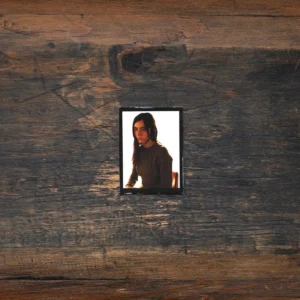
little wide open artworkOn Little Wide Open, Kevin Morby’s songwriting manages to sound both epically expansive while exuding a very simple warmth. It’s one of Morby’s gifts, and the new album might be his most consistent demonstration of it. It was produced by Aaron Dessner, with contributions from Justin Vernon, Katie Gavin, Lucinda Williams, Mat Davidson, Meg Duffy, and more. “Little Wide Open is set to a backdrop of tangled highways, towns with populations less than 100,000, roadside crosses, a rock and roll romance, coupling butterflies, being an American entertainer, Econoline vans, and more,” Morby explained. “This is, without a doubt, the most personal and vulnerable album I’ve ever made. Aaron did a heroic job of holding me back from throwing too many tricks at the songs and letting my stories stand a bit naked. Despite its title this album is in fact, very wide open.”


Rostam, American Stories

American StoriesRostam’s American Stories is a record of gorgeous ambition. To my ears, it’s the ex-Vampire Weekender’s best solo album to date, more direct and coherent than Half-Light and Changephobia, both impressive records in their own right. Clairo is featured on the early single and highlight ‘Hardy’, while Tobias Jesso Jr. co-wrote a couple of tracks. “At some point in making this record I realized the album I wanted to make was one that reflected my identity as both Iranian and American,” Rostam explained. “Pushing the most Iranian elements right up against the most American ones brought me a certain kind of joy. The first time I put microtonal saz melodies over Western guitar chords, I was thrown off by the way the two rubbed together. But the more I listened the more I became drawn to that rub. I became addicted to it.”


Ivy Knight, Iron Mountain

ivy knight.Iron Mountain is the debut album by Oakland-raised, Brooklyn-based singer-songwriter Ivy Knight. Made in collaboration with Deer park, the record homes in on subtly accented folk-rock after a couple of blearier, stripped-back EPs. “Whenever I’m with him, I can usually tap into stuff that I don’t think I can tap into when I’m alone,” Knight said in our Artist Spotlight interview. But when I’m developing a song, if I’m stuck or something, I think of this grid of space that has objects from the themes that I’m interested in, and I’m like, ‘Let’s traverse this. We can walk through and see this theme, and then what about this object or this item?’ Placing them in space physically, and then it gives me some structure to get to each thing.”
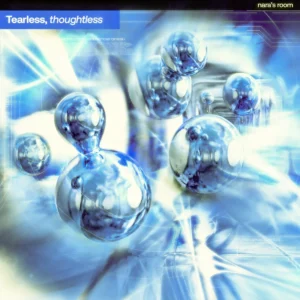

Nara’s Room, Tearless, thoughtless

tearless thoughtlessNara’s Room – the Brooklyn-based quartet led by Nara Avakian – have released a new album, Tearless, thoughtless. Following their 2024 debut Glassy star, the record was previewed by the singles ‘Tucson’, ‘Lizzie McGuire’, ‘Reseda’, which offer a taste of its expansive range. Much of the record reflects back on Avakian’s youth, with them commenting on ‘Reseda’: “I think when I experience change and loss, I tend to recede toward familiar places and things that no longer exist anymore. Reseda Blvd is a long and winding road in the San Fernando Valley in Los Angeles, where I grew up. It intersects with Sesnon Blvd. These roads intersect at almost the exact point of my childhood home, now gone, and yet I still recede. The loss of this relationship led me to recede to the idealized past of Reseda Blvd.”

Mad Honey, Bridge Over Cumberland

mad honeyOklahoma City band Mad Honey level up on their sophomore album, Bridge Over Cumberland. The follow-up to 2023’s Satellite Aphrodite was preceded by the singles ‘Moshfeghian’, ‘Reaching’, and ‘Marie’s Song’. Co-produced by the band’s Tuff Sutcliffe and Lennon Bramlett, it finds the group laying orchestral instrumentation – bowed strings, piano, glockenspiel, woodwinds, and synths – over their bleak, vaporous wall of sound. It might be the best shoegaze record you’ll hear this month.


Other albums out today:

Touch Girl Apple Blossom, Graceful; Jeff Parker ETA IVtet, Happy Today; Spencer Krug, Same Fangs; SUSS, Counting Sunsets; Telehealth, Green World Image; Rhododendron, Ascent Effort; Dua Saleh, Of Earth & Wires; Peter Frampton, Carry the Light; The All-American Rejects, Sandbox; David Bird, Hinterlands; Held., Grey; Death Kneel, Remembering Well; New Constellations, It Comes in Waves; culfre, Other People’s Pictures; Lawrence Kim, The Hours & The Times; Christian Dillingham, As It Relates to Now.

Jonathan Anderson Takes Dior Cruise 2027 to Hollywood

0

The Dior Cruise show just took a flight to the States, not exactly unknown territory for Jonathan Anderson, who left Ireland as a teenager with plans of becoming an actor, before the fashion industry got its hands on him. Monsieur Dior himself spent some quality time in Los Angeles, back when old Hollywood glamour was just Hollywood glamour. “No Dior, no Dietrich,” said Marlene Dietrich while working on Alfred Hitchcock’s Stage Fright. Some people’s Californian dream simply includes dressing Elizabeth Taylor, Grace Kelly, Marilyn Monroe and a few Oscars along the way. Not a bad starting point for a cruise collection, if you ask me.

Dior Cruise 2027
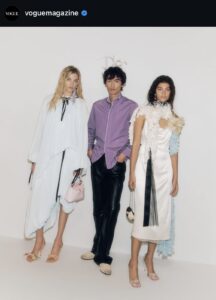
@voguemagazine via Instagram

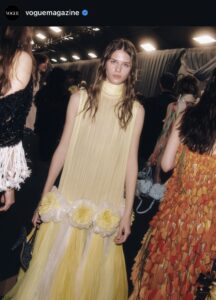
Get French chic and a bit of savoir-faire to play nice with Hollywood and everyday Americana, and you’ve got yourself a show. Which, of course, only gets better with vintage cars and film noir lighting inside LACMA’s new, and concrete-heavy, David Geffen Galleries. Enough to bring Al Pacino, Miley Cyrus, Anya Taylor-Joy, and Sabrina Carpenter to Mid-Wilshire for the evening. Carpenter showed up in a yellow dress, rosettes sitting around the hips, which later surfaced as the opening look. No surprise for anyone who had read the show notes, written as if it were a script: ‘A model appears on the runway in a buttercup-yellow dress…’

Dior Cruise 2027
@voguefrance via Instagram

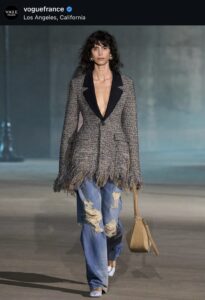
That dress also came as part of a trio, polite enough to offer a purple or black option. Next came the strongest Bar jacket I’ve seen so far, in sparkling donegal tweed, with threads dangling off the hem as if it had been freshly destroyed. What followed were poppy heads built in volume, satin skirts refusing symmetry, boas leaning on texture, robe coats, loose evening dresses, fringe, ribbons, John Galliano references, bias-cuts, newspaper-print bags (Chanel’s Cruise already went there, hopefully no one else follows), and everything in between.

Dior Cruise 2027
@voguemagazine via Instagram

The men (their first time sharing a runway with the Dior woman) walked out in the absolute Anderson uniform, shirt and jeans, alongside leather trousers, a suit here and there, the occasional knitted cape, and feathered (and worded) Philip Treacy headpieces, a nod to the late Isabella Blow, famously seen in a Treacy original built around her name.

“What you’re seeing here, is part of a kind of broader picture of what we will do over the next 12 months in cinema. We’re in Hollywood, and we’re starting something, but it will be a larger picture thing that we will do with franchises, with film, with other things. So this is going to be like: how does a fashion house work with cinema? And how does the cinema work with a fashion house, and what is a new type of business model within that?” the designer told Vogue. Ready for a cinematic year, then.

Gracie Abrams Shares Video for New Song ‘Hit the Wall’

Gracie Abrams has returned with a new song, ‘Hit the Wall‘. It’s the lead single from her forthcoming album Daughter From Hell, which arrives July 17. It was co-produced with Aaron Dessner and also credits Bryce Dessner, Justin Vernon, and Ben Lanz. Check out the Renell Medrano-directed clip below.

Dessner worked with Abrams on her last album, 2024’s The Secret of Us. On Instagram, he wrote:

So so so so so beyond excited to share that @gracieabrams’ 3rd album, “Daughter from Hell”, is out July 17 everywhere. The first single, “Hit the Wall”, is out this Thursday night!! I can’t believe it’s been 6 years since Gracie and I started making songs together. I’m deeply grateful for every song we have made and the way we have kept challenging ourselves and growing together as collaborators and friends, sometimes hitting the wall, and then pushing and breaking through. It has been such a journey since we began working on Daughter from Hell two years ago. We started on the same day that we recorded That’s So True and I Told You Things at @electricladystudios in New York – multiple songs on this album were made in that time. Since then we have searched and searched for songs in Long Pond, in London and back at Electric Lady. You’ll hear us expanding our musical vocabulary and pushing into uncharted waters sonically, and most of all the sharpening and deepening of Gracie’s lyricism and expression in ways that continue to astound me. I believe this album contains absolutely the most moving and powerful work we have done together — it feels elevated in every way — and I can’t WAIT until you all get to hear it. We will share more details soon on all the dear friends who helped us along the way.

Michigan’s Startup Scene: Opportunities and Challenges for New Entrepreneurs

Michigan has a specific kind of energy right now. It is a mix of that classic, industrial grit and a new wave of digital innovation that is popping up everywhere from Grand Rapids to Detroit. For a new entrepreneur, the state is basically a playground of opportunity, but it is not exactly a walk in the park. You have to know how to navigate the local hurdles if you want to build something that actually lasts.

The Opportunity: A Community That Wants You to Win

One of the best things about the Michigan startup scene is the lack of “gatekeeping.” Unlike some of the coastal tech hubs where everything feels incredibly transactional, people here actually want to help. There is a real sense of community. Whether you are tapping into the automotive tech legacy or starting a niche e-commerce brand, you will find mentors and local hubs that are genuinely invested in your success.

The cost of living and doing business is another massive plus. Your dollar simply goes further here. You can afford a decent office space or warehouse in places like Lansing or Ann Arbor without having to give up your firstborn. This lower overhead gives you a bit more “runway” to figure things out before the pressure to be profitable becomes overwhelming. You aren’t just paying for the zip code; you’re paying for the space to innovate.

The Challenge: That Mid-Stage Capital Gap

But it is not all sunshine and low rent. One of the biggest challenges Michigan entrepreneurs face is the “funding gap.” It is relatively easy to find seed money or small local grants to get an idea off the ground. The state is great at that “early-stage” push. But once you hit that middle stage—where you need to hire five more people, buy a massive piece of equipment, or invest in a serious marketing push—things can get a little tight.

This is the moment where many startups stall out. You have the demand, but you do not have the liquid cash to meet it. Honestly, this is why a lot of founders start looking at more traditional routes to keep the momentum going. If you find yourself in that spot, checking out business loans in Michigan can actually give you the breathing room you need to scale.

It is about buying yourself the time to grow without having to give up a huge chunk of your company to an investor who might not share your vision. Sometimes, the best partner is the one who gives you the capital and lets you stay in the driver’s seat.

Navigating the Talent War and “Brain Drain”

Another hurdle? Finding the right people. Michigan has amazing universities—U of M and MSU are churning out top-tier talent every year—but the “brain drain” is a real thing. A lot of graduates still head for Chicago or New York the second they get their diploma because they think that’s where the “real” action is.

To compete, you have to offer more than just a paycheck. You have to sell the mission. People in the Midwest value stability and authenticity. If you can show them that your startup is a place where they can actually make an impact—and still have a life outside of work—you will find an incredibly loyal workforce. Michigan workers are known for their work ethic; once they believe in what you’re doing, they are with you for the long haul.

The Power of the Industrial Legacy

We can’t talk about Michigan without mentioning the manufacturing backbone. For entrepreneurs in the hardware or “deep tech” space, this is a goldmine. You are surrounded by supply chains and experts who have been building complex machines for a century.

While a software founder in Silicon Valley might struggle to find someone to prototype a physical part, a Michigan founder can usually find a machine shop within a twenty-minute drive. That proximity to “making things” is an underrated advantage that more startups are starting to leverage.

The Grit Factor

At the end of the day, Michigan rewards resilience. This is a state that knows how to reinvent itself, we’ve seen the highs and the lows, and we’re still here. If you are willing to put in the work and lean into the local support systems, the opportunities are there. It is about being smart with your capital, staying honest about your challenges, and not being afraid to ask for help when you hit those inevitable growing pains. It is a wild ride, but there is no better place to build something real and lasting.

Drake Releases ‘Iceman’ and Surprise Albums ‘Habibti’ and ‘Maid of Honour’

Drake has released three new albums. Along with the much-anticipated Iceman, he’s dropped two surprise records: Habibti and Maid of Honour. Sprinkled across a total of 43 songs are features with Future, Molly Santana, Sexyy Red, Loe Shimmy, and 21 Savage. Take a listen below.

Drake revealed that the three projects would arrive simultaneously during his “Iceman Episode 4” livestream, sharing the message, “All 3 albums dropping at midnight from the biggest sound.” He then put up the album cover images individually on Instagram. The artwork for Maid of Honour notably features a photo of Drake’s mother as a young woman.

WooCommerce Product Image Enhancer

0

Most WooCommerce store owners think their biggest problem is traffic. But the numbers say otherwise. A recent web traffic analytics report by HubSpot found that 31% of websites get over 50,000 monthly unique visitors. So why do sellers still struggle to make conversions? In reality, many of them are quietly losing sales after people have already landed on their listings. And it all boils down to visuals. Just as it does for Shopify brands, a WooCommerce product image enhancer also matters.

To a certain extent, product photos are the storefront, salesperson, and closing argument all at once. In other words, they are the deciding factors between a scroll and a sale. That means having weak product visuals is not an option.

Fortunately, AI tools are changing the game. More than just making images look better, a WooCommerce product image enhancer like Simfa also relies on visual consistency and psychological trust.

Let’s explore what this means!

What a WooCommerce Product Image Enhancer Actually Does

For many customers, product images carry the entire weight of persuasion. How? Customers do not consciously analyze photos. They essentially just feel them. So, when a store has different lighting across products, mixed backgrounds, or uneven quality, a subtle friction arises in the buyer’s mind. As such, the store would feel unreliable, regardless of how great the actual product is. Even experts say that 75% of shoppers use product images to make purchase decisions.

Given the situation, traditional methods remain an option. However, these require technical skills, time, and professional outsourcing. And that won’t exactly work well for modern commerce. That is why the best solution is a WooCommerce product image enhancer. This kind of AI tool standardizes perception.

It helps store owners in:

  • Unifying lighting and tone across product images
  • Removing messy and inconsistent backgrounds
  • Enhancing sharpness and clarity for better resolution

To put it simply, it goes beyond editing images and builds visual trust across the store.

Simfa: A New WooCommerce Product Image Enhancer

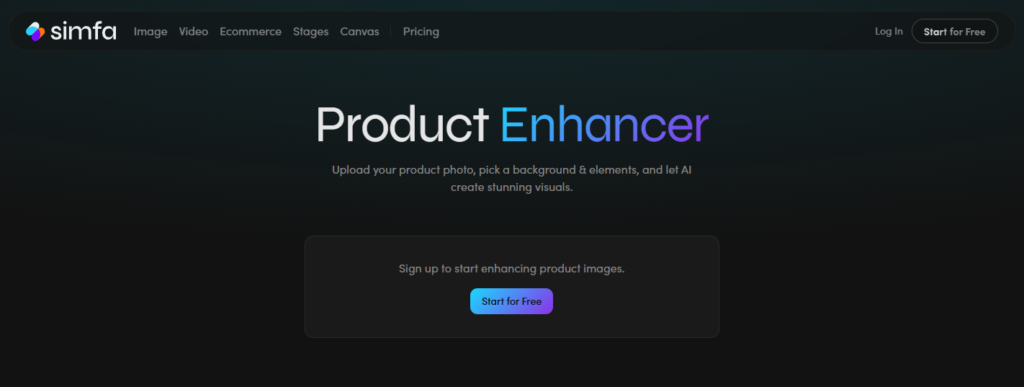
WooCommerce product image enhancer

One emerging solution in this space is Simfa. It is an AI-powered creative platform built to simplify visual editing for sellers and creators. Instead of treating image editing as a technical process, the app turns it into an automated, fast, and scalable process. And who would not want that?

Among many other image and video tools (e.g., image upscaler, image generator, color grading, face and outfit swaps), Simfa offers a dedicated product enhancer feature. With it, sellers can take even their most basic product photo and transform it by choosing from dynamic backgrounds, a range of visual elements, and adding custom instructions for extra styling touches.

What makes Simfa much more appealing is that it also delivers specialized e-commerce features that specifically benefit WooCommerce stores. Atop of these offerings is the ability to connect a WooCommerce store to the Simfa account and access its SEO META and Bulk Pricing Updater. It even has an AI-driven description creator that generates optimized product descriptions.

With Simfa, customers will be:

  • More likely to spend more time on product pages
  • More confident about the quality
  • Less likely to abandon checkout

All of which are useful for growing WooCommerce stores that manage dozens (even hundreds) of product listings and are eager to make sales.

Final Notes: Why Simfa Excels in Competitive Niches

In saturated markets, product differentiation is often minimal. The moment sellers assume that they are the only ones selling a particular product, they have already lost. The truth is, many stores sell similar or even identical items. So what separates winners from losers? It is actually not just the product. Not just the price. But also perception. A WooCommerce store with clean, consistent, and high-quality visuals feels more trustworthy, even if the competitor is selling the same product for a lower price.

And that is what sets Simfa apart. It aligns with the growing demand for consistency, speed, and visual quality. Therefore, if you are looking for a promising WooCommerce product image enhancer — one that supports better branding, higher conversions, and a scalable system of trust, you won’t go wrong with Simfa.

In the end, great products deserve great visuals, and in WooCommerce, product photos often do the selling long before anything else does. Start enhancing your visuals today with Simfa and see the difference it makes for your store.

The Avalanches Return With New Song ‘Together’

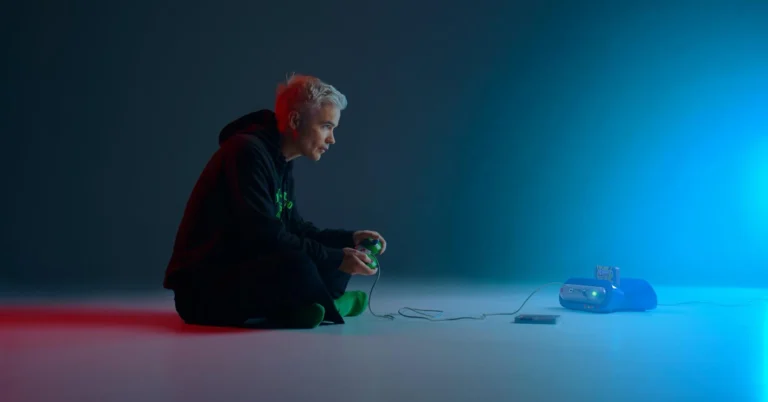
After teasing a new album in characteristically cryptic fashion, the Avalanches are back with new music. The trio of Robbie Chater, Tony Di Blasi, and Andy Szekeres made the ebullient new single ‘Together’ in collaboration with Nikki Nair, Jessy Lanza, and Prentiss, emphasizing a communal spirit. As a press release notes, the accompanying video marks “the first time Apple has allowed someone to anthropomorphise one of their products.” I’ll be transferring it straight into my own iPod Classic. Watch and listen below.

“How are you looking after your memories?” the press release asks. “At Takumi digital archives your most treasured moments are safe with us.” Presumably that’s related to the photo above.

The Avalanches’ last album was 2020’s We Will Always Love You. In 2024, the group featured on Jamie xx’s In Waves.

The Cultural Power of Fear: How Scared to Death Captures the Modern Horror Moment

Horror has always reflected the anxieties of its time. In every decade, the genre evolves alongside society’s fears, cultural tensions, and emotional uncertainties. From Cold War paranoia to post-digital isolation, horror films consistently act as mirrors for the collective subconscious. Today, the genre is experiencing another major cultural resurgence, and audiences are embracing fear-driven storytelling with greater intensity than ever before.

Modern horror is no longer viewed as a niche category reserved for cult audiences. It has become one of the most commercially successful and critically respected areas of contemporary cinema. In this environment, projects like scared to death are attracting attention not only from genre fans but also from cultural critics, entertainment investors, and high-end audiences seeking immersive cinematic experiences.

The renewed popularity of horror reveals something important about modern society: fear has become both emotional entertainment and cultural reflection.

Why Horror Feels More Relevant Than Ever

The modern world moves at a relentless pace. Audiences are constantly exposed to economic uncertainty, political division, technological disruption, and social instability. In many ways, horror films provide a controlled emotional outlet for processing these tensions.

Unlike other genres, horror directly confronts vulnerability. It forces viewers to experience uncertainty, discomfort, and anticipation within a safe environment. This emotional release explains why horror often performs exceptionally well during periods of cultural stress.

What makes contemporary horror especially powerful is its sophistication. Today’s audiences expect more than simple jump scares. They want psychological depth, social commentary, layered symbolism, and emotionally grounded characters. Modern horror filmmakers have responded by creating stories that feel intellectually engaging while remaining deeply unsettling.

Films such as scared to death reflect this evolution perfectly. The genre’s success now depends as much on atmosphere, emotional realism, and cultural relevance as it does on fear itself.

Horror Has Become a Prestige Genre

For years, horror existed outside mainstream critical recognition. Major award ceremonies rarely acknowledged the genre, and many studios treated horror as low-budget commercial entertainment rather than serious filmmaking.

That perception has changed dramatically.

Over the past decade, horror films have gained significant respect within the entertainment industry. Critics now analyze horror through artistic, psychological, and sociological lenses. Directors working within the genre are being recognized for visual innovation, storytelling ambition, and thematic complexity.

This shift has elevated horror into a prestige category capable of attracting both independent investors and luxury entertainment audiences. High-net-worth viewers who once gravitated exclusively toward prestige dramas or large-scale thrillers are increasingly drawn to elevated horror experiences that combine artistic sophistication with emotional intensity.

The genre’s growing cultural status also explains why horror premieres, private screenings, and festival events are becoming more exclusive and high-profile.

Fear as a Shared Cultural Experience

One of horror’s most unique strengths is its ability to create collective emotional reactions. In an era dominated by personalized algorithms and isolated streaming habits, horror still encourages communal viewing experiences.

Audiences gather for horror because fear becomes more powerful when shared. Suspense inside a crowded theater creates a level of emotional participation that few other genres can replicate. This communal intensity helps explain why horror consistently generates strong audience engagement despite constant shifts in viewing trends.

At the same time, horror fandom has become increasingly influential online. Discussions surrounding symbolism, hidden meanings, psychological theories, and alternate interpretations allow films to remain culturally relevant long after release.

Projects like scared to death thrive within this environment because modern audiences no longer passively consume horror—they actively analyze and participate in it.

Luxury Audiences and the New Entertainment Landscape

The growing sophistication of horror has also expanded its appeal among affluent entertainment audiences. Luxury viewers increasingly seek immersive, emotionally engaging experiences rather than purely escapist blockbuster spectacles.

This audience shift is particularly visible around private screenings, film festivals, investor events, and executive entertainment gatherings connected to major production hubs like New York and Los Angeles. Horror’s cultural prestige now attracts producers, financiers, and business leaders who view the genre as both commercially valuable and artistically relevant.

Because many of these industry professionals operate on demanding travel schedules, premium transportation and executive mobility remain essential components of the entertainment ecosystem. Services such as Teterboro airport car service have become closely associated with high-level film industry logistics, particularly among executives, investors, and private aviation travelers moving between meetings, screenings, and production negotiations.

In many ways, the business infrastructure surrounding modern horror now reflects the genre’s elevated cultural status.

The Streaming Era Amplified Horror’s Reach

Streaming platforms have accelerated horror’s global resurgence. Unlike traditional theatrical models, streaming allows horror films to reach highly targeted international audiences almost instantly. This accessibility has introduced viewers to a wider variety of horror storytelling styles, from psychological thrillers to experimental supernatural narratives.

Streaming has also encouraged greater creative risk-taking. Without relying entirely on theatrical performance, filmmakers have more freedom to explore unconventional themes and darker subject matter.

As a result, horror has become one of the most creatively dynamic genres in modern entertainment. Films no longer need massive budgets to generate cultural impact. Strong concepts, emotional authenticity, and atmospheric storytelling often outperform expensive visual spectacle.

The growing conversation surrounding scared to death reflects this changing industry landscape, where originality and emotional resonance matter more than formulaic franchise structures.

Why Horror’s Cultural Influence Will Continue Growing

The current horror renaissance shows no signs of slowing down. If anything, the genre’s influence continues expanding across mainstream culture, streaming entertainment, fashion, gaming, and digital media.

Horror remains uniquely positioned because it adapts quickly to changing societal fears. Every generation redefines what frightens them, and the genre evolves accordingly. This flexibility allows horror to remain culturally relevant even as entertainment trends shift.

At the same time, audiences increasingly value emotionally immersive storytelling experiences that feel authentic rather than manufactured. Horror delivers exactly that. It engages viewers psychologically, emotionally, and socially in ways few genres can consistently achieve.

Films like scared to death represent more than entertainment products. They reflect the emotional climate of the modern era—a time defined by uncertainty, overstimulation, and constant cultural transformation.

In today’s entertainment landscape, fear is no longer simply a cinematic device. It has become one of the most powerful storytelling languages in contemporary culture.

Amrit Karki Presents New Work At 2026 Sā Ladakh Biennale

The Rubin Museum of Himalayan Art has announced a new five-year partnership with sā Ladakh Biennale, beginning with the commissioning of a work by Nepalese artist Amrit Karki for the biennale’s 2026 edition. Running from 1–10 August across Ladakh’s Leh-Kargil corridor, the biennale takes place at an altitude above 3,000 metres, earning the title of the world’s highest regenerative art biennale. The event will be bringing together contemporary art practices interested in ecological and cultural landscapes.

Karki, who is currently based in Pokhara, Nepal, is one of 24 artists participating in this year’s edition, and the first artist from Nepal to take part in the biennale. Recognised for his durational and performance-based works exploring spirituality and the unique relationship between the visible and invisible , the artist will develop a new commission following a month-long residency in Ladakh. His previous collaboration with the Rubin included the five-day performance What You Have Given Me, I Set Free Forever at the Nepal Art Council in 2024.

Curated by Vishal K Dar with Tsering Motup under the theme Signals from Another Star, the 2026 edition of sā Ladakh Biennale brings together artists from Ladakh and the wider world to investigate questions of land, memory, climate and lived experience. Following a rather unconventional exhibition format, the biennale extends across villages, learning spaces and open landscapes, spotlighting low-impact artistic production and long-term engagement with the region.

The Rubin’s collaboration with the biennale signals the museum’s broader move toward a decentralised global model centred on partnerships and cultural exchange across the Himalayan region. Future collaborations between the Rubin and sā Ladakh Biennale are also planned for 2028 and 2030.