Home Blog Page 63

Best Place To Live In California 2026

Relocating to California is a major life decision, and choosing the right city can shape your finances, career, and overall happiness for years. In 2026, many people are rethinking what “best” really means. Instead of chasing famous cities, smart relocators are looking for places that offer balance. The goal is not perfection. It is finding a city where daily life feels manageable and rewarding at the same time.

What Most People Need When They Relocate

When people move to California, they usually face the same challenges. Housing costs feel overwhelming. Commute times can eat into personal life. Job security matters more than scenery once the move is complete. A good place to live solves these problems instead of adding new ones.

The best cities are those where income aligns better with expenses, neighborhoods are clearly defined, and newcomers can settle in without constant financial stress. This matters even more in 2026, as people are prioritizing stability and quality of life over status.

Why San Diego Stands Out Overall

San Diego is often considered the best place to live because it performs well across many important areas without extreme tradeoffs. The job market is diverse, with opportunities in healthcare, biotech, education, tourism, defense, and professional services. This variety helps people who relocate without a guaranteed role or those who may want flexibility in the future.

The city is also easier to navigate compared to larger metros. Neighborhoods feel distinct, and it is possible to choose an area that fits your lifestyle rather than forcing yourself into one expensive zone. While housing is not cheap, it feels more predictable. Many newcomers find success by renting first, exploring inland neighborhoods, and avoiding rushed decisions. This approach often leads to better long-term satisfaction.

Lifestyle Matters More Than You Expect

One reason San Diego works well for relocators is how it supports everyday life. Good weather, outdoor access, and a calmer pace make it easier to build routines that reduce stress. This is especially helpful when you are new and trying to create a sense of home.

Unlike cities where entertainment always costs money, San Diego offers simple ways to enjoy free time. Walkable areas, parks, beaches, and community events help newcomers meet people without pressure. These details may seem small, but they make a big difference when adjusting to a new city.

Comparing Other Popular Relocation Options

Not everyone will find San Diego to be the perfect fit. Sacramento appeals to people who want more space and a realistic path to homeownership. It works well for those in government, healthcare, logistics, and education, and it often provides lower monthly pressure on household budgets.

Irvine attracts families and professionals who value structure, safety, and strong schools. It is well planned and consistent, which helps people who want predictability. The tradeoff is cost, but smaller homes or longer-term rentals can make it workable.

San Jose fits people focused on career acceleration, especially in tech. The income potential is high, but so are expenses. Relocators here usually need a clear financial plan and flexibility with housing choices.

How to Relocate With Confidence

A successful move starts with setting clear limits before you arrive. Decide on a maximum housing budget that includes utilities and transportation. Be honest about commute tolerance, because traffic affects quality of life more than most people expect. Visit neighborhoods during regular weekdays to see how they really function.

Many people find it helpful to secure short-term housing first. This gives you time to explore and prevents costly mistakes. Planning ahead turns a stressful move into a controlled transition.

The idea of Living In California often comes with high expectations, but the reality depends on preparation and location choice. In 2026, San Diego remains the best overall place to live for most people because it balances opportunity, lifestyle, and livability. With realistic planning and the right city, relocating can become a fresh start instead of a financial burden.

Rolling Blackouts Coastal Fever Return With New Song ‘Sunburned in London’

Rolling Blackouts Coastal Fever are back with a new song, their first new music since 2022’s Endless Rooms. The glimmering ‘Sunburned in London’ arrives with a video shot at Melbourne’s Northcote Theatre, featuring Stella Donnelly, Sophie Ozard, and Julia Wallace on backing vocals and keys. Check it out below.

“As a band, we have always made songs about cities,” the band’s Tom Russo said in a statement. “I was thinking about sensory overload and relentless beauty, and the creeping feeling in the streets that the party’s winding up and the lights are about to come on.”

The Weirdest, Messiest, and Most Memorable Moments of the 2026 Grammys

Ever prone to alliteration, I considered using “mildest” as the first superlative in the title of this 2026 Grammys recap, but let’s face it: Mildness is a defining quality of music’s biggest night, not a momentary one. To sit through eight hours of the Recording Academy handing out awards (including the pre-telecast Premiere ceremony, where the majority of the awards are given), you have to be either contractually obligated, financially invested, or nominated, and for those of us who have to pull an all-nighter in order to do so, it is especially hard not to lose interest. What’s the point of singling out the blandest parts of a ceremony – Trevor Noah’s insufferable jokes, Pharrell’s corny advice, Billie Eilish snagging a trophy two years after her last album was released, an Alex Warren performance that somehow made you miss Benson Boone – whose aftertaste is normally a resounding “Meh”?

What, you may add, is the point in caring about any of it? The Grammys have always skirted the line between celebratory and self-congratulatory, and veering too far to the wrong side has a way of undercutting their occasional significance. Sabrina Carpenter, who walked away empty-handed despite proving that she should be on the performers list every year, got a chuckle out of me when she asked everyone looking for a little validation to stand up during ‘Manchild’. (Unlike Noah, she understands that a good roast should always reflect back on one’s own frailty.) Whether in a genuine attempt to recognise excellence in music, correct past wrongs, or stay relevant, however, the Recording Academy gets some things right. And sometimes, when it does, you get the sense that it’s worth the spectacle.

This feeling was ignited in me early on, when the Cure won their first Grammy. And then when FKA twigs pulled a surprise win in a male-dominated Best Dance/Electronic Album field, even though presenter Darren Criss hilariously butchered the pronunciation of EUSEXUA. And then when Turnstile, sincere as ever, accepted their awards. But there was always room for the Grammys to mess up in the main ceremony. Yet despite the inevitable messiness, there was something genuine that reverberated through the pageantry of it all, a reminder that the people behind today’s most popular recordings are more important than celebrities breaking records.

Let’s sort out the most bizarre, chaotic, and commendable parts of the night, shall we? (Sorry, Rap Album of the Year GNX just isn’t that wordplay-friendly.) I’ll let you draw the line wherever you want.


First-Time Winners the Cure, Kehlani, Turnstile, and… His Holiness the Dalai Lama

This year’s first-time winners were a weird, cross-generational mix that included the Cure, Kehlani, Turnstile, Clipse, FKA twigs, and Tyler Childers. Rufus Wainwright, accepting the Dalai Lama’s award for Best Audio Book, Narration, and Storytelling, offered one of the most quotable lines of the night: “Obviously, I’m not the Dalai Lama.” I’ll be using it next time I’m about to give someone advice.

Justin Bieber’s Stripped-Down Performance

We all had the same thought when Justin Bieber stepped onto the stage: Why is he only wearing boxers and socks? The more the stripped-down performance dragged on, the more I was convinced there was a think piece there about the disarming intimacy of it all, and I don’t even care for ‘Yukon’. As the camera shifted between him and his wife, it was somehow refreshingly unceremonious, definitely earnest, even raw. Everything happening at the Grammys is bogged down by the fact that it’s happening at the Grammys, somewhere called the Crypto.com arena, but this seemed to exist outside of that realm. We were all stunned there for a little bit.

The Best New Artist Whirlwind

The Grammys are not a fast-moving event, a fact sneakily underlined by how many of the performances were set in the liminal spaces of transportation: airport terminals, parking lots, gas stations. But that Best New Artist medley was a lot to digest at once, and the quality plummeted quickly. The Marías delivered a touching, oh-so-blue performance that had Billie Eilish loudly cheering (her Hit Me Hard and Soft is no doubt aesthetically aligned), Addison Rae’s magnetic appearance on the back of a truck got Drag Race fans typing, the transition to Katseye was smooth, Leon Thomas was solid  – but the overbearing ballads of Alex Warren and Lola Young (‘Messy’ did not need to be stripped down), not to mention sombr’s hamfisted disco, were too much too handle. Thankfully, they were offset by the effortlessly breezy Olivia Dean, ultimately a safe and deserving recipient of the award.

Lola Young, Duh

“I very much relate to this song,” Charli XCX said when announcing Lola Young’s ‘Messy’ as the winner of Best Pop Solo Performance. It would be one of the biggest surprises had the song not received a standing ovation earlier, an example of how charming messiness can be.

Tyler, the Creator Self-Destructs

The Grammys are often chaotic bad, but Tyler, the Creator’s performance – the best of the night – was on the other end of the spectrum. His medley of ‘Thought I Was Dead’, ‘Like Him’, and ‘Sugar on My Tongue’ was seamless and electrifying, as much proof of his magnetism as the aesthetic sensibilities that made him the inaugural Best Album Cover winner. That much was expected, but seeing him blow up the building and collapse on the floor was hair-raising entertainment.

Cher’s Surprise Appearance

The only thing more iconic than Joni Mitchell’s “Oh, I won?” last night was Cher showing up, offering some words of wisdom, then walking off before announcing Record of the Year. After Noah called her back, she said the winner was Luther Vandross, whom Kendrick Lamar sampled on the winning ‘Luther’. Her silliness near the event’s supposed climax was enlightening. If they’d let her ramble for a few more minutes without revealing the winner, how many of us would notice they’d skipped a category?

The Grammys (Rock Version)

A certain section of the internet may have been upset that a hardcore band won in a Best Metal Category featuring Spiritbox, Sleep Token, and Ghost, while another reignited debates around Turnstile’s hardcore status. But to the average viewer, the more immediate takeaway was that this year’s Grammys were particularly guitar-forward. I mean, Bruno Mars didn’t have to shred on the guitar while performing ‘APT.’, but it ended up feeling like an apt way to kick off a ceremony that also included a rocked-out version of ‘Abracadabra’ featuring drummer Josh Freese. (Maybe they felt the need to up the ante after last year’s just-fine ‘Die With a Smile’.) Lady Gaga’s extravagant performance was not only a full-circle moment after the song’s music video premiered during the 2025 Grammys, but a much-needed jolt of energy after Jelly Roll’s depressing win.

The Sprawling In Memoriam Segment

Although weirdly segmented by genre and chaotic in its own way, the sprawling In Memoriam segment got pretty much everything right. Post Malone’s vibrato stunned during his Ozzy tribute alongside Slash, Duff McKagan, Chad Smith, and Andrew Watt, while Lauryn Hill’s first Grammys appearance since 1999 did not disappoint – paying tribute to D’Angelo and Roberta Flack, it soared through several moods before rejoicing in Fugees’ take on ‘Killing Me Softly’.

“ICE OUT” and Bad Bunny’s AOTY

From Justin Bieber to Joni Mitchell, numerous artists wore “ICE OUT”  pins while appearing onstage, culminating in Bad Bunny’s declaration as he accepted the Album of the Year trophy. Grammy voters sometimes surprise us by making the correct choice for the most coveted award, but rarely does it carry such a strong sense of urgency and weight, amplifying a message that was reiterated in unambiguous and varyingly personal terms throughout the ceremony – from Billie Eilish’s “No one is illegal on stolen land” to Olivia Dean’s “I’m a product of bravery.” For Bunny, bravery looked like soaking in the gravity of the moment and getting the words out as lovingly as he could: “We’re not savages. We’re not animals. We’re not aliens. We are humans, and we are Americans.” It looked like speaking in his native tongue before dedicating his award “to all the people that had to leave their homeland, their country, to follow their dreams.” As the coffee wore off and the sun was coming up, his conviction was the only thing keeping my heart pounding.

Cairn: How to Climb

0

Cairn is finally out, and if you’re jumping in, the first thing you’ll need to get comfortable with is climbing. The Game Bakers’ latest release is a realistic climbing adventure in which you play as Aava, a seasoned mountaineer attempting to become the first person to reach the summit of Mount Kami. The game has you scaling rock faces for most of the game, so knowing how climbing works in Cairn can help you plan routes, make better use of Aava’s strength, and avoid rookie mistakes that can quickly send you back down. So, to get started, here’s how to climb in Cairn.

Cairn: How to Climb

Cairn features a realistic, simulation-style climbing system, so you need to keep an eye on hand and foot placement, balance, and how far Aava can safely reach. To climb in Cairn, simply approach a rock face and press X on Xbox, Square on PlayStation, or left-click on PC. Aava will grab the wall, and the game will automatically select one of her limbs.

You can then use the left stick or WASD keys to drag that hand or foot toward a ledge, crack, or other non-flat surface, and press the same button again (X on Xbox, Square on PlayStation, or left-click on PC) to place it. Then, repeat the process with each limb to move higher.

Cairn uses a tight third-person camera, so finding the right way up often takes a bit of looking around. You can press LB on Xbox, L1 on PlayStation, or Tab on PC to bring up the camera and get a wider view of the cliff before you start moving again.

If a placement doesn’t feel right or if Aava places her hand flat against the wall instead of grabbing a hold properly, you can undo the last move by hitting B on Xbox, Circle on PlayStation, or right-click on PC. While the game usually picks which limb to move next, you can manually select a specific hand or foot by pressing RB on Xbox, R1 on PlayStation, or Space on PC.

Moreover, like real climbing, Aava is far stronger and more stable when she’s pushing upward with her feet rather than pulling herself up with her arms. So, you’ll often find it easier to place her feet on solid footholds and press upward rather than hang from her hands.

And that does it for our how to climb in Cairn guide. For more gaming news and guides, be sure to check out our gaming page!

Are Video Games the Best Way to Spend a Night in With Friends?

There’s a familiar moment that keeps happening. Someone suggests going out. Everyone agrees it sounds nice. Then reality kicks in. Prices. Travel. Timing. Energy. Before you know it, the plan quietly falls apart and the group chat goes silent. No one’s annoyed, but everyone’s a bit disappointed. You tell yourself this is just how adulthood works and move on, even though you miss actually spending time together.

That’s where gaming sneaks in. Not as a big decision or a lifestyle change, but as the easiest option left on the table. No bookings. No getting ready. No spending money you’ll regret tomorrow. Just showing up, talking, and doing something together. And honestly, that starts to feel like a win.

Nights out stopped being the obvious choice

It’s not that people don’t like going out anymore. It’s that it’s become a lot harder to justify. You add up food, drinks, transport, and suddenly a casual evening feels like a financial commitment. Even when you try to keep it simple, costs creep in from everywhere.

A night in with games flips that completely. You’re entertained for hours without watching your bank balance drop. There’s no pressure to stay out longer just to make it “worth it.” You can hang out, laugh, and log off when you’re tired. That freedom changes how social time feels, especially when money is tight or priorities have shifted.

Scheduling gets easier when nobody has to travel

One of the biggest barriers to seeing friends is distance. Different cities. Different countries. Different time zones. You want to meet up, but coordinating everyone’s schedules feels like organising a small event, and nobody wants to deal with that kind of pressure.

Gaming removes that friction. You don’t need everyone in the same place. You don’t even need everyone free for long. People can drop in late, leave early, or just listen in. That flexibility makes it easier to actually make plans happen instead of talking about them for weeks and never following through.

Games give you something to do together

A lot of social plans rely on conversation alone. That’s fine, but it can feel awkward or draining, especially after a long day. Games give everyone a shared focus. Something to react to. Something to laugh about.

That’s why even a quick game of poker without the need to gamble can be enough to spark an evening. You’re not staring at each other waiting for topics to come up. You’re doing something together, and conversation flows naturally around it. The activity carries the social weight, which takes pressure off everyone involved.

It’s social without being exhausting

There’s a big difference between being social and being overwhelmed. Loud spaces, constant noise, and forced energy drain people faster than they realise. Gaming lets you control the vibe.

You can talk when you want. Stay quiet when you don’t. Sit in comfortable clothes. Eat your own food. That balance makes socialising feel sustainable again, especially for people who still want connection but don’t want to be “on” all the time. It’s relaxed in a way that traditional nights out rarely are anymore.

Distance stops mattering as much

One of the quietly powerful things about gaming nights is how they keep long-distance friendships alive. When friends move away, staying close usually gets harder over time. Messages get shorter. Calls get rarer. Life fills the gaps.

Games create shared experiences again. Inside jokes. Moments. Stories you reference later. You’re not just catching up on life, you’re doing something together in the present. That shared time matters more than people realise, especially when geography would otherwise pull friendships apart.

It’s easier to mix different friend groups

Combining friend groups can be awkward. Different personalities. Different interests. Different dynamics. Gaming smooths that out because it gives everyone common ground instantly.

You don’t need to explain why you know someone or manage conversation flow. The game does that for you. People bond over mechanics, strategies, and shared wins. Over time, separate groups start feeling like one because they’re connected through the same activity rather than forced interaction.

You end up meeting new people naturally

Another unexpected bonus is how often gaming introduces you to new people. Friends bring friends. Someone invites a teammate. Suddenly there’s a new voice in the group chat and everyone gets to know them.

Because you’re already doing something together, meeting new people feels low-pressure. There’s no awkward introduction phase. You’re just there, playing. That’s how groups grow without effort, and how social circles expand without needing formal plans or events.

It reflects a bigger cultural shift

This isn’t just a personal thing. Gaming is now completely reshaping global culture, including how people socialise. It’s no longer niche or isolating. It’s mainstream, shared, and woven into how friendships work.

People don’t talk about games instead of life. They talk about life while playing games. That distinction matters. Gaming hasn’t replaced socialising. It’s adapted it to fit modern lives that are busier, more expensive, and more spread out than ever before.

Why gaming instead of a night out just makes sense in today’s world

At some point, the question stops being whether gaming is a good way to spend a night in with friends, and starts being why it works so well. It removes the pressure, the cost, and the effort that often get in the way of seeing people you care about. You still laugh, still talk, still share moments, just without the hassle that comes with traditional plans. It fits around real life instead of competing with it.

For a lot of people, that’s exactly what makes it special. You don’t have to choose between being social and being comfortable. You don’t have to wait for the perfect time or perfect plan. You just show up, play something together, and let the evening unfold naturally. And once you realise how easy and enjoyable that feels, it’s hard not to wonder why you ever made it more complicated than it needed to be.

The Best Online Casino-Themed Video Games Available in the U.S.

0

Open up a U.S console store, type “casino”, and the results are a mess. Some tiles look like straight-up gambling apps, some look like parody cartoons, and every so often, there is a game that actually feels like a proper video game first and a casino second. Those are the ones players talk about on forums at 2 a.m., usually while they are still sitting at a virtual poker table.

If you care about the feel of a game, not just a giant “spin” button and a shower of coins, that distinction matters. Plenty of software borrows the casino floor’s look. Far fewer titles use that setting to build characters, communities, or online spaces that people want to come back to for months.

So, the focus here is deliberately narrow. Not real-money casinos, not bonus code landing pages, just the online casino-themed video games available in the U.S that behave like games, with systems to learn, lobbies to sit in, and stories to tell in the group chat later.

Walking Into a Casino That Lives on Your Console

The easiest reference point is The Four Kings Casino and Slots. On the store page, it sits in the same category as dozens of other casino apps. On a television, once it loads in, it feels closer to a small-scale MMO that happens to be obsessed with blackjack, roulette, and slots.

There is a character creator. There is a hotel-style lobby. Players drift between bars, banks of machines, and table pits in real time, waving, sitting, standing back up again. Chips are virtual, wardrobes unlock slowly, and seasonal events come and go. It is more like walking through a digital resort than clicking icons in a menu.

Because everything runs on play money, it scratches a similar itch to browsing the latest no deposit bonuses during a quiet moment at work, but with more texture. Walking across patterned carpet to reach a favourite machine is a tiny detail, yet it still changes the way the space feels. Many nights inside Four Kings end up being more about quietly hanging out than chasing any specific win.

AAA Video Games with Casinos Hiding Inside

Beyond dedicated casino titles, there are the blockbusters that quietly double as casino sims for anyone who wants them to.

Grand Theft Auto V is the obvious example. With the Diamond Casino and Resort update, the game added a high-rise casino complex to Los Santos. On paper, it is one location among many. In practice, for a lot of players, it becomes its own game inside the game, with late nights spent between the blackjack tables, the slot machines, and the horse racing lounge while the rest of the map waits outside.

Red Dead Redemption 2 plays the same trick, but at a very different speed. Its poker games in back rooms and saloons are slow, talky, and incredibly sticky. Hands stretch out. Characters mumble. A few chips change hands at a time. Players often log on planning to clear a main mission, then realise an hour later that they are still sitting at the same felt table, inventing rivalries with AI ranchers and outlaws.

Japanese series like Yakuza and its spin-offs, such as Judgment, add their own take. Behind doors and down staircases sit small casino rooms with blackjack, roulette, mahjong, and slot-style machines, all wrapped inside crime stories and side quests. Fallout: New Vegas makes the casino its whole backdrop, turning the strip into a run of themed houses that each handle cards, credit, and comps slightly differently.

Poker Games That Treat the Table Like a Stage

For some players, the casino exists only around the poker table. Modern poker games lean into that, building the whole experience around online tournaments, tells, and that slow rhythm of fold, call, raise, repeat.

Prominence Poker is one of the names that keep coming up. The city it is set in, Prominence, is fictional, but the structure is familiar. There are back rooms, bigger rooms, bosses to beat, and crews to face down. The story framing is pulpy, almost comic-book at times, yet underneath it sits a real Texas Hold’em engine that rewards patience and reads.

Sessions can feel messy in a good way. Players fidget, gesture, and lean back in their chairs. Emotes fire at odd moments. The game keeps track of progress over time, so a lucky night against strangers can quietly push an avatar up a rung on the ladder.

Pure Hold’em takes the opposite route in tone. It sells the fantasy of polished TV poker, with studio lights, sharp tables, and very clean camera cuts between angles. Players begin at low-limit tables and work their way upward, watching chip stacks grow and shrink. The online lobbies look less like a casino pit and more like a tournament lobby, but the rhythm of hands, blinds, and pressure is the same.

Old-School Chips and Stranger Spins on the Formula

None of this came out of nowhere. Older players can point to cartridge-era casino games that lived and died on simple blackjack and slot simulations, or to the tiny gambling corners of role-playing games that ran on 16-bit hardware. The graphics were blocky, the rules were the same.

Modern indie games take those ideas and twist them into odd shapes. Some use card draws and dice as the backbone of deckbuilding or roguelike systems. Others take the bright lights, chiming sound effects, and spinning symbols of the casino floor and wrap them around rhythm challenges or bullet-hell shooters. The result does not look like a traditional casino, but it feels strangely close in the moments where a run comes down to one last roll of the dice.

Our Favourite Casino-Themed Video Games Overview

  • The Four Kings Casino and Slots
  • Prominence Poker
  • Pure Hold’em
  • Grand Theft Auto V: Diamond Casino and Resort
  • Red Dead Redemption 2 poker and blackjack
  • Yakuza / Judgment casino rooms
  • Fallout: New Vegas strip casinos

A Different Kind of Casino Night

Put all of that side by side, and the pattern becomes easier to see. The casino in 2025 is not only a building; it is also a setting developers use to create tension, glamour, or a certain kind of late-night energy.

For U.S players, that means a casino-themed session can look like a walk through The Four Kings lobby, a long night in Prominence Poker, a quick visit to the Diamond Casino before a heist, or an hour lost to a dusty Red Dead table. The stakes are virtual, the chips reset, and nobody has to catch a flight home. The stories that come out of those sessions, though, still sound a lot like the ones people tell after a real trip to the tables.

Jacquemus Fall 2026 “Le Palmier” & His Grandmother

0

Excitement around Jacquemus’ upcoming ready-to-wear “Le Palmier” collection needed no help. The runway took care of that. What did need clarifying, though, was the label’s emotional center. So, days before the show, Simon Porte Jacquemus made quiet the announcement, the first brand ambassador in the house’s history. And it felt personal, because it was.

Less than a week before the show, Simon posted a cryptic Instagram story. “Good evening. This week I’ll announce my very first Jacquemus ambassador… I can’t believe it. See you soon.” The guessing game began immediately, supermodel, actress, pop star, all predictable. The announcement wasn’t. Liline Jacquemus, his 79-year-old grandmother got the title. And we couldn’t be happier. Fans didn’t need a second glance, she’d been in Simon’s 2020 summer campaign, shot at home during the pandemic.

Screenshot of Jacquemus' grandma-brand ambassador announcement via Instagram
@jacquemus via Instagram

“Before Jacquemus existed, she was already my inspiration. Her strength, her elegance, her authenticity… she shaped the way I see women, and the way I imagine this Maison.” But with that honor comes rules. As Simon wrote in his announcement post “The ambassador must not pronounce the names of other fashion houses. The ambassador must not wear any other brand, archive, label, or ‘just something comfortable’ comfort is conceptual. The ambassador must not remove Jacquemus pieces at home, at night, or in dreams.” You get it. In a world obsessed with worshipping “star faces”, Liline is more than welcome. Just like family values, real inspiration, and raw emotions. Fashion actually needed her.

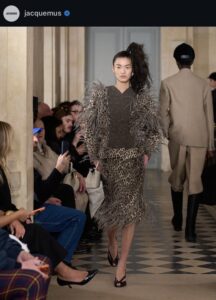
It all started with little teaser videos that carried the name of the collection, and… well, palm-tree hairstyles. That iconic ’80s-it style, made just weird enough to be cool. Even the invitations to the show came with a comb and a Jacquemus’ step-by-step guide to the perfect, proudly standing palmier. So yes, it was a pretty fun collection, but the fun didn’t end on the head. “I wanted to have this strong woman, the spirit of the ’80s, the cut of the ’50s, and the sensuality of the ’90s,” the creative told Vogue.

Screenshot of Jacquemus' Instagram post featuring a runway moment of the "Le Palmier" show
@jacquemus via Instagram

Think hourglass silhouettes, huge hats, not just the elegant kind, but also the kind a 5-year-old birthday boy would approve of. Blacks and vivid colors like reds, yellows, and turqoises, patterns like polka dots and animal prints, fringes everywhere. And when I saw everywhere, I mean at the Picasso Museum where everything took place, let’s not forget his love for Paloma and Pablo Picasso. His finale was a recreation of the dress painted in “Woman with a Fan” after all. One shoulder, glass in the right place, and Jacquemus reminding us of what matters.

Jonathan Anderson’s Dior Couture Debut Smelled Like Flowers – Cyclamens To Be Exact

0

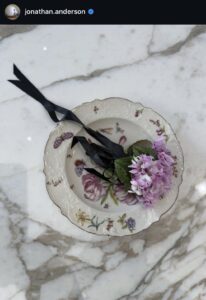
“The more you love the brand, the more it will give you back.” That was the line Anderson heard last year when he asked John Galliano to meet him and his first ever collection for the Christian Dior label. For Galliano, the designer who stayed by the side of the brand for more years than Christian Dior himself, some would’ve expected a grand speech or a cryptic fashion prophecy, but luckily, he arrived at the office with a bag of Tesco sweets and a modest bunch of cyclamen, tied neatly with black silk ribbons. “I took this as a starting point so that everyone could receive the same posy of flowers I had received,” Anderson shared on his Instagram, just a few days before the show.

Screenshot of Jonathan Anderson's Instagram post with the posy of Cyclamens
@jonathan.anderson via Instagram

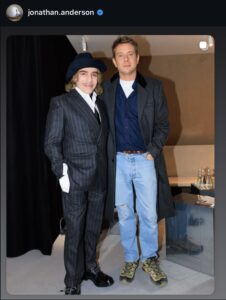
If you’re launching a couture era, flowers with a backstory, plus a Galliano cameo, are a pretty solid place to start. And as it seems, it’s the move to finally make Galliano attend a Dior show too. It had been over a decade since he had been part of any Dior runway moment, the man was last tied to the house back in 2011, before the long, long gap that followed. “He is Dior in the public imagination, still to this day, because what he built was so big in terms of the rebirth of fashion. I loved the idea of him being back at Dior. I felt like it was a full-circle moment,” Anderson told Business of Fashion, and I couldn’t agree more.

Screenshot of Jonathan Anderson's Instagram post with John Galliano at the show
@jonathan.anderson via Instagram

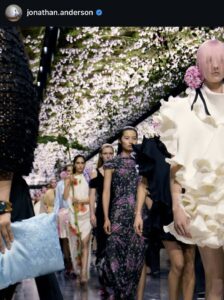
After the guests received their now-signature flowers in a white Dior box that carried the show’s invitation, they walked in the venue only to be greeted by more flowers. A ceiling of them, actually. Cyclamen, of course. Everyone slowly took their seats, Brigitte Macron, France’s First Lady, Bernard Arnault, LVMH chairman, Jeff Bezos, Pharrell Williams, Jean-Paul Gaultier, Carla Bruni, Jennifer Lawrence, pretty much everyone, except Rihanna. Naturally, the show ran an hour late. Honestly, I think I’d wait for Rihanna too.

Screenshot of Jonathan Anderson's Instagram post with an image of the show's runway
@jonathan.anderson via Instagram

But when it finally started, the opener came as a trio of dresses with tulle-built hourglass volumes, familiar enough to remind us of the creative’s ready-to-wear debut. And as the show went on, those shapes only grew larger, thanks to Magdalene Odundo, a ceramicist Anderson likes to keep close. Every single look had some kind of flower attached to it. If it wasn’t on the garment, it was on the shoes, if it wasn’t on the shoes, it sat on a shoulder, and when it wasn’t on a shoulder, it ended up glued to the model’s ears. Still, the collection wasn’t nearly as extra as that sounds. Everything was toned down a notch, mixing high and low elements. I saw sculptural volumes, sparkling sequins, soft feathers, elegant drapes, but I also saw Raf Simons-coded coats, knitwear and ribbed tank tops, and I really enjoyed the tension. It kind of framed the ateliers’ power as something clear, essential, commanding.

“Couture is kind of an endangered craft, as a mindset, a mythology, and making with hand. What Dior is doing, and other couture houses, which there’s not many left, they’re protecting this endangered craft as a national symbol of making,” Anderson shared with Business of Fashion. “Dior couture needs to exist because they (the artisans) are practicing a skill that if you don’t practice would disappear.” And that’s exactly why haute couture carries that sense of sacredness. It exists far away from almost everyone, except for the few clients invited into the maison’s private world built around that collection. But that distance, the fact that 99.5% of the public remains on the outside, is the whole point. Couture feeds on imagination, and mostly lives there long after the show is over. It’s a backstreet in an industry that keeps growing bigger and faster every day, celebrating chosen pairs of hands, their work, their traditions, and the luxury of taking time.

Sustainable Fabrics Every Fashion Lover Should Know

Fashion has always been a form of self-expression, but lately, it has also become a reflection of our values. More shoppers are pausing before checkout, asking where their clothes come from, how they’re made, and what kind of impact they leave behind. Sustainability is no longer a niche conversation it’s shaping how people build their wardrobes, invest in quality pieces, and connect emotionally with what they wear.

For many fashion lovers, this shift starts with fabric awareness. From organic fibers to innovative plant-based materials, understanding textiles can completely change the shopping experience. Even traditionally luxurious pieces, such as women’s silk clothing, are now being viewed through a more mindful lens, with consumers paying closer attention to sourcing, durability, and long-term wear rather than fast trends.

Below are some of the most important sustainable fabrics every fashion lover should know, along with why they matter in real-life wardrobe choices.

Why Fabric Choice Matters More Than Ever

Before we drill down on some actual material options, it might be helpful to understand why fabrics are such a big deal in the world of sustainable fashion. The fashion industry consumes massive amounts of water, energy, and chemicals. From a consumer’s point of view, this means a garment might feel disposable something with a tendency to fall apart, fade quickly, or simply not hang together well after a few wearings.

Sustainable materials turn the script on the above experience. These materials will likely be more breathable, durable, and skin-friendly compared to other materials. The end-user will enjoy fewer replacements, a more confident wardrobe, and a look that is less chaotic and more intentional.

Organic Cotton: A Better Everyday Essential

Organic cotton is normally the most popular entry point toward a more sustainable lifestyle. Conventional cotton is compared and contrasted with organic cotton, which is cultivated using less water, no toxic pesticides, and no fertilizers.

From a consumer standpoint, organic cotton stands out for its softness and breathability. T-shirts, dresses, and basics made from this fabric tend to feel gentler on sensitive skin and hold up better after repeated washes. Many shoppers also appreciate the transparency around farming practices, which builds trust and loyalty toward more responsible fashion choices.

Linen: Effortless Style with Low Impact

Linen has traditionally been associated with effortless elegance, and its sustainable profile makes it even more attractive. Since linen is derived from flax plants, it requires less water and fewer chemical treatments. 

In terms of use, linen is the ultimate comfort fabric for tropical weather. It not only cools the body but also relaxes the wearer. Furthermore, linen tends to wrinkle quite easily. However, because of its popularity, linen wrinkles are no longer seen as a drawback but rather a testimony to its authenticity.

Hemp Fabric: Durable and Surprisingly Soft

One of the unique features of hemp is its friendly nature compared to other fibers found on earth. Hemp grows rapidly, maintains soil health, and requires less water than other crops.

One thing that often surprises the shopper, however, is the wearing quality of hemp. Contemporary hemp textiles are now soft, lightweight, and durable. For fashion enthusiasts concerned with quality, hemp clothing will often become, well, an essential or treasured favorite with a beautiful patina.

Responsible Silk: Rethinking a Classic Luxury

Silk has long been associated with the badge of elegance, but the question of sustainability has led the silk industry towards adopting a more measured approach. The concept of ethical silk incorporates sustainable agriculture, the minimized use of chemicals, and more long-lasting garments.

The desirability of silk fabrics to consumers is predominantly based on its versatility and texture. The ability to breathe, regulate, and be kind to the skin makes silk fabrics instant wardrobe favorites, rather than just an occasional treat. Consumers especially appreciate designs that transcend seasonal boundaries, aligning with the ethos of buying better, not more.

Recycled Fabrics: Giving Materials a Second Life

Recycled fabrics might be made from recycled polyester or nylon and are created from post-consumer materials such as plastic containers and old clothing. While not perfect, they do reduce landfill waste and encourage us to use less virgin material.

In terms of user experience, the quality of fabric produced from recycled materials has significantly improved. Fashion lovers cannot distinguish them from the regular fabric, which is a major step towards widespread acceptance. There is added emotional fulfillment if the garment is a means of reducing, rather than contributing to, waste.

Wool: Natural, Renewable, and Long-Lasting

Wool is a renewable resource, bio-degradable, has high insulation properties, and if handled properly, can be one of the most sustainable materials in cooler weather conditions.

People appreciate the quality that wool has to offer. It is hard to wear out, making it last for several years, maybe even decades, if it is of excellent quality. Buying such clothes is always the best decision. Another great feature of wool is the natural heat regulation property.

How Consumers Are Changing the Way They Shop

One noticeable trend among fashion-conscious consumers is the shift from impulse buying to intentional purchasing. People are reading labels, researching fabrics, and thinking about how each piece fits into their lifestyle.

Sustainable fabrics play a big role in this behavior change. When clothing feels better to wear and aligns with personal values, it creates a deeper connection between the wearer and the garment. This often leads to better care, longer use, and a more curated wardrobe overall.

Building a More Thoughtful Wardrobe

Knowing sustainable fabrics isn’t about perfection, it’s about progress. Most consumers aren’t replacing their entire closet overnight. Instead, they’re making gradual changes, choosing better materials when it’s time to buy something new.

By focusing on comfort, longevity, and versatility, fashion lovers can create wardrobes that feel good in every sense. Sustainable fabrics support not just the planet, but also a more satisfying and mindful fashion experience one that values quality over quantity and personal style over passing trends.

Grammys 2026 Winners: See the Full List

The 68th annual Grammy Awards took place on Sunday, February 1, at the Crypto.com Arena in Los Angeles. Kendrick Lamar, who led the pack with nine nominations, walked away with four trophies, while Bad Bunny’s Debí Tirar Más Fotos became the first-ever fully Spanish-language album to win Album of the Year.

Lady Gaga took home three Grammys, including Best Pop Vocal Album for MAYHEM, Best Dance Pop Recording for ‘Abracadabra’, and Best Remixed Recording (for Gesaffelstein’s remix of ‘Abracadabra’). Olivia Dean was named Best New Artist, while The Cure, Turnstile, Lola Young, and more won their first-ever Grammys. The first-ever Grammy for Best Album Coverwent to Tyler, the Creator’s CHROMAKOPIA.

Check out the full list of winners below.

Album of the Year
Bad Bunny – Debí Tirar Más Fotos
Clipse, Pusha T & Malice – Let God Sort Em Out
Justin Bieber – Swag
Kendrick Lamar – GNX
Lady Gaga – Mayhem
Leon Thomas – Mutt
Sabrina Carpenter – Man’s Best Friend
Tyler, the Creator – Chromakopia

Record of the Year
Bad Bunny – DTMF
Billie Eilish – Wildflower
Chappell Roan – The Subway
Doechii – Anxiety
Kendrick Lamar & SZA – Luther
Lady Gaga – Abracadabra
Rosé & Bruno Mars – Apt.
Sabrina Carpenter – Manchild

Song of the Year
Bad Bunny – DTMF
Billie Eilish – Wildflower
Doechii – Anxiety
Huntr/x – Golden
Kendrick Lamar & SZA – Luther
Lady Gaga – Abracadabra
Rosé & Bruno Mars – Apt.
Sabrina Carpenter – Manchild

Best Pop Solo Performance
Chappell Roan – The Subway
Justin Bieber – Daisies
Lady Gaga – Disease
Lola Young – Messy
Sabrina Carpenter – Manchild

Best Pop Vocal Album
Justin Bieber – Swag
Lady Gaga – Mayhem
Miley Cyrus – Something Beautiful
Sabrina Carpenter – Man’s Best Friend
Teddy Swims – I’ve Tried Everything but Therapy (Part 2)

Best Contemporary Country Album
Eric Church – Evangeline vs. the Machine
Jelly Roll – Beautifully Broken
Kelsea Ballerini – Patterns
Miranda Lambert – Postcards From Texas
Tyler Childers – Snipe Hunter

Best Música Urbana Album
Bad Bunny – Debí Tirar Más Fotos
Feid – Ferxxo Vol X: Sagrado
J Balvin – Mixteip
Nicki Nicole – Naiki
Trueno – EUB Deluxe
Yandel – Sinfónico (En Vivo)

Best New Artist
Addison Rae
Alex Warren
Katseye
Leon Thomas
Lola Young
The Marías
Olivia Dean
Sombr

Best Rap Album
Clipse, Pusha T & Malice – Let God Sort Em Out
Glorilla – Glorious
JID – God Does Like Ugly
Kendrick Lamar – GNX
Tyler, the Creator – Chromakopia

Producer of the Year, Non-Classical
Blake Mills
Cirkut
Dan Auerbach
Dijon
Sounwave

Songwriter of the Year, Non-Classical
Amy Allen
Edgar Barrera
Jessie Jo Dillon
Laura Veltz
Tobias Jesso Jr.

Best Pop/Duo Group Performance
Cynthia Erivo & Ariana Grande – Defying Gravity
Huntr/x – Golden
Katseye – Gabriela
Rosé & Bruno Mars – Apt.
SZA With Kendrick Lamar – 30 for 30

Best Dance/Electronic Recording
Disclosure & Anderson .Paak – No Cap
Fred Again.., Skepta & PlaqueBoyMax – Victory Lap
Kaytranada – Space Invader
Skrillex – Voltage
Tame Impala – End of Summer

Best Dance Pop Recording
Lady Gaga – Abracadabra
PinkPantheress – Illegal
Selena Gomez & Benny Blanco – Bluest Flame
Tate McRae – Just Keep Watching (From F1® the Movie)
Zara Larsson – Midnight Sun

Best Dance/Electronic Album
FKA twigs – Eusexua
Fred Again.. – Ten Days
PinkPantheress – Fancy That
Rüfüs Du Sol – Inhale / Exhale
Skrillex – F*ck U Skrillex You Think Ur Andy Warhol but Ur Not!! <3

Best Remixed Recording
The Chemical Brothers & Chris Lake – Galvanize (Chris Lake Remix)
Huntr/x & David Guetta – Golden (David Guetta Rem/x)
Lady Gaga & Gesaffelstein – Abracadabra (Gesaffelstein Remix)
Mariah Carey & Kaytranada – Don’t Forget About Us (Kaytranada Remix)
Soul II Soul – A Dreams a Dream (Ron Trent Refix)

Best Rock Performance
Amyl and the Sniffers – U Should Not Be Doing That
Hayley Williams – Mirtazapine
Linkin Park – The Emptiness Machine
Turnstile – Never Enough
Yungblud, Nuno Bettencourt & Frank Bello Featuring Adam Wakeman & II – Changes (Live From Villa Park / Back to the Beginning)

Best Metal Performance
Dream Theater – Night Terror
Ghost – Lachryma
Sleep Token – Emergence
Spiritbox – Soft Spine
Turnstile – Birds

Best Rock Song
Hayley Williams – Glum
Nine Inch Nails – As Alive as You Need Me to Be
Sleep Token – Caramel
Turnstile – Never Enough
Yungblud – Zombie

Best Rock Album
Deftones – Private Music
Haim – I Quit
Linkin Park – From Zero
Turnstile – Never Enough
Yungblud – Idols

Best Alternative Music Performance
Bon Iver – Everything Is Peaceful Love
The Cure – Alone
Hayley Williams – Parachute
Turnstile – Seein’ Stars
Wet Leg – Mangetout

Best Alternative Music Album
Bon Iver – SABLE, fABLE
The Cure – Songs of a Lost World
Hayley Williams – Ego Death at a Bachelorette Party
Tyler, the Creator – Don’t Tap the Glass
Wet Leg – Moisturizer

Best R&B Performance
Chris Brown Featuring Bryson Tiller – It Depends
Justin Bieber – Yukon
Kehlani – Folded
Leon Thomas – Mutt (Live from NPR’s Tiny Desk)
Summer Walker – Heart of a Woman

Best Traditional R&B Performance
Durand Bernarr – Here We Are
Lalah Hathaway – Uptown
Ledisi – Love You Too
Leon Thomas – Vibes Don’t Lie
SZA – Crybaby

Best R&B Song
Chris Brown Featuring Bryson Tiller – It Depends
Durand Bernarr – Overqualified
Kehlani – Folded
Leon Thomas – Yes It Is
Summer Walker – Heart of a Woman

Best Progressive R&B Album
Bilal – Adjust Brightness
Destin Conrad – Love on Digital
Durand Bernarr – Bloom
Flo – Access All Areas
Terrace Martin & Kenyon Dixon – Come as You Are

Best R&B Album
Coco Jones – Why Not More?
Giveon – Beloved
Ledisi – The Crown
Leon Thomas – Mutt
Teyana Taylor – Escape Room

Best Rap Performance
Cardi B – Outside
Clipse, Kendrick Lamar, Pusha T & Malice – Chains & Whips
Doechii – Anxiety
Kendrick Lamar Featuring Lefty Gunplay – TV Off
Tyler, the Creator Featuring Teezo Touchdown – Darling, I

Best Melodic Rap Performance
Fridayy & Meek Mill – Proud of Me
JID, Ty Dolla $ign & 6lack – Wholeheartedly
Kendrick Lamar & SZA – Luther
PartyNextDoor & Drake – Somebody Loves Me
Terrace Martin & Kenyon Dixon Featuring Rapsody – WeMaj

Best Spoken Word Poetry Album
Marc Marcel – Black Shaman
Omari Hardwick & Anthony Hamilton – Pages
Queen Sheba – A Hurricane in Heels: Healed People Don’t Act Like That (Partially Recorded Live @City Winery & Other Places)
Saul Williams & Carlos Niño & Friends – Saul Williams Meets Carlos Niño & Friends at Treepeople (Live)
Mad Skillz – Words for Days, Vol. 1

Best Jazz Performance
Chick Corea, Christian McBride & Brian Blade – Windows (Live)
Lakecia Benjamin Featuring Immanuel Wilkins & Mark Whitfield – Noble Rise
Michael Mayo – Four
Nicole Zuraitis, Dan Pugach & Tom Scott Featuring Idan Morim, Keyon Harrold, Rachel Eckroth & Sam Weber – All Stars Lead to You (Live)
Samara Joy – Peace of Mind / Dreams Come True

Best Jazz Vocal Album
Dee Dee Bridgewater & Bill Charlap – Elemental
Michael Mayo – Fly
Nicole Zuraitis, Dan Pugach & Tom Scott Featuring Idan Morim, Keyon Harrold, Rachel Eckroth & Sam Weber – Live at Vic’s Las Vegas
Samara Joy – Portrait
Terri Lyne Carrington & Christie Dashiell – We Insist 2025!

Best Jazz Instrumental Album
Branford Marsalis Quartet – Belonging
Chick Corea, Christian McBride & Brian Blade – Trilogy 3 (Live)
John Patitucci Featuring Chris Potter & Brian Blade – Spirit Fall
Sullivan Fortner – Southern Nights
Yellowjackets – Fasten Up

Best Large Jazz Ensemble Album
Christian McBride – Without Further Ado, Vol 1
Danilo Pérez & Bohuslän Big Band – Lumen
Deborah Silver & The Count Basie Orchestra – Basie Rocks!
Kenny Wheeler Legacy Featuring The Royal Academy of Music Jazz Orchestra & Frost Jazz Orchestra – Some Days Are Better: The Lost Scores
Sun Ra Arkestra – Lights on a Satellite

Best Latin Jazz Album
Arturo O’Farrill – The Original Influencers: Dizzy, Chano & Chico (Live at Town Hall)
Arturo O’Farrill & The Afro Latin Jazz Orchestra – Mundoagua – Celebrating Carla Bley
Gonzalo Rubalcaba, Yainer Horta & Joey Calveiro – A Tribute to Benny Moré and Nat King Cole
Miguel Zenón Quartet – Vanguardia Subterránea: Live at the Village Vanguard
Paquito D’Rivera – Madrid-New York Connection Band – La Fleur de Cayenne

Best Alternative Jazz Album
Ambrose Akinmusire – Honey From a Winter Stone
Brad Mehldau – Ride into the Sun
Immanuel Wilkins – Blues Blood
Nate Smith – Live-Action
Robert Glasper – Keys to the City Volume One

Best Traditional Pop Vocal Album
Barbra Streisand – The Secret of Life: Partners, Volume 2
Elton John & Brandi Carlile – Who Believes in Angels?
Jennifer Hudson – The Gift of Love
Lady Gaga – Harlequin
Laila Biali – Wintersongs
Laufey – A Matter of Time

Best Contemporary Instrumental Album
Arkai – Brightside
Béla Fleck, Edmar Castañeda & Antonio Sánchez – BEATrio
Bob James & Dave Koz – Just Us
Charu Suri – Shayan
Gerald Clayton – Ones & Twos

Best Musical Theater Album
Buena Vista Social Club
Death Becomes Her
Gypsy
Just in Time
Maybe Happy Ending

Best Country Solo Performance
Chris Stapleton – Bad as I Used to Be (From F1® the Movie)
Lainey Wilson – Somewhere Over Laredo
Shaboozey – Good News
Tyler Childers – Nose on the Grindstone
Zach Top – I Never Lie

Best Country Duo/Group Performance
George Strait Featuring Chris Stapleton – Honky Tonk Hall of Fame
Margo Price Featuring Tyler Childers – Love Me Like You Used to Do
Miranda Lambert & Chris Stapleton – A Song to Sing
Reba McEntire, Miranda Lambert & Lainey Wilson – Trailblazer
Shaboozey & Jelly Roll – Amen

Best Country Song
Lainey Wilson – Somewhere Over Laredo
Miranda Lambert & Chris Stapleton – A Song to Sing
Shaboozey – Good News
Tyler Childers – Bitin’ List
Zach Top – I Never Lie

Best Traditional Country Album
Charley Crockett – Dollar a Day
Lukas Nelson – American Romance
Margo Price – Hard Headed Woman
Willie Nelson – Oh What a Beautiful World
Zach Top – Ain’t in It for My Health

Best American Roots Performance
Alison Krauss & Union Station – Richmond on the James
I’m With Her – Ancient Light
Jason Isbell – Crimson and Clay
Jon Batiste Featuring Randy Newman – Lonely Avenue
Mavis Staples – Beautiful Strangers

Best Americana Performance
Jesse Welles – Horses
Maggie Rose & Grace Potter – Poison in My Well
Mavis Staples – Godspeed
Molly Tuttle – That’s Gonna Leave a Mark
Sierra Hull – Boom

Best American Roots Song
I’m With Her – Ancient Light
Jason Isbell – Foxes in the Snow
Jesse Welles – Middle
Jon Batiste – Big Money
Sierra Hull – Spitfire

Best Americana Album
Jesse Welles – Middle
Jon Batiste – Big Money
Larkin Poe – Bloom
Molly Tuttle – So Long Little Miss Sunshine
Willie Nelson – Last Leaf on the Tree

Best Bluegrass Album
Alison Krauss & Union Station – Arcadia
Billy Strings – Highway Prayers
Michael Cleveland & Jason Carter – Carter & Cleveland
Sierra Hull – A Tip Toe High Wire
The Steeldrivers – Outrun

Best Traditional Blues Album
Buddy Guy – Ain’t Done With the Blues
Charlie Musselwhite – Look Out Highway
Kenny Wayne Shepherd & Bobby Rush – Young Fashioned Ways
Maria Muldaur – One Hour Mama: The Blues of Victoria Spivey
Taj Mahal & Keb’ Mo’ – Room on the Porch

Best Contemporary Blues Album
Eric Gales – A Tribute to LJK
Joe Bonamassa – Breakthrough
Robert Randolph – Preacher Kids
Samantha Fish – Paper Doll
Southern Avenue – Family

Best Folk Album
I’m With Her – Wild and Clear and Blue
Jason Isbell – Foxes in the Snow
Jesse Welles – Under the Powerlines (Live April 2024 – September 2024)
Patty Griffin – Crown of Roses
Rhiannon Giddens & Justin Robinson – What Did the Blackbird Say to the Crow

Best Regional Roots Music Album
Corey Henry & The Treme Funktet – Live at Vaughan’s
Kyle Roussel – Church of New Orleans
Preservation Brass & Preservation Hall Jazz Band – For Fat Man
Trombone Shorty & New Breed Brass Band – Second Line Sunday
Various Artists – A Tribute to the King of Zydeco

Best Gospel Performance/Song
Cece Winans & Shirley Caesar – Come Jesus Come
Jonathan McReynolds & Jamal Roberts – Still (Live)
Kirk Franklin – Do It Again
Pastor Mike Jr. – Amen
Tasha Cobbs Leonard & John Legend – Church

Best Contemporary Christian Music Performance/Song
Brandon Lake & Jelly Roll – Hard Fought Hallelujah
Darrel Walls & PJ Morton – Amazing
Elevation Worship, Chris Brown & Brandon Lake – I Know a Name
Forrest Frank – Your Way’s Better
Lecrae, Killer Mike & T.I. – Headphones

Best Gospel Album
Darrel Walls & PJ Morton – Heart of Mine
Tamela Mann – Live Breathe Fight
Tasha Cobbs Leonard – Tasha
Tye Tribbett – Only on the Road (Live)
Yolanda Adams – Sunny Days

Best Contemporary Christian Music Album
Brandon Lake – King of Hearts
Forrest Frank – Child of God II
Israel & New Breed – Coritos, Vol. 1
Lecrae – Reconstruction
Tauren Wells – Let the Church Sing

Best Roots Gospel Album
The Brooklyn Tabernacle Choir – I Will Not Be Moved (Live)
Candi Staton – Back to My Roots
Gaither Vocal Band – Then Came the Morning
The Isaacs – Praise & Worship: More Than a Hollow Hallelujah
Karen Peck & New River – Good Answers

Best Latin Pop Album
Alejandro Sanz – ¿Y Ahora Qué?
Andrés Cepeda – Bogotá (Deluxe)
Karol G – Tropicoqueta
Natalia Lafourcade – Cancionera
Rauw Alejandro – Cosa Nuestra

Best Latin Rock or Alternative Album
Aterciopelados – Genes Rebeldes
Bomba Estéreo, Rawayana & Astropical – Astropical
Ca7riel & Paco Amoroso – Papota
Fito Páez – Novela
Los Wizzards – Algorhythm

Best Música Mexicana Album (Including Tejano)
Bobby Pulido – Bobby Pulido & Friends Una Tuya Y una Mía – Por la Puerta Grande (En Vivo)
Carín León – Palabra de To’s (Seca)
Fuerza Regida & Grupo Frontera – Mala Mía
Grupo Frontera – Y Lo Que Viene
Paola Jara – Sin Rodeos

Best Tropical Latin Album
Alain Pérez – Bingo
Gilberto Santa Rosa – Debut y Segunda Tanda, Vol. 2
Gloria Estefan – Raíces
Grupo Niche – Clásicos 1.0
Rubén Blades Featuring Roberto Delgado & Orquesta – Fotografías

Best Global Music Performance
Angélique Kidjo – Jerusalema
Anoushka Shankar Featuring Alam Khan & Sarathy Korwar – Daybreak
Bad Bunny – Eoo
Ciro Hurtado – Cantando en el Camino
Shakti – Shrini’s Dream (Live)
Yeisy Rojas – Inmigrante y Que?

Best African Music Performance
Ayra Starr & Wizkid – Gimme Dat
Burna Boy – Love
Davido Featuring Omah Lay – With You
Eddy Kenzo & Mehran Matin – Hope & Love
Tyla – Push 2 Start

Best Global Music Album
Anoushka Shankar Featuring Alam Khan & Sarathy Korwar – Chapter III: We Return to Light
Burna Boy – No Sign of Weakness
Caetano Veloso & Maria Bethânia – Caetano e Bethânia Ao Vivo
Shakti – Mind Explosion (50th Anniversary Tour Live)
Siddhant Bhatia – Sounds of Kumbha
Youssou N’Dour – Éclairer le monde – Light the World

Best Reggae Album
Jesse Royal – No Place Like Home
Keznamdi – Blxxd & Fyah
Lila Iké – Treasure Self Love
Mortimer – From Within
Vybz Kartel – Heart & Soul

Best New Age, Ambient, or Chant Album
Carla Patullo – Nomadica
Cheryl B. Engelhardt & Gem – According to the Moon
Chris Redding – The Colors in My Mind
Jahnavi Harrison – Into the Forest
Kirsten Agresta-Copely – Kuruvinda

Best Children’s Music Album
Flor Bromley – Herstory
Fyütch & Aura V – Harmony
Joanie Leeds & Joya – Ageless: 100 Years Young
Mega Ran – Buddy’s Magic Tree House
Tori Amos – The Music of Tori and the Muses

Best Comedy Album
Ali Wong – Single Lady
Bill Burr – Drop Dead Years
Jamie Foxx – What Had Happened Was…
Nate Bargatze – Your Friend, Nate Bargatze
Sarah Silverman – PostMortem

Best Audio Book, Narration, and Storytelling Recording
Dalai Lama – Meditations: The Reflections of His Holiness the Dalai Lama
Fab Morvan – You Know It’s True: The Real Story of Milli Vanilli
Kathy Garver – Elvis, Rocky & Me: The Carol Connors Story
Ketanji Brown Jackson – Lovely One: A Memoir
Trevor Noah – Into the Uncut Grass

Best Compilation Soundtrack for Visual Media
Timothée Chalamet – A Complete Unknown
Various Artists – F1® the Album
Various Artists – KPop Demon Hunters
Various Artists – Sinners
Various Artists – Wicked

Best Score Soundtrack for Visual Media (Includes Film and Television)
John Powell – How to Train Your Dragon
John Powell & Stephen Schwartz – Wicked
Kris Bowers – The Wild Robot
Ludwig Göransson – Sinners
Theodore Shapiro – Severance: Season 2

Best Score Soundtrack for Video Games and Other Interactive Media
Austin Wintory – Sword of the Sea
Gordy Haab – Indiana Jones and the Great Circle
Pinar Toprak – Avatar: Frontiers of Pandora – Secrets of the Spires
Wilbert Roget, II – Helldivers 2
Wilbert Roget, II & Cody Matthew Johnson – Star Wars Outlaws: Wild Card & A Pirate’s Fortune

Best Song Written for Visual Media
Elton John & Brandi Carlile – Never Too Late (From the Film “Elton John: Never Too Late”)
Huntr/x – Golden
Jayme Lawson – Pale, Pale Moon
Miles Caton – I Lied to You
Nine Inch Nails – As Alive as You Need Me to Be
Rod Wave – Sinners

Best Music Video
Clipse – So Be It
Doechii – Anxiety
OK Go – Love
Sabrina Carpenter – Manchild
Sade – Young Lion

Best Music Film
Devo – Devo
Diane Warren – Relentless
John Williams – Music by John Williams
Pharrell Williams – Piece by Piece
Raye – Live at the Royal Albert Hall

Best Recording Package
Bruce Springsteen – Tracks II: The Lost Albums
Duran Duran – Danse Macabre: De Luxe
Mac Miller – Balloonerism
Mac Miller – The Spins (Picture Disc Vinyl)
OK Go – And the Adjacent Possible
Tsunami – Loud Is As
Various Artists – Sequoia

Best Album Cover
Bad Bunny – Debí Tirar Más Fotos
Djo – The Crux
Perfume Genius – Glory
Tyler, the Creator – Chromakopia
Wet Leg – Moisturizer

Best Album Notes
Amanda Ekery – Árabe
Buck Owens and His Buckaroos – Adios, Farewell, Goodbye, Good Luck, So Long: On Stage 1964-1974
Anouar Brahem, Anja Lechner, Django Bates & Dave Holland – After the Last Sky
Miles Davis – Miles ’55: The Prestige Recordings
Sly and the Family Stone – The First Family: Live at the Winchester Cathedral 1967
Wilco – A Ghost Is Born (Expanded Edition)

Best Historical Album
Doc Pomus – You Can’t Hip a Square: The Doc Pomus Songwriting Demos
Joni Mitchell – Joni Mitchell Archives, Vol. 4: The Asylum Years (1976-1980)
Nick Drake – The Making of Five Leaves Left
Various Artists – Roots Rocking Zimbabwe – The Modern Sound of Harare’ Townships 1975-1980 (Analog Africa No.41)
Various Artists – Super Disco Pirata – De Tepito Para el Mundo 1965-1980 (Analog Africa No.39)

Best Engineered Album, Non-Classical
Alison Krauss & Union Station – Arcadia
Cam – All Things Light
Japanese Breakfast – For Melancholy Brunettes (& Sad Women)
Pino Palladino & Blake Mills – That Wasn’t a Dream

Best Engineered Album, Classical
Andris Nelsons, Kristine Opolais, Günther Groissböck, Peter Hoare, Brenden Gunnell & Boston Symphony Orchestra – Shostakovich: Lady Macbeth of Mtsensk District
The Cleveland Orchestra & Franz Welser-Möst – Eastman: Symphony No. 2 – Tchaikovsky: Symphony No. 2
Sandbox Percussion – Cerrone: Don’t Look Down
Third Coast Percussion – Standard Stoppages
Trio Mediæval – Yule

Producer of the Year, Classical
Blanton Alspaugh
Dmitriy Lipay
Elaine Martone
Morten Lindberg
Sergei Kvitko

Best Immersive Audio Album
Duckwrth – All American F**k Boy
Justin Gray – Immersed
Tearjerkers – Tearjerkers
Trio Mediæval – Yule
Various Artists – An Immersive Tribute to Astor Piazzolla (Live)

Best Instrumental Composition
John Powell & Stephen Schwartz – Train to Emerald City
Ludwig Göransson Featuring Miles Caton – Why You Here / Before the Sun Went Down (From “Sinners” Score)
Miho Hazama, Danish Radio Big Band & Danish National Symphony Orchestra – Live Life This Day: Movement I
Nordkraft Big Band, Remy Le Boeuf & Danielle Wertz – First Snow
Sierra Hull – Lord, That’s a Long Way
Zain Effendi – Opening

Best Arrangement, Instrumental or A Cappella
Cynthia Erivo – Be Okay
Nordkraft Big Band & Remy Le Boeuf – A Child Is Born
The Westerlies – Fight On
The 8-Bit Big Band – Super Mario Praise Break

Best Arrangement, Instruments and Vocals
Cody Fry – What a Wonderful World
Jacob Collier – Keep an Eye on Summer
Lawrence – Something in the Water (Acoustic-ish)
Nate Smith & Säje – Big Fish
Seth MacFarlane – How Did She Look?

Best Orchestral Performance
Andris Nelsons & Boston Symphony Orchestra – Messiaen: Turangalîla-Symphonie
Esa-Pekka Salonen – San Francisco Symphony – Stravinsky: Symphony in Three Movements
Gustavo Dudamel & Simón Bolívar Symphony Orchestra of Venezuela – Ravel: Boléro, M. 81
Michael Repper & National Philharmonic – Samuel Coleridge-Taylor: Toussaint L’Ouverture, Op. 46 – Ballade Op. 4 – Suites From “24 Negro Melodies”
Yannick Nézet-Séguin & The Philadelphia Orchestra – Still & Bonds: Symphonies & Variations

Best Opera Recording
Alan Pierson, The Choir of Trinity Wall Street & Silvana Quartet – Kouyoumdjian: Adoration (Live)
American Composers Orchestra & Carolyn Kuan – Huang Ruo: An American Soldier
Emily D’Angelo, Ellie Dehn, Ben Bliss, Kyle Miller, Greer Grimsley, The Metropolitan Opera Orchestra, The Metropolitan Opera Chorus & Yannick Nézet-Séguin – Tesori: Grounded (Live)
Houston Grand Opera, Kwamé Ryan, Janai Brugger, Jamie Barton & J’Nai Bridges – Jake Heggie: Intelligence
Irish National Opera & Elaine Kelly – O’Halloran: Trade / Mary Motorhead

Best Choral Performance
Anne Akiko Meyers, Los Angeles Master Chorale & Grant Gershon – Billy Childs: In the Arms of the Beloved
The Clarion Choir & Steven Fox – Requiem of Light
Conspirare & Craig Hella Johnson- Advena: Liturgies for a Broken World
The Crossing & David Nally – David Lang: Poor Hymnal
Los Angeles Philharmonic, Gustavo Dudamel & Alisa Weilerstein – Gabriela Ortiz: Yanga

Best Chamber Music/Small Ensemble Performance
Alan Pierson & Alarm Will Sound – Donnacha Dennehy: Land of Winter
Lili Haydn & Paul Cantelon – Lullabies for the Brokenhearted
Mak Grgić & Mateusz Kowalski – Slavic Sessions – Slavic Sessions
Neave Trio – La mer: French Piano Trios
Third Coast Percussion – Standard Stoppages

Best Classical Vocal Solo Album
Allison Charney & Benjamin Loeb – Alike – My Mother’s Dream
Amanda Forsythe, Robert Mealy, Paul O’Dette & Stephen Stubbs – Telemann: Ino – Opera Arias for Soprano
Devony Smith, Danny Zelibor & Michael Nicolas – In This Short Life
Sidney Outlaw & Warren Jones – Black Pierrot
Susan Narucki & Curtis Macomber – Kurtág: Kafka Fragments
Theo Hoffman & Steven Blier – Schubert Beatles

Best Classical Compendium
Christina Sandsengen – Tombeaux
Janai Brugger, Isolde Fair, MB Gordy & Starr Parodi – Seven Seasons
Los Angeles Philharmonic, Gustavo Dudamel & Alisa Weilerstein – Gabriela Ortiz: Yanga
Sandbox Percussion – Cerrone: Don’t Look Down
Will Liverman – The Dunbar/Moore Sessions, Vol. II

Best Contemporary Classical Composition
Christopher Cerrone – Cerrone: Don’t Look Down
Donnacha Dennehy – Dennehy: Land of Winter
Gabriela Ortiz – Ortiz: Dzonot
Shawn E. Okpebholo – Okpebholo: Songs in Flight
Tania León – León: Raíces (Origins)