David Byrne and composer Daniel Pemberton have released a new song for the soundtrack to Musk, the new Elon Musk documentary directed by Alex Gibney. Titled ‘Let Me Sell You a Dream’, it’s a playfully upbeat song with lyrics comprised entirely of Musk quotes. Check out a music video for it below.
“It would be too easy and probably not as much fun to overtly criticize Musk,” Byrne said in a statement. “Better, I thought, to try and get inside his head a little bit, to use phrases he himself has used in interviews and statements, and let the character in the song be the one who describes himself.”
Byrne recorded the track in hotel rooms while on tour. “When I wrote the words and melody to this song I hadn’t seen the film,” he continued. “But I trusted Gibney, I’d loved a bunch of his other movies I’d seen, and am a fan of Pemberton’s work. So when they approached me it sounded like fun.”
“I am a huge fan of David Byrne – having followed him from fronting The Talking Heads at CBGBs to his ‘Who Is the Sky’ Tour,” Gibney commented. “I desperately wanted an uptempo song for the end of the film that would channel the chaotic spirit of Elon. I reached out to David – who happened to be in the UK. To my surprise and delight, he bicycled over to meet with Daniel and they conjured up musical magic.”
Daniel Pemberton added: “David Byrne is one of the great artists and thinkers of our time. A generational observer, commentator and storyteller – to collaborate together on a song so timely, one that reflects the world we are now living in, was incredibly exciting.” He continues, “We find ourselves in a messy, complicated moment in history where the richest and most powerful use unrealistic promises, dreams and deflection to consolidate their wealth and control rather than to work towards a genuine better future for anyone else. I love getting the opportunity to address that through music and also getting to hang out with the artistic icon that is David in the process. We went for a walk, talked about architecture, hung out, had coffee, wrote music. David is a wonderfully inspiring ball of thoughts and energy. I hope the message and spirit of this song connects and resonates. It was a lot of fun to make.”
If you love teen dramas with a hint of mystery, Minerva Academy might catch your eye. The Italian Netflix series is set at an elite military school and follows the cadets as they experience growing pains while undergoing rigorous training.
With 2.7 million views this week, the show is currently a top 10 title in 45 countries. Turns out, the premise is enticing enough to draw viewers in. Could it sustain another season? Here’s what we know so far.
Minerva Academy Season 2 Release Date
At the time of writing, there’s no official news about a potential Minerva Academy season 2.
That said, the drama premiered recently, and viewership numbers are solid. Since the first season ending leaves the door open for more, a renewal announcement might be just around the corner.
If all goes well, new episodes could arrive in late 2027.
Minerva Academy Cast
Ciro Minopoli as Salvo Fusco
Biagio Venditti as Vincenzo Cipriani
Margherita Buoncristiani as Camilla Savino
Simone Secce as Diego Giordano
Giulio Brizzi as Max Midolo
Cristiana Capotondi as Laura Canali
Massimiliano Gallo as Achille Giordano
Nicole Malay as Rachele Mari
What Is Minerva Academy About?
Minerva Academy is set at an elite military high school where students live under strict rules. Think flag-raising ceremonies and grueling training sessions. The plot revolves around Salvo, a teenager who enrolls at the school because his friend Francesco, who used to be a student, disappeared without a trace.
Salvo is determined to find out what happened to him. While he investigates, he gets caught up in the academy’s complicated social hierarchy. Rivalries between cadets, forbidden romances, bullying, and abuse of power all complicate his search for the truth. Needless to say, the school’s polished image hides a darker culture.
By the time the first season comes to an end, viewers find out what really happened to Francesco. Since graduation is a long way off, Minerva Academy season 2 could continue to follow the students as they navigate romance, training, and growing up. If the creators throw another mystery into the mix, even better.
Are There Other Shows Like Minerva Academy?
If you enjoyed Minerva Academy, you might also like Elite, another teen drama streaming on Netflix.
Grouper’s Liz Harris recently revived her her shoegaze trio Helen, which released its first LP in 11 years, Linda’s Head, last week. Now, she’s back with the announcement of a new solo project. Out November 27 via kranky, Music for Two Films About Water comprises two two long instrumental tracks Harris made to score two short films that – you guessed it – revolve around water. The second track, a 22-minute piano meditation composed for Takashi Makino’s Constellation, is out now.
Constellation is part of a collection of works exploring how new meanings emerge through the arrangement of existing images, memories, and fragments, which in the film appear and disappear within mercurial water textures. The album’s first track, ‘Untitled (from We Exhale)’, is taken from Tanja Engelberts’ We Exhale, which takes the perspective of the Rhône River, tracing its changes through damming, channeling, and pollution.
“It is easy to see the beginnings of things, and harder to see the ends.” So begins Joan Didion’s essay ‘Goodbye to All That’, a major influence on Jess Williamson’s new album, A Mile South of Heaven. Maybe part of why the record sounds so organically easygoing is because it feels like a fresh start; it’s the singer-songwriter’s first after completing her deal with Mexican Summer and signing with the more twang-forward New West Records, as well as her first with producer Shooter Jenkins after a couple with Brad Cook (2022’s I Walked with You a Ways, Williamson’s collaborative LP with Waxahatchee as Plains, and her 2023 breakout Time Ain’t Accidental). There was no breakup or tragic loss to anchor the album’s narrative this time around, so she gravitated back to timeless questions of belonging and identity. On ‘Goodbye to All That’, the record’s opener and lead single, she pens her own complicated farewell to Los Angeles, her part-time home and host of childhood ambition. What’s harder to see throughout the record – wondrous, deeply resonant, and completely unforced – is that she’s simultaneously finding ways to cling on to it.
In practical terms, Williamson splits her time between LA and Marfa, Texas, about five hundred miles away from Dallas, where she grew up. But listen to a song like the closing ‘The Gem and Mineral Show’ and you’ll realize she’s rarely writing about one city without feeling the hum of the other. The easy thing would be to say that she’s caught in the middle, as she puts it on the opening track; later, on ‘Country Mile, she sings, “Just step to the middle and you won’t have to fight.” And while she might be referring to an argument between lovers, there’s a similar benefit to living in between places, committing to loneliness as opposed to community, and chasing the phantom of fame. A Mile South of Heaven clearly isn’t a record born from that frictionless dream, though. Williamson is a poet, after all, a mystical songwriter amassing battle scars from fighting the wind and playing with fire in order to calm down. Whether you’ve never visited the US or tuning in from the exact stretch of highway Williamson adopted to promote the album, it’s hard to deny that it sounds, in the purest sense, like a force of nature.
We caught up with Jess Williamson to talk about a Joan Didion essay, being alone in hotels, the Chateau Marmont, and other inspirations behind A Mile South of Heaven.
Joan Didion’s essay ‘Goodbye to All That’
As the basis for the opening track, I wonder how the essay helped you understand your relationship to LA.
Joan Didion wrote this essay about leaving New York City. It starts off describing when she first got there, and how wide-eyed and thrilled she was about everything, and then goes into how after eight years, she realized that you meet the same people at the parties that you go to, that it’s possible to stay entirely too long at the fair. The sheen wears off, and she realizes that she’s ready to go. She wants to leave New York, and what it had meant to her when she was brand new in her early 20s changed; she was a little jaded and over it. I love that essay, and I read it a long time before I ever moved to LA. When I was coming up on my eighth year in Los Angeles, I had a lot of similar feelings as Joan Didion has in her essay, and I felt like, “I think I’m ready to go. I think it’s time for me to leave LA. I don’t really know why I’m still here – my family is all in Texas, my boyfriend is in Texas.”
At that point, I’d been going back and forth between LA and Marfa already, and spending even more time in Marfa, really, than LA, so that complicated things, too. I’d get back to LA and I’d kind of be like, “Anybody out there? I’m here.” It just started to feel like, “I don’t know if I need to keep being here.” I think it was valuable and meaningful to come here when I did, and I’m so grateful that I did, but I had this moment of, “I think it’s time to go.” So I wanted to write a song about it as my goodbye to LA. I was like, “Okay, this is gonna be my ‘Goodbye to All That’, but it’s gonna be about LA, and it’s gonna be a song.”
I wrote that song really fast. It’s funny, sometimes songs come so fast that I think it’s almost too easy, so that one must not be very good or something. This was one that I wrote really fast in an afternoon, so for a while, when I just had demos of these songs, I had that demo at the very end because I was like, “I don’t know about that one.” Everyone that heard them would be like, “No, I like that one, actually.” It’s funny how I overlooked that song – it ended up being the lead single – just because it came so fast it almost felt too easy. Something that I’ve realized about songwriting is a lot of times it does feel like you’re channeling something that’s coming from somewhere else, and you’re just trying to catch it while it’s there.
That one was really a unique situation, because as I was writing it, when I got to the third verse where the lyrics say, “Goodbye to the poets, the dreamers, and their songs / I’m afraid there’s so much I still haven’t done” – I’m gonna cry now, because I was tearing up. I don’t know where those lyrics came from. It didn’t really feel like I wrote them – it was like I was saying my goodbyes in a genuine way in that moment. That really hit me hard, where I was like, “I don’t want to say goodbye to the dreamers, the poets, and their songs, and there is so much I still haven’t done.” It was this thing where I was like, “Dang, I do feel lonely here at times, and I do sometimes question why I’m still in LA, but I don’t feel ready to let it go just yet.” It was a weird thing where the song itself kind of helped me realize I wasn’t quite ready to say goodbye.
There’s this part where she writes about kind of cherishing the loneliness of the big city in a way, and in your song, you’re crying out for it. I wonder if you can speak to that kind of the double-edged sword of loneliness.
I think loneliness can be very useful in some ways because of the anonymity of being in a big city. You can have dinner alone at the bar at a fancy steakhouse, and nobody knows who you are, and it can feel very romantic, very inspiring, fun, and cool. There’s a loneliness that can be really romantic and valuable as an artist, too – to be completely untethered from anybody’s ideas that they have about you, because so much of being an artist is building your own mythology. When you come from somewhere and you have family, you have people that have known you for a really long time, they think of you a certain way, and maybe keep you in a certain box. It can be tempting to put yourself in that box, even as you’re growing and changing and evolving and finding who you are. In that way, I think loneliness can be transformative and powerful and empowering – to be alone and define who you are in a new environment.
But I also think the double-edged sword of that is – and this is a lot of what the song is kind of about, and also Joan Didion’s essay – there’s kind of a time for that, and then there’s a time in life where family, community, home, being known, and being able to be your authentic self matter more. Not having to have mythology around you and not needing to go out there and be sparkly in the world. When I moved to LA, it was the right thing to do, and it was the right time for a lot of those feelings I talked about earlier. Then when I wrote this song, it was me kind of realizing that there are other things I want in life now. I still value the romance of some of that solitude, but I also don’t want to be just a loner forever, sitting at the bar having dinner by myself with a book, you know?
Being alone in hotels
It ties into an interesting duality that I noticed in relation to being alone in hotels – in ‘Tracking the Tropics’, you describe it as an out-of-body feeling, while in ‘Hum of the City’ it makes you feel at home. Do you remember the first time you checked into a hotel alone?
I can’t remember the first time I checked into a hotel alone, but I do remember the first time I was in a hotel alone, and it was scary. It was when I was in college. I studied abroad in Barcelona, and my aunt was a flight attendant, so she worked it out to where my flight to Barcelona was a flight that she was working. I got to go with her, which was really sweet because I was a teenager in college who had never been overseas. I got to be on her flight, and then I went with her from the airport to the hotel where her and all the flight attendants were staying. That night we went to dinner, and the next day she had to leave so early for her next flight back. I vaguely remember her saying bye, and I fell right back asleep.
When I woke up, she was gone, and I was alone in a hotel room in Barcelona. I was so scared because I was like, “How do I – I don’t know where anything is.” I knew I was supposed to meet or go somewhere with the school, I had an address, and I knew to ask for a taxi. That was all that I knew. That’s such a fun question because I haven’t thought about that in so long, but it’s actually sweet to think back on my younger self because what I just described is incredibly routine now. [laughs] But back then it was scary.
Is that part in ‘Hum of the City’ based on a real conversation with a bartender?
It’s kind of a conglomerate of a few stories. There are a few situations like that on the album where a few different real experiences for me get put together into almost a short story. There have been so many times where I’ve been in conversation with a bartender in a hotel lobby. I am very opinionated about music, and I have certainly asked bartenders to change the music, turn it up or down, or put on my playlist.
Your own playlist?
Yeah! Depending on the situation, sometimes that is actually welcome, believe it or not. [laughs] So it isn’t one particular moment; it’s more of a window into being a solo traveler, being open to the place that you’re in, and the conversations you can end up in with strangers. The lyric is, “Asking the bartender to please change the song/ There’s a story there, but it’s too sad and too long/ Just play some old country music where they find true love or lose it.” Basically, I have had this experience with people that just don’t know that much about music – music isn’t that important to everyone, so sometimes they’ll just have something on and they’re not even paying attention. I’ve had this experience of suggesting that someone put on Willie Nelson or Waylon Jennings, and noticing how, when you put on music like that, it completely transforms the energy of the space. I think – and maybe I’m biased – it elevates the mood, it puts people at ease, it’s sexy and laid back. I’ve had this amazing experience of seeing people realize they’ve never really listened to old country music, like Patsy Cline, where they’re like, “Oh, this is cool.” I’m like, “Yeah, it’s the coolest.”
That’s one of my favorite moments on the record, exactly because I feel that transformation happening in the space of the song, the way it slows down.
Thank you. I know what you mean. It is almost like its own little song within the song.
It’s also like the thing that makes you feel at home is the yearning for that feeling.
Yeah. Also, feeling so at home alone in hotels a little bit harkens back to that solo artist self, when you’re untethered and out in the world. You can kind of be whoever you want to be for a night, you know? There’s something about that that feels like being home. Too much of it gets lonely, but every now and then, checking into a nice hotel all by myself, I’m like, “This is the dream.” Probably the lyric really should say, “I feel so at home all alone in a nice hotel.” [laughs] That’s the key. When it’s a crappy hotel, you’re like, “Dang, get me out of here.”
Do you have a specific kind of crappy hotel in mind?
Oh my gosh, so many! And that’s the hotel lobby reference on ‘Tracking the Tropics’, it’s more about the functional hotels that I’m in when I’m touring. They’re just chains, and they’re fine, but it’s not anything fancy, you know?
They’re not going to play your own playlist, probably.
No, they probably don’t even have control over the music.
Highway 2810 in Marfa, Texas
First, I want to say congratulations on adopting a highway. I didn’t even know that was possible. How did the idea come to you?
You see these signs around Texas a lot – and in California, too, but moreso in Texas – you’ll just be driving and it’ll say this segment of highway was adopted by a business, a family, or in memory of a person. I’d always seen it, and I never knew how it worked; I just thought it was a neat thing. I started thinking about doing it myself when I realized that I wanted to call the album A Mile South of Heaven. I also do have a special relationship with this specific stretch of highway that I got to adopt. This part of the highway has been a part of my process with this album, and my last album, Time Ain’t Accidental – basically as long as I’ve been splitting time in Marfa.
It’s a cool program because you’re volunteering to keep that stretch of highway clean and pick up litter. Officially, you have to get a group together a few times a year and report it to the Texas Department of Transportation, and they give you vests and trash bags. I thought, “Cool, this is a great way to take care of that area that already means a lot to me,” and I’m out there a lot anyway on my walks. I thought it would be a fun thing to do in association with the album and give people a physical place that they can go and listen to the record. That would be my dream: for people to go take a drive out there and just listen to the record. That’s why I’m calling it the unofficial Mile South of Heaven.
You mentioned going on walks there, and I know you test-drove material around there. How do you feel the ritual of it and the landscape itself helped give shape to the record?
I think that there’s something really powerful about walking down an empty highway surrounded by big, open sky, mountains in the distance, cows, little critters on the road, and sometimes wildflowers. You’re just enveloped by the big expanse of the sky, and no one’s around. Listening to this music that I’m making, knowing that the goal is that it’s going to be out in the world for all to experience, but having it first just for me, surrounded by so much beauty that’s so big, while I’m so small within it – there’s something about that that is clarifying for the choices that I made with the album.
It’s easy, when you’re in a city and in a community of musicians, to be bouncing ideas off each other or thinking about what other people are doing. But being out there, I’m just thinking about what I’m doing, what I want to say, and what musical choices feel good to me. I’m almost bouncing the ideas off of the landscape and the sky, instead of comparing it to what is doing well on the internet right now. It’s a different perspective. There’s a big, wide world out there of things you can do with music. Sometimes if you’re just on the internet or in a city with your friends, you can think maybe there’s a narrow path, but there are actually limitless options, and there are a lot of people in the world that like all kinds of different things. So, I hope that it helps me to just think expansively and be open to a lot of different ways of writing lyrics or making musical choices.
Also, it’s just pretty, and I like walking. I also like to drive it, because I can see more stuff and go much further when I drive. It’s a really great way to get out of the house, be out in nature, and listen back to what I’ve been working on.
Did you listen to other records as well, or did you just stick to your own demos around that time?
I’m always listening to music, but there wasn’t any specific album that I was really listening to all the time when I was writing the songs or making the record, which is somewhat intentional because I want it to feel like me. But just being a lifetime lover of music, there’s so much music in my unconscious mind that influences and references sneak in, but nothing intentional like trying to go for something that’s already existed. I like to listen to a lot of ambient music around the house, honestly. It’s just really relaxing and grounding, and it’s so different from what I do that it feels like a supportive thing to have on that’s just kind of an attitude.
The White Horse in Austin, Texas
I believe that’s the bar you sing about in ‘Tracking the Tropics’, a place where you spent a lot of time in your 20s.
All through my 20s, I was living in Austin. I was working at a Mexican restaurant on the east side, I would ride my bike to work, and then after we would close the restaurant we would go to the bars, and I would meet my friends. Every weekend, I would go to this bar called The White Horse in East Austin, and it’s still there. I didn’t even know at the time how lovely of a period of time that was in my life. I was starting to play shows, I was recording, starting to self-release music, and playing shows around Austin, or booking little DIY tours, or maybe I’d fly to New York to open for a friend. But I was still waiting tables and bartending and nannying. I had such a cool group of girlfriends and a really cool music community in Austin. It was such a nice time.
Back then, I took it for granted, because I just really wanted to be able to do music as my job. I had this big dream, and I wanted to make it work, and now I do get to do that, and I’m so grateful. Sometimes it’s challenging for unique reasons that you could never totally predict or realize until you’re kind of in it, just like anything in life. Obviously any dream or goal or anything worth doing in life has its challenges that you’re not gonna know about until you’re in it. So that song, ‘Tracking the Tropics’, I was on tour and having a hard time with it, and wishing I could get in a magic time machine and go back to being in my early 20s with my friends, just kicking it at the bar on a Friday night, not a care in the world.
Obviously you can’t go back to another time, and you can’t go back even to the same place in a different time, because now the east side of Austin, where I used to live, is a very different place. When I go back to The White Horse, it feels different. I don’t know anybody there anymore. It’s a little bit almost like going back to your old high school and you’re like, “There’s my old locker, there’s my old teacher’s room,” and you can’t really go back. But in a way, I don’t think of it as a sad thing in the song. I actually just think of it as appreciating the past, because at the time when I was in it, I was really happy and I was having a lot of fun, but I don’t think I understood what a sweet time it really was until later.
When was the last time you went back there?
The last time I went was almost two years ago. I was there in December of 2024, but maybe I’ll go tonight. I’m in Austin. Maybe I’ll go.
Morning Pages
I have some context because I read your newsletter post about starting the practice. Tell me more about what it unlocked for you and how it fed into the album.
Morning Pages is this practice I learned about from reading The Artist’s Way by Julia Cameron. But I should say, like so many people, I never finished The Artist’s Way. I bought it, I started reading it, I read the part about Morning Pages, read a little bit more and kind of gave up on it. It’s so funny, there’s a bumper sticker – I can’t remember exactly what it says, but apparently this is a very common thing to never finish The Artist’s Way. Basically the practice of Morning Pages is that you get a journal, and every morning when you wake up, you write three full pages in your journal. Whatever size you choose, a page is a page, and you write three. The idea is that it’s not for anyone else to read; it’s not even for you to go back and read. It’s just dumping your thoughts on a page. It’s not meant to be a to-do list – it’s just putting pen or pencil to paper and getting your thoughts on the page before you start your day.
It has become a daily ritual for me, and I’ve been doing it for like 10 years now. I make my coffee, I light a candle or incense, I have my Morning Pages playlist that I’ll put on, or sometimes I mix it up with some other ambient music. But I don’t like a lot of words – it’s very specific, so I don’t want it to be distracting, but I do like to have music on when I do it. I just put my thoughts on the page, and it’s something that’s become so necessary now. I feel like I’m almost addicted to this or something, because when I don’t do it, I kind of feel it all day. I feel a little disjointed or not as grounded.
As far as directly how it influenced the record, it’s hard to say because I don’t go back and read it. But I have all these journals from all of the life that I lived that I ended up writing these songs about, and so I’m sure it influenced it in some way. It certainly helped me make sense of it all.
The Chateau Marmont in Los Angeles
You reference it on the last song, ‘The Gem and Mineral Show’, where, even though you’re “sipping champagne with the Queen of Americana” – and I think this relates to Morning Pages – you’re not describing the scene so much as your internal monologue. You could give some insight into the story behind the song, but I’m also curious if that’s one you ended up editing a lot in terms of the lyrics, maybe trying to home in on the feeling as opposed to the details around it.
That is a song that I took a lot of time with the lyrics on, because it deals with a lot of important things I was going through, and I wanted to figure out how to say it right. I was editing the lyrics right up to recording, probably. Whereas ‘Goodbye to All That’ was one of those songs I wrote quickly in an afternoon, ‘The Gem and Mineral Show’ went through a lot of different iterations.
I found myself getting a last-minute invitation to a Grammys afterparty at the Chateau Marmont in Los Angeles. I was invited by Jack Antonoff because he had posted that my song ‘Hunter’ was his number one most listened to song of 2023. So I went to this party. I’d never been to anything like that before, and I was very much in awe of the whole situation. There were all of these pop stars there, and the Queen of Americana that I reference in the song is Taylor Swift. She was there, and I got to meet her, and it was just crazy. It was like a fairytale, like a movie. It’s the stuff that you think about – the reason you move to a place like LA is that maybe you would end up at something like this. It was one of those moments where I was like, “Oh my God, this is the dream, to be able to be here.” Then, of course, I’m thinking not only in the present moment, but what it’s gonna mean. Are these my friends now? Are these my collaborators now? Is this gonna be my community now? My gears were churning.
Her boyfriend’s family’s cabin in Terlingua, Texas
Then, the very next month, my dog died. That was very devastating for me, because she was like my child. My boyfriend and I buried her at his family’s land in Terlingua, Texas, near the cabin that his dad built. It’s an off-grid adobe cabin that his dad built by hand back in the ’70s. We buried her there, and I basically just spent the next month or so in Marfa in mourning, going down to see her as much as I could. The cabin is about an hour and a half away from Marfa. This one day, I was driving out there because we made this really cool cactus garden. Every time I would go, I would plant a cactus or leave a candle or something, so it was just nice to have something to do because I was so sad – somewhere physical to go and something to do that felt like I was being useful in some way.
Alpine, Texas is the town that you drive through to get to Terlingua from Marfa. They were having a gem and mineral show, which they do every year, and I had never been before, so I decided to stop by. I was wandering through the aisles with all the crystals and fossils and stuff, and I was thinking about how just a few weeks before, I was in a fancy dress at the Chateau Marmont with the Queen of Americana, which is what I’m calling Taylor Swift. I don’t mean Americana music; I mean like Americana, like the American dream, basically.
Like Miss Americana.
The documentary that she made about herself, exactly. [laughs] And there I am in Alpine, Texas at this gem and mineral show wearing work pants and camo, thinking, “I’m kinda like a tourist here at this gem and mineral show in Alpine, and I was kind of a tourist there.” That’s not my community, those people aren’t my friends, I’m not collaborating with them. I got invited for a night, and that was it, and that’s lovely. But I’m not in the inner circle, and I was struck by how I was kind of allowed to be in both places, and yet not really feeling totally like an insider, or totally knowing where I belong. If I moved to LA with the hope to make my dreams come true or whatever, a night like that kind of feels that way, but if nothing else really happens… I mean, it’s neat, it’s like a fun story, a cool thing to get to do, but where do I really belong?
I’m sure you can relate to this being Greek, but “tourist” is kind of an insult, right? Those are the people that come in, take pictures, and kind of mine whatever’s going on for content or for their own experience, but they’re not really part of it; they don’t really get it. It’s an insult in LA to be a tourist, and it’s an insult kind of in West Texas to be a tourist. So for me, that lyric, “You don’t have to tell me, I already know/ I’m a tourist here, I come, I go,” is a little bit like getting ahead of the insult. I’m not trying to say I’m a local in West Texas, and I’m not trying to say I’m friends with pop stars.
Then the next question is a big question of the whole album, which is, “Well, then what kind of am I? Where is home? Where do I really belong?” I’m still kind of asking that, but for the meantime, the answer that I’ve landed on is I think where I belong is in the music. Going back and forth between LA and Marfa, in its own weird way, feels like the most home thing that I can think of right now for me. It happens to be two places, but it’s feeding different parts of myself, so it’s working for now.
When you said “in the music,” I thought you were maybe going to say “in the middle,” because I do feel like in ‘The Gem and Mineral Show’, there’s this full-circle moment of feeling like you’re in the middle, which comes up in ‘Goodbye to All That’ and even ‘Country Mile’.
I think you’re right, because it can be so enticing to want to have answers, and for things to be black and white, but there is some comfort in surrendering to the gray area, which we could call the middle, and not needing to know yet, and kind of seeing what happens – being open.
We’ve talked about a lot of different places in this conversation, but when you think about that cabin, or West Texas in general, does it feel different to you now compared to when you wrote these songs?
My experience now with Marfa is different than when I wrote ‘The Gem and Mineral Show’. I wrote that song maybe two years ago, and since then, my relationship to Marfa has really evolved. Now, it does feel like home, actually. I think the way that I’m orienting my experience is that Marfa’s home. Marfa’s really where my community is, and it’s where I feel the most comfortable, at peace, and settled. LA is a place that I still get to go, and I go when I need to be there and have a reason to be there, but I don’t want to be there all the time.
This week we had a really special event in Marfa for the album release, and it was such a truly magical night. So much of the community showed up, my friends showed up, and the organization that I put it on with, called Ballroom Marfa, was just so generous to do it with me. It was a neat little heart moment where I was like, “Yeah, this actually is my home.” I’ve always loved that place since the first time I went there. I’m not there all the time, and people that are true Marfa locals have earned that title, because it is not an easy place to live year-round. I wouldn’t want to try to say that I’m a true local, because I’m not always there, but it does feel like a place where I can really feel relaxed and feel good.
There’s not anything to prove out there, in a way. There are just really great people, and it’s a wonderful place to be. I just got there a couple days ago; I drove back from LA into Marfa, and I got in kind of late. It was dark, and I pulled up to my little house there, and the light was on inside. There’s a cat that lives in the yard that I love so much, that I named Tomas, and he was there. I had been gone for a while, and I was just smiling so big. I was like, “Yeah, I’m home. I love it here.”
This interview has been edited and condensed for clarity and length.
There’s something intoxicating about locked-in murder mysteries. Since the pool of suspects is limited, you practice your detective skills alongside the investigator, trying to figure out whodunnit.
Add a meta aspect into the mix, and you’ve got The Final Problem, a recent Spanish thriller that keeps Netflix viewers on their toes.
With 3.2 million views this week, the series is among the most-watched non-English titles on the platform and #1 in five countries. Does this mean a follow-up might be on the way? Here’s what we know so far.
The Final Problem Season 2 Release Date
At the time of writing, there’s no news about a potential The Final Problem season 2.
That said, the Spanish production is listed as a limited series on Netflix, and the mystery is solved by the time the end credits roll. In other words, the four episodes available are likely all we’re going to get.
The Final Problem Cast
José Coronado as Benjamin Basil
María Valverde as Adela Figueroa
Martiño Rivas as Francisco Foxá
Maribel Verdú as Mrs. Raquel Ausländer
Gonzalo de Castro as Fonseca
Cristina Kovani as Vicky
José Condessa as Tony
Pepón Nieto as Doctor Seruya
What Is The Final Problem About?
Inspired by Arturo Pérez-Reverte’s novel of the same name, The Final Problem is set in 1959. You follow Benjamin “Basil” Basil, a once-famous actor who built his career playing Sherlock Holmes.
While traveling to Mallorca for a potential film opportunity, Basil and his companions are caught in a violent storm. They end up stranded on a remote island, where they take shelter in an isolated hotel. Thirteen guests are trapped there with no way to leave.
Before long, a quiet English tourist is found dead in what initially appears to be suicide. Basil, however, notices details that suggest otherwise. Without any way to contact the authorities, the actor is forced to channel the famous detective he once portrayed. As more people die, it becomes clear that nobody can be trusted.
While The Final Problem season 2 is unlikely, the limited series doesn’t leave the audience hanging. You learn who the perpetrator was, so you don’t have to worry about unanswered questions. If you like mysteries, you’ll also have a good time.
A swimsuit size chart only works as well as the numbers you bring to it. Most charts ask for the same three or four measurements, and each one takes less than a minute to take. The part that decides whether a suit fits is what happens around those minutes: how you set up, which number you trust for which piece, and what you do when the numbers disagree.
Swimwear leaves less room for error than everyday clothes. A T-shirt that runs a little large just hangs loose, but a swimsuit is cut to sit flat against the skin, so a small gap or a tight spot shows right away. Sizing also shifts from one label to the next, and the size on an old suit is not always a reliable guide to the next one.
Fresh numbers solve that. With them in hand, each new chart becomes a quick comparison, one piece at a time, instead of a guess.
A soft fabric tape is the right tool, the kind that comes in a sewing kit. A metal tape from the toolbox bends in the wrong places and adds half an inch without anyone noticing. A piece of string marked with a pen and laid against a ruler also works.
Wear as little as possible, or something thin and close to the body. A non-padded bra is fine for the bust measurement, since padding can add an inch or more. A heavy sweater or jeans will throw every number off.
Stand in front of a mirror with your feet together and your arms relaxed at your sides. The mirror is there to check one thing: that the tape runs level all the way around. A tape that dips lower at the back is the most common reason a measurement comes out too large.
Breathe normally and let your stomach stay where it naturally sits. Pulling in for the tape gives a number that the swimsuit will have to live with all afternoon. Measure to the nearest quarter inch, then take each measurement a second time.
If the two readings differ, measure a third time and keep the one that repeats. Late afternoon is a good time to do this, since the body is often a little fuller than first thing in the morning.
Swim charts usually ask for some combination of these measurements.
Bust: around the fullest part of the chest, usually across the nipple line, with the tape snug but not pressing in.
Waist: around the narrowest part of the torso, typically an inch or so above the belly button.
Hips: around the fullest part of the hips and seat, with the tape parallel to the floor.
Torso: a vertical loop from the top of one shoulder, down the front, between the legs, and back up to the same shoulder.
Write all four down in one place, with the date. Bodies change over a year, and an old note can quietly lead to the wrong size.
The Torso Loop
The torso loop is the one measurement that is hard to take alone, and it is also the one that decides whether a one-piece fits. Start the tape at the highest point of the shoulder, where a bag strap would sit. Run it down over the bust, through the legs, and up the back to the same point.
Keep the tape snug against the body but not pulled tight between the legs. If no one is around to help, clip the end of the tape to the shoulder of a close-fitting top with a small binder clip, then feed it through and read the number in the mirror.
Each measurement matters more for some pieces than others. Knowing which one leads saves a lot of returns.
A one-piece is ruled by the torso loop and the bust. If the torso is too short for the suit, the straps dig in and the leg openings ride up. If the torso is too long for the suit, the fabric sags at the chest and wrinkles at the waist. A one-piece that matches the waist and hips but misses the torso will not sit right.
Two-piece styles split the decision in half. A bikini or tankini top follows the bust measurement, and the bottom follows the hips. This is why so much womens swimwear is now sold as separates, with the top and bottom sized on their own. Someone who measures a medium on top and a large on the bottom can buy exactly that, and the result usually fits better than a matched set in either size.
The waist measurement is the tiebreaker for high-waisted bottoms and swim skirts, where the waistband sits right on that line.
Falling between two sizes on a chart is common, and the first step is to find out which number is causing it. If the hips land in a medium and the bust lands in a large, the answer depends on the piece. For a one-piece, go with the number that leads, usually the bust or torso. For separates, simply buy two sizes.
When a single measurement sits right on the line, the fabric helps decide. Swim fabric relaxes slightly when it is wet, so a suit that feels comfortably snug when dry often settles in the water. For that reason, many fitters suggest taking the smaller size when in doubt.
The exception is the torso. A one-piece that is too short in the body will not loosen enough to fix itself, so a long torso usually calls for sizing up. Adjustable straps, ruched side seams, and tie details also give a suit more room to adapt, which makes them a safer choice for anyone who sits between sizes.
Recheck When It Arrives
Measuring gets the order right, and the try-on confirms it. Put the suit on over clean underwear with the tags still attached, then move. Sit down, bend forward as if picking up a towel, raise both arms overhead, and walk across the room.
Watch for a few signs. Straps should not leave marks on the shoulders. Leg openings should stay flat, not roll or cut in. The bust should be covered without gaping when leaning forward, and the back should not pull down when sitting.
When a suit passes those checks, add its size and style to the note with your four numbers. The next time a chart appears, you will already know which size works for you, and the tape can stay in the drawer.
As the wave of generative AI sweeps across the field of artistic creation, many works have become absorbed in the dazzling effects produced at the click of a button. JAIME JIAMING YAO, however, has carved out a path of his own. He is as one of the more distinctive voices working at the intersection of public digital art and AI cinema, an artist whose work is as rigorous in its engineering as it is in its ideas. Based in Los Angeles, he works across the dual roles of designer and AI filmmaker, bridging two creative fields: public digital installations and AI-driven narrative short films. With real-time 3D pipelines, point-cloud reconstruction, Unreal Engine, and multi-model AI workflows as the foundation of his practice, Yao brings urban space, memory, perception, and human-centered storytelling into digital media, preserving the original creative core of art amid rapid technological change. Rather than treating AI as a simple image-generation tool, he sees it as a medium for extending the boundaries of perception, exploring the complex connections between people and space, the fleeting and the eternal, across public screens and cinematic narratives.
Yao’s creative practice is rooted in public art in Los Angeles. As a Creative Technologist at StandardVision, an pioneering Los Angeles studio specializing in large-format architectural media, he focused on large-scale immersive media installations, creating public-facing art projects for Long Beach Airport and the Los Angeles Public Library. Unlike artworks displayed in galleries for static contemplation, public digital installations encounter ordinary viewers who are constantly moving, arriving unpredictably, and passing through. Travelers, library visitors, and pedestrians do not necessarily stop with the expectation of viewing art. The work therefore has to become embedded in everyday circulation and reach viewers almost inadvertently. Few artists work under these conditions, and fewer still make the conditions themselves part of the work; Yao does both. This creative premise has also shaped a principle that runs throughout Yao’s practice: art is not a closed-off exhibit, but a dynamic dialogue of perception that takes place when people encounter the city.
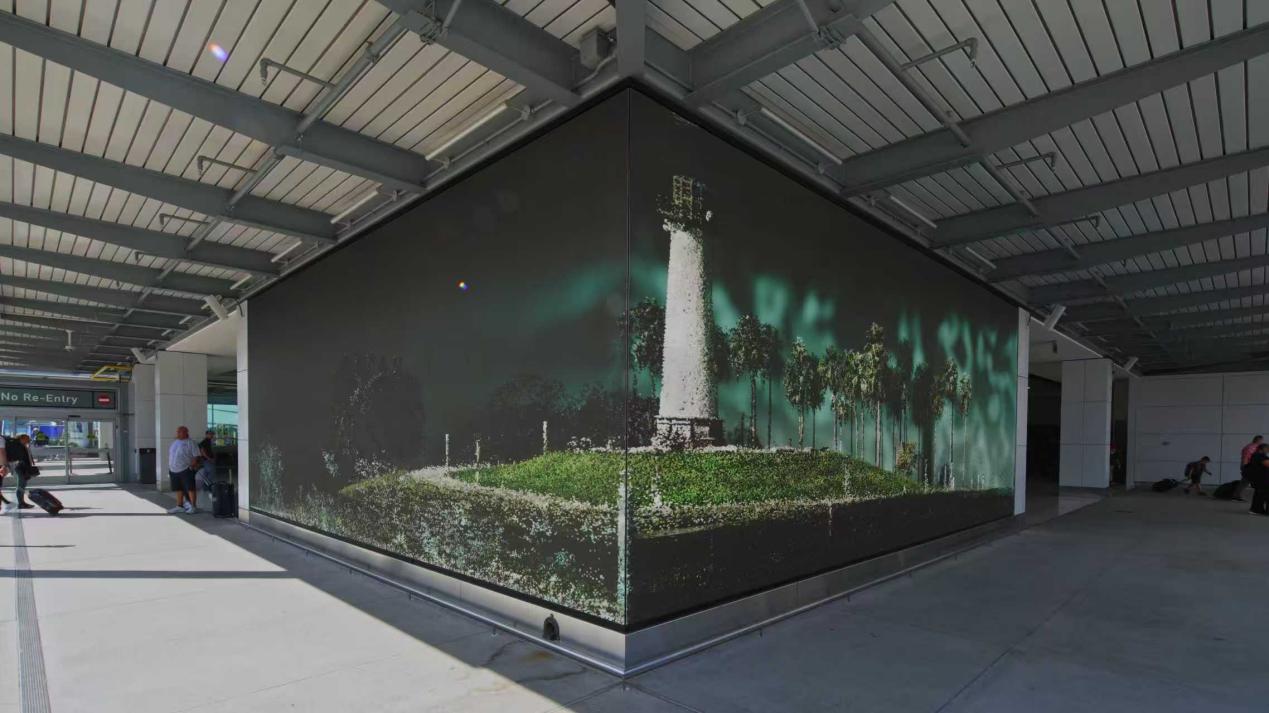
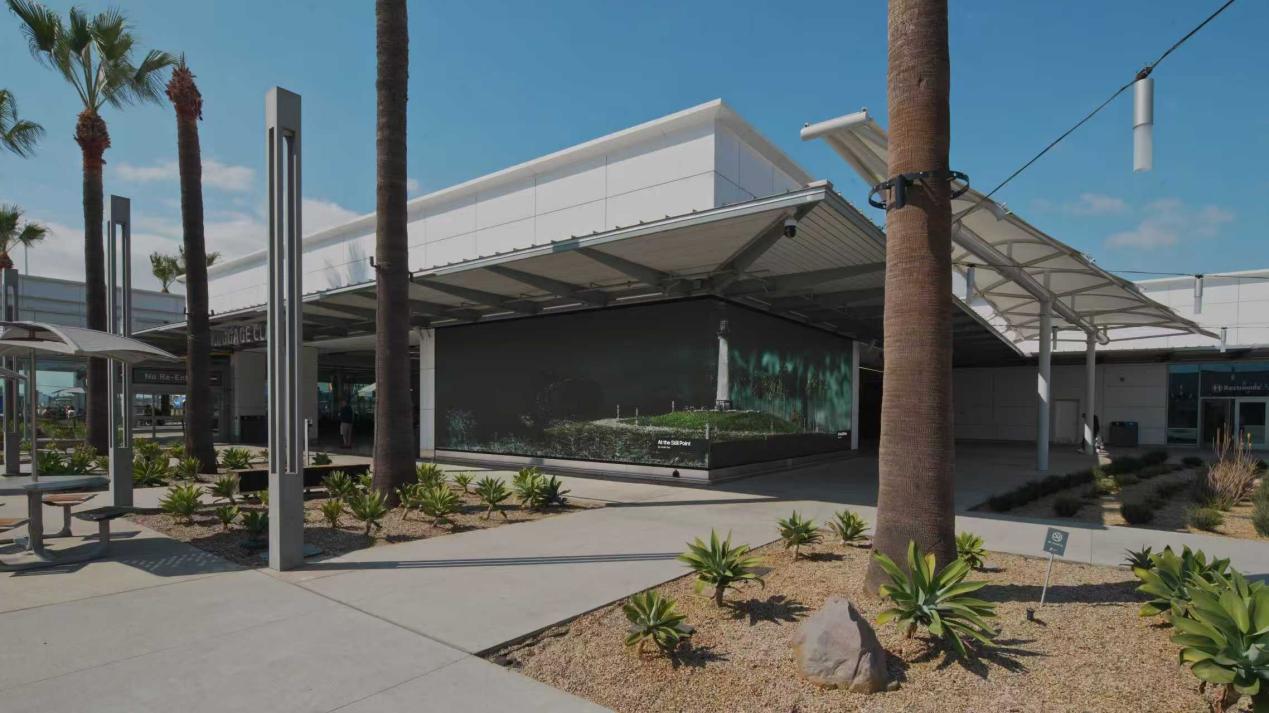
Installed at Long Beach Airport in 2025, At the Still Point, a public anamorphic LED installation, is the signature work of Yao’s public installation practice and a technically demanding piece that few artists attempt at this scale. Using point-cloud technology, he deconstructs and reconstructs a local Long Beach lighthouse and its surrounding coastal landscape. Countless discrete points of light continually gather and disperse, allowing the landmark to move back and forth between recognizable reality and fluid texture, constantly oscillating along the boundary between the physical and the abstract. The work makes thoughtful use of the continuous movement of people through the airport, breaking away from the fixed-viewpoint logic of conventional moving images. Through the visual depth created by the deep-screen display, the points of light converge at a predetermined optimal viewing position into a clearly defined, richly layered lighthouse seascape. As travelers move, turn, or pass by from the side, however, the points overlap and intersect, dissolving the solid architectural outline and transforming it into an abstract poem of light woven from shifting densities and flickering rhythms.
An airport is itself a transitional space of departure and arrival, while the lighthouse has long carried associations of guidance and return. Yao uses these meanings to extend the spatial narrative into the realm of inner experience. Among the travelers passing through, some are returning home while others are setting out toward unknown destinations. Each person carries a different impression of the city—perhaps a familiar memory long settled in the mind, or perhaps an indistinct expectation still taking shape. The gathering and dispersing points of light echo the alternating pull between memory and anticipation. Within a terminal filled with constant crowds and hurried footsteps, At the Still Point anchors a brief moment of stillness within an ever-changing digital image, inviting passersby to pause their gaze and perceive where they are in the present, suspended between what lies behind and what lies ahead. Impressions of Travellers, exhibited in the same setting, continues this narrative thread of the airport by focusing on travelers’ fleeting states of mind. Together with At the Still Point, it forms a complementary pair that brings a sense of human warmth into a space of transit. Airport art is often decorative by default; these two works are unusual in treating the terminal as a site for genuine and unique reflection.
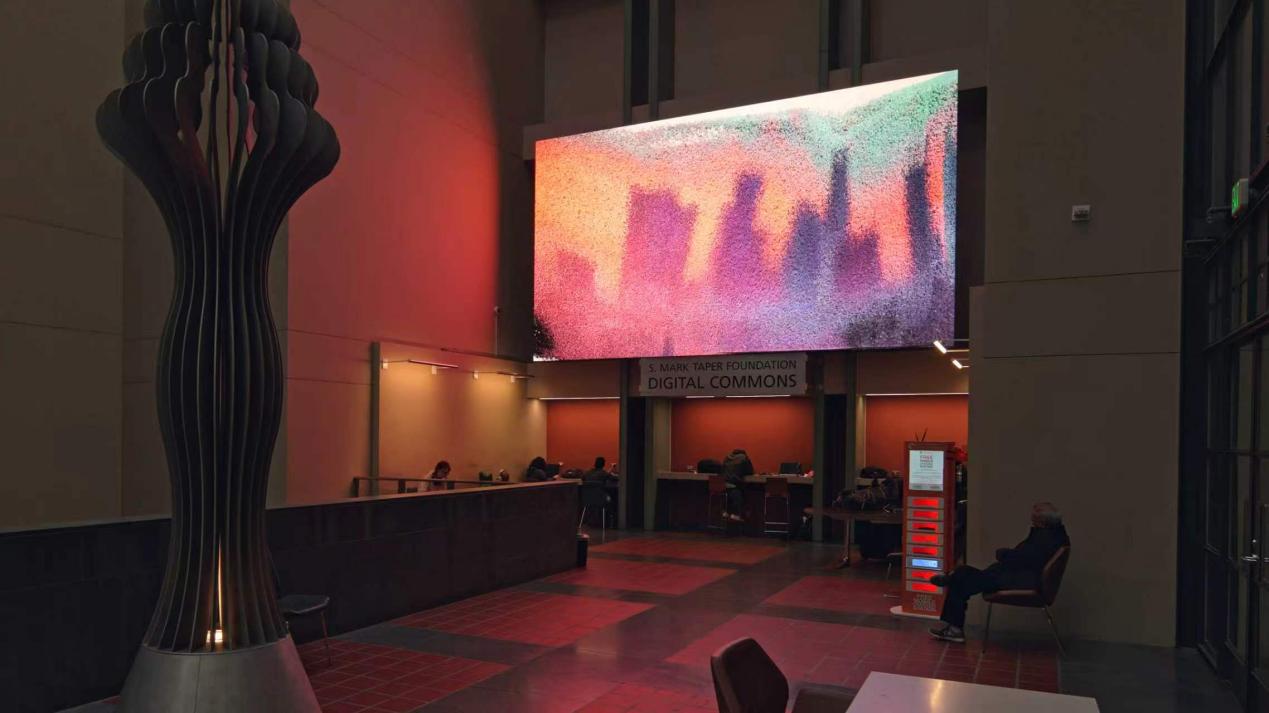
At the Los Angeles Public Library, Yao presented another body of work. LA Impressions uses Unreal Engine 5 to construct dynamic digital imagery, drawing on the creative essence of Monet and Impressionism. Rather than insisting on the precise reproduction of buildings and streets, the work turns toward the city’s constantly changing light, color, and sensory experience. Urban architecture, streets, and sky gradually emerge from interwoven, floating strokes of color, much like an Impressionist oil painting. While traditional painting fixes the light and atmosphere of a particular instant, Yao expands this capture of the moment into an experience of continuous movement. Digital space merges with painterly brushwork as color, form, and atmosphere evolve without interruption. It is among the more painterly uses of a real-time game engine to appear in a civic setting, and it reflects a command of Unreal Engine that goes well beyond the tool’s usual role in games and previsualization.
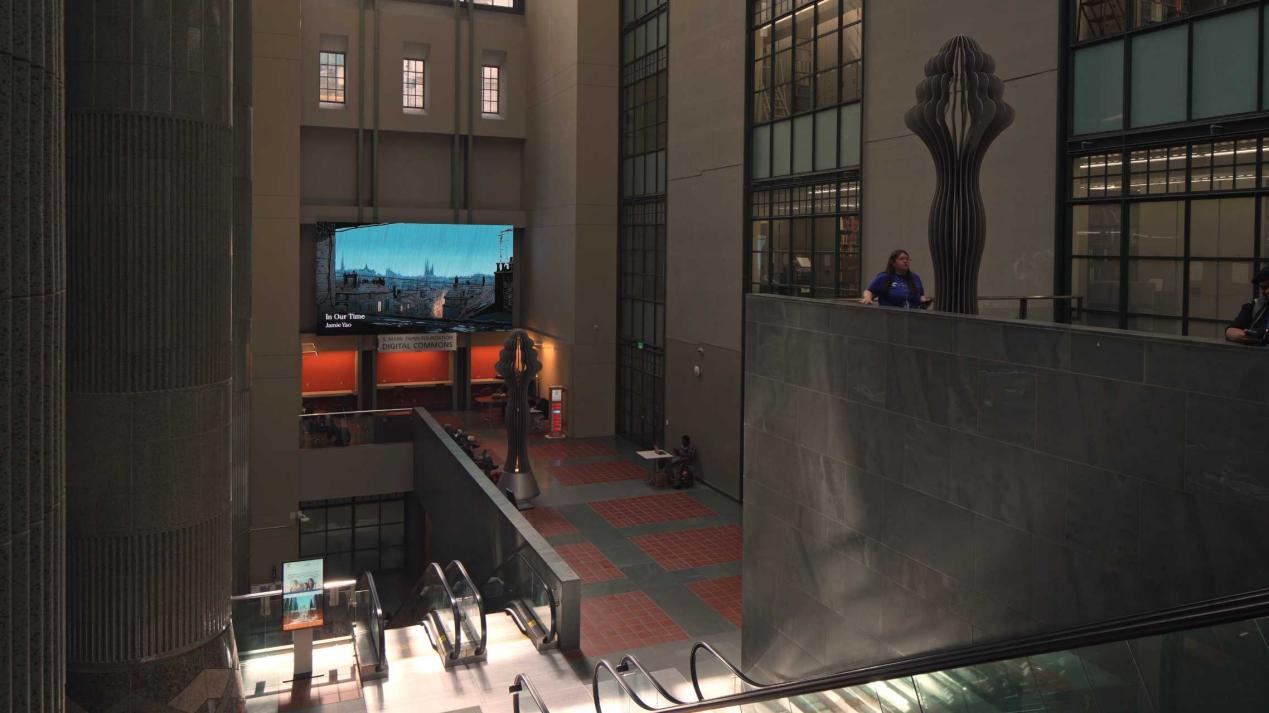
The library is a public space for reading, contemplation, and telling the stories of the city, and placing the work there creates a subtle dialogue with its surroundings. It encourages viewers to move beyond the habitual act of identifying landmarks and recognizing streets, and instead become aware of how light shapes the way we experience a city. The work is conceived not to remain confined to the screen inside the exhibition space, but to alter the viewer’s perspective on the city itself: after leaving the library, people might begin to notice the fleeting play of light along familiar streets and discover moments of poetry within everyday life. In Our Time, exhibited at the same library, further extends digital media’s observation of contemporary society, using moving images to record fragments of the present era and turning the public library into a site where digital art and civic thought encounter one another.
Beyond large-scale public installations, Yao has extended his practice into AI-driven narrative filmmaking. At Flick.art, the Y Combinator-backed AI filmmaking platform where he works as a Creative Partner, he has concentrated on the point where AI filmmaking most often breaks down: character consistency, visual continuity, and narrative coherence. Rather than applying ready-made prompts, he builds each film on a complete visual design framework, character concepts, three-view references, storyboards, and composition and color standards, and uses that framework to direct and evaluate what image, video, and audio models produce, before carrying the material through editing, sound placement, and final assembly. His AI short film Ulysses received the Best Supporting Character Award at the 2026 MIT Global AI Film Hack, and another short film, The Herder, was an Official Selection of the Cinequest Film Festival, a highly influential independent film festival in North America. It is a significant recognition that places his films within the professionally juried festival circuit rather than the crowded field of online AI experiments. Both works rest on the same premise as his installations: the technology is a medium, and the narrative and aesthetic decisions remain the artist’s. Yao’s AI filmmaking moves beyond the trap of technological spectacle, offering an independent and complete artistic expression
In today’s field of AI art, many works rely heavily on model-generated outputs and can easily fall into stylistic homogenization and assembly-line creativity, leaving originality open to question. Yao’s practice draws a clear distinction between “using AI tools” and “allowing AI to dominate the creative process.” Whether in the point-cloud lighthouse, the Impressionist city imagery created with Unreal Engine, or AI narrative films produced through collaboration among multiple models, the original ideas, narrative frameworks, aesthetic decisions, and spatial logic all originate with the artist. AI, real-time 3D pipelines, and point clouds are simply media in his hands, much like paint for a painter or a camera for a photographer. That discipline is what separates his work from much of what currently circulates under the label of AI art.
Working across the two fields of public digital installation and AI filmmaking, Yao consistently builds his practice around the idea of “perception in motion.” Travelers moving through an airport, shifting daylight across the city, and the journeys and inner states of characters in his films all become central motifs in his work. Rooted in the diverse city of Los Angeles, he uses digital media as a bridge, transforming abstract memories, expectations, and fleeting sensations into visible forms of light and image. His work demonstrates that originality in AI art does not lie in rejecting algorithms, but in ensuring that human creators retain control over narrative and aesthetic decisions—using technology to expand the boundaries of artistic expression and allowing digital light and imagery to carry a sense of humanistic poetry. It is a body of work of unusual range and conceptual discipline, and one that has already earned recognition in both the public art and film communities. In an era of rapidly evolving algorithms, JAIME JIAMING YAO continues to explore the space between the physical city and the virtual digital world, continually writing visual narratives that belong to our time.
Pest problems have a frustrating habit of developing where nobody is looking. A few tiny droppings in a storage area, faint damage along a wooden surface, or signs of insects near a window may seem minor at first, yet they can point to something larger. Regular pest control Oahu services can help property owners catch these problems earlier, before termites, rodents, ants, cockroaches, or other pests have time to cause more extensive damage. Routine inspections and preventive treatments create a practical layer of protection for the building, stored belongings, food areas, and the everyday comfort of the people using the space.
Small Signs Can Point to Bigger Problems
One of the challenges with pests is that visible activity does not always show the full extent of the problem. Rodents may travel inside walls, termites can feed on wood without immediately drawing attention, and insects may nest in areas that are rarely checked.
That is why waiting for obvious damage can be expensive.
Routine pest inspections give professionals an opportunity to look for evidence that an untrained eye may overlook. Droppings, gnaw marks, damaged wood, nesting material, moisture issues, and entry points can all provide useful clues.
Finding those signs early makes it easier to plan an appropriate response before the problem spreads.
Termites Can Damage More Than What You Can See
Termites are especially concerning because they can feed on structural wood while remaining largely hidden from everyday view.
A homeowner may notice a small area of damaged trim or unusual marks near a wall and assume the issue is limited to that spot. In reality, termite activity can extend into framing, flooring, or other wooden components.
Regular inspections help identify conditions that may encourage termite activity and look for evidence of an active infestation. When problems are detected sooner, treatment can begin before damage becomes more extensive.
That can make a meaningful difference when the alternative is repairing compromised wood throughout a larger part of the property.
Rodents Can Create Expensive Secondary Damage
Mice and rats are not only unpleasant visitors. Their chewing behavior can damage insulation, stored belongings, containers, and even electrical wiring.
A small opening may be all they need to enter a building. Once inside, they can move through wall cavities, ceilings, garages, storage areas, and other spaces that provide shelter.
Regular pest management can help identify possible entry points and signs of rodent activity before a population becomes established.
Professionals may also recommend practical changes, such as sealing gaps or reducing easy access to food and water. Prevention often costs far less than repairing damaged materials later.
Food Storage Areas Need Extra Attention
Kitchens, pantries, garages, and commercial storage spaces can all become attractive to pests when food, water, or shelter is easy to reach.
Even a small amount of spilled food or an unsealed container can encourage activity. Once pests find a reliable food source, they may return repeatedly.
Routine pest control helps monitor these areas and identify conditions that may be contributing to the problem. In homes, this can protect dry goods and pantry supplies. In businesses, it can also support cleaner, more organized food storage practices.
Regular monitoring is especially useful because pest activity may increase before people notice visible signs.
Furniture and Stored Belongings Can Be Vulnerable Too
Property damage is not limited to walls and structural components. Depending on the pest, stored clothing, paper, furniture, cardboard boxes, fabrics, and personal belongings may also be affected.
Storage rooms and garages are particularly easy to overlook because they are not always visited every day. Pests can settle into these spaces for weeks before anyone notices.
A regular inspection schedule encourages those areas to be checked more often.
That simple habit can help protect items that may be expensive, sentimental, or difficult to replace. It can also prevent a small pest issue in storage from spreading into other parts of the property.
Moisture Problems Can Invite Unwanted Activity
Water is one of the most common things pests seek. Leaking pipes, standing water, damp wood, clogged drains, and poorly ventilated areas can create conditions that make a property more attractive.
A good pest professional may point out these conditions during an inspection, even when they are not the direct cause of the current problem.
Fixing moisture issues can support pest prevention while also protecting the property itself from deterioration.
This is one reason effective pest management is often broader than applying a treatment. It involves understanding why pests are showing up and reducing the conditions that allow them to stay.
Regular Visits Can Make Changes Easier to Notice
When a property is inspected only after a major infestation appears, technicians have less information about how the problem developed.
Regular visits create a useful history.
A professional who has previously inspected the property may recognize new activity more quickly or notice that a vulnerable area has changed. That continuity can make treatment more targeted and prevention advice more specific.
It also gives property owners a chance to ask questions about anything unusual they have noticed between visits.
Over time, this kind of monitoring can turn pest control from an emergency response into part of routine property care.
Prevention Can Be Less Disruptive Than Emergency Treatment
A serious infestation often demands more attention than a small problem caught early. It may require multiple visits, more extensive treatment, repairs, cleaning, or temporary changes to normal routines.
Preventive service is usually much easier to plan around.
Regular inspections can identify vulnerabilities before they develop into emergencies. Even when pests are found, early treatment may be simpler because the activity has not had as much time to spread.
For property owners, this can mean fewer surprises and less disruption. Nobody enjoys discovering a major pest problem in the middle of a busy week.
Protecting Property Means Thinking Ahead
The strongest reason for regular pest control is not simply to avoid seeing insects or rodents. It is to protect the property from damage that may be expensive, inconvenient, and sometimes difficult to detect until it has progressed.
A preventive approach combines inspection, treatment when needed, attention to entry points, and practical advice about conditions that attract pests.
That creates a more complete strategy than reacting to one sighting at a time.
Homes and businesses both benefit from knowing that vulnerable areas are being checked before problems become obvious. Wood, wiring, storage spaces, food supplies, furnishings, and other valuable parts of the property all deserve that attention.
Pest control is ultimately another form of maintenance. Just as roofs, plumbing, and electrical systems are checked before something fails, pest activity is easier to manage when it is monitored early. A little consistency can prevent a small issue from becoming a costly repair and help keep the property protected, comfortable, and easier to care for over the long term.
There’s so much music coming out all the time that it’s hard to keep track. On those days when the influx of new tracks is particularly overwhelming, we sift through the noise to bring you a curated list of the most interesting new releases (the best of which will be added to our Best New Songs playlist). Below, check out our track roundup for Wednesday, October 7, 2026.
Twisted Teens – ‘Stalks’
Twisted Teens’ restless momentum continues with ‘Stalks’, the second single from their third LP of 2026, The Holy Cross Tigers. Like most of the band’s songs, it is equal parts scrappy and infectious, and it comes paired with a video by (checks notes) Mama Hot Dog.
Star Moles – ‘Born Again’
It’s about time more people get into Star Moles’ music. Following her 2025 breakout Highway to Hell, Emily Moales has signed to Dead Oceans and shared a new single under the moniker, the groovy, sparkling ‘Born Again’. “The thing about writing something that’s true is that it basically can’t be narrative,” she reflected. “If you’re angry or sad or in love, the feeling itself is an exaggeration. Trying to tell the truth in a song by saying ‘here’s what happened’ isn’t satisfying to me. ‘Born Again’ is a painting of real frustration, and the best way I can express that feeling is with a strong voice and words that mythologize. I wouldn’t say I’m religious, but I think sometimes my emotions are.”
Paul McCartney – ‘City Fox’, ‘One Night Stand’, and ‘Chelsea Boots’
Paul McCartney has expanded his latest album The Boys of Dungeon Lane with four new tracks. In addition to a “flip mix” of the Ringo Starr duet ‘Home to Us’, there’s a nostalgic ballad called ‘City Fox’, the perky ‘One Night Stand’, and the playful ‘Chelsea Boots’.
untitled (halo) – ‘sex’
untitled (halo) have followed up ‘aimee lou wood freestyle’ and ‘easy rider’ with another riveting tune from their self-titled album, one that might also be their most danceable. “This is a song that makes you feel like you just left the 4am rave and are finally walking to see the natural light,” Ariana Mamnoon said of ‘sex’. “Perhaps the most dance track by the band, one that feels relatable and while a bit disjointed and gleeful, there are moments of restraint. The song is about a desire for the party.”
They Are Gutting a Body of Water – ‘illusion hue’ [feat. Toner] and ‘am i wrong [feat. A Country Western, Dead Sullivan]
They Are Gutting a Body of Water (TAGABOW) have dropped another pair of cuts from their forthcoming mixtape, KOOL FAITH / LOOSIES II, ‘illusion hue’ (featuring Toner) and ‘am i wrong’, a grittily radiant collaboration with A Country Western and Dead Sullivan.
Font – ‘Punish Task’
Font – the quartet of Thom Waddill, Anthony Laurence, Jack Owens, and Roman Parnell -have previewed their new album, American Bully XL, with the glitchy, hard-hitting ‘Punish Task’. “The song is about the relationship between dark and light, rage and euphoria,” Waddill explained. “It’s about betrayal and grief and feeling condemned to forever pick at a bleeding scab. The angry dark underside of nostalgia’s fake coin.”
Sampa the Great – ‘Location’
Sampa the Great has dropped ‘Location’, the latest offering from her upcoming album, Nu Zamrock. “While African music influences the world, the infrastructure rarely supports its creators,” she said of the boisterous track. “This song confronts the global imbalance – and the cost of creating outside the West.”
Jess Kerber – ‘Louisiana Song’
Jess Kerber has unveiled ‘Louisiana Song’, a gorgeously affecting song from her upcoming album, The World Is Dark. “This song is about my home state and growing up in a place that feels pretty far away from everything else,” Kerber explained. “Louisiana carries so much unique beauty, but also has a tinge of tragedy that’s forever built in. The state loses a lot of coast line each day, so in 50 years, 100 years, it will look different than it does today; it changes every hour. And the feeling of knowing that you won’t be able to return to the thing that you came from is certainly a strange one.”
Sylvie – ‘Not Looking Back Anymore’
Ben Schwab is ‘Not Looking Back Anymore’ on his new single, but the next Sylvia record, New Season, is sounding tenderly nostalgic. The band’s debut with Ghostly International arrives November 6.
studio20 – ‘Penny Drop’
Kent quartet studio20 have signed to Communion and shared their first single, ‘Penny Drop’, a kaleidoscopic blast of catharsis. “The song was conceived in winter 2025,” the band’s Isaac (not Wood, though comparisons are inevitable) recalled. “I would try and write a minute’s worth of new music every day – I was not in the best headspace. It was very cold. That demo hung around for ages. There was something uneasy about it.”
“The chorus lyrics came about from a gut feeling, more focused on the sounds than the words,” Isaac continued. “At that point I felt like the vocal performance embodied the sentiment more than the lyrics themselves. The band unravelled my stream of consciousness and we discovered the meaning – the Penny Drop feeling when you realise something isn’t what it used to be. Even the ending we left painfully unresolved to tease the listener.”
Last week, Paul McCartney announced an expanded edition of his first new album in six years, The Boys of Dungeon Lane. Out today digitally, The Boys of Dungeon Lane (Special Edition) features three previously unreleased songs – ‘City Fox’, ‘One Night Stand’, and ‘Chelsea Boots’ – as well as a new version of his duet with Ringo Starr, ‘Home to Us’. A physical release will follow on December 9. Listen to the new tracks below.