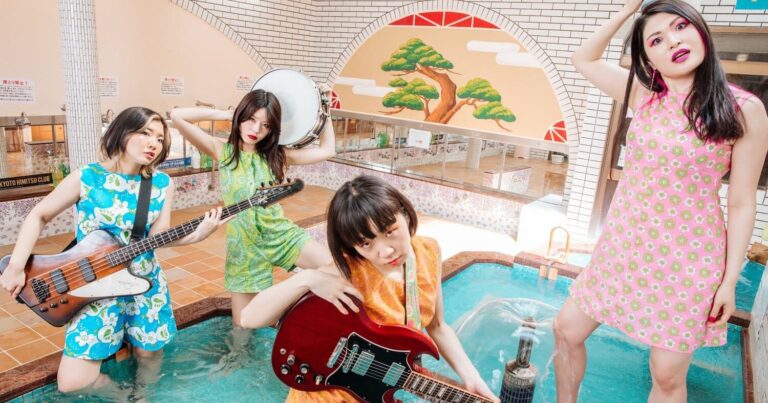
Otoboke Beaver have today released a video for ‘I Don’t Want to Die Alone’, the final single from their forthcoming album Super Champon. Watch and listen below.
“This is probably my favourite track on the new album,” lead vocalist and guitarist Accorinrin said of ‘I don’t Want to Die Alone’ in a press release. “We mixed in a lot of different styles. There are ‘Pop’ parts, or like ‘idol’ style parts, and ‘hard rock’ parts. It’s fun to play.”
Super Champon is due for release this Friday, May 6 via Damnably. It features the previously released tracks ‘PARDON?’ and ‘YAKITORI’.
Mykki Blanco has enlisted singer-songwriter Diana Gordon and rising country artist Sam Buck for ‘Your Love Was A Gift’, the second single off their forthcoming album. The track, which follows ‘Family Ties’ featuring R.E.M. frontman Micheal Stipe, was produced by Falty DL (Drew Lustman). Give it a listen below.
“‘Your Love Was a Gift’ is for me,” Blanco said in a statement. “If not the most honest, it’s the most beautiful song I’ve ever written. The idea for the song comes from my own wins and losses in the game of love and it’s a story of coming of age as much as coming to terms in adulthood with feeling unloved, yearning to be loved and yearning to be understood.”
Blanco added: “Diana Gordon is a standout songwriter and singer and I’m crafting this song with her as the lead vocal and myself taking the more experimental backseat was a deliberate choice. Diana doesn’t just glimmer on this song, she shines, she owns it she makes the heartfelt lyrics I wrote come alive.”
Joan Shelley has shared a video for her new single ‘Amberlit Morning’, a duet with Bill Callahan. It’s taken from Shelley’s upcoming album The Spur, which is out June 24 (via No Quarter) and includes the previously released title track. Check out a video for ‘Amberlit Morning’, co-directed by Cyrus Moussavi and Brittany Nugent, below.
Shelley shared the following statement on the song:
When I was a child, my father the painter would tell me the Picasso quote: “Every child is an artist. The problem is how to remain an artist once we grow up.” He tried to teach me to hold on to that wonder and clear vision, but holding on proved impossible.
As I wrote this song, I watched it take on this theme of beauty and impermanence. I imagined making it a duet that would feel like a conversation between two constellations. I wanted to be sung a mythical bedtime story, one that Bill Callahan might write. So I asked him to write and sing it with me.
Could we capture that stellar perspective? – seeing the world from before we learned the sense of triumph or of tragedy; before we learned what we should be proud of or what we should fear.
Callahan added:
Joan’s guitar riff instantly sucked me into the world of the song. A world that was ongoing and ending and going on again. She wanted a little help fleshing it out, or just having someone else’s perspective on what she was looking at. I threw in some lines that she called mythical. I tend to see in myths, in dreams. I may have added a chord change, possibly at her request— the beautiful thing about the song for me is that it’s kind of covered its tracks in the snow so now I can’t remember entirely what I added or changed. Maybe that guitar riff is someone covering their tracks in the snow. I can just appreciate the mystery of the thing as a whole. Joan claims the high voice at the end is mine, the high voice covering the tracks of the low. I don’t know if I believe her.
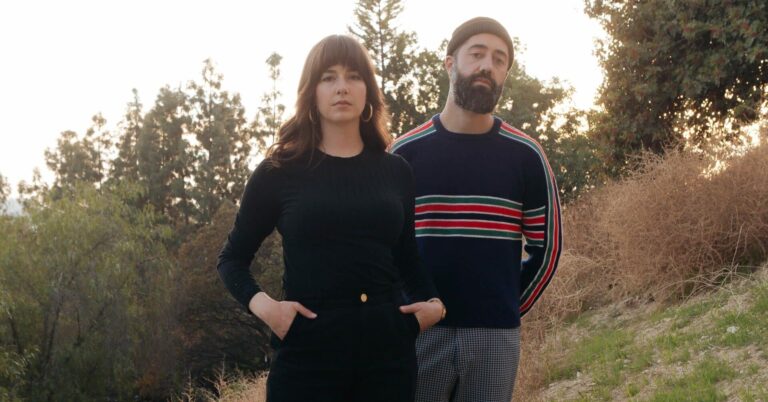
Brijean – the collaborative project of percussionist Brijean Murphy and bassist Doug Stuar – have announced their new EP Angelo, which arrives on August 5 via Ghostly International. The 9-track effort will follow Brijean’s 2021 debut full-length, Feelings. Today, the duo has unveiled its lead single ‘Shy Guy’, which you can check out below.
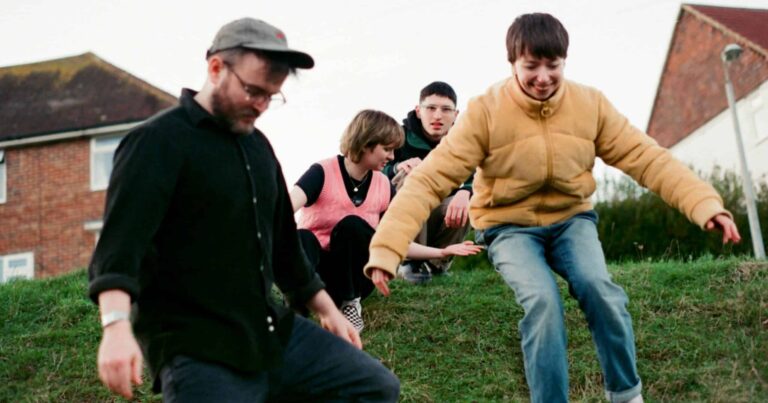
ME REX have dropped ‘Toilet of Venus’, the latest single from their forthcoming Plesiosaur EP. It follows the previously released track ‘Jupiter Pluvius’. Take a listen below.
“’Toilet of Venus’ looks at present struggles and what they will reveal,” the band’s Myles McCabe explained in a statement. “The Toilet of Venus is a scene often depicted in classical paintings, by people who could not have foreseen the way that language would change the meaning of the word ’toilet’. This kind of shift in perspective is what made me want to use it for the title of this song.”
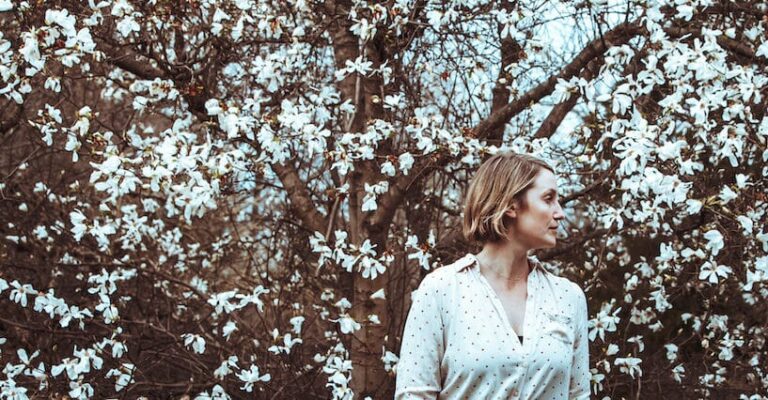
Spacemoth, the psych-pop project of Bay Area-based artist Maryam Qudus, has announced her debut album. No Past No Future will arrive July 22 on Sadie Dupuis’ label Wax Nine via Carpark Records. It includes the previously released single ‘This Shit’ as well as a new track called ‘Pipe and Pistol’, which comes with an Ambar Navarro-directed video. Check it out and find the LP’s cover art and tracklist below.
“‘Pipe and Pistol’ revolves around a wobbly synth and distorted drum loop, played with and processed by a Korg MS-20,” Qudus said in a statement. “The song was inspired by my parents, who immigrated from Afghanistan in the late 70’s and explores the challenges faced when building a new life in America. Interweaving colorful psychedelic visuals and blue collar employment, Ambar Navarro’s video for ‘Pipe and Pistol’ speaks to the surreal and confusing experience of navigating a new life in America in the late 1970’s.”
No Past No Future Cover Artwork:
No Past No Future Tracklist:
1. Mind Modulation
2. This Shit
3. Pipe and Pistol
4. UFObird
5. Waves Come Crashing
6. L.O.T.F
7. Asking For You
8. Flutter Memory
9. Round in Loops
10. If I Close My Eyes and Pretend
11. Noise of Everyday Life
12. Berries and Watch You Cry
13. No Past No Future
“This is another break up song but over time it has taken on new meaning from its original intention,” Reid said of ‘How Do I Show My Love?’ in a statement. “Over the past few years life has been pretty harsh for a lot of people and when I sing this song it makes me feel how hard it has been to stay connected and express my feelings for certain people I care about. I find it hard at the best of times to communicate properly in a way that I would like but that can feel impossible when times are hard and people are forced to be apart.”
Black Star – the duo of Yasiin Bey (formerly known as Mos Def) and Talib Kweli – have released No Fear of Time, their first new album in nearly 25 years. The follow-up to 1998’s Mos Def & Talib Kweli Are Black Star is out now exclusively via the podcast app Luminary, but Black Star have made a lyric video for opener ‘o.G.’ available on YouTube. Check it out below, and if you’re a Luminary subscriber, you can listen to the Madlib-produced LP here.
“About 3-4 years ago I was visiting yasiin in Europe and we started to talk about songs to do on an album, so I flew an engineer out just to see what that would be,” Kweli said in a statement. “Once I realized this conversation is starting to organically become a creative conversation, I started making sure to have the engineer around at all times. There was one day we were just in a hotel listening to Madlib beats, and he’s like “Play that Madlib tape again.” I’m playing the beats and he starts doing rhymes to the beats. And that’s how we did the first song.”
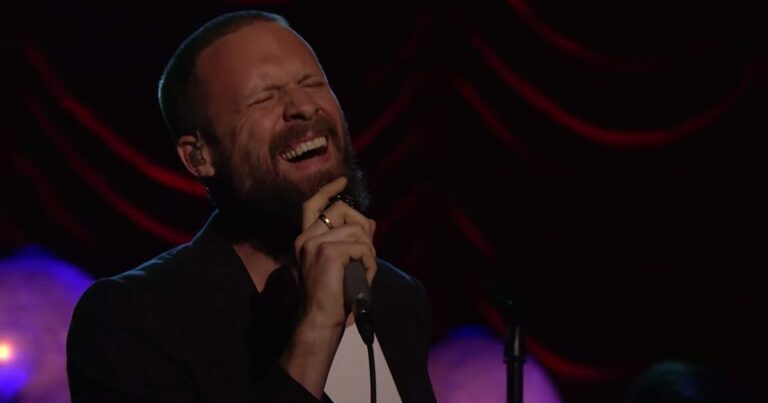
Father John Misty stopped by The Tonight Show Starring Jimmy Fallon last night (May 3) to deliver a performance of his single ‘Kiss Me (I Loved You)’. Watch it below.
‘Kiss Me (I Loved You)’ appears on the singer-songwriter’s latest album, Chloë and the Next 20th Century, which arrived last month via Sub Pop. Josh Tillman recently shared a music video for the track, which is directed and edited by David Raboy and stars Annie Hamilton and Alexander Zuccaro as they spend the night at a bar.
On her debut album, Yesterday Is Gone, Canadian-Serbian artist Dana Gavanski journeyed through her teenage years growing up in Vancouver as well as her move to Montreal, where she picked up the guitar during her final year of university. It was while spending a summer as her producer father’s assistant on a horror film in the Laurentian Mountains of southern Quebec that she made enough money to focus on writing material for her first EP, Spring Demos, which emerged in September 2017. In 2020, she accompanied her beguiling debut full-length with a covers EP titled Wind Songs, but their release was clouded by the peak of the pandemic. Now based in South London, the musician also started losing her voice around that time, and the process of healing her vocal cords deeply informed the writing of her sophomore album, When It Comes. At times, it meant reaching a place of acceptance and working within those limitations, but there was also an urge to defy and push beyond the loneliness of that struggle. As a result, the record is as introspective and otherworldly as her debut, but it also allows itself to be whimsical and dynamic, foregrounding her voice in varied and surprising ways.
We caught up with Dana Gavanski for this edition of our Artist Spotlight interview series to talk about recovering her vocal cords, the process of making her second album, practicing presence, and more.
Because of the journey you went on to make When It Comes, both vocally and musically, you’ve said that this album feels like your first. At this point, how do you look back on your debut LP? Does it feel removed from this album?
It was a different time – I’d like to say I was a different person when I wrote that album. But there’s definitely a progression, they’re all steps on the ladder in a way. There’s some kind of earworm that I wanted to explore a bit more that I may have discovered in that first album or in the covers EP. But it’s a bit a more individual, I think, and more idiosyncratic and strange. It’s definitely poppy, but I’m trying to figure out what’s my sound. Whereas in the first album, I was trying to make a perfect album: a straightforward, poppy album.
With Yesterday Is Gone, you’ve said that it was your intention going into it to make straightforward songs. How much of a conscious decision was it to tap into the idiosyncratic side of your songwriting this time? Was it a less goal-oriented process?
Because of the difficulty of singing during that time, I didn’t really have a goal other than to sing. To be able to write a song – and whatever it is that came out, it became quite precious. There was a preciousness to it because of the limited use of my voice. And this album, it was still about writing pop songs, but trying to push the limits of that genre – push it, and also nicely fit into it. So some of the songs were more jagged, but still retain a pop [sensibility] to them. It wasn’t a conscious choice as much, it was much more trying to be intuitive, because a lot of what I was trying to do to get my voice back was to relax and not get angry or sad or be too judgmental and let it get me down. So in order to write songs, I was just trying to go with how I was feeling rather than, “This is how I want it to be.”
How much was the process of working through those voice issues intertwined with the making of the album?
I only got my voice almost totally back in November. And then I kind of started having some issues again a month or two ago when I had a series of difficult things happen. So I’m just kind of aware of it, but it’s not as bad as it was during that period. It was a constant struggle. Making the album, there were some really beautiful moments, but it was definitely not easy. [laughs] I didn’t know if I could even sing when I got to that point.
To the point of recording it?
Yeah, it was a day-to-day thing. Maybe one day I’d be like, “I think I’ll sing today.” And then I’d have to be like, “No, actually, let’s try again tomorrow.”
How did being aware of your voice affect the way you write songs?
In a way, I still was able to not think about it. I think I just accepted the pain, that’s what it was. I often just ignored the pain, and maybe detrimentally, because maybe when I wasn’t supposed to sing, I did still sing. I really wanted to get back to writing again, and I couldn’t really at the beginning of the pandemic, at least on my own. I found it really hard to start writing an album. And then around the time that I lost my voice, I was ready, I was so ready to start writing again. It was hard to come to terms with my body’s physical limitations and my own desires.
Did it make you reflect on what made you fall in love with singing and music in the first place?
I mean, I was trying to find my love for music again. All our minds were so occupied with what was going in the world, and my first album came out during this time, so it was really strange. All the anticipation kind of got sucked into a black hole, in a way. I was in a new city and kind of in shock. It was never like, “I’ve arrived at this place where I love it again.” I constantly felt a bit scared of it, but I don’t find that as negatively a bad feeling. What excites me about songwriting is not knowing. I don’t like relying on a way of doing something, so maybe that’s why there’s something terrifying about writing music for me. Because I don’t know where I’m going at all every time I start, I want to surprise myself. It’s kind of a cinematic terror. [laughs] I don’t know, I’ve never actually described it as such. But it’s me trying to go to an unknown place, and that’s really hard to do.
When I wrote ‘The Reaper’ or ‘Indigo Highway’, those songs kind of just came out right away, mostly in their full form. I think it comes from partially letting your mind drift without controlling it too much, and that’s what we do so much day-to-day, is just constantly control our minds. I didn’t even want to write about that topic in ‘The Reaper’. [laughs] I’m like, “What am I writing about? The Reaper? Sounds like a cartoon character or something.” But I was curious what my mind was trying to say.
Did the places you were in – I know you worked on the album in Montreal, Belgrade, and London – affect the atmosphere of the songs or your headspace while you were making them?
Definitely. When I was in Montreal to get my visa to stay in London, it was right before the pandemic, and I didn’t know that the pandemic was going to happen. It was snowing, and I was alone. I hadn’t really been alone for a while. And I was just really enjoying the romance of spending night after night with myself, in a city that I once used to live in but hadn’t lived in for quite a long time. That’s where I wrote most of ‘I Kiss the Night’. And ‘The Day Unfolds’ was written in Belgrade, when I was there taking care of a sick family member. Sometimes if you’re alone in a different city, and you have time to be alone and you’re able to sit and focus, it can be a really good time to write. Sometimes you need new stimulants in your mind – not too many stimulants, but a way for your mind to wake up to itself.
Can you describe what it’s like when you have a moment of inspiration?
There’s no, like, eureka moment. It’s more like, “Hm, this sounds good” or “I like this.” You’re not even aware of it, you’re just like, “I wanna get this down.” It’s just trying to maintain a focus on what’s going on inside there and not get distracted. Kind of like a flow state, as they call it. It’s not always clear. Sometimes it’s hard not to get distracted in between moments of inspiration. I think it has a lot to do with practicing presence and playing music daily. It takes really being there with intention.
One of my favorite songs on the album is ‘Letting Go’, which is spare instrumentally but allows space for the voice and the music around it to grow. That slow build almost mirrors that line about “thoughts beginning their slow descent.” It feels like a delicate, intentional process that requires a lot of attention, with that song specifically and maybe the album as a whole.
It’s in between it all, you know. Songwriting is a really strange thing to try and describe, because every song is individual in the way that it comes, too. That was one of the first songs that I wrote that I kept. I feel like that song really encapsulates my personality in a way. [laughs] It’s a real struggle between the different minds that get involved in making decisions. It takes struggle to be present, and I feel like that song is about that struggle to be intentional and saying what’s on your mind. But the ego is very childish in that song.
Now that you’ve completed it and have had some distance from the album, is it clearer to you what the connection between the songs is?
There’s definitely a thematic connection. Reconnecting with what makes me me, this whole theme of letting things come. I guess it’s why I decided to call the album When It Comes, which is actually the title of a track that didn’t make it to the album. Not being too judgmental about the process of what presents itself, like “I don’t want my voice to sound like this” or “I don’t want to be perceived like this.” Trying to remain present and attentive. And I guess with the last song, ‘Knowing to Trust’, it’s about that spirituality that you have with yourself that’s often lost when we start depending on other sources of information and other people’s opinions, our partners, our friends. Trying to bring everything back to remind ourselves to trust ourselves.
Is there something specific that you were conscious of avoiding in terms of how you wanted your voice as an artist to be perceived?
I think was just trying not to play so much to the gallery, I guess that’s what David Bowie said once. Try to avoid thinking what other people will think. Of course, I want this album to be embraced, but I’m trying to let myself go with how the songs wanted to be, trying to avoid being too controlling.
I feel like that’s reflected in how a lot of the songs here generally take their time, which also comes through in the lyrics of tracks like ‘The Day Unfolds’’ and ‘Under the Sky’. Do you feel that the pace of the album came as a result of the circumstances in which you made it, or was it almost a reaction to them?
I think it’s quite subconscious. Just circumstances, the way that I was probably feeling around that time.
Do you feel like you’re generally the kind of person who tends to take things slow?
I do take things slow often. It takes me time to get to something. But on the other hand, I’m quite impatient and I’m quite reactive. So I have a mix of that. I’m trying to bring in a slowness to things. Or, rather, I’m not trying to bring in the slowness, but I’m trying to accept my pace. Because I think reactiveness, this kind of quick, jumping on things, is often trying to cover up the discomfort of whatever pace it takes to get somewhere.
It goes back to what you were saying about wanting the music to be a reflection of your character, but there’s always a conflict between those different sides of yourself.
Well, what’s interesting about it all, about human beings, is this constant tension between the habits that we have, our neuroses, our lives, and what we want, what we think is good, what is good for us. How those multiple sides fight and struggle against each other. It’s constant motion. And sometimes it feels quite stagnant, I think, when we find ourselves reacting to things the same way. Which, I think generally it is like that – you kind of get into a comfort zone and you’re like, I don’t want to let this in, this is how I want to do things. And sometimes you open up slightly a bit.
There’s also a mythological or metaphorical quality to a lot of the lyrics on the album. What draws you to that kind of language?
It’s kind of fun to play in characters and imagine your voice coming out of another entity or person. I think that a lot of the stories that we make and experience in our lives, we mythologize daily. We all grow up with myths and stories about what’s right and wrong. I guess only a few songs have this kind of otherworldliness, but there’s a playfulness to it, just trying to explore my different voices.
Considering the role the voice plays on the record, ‘Lisa’ strikes me as an especially powerful song. It’s sung from the perspective of the sea, and it has a poetic way of evoking really specific feelings – I love the phrase “sun-soaked loneliness.” But with the vocal solo at the end of the song, it feels like a natural conclusion, an acceptance of the things that can’t be communicated through words, and maybe not even any other instrument.
That song is kind of my first foray into really letting my voice out. And it’s really fun to play live, because I feel I can’t hide. I used to hide behind my voice, hide behind the guitar – and still do, kind of – but it feels really powerful to sing. That ending, it was really hard when we were rehearsing and playing it, we all just wanted it to continue. One of those never-ending endings.
What did it take for you to reach that place where you were comfortable in your presence?
I think it’s the songs that I wrote, defying my voice issues. There’s a few songs, like ‘Bend Away and Fall’, that are quite quiet, lullabies in a way. But then there’s other songs that are defiantly present. Like with ‘The Reaper’, for some reason the chorus bit came out and I was like, “How am I ever gonna sing this?” I can sing it, but it hurts. [laughs] I just really wanted more from my voice. Because I was not able to use it, I was pushing it more. I was listening to a lot of David Bowie and just thinking about my own stage fright and presence, and I think it was in the back of my mind to be more forthcoming in a certain way.
Going forwards, are there any other ways that you’d like to push yourself not just vocally, but musically as well?
I’d like to develop more of an understanding of four-part harmonies and different chord structures – ways to build things up in a different way than I’m used to. Play and write more with other people – maybe not particularly for my stuff, but I’m doing that at the moment with two others, we’re just writing music and write everything in the room when we’re there. And it often comes out kind of silly, but I think good in a way.
Writing with other people, it’s nice because it’s really a non-judgmental process, as much as it can be. It’s good to try things that you think could be really dumb, and when you’re on your own sometimes, you don’t do that because you just have yourself to turn down. Whereas when there’s two other people with you and you’re ready to express something, they’re like, “Actually, let’s try this.”
This interview has been edited and condensed for clarity and length.