

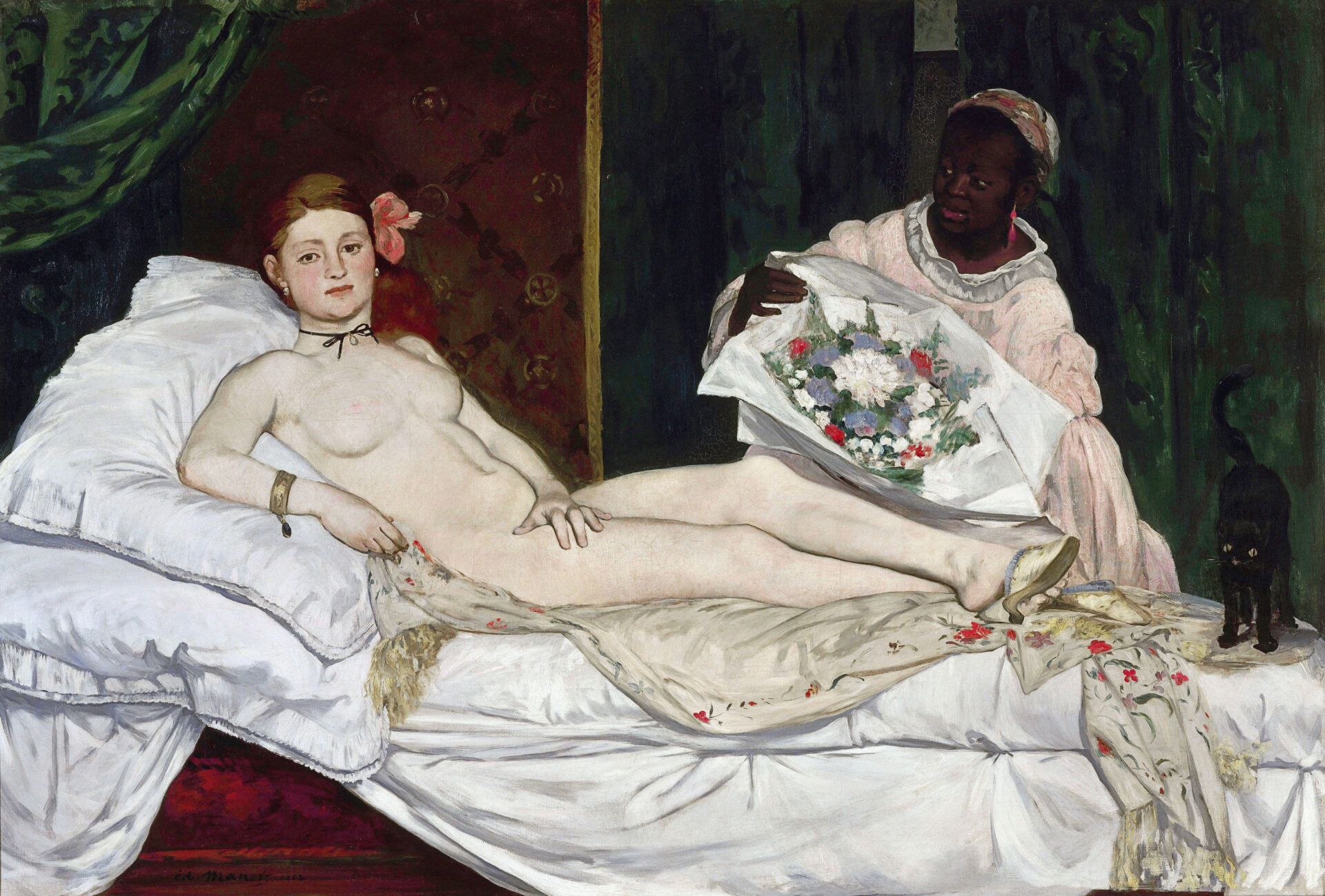
Walking through a museum today, you’d be forgiven for forgetting that many of the works hanging silently on those walls once caused riots of various sorts, with crowds jeering and critics fuming. These seven pieces felt like they arrived as provocations, and the public let them know it.
1. Édouard Manet, Olympia (1863)
When Olympia hit the 1865 Paris Salon, critics were truly horrified. The subject itself, a reclining nude, was nothing new. However, viewers were scandalised by everything around her: a contemporary Parisian courtesan rendered with an unglamorous frankness, her gaze meeting the viewer’s without one trace of shame. Add Manet’s loose, visible brushwork, which served as a rejection of academic polish, and you get a painting so mocked in person that guards had to be posted beside it.
2. Marcel Duchamp, Fountain (1917)
Few objects have detonated quite as much debate as a porcelain urinal turned on its side and signed “R. Mutt.” Duchamp submitted it to a show that claimed to accept any work for a fee; the organizers rejected it anyway. The question it forced onto the art world was whether value lives in craftsmanship or in the idea behind the gesture, and it still hasn’t quite been answered, which is why Fountain remains a cornerstone of conceptual art more than a century on.
3. Gustave Courbet, The Origin of the World (1866)
Courbet’s unflinching view of the female body was too explicit for public display for over a hundred years. It passed quietly between private collectors and was kept out of sight, until it finally entered a public museum in 1995. Even now, it’s one of the rare paintings that still forces a conversation about censorship and museums.
4. Andres Serrano, Piss Christ (1987)
A crucifix submerged in the artist’s own urine, photographed in a warm amber glow. While many viewers regarded the work as blasphemous, Serrano — a practising Christian raised in the Catholic faith himself — said it reflected on Christ’s physical suffering during the Crucifixion and sought to restore a sense of its humanity. The photograph nevertheless ignited fierce debate over religious imagery and public funding for the arts.
5. Chris Ofili, The Holy Virgin Mary (1996)
Glitter, cutouts from pornographic magazines and elephant dung, applied to a reimagining of the Virgin Mary: when this piece landed in the 1999 Sensation show at the Brooklyn Museum, it triggered a huge international uproar. New York Mayor Rudy Giuliani even tried to strip the museum of its public funding over it. The museum eventually fought back in court and won.
6. Carl Andre, Equivalent VIII (1966)
On the surface, minimalist sculpture Equivalent VIII is aggressively simple, with 120 firebricks stacked two deep in a plain rectangle on the gallery floor. Still, when the press got wind, years after the Tate had acquired it, of what public money had paid for a pile of bricks, the tabloids had a field day. The uproar ended up doing more to drag minimalist and conceptual art into everyday conversation than any museum wall text ever could.
7. Robert Mapplethorpe, The Perfect Moment (1989)
Mapplethorpe’s retrospective, full of images exploring sexuality, nudity and BDSM, sparked one of the most consequential censorship battles in American art. When the Contemporary Arts Center in Cincinnati agreed to show it, the museum’s director was hit with criminal obscenity charges. He was acquitted, but the trial left a notable mark on discussions surrounding free expression.

