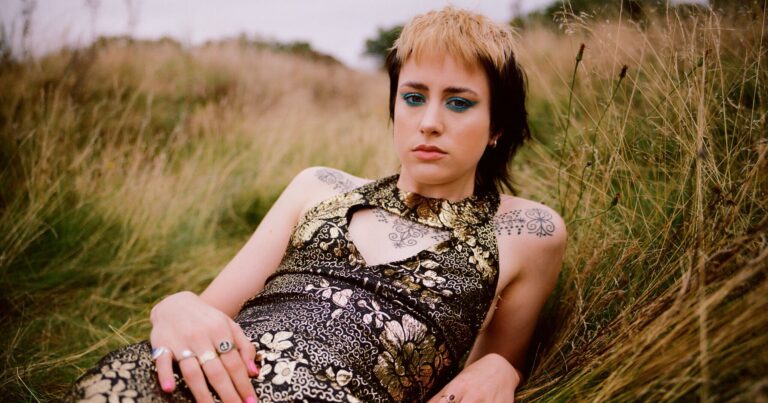
London artist Daisy George has announced her debut EP, see me now, sharing the new single ‘do u feel?’ alongside the news. It lands on November 25 via Brace Yourself Records. Check out the new track, a collaboration with SANITY, below.
“I wrote this song with SANITY around the time when Sarah Everard was killed in 2021, when the issue of violence against women was prevalent in the news,” George commented in a statement. “It seemed more than ever that everyone had an opinion on how women should behave, who ‘qualifies’ as a woman, and what the experience of being a woman in today’s society meant. ‘do u feel?’ is a direct statement for all women who feel frustrated or who don’t feel heard or truly understood, and the track is loud and powerful to match that frustration.”
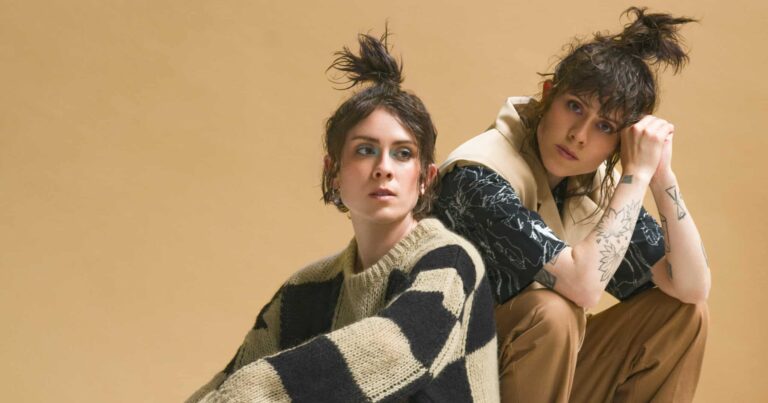
Tegan and Sara have shared another single from their ucoming album Crybaby. This one’s called ‘I Can’t Grow Up’, and it follows earlier cuts ‘Fucking Up What Matters’, ‘Yellow’, and ‘Faded Like a Feeling’. Check out its Mark Myers-directed video below.
The new track “was musically inspired by Chicago band Dehd and their album Flower of Devotion,” Sara Quin explained in a press release. “The song started on bass, an instrument I’d never written with until Crybaby, and I was channeling a little bit of Emily Kempf from Dehd, and Peter Hook from New Order. My partner had traveled back to the U.S., after a year of being stuck in Canada during the pandemic, and I was enjoying late nights alone writing music and singing full tilt in the basement.”
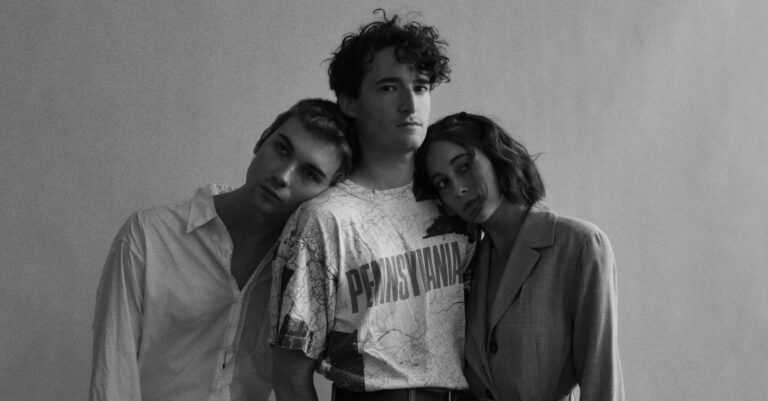
Brooklyn trio Nation of Language are back with a new single, ‘From the Hill’. It will be part of a 7” that’s set for release on December 9 and will include another track, ‘Ground Control’, as a vinyl exclusive. Take a listen below.
“’From the Hill’ is a song reflecting on times when friendships fall apart over romantic entanglement, accompanied by the sensation that you’re somehow watching it happen from above with a more zoomed-out perspective,” singer Ian Devaney explained in a statement. “It can feel at times like certain parts of life are a story with which you’re just following along – the characters enter, they play their role, and then they leave. Often it’ll feel sudden and catch you off guard, and other times you’re able to see that it’s the only way things could have played out despite what you may have wanted.”
The song marks the band’s first new music since their 2021 album A Way Forward. “For us, we’re in a moment right now where it feels good to get this out into the world. It’s one that didn’t really feel like it fit the vibe of A Way Forward, nor is it any real indication of where the next record is likely heading. When that situation arrives we like to use these 7” releases to step outside the larger framework that the albums provide and just release a track that we love, so this is us doing that once again.”
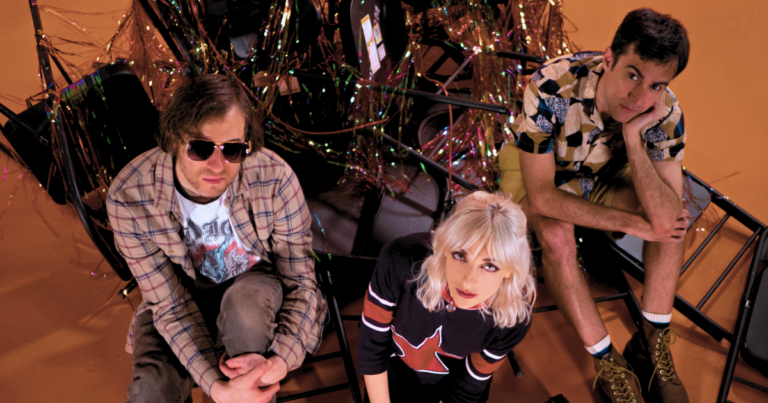
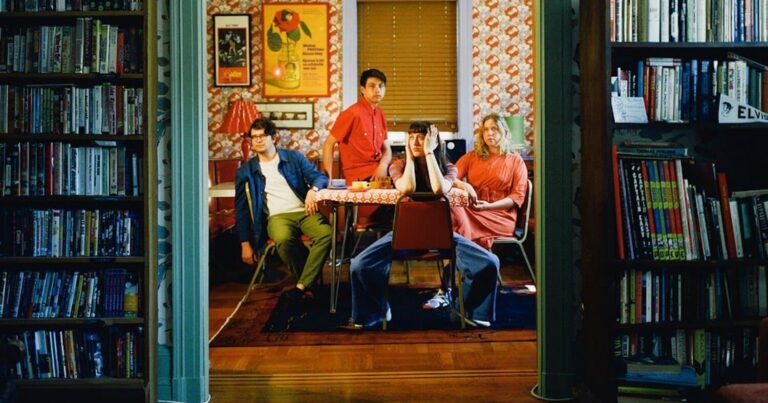
Brooklyn band Foyer Red have released a new song, ‘Pollen City’. It follows their recent single ‘Pickles’, which came out in July, and May’s ‘Flipper’. Check it out below.
“There’s a special kind of buzzy energy in the air when the seasons change and the weather gets warmer; Pollen City is about that inherent impulse to stir things up, sometimes in a wicked sort of way,” lead singer Elana Riordan explained in a statement. “This track is the first song we wrote from scratch collaboratively as a 5-piece late last year, with ‘Flipper’ and ‘Pickles’ being more associated with the Zigzag Wombat era. I like to think of it as a bridge into the new world the five of us have created together, teasing some new sounds and forms, shapes and colors, etc.”
Jobber have released ‘Hell in a Cell’, the title track from their upcoming EP that’s out October 21 on Exploding in Sound. Following lead single ‘Entrance Theme’, it arrives with a music video directed by Steve Marucci. Watch and listen below.
Discussing the new song, vocalist/guitarist Kate Meizner said in a press release:
‘Hell in a Cell’ is basically an allegory. On its surface, it’s a narrative about a fictional wrestler mentally preparing for a match and questioning whether it’s worth it to put her body on the line for the sake of spectacle, which, in this case, is a match set to end with her taking a 30 ft jump off a steel cage a la Undertaker vs Mankind at HIAC 1998. Pulling back the curtain a bit, the lyrics are pretty personal and came out at a time when my job was having an especially negative impact on my health. I wanted to quit so badly, but in the midst of covid-19 related layoffs and economic downturn, everyone was being bludgeoned with anti-labor talking points like…. “why are you complaining about your job? You should feel grateful to even have a job!” The lyrics “Am I ungracious? / Because I won’t turn water into wine / Am I buried forever? / If I start speaking my mind” are from the POV of the wrestler, but also came from a personal place, expressing my anger toward workplaces and their horrendous, exploitative treatment of workers.
Musically I wrote the heavy intro riff of “Hell in a Cell,” when I was listening to the Helmet album “Betty” on repeat. The intro sounded like the perfect entrance theme for a physically huge, hulking wrestler like Kane or Braun Strowman, and I shaped the song ‘around’ the riff to mirror the cinematic ebb and flow of a wrestling match. Mike F (drums) and Justin P (sound engineer) were instrumental in shaping the dynamics of the song – making the big riff parts sound huge in contrast the quieter parts with delicate guitars and melodies.
Shygirl has dropped the final teaser of her upcoming album Nymph ahead of its release on Friday, September 30. ‘Shlut’ follows the previously unveiled singles ‘Firefly’, ‘Come for Me’, ‘Coochie (a bedtime story)’, and ‘Nike’. Check it out below.
Frankie Cosmos have released ‘F.O.O.F.’, the latest single in the lead-up to their new album Inner World Peace – out October 21 via Sub Pop. It follows the previously shared tracks ‘One Year Stand’ and ‘Aftershook’. Check it out below, along with a video by artist Cole Montminy.
“For me, ‘F.O.O.F’ is about creating random boundaries and schedules for yourself in an attempt to feel in control,” the band’s Greta Kline said in a statement. “Feeling time passing at varying speeds and time traveling with music.”
“I love Cole’s art, and we were all so excited and grateful they were on board to make this video,” Kline added. “I’ve struggled with feelings of isolation as a result of the pandemic, combined with escalated use of technology. This video embodies that, and the ending provides a sense of relief and freedom from those feelings. We could all stand to smash our computers and go touch some grass.”
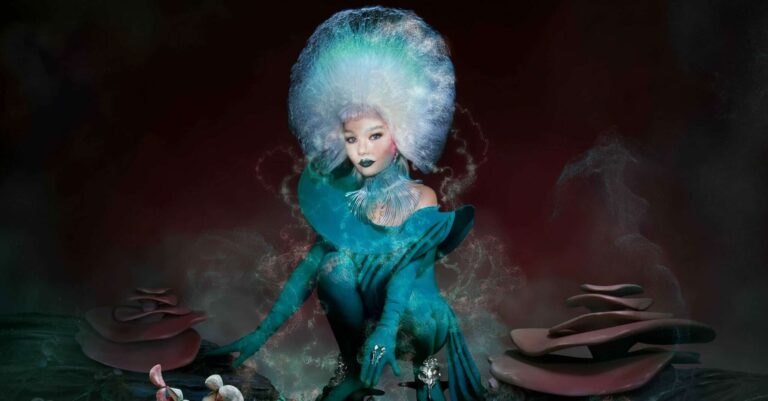
Ahead of its release on Friday (September 30), Björk has shared the title track to her new album Fossora. It follows previous offerings ‘Atopos’, ‘Ovule’, and ‘Ancestress’, which we named our Song of the Week. Check out the new single, produced by Björk and featuring Kasimyn, below.
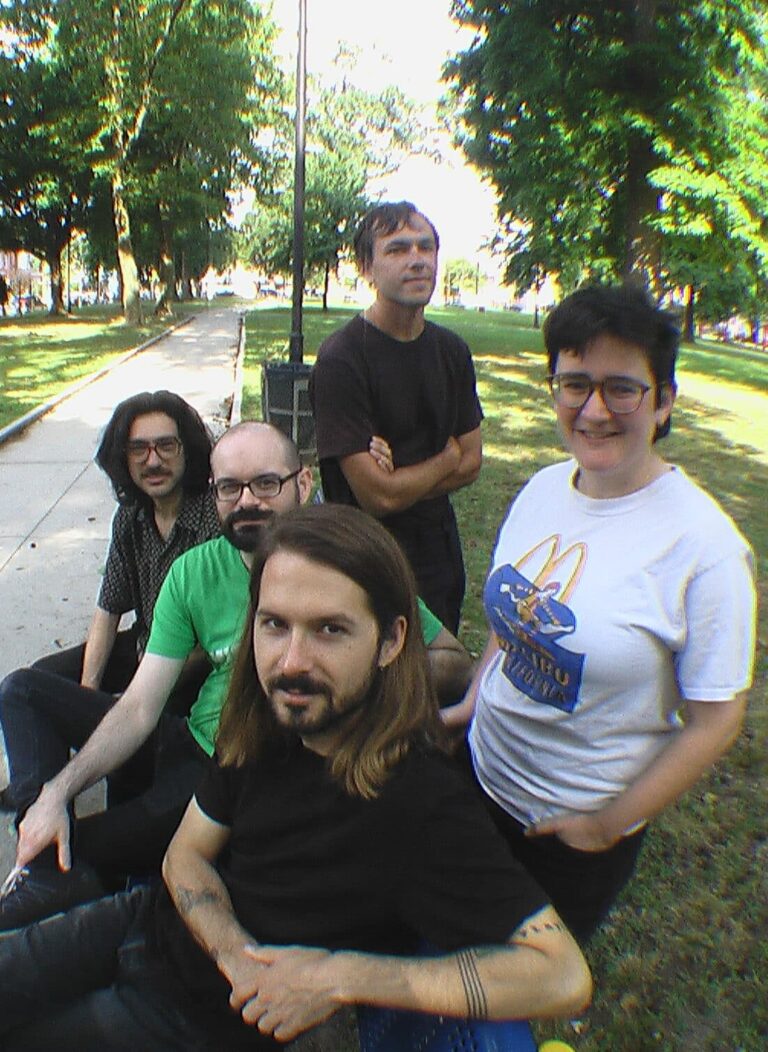
2nd Grade is the Philadelphia power-pop project led by Peter Gill, who has clocked time in bands like Friendship and Free Cake For Every Creature. While working in other groups, Gill started writing and recording songs on his own, drawing inspiration from the bright, hooky songwriting of bands like Guided By Voices, Big Star, and Teenage Fanclub. His first record under the moniker was 2018’s Wish You Were Here Tour, a collection of sweet lo-fi pop songs that were given the full-band studio treatment on a reissue that came out last year on Double Double Whammy. Between the two versions of that record, 2nd Grade put out Hit to Hit, a 24-track LP brimming with ideas that felt both breezy and dynamic, cheeky yet earnest. The band – whose lineup also includes guitarists Catherine Dwyer and Jon Samuels, bassist David Settle, and drummer Francis Lyons – have honed in their approach on Easy Listening, their tightest and most thrilling effort to date, which is out Friday. As it jumps between styles that are skilfully stitched together, the album strikes a balance between rock n’ roll euphoria and teenage ennui, escaping into a world of fantasy that’s worth believing no matter how unattainable it feels.
We caught up with 2nd Grade’s Peter Gill for this edition of our Artist Spotlight interview series to talk about the making of the band’s new album, the inspirations behind it, society’s obsession with youth, and more.
Can you remember what your headspace was like going into the album?
Yeah, I pretty vividly remember my headspace, and that’s because these songs were written during the spring of 2020. Hit to Hit came out at the end of May, and I wrote this record during the very beginning stages of COVID quarantine, leading up to when Hit to Hit came out. It was a weird time, because I was still walking dogs and working during that time, but also, I was just at home a lot because you couldn’t go anywhere. So I was kind of bored in one way, but also, I was so excited because those Hit to Hit singles were coming out and excitement was building for this new record. All day long, you’d be getting social media notifications dinging, which sets off all the dopamine channels in your brain. It was a time of great boredom and great excitement, and I think I channeled both of those feelings and themes into these new songs I was writing. A lot of the songs are about wanting to be a rock star, but then a lot of the songs are also just kind of about feelings of, like, you’re spinning your wheels or you’re not getting anywhere – those rock star fantasies are actually pretty far out of reach for you.
The album is full of characters who are enthralled by rock and roll in some way, but I was wondering how close to those characters you feel, or if there’s a certain ironic distance there for you.
It would be wrong for me to say the songs are about me and about what I’m going through, necessarily, so to use the word “characters” kind of feels right. But also, some of the feelings and themes that the songs touch on do feel really personal to me and what I was going through. I guess in a narrative sense, there is a lot of distance between me and the songs. But more abstractly, they feel pretty personal.
It varies from song to song, too. I’m thinking about ‘Beat of the Drum’, for example, which has a more carefree energy compared to a song like ‘Hung Up’, which includes the line, “I hide behind guitars all the time.”
Yeah, that one’s not so carefree. [laughs]
Were you cautious about how to approach that dynamic?
I didn’t feel too cautious. I’d say my working method is to just throw a lot of stuff at the wall and see what sticks. When I’m coming up with ideas or writing new songs, I try not to think too much about those sorts of questions like “How personal is this?” or “How will it be perceived in a press release?” or something. I’m mostly just coming up with as many ideas as I can, and preferably good ideas. And then later, it’s sorting through and figuring out what hangs together. I’m a huge fan of bands like Guided by Voices, or really any band or any album where it’s a bunch of wildly different stuff kind of jumbled together. So for me, it just makes a lot of sense to have one song that is about hang-ups or getting down, and then having another song like ‘Beat of the Drum’. Which is like a bubble gum song, so it’s really stupid, but it also has an intellectual component of just wondering, what is it about a drum beat that makes someone want to dance? How does a drumbeat even exist? Why does having snare on two and four sound so good to everyone? There’s some pretty cool neuroscience at work.
Since I wrote that song, this past month, I’ve been reading this book about the physical properties of sound and how our brains process and respond to sound and music. And it turns out that they don’t fully understand the science of it, but studies have shown that when a subject is listening to something with a very steady predictable drumbeat or pulse, there will be corresponding waves of electrical activity in the brain, neurons firing at the same time as those beats. And in fact, there are also waves that subdivide those beats, so like, instead of just going quarter notes, the brain will fill in the half beats in between, too. Which is pretty crazy. [laughs] It’s funny that I just read that and it actually answered a lot of questions I had. That song was about those questions.
I’m curious if there was more sorting through with this album, given its relatively shorter tracklist.
Yeah, there was definitely closer attention paid to the editing side. I purposely wanted it to be more focused than Hit to Hit was, so a shorter tracklist and a shorter runtime. The runtime I think is like 31 minutes or something. I just wanted to really trim the fat this time around. I wrote a lot of songs for this record, and I think I ended up choosing these ones both because they’re some of my favourites of the batch, and also because I thought they thematically hung together in a way that isn’t completely random and abstract. It feels like an album to me.
You’ve said that the perfect length of a song for you is one and a half minutes. Were you less conscious about the songs’ runtime this time around, or has your ideal chaned?
Yeah, I’d say that continues to be my ideal – let’s bump it up to a minute and 45 seconds now, I think that’s the perfect length. [laughs] Which has changed, I once said it was a minute thirty. I think I was very conscious of runtimes this time around. The funny thing is, people asked me about the length of the songs a lot when I talk to people, and honestly, when I started writing songs, I wasn’t aware of how short they were. It just kind of happened that way. By the time I decided the song was done, I would record it and find out how short it was. And now, I’m definitely more conscious of it, and I still want the songs to be short, generally. There’s a couple songs I wanted to be longer, like ‘Strung Out on You’ is two and a half minutes, and ‘Teenage Overpopulation’ is like three and a half, and that was on purpose because I knew I wanted those to be singles. And I guess for playlisting purposes, I felt like if a song was a more conventional length, it might have a better chance of popping up in playlists or getting played maybe on college radio or independent radio.
With ‘Teenage Overpopulation’, which is the longest song on the album, it also makes sense because I feel like it’s kind of intentionally conflicted in its messaging – there’s a lot going on in the song. What got you thinking about that subject matter in the first place?
I think the subject matter generally is stuff that I have been thinking about for a long time, and there’s a lot of angles that you can come at it from. From one angle, you look at the music industry, and a lot of the people that are making it in a big way, getting a lot of attention and have a lot of resources behind them – a lot of them are very young, maybe artists in their early 20s. And there’s just this widespread notion that it’s a young person’s industry, and it’s possible to age out of it and be disqualified because you’re seen as too old. It’s this obsession with youth.
Also, as a power-pop musician, a lot of the genre of power-pop to me is about evoking teenage feelings, and a lot of my favourite music from, you know, like Pet Sounds is very famously an album of teenage feelings and emotions. A lot of Big Star is about the teenage experience that Alex Chilton never got to fully have because he was a touring musician on the road from the age of like 15 onward. It’s a genre that just historically is hyper-focused on that time in a person’s life, for better or worse, so it felt funny to have a power-pop song that is an anthem of protest against teens. [laughs] That’s not the only thing that song is, obviously, but that’s one way to read it.
At the end of the song, you shout out a bunch of famous young people, and you’ve put Malala right next to Butt-head.
[laughs] Yeah, we were in the studio and the band made me do that. It wasn’t on my list originally, and they were like, “You have to say Butt-head after Malala.” Which felt wrong, but it’s funny and it creates like a jumble. Most of those people are supposed to be teenagers, but a few non-teens slipped through the cracks. Ruby Bridges, for example, was not famous for being a teenager. She was famous for being just a little kid, but she’s a little kid who changed the world in a pretty big way. Once she was in the song, it didn’t feel right to take her out of it, so she got to stay. And Beverly Marsh is a Stephen King character, and I think she’s only like 12 or 11 in the book. But I just made a mistake, so she’s in there.
What we’re talking about made me think of another line from the title track: “My friends don’t seem to mind them in the 1990s all the time.” Is that something you relate to?
I’m not stuck in the past or anything, but something about that line still feels honest to me. I don’t know if I can place it really. I was born in the 90s, too, and I’m forever tied to that period of time. It’s not like I’m living in the 90s or anything, though.
It sounds like it’s more about being drawn to a specific musical era.
I don’t have a nostalgic pull to the 90s, but I do have a very strong pull to the music of the 90s. Not from nostalgia, but just from aesthetic appreciation. Especially someone Guided by Voices, Bob Pollard, I’m just forever amazed that I am alive on this planet at the same time that he is creating this body of work and forever shifting the musical language. It’s pretty extraordinary. It’s how I feel about Bob Dylan, too, I can’t believe I can just sit down and put on any one of his albums at any time. It’s probably how people felt about Picasso when he was alive. It’s an amazing time to be alive as a fan of music, as I’m sure you know.
‘Wouldn’t It Be Nice to Let It Be’ is only two minutes and fifteen seconds, but it still feels like it’s stretching out before it cuts abruptly. It feels like a way of bringing out the dreamlike quality that’s evoked in that line, “I’m just holding the cross section of a dream.”
“Dreamlike” is a great way to describe it. It sort of describes this state of being that is so unattainable, it can only exist in dreams, just to be completely free of care or worry. It’s almost as if you’re having a dream, and the whole time in the dream, you know that you’re dreaming, you’re aware of it. And so you’re kind of existing in two states at once. And then having it end abruptly, it’s like, “Time to wake up.”
And the record ends with you singing “dreaming of dreaming of dreaming a dream.” Is there a personal significance there for you?
Yeah, there is, but again, not narratively or specifically. I don’t have a lot of dreams, or I don’t remember my dreams when I wake up. But more, rather, so much of my experience in this reality is just bubbles inside of bubbles instead of bubbles. Everything that I experience is shaped by my attitude and my expectations that I’m not experiencing some objective reality. “Dreaming and dreaming of dreaming a dream,” when I wrote that line, I was afraid that people would think of Inception, that movie where it’s dreams inside of dreams. That’s not what I’m trying to get at. It’s not some mindfuck, you know, I’m not trying to blow someone’s mind. There’s something about the way those words sound together too, or just any word being repeated a lot, that has a hypnotic effect to it, which, to me, reinforces the meaning of it.
Do you feel like Easy Listening is your most collaborative album?
This one is the most collaborative so far. And that was definitely a big goal of mine, to have the band just take up more space. Part of that is, I stopped playing guitar in this band, I don’t play guitar anymore. I just sing the songs and I write them. So all the guitars you’re hearing are stuff that Jon and Catherine came up with. Also, they helped out more with the arrangements and general decisions. We still kind of got screwed up by COVID. It made it so that we couldn’t like really get super deep into workshopping the songs before they were recorded, we had to be really efficient with how we spent our time. I love the way it turned out, and I think that’s a testament to how much they inspire me as musicians. I’m excited for the collaboration to only become stronger and more in-depth.
Can you share something that inspires you about each of your bandmates?
There’s four other members, and they’re all incredible musicians who have tons of really awesome projects. David, Francis, and Catherine are awesome songwriters in their own right. Catherine has this band called Spring Onion. She has this knack for coming up with melodic ideas that would never in a thousand years have occurred to me, and they’re completely the perfect fit, so it’s always so cool to see what kind of guitar stuff she’s going to come up with and bring to the songs. Francis has this project called ylayali, which is less songwriter-based. It’s really hard to explain what it is that he’s doing with this project, but it’s so unique and inspiring and powerful. And Jon, he doesn’t write songs as far as I know, but he’s an extraordinary guitarist with so much curiosity about all different types of music. Again, it’s really hard to explain what he does, but he has this project that, to me, is similar to someone like Bill Orcutt, where it’s solo guitar music that maybe has aesthetic roots in American primitive guitar, but it has taken those ideas so much further that it is unrecognizable compared to that. It’s music that I put on and my brain is just exploding with activity.
David has a bunch of bands, including this one called Psychic Flowers that’s power-poppy.David, from all of them, is probably the most on my same wavelength. It feels like he can read my mind sometimes when I’m trying to explain what I want from a song. He just seems to have completely the exact same rolodex of influences that he can just draw upon at will. And also, for the live show, he brings the real rock and roll energy that I crave. I’ll be singing and then if I turn around, he’s in full power stance with this really cool denim jacket, just completely selling the rock and roll idea. Which is hard to do – a lot of times it can come across as half hearted, and he’s out there convincingly bringing it across. And that inspires me too, because I’m always thinking about the visual side of what we do.
This interview has been edited and condensed for clarity and length.