Here are four album artworks that left us extra eager to hear the accompanying music in March 2026:
Phoebe Salmon @phoebesalmon, ELIZA – The Darkening Green
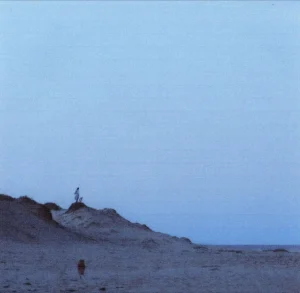
This breathtaking, earth-embedded image of ELIZA was taken by Phoebe Salmon, a filmmaker and photographer based in London. Salmon’s wider practice often situates bodies in friction with their environments, and The Darkening Green certainly feels like a version of that instinct.
Behind the lens is photographer Charles Myers, a member of Yebba’s creative circle. The photograph is disarmingly simple, capturing a lone Bigfoot figure crossing a chain of stones through glassy water, framed with almost painterly restraint.
Etta Friedman has crafted Ricochet’s cover art, depicting a pale spiraling shell on a dusty blue background. There’s a beautiful stillness to the image, carried by its cool, vintage-toned palette and diffused light.
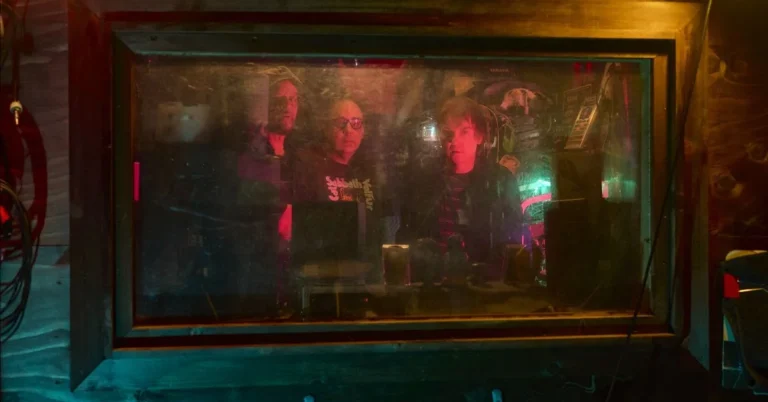
Paul Romano and Mikel Elam, dälek – Brilliance of a Falling Moon
Created by Paul Romano, with additional art by Mikel Alam, the artwork accompanying Brilliance of a Falling Moon is striking and richly psychedelic. Colourful florals, masks and traced facial outlines sit at its centre, emerging through hushed purples and blues to form a kaleidoscopic, detail-dense composition that reveals something new with every look.
There’s so much music coming out all the time that it’s hard to keep track. On those days when the influx of new tracks is particularly overwhelming, we sift through the noise to bring you a curated list of the most interesting new releases (the best of which will be added to our Best New Songs playlist). Below, check out our track roundup for Friday, April 3, 2026.
Jack White, ‘G.O.D. and the Broken Ribs’ and ‘Derecho Demonico’
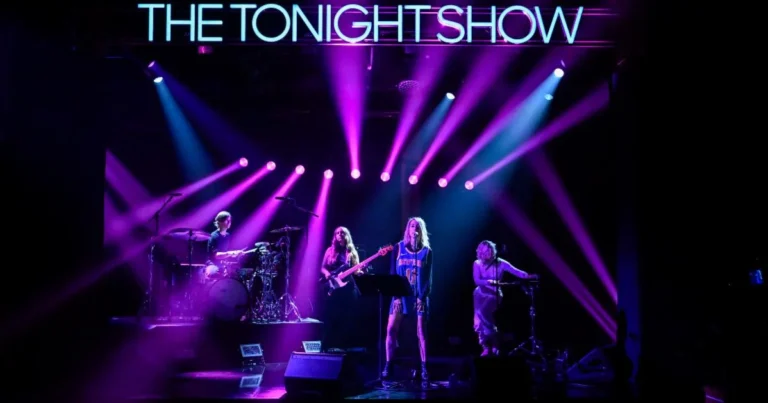
Jack White is delivering his sixth performance as musical guest on Saturday Night Live tomorrow, with Jack Black (his “brother from another colour”) hosting. He might play one or both of his just-released songs, the romping, riff-heavy ‘G.O.D. and the Broken Ribs’ and ‘Derecho Demonico’, which arrive two years after White’s last album, No Name.
Ravyn Lenae – ‘Bobby’ and ‘Reputation’ [feat. Dominic Fike]
For her first music of 2026, Ravyn Lenae has served up not one but two songs, one of which features a guest verse from Dominic Fike. ‘Bobby’ – not the collaboration – is an “internal dialogue” about whether to continue or end romance, while ‘Reputation’ portrays the relationship’s dissolution in more upbeat fashion.
she’s green – ‘paper thin’
Minneapolis band she’s green have announced a new EP, Swallowtail, due July 10 via Photo Finish Records. Accompanying the news is ‘paper thin’, which gauzily explores desire in a fading relationship. “‘paper thin’ explores the power of lust in a dying relationship: how it can be confused for love when in reality, the relationship has already faded,” bandleader Zofia Smith explained.
Leyla Ebrahimi – ‘I’m Sorry Maria’
Leyla Ebrahimi has released ‘I’m Sorry Maria’, a comforting yet cathartic slice of alt-pop. In addition to go-to collaborator Shane Pielocik, the track was co-produced by Alexander 23 (Olivia Rodrigo, Reneé Rapp), who helps inject a familiar sense of melodrama. “This song is about regret,” Ebrahimi shared. “Regret, and also confusion and anger and owning the fact that you can be 100 percent convinced that you know what’s right for you in any given situation, and find out later — when it’s too late — that you were totally wrong. It’s also, most of all, about letting that truth out at the top of your lungs.”
Frog – ‘Dark Out’
New York duo Frog have unveiled a new single, ‘Dark Out’, from their forthcoming album Frog for Sale. “This is an album about how money sometimes gets in the way of love,” Daniel Bateman has said of the project, which may or may not help you dissect the endearingly weird lyrics of ‘Dark Out’.
flowerovlove – ‘American Wedding’
flowerovlove has dropped a catchy, country-tinged new song called ‘American Wedding’. The track was written with Russell Chell, Skyler Stonestreet, and Ryland Blackinton. I wonder if it was timed to the release of Zendaya and Robert Pattinson’s controversial wedding film The Drama?
When it comes to troubled detectives, few can hold a candle to Harry Hole. Obsessive, driven, and endlessly compelling, he’s the kind of protagonist Nordic noir thrives on. More importantly, he’s been delighting crime readers for three decades. Now, he’s the subject of a new Netflix series.
Detective Hole, based on Jo Nesbø’s popular novels, is currently one of the most-watched non-English series on the platform, with 4.9 million views this week. It’s also the #1 show in 21 countries. Could this mean a second season is already on the way?
Detective Hole Season 2 Release Date
At the time of writing, there’s no information available about a potential Detective Hole season 2. No need to worry, as there’s still time for Netflix to give the green light.
Viewership numbers are strong, and the character’s popularity undeniable. As long the follow-up becomes a reality, more episodes could arrive sometime in 2027.
Detective Hole Cast
Tobias Santelmann as Harry Hole
Joel Kinnaman as Tom Waaler
Pia Tjelta as Rakel Fauke
Ellen Helinder as Beate Lønn
Anders Baasmo as Bjarne Møller
Cato Skimten Storengen as Bjørn Holm
Agnes Born as Camilla Loen
What Could Happen in Detective Hole Season 2?
Detective Hole centres on the titular character, Harry Hole, a brilliant homicide detective working in Oslo.
Haunted by past trauma and struggling with addiction, Harry is assigned to investigate a series of ritualistic murders. At the same time, he’s forced to deal with Tom Waaler, a corrupt cop.
Over the course of nine episodes, the series tracks a layered mystery spanning serial killings, police corruption, and blurred moral lines. Turns out, solving the case may cost Harry everything.
“It’s the first time the series starts viewing the story solidly from Harry’s perspective, it feels like, and it’s an incredible page-turner of a book… You will have to watch it twice to realize you could have figured it out along the way, but a beer on me at Schröder’s if anyone gets the whole plot before it ends — unless you’ve read the book, of course,” director and executive producer Øystein Karlsen told Tudum.
By the time the finale wraps up, you learn who the killer is, but there are still plenty of lingering questions. Since there’s enough original source material to draw from, we hope to see them answered in Detective Hole season 2.
Ahead of his Saturday Night Live performance this weekend, Jack White has returned with two new songs. ‘G.O.D. and the Broken Ribs’ and ‘Derecho Demonico’ were produced by White with backing from his longtime live band, drummer Patrick Keeler, bassist Dominic Davis, and keyboardist Bobby Emmet. The tracks will receive a 7″ vinyl release tomorrow, and you can hear them below.
Jack White’s most recent album, No Name, arrived in 2024.
In this segment, we showcase the most notable albums out each week. Here are the albums out on April 3, 2026:
Thundercat, Distracted
Thundercat is back with a collaboration-heavy album called Distracted. It’s his first album in six years but continues the exploration of grief that marked its predecessor, It Is What It Is. The LP features a collaboration with the bassist and singer’s late friend Mac Miller, as well as guest spots from A$AP Rocky, Tame Impala, Lil Yachty,m Channel Tres, and Willow. Kenny Beats, Flying Lotus, and the Lemon Twigs contributed additional production. “I don’t think the heartbreak ever stopped,” he said in press materials. “If it ain’t a girl, it’s taxes. If it ain’t taxes, it’s World War III. If it ain’t World War III, it’s a new update to the phone.”
In both sound and spirit, Wendy Eisenberg is all about embracing the possibility of togetherness. The revelatory self-titled album from the guitarist, songwriter, and composer, out now on Joyful Noise, follows 2024’s Viewfinder, though it first started materializing in 2020 when Eisenberg moved from Massachusetts to Brooklyn. Joining them during the recording were bassist Trevor Dunn, drummer Ryan Sawyer, and co-producer Mari Rubio, who handled pedal steel, synth, and string arrangements. “I was finally around people who accepted me,” Eisenberg reflected. “Many of the songs on this record were written in that new feeling. I wanted it to be incredibly comforting as it describes some massive changes in self-understanding and self-regard. It’s about relief.”
Robber Robber’s new album, Two Wheels Move the Soul, was recorded in the wake of an apartment fire that left Nina Cates and Zack James displaced. Relying on the generosity of the Vermont music community, they couch surfed for months, and while that infrastructure may have now seemed like a distant dream, music remained their only constant – “a new familiar place,” to quote ‘Backup Plan’ from their first LP, Wild Guess. Once again, the pair, along with guitarist Will Krulak and bassist Carney Hemler, returned to Little Jamaica Studios to lay down their new album for Fire Talk, Two Wheels Move the Soul, with engineer Benny Yurco. At once groovier and grimier than their debut, it hammers down on the same themes of shaky communication and perpetual unrest as if almost no time has passed between records. Yet through the rubble, they find new ways to navigate their shared space. Read the full review.
You might have taken one look at Makthaverskan’s name and assumed they were some kind of Scandinavian metal band. The Gothenburg quintet are more of a dream-pop act, and Glass and Bones is their fifth album. I’ve only taken a cursory interest in their music before, but the new record totally changed that: from the moment Maja Milner’s voice comes wailing in, it’s time to fully start paying attention. Even when the songs sound wrought from despair, their exuberant energy – punctuated by dynamic drumming and chiming, prickly guitars – never lets up. “It feels like the aim with this album was to lean even further into who we are,” the band said in press materials. “A fully distilled version of the Makthaverskan sound.”
Arlo Parks has returned with a new album, Ambiguous Desire. Preceded by the singles ‘Get Go’, ‘Heaven’, ‘2SIDED’, and ‘Beams’, the follow-up to My Soft Machine was inspired by the dance music the singer-songwriter was exposed to while club-hopping in Brooklyn and Queens. As she keeps blurring the edges of her sound, Parks’ writing is only getting more incisive in its introspection. “I danced more than ever as I made this record, I made more friends than ever too, found myself in the weird underbelly of New York juke nights, unleashed, laughed and laughed and laughed,” she recalled. “This record has desire at its center. Desire is a life force, it’s a wanting, a yearning, a momentum – we are all alive because there is something or someone we want – desire is an engine. But it is also mysterious, tangled, random, enlightening and HUMAN.”
After their KEXP session at France’s Rennes Festival went viral, Angine De Poitrine have unleashed another album of confoundingly dancey math-rock. Mining the intersection between party and prog music, Vol. II follows on from 2024’s Vol. I and features the early single ‘Fabienk’. The anonymous duo is composed of “Khn de Poitrine” on microtonal guitars and vocals and “Klek de Poitrine” on percussion and vocals. The band is supporting the release with a world tour, which kicks off today in Montréal.
Birding is the wondrous debut LP from deary, the dream-pop three-piece of Ben Easton (guitar), Dottie Cockram (vocals, guitar), and Harry Catchpole (drums). “I got really into reading about birds and all these historical stories and poetry about them,” Cockram explained. “You find these beautiful images of birds that represent hope, but they’re also animals. Some of them, like vultures and crows, are a sign of death to some people. They represent all these different elements, which I think sum up a lot of the album.” Easton added, “The album is all about human consequences. Consequences on each other, our own minds, on mental health, on nature. One idea that was quite tangible to us is the idea that humans have the biggest consequences on innocent, vulnerable, sentient beings, like birds, for example. It goes with the vulnerability of our inner selves, or the child in us, which pairs with the album art—a kid trying to fly. It’s very ethereal, but it also has a lot of sad undertones to it as well.”
After signing to Sub Pop, Sunn O))) have returned with their first album in seven years. The drone-metal duo’s self-titled album is incessantly noisy and primitive-sounding, inspired by the natural landscape that surrounded them while recording at Bear Creek Studios, Woodinville, Washington. “The vast tracking room had big windows looking out on trees,” Stephen O’Malley recalled. “We could go hiking and be out in the woods, spend time outdoors. That became a big part of it.” And while their recent work has been heavily collaborative, O’ Malley and Greg Anderson are the sole performs on the LP, which they co-produced with Brad Wood. “What’s been happening with our performances over the last couple years with the two of us and no other collaborators has been really fresh and exciting,” Anderson added.
MIKE, Earl Sweatshirt, and SURF have linked up for a new joint tape, POMPEII // UTILITY. The 33-track effort is a double LP, with MIKE handling the first 15 songs and Earl leading the last 18. Disc 1 features Anysia Kym, Jadasea, Niontay, and Na-Kel Smith, while Lerado Khalil guests on the second disc. “I relate to MIKE like my actual sibling,” Sweatshirt said in a recent interview with The Face. “That’s the foundation that made it easy for the project to come together.”
Katie Alice Greer, Perfect Woman Sound Machine, Vol. 1; Bruce Hornsby, Indigo Park; Knumears, Directions; Maria Taylor, Story’s End; 41, Area 41; Charley Crockett, Age of the Ram; Larrison, Original Recordings, 1992-1999; Joe Pernice, Sunny, I Was Wrong; Swae Lee, Same Difference; Poison Ruin, Hymns from the Hills; Division of Mind, Exoterror; Ber, Good, Like It Should Be; Sofía Rei, Antónima; Radwan Ghazi Moumneh, Frédéric D. Oberland, Eternal Life No End ليلة ظلماء ملعونة، كحياة طالبيها; Los Retros, Odisea; Billy Fuller, Fragments; Sam Barber, Broken View; Sophia Yau-Weeks, Misty Mountain.
Comparing Simfa vs Reface is like deciding between Apple and Samsung when buying the latest smartphone. Both have promising features and seem to be equal at first glance. However, one is definitely more worth it than the other. With face-swapping apps coming a long way from a source of quirky effects to powerful creative tools, choosing the one that offers solid value can be tricky.
To help users make an informed choice, this quick but comprehensive guide will compare Simfa vs Reface, highlighting the primary features and pricing options. It will look at both the web-based versions, particularly Simfa’s AI Face Swap and Reface’s Unboring Face Swap. At the end of the article, users are sure to find which one is the smarter pick for content creation.
Simfa vs Reface: Key Features
Image Credit: Simfa and Reface
Face-Swapping Process
Unlike other options in the market, Simfa puts great emphasis on the swapping process by employing a calibration-first pipeline. In detail, it leverages its powerful artificial intelligence system to analyze the source file and develops a 3D representation of the face by synthesizing light conditions, geometry, and skin tone. This specific, detailed process enables Simfa to seamlessly integrate the face into an image or footage that maintains the correct movements, angle, lighting, and even expressions. And honestly, that makes a difference.
On the other hand, Reface has been in the face-swapping scene for a few years now and has developed its original face-swap technology. This particular innovation uses algorithms to identify facial features and generate face swaps that maintain realism and movements.It has a facial mapping feature that allows users to produce high-quality and hassle-free results. Reface also incorporates a library of templates that enables endless creativity.
User Experience
When it comes to ease of use, Simfa employs a quick two-step process, along with an easy-to-navigate interface. The simple layout clearly helps users perform face swaps by uploading the source photo and target image or video, then letting Simfa do what it does best. Waiting is also not an issue, as most results finish rendering in less than five seconds. After that, the output is instantly available for download without any additional installations required. Uploading files and posting of results on social media are also uncomplicated, as it supports JPG and PNG for still images and MP4, MOV, and WebM for videos.
Meanwhile, Reface has a slightly longer process, which includes three steps. Users need to upload the portrait, select a photo or video to face swap into, then wait for the process to complete and download the result.Moreover, Reface features an intuitive platform that caters to all levels of users. In terms of supported formats, this tool is limited to JPG, MP4, and MOV files.
Privacy and Security
Simfa ensures the secure storage of personal data and files. It even allows every user to demand immediate deletion of these or request a copy of the held information.
In contrast, Reface claims that it does not gather or store any files that users upload while using the app.
Simfa vs Reface: Pricing
Image Credit: Simfa and Reface
In terms of pricing, Simfa is on the more expensive side. However, it is only because the app aims to deliver specialized packages for every type of user. Its Starter Pack comes in at $4.99, which includes five credits, two generations, standard processing, and email support. Meanwhile, the $19.99-Plus Pack offers 25 credits and 12 generations, and the $49.99-Pro Pack provides 100 credits and 50 generations. Both the Plus and Pro Pack entail standard processing and email support. Simfa also offers a membership option for $19.99 a month, which brings 30 credits every month, free AI image generations, priority processing and support, and early access to new tools.
Reface, on the other hand, only has two subscription-style package options. The Basic Tier is priced at $3.08 a month, which promises exclusive content, no ads, and no watermarks. For its Premium Tier, users can pay $5.99 per month to get all the inclusions of the base package, along with unlimited face swaps, priority processing and support, and video restyle features.
Quick Comparison Table
SIMFA
REFACE
WINNER
Quality
Advanced calibration process,
higly realistic
Facial mapping, template-based, good realism
SIMFA
Speed
2-step process
3-step process
SIMFA
Ease of Use
Beginner-friendly
Beginner-friendly
TIE
File Support
JPG, PNG, MP4, MOV, WebM
JPG, MP4, MOV
SIMFA
Privacy
User-controlled
No file storage claimed
REFACE
Pricing
Flexible packages and plans
Simple subscriptions
SIMFA
The Faceoff: Simfa vs Reface
While Reface is not so bad itself, Simfa is the clear winner of this comparison. It champions realism, advanced editing, and professional control. With cutting-edge features and flexible pricing packages, Simfa is the ultimate choice, delivering unmatched quality and creative potential.
Investing in Simfa means investing in quality and versatility. So, don’t just swap faces, empower your vision with Simfa!
The lead-up to a wedding can be stressful. Planning a party is anxiety-inducing, with a billion little things to take care of. Add in the possibility of the couple getting cold feet, and the entire thing resembles a Jenga tower that could crumble any minute.
New Netflix series Something Very Bad Is Going to Happen takes that idea and pushes it to unnerving territory. With 4.5 million views this week, it’s the second most-watched show on the platform, proving there’s still a big audience for horror content. Could this mean that a second season is on the way?
Something Very Bad Is Going to Happen Season 2 Release Date
At the time of writing, there’s no official news about a potential Something Very Bad Is Going to Happen season 2. That said, it’s early days.
The title isn’t listed as a limited series, and Netflix often waits a bit to assess viewership before making a decision either way. The narrative does wrap up in a satisfying manner at the end of the eight episodes available, but the door remains open for future storylines. All in all, things look promising.
As long as season 2 gets the green light, more episodes could arrive sometime in 2027.
Something Very Bad Is Going to Happen Cast
Camila Morrone as Rachel Harkin
Adam DiMarco as Nicky Cunningham
Jeff Wilbusch as Jules Cunningham
Gus Birney as Portia Cunningham
Karla Crome as Nell Cunningham
Sawyer Fraser as Jude Cunningham
Ted Levine as Boris Cunningham
Jennifer Jason Leigh as Victoria Cunningham
What Is Something Very Bad Is Going to Happen About?
What if you’re about to marry the wrong person? That’s the question the Something Very Bad Is Going to Happen protagonist, Rachel, keeps struggling with.
Created by Haley Z. Boston and produced by the Duffer Brothers, the show follows the bride-to-be and her fiancé Nicky during the week leading up to their wedding. What begins as a romantic getaway to Nicky’s wealthy family’s remote estate quickly turns unsettling.
Rachel becomes increasingly convinced that something is deeply wrong, especially as eerie coincidences and strange behaviours pile up. Once she makes a horrifying discovery, her doubts about whether Nicky is actually her soulmate reach a boiling point.
We won’t give away spoilers, but the eight episodes of season 1 are a wild ride. By the time the end credits roll, you won’t be left with many unanswered questions. However, you’ll be curious about what the future holds for Rachel, which is where Something Very Bad Is Going to Happen season 2 could come in.
Haley Z. Boston is open to a sequel, but it might revolve around a different story. “I’ve thought about the show as a potential anthology, and whatever that next existential fear is, I’d need to figure out what to explore there,” the show’s creator told Entertainment Weekly.
Fingers crossed she will, and fans will reap the benefits.
Are There Other Shows Like Something Very Bad Is Going to Happen?
If you enjoyed Something Very Bad Is Going to Happen, there are many excellent horror series streaming on Netflix. Like The Haunting of Hill House, The Fall of the House of Usher, Midnight Mass, Stranger Things, or Wednesday.
The nature of visual art is constantly evolving, and emerging artists have to navigate the challenging dynamic of referencing the centuries of art history that have come before them, the established artists who are creating the strongest works right now, and trying to forge a unique path that references this all within their own signature style.
Olya Eliseeva, Natalia Kungurova and Medina Mammadkhanova are three artists rising to this challenge. They all create work in varying styles that reflect their unique backgrounds and what it means to be a contemporary artist working across Europe and the UK.
Olya Eliseeva’s work features kinetic elements, including a swinging lantern above a sculptural installation, which reminds me of religious ceremonies. She also incorporates performance into her practice, using her own body as part of the work, much like artists such as Ana Mendieta did, but Eliseeva’s work has a more tranquil air. She isn’t instructing the viewer how to feel, but instead allowing them to find their own interpretation of the piece.
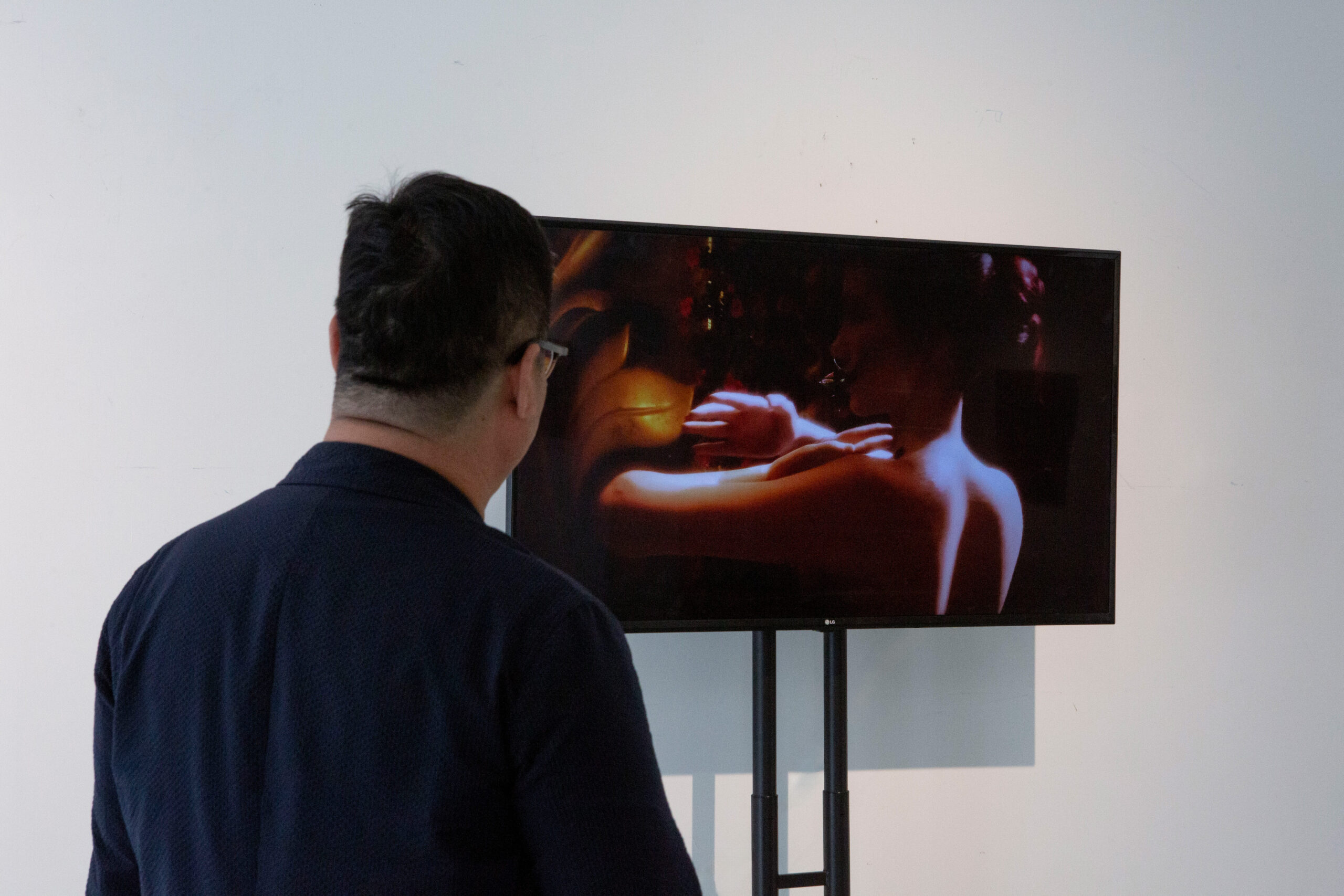
Her latest work, ‘Name It’, adopts a more vulnerable stance, with the exposed body seen from behind, sometimes veiled, showing how her work is evolving to become more personal and revealing of her own life experience. It fits into a wider movement towards recognising the power of resilience and the constant objectification that female bodies have been subjected to via the male gaze. It’s a movement that’s rightly given greater prominence to artists such as Mendieta and Frida Kahlo, but also one that’s being built upon by contemporary artists such as Tracey Emin and Sarah Lucas.
Natalia Kungurova also focuses on the human experience and resilience, but takes a far more abstract approach, using gestural paintings that don’t immediately make the narrative behind them clear. Yet, just like other abstract painters such as Gerhard Richter and Mark Bradford, and the Abstract Expressionists that came before them, there is more to discover under the surface.
The clues lie in the titles of works such as ‘Broken Dreams/Unattainable’ and ‘Power of Shadows’. She is trying to show us what lies beneath the surface of all of us, the pain, the struggles, the recovery that we all go through in life. It’s not always visible, but it’s still there beneath the surface, and just as with her paintings, the story can’t be seen by simply skimming the surface but only by spending time with these works. Seeing where the marks, colours and textures take us and speak to us, telling us more about our own struggles than about the artist’s journey that inspired them.
Medina Mammadkhanova takes this idea of sharing our emotions to an interactive level. Her installation ‘Emotional Processor’ asks each participant to select an emotion, receive a printed question, write down their emotion and then either keep the note or shred it in a moment of catharsis.
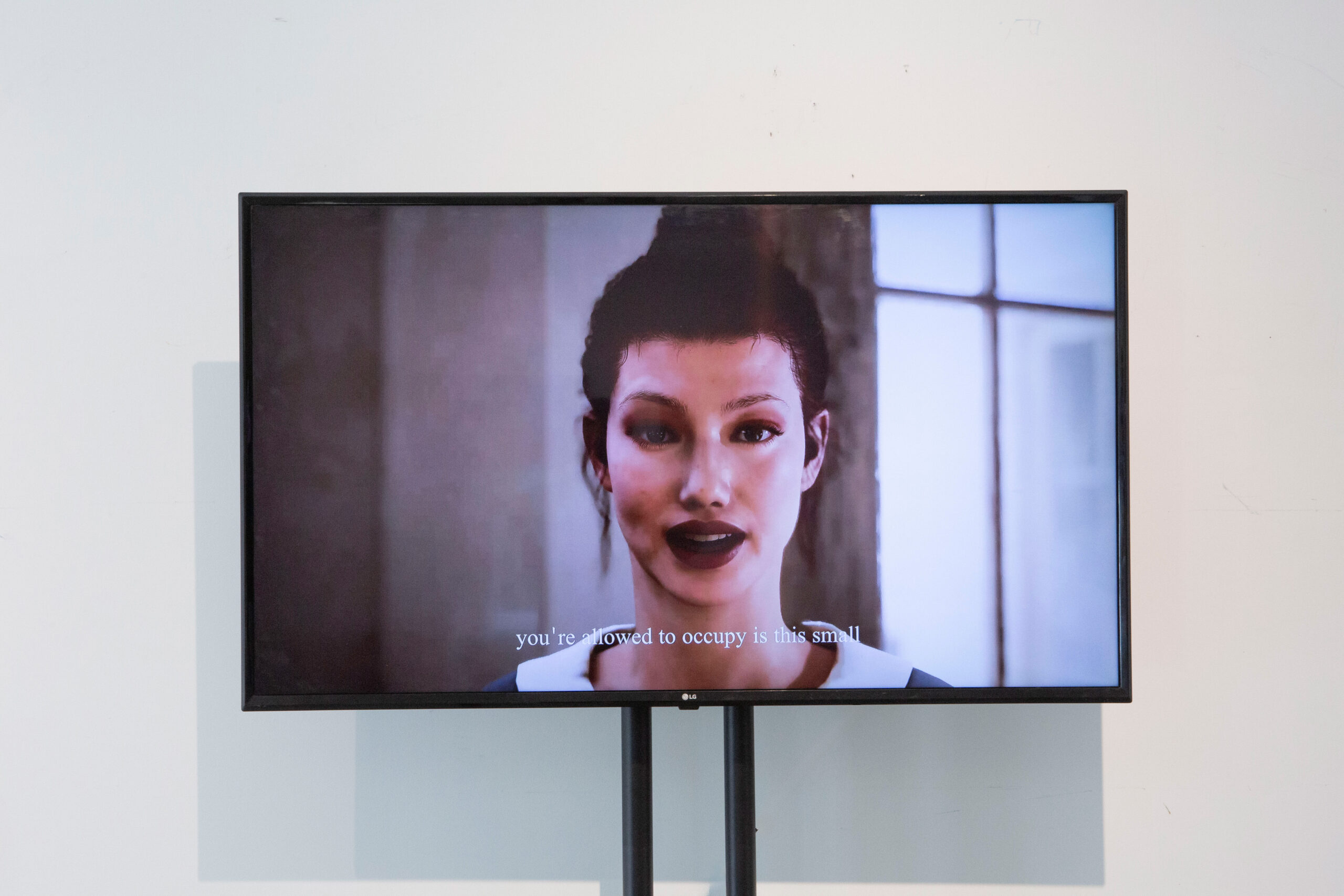
It questions how we let machines and algorithms determine our emotions, rather than look within ourselves for answers. It’s a work that’s become even more relevant in a time when many people immediately turn to ChatGPT for an answer to a difficult challenge, rather than attempting to answer it themselves. Amalia Ullman created a ‘fake’ social media as part of her ‘Excellences & Perfections’ work, and as social media has evolved and our lives are increasingly guided by algorithms, artists questioning how it manipulates us is becoming an important element of artistic discourse.
All three artists have taken radically different approaches to reflecting the emotional and spiritual. Yet what unites us all is that uniquely human experience; we all feel, we all hurt, and we all heal. We’re living in an age of online arguments and divisive discussions around gender, race and sexuality. These three artists all ask us to remember what brings us together. They are asking: when so many factors drive us apart, could art be the reason to reunite us?
More information on Olga Eliseeva’s work may be found on her website and Instagram.
More information on Natalia Kungurova’s work may be found on her website and Instagram.
More information on Medina Mammadkhanova’s work may be found on her website.
All three images are copyrighted and courtesy of the respective artists. First image: Olya Eliseeva. Second image: Natalia Kungurova. Third image: Medina Mammadkhanova.
With Paris Fashion Week winding down, everyone starts looking for excuses to keep walking the city a little longer. On Rue de la Verrerie, you won’t have to look too hard for one. A perfectly round black door cuts through a wall of stone, marked only by two precise As. That’s your cue, the Fondation Azzedine Alaïa. Inside, you’ll find an exhibition titled Azzedine Alaïa and Christian Dior: Two Masters of Haute Couture, expect exactly what it says.
Curated by Olivier Saillard, the exhibition pits two couture immortals in a tête-à-tête that could have first happened in 1956… or in pure imagination. Fresh off his arrival in Paris from Tunisia, Alaïa briefly landed at the Dior atelier. Internships can be fun. Short too. This one lasted four days, but it never really left him. Dior’s dresses fascinated him, not for how they looked, but how they held. Alaïa started there and the obsession with cut stayed. So did the need to master it.
Almost 600 Dior designs later, the fascination hadn’t worn off. If Dior had a most devoted collector, it was Alaïa. “He felt he was saving treasures… He was a custodian. He spent what he earned acquiring the work of other masters. He didn’t have a private plane. He didn’t go on vacation. He collected, collected,” Carla Sozzani told Vogue. Dior archives spent two years with the Fondation Azzedine Alaïa, documenting, cataloguing, photographing. Alaïa next to Dior, garment by garment.
The exhibition shows what dedication looks like, and how strangers can sneak under your skin, beautifully. And don’t you dare step outside once you’ve seen every gown. Upstairs, guests step into Alaïa’s studio, frozen in time for two years after his death. Not a single thing was moved. Glass walls let you see him at work. Glasses, medicines, patterns, half-finished dresses, and your very own goosebumps.
U2 have returned with a new EP, Easter Lily. It follows last month’s Days of Ash, which was also surprise-released. Check it out below.
U2 – Easter Lily spans six songs, including a new collaboration with Brian Eno. In contrast to the overtly political tone of Days of Ash, most of which was dedicated to activists, the new EP appears to be more personal. Opener ‘Song for Hal’ pays tribute to the band’s late friend and producer Hal Willner, who would’ve turned 70 on Easter Monday.
The descriptions of the other songs in a press release are pretty vague: “‘In a Life’ is a song celebrating friendship. ‘Scars’, is a song of encouragement and acceptance; scars and all, with a twist. ‘Resurrection Song’ is about pilgrimage, a road trip into the unknown with a lover or friend. ‘Easter Parade’ is a devotional song, a celebration of new life, rebirth and resurrection.” Only ‘COEXIST (I Will Bless The Lord At All Times?)’, which features the soundscape by Brian Eno, is billed as “a lullaby for parents of children caught up in war.”
In a statement, Bono said:
We are in the studio, still working towards a noisy, messy, ‘unreasonably colourful’ album to play LIVE… which is where U2 lives. We still look to vivid rock n roll as an act of resistance against all this awfulness on our small screens. These are for sure ‘wilderness years’ for so many of us looking at the mayhem out there in the world.
It’s a time that has our band digging deeper into our lives to find a wellspring of songs to try meet the moment… With Easter Lily we ended up asking very personal questions like: Are our own relationships up to these challenging times? How hard do you fight for friendship? Can our faith survive the mangling of meaning that those algorithms love to reward? Is all religion rubbish and still ripping us apart…? Or are there answers to find in its crevices? Are there ceremonies, rituals, dances that we might be missing in our lives? From the rite of Spring to Easter and its promise of rebirth and renewal… Patti Smith’s album Easter gave me so much hope when it was released in 1978. I wasn’t yet 18. The title is a nod to her.
We will attempt hoopla and fanfare at a later date to remind the rest of the world we exist but in the meantime… this is between you and us.
Like its predecessor, Easter Lily is accompanied by another digital edition of U2’s Propaganda zine. It includes sleeve notes from the Edge, a conversation between Bono and Franciscan friar Richard Rohr, an essay from Clayton on art and the journey of recovery, and more.