It’s not New York’s first time meeting Nicolas Ghesquière, and neither is his. 1989 saw him on fashion assistant duty at Jean Paul Gaultier, three decades before his first Cruise show for Louis Vuitton landed at JFK’s TWA Terminal. The Cruise 2027 collection explored uptown versus downtown New York, while the venue explored an even more radical concept: letting fashion editors indoors. The Frick Collection in Manhattan’s Upper East Side plays host this time, granting access to 18th-century-drenched galleries the general public still has to whisper through. No institution is fully immune to corporate seduction, and Louis Vuitton’s very generous three-year arrangement (complete with free-entry evenings and exhibition funding) sounds like an appealing one.
A crowd made up of Anne Hathaway, Cate Blanchett, Zendaya, Emma Stone, and the occasional human headline, gathered inside to watch Ghesquière’s take on one of New York’s favorite binaries, uptown vs. downtown. Uptown is made up of Frick-level silence, inherited money, and kitten heels. Downtown means clubs, street art, and anything that used to look like a problem before it looked expensive. Somewhere in the middle sits the late Keith Haring, a graffiti artist turned gallery fixture (father of those dancing figures you’ve seen on tote bags, T-shirts, and probably at least one situationship’s apartment walls). Luckily for Ghesquière, the Vuitton archives happened to contain a 1930s trunk Haring covered in black Sharpie back in the ’80s before handing it off to a roommate, and long before the house placed a winning bid on it. So naturally, out came the trunk.
And with the nostalgic opening came a 56-look collection, ranging from leather goods to boxing shoes that looked like they had been pulled from The Fifth Element. Ruffles kept company with structured jackets, Bermuda shorts arrived in vivid pied-de-poule, minis looked as if folded with origami logic in mind, while Americana denim made things feel briefly simpler. This collection is not for the faint of heart. Neither are the textured tops, placed somewhere between the Gilded Age and 2026, paired with heavily detailed cargo trousers and dense embellishment. Whether at Gucci in Times Square or Vuitton at the Frick, New York keeps choosing overstimulation as its natural state.
Tour news moves fast. One presale code lands, a venue page flips, and your readers rush to buy. Our Culture already lives in that rhythm with quick news hits, reviews, and festival coverage that rewards speed.
If you track ticket links by hand, you will miss changes. If you poll too hard, sites will shut you out. The goal sits in the middle: collect just enough data to spot real shifts, then ship clean updates before the buzz cools.
What you should collect (and what you should skip)
Start with a tight scope. Ticketing pages look rich, but most of it does not help a reader. Grab the fields that drive action: onsale time, price range, fees if shown, section tiers, and “sold out” state.
Skip seat maps and user-level cart steps. Those flows break often, and they raise risk. You can still deliver value by tracking when inventory returns, when a second date appears, or when a link reroutes to a new vendor.
Use event IDs when sites expose them. Many ticket platforms embed stable IDs in page JSON. IDs make your alerts more exact than fuzzy text match.
Why ticket sites fight scrapers so hard
Ticketing sits on fraud pressure. Bots also eat a huge slice of web traffic. Imperva reports that bots make up about half of all internet traffic, and “bad bots” alone drive close to a third.
That reality shapes how ticket sites defend pages. They rate-limit hard, challenge browsers, and score every visit. They also watch for repeat IPs, odd headers, and fast click paths.
If your scraper acts like a metronome, it will stand out. If it slams one IP, it will burn that IP. You need a plan for pacing, identity, and repeat checks that still feel human.
A simple fetch plan that scales past “it works on my laptop”
Split your work into two lanes: discovery and monitoring. Discovery finds new events and links. Monitoring checks known URLs for changes, then triggers an alert.
Lane 1: Discovery with light touch
Discovery should run slow and wide. Pull from artist sites, venue calendars, and promoter pages. Cache results and only re-crawl pages that change often.
Use conditional requests when you can. ETag and Last-Modified headers let you avoid full downloads. That cuts load on the site and cuts your risk.
Lane 2: Monitoring with stable sessions
Monitoring needs steady identity. Ticket pages may gate price blocks behind scripts, so you may need a headless browser for some targets. Keep headless use rare and focused, since it costs more and draws more checks.
Rotate network paths, but do it with rules. Use the same IP for a short session, then switch. Spread checks over time and region to match real demand.
Most teams solve that with proxies. Put them behind a queue so your scraper never spikes a site. Treat the pool like a budget, not a fire hose.
Data quality: the part that saves your newsroom
Ticket data gets messy fast. One page may show “from $49.50,” another shows “$39.50 to $89.50,” and a third hides fees until checkout. You need a normal form that your editors can trust.
Store raw captures and parsed fields side by side. Raw HTML or JSON lets you re-parse when a selector breaks. Parsed fields power alerts and quick write-ups.
Track change history. A single price shift matters less than a pattern. A trend of fee changes or added VIP tiers can turn into a clean story angle.
Staying on the right side of policy and risk
Read each site’s terms before you scrape it. Many ticket vendors ban automated access and resale scouting. Your brand takes the hit if you ignore that.
Respect robots.txt where it makes sense, and never hit checkout or payment steps. Avoid login walls and personal data. Stick to public pages that a normal fan can load without an account.
Rate limits matter even when a page loads in your browser. Set ceilings per host, add random delay, and back off on errors. If a site starts throwing challenges, pause and review instead of brute forcing.
What “success” looks like for a culture team
You do not need a massive data rig to win. You need steady, verified signals that match how readers buy tickets. Focus on change alerts, not full-site mirrors.
When your pipeline works, editors stop chasing broken links. Writers spend more time on context, not refresh spam. Readers get cleaner presale posts, quicker updates, and fewer dead ends.
After reading the first twenty pages of Missouri Williams’ second novel, The Vivisectors (2026, Farrar, Straus and Giroux), I have posted on my Substack that, from the very beginning, Williams’ sentences feel like the thrill of tossing a blow dryer into a hot, sudsy bathtub.
Blurbed by Vulture as one of the most anticipated books of 2026, Williams’ second novel starts when Agathe’s mother attempts—and fails—to commit suicide. Working as a research assistant for her boss, one of the academic professors at the unknown university, whom she first secretly and later openly hates, Agathe is mostly a cluster of indifferent things. She lives with her uncle in the vegetation-infested town. Her father considers her a failure. Once a week, she’s forced to visit her immobile mother.
With few words to spare and seemingly bereft of feelings, Williams crafts Agathe’s aura from the inside out. Self-described as an “excellent listener because she has never said anything back,” she reads voraciously. She’s not picky while reading from her uncle’s massive library. And although she comes from a family of prominent editors, Agathe—dreamless and ambitionless—appears aloof to the privileges surrounding her. Dark sky casts over the damp city, overgrown with giant, rapidly spreading flora. A sense of dread and porous despair coils itself around the novel’s characters like hot glue, binding them not through affection but through psychological malice.
On the verge of collapse are “dilapidated museums with their rows of rotting paintings, the empty streets that had entirely been given over to plant and animal life. A tree grew through two floors of an old department store. Desolate boulevards.” Beneath Agathe’s feet, even the asphalt bulges. “There were weeds everywhere.” To fuel the unease, Williams uses menacing flora as a metaphorical substance for moral decline. Soon after orchestrating a fake friendship with a disgraced student named Adam, Agathe finds herself caught in a shitstorm of unfamiliar emotions. Like weeds jutting through cracked pavement, these feelings surface violently and begin to consume her. Within the plagued town, she starts to fall into pieces no glue gun could ever repair. By the novel’s end, her crippled love-hate tempest spins out of control. Or is it a form of redemption? How could we really know?
Williams’ sentences are smooth yet calibrated to crack open the psychological tantrums of outsiders. Her prose folds itself into the literary legacy of writers such as Clarice Lispector, Anna Kavan, Rachel Kushner and Ottessa Moshfegh. I spoke with Williams about writing The Vivisectors, the function of detestable characters, and why literature needs to preserve its relationship to unlikability. Missouri Williams is the author of The Doloriad, which won the 2023 Republic of Consciousness Prize, was shortlisted for the VCU Cabell First Novelist Award, and was named a best book of 2022 by Vulture. Her work has also appeared in The Nation, The Baffler, The Believer, Granta and The Drift.
Your debut novel, The Doloriad (2022), was described as “a macabre epic that interrogates the shadow cast by a family’s unyielding desire to persist.” A preoccupation with family — bizarre, fractured bonds marked by emptiness and disconnection — also runs through your new novel, The Vivisectors (2026). Are dysfunctional family structures a central premise for you as a writer?
I think so. There’s a family at the center of each of my novels so far, either the presence or absence of one, and that’s mostly true of my short fiction, too. I’m interested in the family as an enclosed domain in which people can control and shape each other with minimal outside interference. Families terrify me. I would say that the family in The Vivisectors was something new for me because of its relationship with prestige and belonging, in contrast to the degraded familial world of The Doloriad. Throughout the book, Agathe’s equally dysfunctional family is presented as something potentially enviable because of its status. A family’s relationship to status and self-preservation really interests me.
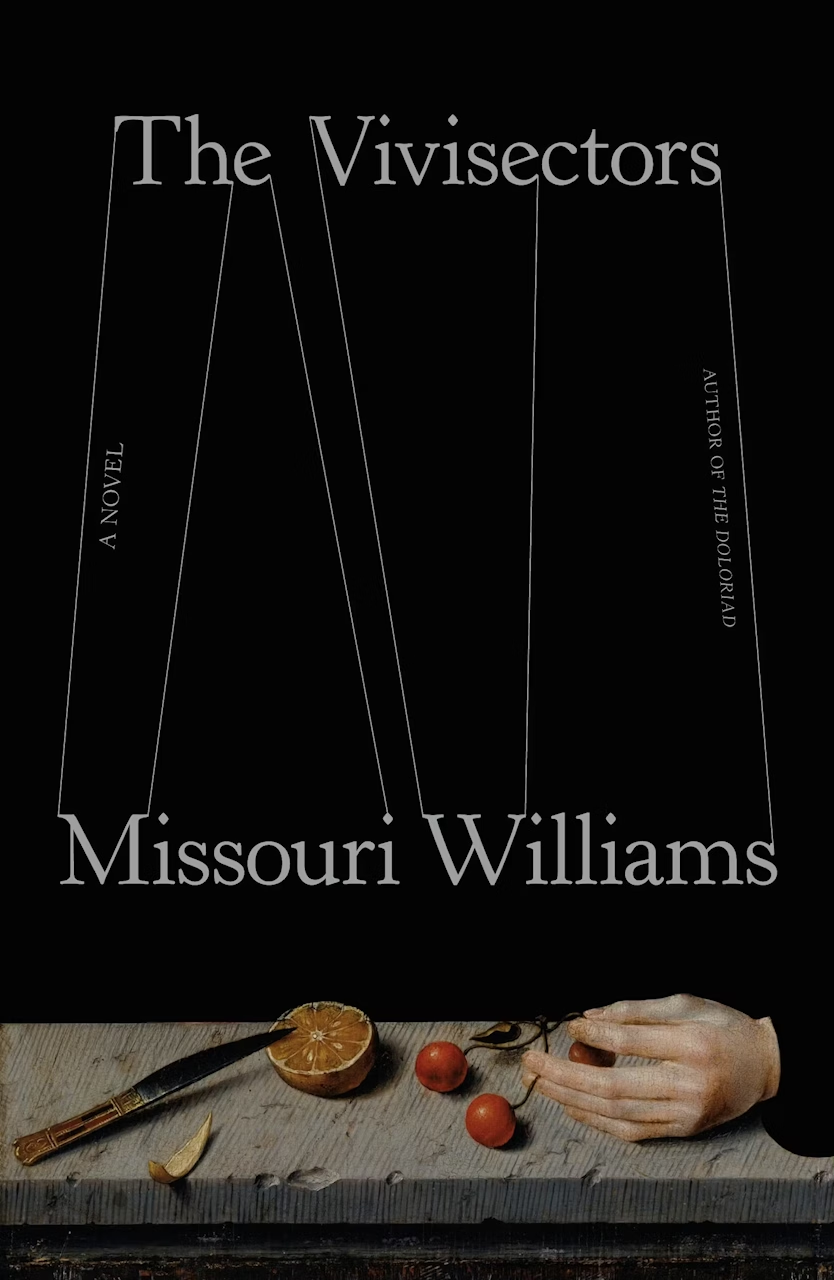
The Vivisectors Book Cover
I’m curious about the process of writing The Vivisectors. How did you approach the novel? Were there other books or writers you had in mind while working on it?
I approached the book like a puzzle to be solved. The writing process was very controlled; sometimes I would think about one sentence for days. I wanted the prose to seem so smooth on the surface, for everything to be ordered and clean, nothing much to catch the eye, but at the same time for the book to be bright and jagged and withholding. I wanted to write something light and reflective but secretly weighty. There are many things hidden from both the narrator and the reader. Wanting this kind of structure meant that a lot of the writing process was often non-linear, a process of finding the connections between different aspects of the character and story, thinking about the ways that one image might rebound on another, and of being surprised by what I discovered.
“I wanted the prose to seem so smooth on the surface, for everything to be ordered and clean, nothing much to catch the eye, but at the same time for the book to be bright and jagged and withholding. I wanted to write something light and reflective but secretly weighty.”
I love so many books. Here are just a few that I was thinking about while writing and what they gave to me. Plato’s Republic for everything that it says about cities and souls. Italo Calvino’s Invisible Cities for the same reason. Greek tragedies and Gerald Murnane’s The Plains for thinking about what a chorus can do. Edmund Spenser’s Faerie Queene and The Romance of the Rose for their extended allegories and moral instruction. Nabokov’s Pale Fire and Pnin for their sense of academic triviality, the decadence of thought. Piers Plowman for the seriousness of salvation. And then John Donne’s Devotions on Emergent Occasions is a text that comes up a lot in the book itself, sort of as a touchstone for thinking about figurative language.
How did you arrive at the title? I’m asking because, after reading the novel, it seems that the characters are all, in some way, “rearrangers of other people’s things” — solving one problem, then another. Most of them fall apart. Some find refuge within the university, but almost all of them are bound by their disconnection from one another.
I was looking for a figure or image that could capture the impulse to tear another person apart through the dissection of speech, to look for what is buried beneath the surface meaning. I wanted to think about the kind of interpretive paranoia that might emerge as the disembodiment already present in a society that revolves around the transmission of speech and thought through writing, which is intensified by the movement of discourse online. Even though the internet features only intermittently throughout the novel, the type of reading it has engendered very much informs its atmosphere and world.
While reading the novel, particularly some of your most radiant sentences, I was reminded of Clarice Lispector, Anna Kavan, Rachel Kushner, and Ottessa Moshfegh. This was especially true in relation to Agathe, the main character, whose deep interiority is paired with an almost anesthetized emotional distance. She seems semi-interested, ambitionless, and detached, yet she renders the crumbling world of the city and university — suffocated by omnipresent flora — with acute detail. What was the background to writing Agathe’s character?
I wanted to write someone completely blind to their own inner reality but who aggressively believes otherwise. Agathe insists that she is a certain way but then her actions and perceptions contradict her self-interpretation; she is receptive to the world and everything in it and conveys her experience vividly and full of feeling. Anna Kavan is a real hero to me––I think of how consuming the narrator’s obsessions are in Ice, how relentlessly he is driven by his desire to apprehend the woman that he pursues in a certain way and the destruction that this leads to. I also wanted to position Agathe as the product of her surroundings. A friend described The Vivisectors as the bildungsroman of a person but also of a city. It’s explicitly concerned with the possibility of different types of growth and the difficulty of recognition. Agathe is a sceptic, not because she doubts, which is natural, but because she denies the reality of other people, which is much crueler.
“I think literature needs to preserve its relationship to unlikability, to difficult and upsetting things.”
Beyond the characters, you construct an entire country, and the power of vegetation — the flora — plays a huge role in the novel. It seems to register unease and malaise between the characters, but also a broader environmental imbalance and crisis within this imaginary world. Gardens and parks feel powerful, almost feared. Asphalt is crumbling; weeds grow through its cracks. It is always raining. The city is damp, unstable, and constantly on the verge of collapse. I imagined it somewhere in Scotland or Ireland. How did the country you come from inform the way you wrote the novel’s imaginary landscape and city?
When writing the novel I was living across so many different cities: London, Prague, Brussels, Chicago, and travelling to so many others. All of these have made their way into the setting in some way. But the damp and decline is––for me––very post-Brexit England, with crumbling, ailing infrastructure, and a generalized sense of depression accompanied by clinging to an image of a past of supremacy. That aside, it was very important to me that nothing in the novel be definitively traceable to anything in our world; I wanted each place and character to gesture in many directions simultaneously. And then the world of the novel is not that of nations, but of competing city states. If I was inspired by the places that I was living in terms of atmosphere, the political and social climate of the book draws from Ancient Greece and the warring Italian city states of the medieval period. It reflects discourses of empire that belong much more to antiquity than they do to our own time, although that’s buried there too, of course. In the world of the novel the insider-outsider dynamic is conducted along the paradigm of citizenship and participation in the life of one dominant city. But the encroachments of the natural world compound the sense that the power of this city is waning.
I loved the detail of the red tram. Was this partly inspired by the old trams in Prague?
Yes! I love the trams here, and also how blasé people are about dashing in front of them. I’m always afraid of getting run over.
Although Agatha is detached, depleted, and often unlikeable, you write her with dazzlingly cold, scornful humor. I loved her emotional atmosphere, and even her lack of empathy. She almost becomes likeable. Kirkus described your writing as “heir to writers like Ottessa Moshfegh, whose female protagonists often possess a passivity and an icy detestation of society that teeters on the brink of nihilism.” What do you think when critics compare you to such writers? And what do you think is literature’s relationship to unlikeability?
I think the novel quite self-consciously positions itself within this kind of germinal tradition, especially in the chapter where the schoolmaster rants about the state of contemporary literature and what he sees as its bloodless first-person narrators. And I agree with her argument there, which is that this mode of narrative is responding to the conditions of our time, and more than anything a kind of emptying out of the present by the movement of our attention online. After writing The Doloriad, I wanted to try my hand at something constrained to a single voice and mind, and then further hemmed in by the nature of the character doing the perceiving. At the same time, I think the book also undermines and almost parodies that perspective through its inclusion of more absurdist elements. A novel I felt a lot of kinship recently is Harriet Armstrong’s To Rest Our Minds and Bodies, which I think is almost like the ultimate realization of that form, the first-person passive female narrator exaggerated to Beckettian proportions. It was an amazing read.
I think literature needs to preserve its relationship to unlikability, to difficult and upsetting things. It doesn’t make sense to me to make the kind of moral demand of a book that one might make of a person, that it should treat its characters well, that it should only depict ‘good’ or acceptable things.
I enjoyed the novel’s unexpected, restless ending — Agatha finishes what her mother intended. Did you have other endings in mind, or was this ending clear to you from the beginning?
I knew what I wanted to happen, just not how I’d get there. In the end it surprised me that what she does, however outrageous, feels like part of her growth, that she finally does something for another person, however contra the laws of society. She respects her mother’s desire to author her own ending.
Beyond literature, I was also reminded of Lucrecia Martel’s film The Headless Woman, a mysterious story about a middle-aged dentist, Vero, who enters a peculiar psychological state after a car accident and tries to determine whether she has killed someone. What is your relationship to cinema as a writer?
I wanted to make films long before I wanted to write books, and I hope one day I will. I see my writing as dominated by certain images. For a long time, I co-edited the film journal Another Gaze, where I worked with so many amazing writers, and the best kind of film criticism really does teach you how to write visually if you want to do justice to your object. On another note, I saw The Headless Woman years ago and still think about the way it charts the worst possible relationship to doubt. I found the film so upsetting.
Who were — and who are — your literary heroes?
Clarice Lispector. Mervyn Peake. William Gaddis. Anna Kavan. Nathalie Sarraute. Herman Hesse. Thomas Pynchon. Bruno Schulz. But I have so many more. I loved to read long before I ever thought about writing.
How is your life and writing in Prague? How does the city inform both? I’m asking because I studied and lived there for seven years, then eventually became fed up with the city. Since visiting again, however, I have fallen in love with it once more.
I have lived here longer now than I have ever lived anywhere else; it feels like home to me now. I love how green and vibrant the city is and the torrential summer rains. That sense of everything growing so rampantly in both my novels comes from my time here. I think it’s about as perfect as a city can be.
The people’s princess is back on the French Riviera. Bella Hadid has long been considered Cannes royalty at this point, and not without reason. Years of Schiaparelli couture branches wrapped across her chest, dramatic red chiffon trailing behind her, and the occasional archival reference have made her one of the festival’s safest fashion bets. Turning heads on the red carpet was never going to be the issue. Ours, however, kept turning for the off-duty looks too.
The premiere of Jeanne Herry’s Garance marked Hadid’s first official outing of the festival, and Prada handled the occasion accordingly. The model wore a custom strapless grey maxi dress, embellished with crystals across the bodice, later topped with a matching jacket that seemed far more interested in becoming a cape. And as a Chopard ambassador, the sparkle hardly stopped at the dress.
Not too long after, Antonin Baudry’s La Bataille De Gaulle: L’Âge De Fer premiere welcomed her and her custom Schiaparelli dress of just 22,160 hours of work and the expertise of 130 artisans. It arrived in ivory, entirely crafted from trompe-l’œil lace embroidery, built from cords and anchored threads, dropping into a deep neckline before falling into a tiered mermaid train. But you’ve seen this before. Jane Birkin at the 1969 Gala de l’Union des Artistes.
Her off-duty looks lean far more casual, though never dull. Hadid was spotted walking the theatre’s iconic staircase in a Tom Ford two-piece from Fall 2026. A somewhat relaxed long-sleeved turtleneck blouse, paired with matching low-rise pants and a tiny croc belt, completed with just the essentials. A pair of shield sunglasses and a key pendant in the shape of Palestine.
In the meantime, the model got her hands on a mint-blue satin zip-up midi dress from Marc Jacobs’ Louis Vuitton Spring 2003 collection, paired with pointed pumps from the brand’s collaboration with Takashi Murakami. And really, what’s the South of France without gingham capris and a few pastels? Preferably finished with a tiny top and a touch of ruffles.
The Cannes Film Festival is officially all about cinema, but it also tends to double as a high-stakes fashion endurance test with one too many cameras and not enough mercy. The opening ceremony already set the tone for what’s to come, couture seems to feel safer when it’s melting under the South of France sun. The following red carpets haven’t exactly disappointed either. Αnd with the festival’s new rule about (no) naked dressing in play, the safest strategy this year seems to be simple: just look cool. Thankfully, our favorite looks played along.
Moore understands the concept of looking cool, Brad Goreski (on styling duty) seems to do so too. The actress’s Oscars look had us already waiting with anticipation. Little did we know Mariacarla Boscono’s top, seen on the Gucci Cruise runway in Times Square just two days prior, would make it all the way to the French Riviera. Satin trousers, Chopard jewelry, and a pair of pitch black, mask-ish sunglasses completed the outfit.
Blanchett turned to Givenchy and Sarah Burton’s Fall 2026 collection for the occasion. She opted for a maxi, backless halter dress covered in florals and finished with dangling fringes. And if that already sounds like a lot, the matching Bonbon gloves push it further, fringes almost sweeping the floor with every move. Still, on Cate Blanchett, it might just be an almost bare face that holds everything together.
Zhao might have been the best-dressed director of the scene. Our favorite look was “Isabella Blowfish,” a two-piece decorated with black horn-like details and crystals, courtesy of Schiaparelli Spring 2026 Couture. Daniel Roseberry drew inspiration from Elsa Schiaparelli’s fascination with animal life, as well as the late Isabella Blow. Straight from the runway, and already enough.
Exarchopoulos looked a lot like Zoë Kravitz, her dress did, at least. The actress chose a lace gown heavily structured around the hips, from Anthony Vaccarello’s Fall 2026 Saint Laurent collection. Kravitz’s version was already a favorite at this year’s Met Gala, but Cannes called for something slightly different: a touch of burgundy and an open back.
Jordana went with Vaillant Studio, and Vaillant Studio went with an embroidered feathered dress from the Fall 2026 runway. Halter neck, sheer core, a little lace, volume down the waist, leather gloves, and a rose in hand belong under premiere lights. So does black with a pop of pink and red, just enough to echo the carpet beneath your feet.
What’s better than Colman Domingo on a red carpet? Colman Domingo in a Boucheron top. Purple, glittering, with a cape trailing behind, a cinched waist, and sharply structured shoulders. If there’s one thing the actor does better than suits, it’s embracing feminine touches. And by “better,” we mean this is as good as it gets.
Purple had its moment this time around, rightfully so. Mason has a thing for unsuccessfully buttoned-up shirts. We might have developed a thing for purple, unsuccessfully buttoned-up shirts. Paired with blackout sunglasses that feel like they belong to another decade and high-waisted trousers, a touch of dolce vita suddenly slips into France too.
After briefly pretending she’d abandoned pop for “rock music”, Charli’s latest identity crisis comes with a runway and a descent into hell. “Yeah, we’re walkin’ on a runway that goes straight to hell. Nothing’s gonna save us, not music, fashion, or film.” Hate to disagree with the original brat, but fashion might actually save us. Or at the very least, a few archival references and a cameo-filled industry fever dream are enough to temporarily revive a fashion editor’s serotonin levels. And if nothing’s going to save us, the least fashion can do is provide a look.
An invite posted through her finsta (@b.sides), set the tone for SS26, slightly unwell. First of all, because the internet immediately worried about the emotional stability of the “Angels” if Charli actually decided to release a fashion collection unannounced. Secondly, because we are already well beyond Spring/Summer 2026, with Cruise 2027 collections already looking hard to top. Fortunately, music remains the grounding force.
And hell, apparently, comes with a front row. A guest version of Charli, sandwiched between Carine Roitfeld, ex–Vogue Paris editor-in-chief, now leading CR Fashion Book, and Anthony Vaccarello, creative director of Saint Laurent, watched model-Charlie walk down the runway. Supermodel Debra Shaw, Zadig & Voltaire’s Dan Sablon, La Watchparty’s Lyas, Supreme’s Zac Ching, filmmaker Loïc Prigent, the August Barron duo alongside their go-to PR lead David Siwicki, as well as Lucien Pagès, and Michel Gaubert (the man behind Karl Lagerfeld’s and Matthieu Blazy’s Chanel runway soundtracks), did too.
Model-Charli (who also was the only one there), walked the very 90s-inspired runway (also seen in Demna’s Gucci) in Saint Laurent (that’s what ambassadors do, right?), Balmain, Ann Demeulemeester, Chrome Hearts, and Lou De Bètoly, as examples. She even managed to bump into herself, recalling Shalom Harlow and Brandi Quiñones on Gianni Versace’s Spring/Summer 1995 runway. She later twisted her heel, fell, and laid on the floor for a moment before getting back up, much like Carrie Bradshaw in Sex and the City. A few scenes later, she’s lighting a cigarette and walking it off. Something Carrie would romanticise, and Kate Moss would probably treat as a standard Tuesday. Nothing is saved, but at least it’s well-dressed.
Sunglasses have quietly stopped behaving like accessories. They’re doing more than finishing a look. They’re setting it.
This summer that shift feels even clearer. Outfits are getting simpler, lighter, less constructed. The detail that pulls everything together is often just a frame on the face.
Everything else can stay fairly straightforward. Sunglasses do the rest.
Tailoring your outfit to your sunglasses
A plain white tee, a clean shirt, simple tailoring, even sportswear all read differently depending on what’s on your face. It’s immediate. Nothing else in the outfit needs to change.
Slim frames tighten things up. Chunky acetate adds weight. Dark wrap styles lean more technical. Softer shapes feel easier, less deliberate.
That variation is why eyewear has become one of the most reliable ways to shift a look without rebuilding it.
Summer dressing has got more direct
There’s less interest in layering or complicated combinations right now. The focus has moved toward ease. Clothes that work on their own without much adjustment.
Sunglasses fit into that way of dressing better than most pieces. They don’t require coordination. They don’t rely on context. They sit on the face and immediately change how everything else reads.
That’s why they’ve become part of daily wear rather than something saved for specific conditions.
Indoors, outdoors, and everywhere in between
The old rules around sunglasses don’t really apply anymore.
They’re not reserved for bright days or holidays. They stay on through trains, cafés, studios, airports.
Part of that is practical. Light exposure isn’t consistent anymore as screens, artificial lighting, and constant visual demand mean brightness is less about the sun and more about everything else around us.
Light-filtering and anti-blue light lenses sit inside that shift. They don’t announce themselves. They just soften the edges slightly. In practice, they end up being worn like any other pair of sunglasses.
Function Blending Into Style
Light-filtering lenses, including blue light sunglasses have made their way into everyday eyewear in a fairly natural way.
They started with a functional purpose: Reduced eye strain when looking at screens outside, meaning better focus across long days. That part still matters, but it’s no longer the main reason people reach for them.
Once they’re on the face, they become visual rather than technical. A slight tint, a softer reflection, a different way light sits on the lens. Those details read as style long before they read as function.
They’ve effectively merged into the same category as sunglasses.
Choosing blue light sunglasses
Multiple companies offer blue light sunglasses, but you want to look for brands that give you actual information on how much blue light they actually filter. Look for someone with patented blue light technology with explicit filtration rates, like Horus X who specialize in blue light lenses.
Making your outfit more fashion forward this summer.
Sunglasses are often the first thing someone sees, even though they’re one of the last things added.
That’s part of why they’ve become so important in how people dress now. They don’t require explanation. They don’t need context. They just change how everything else is read.
Delivery vehicles have become a constant presence on roads throughout Athens. From Amazon vans and UPS trucks to grocery delivery drivers and food courier services, commercial delivery traffic has increased dramatically over the last few years. While these services bring convenience to customers, they also create new dangers for drivers, pedestrians, cyclists, and passengers sharing the road. Delivery drivers often work under intense pressure to meet deadlines, complete routes quickly, and handle a large number of stops every day. That pressure can lead to speeding, distracted driving, fatigue, and careless decisions behind the wheel.
When a delivery vehicle causes an accident, victims are often left dealing with painful injuries, expensive medical treatment, lost income, emotional stress, and uncertainty about the future. Unlike ordinary car accidents, delivery vehicle crashes usually involve commercial insurance companies, corporate legal teams, electronic tracking systems, and complicated liability questions. These cases are rarely simple, which is why many injured victims turn to an Athens Delivery Vehicle Accident Attorney for legal guidance and financial recovery support.
Why Delivery Vehicle Accidents Are Becoming More Common in Athens
Athens has experienced a steady rise in delivery-related traffic because online shopping and same-day delivery services have become part of daily life. Residents now rely heavily on package delivery companies, restaurant delivery apps, grocery delivery services, and courier businesses. As demand continues growing, delivery drivers spend longer hours on the road and often operate under unrealistic scheduling expectations.
Many drivers are expected to complete deliveries within strict time limits. This environment can encourage unsafe driving behavior. Drivers may rush through intersections, stop abruptly, double park in busy streets, check GPS devices while driving, or operate vehicles while exhausted. In some situations, companies prioritize speed and productivity over road safety.
Delivery accidents also occur because many drivers lack professional commercial driving experience. Some companies hire temporary workers or independent contractors who may not receive proper safety training. Vehicle maintenance can also become an issue when companies fail to inspect brakes, tires, lights, and steering systems regularly.
Common Causes of Delivery Vehicle Accidents
Delivery vehicle crashes happen for many reasons, but negligence is often a major factor. Distracted driving is one of the leading causes because drivers frequently rely on navigation systems, mobile apps, route updates, and customer communication while operating the vehicle. Even a few seconds of distraction can lead to devastating consequences.
Driver fatigue also plays a significant role in commercial delivery accidents. Long work shifts and repetitive routes reduce reaction time and decision-making ability. Fatigued drivers may struggle to notice sudden traffic changes, pedestrians, or vehicles stopping ahead of them.
Speeding is another common issue. Many drivers attempt to complete deliveries faster to meet performance expectations. Speeding reduces stopping distance and increases the severity of crashes. In residential neighborhoods and urban streets, speeding delivery vans create substantial risks for families and pedestrians.
Poor vehicle maintenance contributes to many commercial vehicle accidents as well. Brake failures, tire blowouts, steering malfunctions, and lighting problems can all increase the likelihood of collisions. Companies that neglect routine inspections may be held responsible if mechanical failures contributed to the accident.
Why Delivery Vehicle Accident Cases Are More Complicated Than Regular Car Accidents
A standard car accident usually involves two personal drivers and their insurance companies. Delivery vehicle accident claims are very different because commercial businesses are involved. Large corporations often have aggressive insurance providers and legal teams focused on minimizing payouts.
One major complication involves employment classification. Many delivery companies classify drivers as independent contractors rather than employees. Companies sometimes use this classification to avoid responsibility after accidents occur. However, liability depends on more than job titles alone. Courts may examine how much control the company had over the driver’s schedule, routes, vehicle requirements, and work conditions.
Another challenge involves insurance coverage. Several insurance policies may apply in a single delivery vehicle accident case. There may be commercial vehicle coverage, employer liability insurance, third-party contractor policies, or personal auto insurance involved.
Injuries Frequently Seen in Delivery Vehicle Accidents
Commercial delivery vehicle crashes can cause severe and life-changing injuries, especially when larger vans or trucks are involved. Victims often suffer injuries that require extensive medical treatment, rehabilitation, and long-term care.Traumatic brain injuries are among the most serious outcomes of high-impact collisions. Brain trauma can affect memory, concentration, emotional health, and physical functioning. Some victims experience permanent cognitive impairment that changes their ability to work and live independently.
Spinal cord injuries are also common in severe commercial vehicle accidents. Damage to the spine can result in chronic pain, nerve damage, mobility issues, or paralysis. Neck injuries and back injuries frequently develop even in crashes that initially appear minor.Broken bones, internal bleeding, burns, facial injuries, and soft tissue damage are regularly reported after delivery vehicle collisions. Emotional trauma may continue long after physical wounds heal. Many accident victims struggle with anxiety, depression, sleep disruption, and fear of driving following a serious crash.
Medical treatment after a delivery vehicle accident can become extremely expensive. Emergency room visits, surgeries, rehabilitation programs, physical therapy, medications, and future medical care often create long-term financial stress for injured victims and their families.
How an Athens Delivery Vehicle Accident Attorney Helps Victims
Many accident victims underestimate how difficult commercial vehicle claims can become. Insurance companies begin protecting their financial interests immediately after the crash occurs. Adjusters may contact victims quickly and attempt to secure recorded statements or low settlement agreements before injuries are fully diagnosed.
An experienced Athens Delivery Vehicle Accident Attorney helps protect victims from these tactics. The attorney handles communication with insurance companies, investigates the accident, gathers evidence, reviews medical records, and calculates the full value of damages.
Attorneys often work with accident reconstruction experts, medical specialists, financial analysts, and commercial vehicle investigators to strengthen the case. Legal teams may examine driver history, employment records, maintenance reports, company safety practices, and delivery schedules to determine whether negligence contributed to the crash.
A lawyer also evaluates future financial losses. Many victims focus only on current medical bills, but serious injuries often create ongoing expenses related to rehabilitation, reduced earning ability, disability accommodations, and long-term care. A strong legal claim considers both present and future damages.
Compensation Available After a Delivery Vehicle Accident
Victims injured in delivery vehicle accidents may be entitled to compensation for both financial losses and personal suffering. Medical expenses are usually one of the largest components of a claim. Compensation may include emergency treatment, hospital stays, surgeries, specialist visits, rehabilitation costs, medication expenses, and future medical care.
Lost income is another important factor. Serious injuries may prevent victims from returning to work temporarily or permanently. Compensation can cover lost wages, reduced future earning capacity, and employment-related benefits.
Pain and suffering damages are also significant in many delivery vehicle accident cases. Physical pain, emotional distress, mental trauma, and reduced quality of life can affect every part of a victim’s daily routine. Courts and insurance companies may consider the long-term impact of permanent injuries when calculating compensation.
Final Thoughts
Delivery vehicle accidents often create far more legal and financial complications than ordinary car crashes. Victims may find themselves facing corporate insurance companies, disputed liability claims, electronic evidence issues, and mounting medical expenses while trying to recover physically and emotionally.An experienced Athens delivery vehicle accident attorney helps injured individuals understand their legal rights, preserve critical evidence, determine liability, and pursue full compensation for their losses.
Strong legal representation can make a major difference in the outcome of a commercial vehicle accident case, especially when large delivery companies and insurers attempt to minimize payouts.For accident victims and families struggling after a serious delivery vehicle crash, taking early legal action may improve the chances of securing financial recovery and long-term stability.
If you notice, people do not want trips where every day follows the same schedule that thousands of other tourists already follow. A lot of travelers want to feel connected to the place they are visiting. They want to spend time around local culture, try food that actually belongs to the region, meet local people, and experience things that feel real to them.
This is one of the biggest reasons personalized travel experiences are getting more attention. Travelers want trips built around what they enjoy, how they like to travel, and what kind of memories they want to take back home.
Here are the main ways cultural exploration is pushing more people toward personalized travel experiences.
Travelers Want Local Experiences Instead of Typical Tourist Activities
A lot of travelers are tired of trips that only take them to the same famous places everyone already knows. Those places can still be worth visiting, but they are not enough for many people now. Travelers want to feel the real life of a destination. They want to walk through local streets, visit small food spots, see how people live, and spend time in places that feel connected to the culture.
This is one reason personalized travel experiences are getting more attention. Every traveler has a different idea of what makes a trip special. Some people enjoy local food and markets. Some enjoy history and old neighborhoods. Others want music, art, festivals, or quiet places where they can experience the area without feeling rushed.
Travel today is increasingly shaped by the desire for deeper cultural engagement rather than surface-level sightseeing. Travelers want to experience destinations in a way that feels authentic, whether through local cuisine, unique neighborhoods, or meaningful activities that reflect the character of a place. Delivering this requires more than basic bookings, it requires careful planning that aligns experiences with individual interests. When itineraries are built with this level of intention, the journey becomes far more immersive and emotionally engaging. This is whypersonalized travel planning is becoming central to how modern travelers explore the world.
Plus, a fixed package may show people the main attractions, but it often misses the details that make a place feel alive. Personalized planning gives travelers more space to choose what matters to them, whether that is food, history, daily life, or local traditions. This makes the whole trip feel more natural, more useful, and more memorable.
Food Culture Is Becoming a Major Part of Travel
Food has become one of the biggest reasons people travel. For many travelers, trying local dishes has become part of the entire experience. People want to taste food that belongs to the place they are visiting rather than eating the same international meals available everywhere else.
This growing interest in food culture is increasing demand for personalized travel experiences. Some travelers want street food tours. Others want fine dining experiences connected to local traditions. Some people want cooking classes, family-style meals, or visits to local farms and food markets. Every traveler enjoys food differently, which makes personalization important.
I spoke with Luciano Armanasco, Founder & Tour Leader at Our Dolce Vita. He shared, “The best food experiences are rarely picked from a standard list. They come from understanding what a traveler enjoys, then matching that person with the right local table, market visit, cooking lesson, or small restaurant away from the usual tourist path. For a well-planned trip, food should fit the route, the pace of the day, and the kind of memories the traveler wants to bring home.”
Food also helps people feel more connected to a destination. A traveler may forget a hotel room after a few months, but they often remember a traditional meal shared in a local neighborhood or a small restaurant recommended by residents. These experiences feel more genuine because they are connected to the culture of the place.
Travelers Want Trips Built Around Personal Interests
Some people love museums and history. Others care more about music, shopping, nature, architecture, or cultural festivals. This is why many travelers now prefer personalized experiences that match their own interests instead of general travel packages created for everyone.
Traditional tour packages often follow fixed plans that try to satisfy large groups. The problem is that every traveler has different expectations. A person interested in photography may want extra time exploring local streets and cultural areas, while another traveler may want a relaxing schedule with food experiences and slow-paced activities. Personalized travel planning makes those choices possible.
According to Bill Sanders, from TruePeopleSearch, “Good personalization starts with understanding people. Travel plans work better when they reflect someone’s interests, habits, pace, and reason for taking the trip. A family looking for cultural activities, a solo traveler researching local neighborhoods, and a couple planning a slower getaway may all visit the same city, but they need very different experiences to make that trip feel right.”
People are also paying more attention to how they feel during a trip. Some travelers enjoy busy schedules packed with activities, while others prefer slower travel with more free time. A personalized experience gives travelers more control over pacing, accommodations, activities, and daily plans.
Social Media Is Increasing Interest in Authentic Cultural Experiences
Social media has completely changed the way people discover travel experiences. Travelers no longer rely only on travel brochures or agency recommendations. Every day, people see videos, photos, and travel stories shared by creators, locals, and travelers from around the world. This exposure has increased interest in cultural experiences that feel more real and less commercial.
Many travelers now search for experiences they see online, such as local festivals, hidden food spots, traditional neighborhoods, artisan markets, or cultural activities that are not part of standard tourist routes. People want trips that feel unique and personal because they are constantly exposed to different travel experiences online.
This is also pushing travelers away from generic travel plans. A lot of people already know what they want before booking a trip because they have spent weeks watching destination content online. Some travelers save restaurant lists. Others save local experiences, cultural events, or hidden places they want to visit. Personalized travel planning helps organize these interests into a trip that actually matches the traveler.
Social media has also increased interest in storytelling through travel. People want experiences they can genuinely talk about and remember. A crowded tourist stop may not feel exciting anymore if it looks exactly like every photo online. Travelers now look for moments that feel more personal and connected to the local culture.
Travelers Want More Meaningful Connections During Their Trips
For many people, travel is no longer only about visiting famous places and taking photos. Travelers also want places and experiences that feel personal, warm, and memorable. They notice the mood of a street, the design of an old building, the lighting inside a local restaurant, and the small details that show how people live in that destination. These moments often stay with them longer than crowded tourist attractions.
This is one reason cultural exploration is increasing interest in personalized travel experiences. Some travelers want to attend local festivals. Others want to join cultural workshops, learn traditional crafts, visit old neighborhoods, or spend time in spaces that show the local way of life.
Jonathan Matha, CEO of Modern Chandelier, said, “People often remember a place by how it made them feel. The lighting in a hotel lobby, the design of a dining room, or the atmosphere of a cultural venue can shape the whole travel experience. When those details reflect the local character, the space feels less like a stop on a trip and more like part of the destination itself.”
A personalized travel experience also gives people more room to spend time on the cultural details they truly enjoy. If someone enjoys history, they may want longer visits to old buildings, museums, and historical areas. Another traveler may care more about local music, art, architecture, interiors, or traditional performances. Every traveler connects with culture differently, which makes customized travel planning more valuable.
Group and Family Travel Often Need More Flexibility
Group travel has become more complicated because people within the same family or friend group often want completely different experiences. One person may want adventure activities, while another may prefer cultural tours, shopping, or relaxing experiences. Children, parents, and older family members also travel at different speeds and comfort levels.
That’s where personalized travel experiences become useful. A fixed travel package may work for some people, but large groups usually need more flexibility. Families often want travel plans that allow everyone to enjoy the trip without feeling rushed or uncomfortable. Customized planning helps balance those different interests more effectively.
Even Dan Close, Founder and CEO at We Buy Houses in Kentucky, mentions, “Any plan involving a family works better when it respects how different people use the same space or time. In real estate, one person may care about comfort, another about location, and another about long-term value. Family travel is similar. A good trip should leave room for different needs, so everyone feels included instead of forced into the same schedule.”
Wrapping Up
Cultural exploration has become one of the biggest reasons travelers now look for more personalized experiences. People want trips that feel connected to their own interests, whether that means local food, cultural activities, historical places, art, music, or everyday life in a destination. A standard travel package often cannot give travelers that kind of personal experience anymore.
This is why travel companies are paying more attention to customized planning, flexible itineraries, and local experiences. Travelers want more freedom in how they explore a place and what they spend their time doing.
Hauser & Wirth recently brought its Learning Exchange: Artists Matter initiative to Downtown Los Angeles, during which artists, educators and nonprofit organisations assembled around topics of access and community-led arts education. Held on 2 May 2026, the gathering marked the latest edition of the gallery’s Learning Exchange series following earlier iterations in New York and Somerset, while coinciding with the tenth anniversary of Hauser & Wirth Los Angeles’ learning programmes and local partnerships.
Programmed alongside the exhibition Destiny Is a Rose: The Eileen Harris Norton Collection, the event centred on the role artists and cultural institutions can play in creating long-term educational pathways for young people. One conversation in particular, between artist Mark Bradford and Senior Director of Learning Debbie Hillyerd, explored Bradford’s socially engaged practice and his longstanding commitment to expanding access to contemporary art beyond traditional institutional audiences. Throughout the discussion, Bradford reflected on creativity as a form of shared knowledge and emphasised the importance of artists supporting emerging voices and lived experience within cultural spaces.
The programme also featured contributions from young participants connected to Culture for One, a nonprofit supporting children and young adults in foster care, as well as exhibition tours led by artists and educators from Art Division. Their involvement reinforced the event’s broader emphasis on community collaboration and cultural accessibility, themes that also shape Destiny Is a Rose, an exhibition examining collector Eileen Harris Norton’s decades-long support of women artists, artists of colour and California-based practices.
Watch the short Learning Exchange: Artists Matter film here.