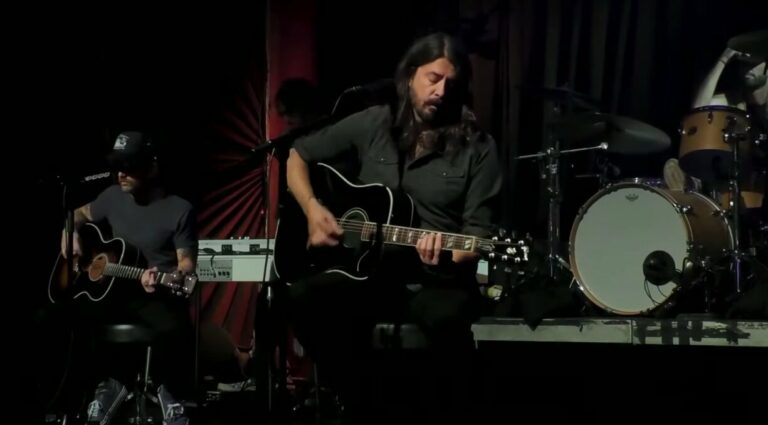
Following the singles ‘Persona Non Grata’ and ‘Forced Convalescence’, Bright Eyes have shared the third track from their forthcoming album, titled ‘One and Done’. Listen to it below.
The song features Red Hot Chili Peppers’ Flea on bass and Queens of the Stone Age’s Jon Theodore on drums, with Nathaniel Walcott providing the track’s orchestral arrangement and Miwi La Lupa singing backing vocals.
The release date of the album, which will be their first since 2011’s The People’s Key, has yet to be announced.
Billie Eilish has released a short film titled ‘NOT MY RESPONSIBILITY’. The video, which addresses the public’s perception of the artist’s body and clothing, premiered at the opening night of her now-postponed 2020 world tour in Miami. Watch it below.
Against a chilling instrumental backdrop, the film sees Eilish removing layers of clothing before sinking into water. “The body I was born with – is it not what you wanted?” she asks. “If I wear what is comfortable, I am not a woman,” she continues. “If I shed the layers, I’m a slut.”
“Would you like me to be smaller? Weaker? Softer? Taller? Would you like me to be quiet? Do my shoulders provoke you? Does my chest? Am I my stomach? My hips?” she goes on to ask.
As she sinks further into the dark, the film ends with the question: “Is my value based only on your perception? Or is your opinion of me not my responsibility?”
Earlier this month, Eilish announced she would postponing all remaining tour dates of her ‘Where Do We Go?’ tour due to the coronavirus pandemic.
To celebrate the cartoon band’s 20-year visual history, the Gorillaz have announced an expansive book called the Gorilla Almanac. The hardback will feature original art from over the years by Jamie Hewlett, as well as games, puzzles, and previously unreleased artwork.
Due out this October, the book will be published by Z2 Comics, and is described by a press release as a “full colour, one-of-a-kind, fun-packed, 120+ page, sideways homage to two glorious decades of Gorillaz.”
“Every fan of comics and animation has dreamed of seeing the Gorillaz make their comic book debut, with the Z2 team chief among them,” Z2 publisher Josh Frankel said. “The artwork, the music, and the mythos all add up to what is destined to be one of our most buzzed about releases in history, and when fans see just what we have planned, I know everyone will agree it was well worth the wait.”
“An almanac is an annual book that is a treasure house of useful information like weather forecasts, trivia and puzzles and games,” Z2 Comics’ Sridhar Reddy told Rolling Stone. “They used to sell almanacs at school book fairs, but I’m pretty sure the internet killed the concept of collecting information into a single published volume. It’s what I love about doing a Gorillaz almanac, in that it brings together so much of the ephemera of the band into a physical book that you can kick back with, take a fun deep dive and listen to great music while you’re doing it. It’s consistent with the band’s ethos of immersion.”
Over the past few months, Gorillaz have released the tracks ‘Aries’, ‘Momentary Bliss’ and ‘Désolé’ as part of the band’s ongoing Song Machine series. Earlier this month, they also performed ‘Aries’ on a remote edition of Jimmy Kimmel Live!
Being an independent musician was hard even before the coronavirus brought the world to a halt. With venues being shut down, tours cancelled, and releases postponed, the ongoing pandemic has shaken up the music industry as a whole, and independent artists are among those whose livelihoods are most threatened by the global crisis. To understand the different ways in which the COVID-19 outbreak has affected artists, we reached out to a number of musicians and asked them how quarantine has impacted their day-to-day lives, as well as their thoughts on how the current situation will shape the music landscape in the future.
Most obviously, the pandemic has forced musicians to cancel or postpone all live shows for the foreseeable future. “At first, I felt disappointed,” says experimental electronic producer Dasychira, who was set to go on tour in support of their debut album, xDream. “With all my shows either postponed or cancelled in Los Angeles and New York, most plans for the year were basically thrown out the window.” Beyond individual shows, festivals taking place in the summer are of particular importance for emerging acts looking to gain more exposure, such as the Australian psych-rock outfit The Lazy Eyes, who also had big plans for 2020. “This year was shaping up to include a lot of firsts for the band, namely going overseas to play at SXSW and The Great Escape,” they say. “We were all a bit down when the initial shock of losing so many exciting prospects was thrown on us, but we are just learning and adapting to these new and weird times.”
Playing live isn’t just an opportunity to promote one’s music – for the majority of working artists, it’s their primary source of income. Given that a recent report found that just 17% of musicians said that they were always able to pay their bills every month even before COVID-19, it’s a particularly dire situation with seemingly no end in sight. “Though most independent artists don’t make a lot of money from music, touring is still our best way to do that,” says Stephanie Phillips of the black feminist punk band Big Joanie, who, like many artists, released her debut solo EP Girlhood digitally due to the difficulties of getting a physical version together in this climate.
But beyond the financial losses suffered due to the cancellation of shows – a fact that highlights the fragility of the business model the industry is currently running on – the inability to play live has also taken a mental toll on many musicians. “Of course we’re economically distressed,” says Japanese singer-songwriter and poetry rapper Haru Nemuri, “but I’m suffering mentally in particular ‘cause when I can truly feel alive is only during my gigs.” For many artists, performing live isn’t just a necessary creative outlet, but a vital part of their artistic identity. This is the case with TV Priest, a UK post-punk outfit that recently put out their debut single, ‘House of York’. “We formed the band primarily as a live experience, to try and connect and commune with other people in a physical space,” they say. “That’s obviously not possible at the moment so it’s forcing us to think about how we can at least try and translate some of that feeling digitally.”
Like most professionals, artists have had to find innovative solutions to try to survive in this rapidly transforming, increasingly digitized environment. As Peter Bibby of Peter Bibby’s Dog Act notes, “one of the most interesting things about this whole thing is how people have adapted to it and found new ways to do what they do.” The most obvious example is the rise of virtual gigs, wherein artists stage livestreams from their living room or home studio and sometimes ask fans to donate whatever they can, if at all. While it doesn’t provide the same kind of financial stability, it helps strengthen the artists’ online presence and retain a connection with their fanbase. But the experience often just isn’t the same. “I’ve done a few Instagram live shows now but they don’t really replace the joy and connection of playing live in front of a real audience,” says Stephanie Phillips.
In the same way that we are now often prompted to look at past works of art in a new light, many musicians who have recently released music they recorded before the pandemic are now finding it take on new meaning. One such case is that of Henry Jamison, the Vermont singer-songwriter whose latest collaborative EP, Tourism, was recorded on or between tours and is “all about the the joys and terrors of life on the road.” Reflecting on the record now, he explains, “it’s almost as if all that touring was building up experiences within me, to be understood in this time away from it.”
Katie Harkin, a musician known for touring alongside the likes of Sleater-Kinney, Courtney Barnett, and Kurt Vile before taking center stage on her self-titled solo debut, finds herself in a similar situation. “I’ve spent most of my life touring since I was a teenager,” she says. “In so many ways this album is a reflection of that.” Interestingly, though, this isn’t the only way the context of the pandemic has reframed the making of the album. Harkin wrote much the record in a cottage in the UK’s Peak District, not far from the village of Eyam, whose self-sacrifice during the 17th century bubonic plague led to the first recorded use of the phrase ‘self-quarantine’. But the connection doesn’t end there. “Much of the interior artwork of the record comes from rolls of undeveloped film I found in my grandparents’ house after they passed,” she says. “They met in a TB sanatorium on the outskirts of Belfast during the outbreak in the 50s. My grandfather spent most of his twenties there. Releasing this record from lockdown, against the backdrop of mourning on a colossal global scale is something I could never have envisaged.”
Staying in quarantine has affected the artists’ creative process in different ways. Devenny, of the UK hip-hop collective 404 Guild, says it’s strengthened the desire for him and his friends in the guild to push themselves and do the best they can. “It has been hard on mentally but I think music has grounded me most days and allowed me a place to express my frustrations and feelings through experimenting and making music,” he says.
Henry Jamison has also been trying to take a practical and positive approach to lockdown, writing a song a day in an effort to “reenter that old way of doing it again.” In contrast to Tourism, he says his next release might be about “the joys and terrors of life at home (and probably everyone else’s will be too.)” But quarantine has made him focus his writing more on the world at large, and less on himself. “It’s almost paradoxical, but also isn’t, that retreating into our homes has led to a palpable feeling of mutual care, and that feeling is coming through in what I’m working on at the moment,” he explains.
But trying to remain productive during these times can often feel pointless. “I’ve just been making silly music on my computer at home rather than making music with my band,” says Peter Bibby. “I’ve found the whole thing quite uninspiring so I’ve definitely given myself a bit of a break from creative pressure and put my energy into other things.”
Part of the problem is having so much free time than that it becomes difficult to focus. “I always felt like a forced moment to breathe or rest would come as a positive experience, like a time to reflect and maybe a time to work on my personal development,” says BABii, an electronic producer who’s part of the GLOO collective featuring Iglooghost and Kai Whiston, and who also released a solo EP called iii+ this month. But it hasn’t always been easy. “Although my body is being forced to stay still, the freedom of time has opened up this huge deep pit in my mind of potential creative endeavours, as well as a huge amount of anxiety about the future. So much so that I am overloaded, unfocused, frozen and slowly edging towards some form of nihilism.”
But even when artists do manage to stay active during this period, it can feel strange to release or even talk about their music with a pandemic going on. “It’s kind of hard to know if it’s even ‘correct’ to be putting work out at the moment when so many things seem so much bigger than a song,” TV Priest say. “But we hope in the very least it’s a bit of a distraction from the world for whoever it reaches.”
Whether or not the current situation has been conducive to the artists’ creative process, it has certainly been a time of reflection for everyone. “Despite the Covid-19 chaos, I’ve managed to find a silver lining under this dark cloud,” says Dasychira. “I’ve been rethinking my intentions as an artist in an unpredictable reality, and how a lot of these intentions stem from self-reflection. By spending the time to get to know ourselves, and how we as individuals effect everything around us, I feel positive that we will all come out of this with a stronger sense of self-awareness in our expressions and actions.”
For singer-songwriter Johanna Warren, who has been touring extensively since 2012 with the likes of Mitski, Julie Byrne, and Marissa Nadler, having this time away from touring has proved unexpectedly valuable. “I feel like a kid who’s been put in time out, and I didn’t even know how bad I needed it,” she says. “I’ve spent most of the last decade on the road and I just put out a new record, so was planning to be on tour for the foreseeable future. But now, being forced to stay in one place, I’m realizing how exhausted I was, how much pain I was in, and how much much I like waking up in the same place day after day, eating at regular times and getting the recommended amount of sleep.” She adds: “The massive carbon footprint of life on the road had also been weighing on me for a long time, so I’m thankful for this opportunity to pause, reflect and re-strategize.”
In terms of how the pandemic will shape the music industry going forward, it’s hard to be certain of anything at this point. As TV Priest note, “it’s troubling to think of the economic impact on venues and spaces for live music and the arts in general.” Stephanie Phillips adds: “Many small, DIY venues will not be able to last the year so we will have to find another way to support independent artists and music organisations.”
But there seems to be sense of hope that, in bringing us together, this crisis might also have positive implications for the music industry in the long-term. “I think it will make the music community tighter and stronger after having to work together to get through such a crappy situation and has opened people’s minds to new possibilities in how to deliver music and performances to the world,” says Peter Bibby. BABii shares a similar view. “I think this will end up morphing the way the music and art world works, it’s gonna take a hard hit but we shouldn’t forget that art and music has never died and has taken worse beatings than this in one way or another,” she says. “I have a strong hope that we will all come through the other side, it just might be a bit of a different place when we get there, and that’s okay, because if nothing ever changed there would be no butterflies.”
Nobody knows how long it will be until we reach the other side of this crisis, but what’s certain is that the music landscape won’t be the same. As The Lazy Eyes note: “It will probably be a while before things go back to normal – and in saying that, there may be a new ‘normal’ to go back to altogether.” Articulating a vision for what that new normal could look like is not the easiest task, but TV Priest argue that “the best possible outcome could be a hopeful return to a more DIY atmosphere; rooted around community and human connection rather than musical proficiency, statistics, marketing collateral, endless content nausea, technological gatekeeping and economies of scale.”
Until then, though, direct fan support matters more than ever – especially as it’s still unclear how governments will act to support the creative sector in the coming months. Whether it comes in the form of buying an album, purchasing merch, or simply seeking out and sharing new artists, every contribution helps. We’ve already seen how powerful it can be when fans come together to collectively support artists: when Bandcamp waived its revenue share in an effort to help musicians impacted by COVID-19, it raised a combined $11.4 million in just two days. After all, giving something back is the least we can do when music has been one of the few things capable of providing comfort during isolating times – COVID-related or not. And as TV Priest put it, “There will be nothing better than that first night out in a dark room surrounded by your friends.”
Singer-songwriter Kaia Vieira, whose music is influenced by the likes of Portishead and Erykah Badhu, has shared a new track titled ‘The Care Giver’. Taken from her upcoming EP, Vikãra, out 29th May via These Furious Records, her latest single following ‘Make it Your Own Way’ and ‘Where Did You Go?’ showcases Vieira’s knack for compelling storytelling as it finds her combining elements of hip-hop with a slow-burning jazz-soul vibe and a touch of soulful electronica.
Talking about the track, the artist explains: “The actual title of ‘The Care Giver’ refers to a guardian figure abusing their position of trust. The figure is seen as this virtuous custodian from the outside but in reality, is ‘plagiarising’ the role of the absent parents. There’s a loss of childhood but there’s also survival, and even hope. It was my first attempt to ‘rap’ and I still wouldn’t call it necessarily rapping – I just wanted to tell a story more directly and it served the song to do it.”
Franz Sussbauer, a photographer and artist based out of Munich, Germany, presented an eye-striking, isolating series focused on the quarantine that was caused by COVID-19. Writing about the series Sussbauer stated: “April 2020 was a lockdown in Germany in case of Covid-19 pandemic. I used this time to get some rare pictures of my hometown Munich in addition to my series ‘Munich Squares’ I took pictures of abandoned places in the city center of Munich. This time it was quite easy to get, because of peoples absence.”
Carly Rae Jepsen has got nothing to prove. While other pop stars are stuck endlessly deliberating how to upgrade their image and style, the Canadian singer’s goal has always remained crystal clear: she wants to make you dance, whether you’re alone in your room or out partying (but especially the former). Time and time again, she’s showcased her ability to take tried-and-true pop formulas and hone them to perfection, crafting unashamedly nostalgic, delightfully upbeat pop music that rarely if ever disappoints. That approach may grow stale at some point, but if there’s ever been a time where we could use a healthy dose unadulterated, pure pop escapism, it’s now – and Dedicated Side B has that in spades.
If 2015’s beloved EMOTION was a testament to the true colours of Carly Rae Jepsen’s music, last year’s Dedicated cemented her status as pop’s most reliably consistent songstress. And just like 2016’s EMOTION Side B, her latest release is much more than just a bunch of throwaway B-sides, but rather a solid collection of songs that could easily stand on their own merit. After all, having written over 200 songs (!) in the span of four years, there were bound to be more gems than the ones that found their way on ‘Side A’ of the album.
Perhaps the one that shines the brightest, though, is the opening track ‘This Love Isn’t Crazy’, which finds her joining forces with megaproducer Jack Antonoff. With lush, vibrant production and lovestruck lyrics, the track once again reaffirms that Jepsen’s belief in the ideal of love is as unshakable as her dedication to classic pop conventions. But what keeps it fresh and exciting is her unwavering conviction that this love is unlike anything else that has ever existed: “I think nobody ever felt this way,” she sings on the breezy ‘Felt This Way’. The equally infatuated, sensuous ‘Stay Away’ boasts one of the record’s most infectious hooks, while ‘Let’s Sort the Whole Thing Out’ takes a more playfully heartfelt approach, driven by a head-bobbing, surf-rock inspired instrumental and bubbly vocals.
But moments like ‘Comeback’, another stand-out collaboration with Jack Antonoff/ Bleachers, are refreshing examples of the self-empowerment themes that are becoming more prevalent in Jepsen’s music. “But I’m thinking ’bout making a comeback,” she proclaims in the chorus, “back to me.” Follow-up ‘Solo’ is just as uplifting of a singles anthem, but this time, it’s the listener she tries to comfort: “So what you’re not in love?/ Don’t go wasting your nights getting so low,” she sings, rhyming the line with a play on words that perfectly encapsulates Jepsen’s entire ethos: “You shine bright by yourself dancing solo.”
Unfortunately, a few tracks pale in comparison, lacking the richness in production or the irresistible hooks the album’s best moments have to offer. Despite displaying some much-needed vulnerability, ‘Heartbeat’ is one of those weaker cuts that can feel more like a leftover, while closer ‘Now I Don’t Hate California After All’ is an interesting take on a tropical style that nevertheless comes off a bit redundant. But listening to Dedicated Side B is like opening up a box full of candies – they might not all be your favourite flavour, but that doesn’t make the best ones taste any less sweet. And besides, the album offers more than just a sugar rush. If Charli XCX’s how i’m feeling now was a pertinent reflection of the inescapable highs and lows of quarantine, Dedicated Side B is a one-way ticket to a blissful utopia where you can run away and forget about the state of things for a while. It’s what Jepsen does best – it’s just that now, it’s more necessary than ever.
FVLCRVM, a Slovakian music producer and DJ, has released his latest track Bad Blood, just today. The song comes before his forthcoming EP Attentioncore which is due to be out on the 17th of July. Bad Blood mixes elements of electronic music and Pop to create a euphonious, thought-provoking song.
Whilst talking about the song and how it came about FVLCRVM said: “This may sound like a love song but the inspiration came from online discussions. I kept reading comments of trolls and generally unhappy people and I kept stalking their profiles (if they weren’t obviously fake) because I desperately tried to understand the way how they think and live. The gap between my bubble and these people is widening every year and sometimes it seems like we live on a different planet. I wanted to reflect the more savvy, intelligent people with this song, treating trolls as trash, thinking that google search can make everyone wiser.”
Alexis Malin, a digital art director and photographer out of Montreal, Canada, has presented an adventurous series named Alaska. In this photo series, Malin explores the beautiful sights and atmospheres that Alaska has to offer, bringing out some astonishing visuals.
Writing about the series Malin stated: “We decided to go on an adventure in Alaska. A dream come true for any landscape photographer. Our project there was to shoot our short film – Tatouage Sauvage in Alaska – where we tatooed ourselves in the middle of the Alaskan wilderness. Along the way, I captured some magnificent moments of what Alaska has to offer. From ice caves to snowy mountains (in august), the tundra in above the arctic circle, wildlife in Denali. It was unforgettable.”
More Eaze is the moniker of Austin-based producer, composer, and multi-instrumentalist Mari Maurice, who mixes in elements of experimental pop, 00s glitch music, and AutoTuned automatic writing. Mari, their latest release for Orange Milk records, is an introspective yet dynamic collection of tracks exploring the duality of the self, reflected in the juxtaposition of off-kilter, sometimes disjointed instrumentals and more direct, conventional-sounding moments like highlights ‘talk’ and ‘i don’t wanna’. Mari has a knack for melodic, punchy pop songwriting as much as fluid, abstract compositions, which not only showcases their versatility as an artist but also works in favour of the album’s thematic core. Ever-evolving cuts like ‘apart’ feat. DiamondSoul and ‘progress in therapy’ feat. Claire Rousay evoke a state of constant flux, like a disembodied form being endlessly molded but never fully contained. As the record progresses, tracks like the expertly titled ‘gender dysphoria trauma bonding’ and ‘how do you have a friend when you’re transitioning in your thirties’ reveal a more vulnerable side of Mari, accompanied by spacious, dreamy production. As if this defining statement of an LP wasn’t enough, the artist went on to release another record just this week titled towards a plane, taking those more meditative, ambient qualities of Mari and expanding them into a full-length record, one whose soothing atmosphere is the perfect antidote for these uncertain times.
We caught up with Mari Maurice for this edition of our Artist Spotlight series, where we showcase up-and-coming artists and give them a chance to talk a bit about their music.
What inspired you to start making music?
I started making music when I was pretty young – I was pretty equally into classic rock and punk pop as a really young kid and had supportive parents who really encouraged me to take lessons on a lot of instruments. As far back as I can remember I primarily wanted to make things. In retrospect, learning all these instruments as a kid was really a means to an end with songwriting and expression. A few records that I remember being really pivotal when I was young were Play by Moby, Yankee Hotel Foxtrot by Wilco, Lifted… by Bright Eyes, God, Ween, Satan by Ween, and the Day They Shot a Hole in the Jesus Egg by the Flaming Lips. I can remember listening to those albums in particular and feeling like I could make music that sounded like that. At 12-13 years old, I would do things like slow down the extremely shitty sound recorder app on the family computer so I could record an entire 2-3 minute acoustic guitar/voice song on it and then record like 5 minutes of radio static and guitar feedback as separate audio files without listening back to the actual song since this rudimentary program didn’t allow overdubs. Then I’d try to mix all those sounds together because I was just so obsessed with figuring out how to create the collage type of elements all those albums have.
How has your approach to songwriting changed over the years?
My songwriting ideas used to be pretty fully formed off the bat. I used to write music and lyrics almost directly in tandem but gradually things have changed where typically there’s a lot of improvisation and editing that goes into the music before I even consider writing a melody or words. Production and timbre have really become an integral part of the writing process for me. A lot of tracks begin as improvisations or small little loops. Bringing in contingency and outside collaboration has also been really important to me as well. Basically, finding ways to constantly challenge myself with writing and recording so that I don’t fall into repetitive tendencies.
Could you talk about the inspiration behind Mari?
Mari was inspired by a lot of things both in and outside of music. I fully transitioned from the start of the recording process to the end of it and obviously that experience really affected a lot of the writing. I found so much comfort in pop music during this time and fell even deeper in love with everything in the PC Music/Hyperpop world. I love music that pushes boundaries but still manages to be playful and fun while doing so. Generally speaking, I am constantly striving to make music that is challenging, strange, and sad but that manages to remain beautiful, fun and whimsical while exploring complex emotional and musical terrain. As such, a lot of work that fits that criteria really influenced the making of this album-things like albums by my Orange Milk labelmates, the Lovely Music Ltd. catalog, artists like Jim O’Rourke, Organ Tapes, 100 Gecs, the whole drain gang/Year 001 scene, etc…
Do you feel that the album is more of a defining statement for you – thus the title Mari? How did that affect the writing process?
It definitely is more of a defining statement! I worked on this record on and off for around 3 years. I worked on a lot of smaller projects during that time as well but production for Mari was going on continuously throughout that period and a lot of the other releases really informed the making of this one and vice versa. Lyrically, these songs are by far my most personal and direct and musically it feels like the first time I have captured a real synthesis of everything I’m interested in. I didn’t necessarily know it was going to be a defining statement when I started work on it. I wrote and recorded a couple of songs early on without having a goal in mind and they just kind of stuck so I kept writing and editing more and more.
A big part of working on almost any record for me is having a period where I hate everything I’m doing and almost give up before coming back to the material reinvigorated. The recording process for this album definitely had multiple moments like that. I recorded 4-5 versions of some of these songs and did dozens of mixes of each version in several cases. About halfway through it became clear that this album was shaping up to be a really important work for me. In addition to being my first solo release as a girl, it also really represents more of a shift in focus in how I want to approach music in the future. It also allowed me to refocus on the fact that so much of what I do comes from pop music even when it’s super fragmented and abstracted. It really feels like a true acceptance of myself as a human being and as a composer.
Could you talk about the collaborations with DiamondSoul, Claire Rousay, and Amulets that appear on the album?
Claire Rousay is one of my best friends and we record/perform together pretty regularly. We made a full length duo record that was released earlier this year on Mondoj and both contribute to each others’ solo recordings as well. She’s one of my favorite people to work with in any context as well as a friend who has really been there for me in a lot of different ways over the years so I knew that I wanted her to be involved in the making of this album. She’d been doing this very rhythmic textural ASMR layering in both her solo recordings and during our recent live performances together that I definitely wanted to integrate into a song. She really brought another layer to “progress in therapy” in both a sonic and ontological way. She’s an expert at finding extramusical sources and creating these whole other worlds of meaning through them.
DiamondSoul and I are label mates and have admired each other’s work from afar for a while. Serendipitously, we were both working on our new records at the same time and posting a lot of clips on instagram and started losing our minds over our respective new material. At some point I proposed working on some tracks together and Alex was immediately on board. I first collaborated with him on a track for the incredible forthcoming DiamonSoul record and then sent some material of my own for him to work with. In both cases, the tracks we sent each other had a lot of space to work around and it was really amazing to get super detail oriented and essentially carve out an arc together. I’ve always felt a strong kinship with Alex’s work and the way he tries to incorporate a lot of diverse influences into his music in really subtle and interesting ways.
Amulets and I lived in Austin together at the same time for a while but weirdly met for the first time when we both played a music festival in Denver. We immediately bonded because we were both really entrenched in the tape label community at the time and it was really exciting to meet someone who was working with a lot of the same people in different ways. We did a few collaborative sets while living in Austin that were truly wild- I remember one where we both just played heavily processed toy keyboards. Amulets is a true master of creating an instant mood and has a pretty incredible repertoire of sounds. The track they contributed to on “Mari” was one of the songs I struggled the most with. I had recorded several versions of it and finally I thought “this really just needs something beautiful and swirling anchoring it.”. I wrote Randall and asked if he could send me some guitar loops/tracks in A mixolydian and I think he sent me files within like 2-3 hours that were absolutely perfect and completely grounded the track. We’re finally moving forward with some other exciting collaborative tracks and ideas after working together on this one.
What are your plans for the rest of the year?
Funnily enough as I write this I have a new tape called “towards a plane” out on Aural Canyon today! It was recorded over the last year and is a very different release from “Mari.” It’s much more muted, calm, and essentially an “ambient” record for lack of a better term. It’s a release I made during a year of intense change between transitioning, moving, and changing jobs 3 times amongst other things and these tracks are attempts at creating a sense of calm/stability in the midst of a hectic and uncertain year. There are a lot similar sonic elements to “mari” but everything is much more placid and disembodied.
In addition to that release, the rest of this year is looking like it will be filled with collaboration. I’m in the process of finishing a really wild record with Nick Zanca and have several other collaborative projects that are all in various stages of completion. I’m also hoping to finish a new tape with my project Fibril and to do some shows virtually and possibly IRL depending on how the current pandemic plays out. I’m slowly working on a new more eaze solo album too but I do not know when that will be finished. In general, I’m trying to work in a more patient/focused manner to really deliver the best work I possibly can with any project.