Hormones influence sleep depth, glucose use, appetite, muscle repair, mood, libido, and mental focus. A supplement may help fill nutrient gaps, but it should match age, lab history, medications, and daily habits. New buyers need plain labels, reasonable serving sizes, and ingredients with a physiological purpose. Careful comparison helps people avoid exaggerated claims and choose support that fits real health needs.
Start With Goals
Before buying ahormone support supplement, shoppers should name the concern they want to address. One person may notice low morning energy, while another tracks slower recovery, poor sleep, or reduced drive. Clear goals make product comparison easier, limit wasted spending, and give any trial period a fair way to measure change.
Check the Ingredient List
A credible formula names each active compound and shows the amount per serving. Proprietary blends make dose review difficult. Common choices include vitamin D, zinc, boron, magnesium, fenugreek, tongkat ali, and vitamin K. Each nutrient or extract should serve a clear role, such as steroid hormone production, mineral repletion, stress response, or muscle recovery.
Review Dose Quality
Higher serving levels do not guarantee better results. Dose quality depends on research ranges, safety limits, and individual tolerance. Beginners should compare label amounts with clinical guidance and avoid formulas that stack many strong extracts together. Underdosed products may do little, while excessive intake can cause nausea, sleep disruption, or abnormal lab values.
Look for Testing
Independent testing gives buyers more confidence in purity and label accuracy. This matters with herbs, minerals, and concentrated plant extracts. Look for batch checks, contaminant screening, and clear manufacturing standards. Facilities that follow good manufacturing practices reduce the risk of inconsistent capsules, hidden ingredients, or poor sanitation during production.
Avoid Hormone Claims
Supplements should support normal physiology, not claim to cure illness or replace medical care. Fatigue, low libido, weight gain, or mood changes can come from thyroid disease, sleep apnea, medication effects, depression, or nutrient deficiency. Strong promises deserve caution. New, severe, or persistent symptoms should be reviewed with a qualified clinician.
Match the Formula
Needs vary by sex, age, training load, and health history. Active adults may prioritize magnesium, zinc, recovery support, and sleep quality. Older adults often need attention to vitamin D, bone metabolism, and energy stability. Men may compare testosterone-focused ingredients, while women should avoid male-oriented formulas unless a clinician confirms fit.
Read the Label
A useful label lists serving size, directions, warnings, allergens, and inactive ingredients. Capsules, tablets, powders, and gummies can differ in absorption, sugar content, and digestive comfort. Check for stimulants, caffeine, sweeteners, and concentrated botanicals. These may affect sleep, heart rate, blood pressure, digestion, or prescription medication routines.
Consider Lifestyle First
Supplement results depend on the routine around them. Sleep duration, protein intake, resistance training, sunlight exposure, hydration, and stress control all influence hormone signals. Poor recovery habits can blunt progress, even with a well-made product. Supplements work best as support, not as a replacement for food, rest, movement, and care.
Track Changes Carefully
Simple notes help separate real shifts from normal changes. Weekly tracking can include energy, mood, sleep, training performance, libido, appetite, digestion, and skin changes. Some people benefit from baseline and follow-up lab work through a clinician. A month may reveal early patterns, but sustainable hormone support usually requires consistent habits.
Watch for Side Effects
Any new product can cause unwanted reactions. Digestive upset, headaches, acne, sleep changes, anxiety, or mood shifts should be taken seriously. Extra caution is needed with fertility treatment, thyroid disease, hormone-sensitive conditions, or prescription drugs. Stop use and seek medical guidance if symptoms feel unusual, intense, or persistent.
Compare Value
Price should reflect serving count, transparent dosing, ingredient quality, testing, and return terms. A low-cost bottle may offer poor value if amounts are weak or several servings are required daily. Subscription plans can suit steady users, but cancellation rules matter. The best option fits goals, budget, tolerance, and routine.
Conclusion
Choosing hormone support supplements begins with understanding health goals, readable labels, sensible doses, and realistic expectations. Buyers should favor tested formulas, evidence-informed ingredients, and companies that explain serving amounts clearly. Daily habits still carry major influence, especially sleep, nutrition, training, and stress control. With careful tracking and medical input when appropriate, people can choose support that respects both safety and cost.
The recentWorld Economic Forum Future of Jobs report suggests that data analysts are among the in-demand careers for 2025-2030. Despite the positive trajectory, it’s undeniable that this job is also very challenging. Somewhere between the third pivot table and the fourth cup of coffee, most analysts have the same thought: there has to be a faster way to do this. That’s exactly why AI tools for data analysis have become indispensable.
Customer feedback. Financial records. Operational Metrics. Sales figures. Website traffic. Things pile up every day. Plus, with growing data complexity and the need for data-driven decision-making, it’s a must to turn thousands of rows into insights. All before opportunities disappear.
Exploring differentAI tools built for different levels of data analysis, everyone can turn a two-day reporting cycle into a twenty-minute conversation. This guide highlights AI tools for data analysis that explain what the numbers mean and catch patterns a tired human eye would miss.
Top Five Best AI Tools for Data Analysis
ChatGPT
Image Credit: ChatGPT
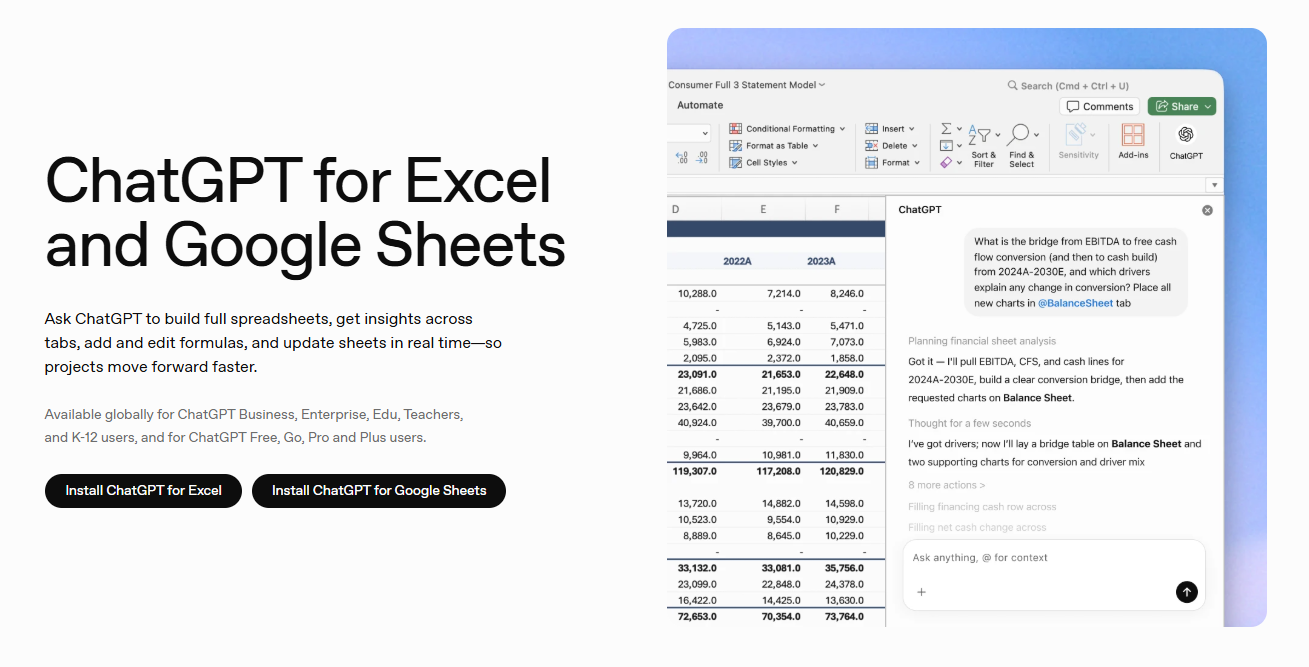
While not a full-blown data analysis platform, ChatGPT is a good starting point for beginners. It’s now capable of analyzing datasets, explaining statistical results, generating SQL queries, writing Python scripts, and summarizing complex reports. Advanced Data Analysis lets users upload a CSV or Excel file and ask questions. ChatGPT for spreadsheets works as a sidebar tool that sits directly in the open workspace, allowing users to edit cells, write formulas, and clean data in the grid in real time.
Key Features:
Speeding up the entire analytical workflow
Returns charts, tables, and plain-language takeaways
Generating templates for various data analysis tasks
Pricing:
Free Package
Go Package – $8 per month
Plus Package – $20 per month
Pro Package – $100 per month
Real Use Case:
Marketing analysts can avoid manual spreadsheet filtering using ChatGPT. By uploading campaign performance data and asking which advertising channels delivered the highest ROI, the AI can summarize performance, identify trends, and recommend next-best actions.
Julius AI
Julius AI lets users perform data analysis through natural language. Not syntax. It has several features that make the work a lot easier. Users upload Excel files, CSVs, or spreadsheets and ask questions. Then, Julius runs regression analysis, detects correlations, identifies outliers, and explains statistical findings. This platform even includes a tool for generating charts, tables, summaries, and detailed reports on the fly. What’s more, users can set analysis tasks on autopilot for less manual work with Scheduled Runs.
Key Features:
Transforming complex datasets into clear answers and actionable insights
Seamless email and Slack integration
Supports iteration through chat for more efficient report updates
Pricing:
Free Package
Plus Package – $20 per month
Pro Package – $45 per month
Max Package – $200 per month
Business Package – $450 per month
Ultra Package – $500 per month
Real Use Case:
Julius AI helps non-technical users, like student researchers, with data analysis without requiring them to write Python or R code. They can use it to determine demographic trends, make visualizations, and do statistical testing at speed.
Power BI
Image Credit: Power BI
While not AI-native, Power BI includes an AI layer sitting on top through Copilot. This allows it to combine business intelligence with AI-powered insights. More powerful and efficient data analysis that provides dashboards and information for understanding performance and taking action. That means users can ask data-related questions, produce DAX formulas, and generate outliers and trends summaries. It draws directly from existing Excel and Azure data. For teams living in a Microsoft world, Power BI slots in with almost no friction.
Key Features:
Solid Microsoft 365 ecosystem integration
Predictive analytics and anomaly detection
Running deep data analysis and generating report pages
Pricing:
Free Package
Power BI Pro Package – $14 per month/user (annual billing)
Power BI Premium Per User Package – $24 per month/user (annual billing)
Power BI Embedded Package – Custom Pricing
Real Use Case:
Retail chains can monitor daily sales, inventory levels, and regional performance with Power BI. It gives them automated dashboards. These let managers respond quickly when particular stores begin to underperform.
Tableau
Tableau built its reputation as one of the industry’s leading platforms for visual analytics. Serving different roles in the analytics workflow, it’s packed with products like Desktop, Server, Cloud, and Next. Its AI-powered capabilities help users derive insights and take action. More specifically, it allows users to explore data interactively, ask questions in natural language, and uncover meaningful trends through intuitive dashboards. Tableau makes multi-source data easier to understand. Even for non-technical stakeholders.
Key Features:
Seamless syncing with Databricks, Microsoft, Salesforce, and Slack
Finding patterns and trends with AI agents, dashboards, and metrics
Creating data-driven decisions with confidence
Pricing:
Free Package
Standard Package – $15 per month/user (annual billing)
Enterprise Package – $35 per month/user (annual billing)
Cloud+ Package – Custom Pricing
Real Use Case:
Content management companies likeBox benefit from the insights Tableau provides. With the goal of enhancing its content and workflow protection, the company optimized its security response to AI misuse threats.
Databricks
Image Credit: Databricks
Teams handling large-scale data analysis can turn to Databricks. Built on the Lakehouse architecture, it stands out for streaming and analyzing data. Its tool suite, including Lakebase, Genie, Agent Bricks, and Lakehouse, enables technical teams to query, transform, and model massive datasets. Both structured and unstructured. Users can expect data engineering, analytics, and machine learning to be combined in a single platform.
Key Features:
Unifying data, analytics, and AI
Data-aware AI for extracting deeper insights
Performing analytical and operational workloads
Pricing:
Free Trial
Pricing model depends on compute usage
Real Use Case:
Databricks allowedPrada Group to manage hundreds of stores across countries more efficiently. The data science team used it to unify data into a single, trusted source. They were able to make AI-powered forecasting models and personalize customer experiences.
Choosing the Must-Have AI Tools for Data Analysis in 2026
Today’s AI tools for data analysis help users uncovertrends, visualize results, and make informed decisions much faster. ChatGPT, Julius AI, Power BI, Tableau, and Databricks allow you to spend less time cleaning spreadsheets, writing formulas, or manually searching for patterns.
However, no single tool here replaces the others or analysts. ChatGPT and Julius AI turn plain questions into real analysis. Tableau and Power BI transform data into visuals people can act on. Databricks handles the heavy liftingbehind the scenes. So don’t limit yourself to just one. Match the right picks to the size and shape of the problem in front of you.
We have all stood somewhere, uncertain whether we had truly arrived. Threshold does not dwell on rupture itself. Instead, it asks: in that moment that is neither here nor there, what does the body do? How does language falter? What does memory hold onto?
Boundaries are not always tangible. Sometimes they are a joke you don’t understand, a silence you cannot explain, the coordinates of a home you cannot find on a map. Threshold collects these moments, not to resolve them, but because they deserve to be witnessed.
The exhibition brings together 14 artists whose works span painting, sculpture, installation, mixed media, and ceramics, responding to a single question: when was the last time you felt truly present somewhere?
Participating artists:
Junpeng and Weixi, Ruoheng Li, Ivy Tang, Yuhe Luo, Meng Li, Xiaoxiao Song, Guangyi Luo, Henryk Terpiłowski, Jade Gaskin, Ziyan Xu, Yingming Chen, Jinshuai Li, Isabelle Zetterström, and Soo Hyun Lee.
Selected Works
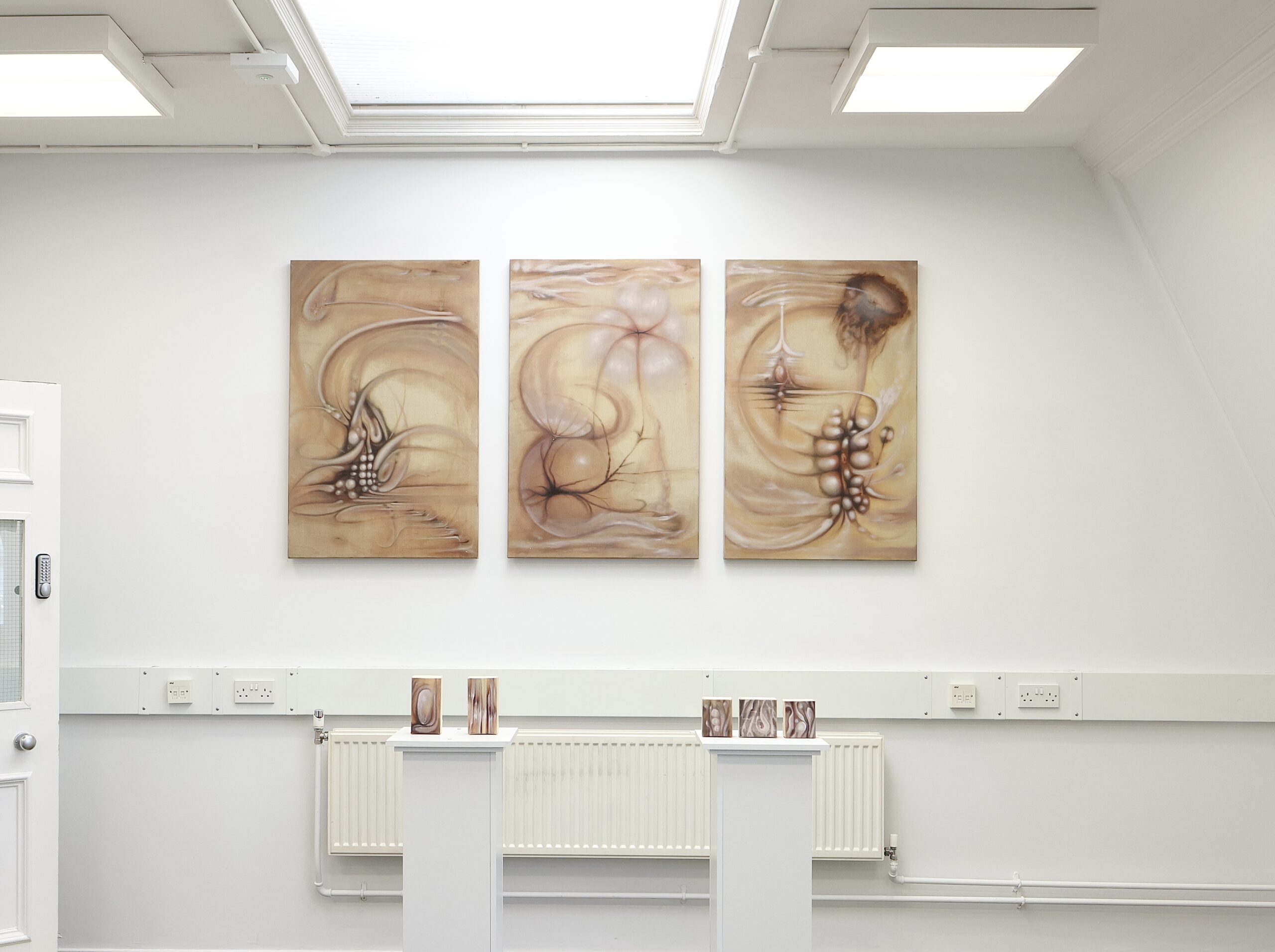
Isabelle Zetterström (b. 1995) is an English-Swedish artist based in London whose oil paintings open portals into ambiguous terrains suspended between the microscopic and the cosmic. In Threshold, her eight paintings drift between deep seas and celestial perspectives: pulsating forms unfurl in tones of blood, merging with volcanic greys, while noctilucent pools resemble water and floating branches shift into veins. The works in Membronic Secretion and the Giant Matter series do not depict the body so much as inhabit it, awakening an uncanny sense of awe and unease. For Zetterström, painting is a spiritual act, a dance with the subconscious that exposes the soul to unseen forces. She summons images from the abyss and escapes into them, only to find her own reflection.
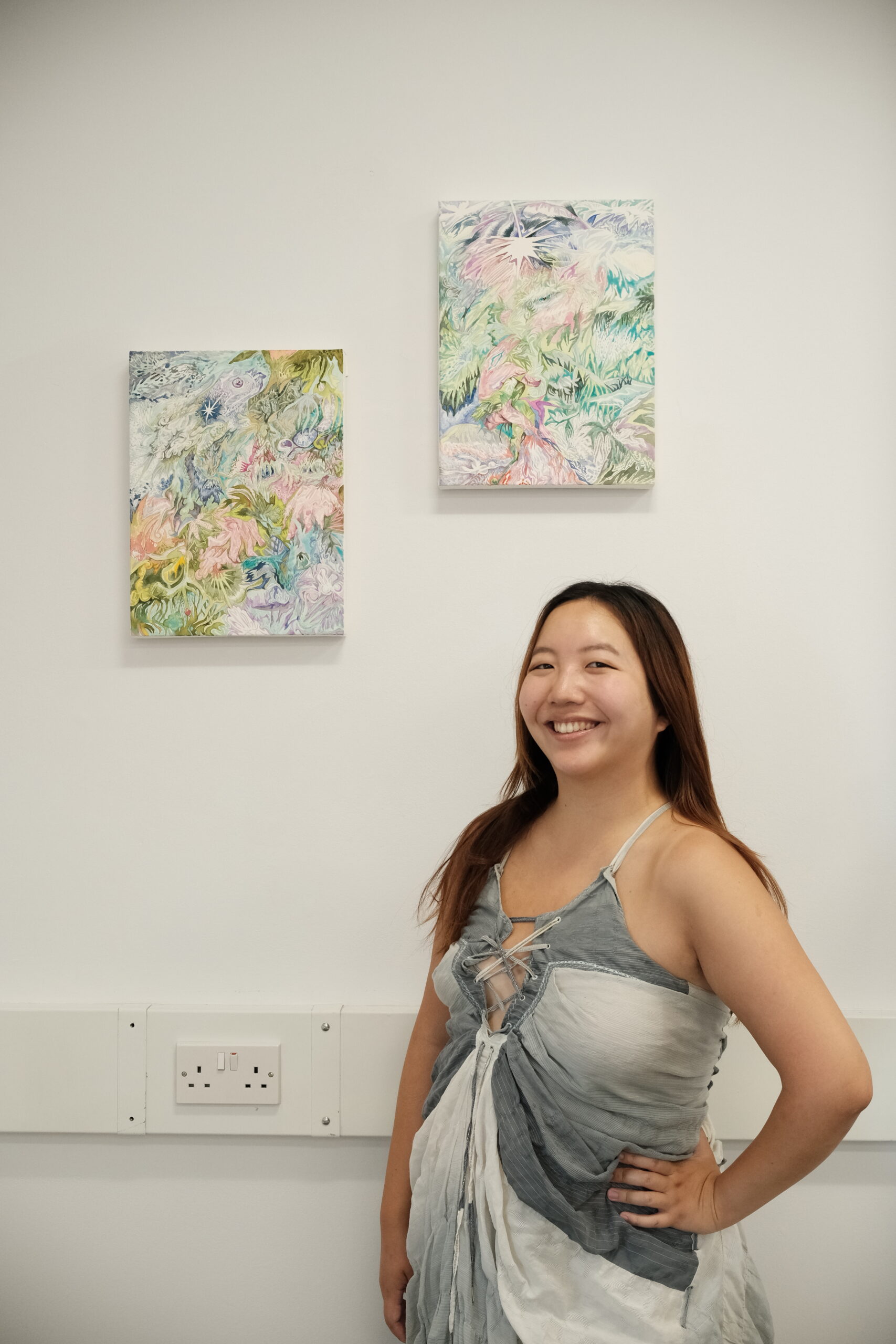
Soo Hyun Lee (b. 1998) is a Korean artist whose watercolour and mineral pigment works investigate how individuals relate to social values such as care, shame, resistance, and love. Her paintings in Threshold capture emotional terrains where softness and violence coexist: layered botanical forms in vivid, restless colour carry figures whose intimacy is also a site of conflict. Each work holds a layered timeline, embodying conflicting impulses of protection and detachment, of nurturing and consuming. In Daring behind the blooming leaves and Daphne, Lee asks what it means to be present within a relationship, and at what cost.
About D Contemporary
D Contemporary serves as a dynamic platform championing top emerging and mid-career artists, both UK-based and international. Supporting artistic practices across a wide range of media including painting, sculpture, digital works, and installation art, the gallery fosters critical dialogue and cross-cultural exchange. Its annual calendar includes a curated series of solo and group exhibitions, artist talks, and collaborations with cultural institutions and independent curators. D Contemporary also works with world embassies on cultural diplomacy, supporting artists from markets with limited exposure to world art capitals. The gallery is currently located at 1 Birdcage Walk, Westminster.
Whiteshepherd is a London-based nomadic gallery and curatorial platform working with emerging artists whose practices navigate diaspora, displacement, and cross-cultural identity. Founded in a South Kensington townhouse and now active across multiple London venues, the gallery’s mobility reflects a curatorial position that art made at the edges of culture cannot be contained within a single room. Whiteshepherd works with artists from the earliest stages of their careers, building first exhibition concepts, developing sustainable commercial frameworks, and creating the conditions for their work to be seen across cultural contexts. In close collaboration with Xima Gallery, which operates three spaces in China, Whiteshepherd brings artists into dialogue with Chinese audiences through exhibitions, residencies, and art fairs. The gallery does not seek to build a bridge between East and West. It seeks instead to create the conditions for effective friction: moments where different aesthetic frameworks, viewing habits, and critical languages meet without being prematurely resolved.
At Kinésique’s presentation in Lower Manhattan, fashion designer Kiki Peng transformed original knit structures, modular construction, and the movement of the body into a tactile design language—one that could be worn, altered, and experienced in real time.
Fashion designer Kiki Peng does not treat clothing as a static object. In her work, garments respond to the body—stretching, revealing, restraining, and protecting as movement continually reshapes their form and meaning. That approach came to life on July 24, 2026, when Peng presented a selection of her original textile and garment works during Kinésique’s three-hour presentation at Gibney: Agnes Varis Performing Arts Center, located at 280 Broadway (entrance at 53A Chambers) in Lower Manhattan.
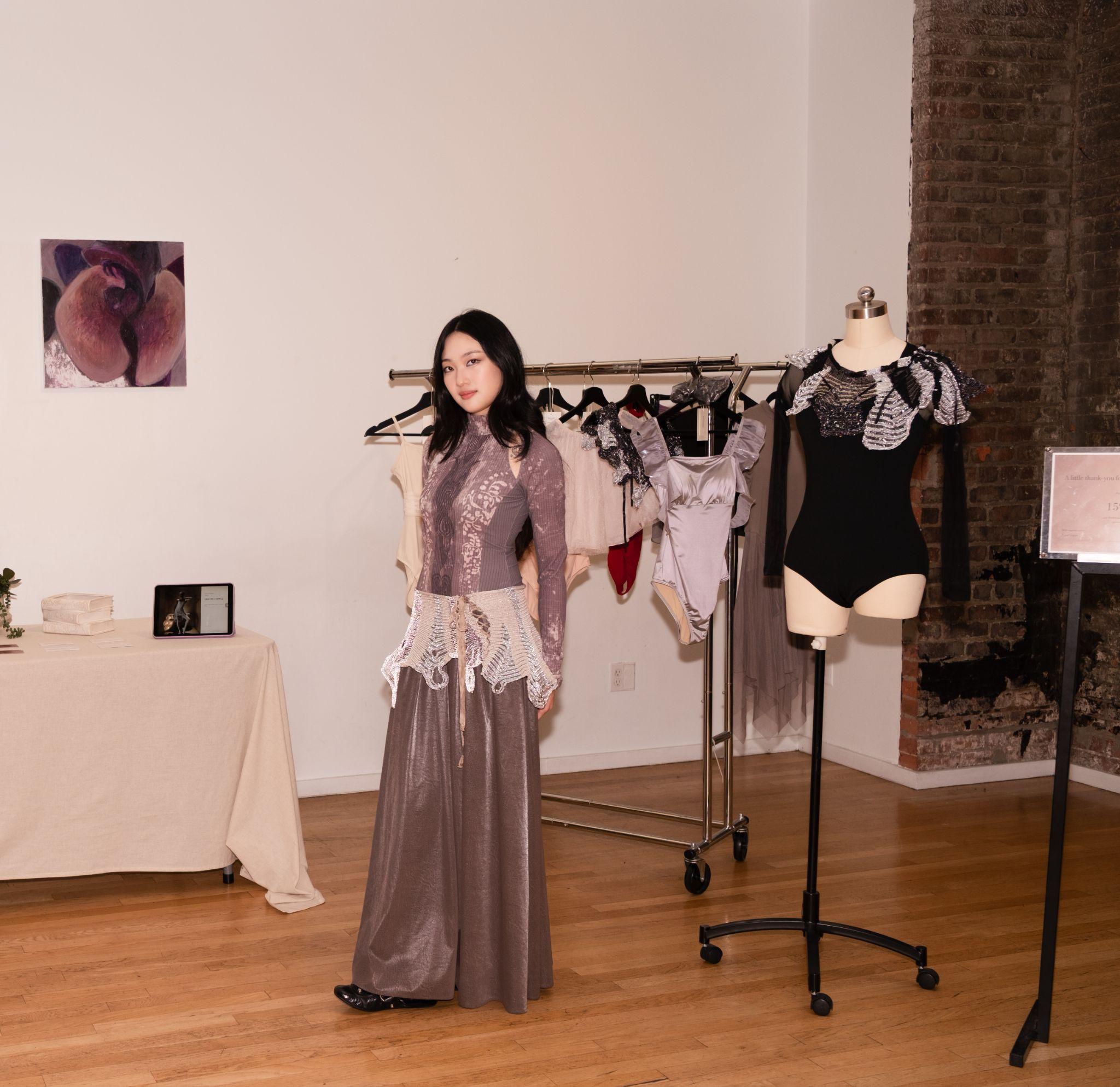
The event introduced Kinésique as a fashion-led dancewear brand interested in the silent language of the body, including posture, gesture, tension and release. A curated selection of ballet-inspired garments appeared alongside original textile works created by Qian “Kiki” Peng, Fashion Designer at Kinésique. The selected pieces articulated the brand’s studio-to-street vocabulary, while Peng’s original knits showed how that language could be expressed through original textile development, construction and body-responsive design.
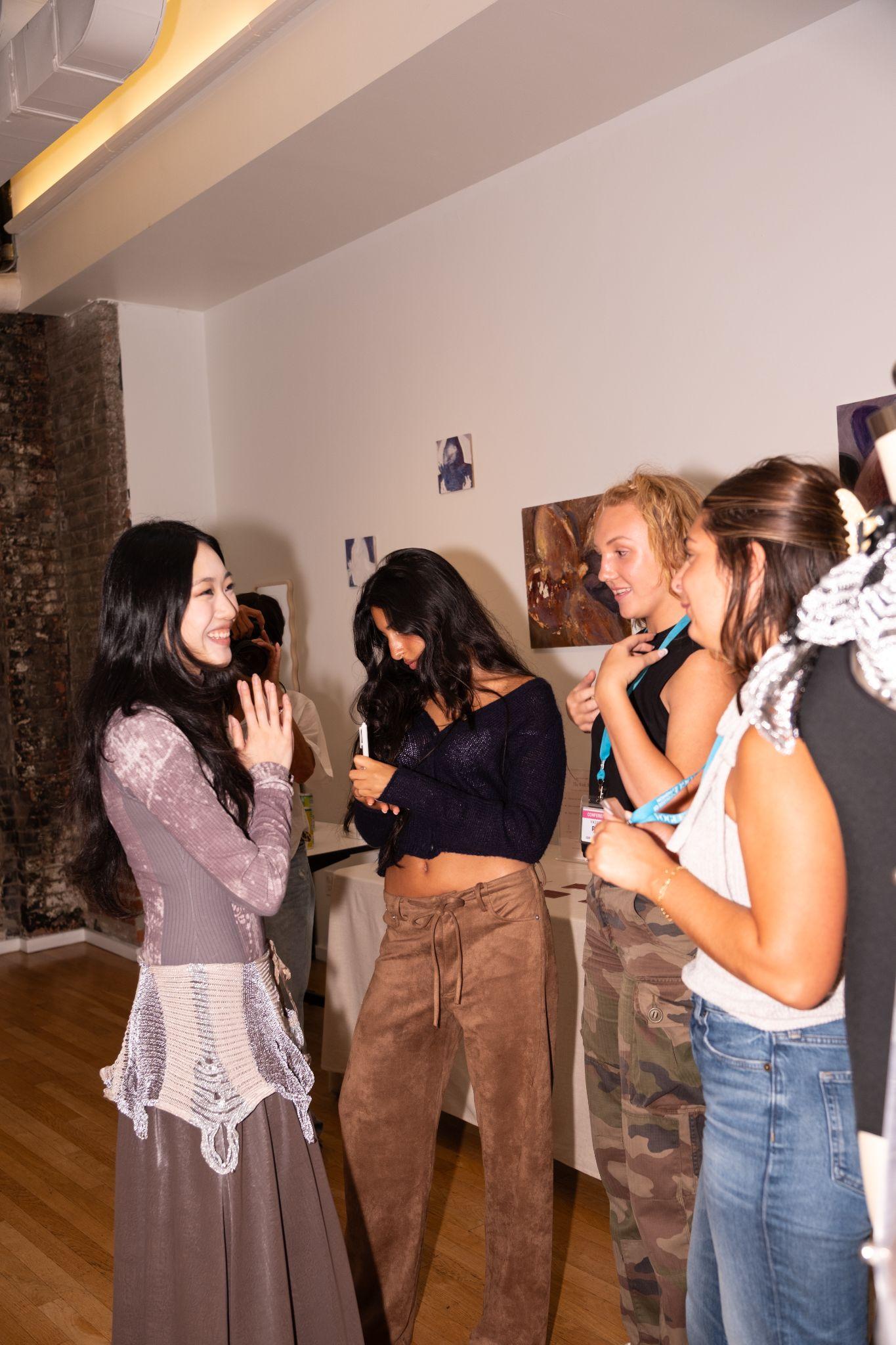
Fashion designer Qian “Kiki” Peng speaks with guests while wearing an original modular knit piece during Kinésique’s pop-up at Gibney.
Known professionally as Kiki Peng, Peng’s work has been presented during New York Fashion Week and featured in Elle China, Harper’s Bazaar China, Sicky, and Goji Magazine, while one of her designs was worn by artist Sevdaliza in media promotion. Her practice spans fashion and textile design, with particular attention to material, proportion and the relationship between garment and body. At Kinésique, she applies that focus through original textile development, technical construction and body-responsive design. Her work often begins with the textile itself, testing how a material holds, releases or extends the body and allowing those qualities to shape silhouette and movement.
At Gibney, these ideas became visible through live fittings, as the placement and proportion of the pieces changed on different wearers.
Kiki Peng stands beside knit pieces of her own design at the Kinésique pop-up, wearing a modular waist piece created as part of the brand’s design language.
That process is rooted in Kinésique’s larger creative framework, The Dual Self. Kinésique describes the concept as an exploration of the contrast between the controlled self presented outwardly and the more instinctive self beneath it. Rather than approaching ballet only through its polished image, the framework also considers the discipline, fatigue and vulnerability involved in producing that image. These ideas appear in Peng’s designs through differences in structure, density, exposure, fit and the relationship between the garment and the body.
Peng’s knit pieces offered the clearest material expression of that framework. Irregular open structures sat beside denser sections; pale metallic tones met darker ones; loose extensions and adjustable ties shifted with the wearer. The work suggested protection and exposure at once. Irregular edges and loose extensions gave the pieces a less fixed silhouette and allowed their form to change according to placement.
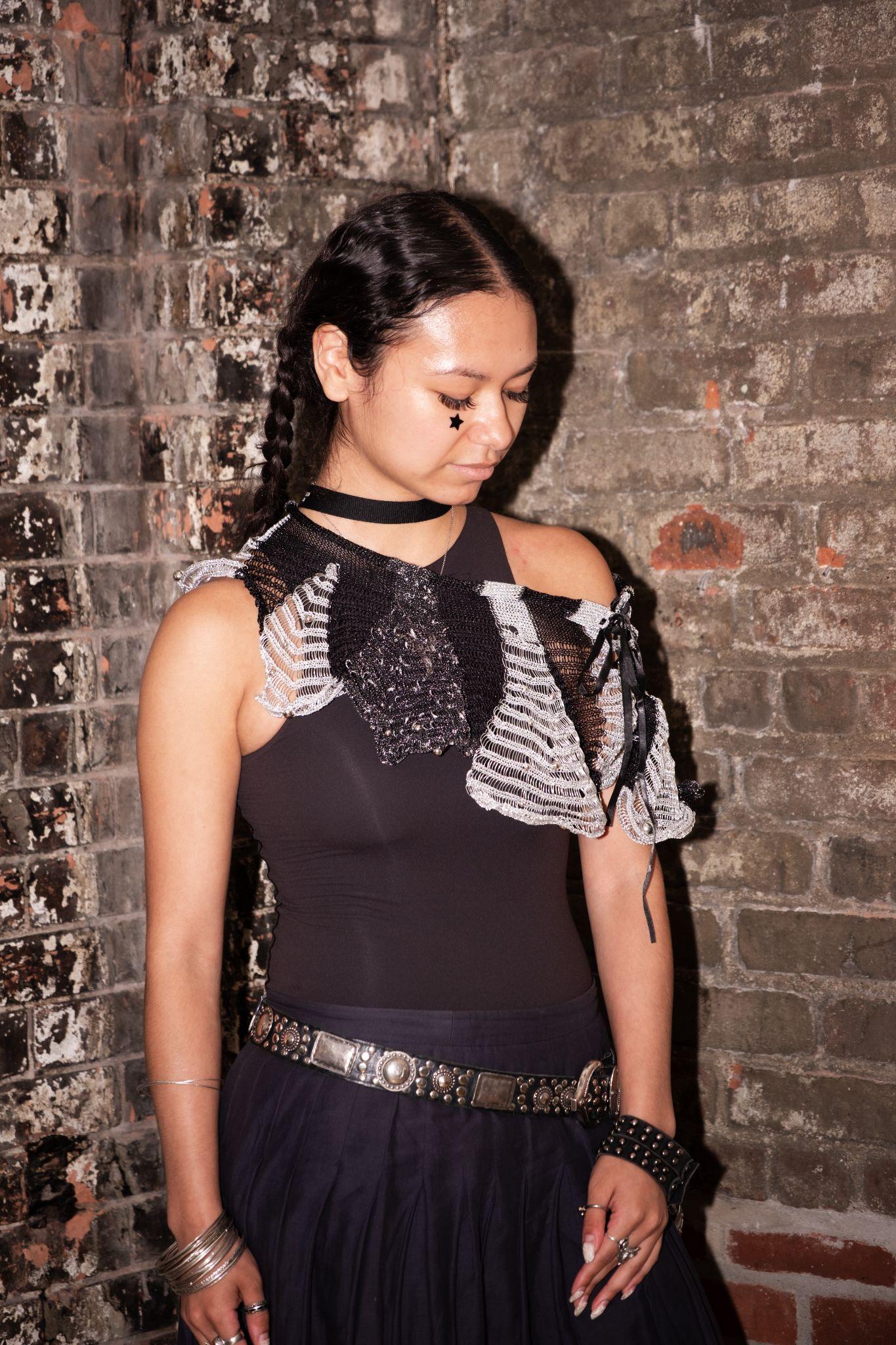
A guest wears Peng’s black-and-silver knit as a sculptural shoulder pieceA detail of her modular waist knit, showing its open construction and adjustable ribbon ties
The modular knits became some of the presentation’s most discussed works. Throughout the event, guests asked to try the pieces, while Peng adjusted their ties, placement and proportion for different wearers. The fittings showed how the same design could take on different proportions and functions depending on placement, styling and the wearer.
The black-and-silver knit, for example, moved between shoulder piece, collar and sculptural accessory. As Peng guided guests through its ties and placement, she also explained the thinking behind the work, including how restraint can create visual tension, how an exposed opening can suggest vulnerability and how an apparently decorative form can behave like a piece of armor.
At the Gibney pop-up, Peng presented the textile and garment studies connected to The Dual Self alongside early visual research and selected design drawings. The presentation gave visitors insight into how the concept was being translated into textile, silhouette and construction without presenting the forthcoming collection as a finished result.
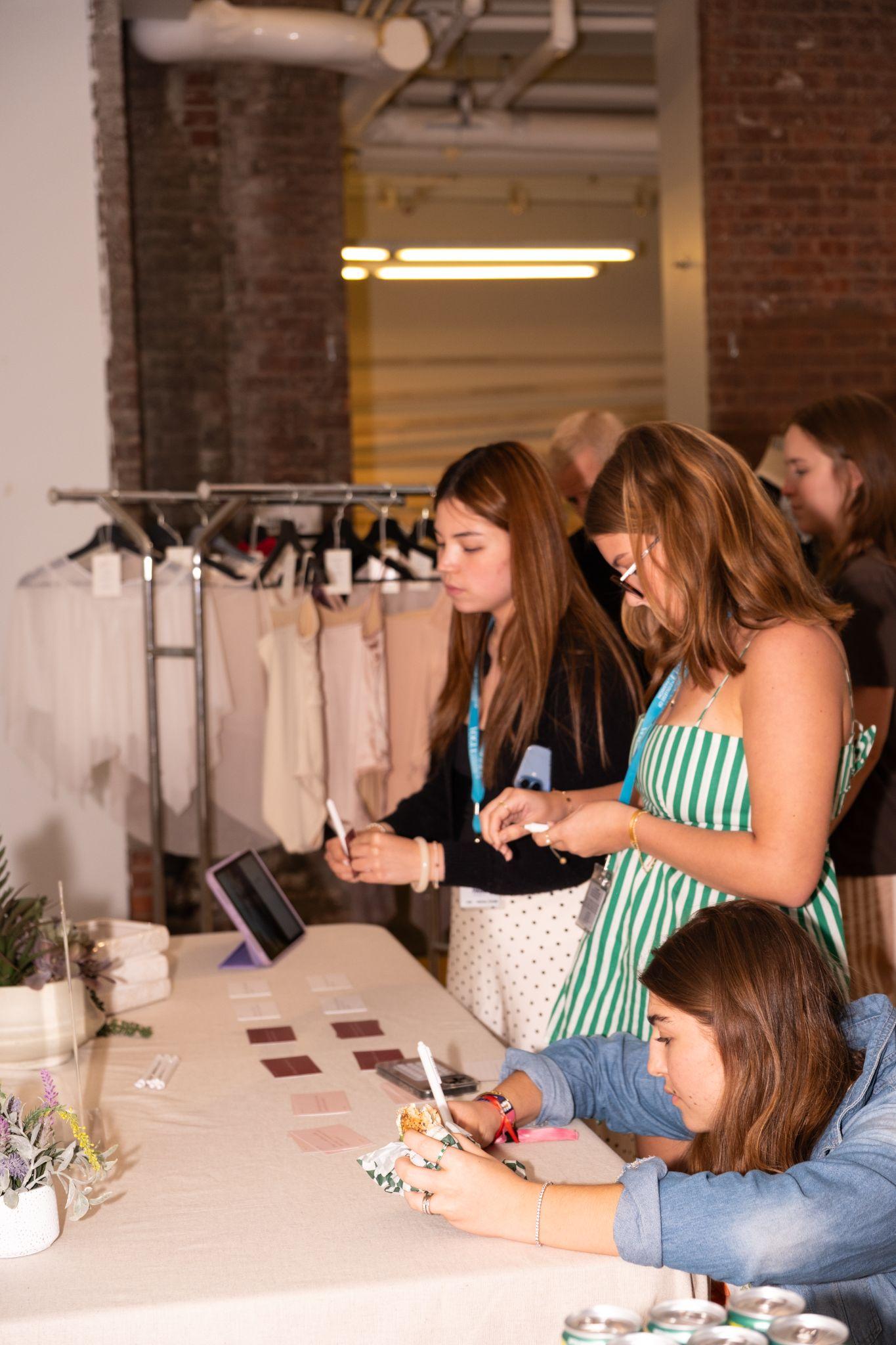
Participation extended beyond the fitting area through Kinésique’s Wish Box. Visitors selected prompt cards about movement, identity, uncertainty and the body, then contributed handwritten responses. More than 30 people took part. The activity was designed as more than an event keepsake: the anonymous reflections formed a archive of participants responded to questions related to the ideas informing Kinésique’s work.
Visitors participate in Kinésique’s Wish Box during the pop-up
In response to the question, “What did dance teach you that nothing else could?” one participant wrote: “It’s okay to not know your next move. Your body will know what to do even if your mind doesn’t.”
The response connected closely with questions about the body and perception explored throughout the presentation. For Peng, the anonymous reflections provided another source of observation alongside the fittings and conversations taking place during the event.
Peng plans to carry the ideas tested through these knits into Kinésique’s forthcoming original collection, currently being created under the working concept The Dual Self: Becoming. The new collection will continue the framework established in The Dual Self while placing greater emphasis on transformation through original garments and textile work.
For Kinésique, that work will continue through in-person presentations, fittings and exchanges with dancers and other wearers. These settings give Peng an opportunity to observe how people move in the garments, how they interpret different forms and how the pieces respond to different bodies. The Gibney pop-up demonstrated that relationship by placing Peng’s design process in direct contact with the people wearing and encountering the work.
The presentation at Gibney brought Kinésique’s conceptual framework into physical form through Peng’s original textiles, modular construction and direct interaction with wearers.
Portable coffee makers have become increasingly sophisticated over the past decade, but one problem has remained surprisingly persistent. Most travel French presses continue extracting coffee long after brewing should have ended, leaving the final sip noticeably harsher than the first. For a product designed around convenience, it is an oddly unresolved compromise.
Rather than treating portability as the primary challenge, Yoo reconsidered something more fundamental: what actually happens inside a French press once brewing is complete.
The problem with every travel French press
Most portable French presses share a flaw that shows up sip by sip: once the plunger is down, the grounds stay in direct contact with the brewed coffee for the rest of the drink. That ongoing contact keeps extracting bitter compounds, so the last mouthful tastes noticeably worse than the first — and cleanup means disassembling the whole vessel over a sink.
LOOM addresses both problems with a two-stage filtration and isolation system. A micro-filtration layer strains grounds out during the initial brew, the way a standard press does. But once brewing is finished, rotating the vessel’s top handle engages a second, silicone-sealed isolation layer that physically walls off any remaining sediment from the drinking chamber — stopping over-extraction instead of just slowing it down.
The body is insulated stainless steel, built to survive daily transport and hold temperature through a commute or a trail. A detachable bottom compartment handles both ends of the brewing cycle — loading grounds in, and clearing spent grounds out — without pulling the whole unit apart. The result merges the function of a French press with the form of a travel tumbler: brew, carry, and drink from a single object, designed for commuters, travelers, and anyone who wants fresh coffee somewhere other than a kitchen counter.
A practice built on solving problems with your hands
Although LOOM presents itself as a relatively restrained consumer product, much of its innovation is concealed within the internal mechanism rather than expressed through its appearance.
That approach aligns closely with Yoo’s design practice.
Currently a Creative Designer at J World Sports Inc., Yoo leads product development across backpacks and bags, overseeing projects from user research and concept development through manufacturing coordination and production. She earned her BFA in Industrial Design from the Rhode Island School of Design, concentrating in Computation, Technology, and Culture while also studying Design Engineering at Brown University—a background that emphasizes engineering performance as much as visual form.
Rather than treating mechanical complexity as something to showcase, LOOM hides it almost entirely. The user experiences the solution through a simple rotational gesture, while the engineering remains largely invisible.
Recognition beyond LOOM
The Houzee Awards win adds to a run of recognition Yoo has received in 2025 and 2026. She was named a Platinum Winner at the 2026 International Architecture & Design Awards in the Product Design – AI-Powered category for Solis Lamp, and a Gold Winner at the 2026 NY Product Design Awards in the pet supplies bowls category. She was also named a runner-up at the 2025–2026 A’ Design Award in the Pet Care, Toys, Supplies and Products for Animals category, and selected as a Fall 2025 winner by Design Dispatch’s Future Forward Designs feature, which spotlights emerging designers.
An approach grounded in use, not just form
Across her projects, Yoo works from the same starting point: identify where a product actually fails people in daily use, then solve that failure through form and mechanism rather than surface styling. LOOM is a direct example — the win wasn’t for how the object looks, but for a filtration and isolation system that changes how the product performs over the course of a normal use cycle, from brewing to cleanup.
That same problem-first approach runs through her broader body of work, which spans consumer electronics, furniture, home goods, sporting goods, and bags and backpacks. She describes her process as built on strategic problem-solving and close observation of how people actually use the things they own, aimed at products that are functional, visually distinctive, durable, and realistic to produce.
Christopher Nolan’s The Odyssey has brought Homer’s epic back to the big screen with a record-breaking $264.1 million global opening, and reviewers are already calling it Nolan’s grandest film yet. If you were no stranger to the allure of the box office hit, here are five pieces of art that offer a glimpse into how painters across Europe interpreted one of literature’s greatest adventures.
Ulysses and the Sirens by John William Waterhouse (1891)
Arguably the most famous artistic interpretation of The Odyssey, Waterhouse’s dramatic canvas captures the moment Odysseus orders his crew to bind him to the mast so he can hear the irresistible song of the Sirens without steering his ship to destruction. The painting beautifully expresses the tension of the scene, with the winged Sirens swarming the vessel in one of mythology’s most unforgettable moments.
Ulysses and the Sirens by John William Waterhouse. Image source: Wikipedia
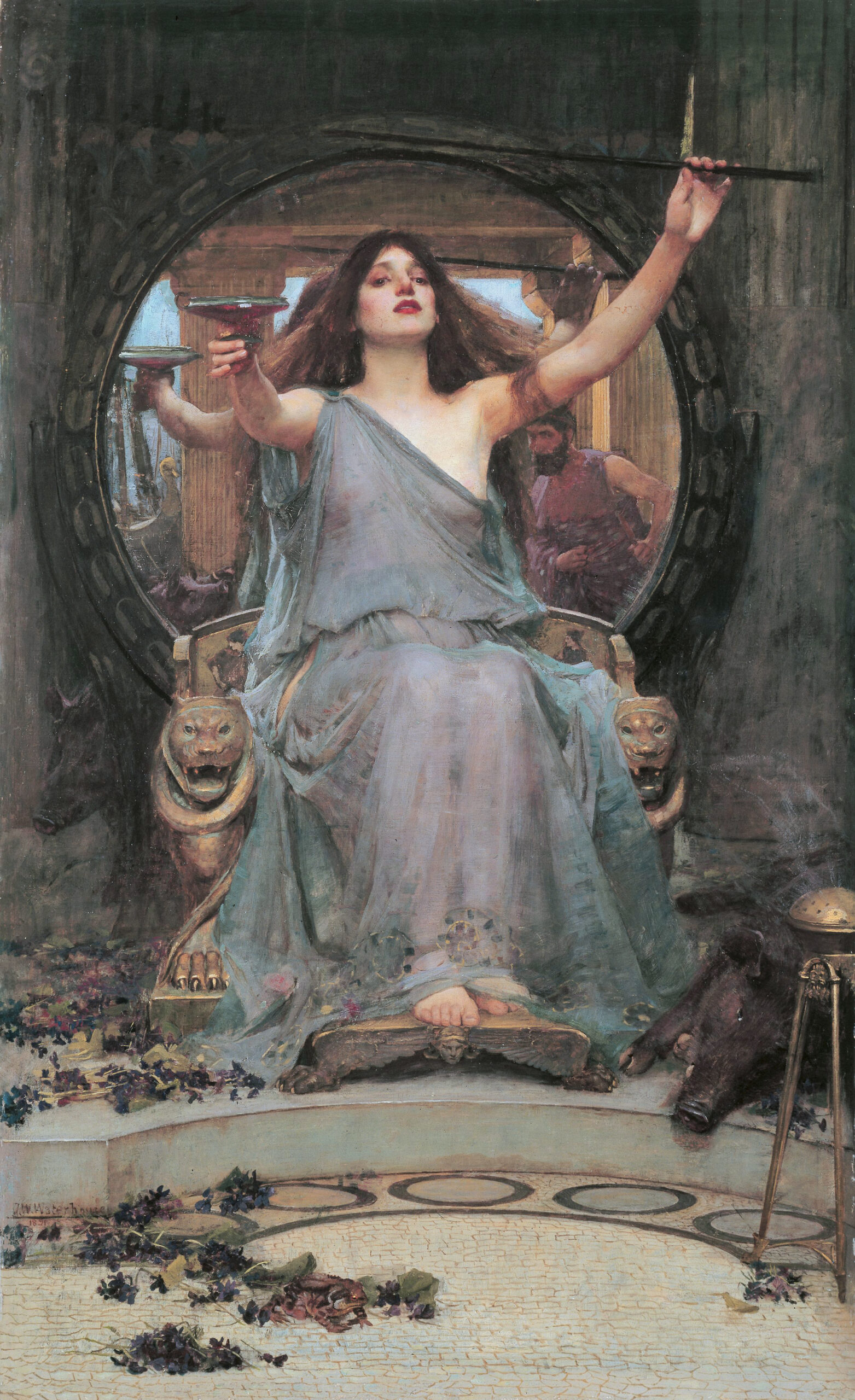
Circe Offering the Cup to Ulysses by John William Waterhouse (1891)
Waterhouse appears another time with his alluring portrayal of the sorceress Circe. Surrounded by symbols of magic like her wand and mirror, Circe fixes the viewer with an unwavering gaze while holding out the enchanted cup that famously transformed Odysseus’ men into swine.
Circe by John William Waterhouse. Image source: Wikipedia
Ulysses Deriding Polyphemus by J.M.W. Turner (1829)
Turner takes Homer’s tale and turns into a dazzling spectacle of colour. Here, he depicts Odysseus sailing triumphantly away after blinding the Cyclops, moments before revealing his name and provoking Poseidon’s wrath. Note how the glowing sunrise hints at victory.
Ulysses Deriding Polyphemus by Joseph Mallord William Turner. Image source: Wikipedia
The Return of Ulysses by Pinturicchio (c. 1509)
Painted during the Italian Renaissance, Pinturicchio’s fresco captures Penelope at her loom, patiently fending off a crowd of suitors during Odysseus’ long absence. In the background, a traveller enters the room — long believed to be Odysseus himself, finally returning home. Rich in decorative detail, the work reflects the period’s fascination with classical literature.
The Return of Odysseus by Pinturicchio
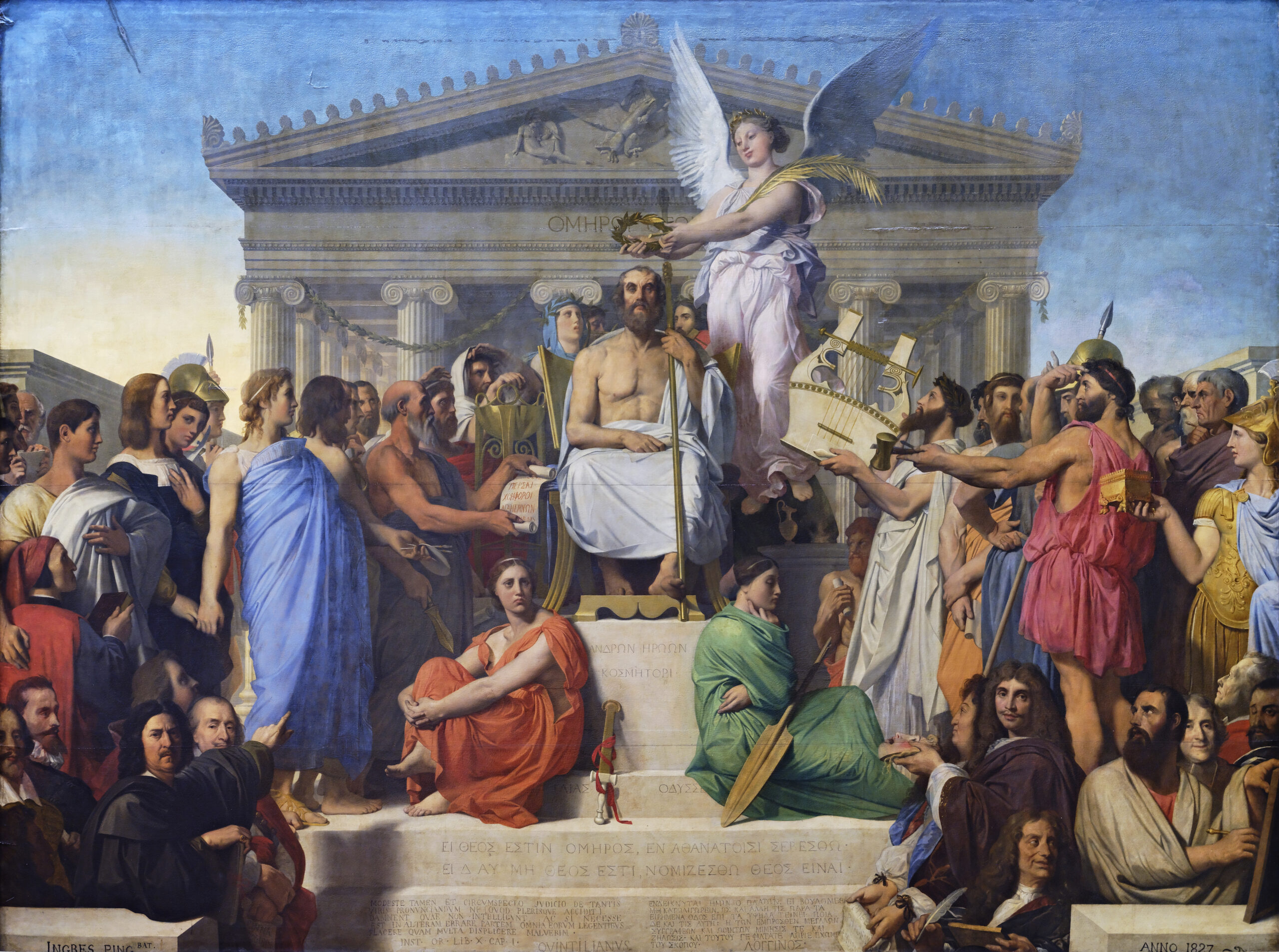
The Apotheosis of Homer by Jean-Auguste-Dominique Ingres (1827)
While it doesn’t depict a specific episode from The Odyssey, Ingres’ monumental tribute to Homer provides a fitting conclusion. Surrounded by poets, philosophers and artists inspired by his work, the ancient author is presented as one of Western civilisation’s greatest creative figures.
The Apotheosis of Homer by Jean-Auguste-Dominique Ingres
Leonardo DiCaprio has been working his magic on screens of various sizes ever since the early ‘90s. One of the highest-paid actors in Hollywood, he goes for meaty roles and complex projects. The kind that typically bring a lot of people to the cinema.
Whether you’ve liked him since Titanic or became a fan more recently, you’ve probably seen at least one DiCaprio film over the last couple of decades. Given his lucrative career, his net worth should be substantial by now, right? Here’s what we know about the actor’s earnings.
As you might expect, he built it thanks to his extensive film career. He began acting as a child, first in commercials and television roles. His film breakthrough was in 1993 with This Boy’s Life, opposite Robert De Niro.
DiCaprio followed it with a widely praised performance in What’s Eating Gilbert Grape, which earned him his first Academy Award nomination. Roles in The Basketball Diaries and Romeo + Juliet further established him as a compelling actor. It was James Cameron’s Titanic, however, that made him a household name.
By portraying Jack Dawson, DiCaprio became one of the biggest movie stars of his generation. Released in 1997, Titanic was the first film to reach the billion-dollar mark at the box office. It also received 14 Oscar nominations, winning seven awards.
From there, DiCaprio used his fame to pursue challenging projects. He is particularly effective at playing obsessive or psychologically unstable characters. You might remember his notable turns in The Beach, Catch Me If You Can, Revolutionary Road, J. Edgar, Inception, Django Unchained, or The Great Gatsby.
In 2016, DiCaprio earned his first Oscar for The Revenant. Since then, he starred in Once Upon a Time… in Hollywood, Don’t Look Up, and the 2025 acclaimed film One Battle After Another.
Besides acting, Leonardo DiCaprio is a producer and activist. He also works with various brands, most recently Rolex.
Leonardo DiCaprio Salary
Actor salaries are typically kept under wraps, but numerous reports have Leonardo DiCaprio listed as one of the highest-paid actors around. According to The Hollywood Reporter, for instance, his fee is around $20 million. The same source notes that he was paid $25 million for The Wolf of Wall Street, but that number included his producer share.
DiCaprio also reportedly made north of $50 million for Inception after taking an upfront pay cut but negotiating a back-end deal sharing a percentage of ticket sales. He had a similar deal for Titanic, which is rumoured to have earned him around $40 million overall.
Leonardo DiCaprio Highest Grossing Movies
While DiCaprio’s paychecks are hefty, his movies earn big, too. Titanic is the fourth highest-grossing film of all time with $2.264 billion, rereleases included. Inceptionmade $828 million, while The Revenant, The Great Gatsby, and The Wolf of Wall Street were big earners as well.
Next up, fans can catch DiCaprio in another Martin Scorsese project. He’ll star in Gothic thriller What Happens at Night, opposite Jennifer Lawrence.
Walk through a genuinely considered home and you can feel the decisions everywhere, even the ones you’re not meant to notice. The coffee table was chosen for the way its edges catch the afternoon light. The ceramics on the open shelf were picked to sit together without competing. The sofa is the color it is because someone thought about how it would look in ten years, not just on delivery day. Nothing in a room like this happened by accident. That’s what makes it feel calm: every object has already been argued for.
Then you get to the dog corner.
In an otherwise deliberate home, the dog’s things are often the one area where none of that thinking applied. A plastic bowl in a color nobody chose on purpose. A leash with a logo loud enough to be seen from across a park. A bed that matches nothing, usually because it was bought in a hurry, from whatever aisle had bowls and leashes lined up next to it, filed under supplies rather than objects. It’s not that anyone loves their dog less than they love their furniture. It’s that the dog’s things were never treated as part of the same design problem as the rest of the room, so they got left out of the argument entirely.
That’s a strange omission when you sit with it. The dog is, for most owners, one of the most present things in the house: at the door every morning, on the floor by the desk, in the car, in half the photos on the fridge. And yet the objects tied to that daily presence were, until fairly recently, exempt from the same scrutiny applied to a lamp or a chair.
Why did that room get skipped?
Not because anyone decided pets didn’t deserve better design. More likely because pet gear had to solve a harder problem first. A collar has to survive weather, saliva, tugging, years of wear, before it gets to be beautiful. A coffee table just has to sit there and look right. When function is doing all the work, aesthetics tend to get treated as an afterthought, a nice-to-have nobody budgeted for.
That’s changing, and not just as a feeling. People are actively searching for a version of this that doesn’t yet fully exist as a category: dog decor, dog home decor, a way to bring the pet corner into the same visual language as the rest of the house. The demand showed up before the vocabulary did, which is usually a sign that a shift is real rather than manufactured.
The walk is the last room to get renovated
Of everything a dog owns, the objects worn outside the house, the collar, the leash, were the slowest to catch up, and for a reasonable reason. A bed only has to look good sitting still. A collar has to look good while doing real physical work, all day, in public, in the rain, for years. That’s a harder design brief than most interiors ever face, which is probably why it took longest to be taken seriously.
Materials that do the work design usually skips
The thing that finally let this category catch up wasn’t a change in taste. It was a change in materials, or rather, a return to materials that had been sitting around all along, doing this exact job for other objects. Full-grain leather and solid brass don’t stay pristine so much as they change, the same way a good pair of boots or a worn leather bag does: creasing, darkening, softening into something that looks more considered with age rather than less. That’s a fundamentally different proposition than most pet gear, which is designed to look identical on day one and day three hundred, until it simply gives out.
A handful of makers have started treating dog gear with that same material seriousness, the kind usually reserved for furniture or leather goods meant to be kept. The Lille Björn is one of the small number of brands buildinghandcrafted dog accessories out of full-grain, vegetable-tanned leather and solid brass hardware, the same materials a furniture maker might reach for when building something meant to be lived with rather than replaced.
The house is finally all one house
Walk back through that considered home one more time, and the dog corner looks different now, not because it’s been hidden more cleverly, but because it’s finally being designed with the same intention as everything else in the room. The bowl was chosen. The leash was chosen. The bed matches, not by coincidence, but because someone finally extended the argument they’d already been making about the rest of the house to the one corner that used to sit outside it.
That’s really what’s happening across pet-centered design right now, not a trend in the disposable sense, but a long-overdue closing of a gap. A truly considered home doesn’t have a room where the thinking stopped. For a long time, the dog corner was that room. It isn’t anymore.
In this segment, we showcase the most notable albums out each week. Here are the albums out on July 24, 2026:
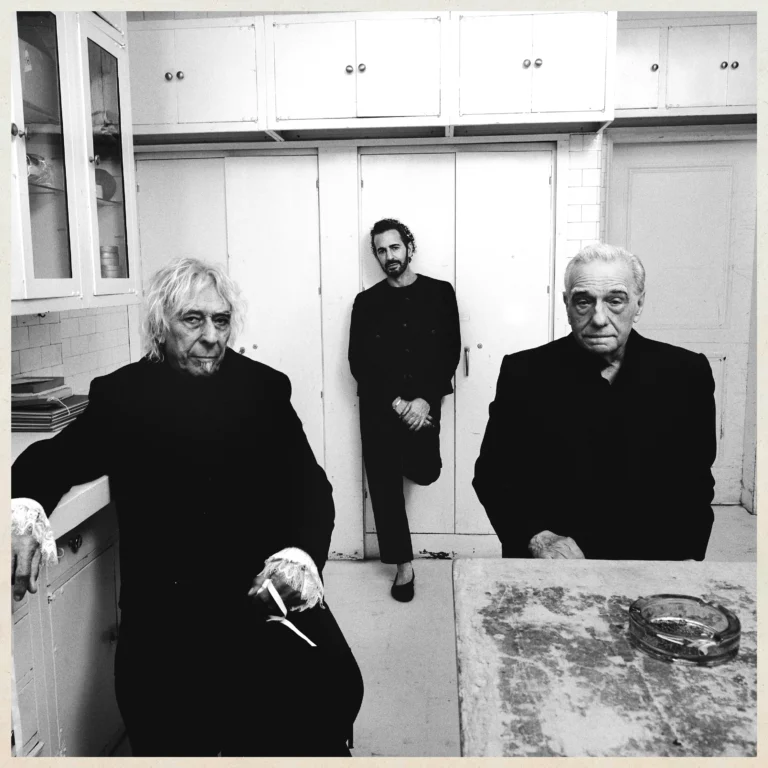
Charli XCX, Music, Fashion, Film
Charli XCX‘s Music, Fashion, Film has arrived. Billed as her “rock album” before it was even formally announced, the record offers a bracing and characteristically messy examination of the pop star’s life post-BRAT. Ahead of its release, Charli shared the singles ‘Rock Music’, ‘SS26’, ‘Wink Wink’, and ‘Camera’, along with their Instagram-exclusive b-sides. It spans 11 tracks and clocks in at just over 30 minutes, while the cover features three icons from each titular category: John Cale for music, Marc Jacobs for fashion, and Martin Scorsese for film.
The Strokes are back with a new album, Reality Awaits. The 9-track LP reunites the band with producer Rick Rubin, who helmed 2020’s Grammy-winning The New Abnormal. It was previewed by the heavily AutoTuned singles ‘Going Shopping’ and ‘Falling Out of Love’. Back in May, Albert Hammond Jr. defended the album in response to a commenter who wrote, “Albert I know you don’t like it bro you can tell us.” He said: “It’s my favorite album we’ve ever done. I can’t express how beautiful it is. I listen to the whole thing and wanna start from the beginning again. It grows and grows and becomes intoxicatingly good.”
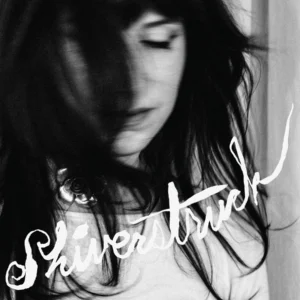
Jilian Medford remembers noting down Shiverstruck, the title of her latest album as IAN SWEET, in her notes app one rnight. “I was just lying in my bed, and it popped in my head,” the singer-songwriter said in our inspirations interview about the record. “I had written the word before I had written the song. It was while I was writing a lot of these songs, so they were starting to kind of have the same conversation, and they were starting to exist and building a world. ‘Shiverstruck’ felt like the word that they could all orbit around, because to me, that word just feels like you’re being caught off guard, you’re being swept away by life. It gives you this overwhelming feeling that you can’t name or explain: the joys, the hardships, the longing, the yearning of life all feel encapsulated in that word.”
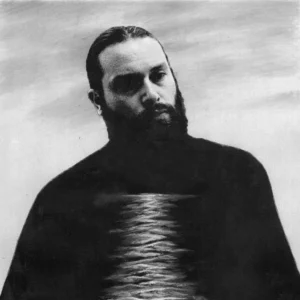
Nick Hakim’s new album, I Can See, is intimately atmospheric and imaginative. Following 2022’s Cometa, the record was crafted over five years that saw him grapple with the end of a record deal and the dissolution of a long-term relationship. Having worked on everything from Adrienne Lenker’s Bright Future to Lil Yacthy’s Let’s Start Here, Hakim assembled a strong team of collaborators, including Andrew Sarlo (Dijon, Bon Iver), and mastered by Heba Kadry (Björk, Ryuichi Sakamoto, Gorillaz).
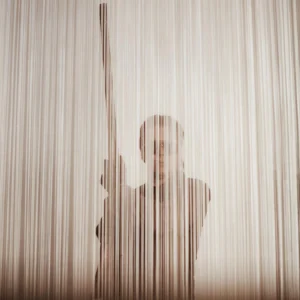
Alex Cameron has returned with his fifth record, Late to Set. The follow-up to 2022’s Oxy Music features production credits from Mark Perkins, Zach Dawes, and Maxim Ludwig, as well as the early singles ‘Red Hook Rain’, ‘Jesus Never Had No Porno’, ‘Satue Down’, and ‘Red Hook Rain’. According to press materials, “This is the sound of a man walking out on somebody else’s family. Into a new world afraid to remember what it used to be. These are songs of protest against life itself. This is the world our fathers feared. And here is its soundtrack.”
After teaming up in 2019 for the joint mixtape Anger Management, Rico Nasty and Kenneth Blume have reunited for a new LP, RX. At 20 minutes, it feels like a sequel, updating the frenzied, playful sound that has become the Maryland rapper’s trademark. “I missed someone that was honest with me,” Rico commented. “And I missed someone who knew me back then, before I had any success. I felt like if I’m going to get back to doing me, I should go back to someone who can be real with me, somebody who’s not too serious or draining.” Blume added, “From the day we met, no one has made me laugh harder or pushed me further out of my comfort zone. RX feels like homecoming. This project is a reminder of where she came from, what made us all fans; and a scary look at how much better she KEEPS getting.”
Tyla, A-Pop; Sam and Louise Sullivan, Love & Devotion; Trophy Wife, Pathetic; REZN, Cycles in the Infinite Dream; Lockstep, I Know What I Saw; Amedeo Cappelletti, Kind Stranger; kelz, A Sweet Passerby; Willow, The Thread; Robyn Hitchcock, The Confuser; Dorio, Agent Friday & The Perfect Angel; Mayday Parade, Sugar; Carter Faith, Cherry Valley Forever; Waterparks, JINX; Scorn-Fury, Outside the limits of your Sight.
“Looking at my life in its final form/ The shape it took, I’d never seen before,” Jilian Medford sings on ‘Silver Screen’, a highlight from her new album Shiverstruck. She might as well be describing the ever-shifting trajectory of IAN SWEET, the moniker that serves as less and less of a vehicle to separate herself from her music. When AI-generated soundalikes start releasing fake music under your pseudonym, what choice do you have but to put your rawest self out there? There’s a wildness to the SUCKER follow-up, which wraps your heart in a knot from the breathtakingly vulnerable opener ‘987’ to the self-reflexive ‘Jilian’. Working with producer Ben Allen, Medford had never pored over her own lyrics this much, never spent so much time focusing on the vocals. But it’s the opposite of any sense of perfectionism that renders this a never-before-seen version of IAN SWEET; not final, but probably unrecognizable to the one that came before or the one that might follow. We’re lucky her songs send shivers down your spine just the same.
We caught up with IAN SWEET to talk about acupuncture, Neko Case, smudged lipstick, and other inspirations behind her new album, Shiverstruck, which is out today.
In what ways did you feel his presence behind the scenes while writing the record?
It’s so beautiful having an animal. It’s something you don’t even really realize, that you just have this other living being with you at all times that you have to take care of and feed and be a mother to. I’ve had Blue now for six years, and every day, I can’t believe I’ve kept him alive, kind of. [laughs] It’s still shocking to me that I have been taking care of this other thing. Both writing and recording the record, he was there with me every single moment. I also brought him with me to Atlanta, where I recorded, and he came to the studio every day. I was kind of nervous, because he’s a bit of chaotic energy, and he can nip at people’s heels. He’s just unpredictable in an amazing way, but once he loves you, you’re in, and he’s the most loyal, precious thing ever. It was really special being in the studio with him, knowing what kind of dog he is; he’s part Jack Russell and part Chihuahua, so he’s definitely got wild energy. And he’s a rescue dog, so he’s got all that baggage with him, too. I was like, “I hope he’s quiet. I hope he behaves.”
And it was really beautiful. He would be in the room with me while I’d be doing vocal takes. He would scratch at the door when I’d go in, because he’d be sad that I left the room, and I’d be like, “Okay, I’m gonna let you in.” He just would sit there completely silent, just staring at me, or be dead asleep as I was recording vocals. It almost makes me want to cry – this creature that I have, who’s normally very energetic, very crazy, wild, but as soon as I was singing, he kind of knew that it was time to just settle in and quiet down. It was really special having him there, doing my vocal takes, and then looking over at him, either looking up at me, or just falling asleep and being so comfortable in the space. A lot of those moments are documented as well; in the vinyl, there’s a pull-out poster with a lot of photos of the studio time, and he’s made his way into every photo, because he was just there in every moment.
This may be a strange question, but were there moments you can think of, be it in the studio or when you were writing, when it seemed like he kind of understood what you were feeling before you even knew it?
I think that really is so true about animals, and also rescue dogs who have been through a lot of their own trauma as well, their own experiences. He very much reads into a lot of my emotions and is very in tune with what I’m going through. I definitely feel like he was aware of it and brought such great energy, even to the writing process. I was writing a lot of the songs in my apartment in New York, and I’d get in my head about something, and then he and I would just go on a walk. I’d just let it go and forget and have moments with him; he’s kind of a tool for me to get out of my head. He represents more to me than just being my dog. I’m looking at him right now because he’s laying right here. [laughs] Yeah, he’s definitely a part of me.
Did he in any way inspire the line “You’re a dog licking at open wounds”? Were you looking at him when the metaphor came to you?
Maybe subconsciously. I’m sure he was in the room when I was writing that, but I have seen him continue if there’s something happening, he’s constantly looking at his paws, and it’s like, “That’s not gonna help you. I think that actually makes the wound worse.”
Driving on the 101 with the windows down and the AC blasting
That’s my favorite way to drive in general, and it’s also a beautiful way to listen to Shiverstruck, especially when you get to the final track, ‘Speed Demon’. Do you tend to only listen to music when you’re driving, or do you sometimes sit in silence and let melodies or lyrics come to you?
Both, for sure, but I do drive in silence, a lot of the time. I do my best thinking and writing and rewriting and just general brain work when I’m driving. I love driving, and that’s something I really missed when I was living in New York for the last three years. I feel really safe and locked-in and creative in my car. I did just get a new car, though. Well, it’s an old car, it’s a 2006 Mercedes, it’s very old. It only plays CDs, so I can’t really have the option to play anything, and it’s been weird. I haven’t listened to my music in the car yet, which is my favorite way to listen to my own music as well. If I’m gonna test a demo or something, I really often want to do it in the car, but I haven’t. And I don’t think my record label’s planning on making CDs, so maybe I have to burn one. [laughs]
The thing with the AC down and windows blasting is that it brings me back to my childhood. My dad would never let that happen. He’d be like, “If we have the AC on, we have to have the windows up.” It’s such a rule, but I don’t know why it is a rule. On a hot day, that is just so nice. I love having the windows down and driving. Traffic sucks, but it’s not the worst. I like doing my thinking in the car.
The phrase “on the run” comes up on a couple of songs, both ‘Speed Demon’ and ‘La La Love Me’. I’m curious about how this theme of escapism came up for you, whether while you were living in New York or coming back to LA.
I was feeling really trapped in New York and having a hard time there, emotionally. With my surroundings, I felt like I couldn’t get out fully or be by myself. There’s a lot of moments in New York of feeling isolated, but never alone. You’re always surrounded by people, but there’s kind of a lonely feeling. Although I love New York, and I loved my time there as well, a lot of this record is me fantasizing, in a way, about wanting to be back in LA. On ‘Silver Screen’, I talk about driving through Laurel Canyon and mention the 101. I was like, “I want something simple like that. Something so simple will be healing for me, to have an escape and be able to be by myself fully.” I wanted to go back to those small things that, at the time, I didn’t think really mattered too much, but then in retrospect, driving in my car with the AC on and whatever is actually really important to me. It’s really something kind of essential to my happiness, and I was missing that. Missing these little simple things that I took for granted.
Acupuncture
All of 2024 and 2025, I would constantly get strep throat. Once every couple of months, I was getting really bad throat infections and getting really sick and couldn’t figure out what was going on. I was like, “Maybe my immune system’s super busted. But that was all in the midst of writing the record, and also, going to Atlanta to record it, and I was praying to God that I didn’t get sick. Somebody recommended I start doing acupuncture as a form of both relieving stress and anxiety, but also for building back up my immune system and getting that regulated. So, I found a really incredible Chinese medicine doctor who I did acupuncture with, and it was really amazing and very healing. It allowed me to slow down and be really present.
I remember one sessoins where the acupuncturist was like, “I’m gonna shut off the lights, you’re gonna be in here for a half hour stay still.” She was like, “Envision what your future you want your future to look like. Do some manifesting, don’t let your mind spin on things that are currently happening. Look towards the future.” And I don’t really do that. I don’t ever take the time to envision what I would want things to look like. Sometimes I’m just so caught up in the moment, or not looking at good things in the future, maybe tripping about something bad. I did end up having to get my tonsils removed, which was not so great. But still, the acupuncturist really helped me through being sick and the healing after that, too, because it was so sensitive and scary to have a surgery on my throat. But now I feel like I’m at my best health and singing shape because of it.
So you recorded the album before the surgery, with that persistent anxiety of getting sick?
Yeah, it’s been four or five months since I got them out. I luckily did not get sick at all during the recording, so I think acupuncture really helped me during that time. But now that I have my tonsils out, I’m definitely feeling so much better. I feel like I used my voice in a different way on this record. I was really wanting my voice to be at the forefront, intentionally. I feel like on past records, I might have buried it behind production, or been a little bit afraid to have it presented so on a platter. I wanted to have it be kind of the star of the record, and let everything else take shape around it. The vocals took the most time out of the whole record, just because I was wanting that to be the focal point and statement piece. It was a lot of singing. Definitely my voice would get strained, but I was taking really good care of it, and taking really good care of myself, too. The anxiety was very much present, for sure, but I tried to push through it.
Blacklisted by Neko Case
I discovered this record only a few years ago. I had always heard about Neko Case and everybody was recommending her, but never really went super deep in. It’s interesting, because it’s not like my music sounds like hers, but that’s the same with a lot of my inspirations. My music doesn’t sound like them, but I think it’s the person in the music that I’m inspired by, and how fearless they are. Her record is so raw, and you can feel her humanity and what she’s going through, through mostly her vocals. Her voice is just so pure, and she sounds perfect to me, but it’s always flawed, in a way. I don’t think she’s messing up notes or anything, but she has that energy of wanting the takes to feel really personal and not like she’s chopping it all up to make it one perfect take. I took a lot of inspiration from that.
The record feels really alive, and especially the song ‘I Wish I Was the Moon’ – I think I played that a thousand times over and over again. It’s the most beautiful song I’ve ever heard, and the lyrics are crazy. “I’m so tired, I wish I was the moon.” I mean, something so simple like that is just the peak level of songwriting for me, where you’re not overthinking it, and you just have a lyric that you can put out there, and it can be universally understood, but it’s also so personal.
Is working with a producer something that helps you deal with the feeling of a vocal take being flawed?
Yeah, I’m really hard on myself with vocals, and it can be tough for me to listen back. But I think that the producer on this record, Ben Allen, really helped me feel confident in the vocals, and was always lifting me up and being like, “This is a fucking killer take.” I would be like, “Ugh, I don’t like it.” And he was like, “This feels very real, and you can feel you in the moment here.” That was something I was learning to lean into in real time. I think that if you have people around you that you trust, and you trust their opinions, and they’re incredibly talented – why would they want to put something out there, too, that wouldn’t sound good? Everybody’s on a team together. That gave me permission to not overthink it and feel comfortable singing crazy takes that I might have completely botched. I would throw out a lot of ideas of, “Let me try this, let me try that,” or him being like, “Let’s try this.” There was no, “No, that’s not gonna work.” Like how I’m saying with Nico, your most flawed take might be the best one. You just don’t know.
I saw in a post with Blueberry that you had a shirt that said, “What part of no don’t you understand,” which I love.
Yeah, I love that one. I don’t know how this began or what it is, but I just find a lot of comfort in these T-shirts. Knowing that they’ve all been owned by someone in the past, there’s rips and holes, and that it’s had a life before me – I mean, that’s all vintage stuff, but there’s something kind of goofy about the Looney Tunes stuff, because I’m like, “Did this belong to a child? [laughs] Who was wearing this? What’s the story behind this?” I’m a huge Space Jam fan and always have been. I have an old song, ‘23’, that’s kind of about Michael Jordan. My dad was a basketball referee, so I grew up loving basketball, but I think I fell in love with the Looney Tunes in Space Jam. It’s not like I’m a big collector or anything serious, but if I find a good Looney Tunes tee, I’m gonna get it. Especially Taz. [This interviewer is wearing a vintage T-shirt with Taz.] I don’t know what it is about Taz. I think Taz was my first crush or something. [laughs] I just love his whole thing, and I’ve got a hilarious T-shirt that I’ll have to send a picture of. Wait, what does it say on the shirt?
It says, “Now try your password,” and there’s a lock.
Oh, that’s funny, and he smashed it. I love how crazy he is.I’ve got a really epic shirt from him with a cowboy hat on, cowboy boots, playing an acoustic guitar with a headset. He’s like a country music star. It’s my favorite shirt ever, and it’s so precious I almost barely wear it. I don’t know what it is, I just really cherish the energy. I feel like as a kid, I was very Taz. I was running around and causing chaos, and it just feels really nostalgic and sweet to me.
Is what you wear important to you at all when you’re writing?
Not particularly writing, but I think in the studio, I want to show up. I feel like I’ll remember those days forever, so it’s kind of burned in your mind, how you showed up that day. I have so many photos from that studio day of that shirt, of “What part of no don’t you understand” and there’s so many photos of Blue and I together, where he’s looking and begging for a treat or something. I just think it’s really funny that I’m wearing that shirt.
Smudged lipstick
In general, messy and not totally manicured looks or vibes, like the imagery of somebody wiping their lipstick away, or having made out with someone and it’s everywhere – this record’s full of those imperfections. I was also kind of in a messy, chaotic period in my life, living in New York and figuring things out, and not wanting everything to be pristine and perfect, and feeling really okay with that. For the first time in my life, I can not be totally put together and present a less precious version of myself to the world. I’ve just been feeling that way even post-making the record. I really wanna let it go and let it be open and not overthink every little thing, even when it comes to your makeup or your outfit. I just want to be raw with it all.
Did the decision to return to LA still feel like an act of self-restraint, like you were pulling back from the messiness, or drawing a line between that life and this one?
I feel a lot better being here, mentally. I don’t ever want to draw a line or a wall between the two, because everything in my life kind of flows into the next moment or next thing I’m gonna be doing. The messiness of New York and the late nights were so formative and important and have led me now to want a little bit more of a stable, calm life. I’m getting older, I want to really settle into who I am and find that inner peace and comfort that can be hard with the chaos of New York. But without that, I wouldn’t have really wanted to return. So if I didn’t have that experience, I would have just been in LA being like, “I’m bored.” [laughs] But I had to get a little bit shaken up to appreciate what was coming next.
‘Superstar’ by the Carpenters
This song actually was the first song I ever was given to sing in a voice lesson when I was 13 years old by my voice teacher. That’s when I discovered Sonic Youth, too, because they covered it. So I was 13 years old, being like, “Whoa.” This song has always been in my life, in one way or another, but why it came in so clear making this record is the restraint that this song has. It’s never trying to go anywhere huge. It’s just telling this story kind of quietly, but it’s not making a huge statement or having these huge final moments of a song. I feel like the song ‘Shiverstruck’ was kind of inspired by this song. Originally, that song was gonna have this big, huge ending, and everything was gonna be hitting in crazy. I was listening back to this song by accident, and I was like, “I think I want to cut that end part completely. I just want to pull back.” I want to pull back on the reins and not feel like every song needs to explode to be emotional. That’s why the song was so important to me in the process. It’s devastating, but it’s not overly produced – just in its quality, just by existing, it can pull at your heartstrings. That was what I was trying to achieve on a lot of these songs.
You mentioned ‘Shiverstuck’, and I wanted to ask how you landed on that word for the title. Of course, my mind also went to the Coldplay song ‘Shiver’.
Oh, I love Coldplay. [laughs] We all know I love Coldplay, and I love that first record especially. But I remember writing down the song title in my notes app one night in my apartment. I was just lying in my bed, and it popped in my head. I had written the word before I had written the song. It was while I was writing a lot of these songs, so they were starting to kind of have the same conversation, and they were starting to exist and building a world. “Shiverstruck” felt like the word that they could all orbit around, because to me, that word just feels like you’re being caught off guard, you’re being swept away by life. It gives you this overwhelming feeling that you can’t name or explain: the joys, the hardships, the longing, the yearning of life all feel encapsulated in that word.
This interview has been edited and condensed for clarity and length.

















 The Strokes are back with a new album, Reality Awaits. The 9-track LP reunites the band with producer Rick Rubin, who helmed 2020’s Grammy-winning The New Abnormal. It was previewed by the heavily AutoTuned singles
  Jilian Medford remembers noting down Shiverstruck, the title of her latest album as IAN SWEET, in her notes app one rnight. “I was just lying in my bed, and it popped in my head,” the singer-songwriter said in our
 Nick Hakim’s new album, I Can See, is intimately atmospheric and imaginative. Following 2022’s Cometa, the record was crafted over five years that saw him grapple with the end of a record deal and the dissolution of a long-term relationship. Having worked on everything from Adrienne Lenker’s Bright Future to Lil Yacthy’s Let’s Start Here, Hakim assembled a strong team of collaborators, including Andrew Sarlo (Dijon, Bon Iver), and mastered by Heba Kadry (Björk, Ryuichi Sakamoto, Gorillaz).
 Alex Cameron has returned with his fifth record, Late to Set. The follow-up to 2022’s Oxy Music features production credits from Mark Perkins, Zach Dawes, and Maxim Ludwig, as well as the early singles ‘Red Hook Rain’, ‘Jesus Never Had No Porno’, ‘Satue Down’, and ‘Red Hook Rain’. According to press materials, “This is the sound of a man walking out on somebody else’s family. Into a new world afraid to remember what it used to be. These are songs of protest against life itself. This is the world our fathers feared. And here is its soundtrack.”
 After teaming up in 2019 for the joint mixtape Anger Management, Rico Nasty and Kenneth Blume have reunited for a new LP,
