What do you actually look forward to on an average weekday? If the honest answer is nothing in particular, that’s worth sitting with for a moment. A packed schedule can still feel empty when you didn’t choose any of its hours for your own sake, and that’s usually the real issue. Enjoyment comes from small, deliberate habits built into your existing routine. Here are eight tips for making everyday life more enjoyable.
Skip the Morning Phone Check
The first few minutes after you wake up tend to set the tone for everything that follows. Your phone is full of other people’s updates and demands, and checking it first thing floods your mind with all of that before you’ve gotten out of bed. A short stretch of quiet instead, even five minutes spent making coffee or looking out a window, gives your day a calmer starting point. That single shift often carries through the rest of the morning, making it feel less reactive and more like a choice.
Tweak Elements of Your Surroundings
Small changes to your space can make an ordinary moment feel genuinely good, not just comfortable. Lighting, noise, and room temperature shape how much you enjoy the time you’re spending. Swap overhead lighting for a lamp, or add music to a task you’d otherwise rush through, and that stretch of time starts to feel chosen rather than endured. These small adjustments add up, and by the end of the day, you can feel how much more pleasant the hours were.
Make One Chore a Ritual
Chores usually happen on autopilot, which gets them done but rarely makes them memorable. When you slow down for one task, whether it’s cooking dinner or folding laundry, and give it your full attention, the experience changes entirely. A favorite playlist, or simply skipping multitasking, is often enough. The chore stays the same, but the attention you bring to it turns a forgettable task into a small, genuine pause in your day.
Carve Out Time for Fun
You benefit from a stretch of time reserved purely for enjoyment, with no productivity attached. That can mean a few chapters of a novel or an episode of your favorite show, depending on your mood. What that window looks like matters less than the fact that it exists at all, carved out on purpose. Many people fill that time with something quick and low-commitment: a casual mobile game, a puzzle app, or a short round of online slots from the couch after dinner. If that sounds appealing, you can learn about JILI games and see whether a quick session fits into your own idea of downtime. What matters most is choosing the activity freely and setting a stopping point beforehand.
Learn Something New
When you pick up a new skill, you tend to tie it to an outcome like a promotion or certification, turning fun into an obligation. Let go of that pressure, and the enjoyment comes back. Try a few phrases in another language, or spend an hour on an instrument; it’s fun once you drop the expectation of mastering it quickly. The slow progress is part of the appeal, since the pleasure sits in doing the thing, not what it gets you.
Make Time to Connect
Conversations with people who matter to you tend to slide to the bottom of a busy week, not because they’re unimportant but because they rarely feel urgent. A short phone call, a shared meal, or a walk with a friend improves your outlook more than most solo activities. Make that connection a fixed part of your week, and it stops quietly disappearing.
Step Outside for a Few Minutes
A change of scenery is one of the simplest ways to make a plain moment feel better, and stepping outside does that faster than almost anything else. During the day, a quick walk around the block breaks up the monotony and gives you something to actually enjoy, not just endure, before you get back to it. At night, stepping onto the balcony or porch offers that same small lift; a change of setting makes the day feel less like one long stretch.
Reflect Before You Sleep
Most days end on autopilot, your mind still half-occupied by tomorrow’s to-do list. Spend two or three minutes before bed thinking through one good moment from the day, however small; it gives your brain something to settle on besides tomorrow’s demands. It doesn’t need to be a full journaling habit; a single sentence in your head is enough. Over time, this closing ritual can make even an ordinary day feel like it actually happened.
It’s tempting to think a life worth enjoying needs big gestures, some grand shift in circumstances or free time you don’t currently have. But the days that end up feeling worth remembering are rarely the loud ones. They’re the ordinary ones where you chose something, however small, with intention. That’s the whole difference between a life you’re living and one you’re just getting through.
Greg Freeman is a Vermont-based singer-songwriter who grew up in Bethesda, Maryland. He released his debut album, I Looked Out, in 2022 via the Bud Tapes label, and it was reissued in 2024 by Canvasback Music, a subsidiary of Transgressive Records. The following year, Freeman broke through with a riffy and poetically incisive collection called Burnover. Barely a year later, he’s back with a new record, All Set the Bone, which took shape in New Mexico, Vermont, Los Angeles, and various tour stops before being tracked with producer John Congleton. Wrestling with a world that seems to bleaken alongside waves of personal turmoil, All Set the Bone is a document of compounding anxiety that overrides its introverted tendencies with tirelessly ambitious, complex, and anthemic songs. “The memory of last year’s loss/ Gets pulled far away from us/ Like-waves-sucked-out-to-the-sea-and-thrust/ Into the perfect tsunami,” he sings on the breathless ‘Hail Mary’, not interested in taming the tides so much as feeling them.
We caught up with Greg Freeman for this edition of our Artist Spotlight interview series to talk about the making of All Set the Bone, pursuing music full-time, recording with John Congleton, and more.
I read that Burnover was barely finished when you started writing All Set the Bone. How would you describe the bleed-through the two records in terms of timeline?
I had kind of been done with that last record for a while before it came out. There was this long, drawn-out mixing process that I went through with that album. I was done with it by the time it was almost ready to be released, and we were re-releasing my first album, so I had to do a bunch of work for that. It felt like I was doing a lot of work on stuff that didn’t connect to in the same way, a lot of old stuff all at the same time. I really felt like I needed to write some new songs to feel good again about playing music. I didn’t really put any expectation on what these new songs would be, but maybe half the record came to me at that point in time. I think I wrote it all pretty quickly – it was written and recorded within one year, which is kind of crazy. It was gonna be an hour and 15 minutes, but we cut two songs.
When you say half of it, do you mean half the songs, or most of the songs halfway done? When did the rest come together writing-wise?
I mean half of the songs. I was living in New Mexico at the time, and I wrote maybe six songs there, and the other half I wrote in Vermont, mostly. I did a bunch of touring in the spring of 2025, and then I moved to this new house that was in the middle of nowhere, in northern Vermont, near the Canadian border. It’s this big old farmhouse, and I was kind of alone there for most of the time, because my roommate was at work. So I had a lot of time to write there, and I wrote a lot of songs in just a couple weeks there.
I’m curious if the solitude in that specific place affected how you wrote. I’m thinking of that line in ‘Loser’s Prize’, “When I’m alone, I can be anyone, but when I’m with you I’m me,” in the sense of how that aloneness might afford you the freedom to write from different perspectives.
For a long time, I was under the impression that I wrote slowly and gradually, and I think a lot of people are under that impression because of how little time they have to work on their art. But then I finally got the opportunity to not have anything else to do except write songs, and just go fuck off to the middle of nowhere, and I had this realization that I actually could be more productive if I don’t have to work a fucking job all the time that wasn’t music. So that was one part of it, but I can see how it would relate to that line. It’s funny, that’s a line that just popped into my head, I think I was thinking about some relationship. But I think that same principle maybe does apply to the creative world. If you’ve been in a small town too long, everyone just knows you as you. It can be hard to reinvent yourself or think about yourself in any other way. Obviously it’s a two-sided expression, it can be good or bad. But I think for me, being able to leave the Northeast and go work on music somewhere so far away was a good thing for me. It allowed me to break out of whatever mental traps I was in.
Does that come up as a need in the moment – where you need to write – or is it mostly now as you’re talking about it that you’re making these connections?
No, I think about it a lot. I feel like my last record was all me trying to figure out how where I lived affected me, and just my general experiences there. This record feels more transient in nature, in terms of where it’s rooted, which I guess reflects my life at the time. But I think it’s important to contextualize yourself in songs. Whether or not you say it in the song is another thing, but at least have some understanding of your own perspective as the singer, so I usually try and apply that to my songs in some way, I think subconsciously.
Between working on a lot of older material and working on this new batch of songs, was there ever a point where you felt like you needed a break? Or was it all spilling out at a pace that was beyond your control?
I don’t think I really wanted a break, because I just didn’t have any other job at the time; I was coasting off this record deal and a couple of tours. Every time you write a song, you get a little bit of momentum, and then at a certain point, you feel like, “Maybe this could be a whole record.” I felt a lot of momentum writing them, and I wanted to keep that theme consistent with the whole process of recording them, practicing them, recording them, and releasing them. I felt like that was an energy that was, for whatever reason, important. Some immediacy was important, if only for my own sake.
With the focus being solely on music and making a living off it, I wonder if that momentum translated as pressure, however self-imposed.
I don’t know. Maybe my last record, I felt way more pressure, because it had been a couple years and I hadn’t put anything out. I also feel like I made that album kind of not intentionally inaccessible. But at the same time of there being a lot of pressure, I kinda got sick of all the pressure and people talking about me and talking about it. I felt the need to make something kind of weird, something that maybe not everyone would like, or something that was different from the first record. This one, I feel like I had way less pressure. I think the longer you have to think about things, the more pressure you put on yourself.
The only pressure I felt was maybe writing about the world around me. I would never say political, but socially aware – there’s certain songs that are dealing with what’s going on in the world, and I felt like it can always be weird writing about a certain social climate, because it’s obviously changing every day. You start imagining putting something out at a certain point in time when people don’t remember this thing or that thing. Not that I was necessarily writing about specific events, but I guess there was a certain pressure of releasing this album into the same world in which I wrote it.
With the passage of time, I guess these anxieties have only affirmed themselves, just by the fact of the world around them not really changing.
At one point, it can seem like you’re frustrated about something that everyone else doesn’t understand, and then suddenly everyone understands and has the same frustrations. And then something could become cliche or overstated. But I feel like I tried to be nuanced enough in some of those songs; at least from song to song, I tried out a lot of different ways of expressing frustration with the world. Hopefully, it’s not two-dimensional.
Was there a specific frustration you felt like the world hadn’t caught up with in some way when you were processing it?
Oh, man. A lot of ICE stuff here in the States was going on, and I lived in – Vermont is a border state, technically, there’s Border Patrol everywhere. There was a lot of that going on in and around where I lived, and there were a lot of protests about that. Obviously, genocide in Gaza was just something you would see every day on your phone. At a certain point, it seemed like it would be more intentional for me to ignore these things that are going on in the world in terms of their influence on my music, topically. It would take more energy to ignore them than to allow them to come through my music or allow how I felt about them to come through my music. It can be really hard to, not even write about those types of things, but allow them into your music. It’s like, how do you write about them while being productive, or how do you write about your feelings about them without being corny or cheesy?
There’s a part of the record that’s shaped by being away from Vermont, or generally in less familiar places. Could you talk about the few weeks you spent in the California desert rehearsing before going into recording?
I was kind of skeptical about doing the record in LA, because it was so far away from everyone, but I thought it would be cool to be in a very new location. But we just got an Airbnb for a week outside the city, and it was cool to just be focused on one thing, you know? All we had to do was just practice every day there, and it was really fun. It was a really fun, good time for all of us. We’d watch movies at night and rehearse during the day, and it felt like a continuation of – I wrote a lot of that record in the desert, in the Southwest, and then we rehearsed it there also, which I thought was nice. A lot of my other music is so tied to where I wrote it and a lot of that is in the cold of New England, in the snow, and with this record, I wanted to imagine that different environment when in the process of making it. You might not necessarily hear that on the record, but I have a different relationship to it in that way.
In rehearsing the songs, do you feel they changed shape as a result of that shift in setting?
A little bit. A few things changed shape. Some people come to the rehearsals with half a song written, and I’m not really like that. I feel like I have to write the whole song. I kind of overcompensate for writing stuff alone by fleshing things out maybe more than I need to.
I’m thinking of some moments that maybe sound improvised, or like they may have come up in that context, specifically the space you create around the beginnings and endings of ‘Hail Mary’ and ‘Untitled 10’. But maybe they were written into the tracks.
I knew that there was a lot of heavy subject matter on the album, or intense songs, so I wanted to balance it out with quiet instrumental parts. I knew that I wanted a couple on the album. The drummer who played on it, my friend Joey [Sullivan] – he’s a jazz guy, mostly, but he plays rock music a lot also. I had a sense of how the band would play, and I knew that I wanted a couple quiet parts, so they were kind of factored in, but I let everyone do what they wanted to do.
When I think about the record, I often think of that line, “I want to feel like a drummer, felt but not shown.” That seems to encapsulate the record’s emotional attitude in some way.
Yeah, true. It’s funny, there’s a part in ‘Curtain’ on my last album that talks about the drummer. Whenever I play those live, I’m kind of brought back into myself, because I’m referencing the band. It’s always a funny moment.
You mentioned being skeptical about recording in LA. Was there a moment where it felt worth the risk to go about it this way, working with John Congleton?
I definitely had those doubts. I feel like I go off my instinct a lot, so I’ll make a decision that I can’t really justify, and then I doubt it. I doubt it after I make it, but then it’s fine.
What’s the line [from ‘Totaled’]? “Life hits quicker than doubt”?
Yeah, true! So I talked to John on the phone, and I knew that I didn’t need anyone to do anything crazy to the record, really, because the songs were so fleshed out, and the band was so good. John is such a pro and artist-first, so I didn’t really have any doubts, but I had a lot of time to think, because I drove from Vermont to LA with all our gear. There were definitely moments where I was like, “Why are we going so far away?”
How long is that drive?
It’s like a four-day drive. It’s one of the furthest drives you could do in the country.
What do you remember thinking about?
I guess I thought about the album some. Man, I haven’t thought about that drive in a while. I’m pretty good at driving alone a long way, so I was just excited, I think, and my van ended up breaking down, like, day 2 of the drive. The transmission died, so it was completely a bust, so I had to get a rental minivan for three weeks. I spent all my money on fixing my van and getting that rental van, which sucked, but I think it was a good adventure. The last two records I made in the comfort of the place where I lived, and I wanted this one to just feel different.
Do you tend to listen to records on long drives? Do you turn on the radio?
I kind of tap after a while of music – and of everything, really. But I listened to so much MF DOOM. That was the most notable theme of my drive, listening to older hip-hop.
We were talking about momentum, and my experience with the record is that it’s built on these high-tension, high-energy songs, at least up until ‘Marooned’. And that’s kind of an emotional breaking point, where you sing about the child in you that’s scared to feel too much. I feel like it carries a lot of weight, but I’m curious what that song unlocked for you about the record.
I really love that song, I think it was probably the last one that I wrote before we recorded it. I wrote ‘Next to Nothing’ and that one on the same day, pretty much. ‘Marooned’ was one that was way less fleshed out than the other ones when we recorded it. We really had no idea what it would be like, but I really love how it turned out. I do think it holds a special place on the album, but I don’t exactly know what that is. Maybe it’s just the long slow burn, but it also feels like a complicated song. It also opens the door to the last couple songs on the album, which, definitely, if you compare it to the first side of the album, is very different.
Were those last few songs also written towards the end?
Yeah, except for ‘Untitled 10’, which was actually the first song I wrote for the album. But the last couple were all written way towards the end. I already had 13 songs written by the time I was writing those, so I just kept writing songs, and they felt like bonus songs. I didn’t feel like I needed them to be anything, so I think there wasn’t the same urgency and importance that I put on ‘Marooned’ or ‘Next to Nothing’. Which allowed them to be a little weirder structurally, and even lyrically, they feel kind of abstract to me.
Was there a point where you started becoming not just conscious of the runtime of the record, but intentional about it in terms of the structure and impact it would have?
Once I realized that it was gonna be a double record no matter what, I kind of stopped thinking about it. We had all 15 songs on the record for a while, and then I finally came around to the idea of cutting two, because I would try and listen to the whole thing, and it was just so hard. It would take up so much time. I think maybe the sixth time I listened to the whole record, I was like, “Okay, maybe it could be a little shorter,” but I didn’t want to cut too much more. I think I could have maybe cut one song, but even then it would be an hour, which is still long. I felt like the album is sprawling thematically, and it doesn’t have any tidy answers, really, so I wasn’t really worried about having it in a neat package.
This interview has been edited and condensed for clarity and length.
In 2025, love and relationships appeared in 67% of Billboard Hot 100 top-10 hits, while introspection appeared in 44%, according to Hit Songs Deconstructed. The same year, paid streaming remained central to the recorded-music economy: IFPI’s Global Music Report 2026 counted 837 million users of paid streaming subscription accounts worldwide. Together, those figures describe the context facing contemporary pop writers. Emotional candour is common, songs compete inside an abundant streaming environment, and familiar subjects need a clear formal identity. Sasha Dumenko’s catalogue addresses that problem through recurring images of separation, distance, memory, failed communication, and return, arranging them around direct hooks and compact narrative situations.
The pattern becomes clearer when the releases are read chronologically. The 2021 singles “Run Away” and “Fog” establish the emotional vocabulary; 2024’s “You’re Running Away Again” turns that vocabulary into a more defined scene; 2025’s “Dial Tones” shifts the same tension toward communication technology; and 2026’s “Come Back Home” reframes distance through the idea of return. Other releases, including “No Longer Have You” and “In the City of Lights”, sit inside the same period, but the five tracks above are enough to show how a repeated set of themes becomes an authorial method rather than a sequence of unrelated breakup songs.
A Vocabulary of Distance
“Run Away,” released in April 2021 through Golden Tbilisi Records, introduces motion as one of Sasha Dumenko’s basic storytelling devices. Its title is an imperative, but the lyric complicates the apparent certainty of that command. The narrator tells the other person to leave while also describing distance, remembered rooms, a damaged bond, unsuccessful attempts to distract himself, and a desire for contact. The contradiction is useful: the song does not present separation as a clean decision. It presents it as language trying to sound final while the emotional situation remains unresolved.
That tension also shapes the song’s hook. Instead of explaining the relationship in detail each time the chorus returns, the repeated command carries the accumulated information from the verses. In songwriting terms, the hook functions on two levels: it is a mnemonic phrase and a compressed dramatic action. The verses add physical details, rooms that retain memory, kilometres of distance, unanswered contact, while the chorus reduces the conflict to departure. This combination gives the listener a clear refrain without stripping the song of narrative context.
“Fog,” released later in 2021, moves the conflict inward. Its lyric connects pain with smoke and fog, self-reproach, wounds, family, and the idea of finding direction. Fog works as both atmosphere and mental condition: visibility is reduced, and the narrator’s emotional state is expressed through an environment rather than through a plot event alone. The writing is associative, moving between personal damage and attachment to close relationships. Compared with “Run Away,” the song is less scene-based, but it establishes a second device that remains relevant later in the catalogue: emotional states are repeatedly attached to objects, spaces, or conditions that can be visualised.
Research on lyric structure helps explain why that approach fits pop. In a 2024 PLOS One study of 12,280 song lyrics, Max Alberhasky and Patrick K. Durkee found a recurring “Arc of Narrative” built from scene-setting, plot progression, and cognitive tension; their genre comparison found that pop lyrics tend to move through plot quickly and contain a relatively high rate of internal conflict. Sasha Dumenko’s early songs operate on a similar principle without becoming miniature short stories. “Run Away” establishes a relationship in collapse; “Fog” establishes a mind trying to process damage. In both cases, the song gives the listener an emotional problem quickly and lets repetition carry it forward.
The shift toward a more concrete mini-narrative is visible in 2024’s “You’re Running Away Again.” Here the departure is not only an emotional metaphor. The lyric places it beside messages, a car accelerating away, smoke, and an admission that the narrator may not have been fully sincere. The word “again” is central to the construction. It converts escape from a single event into a pattern and gives the chorus an implied history before the verses have supplied much exposition. The result is economical storytelling: repetition in the relationship is mirrored by repetition in the song form.
Placed beside “Run Away,” the 2024 track also changes the narrator’s position. The earlier title sounds like an instruction; “You’re Running Away Again” is closer to an observation of a cycle already in motion. That grammatical change reduces the narrator’s control and makes vulnerability a consequence of recognition. Sasha Dumenko is still writing about distance, but the later song assigns the conflict to behaviour, communication, and recurrence rather than to generalized heartbreak. Across the early and middle period, the themes stay stable while the situations carrying them become more specific.
Repetition remains the main creative risk of a catalogue centred on separation. Running away, absence, distance, and return can blur together when every song depends on the same emotional vocabulary. Sasha Dumenko’s writing is more distinct when the mechanism changes from track to track. “Fog” turns confusion into atmosphere; “You’re Running Away Again” turns distance into repeated behaviour; “Dial Tones” turns it into failed contact. The subject is familiar pop material, but the object that carries the subject changes. That variation is what allows recurrence to function as style rather than simple thematic repetition.
Hooks, Phrasing, and Emotional Compression
The formal change can also be seen in duration. “Run Away” lasts 3:49, while “You’re Running Away Again” runs 2:57 and “Dial Tones” 2:46; “No Longer Have You,” released between them in the later catalogue, is also under three minutes. Duration alone does not make a track streaming-friendly, but the shorter formats leave less room for extended exposition. The title phrase therefore has to establish the emotional premise quickly, and sectional contrast has to do more work. Sasha Dumenko’s later writing increasingly treats the hook as a structural anchor: the listener is given the central action or condition early, then the surrounding sections change its emotional meaning.
That choice has support in music-cognition research. In a 2025 Music Perception study, Timothy P. Byron, Carl T. Rushworth, and Maxwell J. Stewart found that excerpts involving the vocal topline, choruses, and compound hooks received higher ratings for salience and memorability. A topline is the lead vocal melody and lyric that sits over the instrumental arrangement; a compound hook combines memorable elements rather than relying on a single isolated phrase. Dumenko’s repeated use of concise title phrases fits that functional logic. The hook is not only a label for the song. It states the dramatic problem in language designed to survive repetition.
“Dial Tones,” released in August 2025 through ACE Music under exclusive licence to S&P Digital, gives absence a technological object. A dial tone signifies connection attempted but not completed: the system responds, but the person does not. That is a useful storytelling device because it turns an abstract condition — emotional distance — into an everyday sound associated with failed contact. It also mirrors pop form. A dial tone is repetitive by nature, so the image and the musical logic of a recurring hook reinforce each other. The track’s 2:46 duration keeps the idea compressed rather than extending it into a long metaphor.
Across these recordings, Sasha Dumenko’s vocal approach is built around intelligibility and direct address. The timbral impression is restrained rather than theatrical, and the phrasing keeps the lyric in the foreground, while the chorus supplies the larger melodic release and the repeated title phrase carries the emotional peak. That fit matters for material based on confession, requests, and unresolved communication: the voice has to remain close enough to speech for the narrator to feel present, but shaped enough melodically for the refrain to register as pop. Emotional delivery is therefore tied to the narrative function of the song, with phrasing, timbre, and hook placement working together rather than treating vocal display as a separate layer.
Memory is another recurring part of that design. A 2025 Memory & Cognition study by Pelin Tanberg, Ryan Yeung, and Myra A. Fernandes found that popular-song cues evoked autobiographical memories in 49% of trials, compared with 33% for spoken versions of the same lyrics. The study does not concern Sasha Dumenko specifically, but it provides a useful framework for understanding why repeated objects and places matter in emotionally focused pop. A room, a road, a phone signal, fog, or the idea of home can act as a retrieval cue. Dumenko’s choruses repeatedly place private emotion inside that kind of simple, recallable image.
From Absence to Return
The 2025–2026 releases broaden the settings without changing the central emotional axis. “No Longer Have You” states loss as an already completed condition, while “In the City of Lights” moves the vocabulary toward place. These titles are useful transitional markers because they show the catalogue shifting from a direct action — running away — toward states and environments. The songwriting remains accessible in its wording, but the later titles carry more of the narrative premise before the verses begin. That is consistent with the shorter, hook-centred structures that define much of the later material.
“Come Back Home,” released by ACE Music in September 2026, makes the return motif explicit. Qobuz credits Sasha Dumenko as composer, giving the track a documented authorial connection between the performer and its musical construction. The title is again an imperative, but its direction is the reverse of “Run Away.” Five years separate a command to leave from a command to return. Read as songwriting rather than biography, that reversal makes home the endpoint of a catalogue that has repeatedly measured relationships through distance.
The comparison between the 2021 material and the later releases is therefore less about replacing one style than refining its narrative mechanics. “Fog” relies on broad, emotionally saturated imagery. “You’re Running Away Again” narrows the focus to a recognisable scene. “Dial Tones” lets a communication device carry the premise, and “Come Back Home” reduces the desired resolution to a destination. What remains stable is the emphasis on relationships, separation, memory, and return. What changes is the precision with which those themes are attached to an action, object, or place.
That development also clarifies the balance between commercial accessibility and individual identity. The songs use standard contemporary-pop tools: compact durations, recurring hooks, direct titles, and relationship themes that need little specialist context. None of those devices belongs to one artist. Dumenko’s identity emerges from the way they are combined across releases. Departures are expressed through verbs, emotional absence is repeatedly linked to communication or location, and the idea of return is framed spatially. The recurring element is a narrative grammar rather than an unusual production device.
The catalogue also has limits. Broad images such as pain, smoke, wounds, and absence can flatten emotional complexity when they are not attached to a concrete scene, and sustained attention to romantic distance narrows the range of characters and stakes. The later writing points toward a way around that limitation. Messages, repeated departures, dial tones, city settings, and home give the listener something to infer from rather than simply naming an emotion. Vulnerability becomes more convincing when it is dramatized through an action or object and not only declared.
In a pop environment where relationship writing and introspection already occupy a large share of mainstream songs, Sasha Dumenko’s relevance lies in the consistency of his craft choices rather than in claiming unfamiliar subject matter. Across releases from 2021 to 2026, emotional vulnerability is organised through recurring verbs, locations, communication devices, compact hooks, and a vocal presentation that keeps the lyric central. That makes the catalogue useful as a contemporary songwriting case study: it shows how a recognisable artistic identity can develop through repeated formal decisions, while still leaving room for the language and situations carrying those themes to become more precise over time.
Knifeplay have announced their first album since 2022’s Animal Drowning. The Philadelphia band’s third LP, What Is Truth?, arrives January 22 on Double Double Whammy. Today’s announcement comes with the release of the tenderly poignant and sprawling ‘Love Song’, alongside a Ben Turok-directed video. Check it out below.
Commenting on the video, Turok said: “This couple is a real 20-year-old couple I casted for the video and drove with from LA to New York. I had planned most of what we shot but of course some things just happened and that’s most of what I liked in the end. I wanted to make something epic in scope, that had all this beauty and emotion baked into its images.”
Bandleader TJ Strohmer, bassist Alex Stackhouse, keyboardist Max Black, drummers Joey Ginaldi and Nora Maupin, guitarist John Klein, and singer and guitarist Johanna Baumann tracked the album across three Philadelphia studios. (Guitarist Dennis Martinelli has since replaced Klein as a guitarist, while Ginaldi has left the group.) The 12-track LP spans nearly 80 minutes, and this line quoted in a press release serves as a kind of mission statement: “This is what we admit in the confusion of being honest.”
1. Toil
2. Little Candle
3. Agonizing Mountain
4. Flowers Must Die
5. Joy
6. Close Your Eyes
7. Toil (Reprise)
8. Lord, Where are You?
9. Stars
10. Love Song
11. Take the Light
12. Please Let the Children Be Artists
If you post every day, the thing that matters in a clipping tool isn’t clip quality, it’s how many minutes you can process a month and how much you have to fix afterwards. A tool that produces beautiful clips but caps you at three hours of upload is useless for a daily schedule, and a tool that gives you unlimited processing but needs ten minutes of correction per clip has just given you a part-time job.
The category has converged on the same core feature set: automatic moment detection, vertical reframing with speaker tracking, auto-captions, and a virality score of some kind. Where tools genuinely differ is on processing limits, caption accuracy in your specific accent and vocabulary, how much control you get over the crop, and whether the export pipeline fits how you actually post.
Processing Limits Are the Real Constraint for Daily Posting
Most plans meter upload minutes rather than clips produced, and that distinction matters enormously. A ninety-minute podcast episode consumes ninety minutes of your allowance whether it yields three good clips or twelve. Entry tiers commonly sit around one hundred to three hundred minutes a month, which is two or three long episodes, and creators posting daily from long-form source material burn through that in the first ten days.
Work out your actual monthly source volume before you look at prices. A podcaster recording two hours a week needs about five hundred minutes monthly. A streamer with four-hour sessions needs several thousand and should be looking at unlimited or high-cap plans, which typically start somewhere around fifty to a hundred dollars a month rather than the twenty-dollar entry tier that gets advertised.
Then check what happens when you hit the cap. Some tools stop processing until the next cycle, some let you buy overflow minutes, and a few throttle you into a queue that adds hours to turnaround. For daily posting, a queue is the worst of the three, because the whole point is clipping this morning’s recording this morning.
Also check reprocessing. If you upload the same episode twice because the first pass missed something, most tools charge you the minutes again, which quietly doubles your consumption on any source you care about.
Caption Accuracy Is Where Most Time Actually Goes
Auto-captions are the feature everyone assumes is solved, and it isn’t. Accuracy for clear American English in a quiet room is genuinely high, often quoted around ninety-five percent, but that figure collapses in predictable ways: strong regional accents, technical vocabulary, brand names, crosstalk between two speakers, and any background noise.
Ninety-five percent sounds excellent until you do the arithmetic on a sixty-second clip, which contains roughly 150 spoken words, meaning seven or eight errors per clip. On ten clips a day that’s seventy corrections, and each one requires finding the word, clicking in, retyping and re-rendering. This single factor separates tools that save you an hour a day from tools that cost you one.
Test with your worst-case source material during the trial, not your best. Your loudest episode, your fastest guest, the segment full of jargon. And check whether the tool builds a custom dictionary, since being able to teach it your product names and recurring terminology once, permanently, is worth more than a few points of baseline accuracy.
Non-English creators should be especially careful here. Support for major European languages is generally solid, and quality drops noticeably for less common languages and for code-switching, which is common for creators who mix English technical terms into another language.
Reframing Control and What the Crop Actually Does
Automatic speaker tracking crops a horizontal recording into vertical by following whoever is talking. It works well for a single presenter and gets unreliable with two or more people, particularly when they overlap or when someone gestures out of frame.
The thing worth checking is manual override. Can you lock the crop to a fixed position for a segment, use a split-screen layout for two speakers, or adjust the tracking sensitivity? Tools that only offer automatic cropping will occasionally produce a clip that whips between faces mid-sentence, which is unwatchable and unfixable without going elsewhere.
Screen-share content is the other common failure. If your source includes slides, a code editor or a demo, automatic vertical cropping usually destroys it, because a full-width screen recording cropped to 9:16 becomes illegible. Tools that offer a stacked layout (speaker on top, screen below) handle this and tools that don’t will force you into a separate editor.
Comparisons in this space go stale fast, and the differences between individual products shift with every release, so it’s worth reading something current on how Opus Clip compares to other tools rather than relying on a feature table from a year ago. What was a clear leader eighteen months ago is often mid-pack now.
What Changes by Creator Type and Content Format
Podcasters have the easiest case: consistent audio, fixed framing, two speakers at most. Almost any tool handles this, so optimise for caption accuracy and monthly minutes rather than reframing sophistication.
Streamers have the hardest case, because sessions run four to eight hours, the interesting moments are sparse, and the source includes gameplay footage that automatic cropping mangles. Look for tools with generous or unlimited processing and reaction-based moment detection rather than transcript-based, since the best stream moments often contain no useful speech at all.
Educators and B2B creators live or die on screen-share handling and terminology accuracy, and they usually get more from a slightly slower workflow with better control than from a fast automatic one.
Solo talking-head creators posting daily short-form arguably don’t need a clipping tool at all, since they’re already filming vertically at the right length. The value there is captions and batch export, which is a much cheaper problem to solve.
Budget-wise, if you’re posting daily and monetising, spending fifty to a hundred a month here is straightforwardly worth it against the editing hours it replaces. If you’re pre-monetisation, free tiers with watermarks are viable for a while, though a watermark on a clip does affect how it’s perceived, and industry data on short-form performance consistently favours content that looks native to the platform over content that looks like output from a tool.
The number worth tracking once you’ve chosen is minutes of your own time per published clip, not clips generated per hour. Time yourself honestly for a week, including caption fixes, crop corrections and re-exports, and you’ll usually find one part of the pipeline eating most of it. That’s the thing to solve, and it’s rarely the thing the vendor’s marketing page is about, because the tool that wins for a daily poster is the one that’s least annoying at volume rather than the one that produces the best single clip.
I never thought I’d connect sports betting with my love for live music.
Last year I went to see Soccer Mommy at a festival in Austin and my friend Jake couldn’t make it because he was watching the playoffs at home. He texted me around 9:15pm saying he’d just placed a bet on RexBet sports bet and won $127 on a game that wasn’t even close. I remember thinking we’re both chasing the same high just on different stages.
The Rush Lives Everywhere
I’ve been going to concerts since I was 17 and that feeling when the lights drop and the crowd screams is unmatched. But over the past eight months I’ve noticed something strange. My friends who bet on sports describe their experience in eerily similar terms. Anticipation. Build-up. That moment when everything clicks and you feel alive.
I started paying attention after a Troye Sivan show in February where I was standing in line and overheard maybe six different conversations about game spreads and player stats instead of setlists. These weren’t finance bros in suits. They were regular people in band tees checking their phones between songs like I check mine for tour announcements. One guy near me had bet on three games that night and won two before the opener even finished.
Timing Is Everything
You know how albums drop at midnight now and people stay up for releases they care about? I do that for Beck’s new stuff, Japanese Breakfast, artists I’ve followed for years. But sports bettors do the exact same thing with game schedules, planning their whole week around when teams play.
I asked my roommate about this because she bets on basketball maybe twice a month and she said the best part isn’t even winning money. It’s having skin in the game and making a boring Tuesday night matter. I get that completely because I’ve driven 4 hours to see a band I only kinda liked because my favorite drummer was touring with them.
The Community Angle
Music festivals taught me that shared experience beats almost everything else. You’re surrounded by strangers who suddenly aren’t strangers because you’re all screaming the same lyrics at 11pm in a field somewhere. Sports betting has built something similar, just online instead of in person. Forums and apps where people share tips and celebrate wins with the same intensity I’ve seen in concert group chats.
What changed my perspective completely was a hemlocke springs show in June at this small venue that held maybe 300 people. I got there early and ended up talking to this couple who’d driven from Montreal, and they told me they’d won enough on a hockey bet to afford the entire trip down. The show cost them basically nothing after their winnings came through. They wouldn’t have come otherwise because gas alone was like $180 and hotels were running $95 a night.
Why This Matters Now
We’re living in this weird moment where entertainment doesn’t fit in boxes anymore. Some people want both experiences. Some want neither and just want to stay home. And some people want to watch a game with real stakes while listening to Sylvan Esso’s new record in the background at 3pm on a Sunday.
I’m not saying everyone should start betting on sports. But I’ve stopped judging how people choose to spend their free time and money after seeing these connections play out. My friend Jake missed that Soccer Mommy show but had his own version of a great night with real emotional stakes and genuine excitement. Different stages and different performers but the same basic human need for excitement and connection.
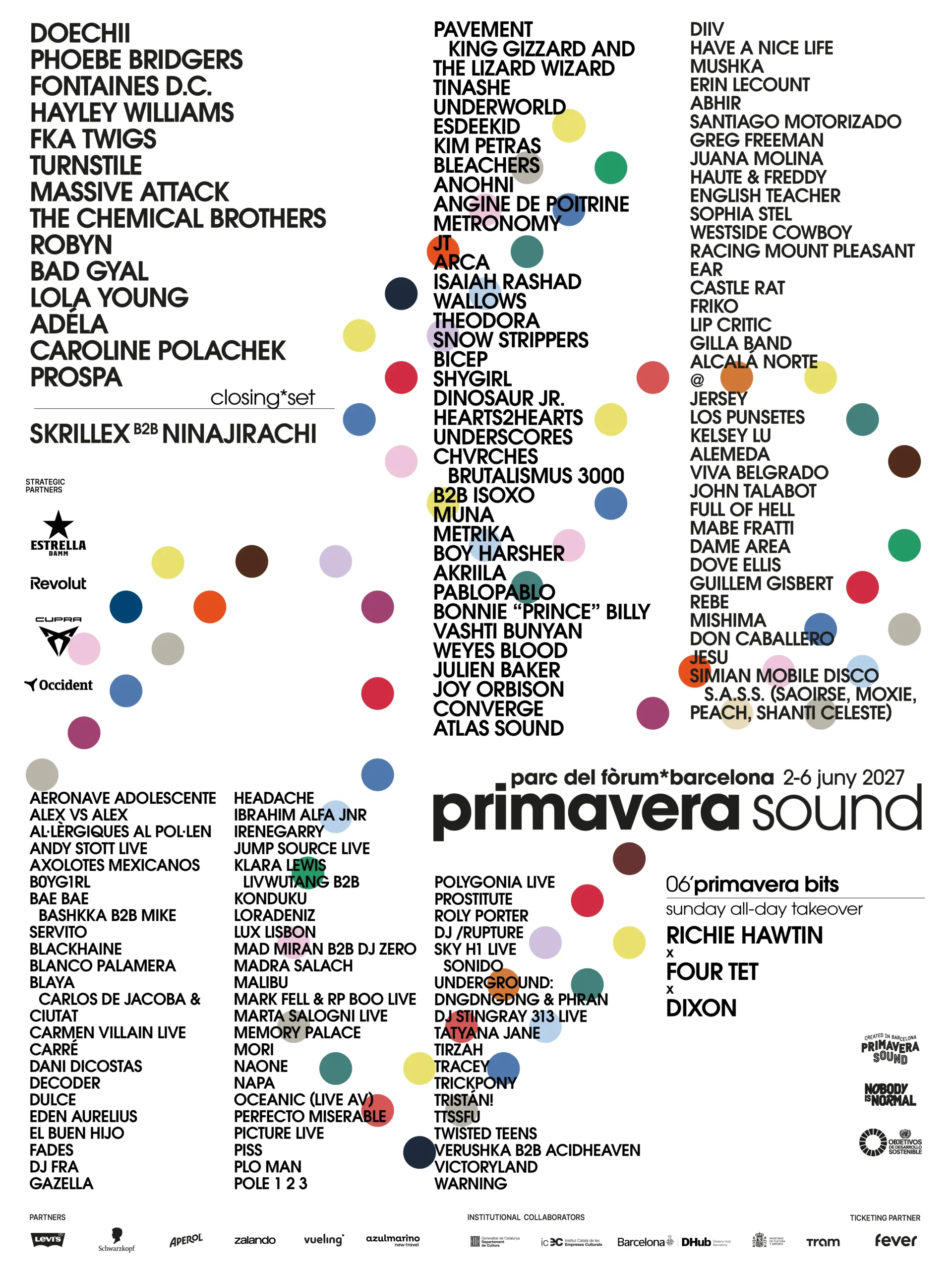
Primavera Sound Barcelona has announced the lineup for its 25th edition, which takes place June 3-5 at the Parc del Fòrum. Next year’s headliners (all top of the bill, according to a press release) include Phoebe Bridgers, Massive Attack, Doechii, Fontaines D.C., Massive Attack, Turnstile, Hayley Williams, The Chemical Brothers, Robyn, Bad Gyal, Lola Young, Pavement, Skrillex b2b Ninajirachi, ADÉLA, Prospa, and Caroline Polachek. Check out the lineup announcement video and poster below.
Bridgers’ headlining performance will mark her first appearance at the Barcelona event, though she did play several of Primavera’s international editions back in 2022. Doechii has also never headlined the festival. And though Massive Attack were set to headline last year, torrential downpour on the festival’s chaotic first day (I still get flashbacks) prevented them from doing so.
Notably, Deerhunter’s Bradford Cox will return under the alias Atlas Sound after a seven-year absence, while Vashti Bunyan is set to make a rare appearance at the age of 81. Also scheduled to perform are Weyes Blood, Julien Baker, @, Gilla Band, Lip Critic, Dove Ellis, Boy Harsher, Arca, underscores, Juana Molina, Tirzah, Jesu, Dinosaur Jr., DIIV, Westside Cowboy, Twisted Teens, Sophia Stel, ear, and more.
Registration for the fan sale is open until October 7 at 23:59 CEST. For registered users, general full festival tickets are priced at €295 plus booking fees, while VIP tickets are €545 plus booking fees. General sales open on October 9 at 11:00 CEST via Fever, with general tickets at €350 plus distribution fees and VIP at €545 plus distribution fees. Find more details here.
Buying an existing home is usually cheaper, faster and more predictable than building one from scratch. A ground-up custom home can run 20% to 30% above the cost of an equivalent existing house once land, site work and financing costs are counted, and move-in takes far longer. Building wins in narrower circumstances: you already own a buildable lot, you pick an efficient plan, and you compare the project against a genuinely similar existing home rather than a national average. Homeowners weighing three choices, buy move-in ready, buy and remodel, or build, should compare all-in costs, not headline prices.
Is It Cheaper to Build or Buy a House? The Short Answer
Three factors decide this question. First, all-in costs versus headline price: a listing price includes the land and the structure, while a building quote often includes neither the land nor the extras. Second, cost certainty versus cost range: a purchase price is a number, a building budget is a range. Third, a production home sold by a builder is a different product from a custom home built on your own land, and conflating them wrecks the math. Before pricing anything, separate your must haves from the features you would simply enjoy.
Buying move-in ready: lowest cash outlay, fastest occupancy, least control.
Buy and remodel: middling costs, phaseable work, established neighborhoods, moderate uncertainty.
Building a custom home: full control, highest variance, highest risk of blowing the budget.
What Housing Data Show About Buying an Existing Home vs. Building
The median new single-family home sold in 2025 went for $417,400 at a median 2,194 square feet, per the Census Bureau, while the average sale price of $523,800 was pulled upward by expensive outliers. For contractor-built homes started in 2025, the median original building contract was $404,000, land excluded. The National Association of Realtors put the existing-home median at $429,100 in August 2026, with 4.9 months of supply, which gives buyers real negotiating room.
These are not apples to apples. Existing homes cluster in established, land-constrained neighborhoods, while a new house often sits farther out on a smaller lot. Treat the numbers as context, not a verdict.
Why a Building Quote Is Not the Full Construction Cost of a House
The Census contract price excludes the land, because the owner already owns it. It also excludes later change orders and separate contracts for exterior or grounds work. That single definition explains most of the bad comparisons you will read online.
The NAHB 2024 Construction Cost Survey found average building costs of $428,215, roughly $162 per finished square foot, or 64.4% of the final sales price. The finished lot added 13.7%, with an average final sales price of $665,298. That survey drew 41 usable builder responses, so read it as a map of where the money goes, not a local estimate.
A complete building budget includes land and closing costs, design and engineering (architect fees commonly run 5% to 10% of building costs), permits and impact fees, clearing and foundation work, utility extensions or well and septic, the contract covering labor and materials, allowances and change orders, construction loan interest, temporary housing, driveway and landscaping, and a contingency. Materials prices and labor rates move, and supply chain issues can stall a delivery and stretch a schedule, so a quote collected months before breaking ground is a starting point, not a promise.
What Does Buying an Existing Home Really Cost?
The listing price is not the whole story. Add closing costs, inspections and specialist reports, immediate repairs, near-term remodeling, moving, HOA dues, special assessments and property taxes.
Age matters. The 2021 American Housing Survey put the median age of owner-occupied homes at 41 years. Among homes built before 1950, recent buyers spent a median of about $3,900 per year on upkeep, against roughly $1,500 for owners in place ten years or more. A low purchase price is often followed by concentrated early spending on a roof, a panel upgrade or plumbing supply lines. The advantage of buying is leverage: you can negotiate repairs or price after an inspection, which nobody can do with a house that does not exist yet.
Does Building Your Own Home Save Money on Energy Efficiency and Maintenance?
Partly. New roofs, systems and appliances have most of their service life ahead of them, builder warranties cover major defects, and homes constructed after 2000 use about 21% less energy for heating than older stock. Energy efficient equipment, better materials and solar-ready design cost far less to install during framing than to retrofit later.
New does not guarantee top-tier performance. There is no single national residential energy code, and jurisdictions adopt different editions with their own amendments. If energy efficiency carries part of your financial case, use a measurable standard. EPA reports that ENERGY STAR certified new homes are at least 10% more efficient than standard new homes built to code. Those savings soften a building premium. They rarely erase it.
The Overlooked Third Option: Buy and Remodel for Better Value
A structurally sound but dated house in the right neighborhood often beats building from the ground up on total cost. Foundation, framing and utility connections already exist, and you are purchasing location you cannot manufacture.
Price the work before you make an offer, sorted into three buckets: cosmetic, system replacement and structural. Cosmetic items such as paint and flooring are predictable. Structural work is where budgets break. Renovation also phases well, which is more cost effective than paying for everything at once. For a Pacific Northwest example of the design-build scope buyers should price before choosing a fixer-upper, the services described by JDI Construction show why remodeling belongs in the comparison as an all-in alternative to buying turnkey or building a new house.
How Land and Site Conditions Decide Whether Building Is Cheaper
One question decides most building budgets: is this lot actually buildable at the price you assumed? Check these factors before purchasing.
Slope, retaining walls and drainage
Soil conditions and required foundation type
Wetlands, flood zones and environmental constraints
Demolition and tree clearing
Distance to water, sewer, power and road access
Septic approval and well depth
Local labor rates and code requirements
Permit, impact and utility connection fees
Site development alone can swing from a few thousand dollars to six figures. NAHB’s 2026 industry survey estimated that government regulation accounts for 26.4% of a new home’s final price across land development and building. That is an industry estimate, and local rules vary widely.
Construction Loans, Timelines and the Cost of Waiting
Per the CFPB, a construction loan is short-term and funded in draws as building progresses, typically at higher interest rates than a purchase mortgage. Some convert to permanent financing; others require a second application once the house is complete. Compare equity required, interest charged during the building process, draw and inspection fees, one-close versus two-close structures, rate locks, appraisal from plans and specs, and what happens if the budget is exceeded.
Then add time. Census data for 2025 show an average of 8.8 months from authorization to completion: about 7.4 months for a built-for-sale home, 11.7 months for a contractor-built custom home and 14.3 months for an owner-built home. That clock starts at permit and excludes land search, design and financing approval. Every extra month means paying rent, storage or a duplicate housing payment.
Do You Need a New House, or More Space at Your Own Home?
If the real problem is square footage rather than the house itself, the cheapest fix may already sit on your property: an addition, a finished basement, a permitted garage conversion, or an ADU used as a rental, a caregiver suite or one of the home offices a household now needs. Feasibility is property-specific, so setbacks, lot coverage, slope, utility capacity and the permitting process come before any per-square-foot estimate. A local builder such as Modern Buildings Seattle ADU Builder illustrates the questions that belong in an ADU feasibility budget. Rental income can make the project closer to investing than to pure spending.
A Build-vs.-Buy Cost Comparison Worksheet
Fill all three columns using the same location, finished square footage, bed and bath count, garage, finish quality and ownership period. If the columns describe different homes, the totals mean nothing.
Line item
Move-in ready
Buy + remodel
Custom build
Land or purchase price
Closing costs
Design, engineering, permits and fees
Site prep and utilities
Contract for labor and materials
Financing costs
Temporary housing
Immediate repairs
Contingency
10-year maintenance and energy costs
Total cash required
Target move-in date
When Buying an Existing Home Is Cheaper
Comparable inventory is available in your target area
You need to move within months, not years
Buildable land is scarce or expensive locally
Available lots need heavy grading or long utility runs
The house you found needs cosmetic work only
You are purchasing a first home and need predictable numbers
You have little tolerance for a moving budget target
When Building a Custom Home Is Worth the Premium
It is rarely cheaper to build than to buy a comparable existing house, but the gap narrows sharply when the conditions below line up.
You already own a buildable, serviced lot
A compact, standardized plan meets your needs
Site factors are known and uncomplicated
Existing stock would need major structural work to function
Accessibility or household-specific requirements cannot be bought
A specific vision, including future needs, shapes the floor plan
You will stay long enough for layout and low early maintenance to repay the investment
Builders in your market are competing on price or incentives
Owners who build their own house in an appreciating market sometimes realize value above their building costs, but that is market-dependent. Customization does not automatically return equal value when you sell.
Your Final Checklist Before Booking a Free Consultation
Two or three comparable existing homes, priced with closing costs
A realistic renovation estimate if a fixer-upper is in play
Written land and site-development assumptions
A preliminary design and building budget, architect fees included
Construction-loan terms in writing
Insurance and property-tax quotes
A timeline with temporary housing costs and a project contingency attached
A local valuation of the finished home
A free consultation with a builder, remodeler or construction lender costs nothing and sharpens your planning. Public resources help too: verify assumptions with the city or county planning department, utility providers and the assessor, and hire a surveyor and a licensed inspector before you commit.
Frequently Asked Questions
Is $100,000 enough to build a house?
Rarely. It may cover a very small structure or a modest ADU on land you already own with utilities in place, but land, site work and permits usually absorb much of that money on their own.
Is $400,000 enough to build a house?
Often, for a modest plan on a serviced lot you already own. The 2025 median contractor-built contract was $404,000, land excluded, so purchasing a lot or paying for heavy site work makes it tight fast.
Is $500,000 enough to build a house?
Usually, for a mid-size house in many markets when the site is straightforward. NAHB’s 2024 survey showed an average final sales price of $665,298. Do not throw every last dollar at finishes; hold back a contingency, because change orders and site surprises break budgets.
Is it financially better value to buy or build your own home?
Buying usually wins on upfront costs, speed and certainty. Building competes when you control the land, the site is simple and the plan is efficient. For many homeowners, buy-and-remodel or adding an ADU deserves its own column in the worksheet.
Most movie marathons fail for the same reason: they are built around one theme and nothing else. You pick five action films, or a decade’s worth of a single director’s work, and by the third film, your attention starts to drift. A better approach treats a marathon like a well-composed playlist, blending genre, country, runtime, and mood so that each film earns its place in the lineup rather than just filling a slot. Traditional movie browsing does not help much here either, since most platforms sort by “trending” or “top rated” instead of how a film will actually feel sitting next to the one before it. Once you start planning with these four variables in mind, choosing what movies to watch stops feeling like a chore and starts feeling like curating your own festival.
Why Movie Marathons Need Strategy
Watching three or four films back-to-back is a bigger commitment than it looks. Streaming data backs this up as over 70% of OTT viewers report binge-watching regularly, and entertainment and movie content now account for roughly 34.57% of all OTT consumption. That is a lot of screen time, and much of it is unplanned. Viewers load up a watch movies queue based on whatever looks good in the moment, then hit a wall of fatigue halfway through.
Fatigue usually comes from sameness, not length. Three thrillers in a row start to feel like variations of the same film, even if the plots are different. Pacing and variety matter just as much as quality. This is where a bit of upfront planning changes the entire experience. Instead of reacting to fatigue, you build in enough contrast to avoid it altogether.
Mix Genre for Better Pacing
Alternating genres is the simplest way to keep a marathon feeling fresh. Drama, comedy, action, and thriller each hit different emotional notes, and switching between them gives your brain a break from processing the same kind of tension or humor for hours.
A few combinations that work well together:
Drama, then comedy: A heavier film followed by something lighter resets the mood before it gets too heavy to enjoy.
Action, then slow-burn thriller: High energy followed by tension keeps engagement up without exhausting the viewer.
Comedy, then international drama: A shift in tone and setting adds variety without jarring the viewer.
The goal isn’t randomness. It’s contrast with a purpose, so each film feels like a deliberate shift rather than a random pick.
Explore Movies from Different Countries
International cinema has moved from niche interest to mainstream demand. Streaming platforms have seen a clear rise in appetite for non-English originals, with titles like Dark and Money Heistpulling in massive global audiences well beyond their home markets. Local-language storytelling is resonating broadly, not just with niche audiences.
Adding a foreign film to your marathon does more than diversify your watchlist. Different countries bring different pacing conventions, visual styles, and narrative structures. A South Korean thriller builds tension differently than a Scandinavian one. A Thai drama lingers on character in ways that many American productions skip past. Mixing in these perspectives keeps your marathon from feeling formulaic, and it’s often the easiest way to watch new movies that wouldn’t otherwise show up in your recommendations.
Consider Runtime in Your Selection
Runtime is the most overlooked variable in marathon planning, and it has an outsized effect on how the whole session feels. Four back-to-back 150-minute epics is a very different commitment than two long films paired with two under 100 minutes.
Think of runtime as an energy budget:
Open with a mid-length film (90–110 minutes) to ease into the marathon.
Save your longest, most demanding film for when attention is highest, usually earlier rather than later.
Close with something shorter and lighter, so the marathon doesn’t end on fatigue.
This kind of pacing keeps retention high through the last film instead of letting momentum collapse in the final stretch.
Match Movies to Your Mood
Genre, country, and runtime all matter, but mood is what ties a marathon together emotionally. Two comedies can have completely different tones: one is broad and silly, the other is dry and melancholic. Matching mood means paying attention to atmosphere, not just category.
Ask yourself what emotional arc you want across the marathon. Do you want to build tension and release it? Stay light throughout? Move from heavy to hopeful? Treating mood as its own selection criteria, alongside genre and runtime, creates a marathon that feels like one connected experience rather than four unrelated screenings.
A Practical Framework for Planning Your Marathon
Here’s a simple way to put all four variables into practice:
Pick your anchor film first. This is the movie you are most excited about; build everything else around it.
Choose a contrasting genre for the next slot. Avoid repeating the same tone twice in a row.
Add one international title. Use it to break up the pacing and bring in a different storytelling style.
Balance your runtimes. Alternate longer and shorter films rather than clustering them together.
Check the mood arc. Make sure the emotional flow across the lineup feels intentional, not random.
Finalize your list and queue it up. Browse and watch movies online on platforms like 9nung, which make it easy to filter by genre, country, and runtime when building out a varied lineup.
A sample lineup might look like: a mid-length comedy to start, a longer international drama as the anchor, a fast-paced action film to re-energize, and a short, mood-matched drama to close things out.
Start Your Next Marathon Smarter
A great movie marathon isn’t about finding four good films. It’s about finding four films that work well together. Mixing genre, country, runtime, and mood turns a random watchlist into a curated experience that holds attention from start to finish. Next time you are planning a marathon, skip the single-genre binge and build something with more range. Head over to 9nung to browse titles across genres and countries, and put this framework to the test on your next watch.
Digital ownership is changing how games fit into everyday life, from the way players collect virtual items to how online communities organize themselves. Decentralized gaming brings blockchain networks, digital wallets and player-run economies into that mix, creating new possibilities along with unfamiliar costs and risks. The technology can sound abstract, but its effects are becoming visible in games people already play.
What makes a game decentralized
A conventional online game runs on systems controlled by its publisher. The company manages accounts, stores player data and decides what happens to every virtual item. If the servers close or the terms change, players usually have little control over the outcome.
Decentralized games move at least some of those functions to a blockchain. A character skin, collectible or parcel of virtual land may exist as a token associated with the player’s digital wallet. Smart contracts, which are programs that run on a blockchain, can process trades or distribute rewards according to published rules.
Decentralization exists on a spectrum. Some projects place assets on a public network while keeping gameplay on private servers. Others give token holders a vote on updates, community funds or marketplace policies. Very few games are entirely independent of a central development team.
The concept has been taking shape for years. Early reporting on blockchain gaming applications discussed developers experimenting with verifiable items and digital economies as far back as 2017. Since then, the focus has widened from collectibles to community governance, portable identities and user-created content.
For players, the practical distinction comes down to control. Check which features actually operate on a blockchain, who can change the rules and what would remain accessible if the developer stopped supporting the game.
Where digital ownership meets real money
A tradable game item can carry financial value outside the game itself. Players might sell a rare cosmetic item through a marketplace, move a supported asset between compatible apps or earn tokens for completing particular activities. This creates a closer connection between entertainment and personal finance than most traditional games offer.
That connection also appears in chance-based platforms that process deposits and withdrawals through digital currencies. Readers researching that specific category can use Webopedia’s crypto gambling hub to compare reviews, welcome offers and explanations of blockchain betting. Such services require the same caution as any activity involving real money, plus extra attention to wallet security, platform rules and local age restrictions.
Price volatility adds another complication across decentralized gaming. An item valued at $50 one week could be worth much less the next, even if nothing inside the game changes. Transaction charges can also turn a small purchase into an expensive one when a network is busy.
Treat any money committed to a game as entertainment spending. Before connecting a wallet, find out whether purchases can be reversed, which fees apply and how withdrawals work. Keep records of transactions and avoid assuming that a scarce digital item will appreciate. Ownership may be recorded on a blockchain, but demand still depends on the game retaining an active audience.
The appeal goes beyond collecting tokens
The strongest decentralized games give people a reason to participate beyond the possibility of earning money. Players stay for expressive design, social interaction and satisfying mechanics. A token may support those experiences, but it can’t replace them.
Portable digital identity is one promising idea. A wallet can act as a sign-in method and hold proof that a player attended an event, finished a challenge or supported a project early. Communities can also use tokens to vote on creative proposals. For example, a group might choose which artist designs a seasonal environment or how a shared fund supports community tournaments.
Low-friction mobile formats have helped introduce blockchain-linked rewards to broader audiences. The popularity of tap-to-earn games shows how a simple repeated action, social sharing and a rewards system can attract large groups quickly. Yet high sign-up numbers don’t always produce a lasting culture. Repetitive play and rewards with limited use may lose their appeal once the initial novelty fades.
Look for evidence of a functioning community before committing significant time. Active discussion boards, regular development updates and clear moderation policies are more meaningful than follower counts alone. A game with modest financial features and an engaged creative audience may have greater staying power than one built around constant token promotion.
AI is becoming part of the system
Artificial intelligence is starting to overlap with decentralized gaming in several practical ways. Developers can use generative systems to produce dialogue variations, adapt non-player character behavior or help creators draft virtual objects. Blockchain records may then identify an asset’s creator, document its ownership history or manage payments when other players use it.
This combination raises difficult questions. If an AI tool creates a costume from a text prompt, the game still needs rules governing training data, commercial rights and revenue sharing. A public ownership record doesn’t settle whether the original material was used with permission.
The current Web3 and AI research points to applications in personalized experiences, autonomous digital agents and content creation. In a future role-playing game, for instance, an AI-controlled character could remember earlier interactions while a blockchain account stores selected achievements. The result could feel more consistent across different sessions or connected virtual spaces.
Players should check what information an AI feature collects before using it. Voice clips, chat logs and behavioral data may reveal more than a wallet address alone. Review privacy settings, limit optional data sharing and use a separate screen name when public activity doesn’t need to connect with your offline identity. Technical novelty shouldn’t obscure ordinary questions about consent and data retention.
The trade-offs players should understand
Decentralized gaming asks players to take on responsibilities that publishers normally handle. Losing access to a wallet can mean losing associated items. Approving a harmful smart contract may allow it to transfer assets without another confirmation. Customer support might have no technical ability to undo the transaction.
Start with a separate wallet containing only the funds or items needed for a specific game. Never share its recovery phrase and verify the official website through the project’s established channels. Before approving a request, read the permissions instead of treating the prompt like a routine login screen.
Environmental impact is another consideration, although blockchain networks vary widely in energy use. Proof-of-stake systems generally require far less computing power than older proof-of-work designs. Players can check which network a game uses and whether the developer publishes specific information about its infrastructure.
A peer-reviewed overview of blockchain-powered gaming also examines barriers such as scalability, security and user experience. These issues shape ordinary play. Slow transaction processing can delay access to an item, while complicated wallet steps can make onboarding frustrating for newcomers.
No technical architecture guarantees a healthy game economy. Developers still need fair rules, reliable moderation and a sustainable source of revenue. Players should be wary when rewards depend heavily on a constant flow of new participants or when the project says little about the entertainment itself.
How to judge a decentralized game
Begin with the game, not its token. Watch unedited gameplay, read independent player discussions and see whether the main activity looks enjoyable without financial rewards. If the experience only makes sense when prices rise, its design may be serving speculation more than play.
Next, identify what you’ll actually own. Some tokens contain the full asset, while others point to files stored elsewhere. If an external server disappears, the blockchain record may remain even though the image or interactive content does not. The project should explain this distinction in plain language.
A useful review also covers the practical details:
Which company or team maintains the game?
Has its smart contract code received an independent security audit?
What transaction, marketplace and withdrawal fees apply?
Can you play without purchasing a token?
What personal data is tied to your public wallet activity?
Give a new platform time before spending heavily. Create an account, test its free features and observe how the team responds when technical problems occur. A functioning withdrawal process and clear support channel tell you more than an ambitious development schedule.
Decentralized gaming will likely settle into daily culture through small, useful features instead of one dramatic shift. A portable collectible, a community vote or a verifiable creator payment may eventually feel as ordinary as cloud saves do now. The games that last will make those systems understandable while giving people a compelling reason to keep playing after the novelty has worn off.