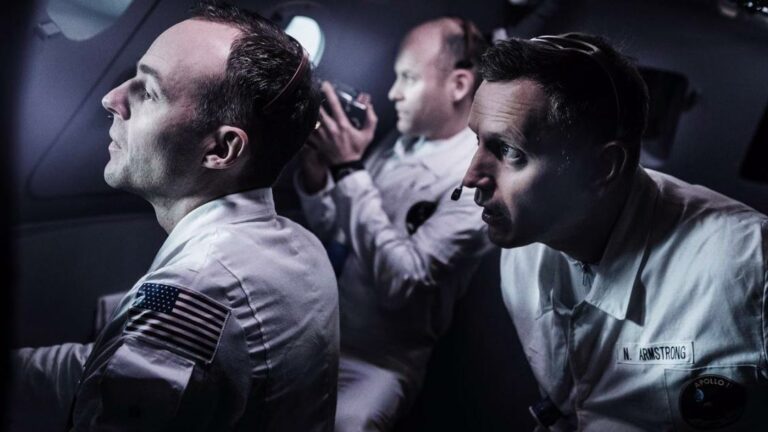
From the first viewing, it is easy to pile Solaris into another IMDB list of sci-fi films that explore life beyond earth. In fact, for many Solaris is considered a response to Stanley Kubrick’s 2001: A Space Odyssey as they both explore space journeys and the presence of artificial intelligence. But any film fan having seen both of the films knows that Solaris goes into an emotional direction, where 2001 doesn’t.
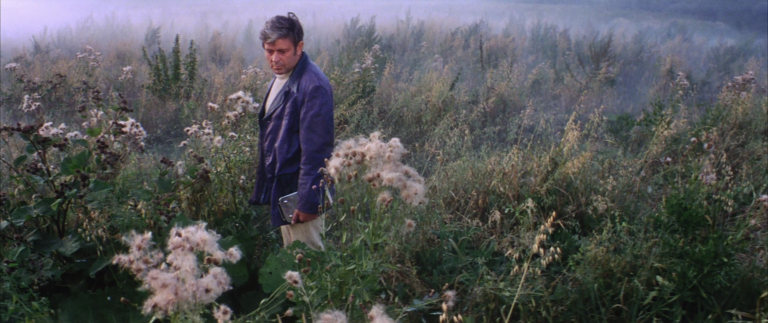
Solaris, a 1972 film directed by Andrei Tarkovsky, is based on a 1961 novel by Stanislaw Lem. Critically speaking, Solaris doesn’t dig into the themes of extraterrestrial intelligence deeply as Lem’s novel does, and unlike, Soderbergh’s 2002 film Solaris starring George Clooney and Natascha McElhone, the theme of love isn’t as prominent either. In this adaptation, Tarkovsky explores nature and human connection to it. The rain, trees, animals are a reflection of nature and life. Tarkovsky utilises every tool he has to lift the beauty of nature and the importance of it to humans. For example, in one specific scene, the character of Kris Kelvin (played by Donatas Banionis) is immersed in nature and a cut is made to a shot showing a horse going by. This shot reflects the beloved symbolism Tarkovsky loved to use. In a 1969 interview with Positif, a French magazine, Tarkovsky talked about the ending of Andrei Rublev, which also uses horses as a symbol, stating: “We wanted to come back to the symbol of life because for me the horse symbolises life.” In Solaris, the same symbol of a horse symbolising life is used and arguably acts as a symbol for Kris as a glimpse of hope.
“My decision to make a screen adaptation of Stanisław Lem’s Solaris was not a result of my interest in science fiction. The essential reason was that in Solaris Lem undertook a moral problem I can closely relate to. The deeper meaning of Lem’s novel does not fit within the confines of science fiction. To discuss only the literary form is to limit the problem. This is a novel not only about the clash between human reason and the Unknown but also about moral conflicts set in motion by new scientific discoveries. It’s about new morality arising as a result of those painful experiences we call “the price of progress.” For Kelvin that price means having to face directly his own pangs of conscience in a material form. Kelvin does not change the principles of his conduct, he remains himself, which is the source of a tragic dilemma in him.
Why is it that in all the science fiction films I’ve seen the authors force the viewer to watch the material details of the future? Why do they call their films — as Stanley Kubrick did — prophetic? Not to mention that to specialists 2001 is in many instances a bluff and there is no place for that in a work of art. I’d like to film Solaris in such a way as to avoid inducing in the viewer a feeling of anything exotic. Technologically exotic that is. For example: if we filmed passengers getting on a tram and we knew nothing about trams — let’s assume — because we had never seen them before, then we’d obtain the effect similar to what Kubrick did in the scene of the spaceship landing on the Moon. If we film the same landing the way we would normally film a tram stop, everything will fall in its rightful place. Thus we need to put the characters in real, not exotic, scenery because it is only through the perception of the former by the characters in the film that it will become comprehensible to the viewer. That’s why detailed expositions of technological processes of the future destroy the emotional foundation of film.”
– Andrei Tarkovsky on Solaris
Much like nature, Tarkovsky also presents ‘the future’ which conflicts with his beloved nature. However, unlike many sci-fi films, Tarkovsky presents it through contemporary buildings and visuals. There isn’t much of an attempt by Tarkovsky to make the world in the film seem futuristic. Arguably through this choice of representing the future as contemporary Tarkovsky critiques the state of the world and the loss of human connection with nature. Moreover, it doesn’t let the film fade away from its emotional side.
Praise has also to be given to the technicality of the film, which truly showcases the sheer talent of the crew. Solaris treats the viewer with some truly mesmerising set design and equally spell-binding cinematography that helps boost the richness and the naturistic side of the film.
In terms of editing, at times the flow of the film can feel long-winded and questionable. However, Tarkovsky chooses to utilise the long takes to let the viewers meditate and contemplate the philosophical questions Solaris poses. Personally, I’ve never seen slow-paced editing as a problem, as long as there is a reason behind it. Tarkovsky clearly had his reasons, and it shows.
Overall, Solaris is a must-watch for any cinephile that looks to explore the world of sci-fi and the mind of Tarkovsky further.
 Ed Sheeran, No. 6 Collaborations Project: Ed Sheeran’s fourth studio album is a star-studded effort featuring Justin Bieber, Camila Cabello, Travis Scott, Eminem, 50 Cent, Cardi B, Paulo Londra, Young Thug, Bruno Mars, Stormzy, Chance the Rapper, Khalid, and more. The guy-with-an-acoustic-guitar-turned-pop-star uses his star status to bring all these artists together for this much-hyped collaborative project, which includes the singles ‘I Don’t Care, ‘Beautiful People’, ‘Cross Me’, ‘Best Part of Me’, and ‘Blow’.
 Big K.R.I.T., K.R.I.T. IZ HERE: A sequel to his 2010 mixtape K.R.I.T. WUZ HERE, this is the fourth studio album by Mississippi rapper Big K.R.I.T. It’s the official follow-up to his ambitious and critically acclaimed double album 4eva Is a Mighty Long Time, while early this year he also dropped a compilation bringing together a series of EPs he released in 2018, TDT. K.R.I.T. IZ HERE features guest appearances from Lil Wayne, J. Cole, Saweetie, Rico Love, Yella Beezy and more.
 Blood Orange, Angel’s Pulse: Announced just earlier this week, Blood Orange is back following his critically acclaimed fourth studio effort, Negro Swan. “Somewhat of an epilogue” to that album, Dev Hynes performed, produced, and mixed the whole mixtape by himself. In a statement, he said he has a habit of creating new material directly after he puts out an album, but that he normally does not release it. “I put as much work and care into it as I do with the albums I’ve released, but for some reason trained myself into not releasing things the rate at which I make them. I’m older now though, and life is unpredictable and terrifying… so here you go mates.”
 Banks, III: Back from a two-year hiatus, Banks returns with her much-anticipated third album, III. The pop star almost titled it Eros, but changed it to convey “beginning, middle, and end” of her life. The album includes the singles ‘Gimme’ and ‘Look What You’re Doing to Me’, which seem to suggest a new kind of musical progression for the artist.



:format(webp)/cdn.vox-cdn.com/uploads/chorus_image/image/60071911/PixarSequels_Getty_Pixar_Ringer.0.jpg)

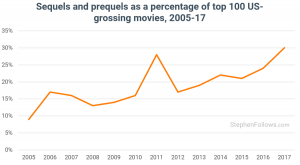
 That said, it’s great news that Pixar recently announced they will only develop original movies for the foreseeable future. It’s absolutely a necessary thing. Their upcoming film Onward is scheduled for release March 2020, and for all we know, neither Tom Holland nor Chris Pratt who lend their voices will be reprising their roles from the Marvel Cinematic Universe. Following that, there are four projects in Pixar’s calendar between 2020 and 2022, ensuring at least three years of original material. Let’s just not sigh in disappointment the moment one of them becomes a franchise and instead give it a fair chance. It might just lead to the next Toy Story.
 Watching Dreamville Presents: REVENGE, the 30-minute documentary that accompanies the third installment in J. Cole’s Dreamville compilation series, one gets a sense of the intense atmosphere of excitement that prevailed in the recording sessions for Revenge of the Dreamers III. Being a part of this collaborative project is like a golden ticket for lesser-known producers and rappers. But it is also an opportunity for J. Cole, one of the least collaborative artists in hip-hop, to get out of his comfort zone. There are moments in ROTD 3 that evoke this exhilarating feeling of collaboration, most evidently ‘Wells Fargo’, a high-energy banger where the less-than-perfect sound quality actually works to the song’s benefit, or ‘Down Bad’, a tight and infectious cut featuring JID, EARTHGANG, Bas, and Young Nudy. Other tracks, as is to be expected with such an overwhelming list of contributors, either lack focus or overstay their welcome, as in ‘Oh Wow… Swerve’ or ‘LamboTruck’. On the other hand, the R&B-leaning tracks that feature Ari Lennox, ‘Self Love’ and ‘Got Me’, are some of the album’s most moving highlights. It’s hard to say what this all-over-the-place project is exactly; it certainly works best as a promotional tool for those lesser-known artists than a coherent artistic effort. Even so, there are a few strong moments that elevate it from the slightly more mediocre Revenge of the Dreamers II.
 “Syre is the nice one, kind of the more sensitive one. And Erys is just kind of like, doesn’t really care at all.” Jaden’s own description of his latest album, ERYS, is surprisingly apt, though not necessarily in the way he meant it to be. The “I don’t care” factor is indeed quite high on this one, but make no mistake: much of ERYS is just filled with a bunch of generic, flavourless trap beats (‘i-drip-or-is’, ‘Again’) that have little to nothing to offer. Plus, isn’t ‘Got It’ basically a sad rip-off of Charli XCX’s ‘I Got It’, or is it just me? In any case, Jaden isn’t afraid to experiment on ERYS, to invariably questionable results. Out of nowhere, we get a punk song (‘Fire Dept’) – yes, you read that right – a couple of painfully autotuned and overly-long emo rap songs, one after the other (‘Blackout’ and ‘Pain’, each close to 7 minutes long), not to mention the 8-minute faux-experimental closer ‘ERYS’. There are a few bright spots, fortunately, like the hard-hitting ‘NOIZE’ feat. Tyler, the Creator, or ‘Own My Own’ feat. Kid Cudi, which sort of has that abrasive Kids See Ghosts vibe to keep it going. But apart from that, ERYS is quite an unentertaining mess.
 Jesca Hoop effortlessly mixes old and new worlds, both musically and lyrically. While Stonechild is the California folk singer’s fifth studio album, many became aware of her work after the critical success that was her 2017 album Memories Are Now. The approach here is similar, but where Memories Are Now combined traditional folk songwriting with a raw, sometimes distorted acoustic guitar sound, Stonechild is more polished, while mixing in subtle electronic elements. But it still inhabits the same dark place, ancient but somehow distinctly modern. Produced by PJ Harvey collaborator John Parish, that PJ Harvey influence immediately makes itself apparent on the dramatic opener ‘Free of the Feeling’ (as well as later on with ‘Red White and Black’), but the rest of the album delves into a more traditional sound while exploring themes such as the dark side of motherhood. ‘Old Fear of Father’ acts as a chilling thesis for the album, as Hoop sings about how misogyny passes on from generation to generation – “I love my boys more than I love my girls/ Try not to show it, she knows like I knew/ I have my father’s legs, long kissed with summer/ Old fear of Father keeps me in Mother’s mirror”. There’s great storytelling here, too, like on the poignant ’01 Tear’, as well as smart commentary on contemporary society and virtual reality on the stunning single ‘Outside of Eden’ featuring This is the Kit. But there’s also one surprisingly personal moment, the track ‘Shoulder Charge’ (feat. Lucius), where Hoop beautifully evokes feelings of alienation and being an outsider, ending on a hopeful note: “And what a fucking relief/ That nothing one can go through/ Has not been shared by two.”
 Are you a fan of boundary-pushing electropop in the style of Grimes and Purity Ring? Or perhaps just a lower-case ‘i’ enthusiast? Then don’t miss out on the new album by BABii, a UK artist who fuses sweet vocals with dark subjects to create a particularly captivating brand of left-field futuristic pop. What separates BABii from the many indie pop musicians mixing dreamy vocals with layered synths is the tight songwriting and electronic flourishes influenced by the likes of Iglooghost, the experimental producer with whom she has toured and collaborated, as in opener ‘SYMMETRii’. HiiDE is also surprisingly cohesive and mature for a debut album, while still being playful and creative, mysterious but open-hearted. ‘CARNiiVoRE’ brilliantly explores the idea of falling in love with someone you know is going to hurt you through the metaphor of a prey animal falling in love with its predator. Other moments are more emotionally direct – “And I miss you/ And I don’t want to” she sings on ‘SKiiN’, one of the highlights of the album. BABii often treats her voice like another instrument, like on the spacy closer ‘SEiiZure’, or the slower-paced ‘POiiSON’, with its quietly entrancing bass-line and affecting chorus. It’s a shame the album is only 35 minutes long – we can’t wait to hear more from her.