Dummy – the Los Angeles-based band comprising Alex Ewell, Emma Maatman, Nathan O’Dell, Joe Trainor, and Lance Umble – have announced a new album. do you love the color of the sky?, the follow-up to 2024’s Free Energy, arrives October 16 via Polyvinyl. It’s led by the spectral, kinetic new single ‘Full Spectrum Dominance’, which comes paired with a video by Matt Wells (POST MAN). Check it out below.
“I was trying to make something just heavier, and we joked it was our nu metal song, during the recording we added the tambourine that gives it a more dancey vibe, Deee- Lite meets Deftones,” Trainer said of the new song. Maatman added: “This is the Technofeudalism bop. Tech billionaires are treating AI like the new Alchemy, using it as a source of power and magic. This supposedly soon-to-be all-powerful technology could not exist without harvesting all of humanity’s intellectual property and collective work. ‘Prima Materia’ is the building block of all alchemical matter, so in the canon of the song, we humans are the Prima Materia.”
do you love the color of the sky? Cover Artwork:
do you love the color of the sky? Tracklist:
1. April Limousine
2. Alluvial Fan
3. Full Spectrum Dominance
4. Squeaky Wheel
5. Touch the Perfect Speed
6. Song of Mana
7. Omen Globe
8. C.B.B.S.I.M.M.P.W.M.
9. N of 1
10. Heaven’s What You Make of It
Motherhood changes almost everything, including the way you shop.
Before having children, I enjoyed browsing clothing stores whenever a new season arrived. Buying a new dress or a pair of shoes felt exciting because I had the time to think about what I wanted to wear. After becoming a mom, shopping looked completely different. Most of my purchases were for my family, while my own wardrobe became an afterthought.
Months turned into years, and one afternoon I realized I was still wearing clothes I had owned long before becoming a parent. They were comfortable, but they no longer reflected who I felt I was. I wasn’t trying to dress like someone ten years younger or keep up with every trend on social media. I simply wanted to feel confident again without spending a fortune.
That was the moment I discovered SHEIN, and it completely changed how I approached updating my wardrobe.
Dressing for Real Life Instead of Special Occasions
One thing I quickly learned as a mom is that fashion has to work for everyday life.
My clothes need to handle school drop-offs, grocery shopping, coffee with friends, and the occasional family outing. They also have to be practical enough for running after children while still making me feel put together.
Browsing SHEIN felt different from shopping in many traditional stores because there was such a wide variety of styles available. Instead of seeing only one seasonal trend, I could choose pieces that actually matched my lifestyle. Whether I wanted comfortable casual outfits, something a little more polished for dinner, or simple basics I could wear repeatedly, there always seemed to be plenty of options.
The biggest surprise wasn’t finding trendy clothes.
It was realizing I could experiment with different looks without worrying that one purchase would consume my clothing budget for the month.
Because the prices were accessible, I felt comfortable trying colors, styles, and combinations I normally would have ignored. Some became everyday favorites, while others reminded me that stepping outside my comfort zone can actually be fun.
That flexibility made fashion enjoyable again instead of stressful.
Looking Current Without Chasing Every Trend
Fashion changes quickly, and social media makes those changes happen even faster.
Every week there’s another color, another style, or another trend that everyone seems to be talking about. Trying to keep up with all of it would be exhausting and expensive.
What I appreciate about SHEIN is that it gives people the freedom to choose what fits their personal style instead of feeling pressured to buy everything that’s popular. I don’t need a completely new wardrobe every season. Sometimes adding one updated blouse, a pair of wide-leg trousers, or a new handbag is enough to make my existing clothes feel fresh again.
Over time, SHEIN became less about following trends and more about helping me build a wardrobe that reflects who I am today.
I also found myself becoming more intentional about shopping. Instead of buying something simply because it was inexpensive, I started choosing versatile pieces that could be worn in multiple ways. A single blazer could work for a parent-teacher meeting, lunch with friends, or date night with my husband.
That mindset made every purchase feel more worthwhile.
Another thing I enjoy is seeing how people style the same items differently. It reminds me that fashion isn’t about wearing exactly what everyone else is wearing. It’s about finding inspiration and adapting it to your own personality and lifestyle.
For busy moms, that kind of flexibility matters.
You don’t need an entirely new closet to feel refreshed. Sometimes a few carefully chosen pieces are enough to change how you feel when you leave the house each morning.
Of course, style means something different to everyone. Some women love bold colors and statement pieces, while others prefer timeless basics that never go out of fashion. The appeal of SHEIN is that it offers enough variety for both approaches, allowing shoppers to create a wardrobe that feels personal rather than prescribed.
Looking back, I realized I wasn’t trying to impress anyone else.
I simply missed feeling like myself.
Motherhood added many wonderful things to my life, but it didn’t erase the person I was before becoming a parent. Taking a little time to refresh my wardrobe became a reminder that it’s okay to invest in yourself too.
Today, I still prioritize my family when it comes to spending, but I no longer feel guilty about updating my own wardrobe occasionally. Thanks to SHEIN, I found a practical way to stay current without stretching our household budget.
If you’ve been wearing the same clothes simply because you’ve been too busy caring for everyone else, perhaps it’s time to set aside a little space for yourself. Explore what SHEIN has to offer, discover styles that fit your everyday life, and remind yourself that becoming a mom doesn’t mean giving up your own sense of style. Sometimes a small wardrobe refresh is enough to help you feel confident all over again.
There’s a moment that happens every time a new phone comes out: you start weighing up whether it’s really worth the price tag. What often gets forgotten in that calculation is the device already sitting in your pocket or drawer, which could be doing a lot more heavy lifting towards the cost than you’d think.
Your Old Phone Is Worth More Than You Assume
It’s easy to write off an old handset as basically worthless once something newer catches your eye. In reality, even phones a few years old tend to hold reasonable value, particularly if the screen is intact and the battery hasn’t been thrashed. The trick is not letting that value quietly evaporate while the phone sits unused for months on end. The sooner a device is handed over after being replaced, the more it’s usually worth.
A Straightforward Route, Whichever Camp You’re In
One of the more useful things about the current trade-in landscape is that it isn’t tied to a single brand. If you’re an Android user due an upgrade, a quick samsung trade in will typically get you a same-day valuation based on the model, storage and condition of your device, with the option to post it off or hand it over in person depending on the service. There’s no need to haggle over price with a stranger or wait around hoping someone replies to a listing.
The process works just as smoothly if you’re switching over to, or staying within, Apple’s line-up. Plenty of services let you trade in iPhone handsets with the same ease, taking into account things like battery health, cosmetic condition and whether the original box or accessories are included. Whichever ecosystem you’re in or moving to, there’s rarely a reason to let an old device just sit there.
Don’t Assume the Worst About Condition
A surprising number of people talk themselves out of trading in a phone because it’s “not good enough” — a scratched screen, a slightly tired battery, a case that’s seen better days. In most cases, this only affects the value rather than ruling the device out altogether. It’s always worth getting a proper valuation before deciding a phone isn’t worth the effort. Minor wear rarely means a device is unwanted.
A Few Steps Before You Hand It Over
Whichever service or route you choose, a bit of preparation makes the whole process far smoother:
Back up first. Photos, messages and contacts should be saved somewhere safe before you go any further.
Sign out of accounts. Remove the device from your Samsung, Google or Apple account and disable any “Find My” style tracking.
Do a full reset. This clears your personal information so the device is ready to move on.
Check for extras. SIM trays, memory cards and any accessories are easy to forget in the moment.
These steps take only a few minutes but they’re the most common reason valuations get delayed or devices get rejected, so it’s worth doing properly rather than rushing.
Let Your Old Phone Pay Its Way
There’s very little upside to leaving an old handset unused once a replacement has arrived. Every month it sits idle, its value edges lower, and that’s money that could easily be going towards the new device instead. Whether you’re arranging a samsung trade in for a phone you’ve outgrown, or deciding to trade in iPhone models that have been replaced, it’s a quick, low-effort way to make the cost of upgrading a little easier to swallow. Better in someone’s pocket, doing a job, than gathering dust in a drawer.
In Bloodline of Echoes, Haibo Jia uses text and digitally generated moving image not only to convey language as “symbolic power” (in Bourdieu’s terms), but also to advance the argument that linguistic capital, within globalisation, relegates the self to the periphery of its own native society and culture. The market value of “legitimate speech” for Globish individuals — those whose goal is to live in the interstices of cosmopolitanism, or to navigate the international professional playground with fluidity — comes at the expense of stripping one’s native language of its affective charge, and of relinquishing the heritage, ethics, collective memory and experience that inhabit the vernacular and the mother tongue.
Still Image of “Bloodline of Echoes”, 2025. Courtesy of the artist.
The historical and political layers of this work are entwined in a complex symbology, associated with modern Chinese visual culture, family values and intergenerational dynamics. The prelude of Bloodline of Echoes is a giant burning sun, which stands for both an ideological centre and a token of the motherland, to which a young and an older woman kneel in ritual prostration as a metaphor for kinship and bodily inheritance. Yet the ancestral worship that connects the two women overlaps with explicit generational divergence and encoded hierarchy; although the mother and daughter perform in unison for the entirety of this video-work, what they say stems from diametrically opposed worldviews.
As Bloodline of Echoes unfolds, Jia has the two women dance and gravitate against differing compositional backdrops. On the one hand, this lets us focus on their individual narrations and their fundamental differences. On the other hand, as both bodies replicate the same movements, it also becomes apparent that an individual will ultimately always remember what may have been forgotten about a native language, or re-learn a native concept, tradition, or practice that once needed no translation.
Still Image of “Bloodline of Echoes”, 2025. Courtesy of the artist.
This Yin/Yang duality is dramatised by the colour of their dresses. However, Jia also deploys the notion of ambiguity to lay bare the cultural negotiations experienced by individuals in the context of globalisation, and the friction of identity such negotiations generate “at home” among family members and compatriots. In fact, the daughter wears white, the colour of mourning in Chinese tradition, as if she recognised what she had to renounce in order to abide by the Westernised global linguistic market. Whereas the mother wears black, which in Chinese cosmological schema corresponds to winter — exacerbated by the dark and snowy landscape to which she belongs in this digitally constructed environment — and associates her with the ancestral memory and deep past her daughter is compelled to obliterate through migration, education, cross-cultural adaptation, and the deconstruction of her native language.
Still Image of “Bloodline of Echoes”, 2025. Courtesy of the artist.
Two fundamental questions outlive Jia’s work, and concern the impact of globalisation on both language and identity as elements endlessly transformed across history and generations: Is globalisation reshaping identity in the same way it reshaped language? And will it harden languages other than English — the current lingua franca — into codes of their own?
Still Image of “Bloodline of Echoes”, 2025. Courtesy of the artist.
The Rose of Jericho, also known as the resurrection plant, is a spike moss that grows in dry deserts, surviving through adaptations that protect its cells during long spells of dehydration. Taja Cheek doesn’t often rely on physiological language in her music, which tends to be elliptical in its introspection – “My cerebellum contradicts me” is a notable exception on ‘church of no one’, the closer of her latest L’Rain album, fata morgana – but she is palpably inspired by such natural phenomena, metaphors of resilience in an increasingly dreary world. Working once again with longtime collaborators Ben Chapoteau-Katz and Andrew Lappin, her new album feels like an extension of the shapeshifting musical world the singer-songwriter has built over the past decade while also prodding at its extremes. Between songs that dissolve in or rise from the ether, that assault or delight the senses, Cheek achieves a strange kind of equilibrium, thriving in an environment that should be hostile to any kind of creative endeavour, let alone such brilliance.
1. rumors of light
If the promise of later track ‘blue’ is true and “shadows can only be made from the light,” how does one catch a glimpse of it? Perhaps it is a rumor, the album’s opening track suggests, a series of false starts that must, eventually, shimmer to life. For an artist as multi-faceted as L’Rain, the inception point scans as difficult, but maybe it can all start with a gentle piano arpeggio.
2. with time
And in time, the arpeggios’ organic, roomy tone dissolves into murkier waters, and it becomes clear that Cheek is operating in the supernatural realm: “I’m a vampire, suck the pain,” she repeats. “Yeah, I mean, I’m just not done yet,” a manipulated voice intones, humorously disrupting the ghostly choir. In fact, she’s barely just begun.
3. blue
The track may have an ambient flavour, but it mirrors nocturnal restlessness as opposed to anything meant to help induce sleep. Sluggish low notes make room for freeform brass that rises like intrusive thoughts, while Andrew Lappin’s unpredictable percussion keeps tumbling out of focus. “Who am I to possess this power?” Cheek wonders, as if remarking on the resonance of her own layered vocals, striving for meaning in the dark.
4. july 5th
The album gradually finds its groove on ‘july 5th’; vocal loops, lush guitars, and a clear lyrical thread percolate like light into rhythm before any kind of drumming enters the mix. Still, it’s not enough to prepare you for a guest appearance from Screechy Dan, who steers the song toward dancehall – and a kind of liberation from the hell it describes – while remaining totally in spirit.
5. bedroom songs
Cheek’s nimble guitar playing is blanketed by her spectral sound design, with additional production by Yuka Honda, who is also credited for the album sequencing. It could have started the record, too, but is more suggestive of a liminal stage, ‘bedroom songs’ as portals to the “proper” ones that follow.
6. borderline
The single evokes “sweaty evenings” that accumulate to the point of taking on a vaporous quality, though the build-up is forceful: slithery guitars relax against kinetic drumming until they become grittier, gasping for air as modular synths pummel through. “Beast or sustenance?” Cheek wonders, capturing that same ambivalence.
7. elmyra
“Like gripping the doorway/ Withstanding tornados” are visceral words for yearning, even if they seem to describe the previous track more than the delicately spectral ‘elmyra’. Cheek leans into her ethereal falsetto over a wondrous constellation of synths, casting a spell without a hint of trepidation over whether it will work.
8. soulless cycle
Cheek allows about a minute of near-silence to prepare our ears for ‘soulless cycle’ – or perhaps to make the shift to its teeth-baring noise all the more jarring. The song’s distorted guitars and frenetic drums are both wrought from and rail against endless torrents of exhaustion, pointing at the cruel irony of how something self-described as a “psycho cycle” can feel so soulless. It’s an absolute highlight that would stand out anywhere in the tracklist, making everything pale in comparison, but it’s smartly placed as the culmination of a couple of full-bodied tracks. It also provides another example of thoughts uttered on a previous track – “If you’re still counting, we’re overflowing” – seemingly being processed in musical terms later on.
9. no body / know body
Another two thirds of a minute to let ‘soulless cycle’ sink in, perhaps also to ponder this track’s titular duality: does transcending the physical bring us closer to understanding it? Or is it more of a push-and-pull, another overwhelming cycle?
10. glass ceiling
Over eerie vocal loops and tinny synths, with Cheek’s breathing as the rhythmic backbone, ‘glass ceiling’ finds the artist back in a kind of comfort zone. But it’s exactly this understated control that allows a heightened level of vulnerability: “Why does it hurt so bad to live out my days?” she asks, plain and piercing.
11. i remember
I always come back to the air horns on Fatigue as an example of Cheek reminding listeners her music isn’t so self-serious, and ‘i remember’ serves a similar purpose. Cheek riffs on classic R&B, singing through laughter – what if ‘elmyra’ was fully upbeat as opposed to just dreamy? More than just an irreverent comedic moment, though, it’s a playful introduction before Cheek fully entertains the idea.
12. birthday
Actually, the idea is more like: What if the lyric was not “Get busy, it’s your birthday” but “Be lonely, it’s your birthday,” which is what Cheek actually sings here, accompanied sumptuously on vocals by Joselia Rebekah Hughes, Rafia Santana, and Tasha Viets-VanLear (aka Tasha, who enlisted L’Rain on her latest album). It’s natural that the most extreme L’Rain song (‘soulless cycle’) would land on the same album as the most ostensibly conventional one, though few deconstructionists of any genre could execute it so meticulously.
13. church of no one
We move from a delightfully lonely song to a darkly reverent one, at once impressionistic and introspective. “Lonely in my head but not my house,” she clarifies, soon after briefly elaborating on the ‘no body / know body’ dichotomy. fata morgana amasses contradictory fragments of self, twisted through non-linear time and mismatched desire, yet finds itself moving forward against all odds, somehow complete.
Job hunting can feel like a job of its own. I should know. I experienced it a couple of years after graduating. Finding openings. Rewriting my resume. Tracking applications. Researching companies. I’ve dealt with a bunch of “we’ve decided to move forward with other candidates,” and that one call from a company I don’t even remember applying for. And doing all of that manually can turn a promising opportunity into another exhausting task. Lucky for those currently looking for jobs, AI tools for job seekers are bringing a more efficient approach to the hiring process.
TheseAI tools are increasingly useful nowadays. That matters when there are an estimated 6.9 million unemployed people, according to theBureau of Labor Statistics. As such, having smart tools can take some of the friction away. That said, this article provides a comprehensive toolkit that covers various aspects of the process.
Top Five Best AI Tools for Job Seekers
Jobright
Jobright stays with applicants throughout the job search. As an AI job-hunting platform, it can match candidates with relevant openings, assess job fit, autofill applications, tailor resumes, generate cover letters, and surface potential connections. Users even gain access to verified interview questions for more targeted preparation. What’s more? It has Orion. An AI copilot for personalized career guidance that helps users carve a path towards a job. Not to mention a feature for streamlining H-1B job searches.
Key Features:
Dedicated AI assistant for real-time insights and smart suggestions
Automates every step of the job search
Job listings from a diverse set of career sites
Pricing:
Free Package
Turbo Package – $39.99 per month
Real Use Case:
Recent graduates can use Jobright to avoid manually searching multiple job boards. It can surface relevant openings and then tailor an application around the job’s requirements. That means less legwork and a greater chance of landing interviews.
Teal
Image Credit: Teal
Teal operates like a command center for the job search. It bundles a collection of job search and resume tools. More specifically, candidates can start organizing, tracking, and managing every application in a centralized hub. At the same time, it can generate multiple resume versions and compare them against specific job descriptions. Even better, it provides keyword matching. Teal’s premise is connecting tailoring an application with actually keeping track of where it was sent.
Key Features:
Follow-up alerts and networking tips
More than 100 templates with different formats and themes
AI-generated resume bullets, summaries, and cover letters
Pricing:
Free Package
Plus Package – $13 per week
Real Use Case:
Many applicants apply for multiple jobs at once. But juggling these can be tough. With Teal, they can monitor each one through a visual pipeline in the job tracker, rather than a messy spreadsheet.
Jobscan
Jobscan, while packed with different AI tools for various stages of the job search, focuses more on resume optimization. It comes with a built-in scanner that compares a resume to a specific job description and identifies missing keywords, formatting problems, and gaps in the match. Such a feature gives applicants a clearer idea of what their application may be missing. From this, users can start building or optimizing their resume. One that is designed to help users get through Applicant Tracking Systems.
Key Features:
ATS resume optimization
Match-rate and keyword analysis for smarter actions
Dedicated tools for cover letters and navigating LinkedIn
Pricing:
Free Package
Monthly Package – $49.95 per month
Real Use Case:
A software developer applying for a role can paste the job description into Jobscan and discover that their resume barely mentions a vital skill. The candidate can then make that experience more visible before applying.
Crystal
Image Credit: Crystal
Crystal approaches job seeking from the human side of hiring. It’s a personality platform that uses assessments to build a profile and provides insights into communication. For job seekers, this can help them understand their communication tendencies. In turn, they can adapt their approach to professional conversations, including interviews. Like gauging how direct, detail-oriented, or relationship-focused to be. Crystal combines six assessments to give users a broader personality profile.
Key Features:
Guidance for adapting communication styles
Supports a complete set of assessment layers
Personality profiling for tailored interview responses
Pricing:
Free Package
Premium Package – $49 per month
Sales Package – starts at $59 per month
Assessments Package – starts at $99 per month
Data API Package – Custom Pricing
Real Use Case:
Highly detailed answers are not always the best approach in interviews. With Crystal’s personality insights, candidates can learn to deliver concise, direct responses during a final-round interview with a VP known for blunt, fast-paced sessions.
Yoodli
Yoodli tackles the part of job hunting that no resume scanner can fix. And that’s speaking during the interview. In essence, it works like a mock-interview space. Just without the judgment and pressure. Yoodli lets applicants customize a conversation to align with speaking goals. That includes setting the topic, speaking partner, and persona. Then it asks questions and responds with follow-ups. After conducting an analysis, it provides feedback on content delivery and overall progress.
Key Features:
Making interview practice more specific than reading common interview questions
Dynamic follow-up questions and real-time feedback
Seamless syncing with Intellum, Workday, Highspot, Seismic, and Docebo
Pricing:
Free Package
Pro Package – $11 per month
Advanced Package – $28 per month
Team & Enterprise Package – Custom Pricing
Real Use Case:
Product designers interviewing for a senior role can run a mock interview with Yoodli. Practicing how to explain a difficult project and then repeat the session after reviewing the feedback.
Choosing the Best AI Tools for Job Seekers in 2026
Why have different AI tools for job seekers? Because a job search isn’t one task. Jobright surfaces roles you’d otherwise miss. Teal keeps you organized as you apply. Jobscan gets you past the ATS. Crystal helps you read theroom. Yoodli makes sure you don’t blow it once you’re in it.
Notice that some suggestions here aren’t exactly for job seekers at all. And that’s the point. Some of the advantages in a crowded job market come from tools built for people whose work depends on reading a room or performing under pressure. Not from another resume template. And when used together, they help applicants find roles, tailor applications, and walk into interviews prepared.
Ryan Hemsworth has announced Numbskull, his first album since 2018. The Elsewhere follow-up, which is out October 21, marks the Canadian producer’s first LP for Topshelf Records. Check out the lead single ‘One Step’ below.
The new album features Sarah Tudzin, Tegan and Sara, Nana Lourdes, Allie, and MSpaint. “With ‘One Step’ I started thinking about old Three 6 Mafia tapes, and some old crunchy 90s UK rave stuff,” Hemsworth said in a press statement. “I imagined this would probably only work with a rapper. But I started making more random friends around this time – someone I connected with and had been giving some production ideas to was Sarah of Illuminati Hotties… I’m not sure why exactly because generally I would’ve sent her something more like her own project. But she jumped at it, and it made me realize this might be my approach with collaboration for Numbskull – only give people wild cards.”
Numbskull Cover Artwork:
Numbskull Tracklist:
1. Vortex
2. One Step
3. I Missed You More [feat. Nana Lourdes]
4. Toy
5. No One Else [feat. MSpaint]
6. Never Learned [feat. Tegan and Sara]
7. Atypical [feat. Allie]
8. Winter Spring
9. A Display of Emotion
10. Breed
11. Break
12. Shifting and Turning
Your illustration looks perfect on screen. The colors glow, the linework is clean, and your character’s expression feels exactly right.
But will all of that survive as a two-inch sticker?
Sticker design is not simply a matter of saving your artwork and clicking “upload.” Size, color, cut shape, and file setup can change how your design turns out in print.
Start With the Sticker, Not Just the Illustration
It is easy to jump straight into polishing the artwork, but the sticker material is what sets the direction for the whole design. Colors, outlines, and transparent areas can behave very differently on white vinyl, clear material, or a holographic finish.
The table below gives you a quick comparison to help you choose the right sticker type for your artwork.
Sticker type
Works well for
What to consider
White background
Detailed art and bold colors
The white base keeps colors more predictable
Clear
Minimal art and negative space
The surface underneath can affect pale areas
Holographic
Bold silhouettes and simple shapes
Fine details may compete with the reflective effect
Sticker sheet
Expressions, icons and themed sets
Every small design must remain readable
Ask yourself: “What should the material add to this design?” If the answer is “nothing,” a clean white background may be the strongest choice.
Build the Artwork at Its Final Print Size
Working on a huge canvas can hide problems. Thin lines, small text, and delicate facial details may look beautiful at 400% zoom but disappear at the actual sticker size.
Create your artwork at the same size you want the final sticker to be. For raster images, use 300 DPI at that size so the design stays sharp. Making a small, low-quality image bigger later will not improve it and may make it look blurry.
When preparing artwork for cheap custom stickers, review the file guidelines on the Vograce product page before exporting. The required color mode, bleed, image dimensions, and file format may vary by sticker type.
Pro Tip: Preview your sticker at 100% before exporting. If the text or small details are hard to see, print a quick paper test at the final size to catch sizing issues early.
Understand Bleed, Cut Lines and Safe Areas
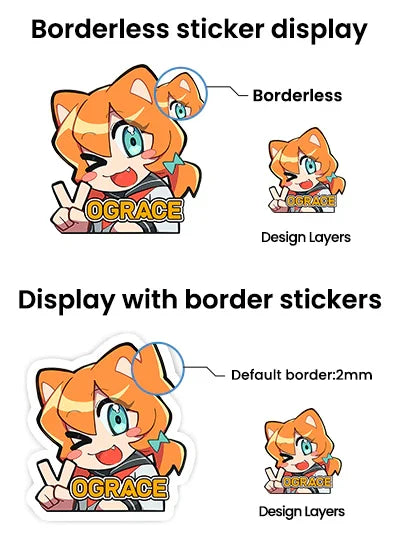
Comparison of borderless and bordered custom sticker designs with a 2 mm default border.
These three terms solve simple problems:
Bleed extends the background beyond the final trim so small cutting shifts do not leave a white edge.
The cut line shows where the sticker will be trimmed.
The safe area keeps important details away from that trim.
Do you need to draw the cut line yourself? Not necessarily. Some printers create it, while others provide a template. Follow the supplier’s instructions exactly. For full-bleed stickers, Vograce requires an extra 2 mm of artwork on each side and advises artists not to include their own cut line.
Keep faces, signatures, and lettering comfortably inside the edge. Hair tips or stars can extend outward, but the design should still look intentional if the cut shifts slightly.
Simplify Without Losing Your Style
Small stickers reward clarity. That does not mean your art must become boring; it means every element should earn its space.
Before exporting, check for:
Outlines too thin to stay visible.
Text that only works when enlarged.
Similar colors that blend together.
Important details too close to the trim.
Rough transparent edges.
Shadows or glows that muddy the silhouette.
Try the “three-second test.” Glance at the design at final size. What do you notice first? Ideally, it should be the character, expression, logo, or message—not a busy background.
Choose a File That Preserves the Artwork
Use the format requested by your printer. Transparent PNG works well for finished raster art, while layered PSD preserves editable elements. AI or PDF can suit vector designs.
Also check the required color mode. Screens display RGB light, while commercial printing commonly uses CMYK inks, so some bright screen colors cannot be reproduced exactly in print. If the printer supplies a specific CMYK profile, use it and review the converted colors before exporting.
Run a Final Preflight Check
Before uploading, confirm that:
Dimensions match the ordered size.
Raster artwork is 300 DPI at final size.
The file meets the printer’s color and format requirements.
Bleed and safe areas are correctly prepared.
Text, spelling, and quantities are correct.
Transparent areas and layers behave as intended.
The exported file opens properly.
Step away for a few minutes and check it once more. Fresh eyes catch surprising mistakes.
Bring Your Sticker Design to Life With Vograce
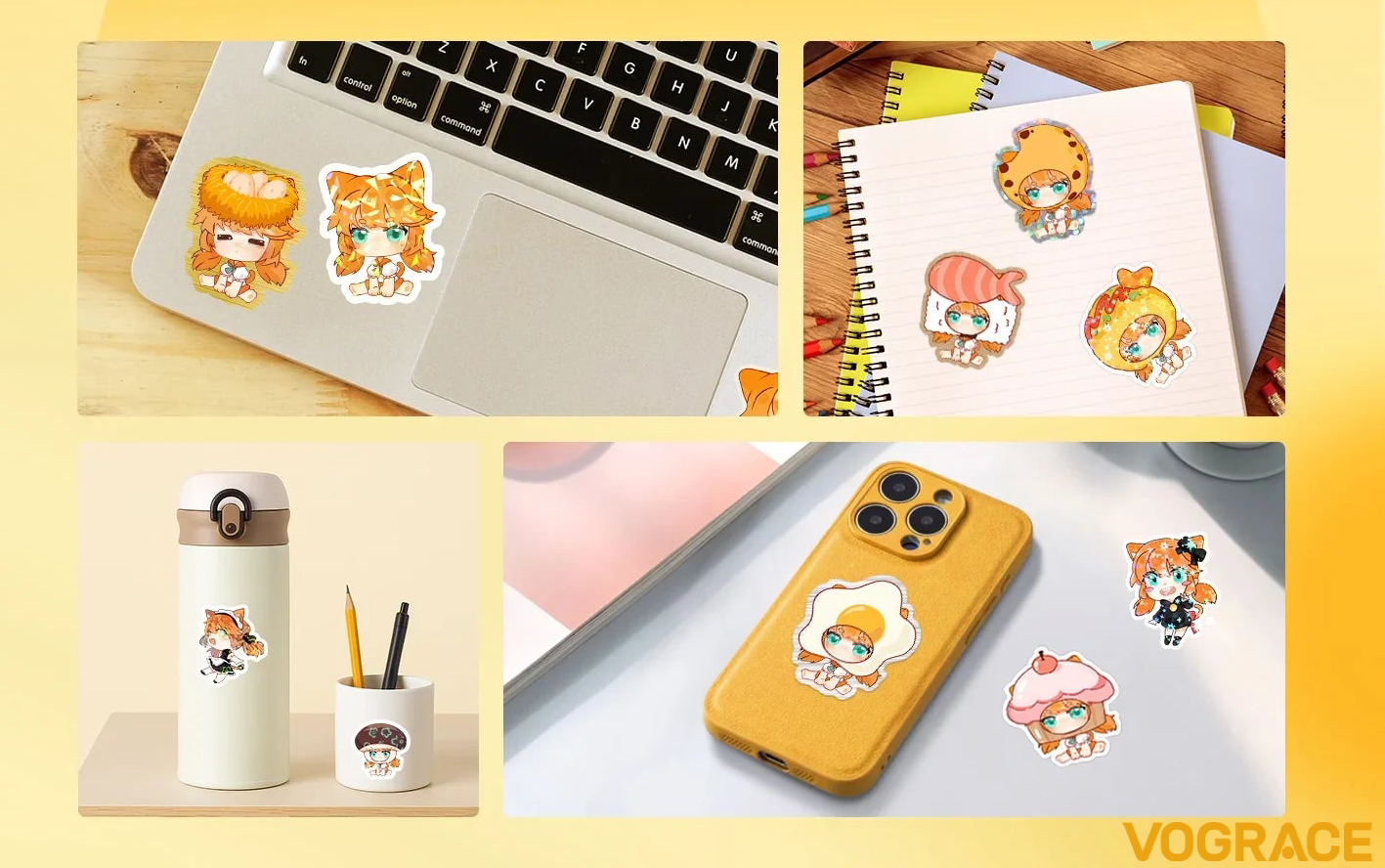
Custom character stickers displayed on a laptop, notebook, bottle, phone case, and other everyday items.
Once your artwork is ready, Vograce can handle the printing and cutting while you focus on the creative side.
Upload your design, choose the size, shape, material, and finish, then follow the file requirements listed on the product page. You can explore exciting options like die-cut, vinyl, holographic, matte, glitter, clear, and washi stickers.
Whether they are for your shop, packaging, gifting, or personal collection, Vograce handles the production and turns your design into stickers made to match your vision.
Comedian Ricky Gervais has a new Netflix series, of the animated variety this time. Alley Cats premiered on the platform on August 7 and was quickly panned by critics, with some going as far as to give it zero stars.
The general public, however, disagrees with that assessment. The show has a good audience score on Rotten Tomatoes, and viewers keep tuning in. With 1.5 million views this week, Alley Cats is currently among the most-watched shows on Netflix globally and a Top 10 show in seven countries.
Does that mean a second season is on the way? Here’s what we know so far.
Alley Cats Season 2 Release Date
At the time of writing, there is no official news about a potential Alley Cats season 2. Netflix is likely waiting to assess viewership before making a decision on the show’s future.
If fans keep tuning in, chances of scoring a renewal are good. Creator Ricky Gervais also seems eager to continue. As long as all goes well, new episodes could arrive in 2027.
Alley Cats Cast
Ricky Gervais as Gus
Tom Basden as Rupert (aka Ponce)
Andrew Brooke as Fang
David Earl as Puke
Kerry Godliman as Lara
Jo Hartley as Kitten
Diane Morgan as Olive
What Is Alley Cats About?
An adult animated comedy, Alley Cats follows Gus, a foul-mouthed stray cat. You join him and his feral buddies as they survive on the streets and in a rundown building. All the while, they can’t help but argue about everything from food to humans to the meaning of life.
Crude humour is a given, but the show has a surprisingly sentimental side. A central storyline begins when the cats discover a lost kitten, forcing cynical Gus to confront ideas about family and responsibility.
The show is a quick watch at only six, short episodes, and it also tackles existential topics. After all, it’s what Gervais does best.
“Everything I’ve done has been a bit existential. (…) And [Alley Cats] is pretty existential because they’ve got even shorter lives than people — they know they haven’t got long,” he told Tudum.
If the show gets renewed, Alley Cats season 2 will likely continue to follow the gang as they get into fresh trouble. We’re sure fans will tune back in.
Are There Other Shows Like Alley Cats?
If you enjoyed Alley Cats, check out some of the other animated series streaming on Netflix.
Claud has announced their third studio album, Me and the Music, which is out October 23 via Dead Oceans. The follow-up to 2023’s Supermodels is led by the single ‘She Doesn’t Love Me’, which arrives alongside a music video. The clip features Claud’s Shelly bandmates Clairo and Josh Mehling, as well as Samia and Annie DiRusso. Check it out and find the album cover and tracklist below.
Claud co-produced the new album with John Congleton. “I was just sick of taking everything so seriously—Supermodels was such a serious record, and I just sulked in feelings for so long,” they said in a press release. “Such terrible things have happened in this country the last few years, but I’ve only grown closer to the people around me because of that. The world has shown me that the worst can happen, but it might just bring you closer to your community. There’s a difference between being sincere with life and taking life too seriously.”
Speaking about ‘She Doesn’t Love Me’, Claud commented: “I love the community I have in America and find so much optimism in people being united in seeking progress. This is a love song for that community.”
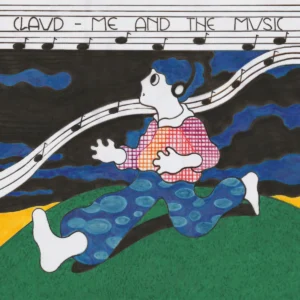
Me and the Music Cover Artwork:
Me and the Music Tracklist:
1. Gay Witchcraft
2. Just Kidding
3. The Legend
4. She Doesn’t Love Me
5. The Reach
6. Spells and Fortune Tellers
7. I Owe You
8. I’m too Sensitive
9. Me and the Music
10. Let’s End on a Good Note