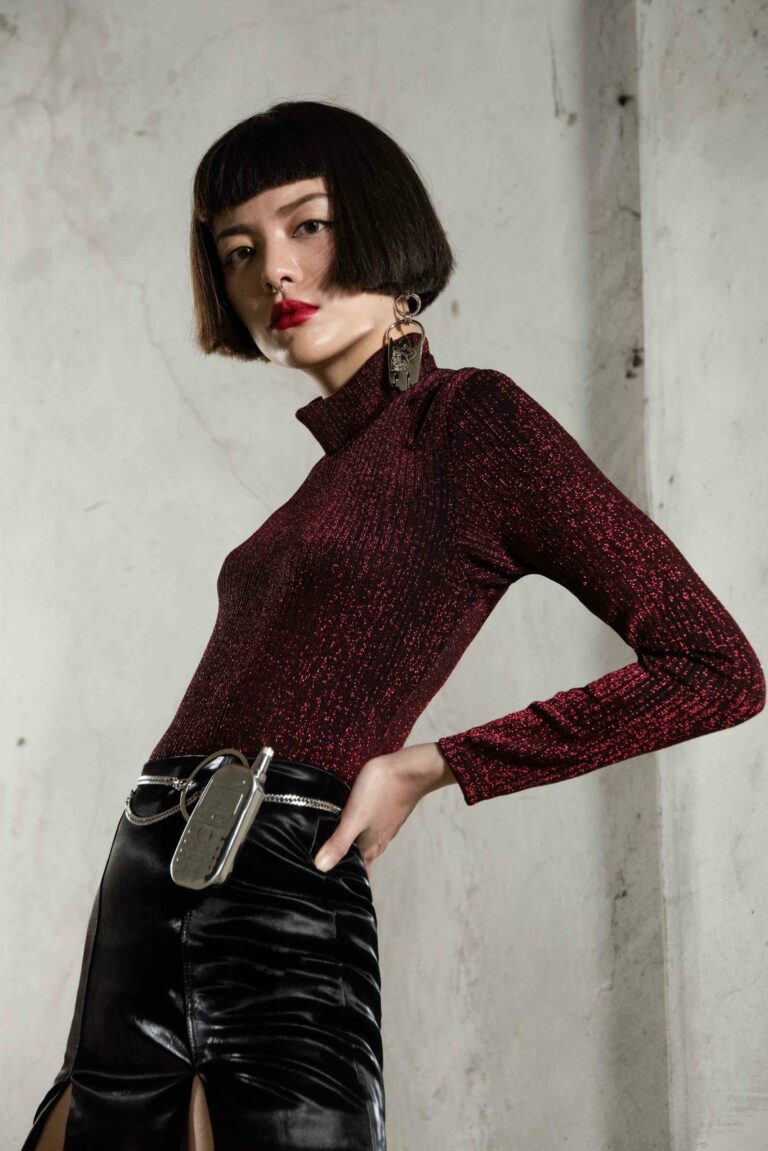
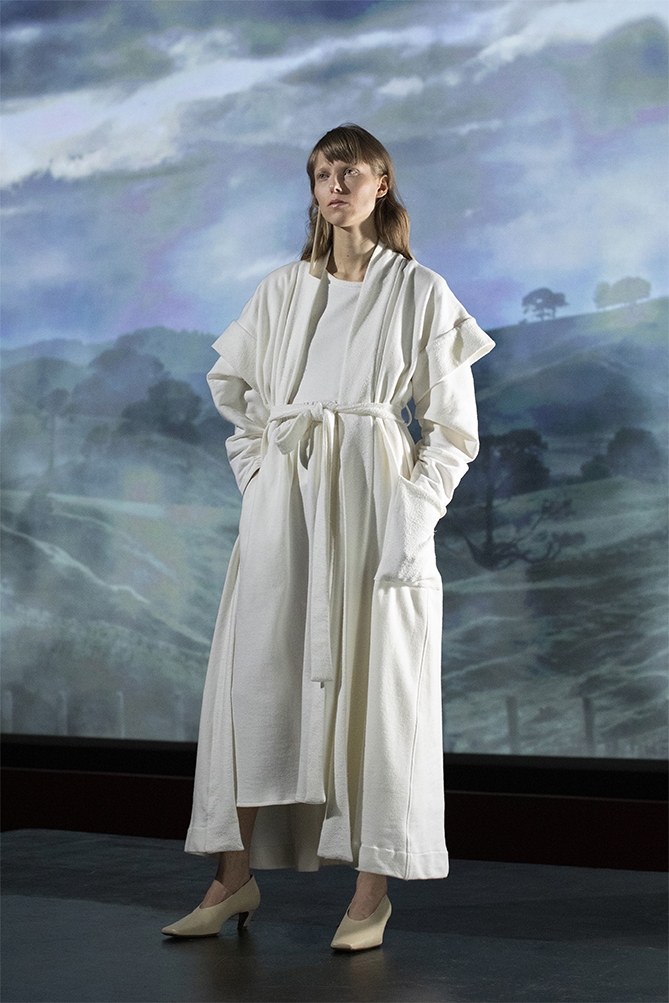
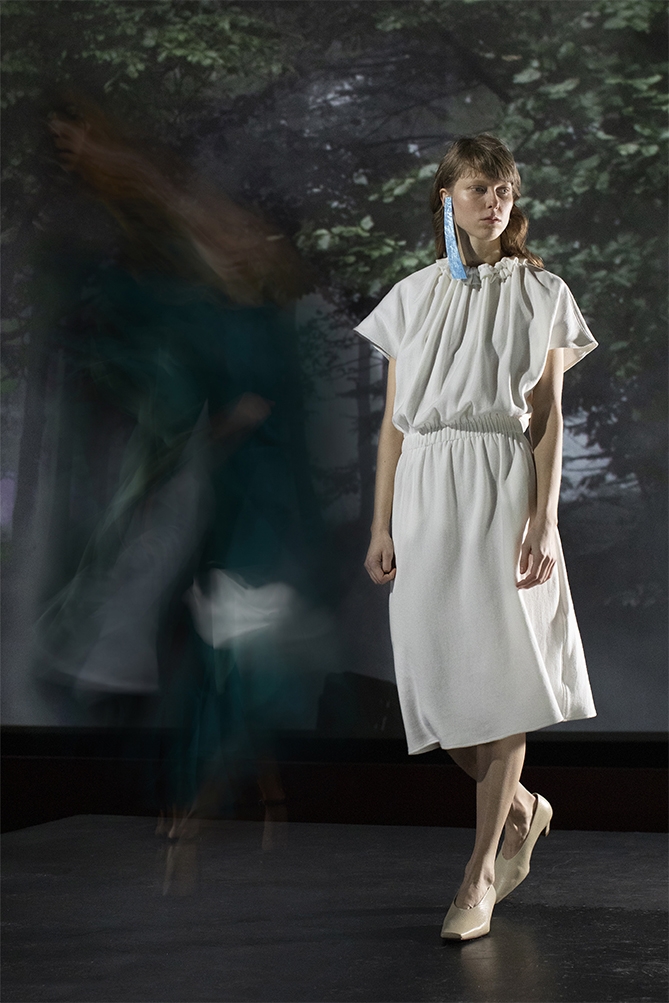
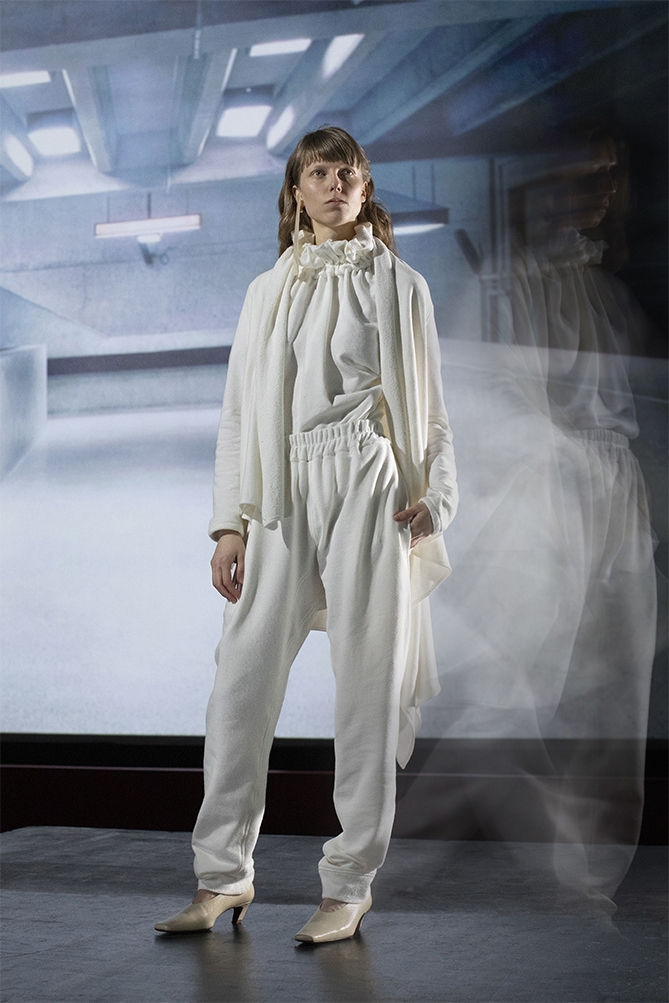
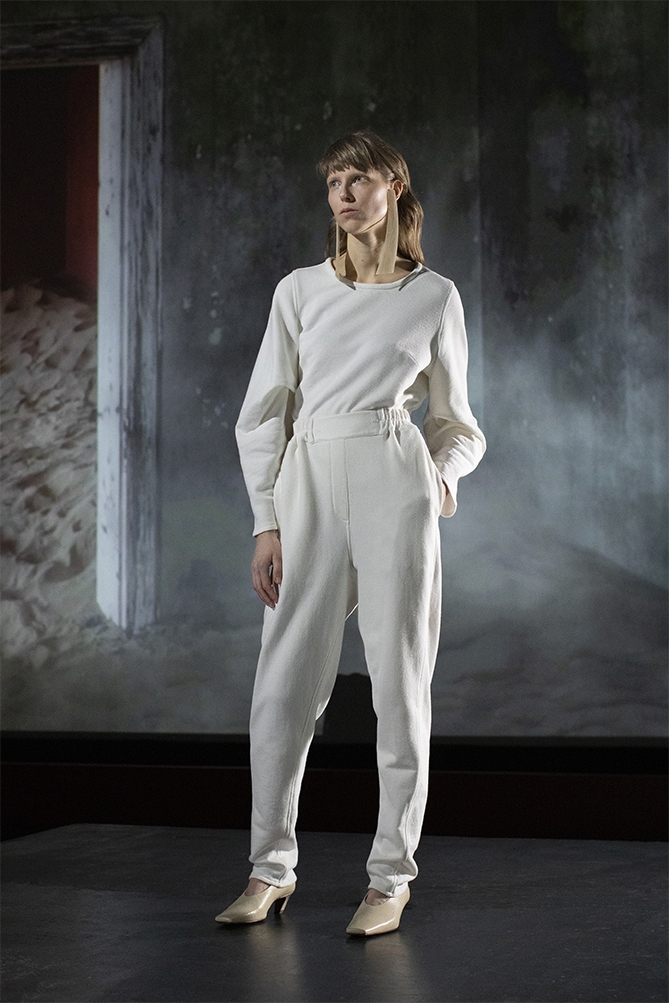
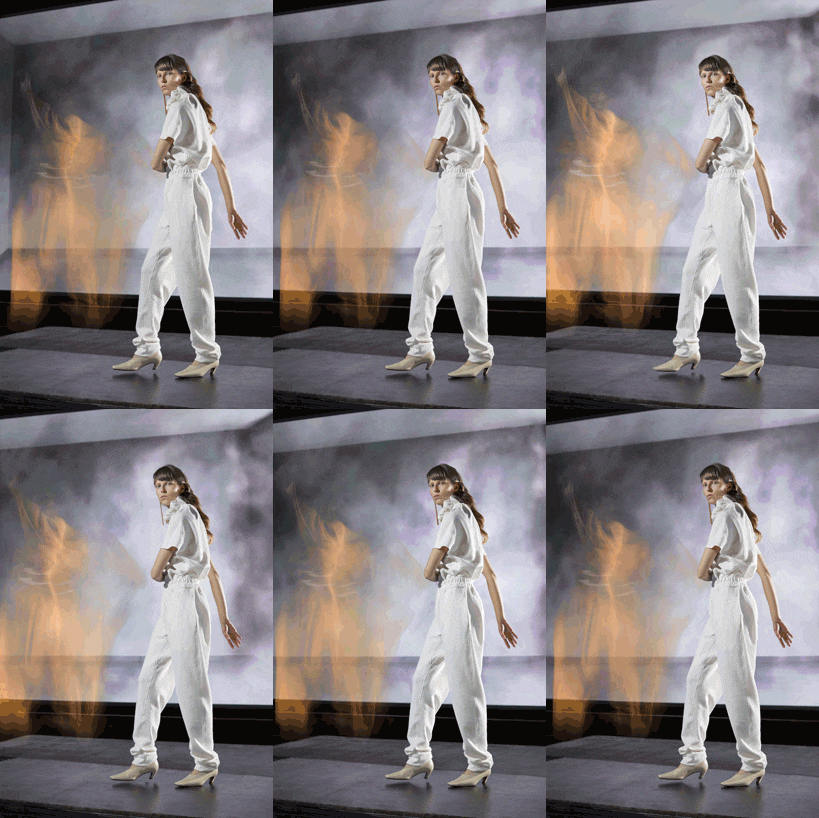
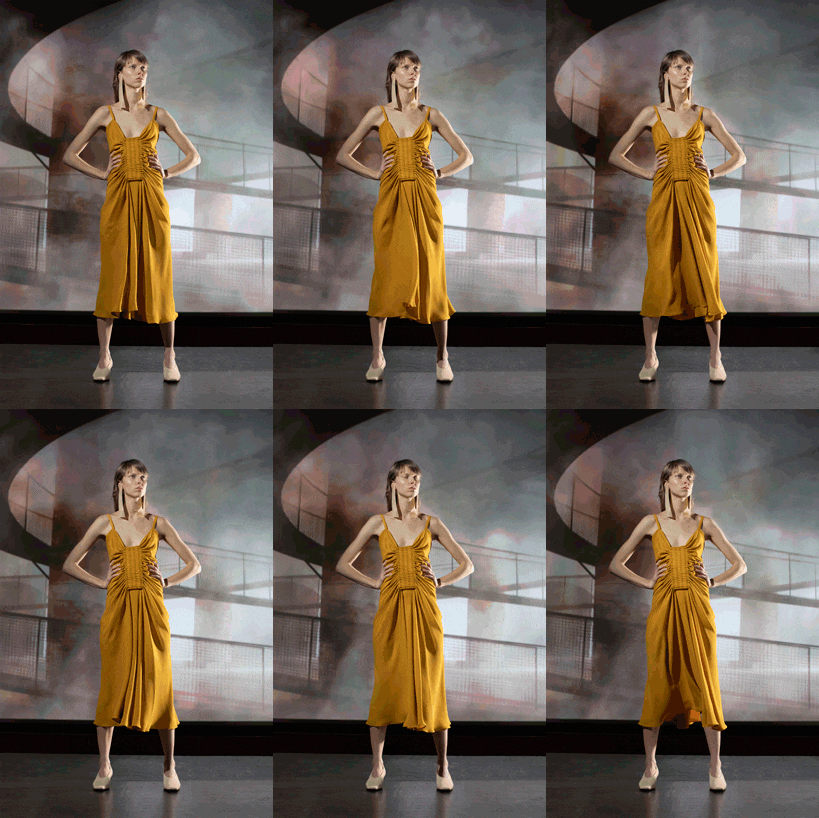
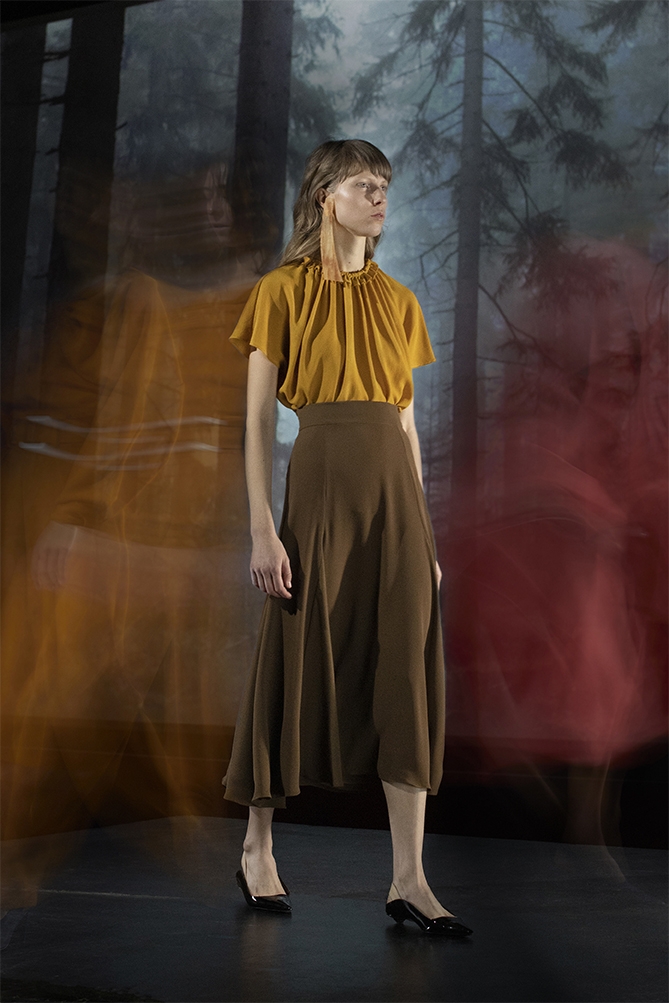
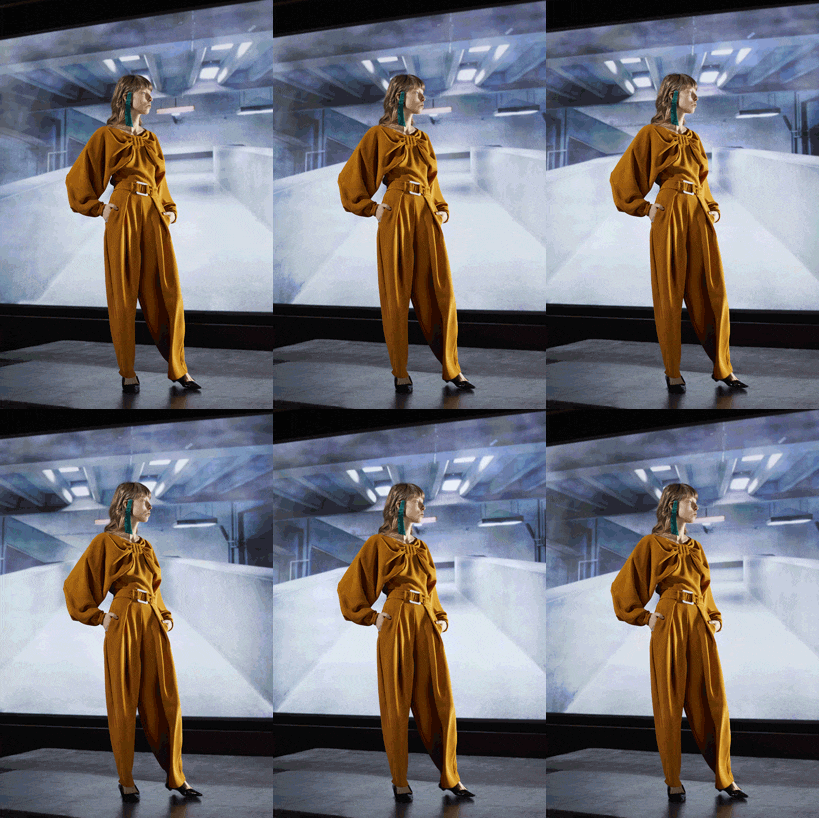
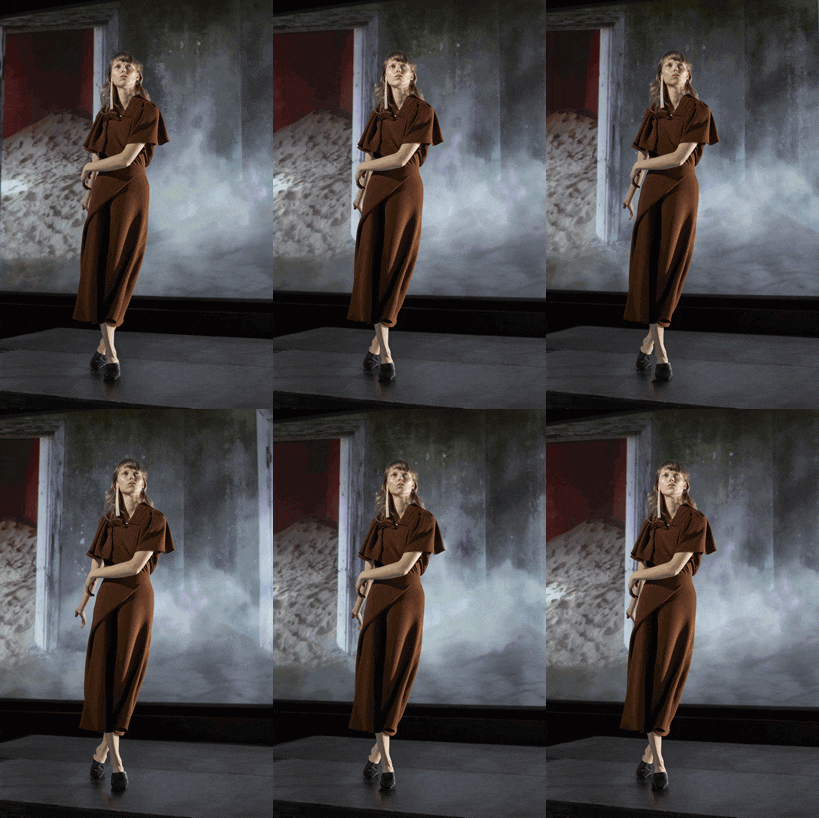
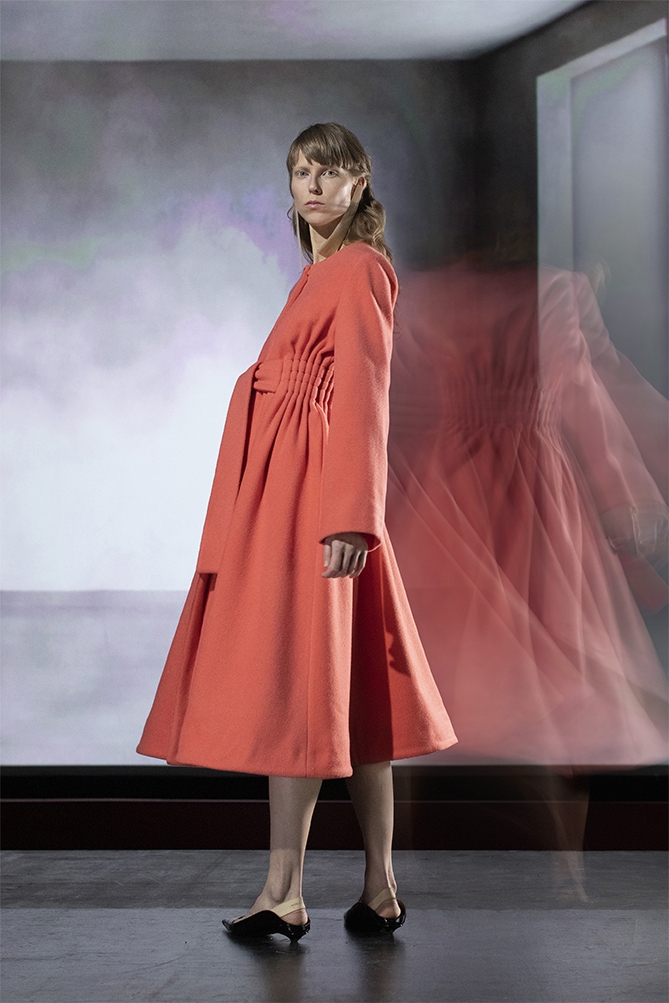
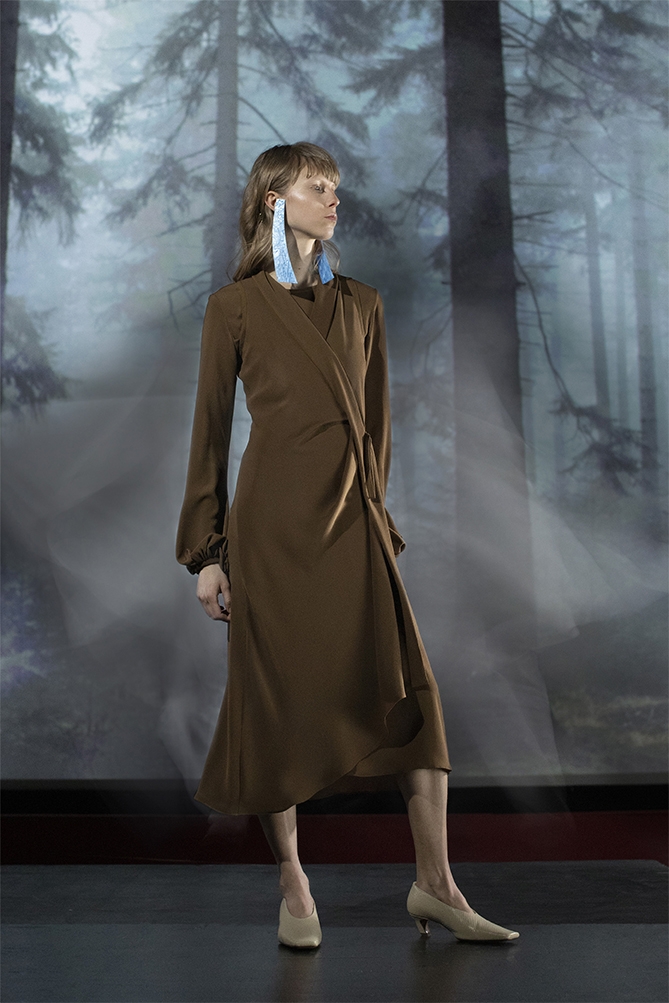
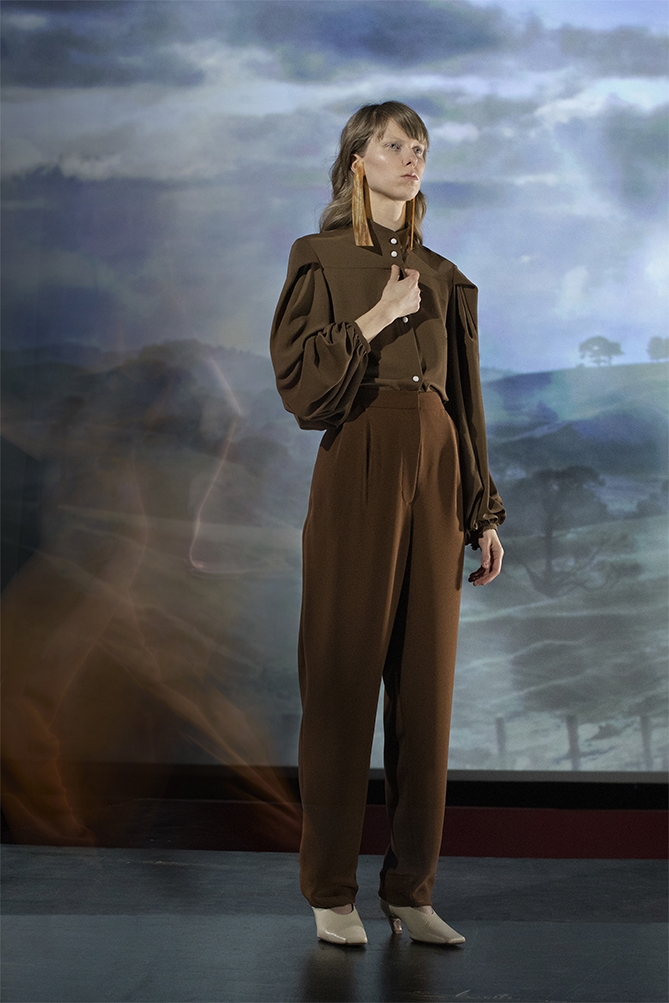
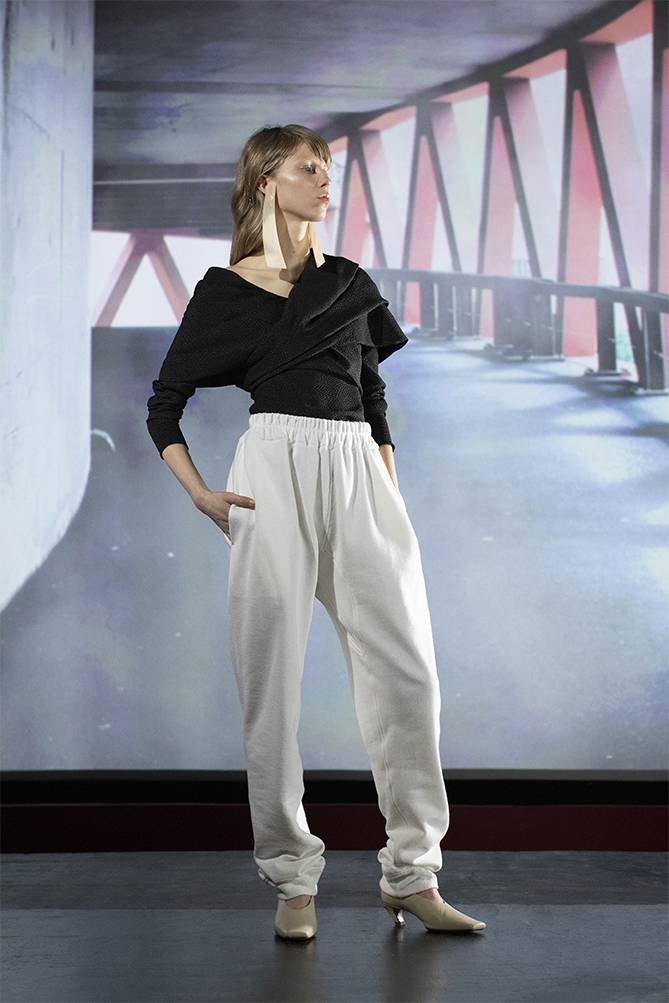
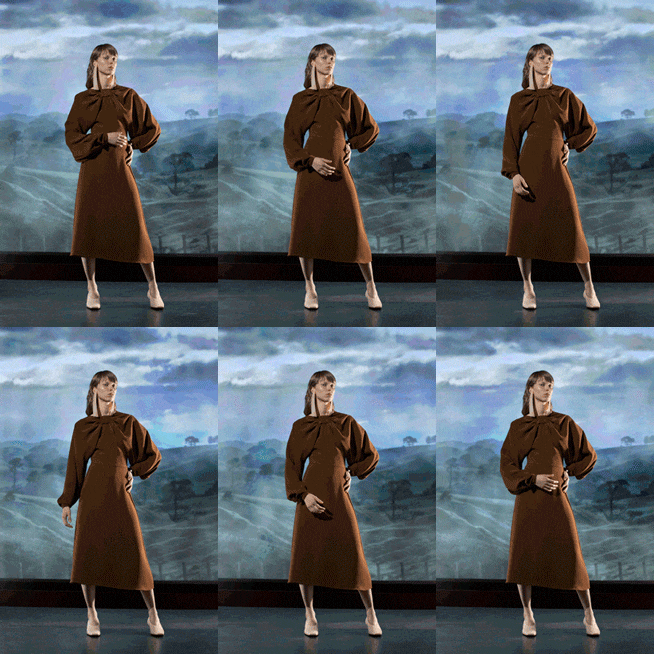
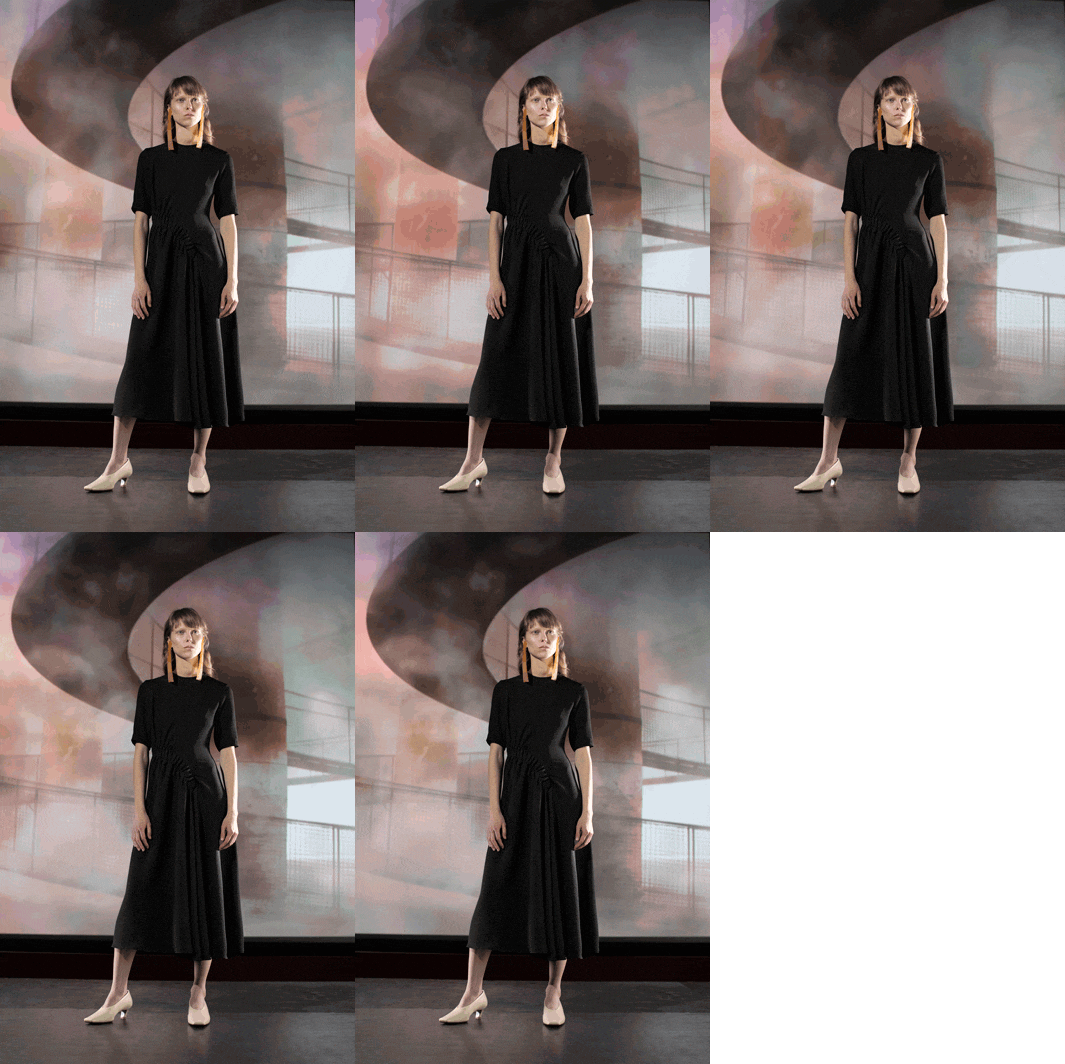
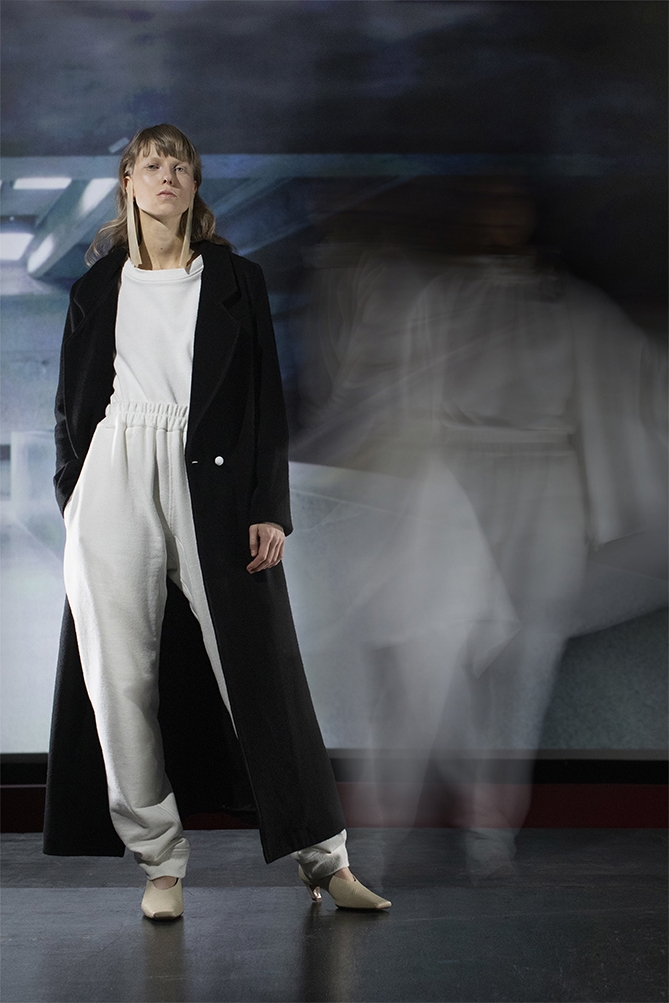
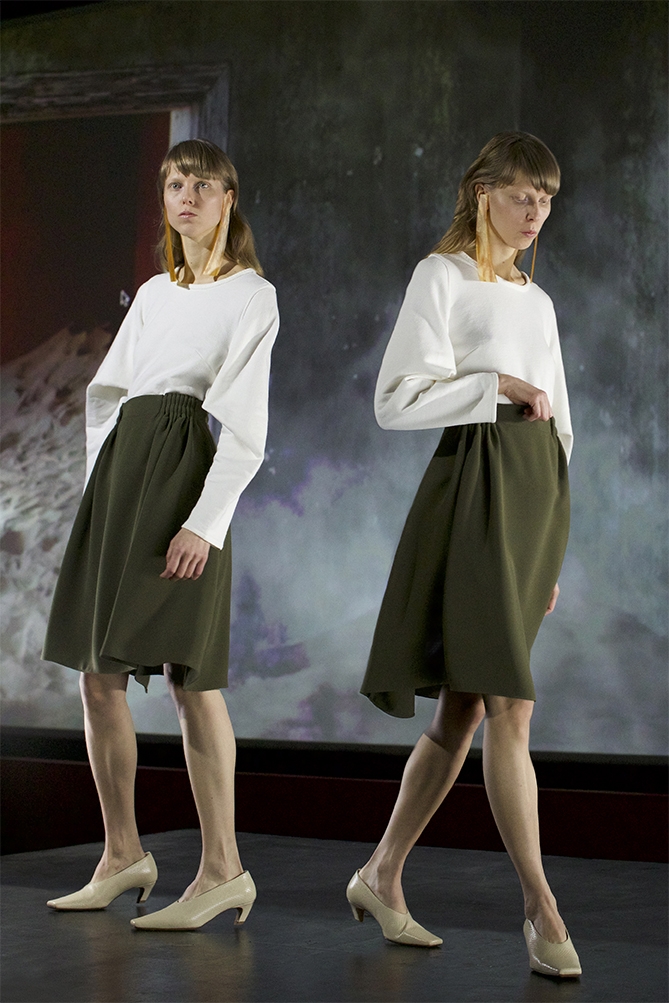
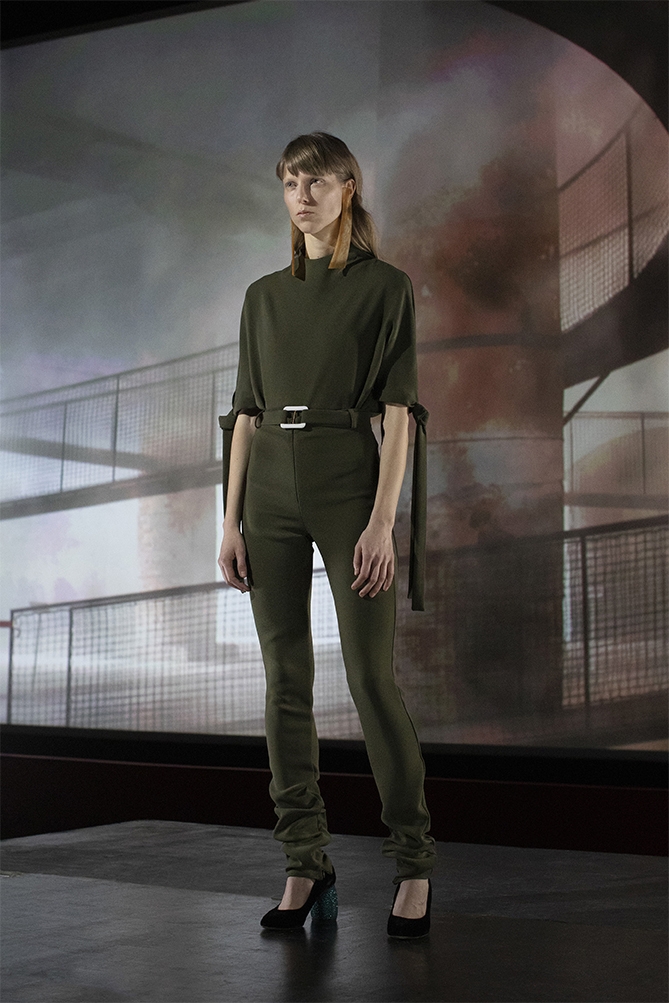
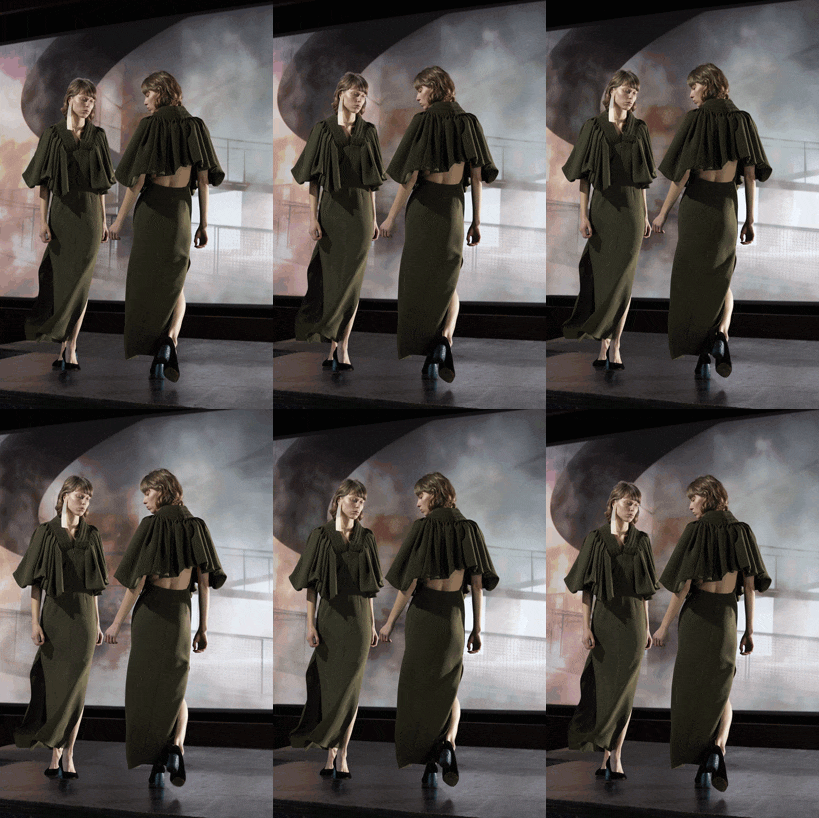
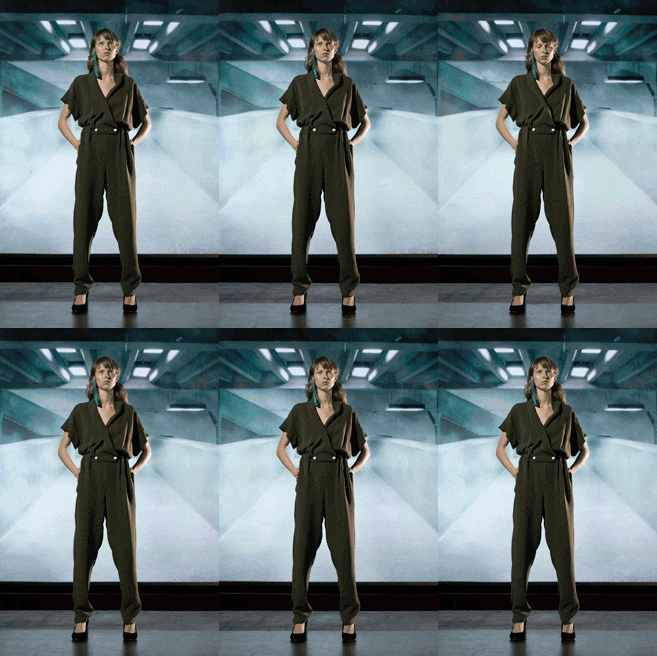
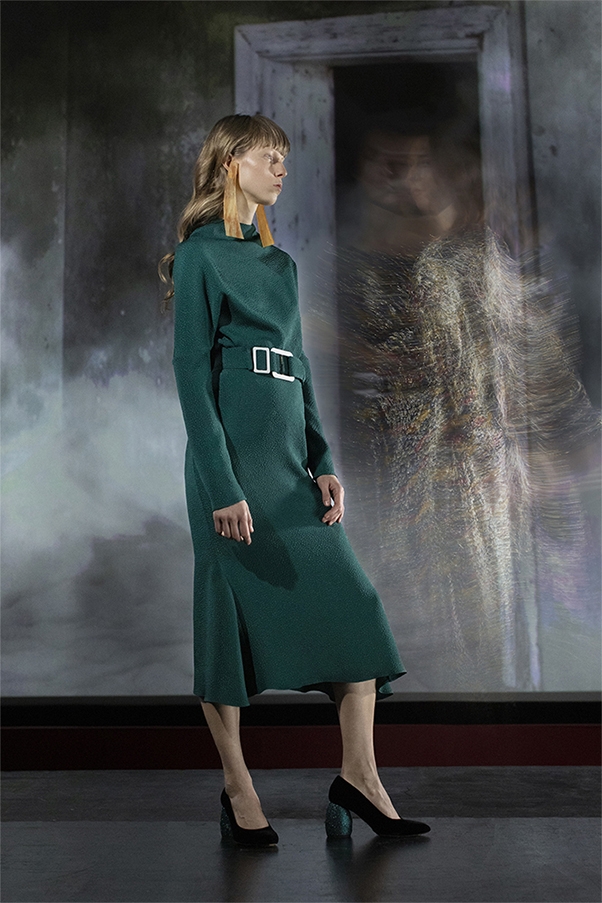
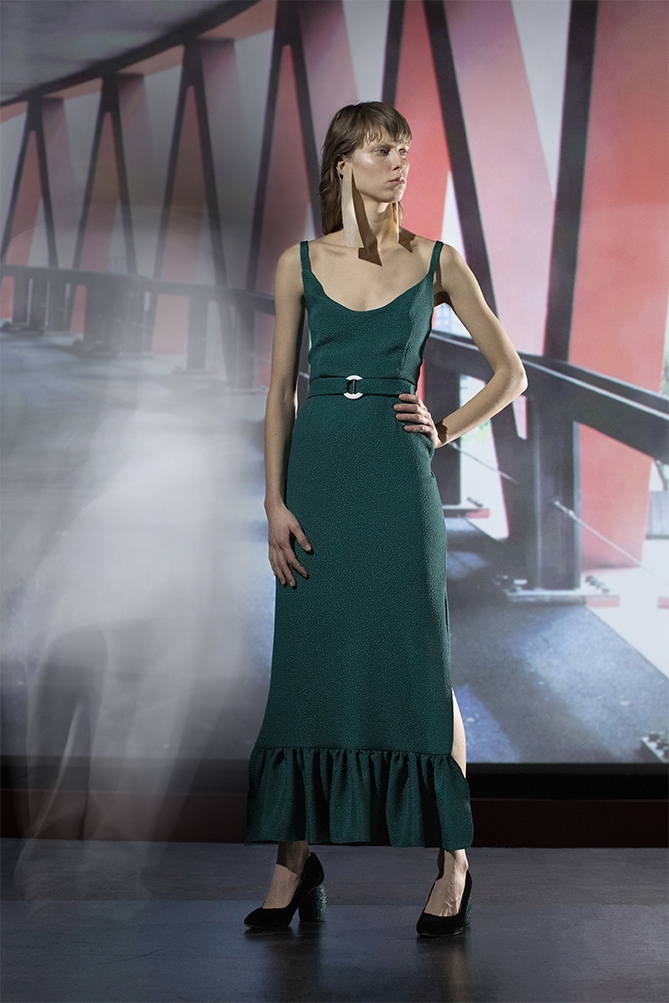
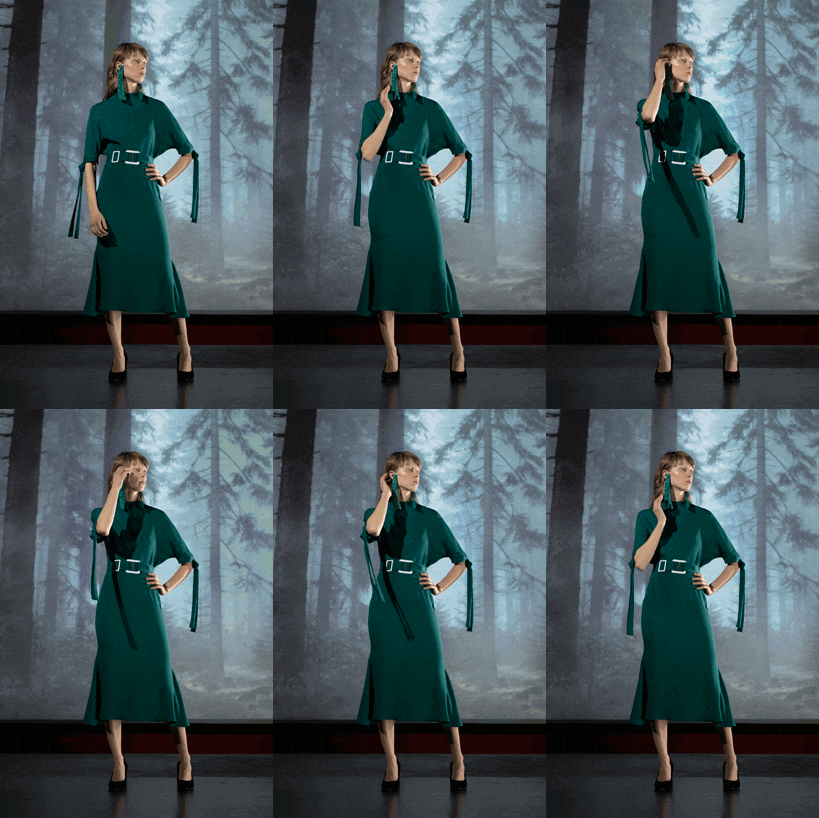
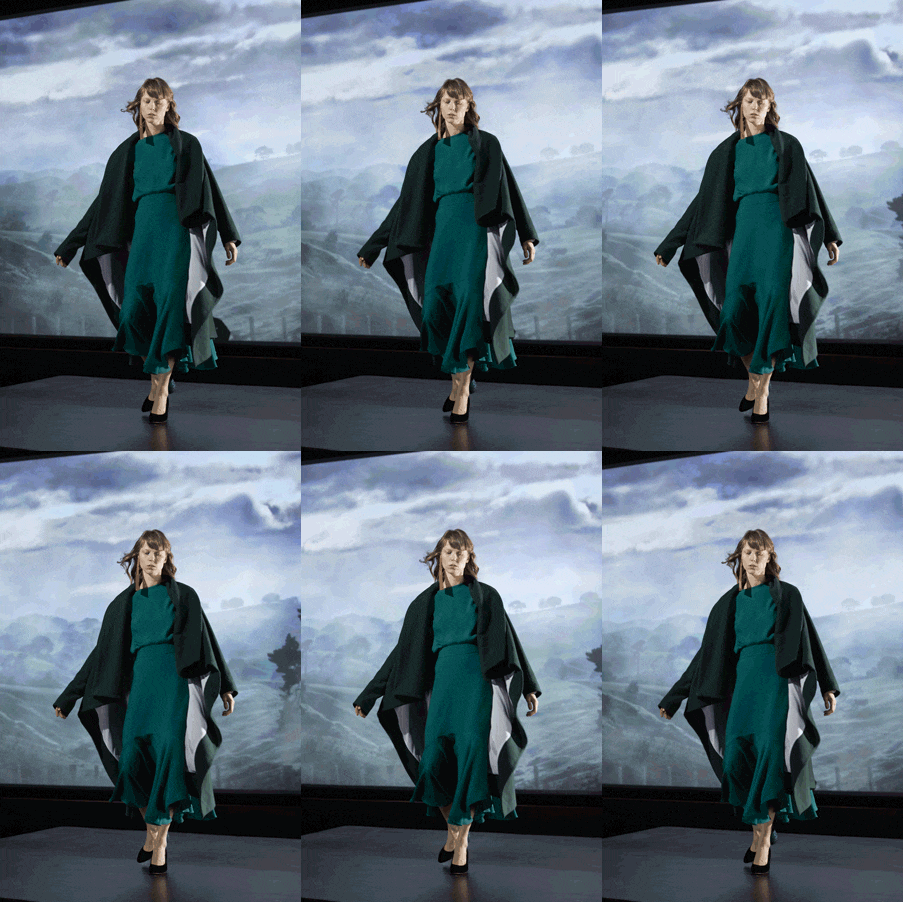
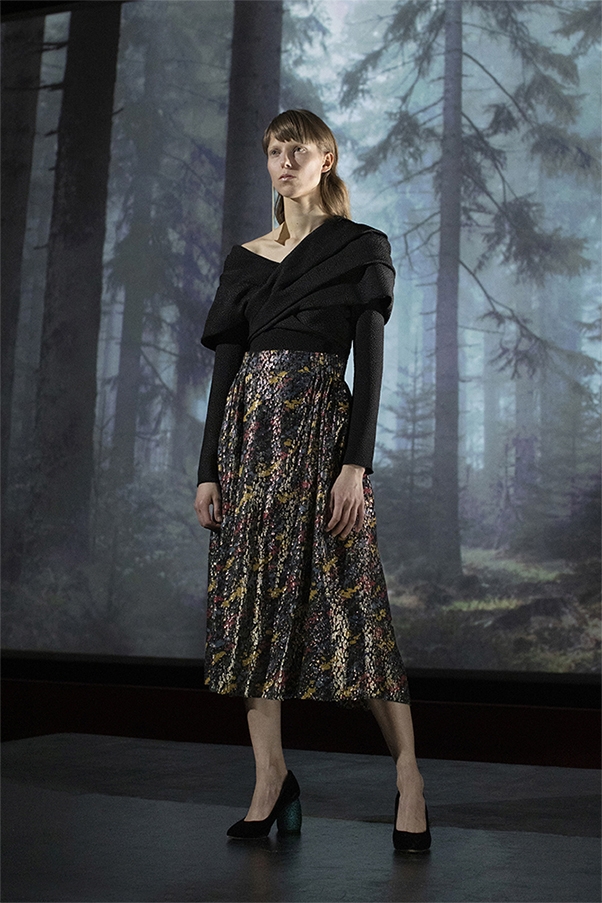
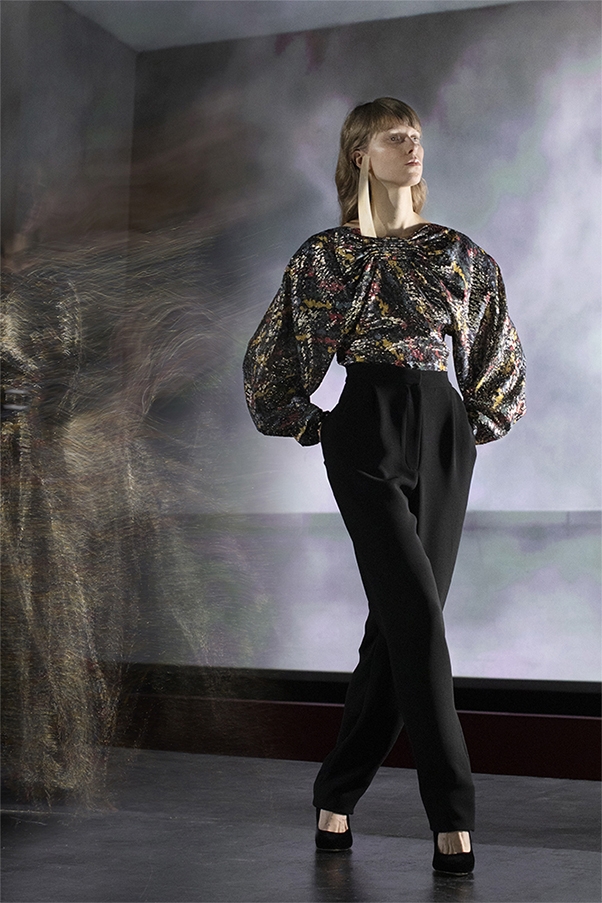
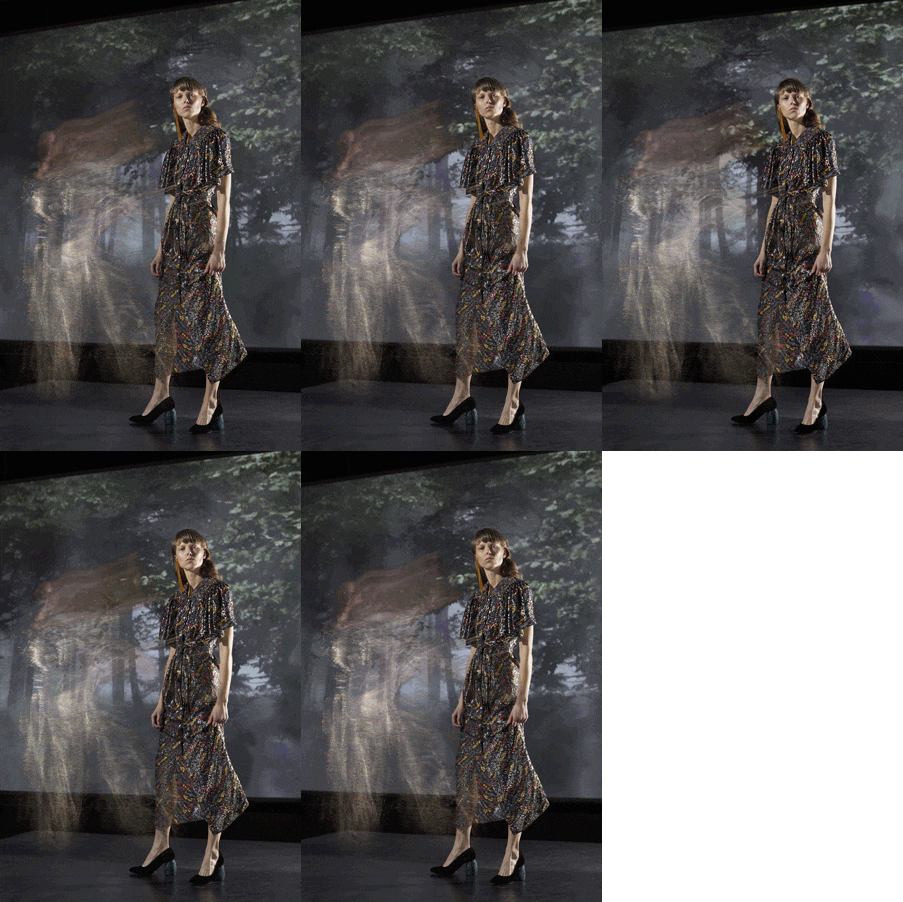
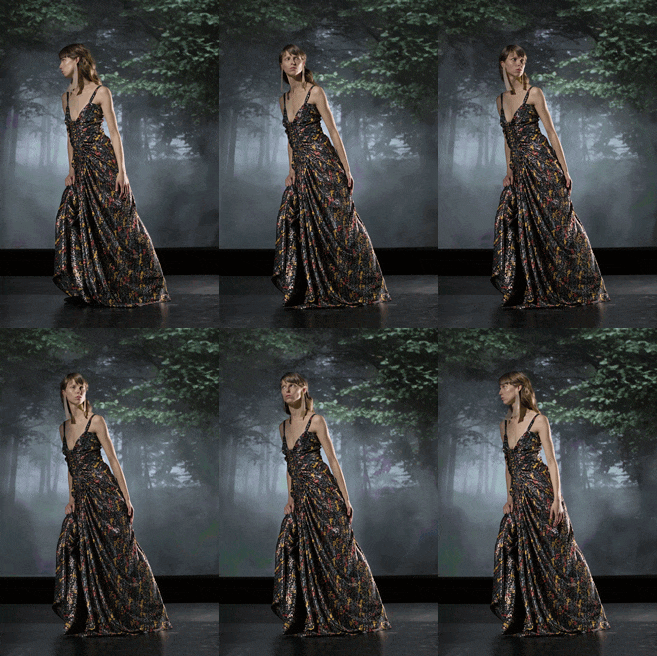
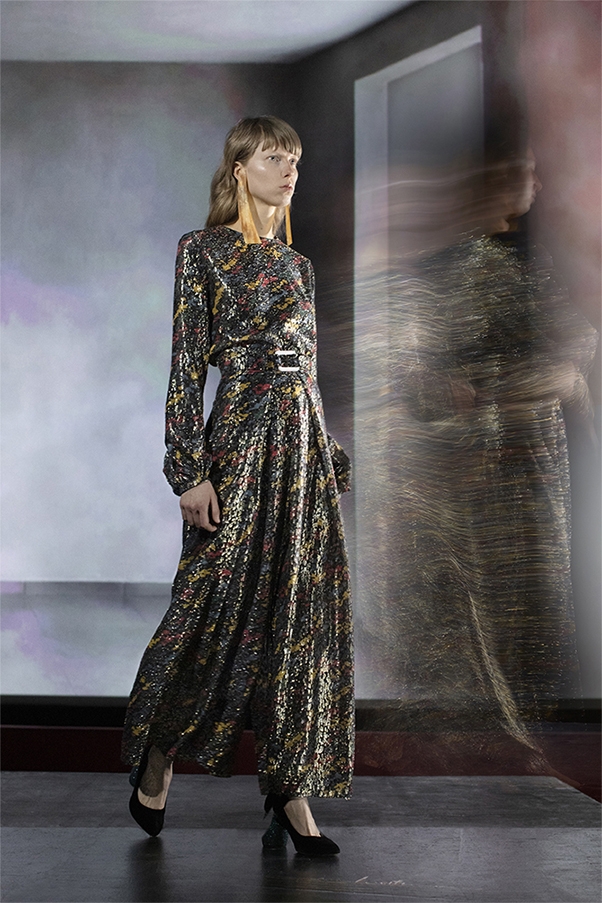
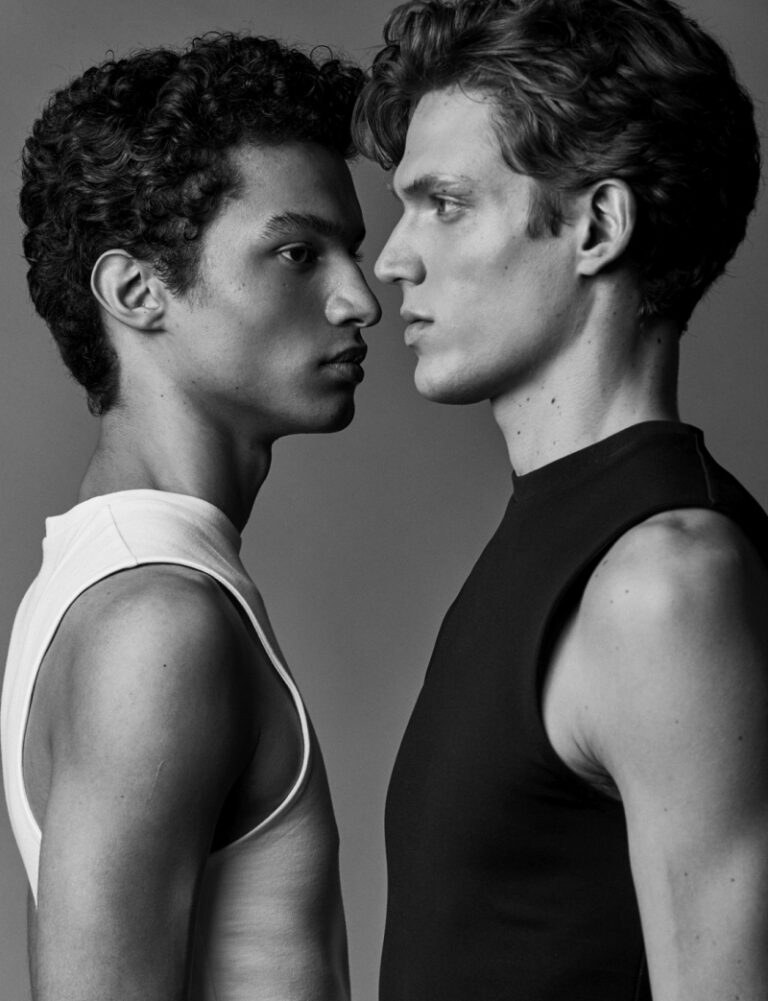
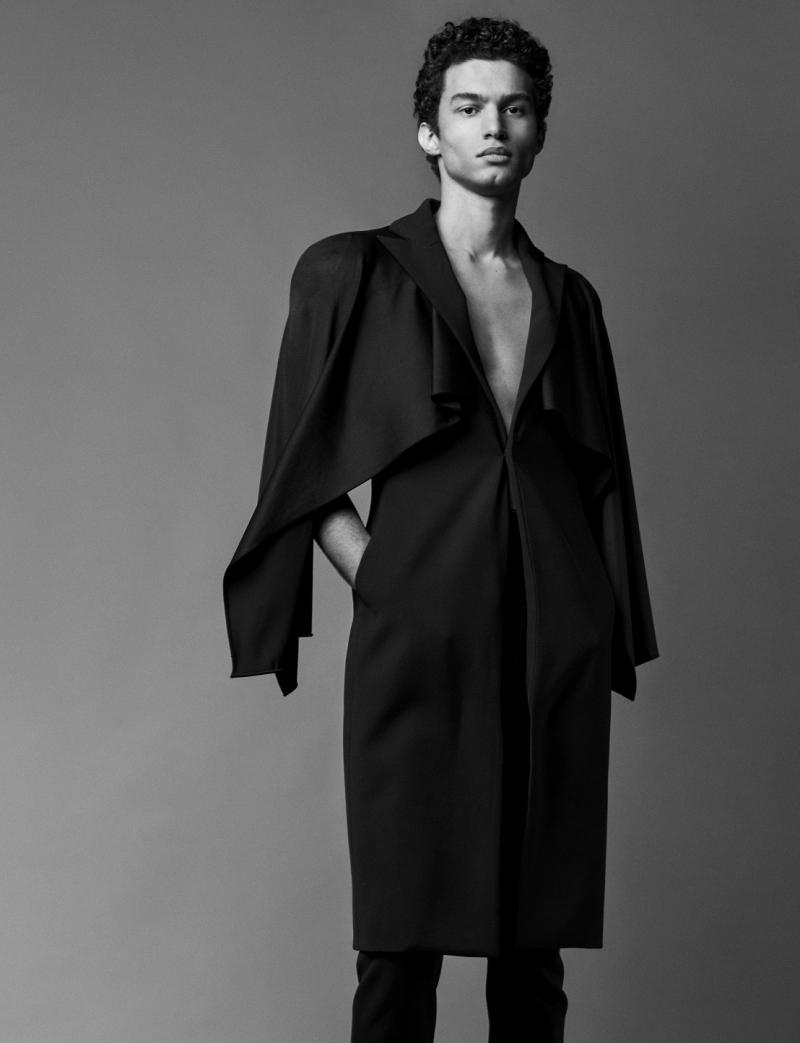
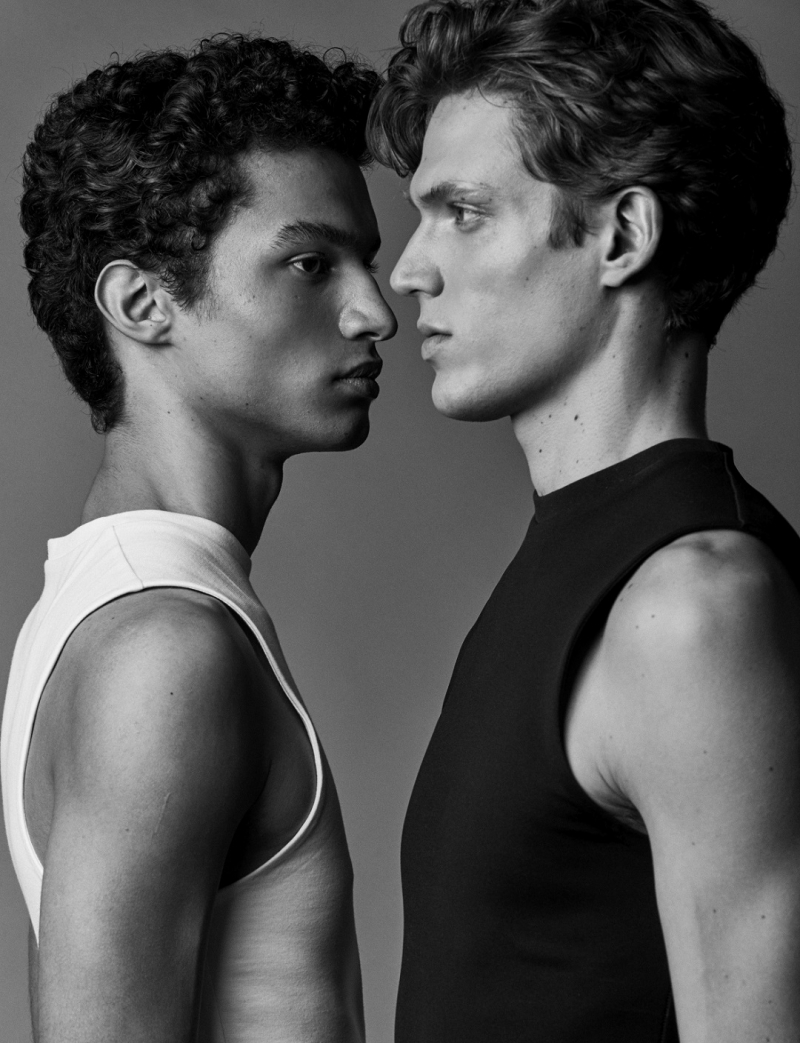
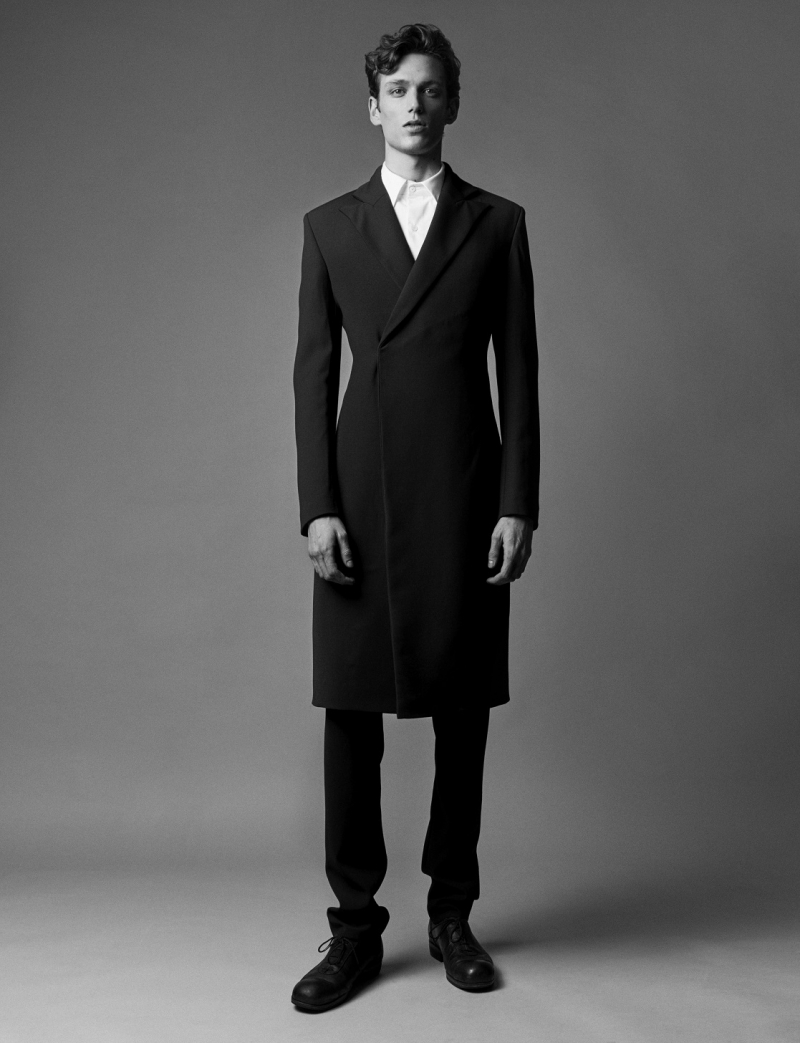
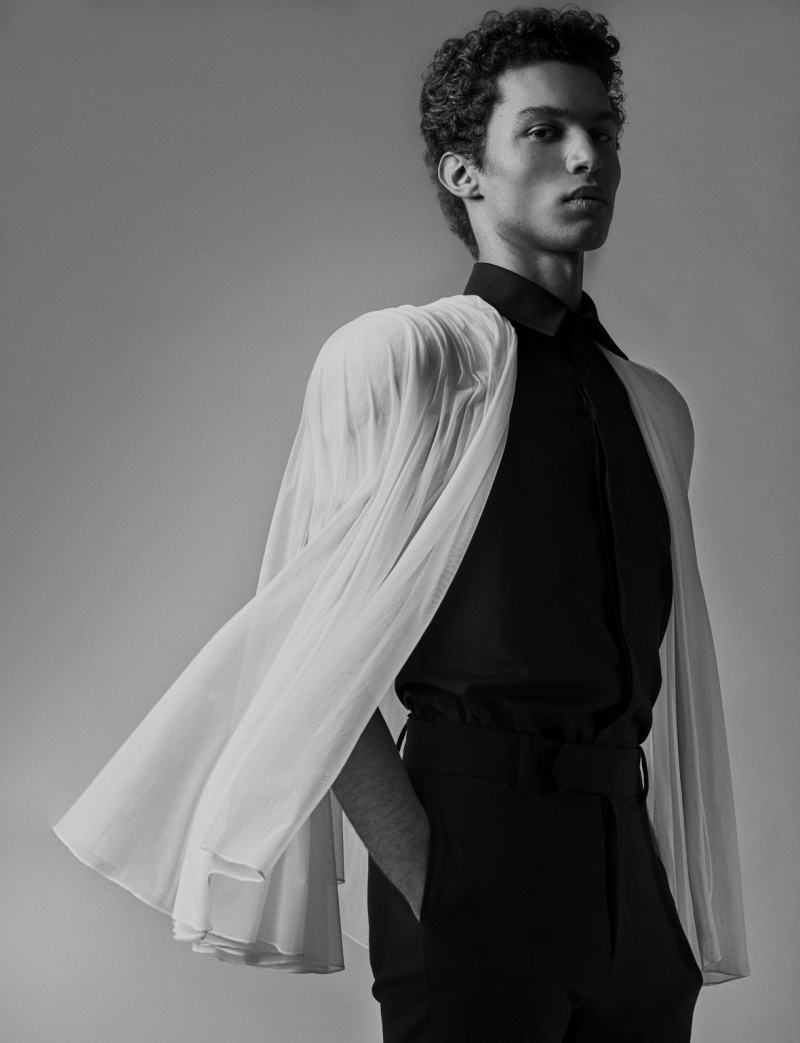
Not long ago, Ray Chu, a disruptive a-gender RTW brand established in 2016, released their latest autumn-winter collection at London Fashion Week alongside a short film named Centipide Love which utilised CGI to bring out the new.
Talking about the collection Chu said: “I have always been interested in technology and how it may (or may not) enhance my brand. CGI is something I’ve experimented with but never truly brought into the fold – and on this occasion, following a time of global in-person abstinence, felt it was the right time to encompass it more productively.
My collaboration with Pigo Lin is very meaningful. The artist and I have wanted to collaborate for some time and considering our incredibly diverse global understanding of fluidity, borderless, genderless, the characters depicted are both gay, straight and everything in between. The centipede character within all the graphics represents the epicentre of sexualism – are you the sexually centrist or, on the side of inclusivity. The artistic depiction of the graphics are both but also, neither.”
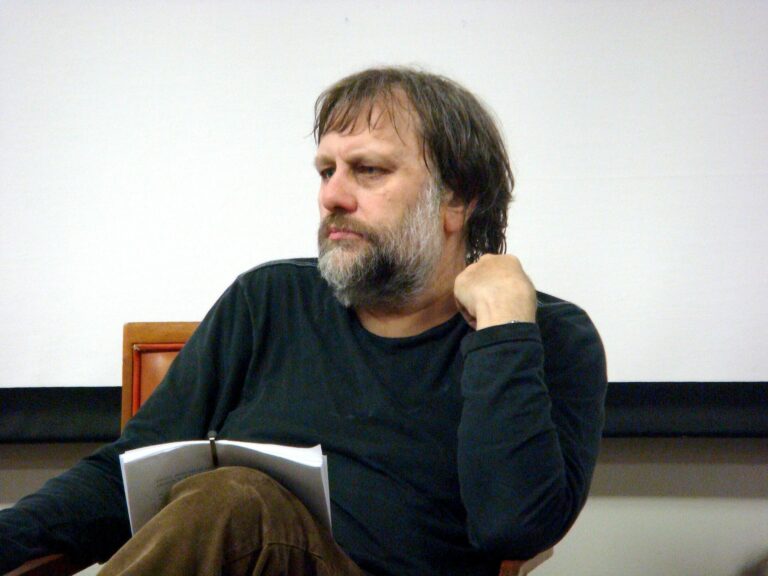
If you’re a fan of Slovenian philosopher Slavoj Žižek this three-minute clip in which he gives a speedy summary of the history of music will be perfect watch for you. Žižek talks about Bach, Wagner, Mahler, Schönberg and Berg.
Slavoj Žižek is a notable Slovenian philosopher who is a researcher at the Department of Philosophy of the University of Ljubljana Faculty of Arts and the international director of the Birkbeck Institute the Humanities of the University of London. Žižek has written over thirty books and has contributed opinion pieces for publications such as RT, The Spectator, The Independent, and Los Angeles Review of Books — to name a few. Žižek was also one of the first philosophers to write about COVID-19.
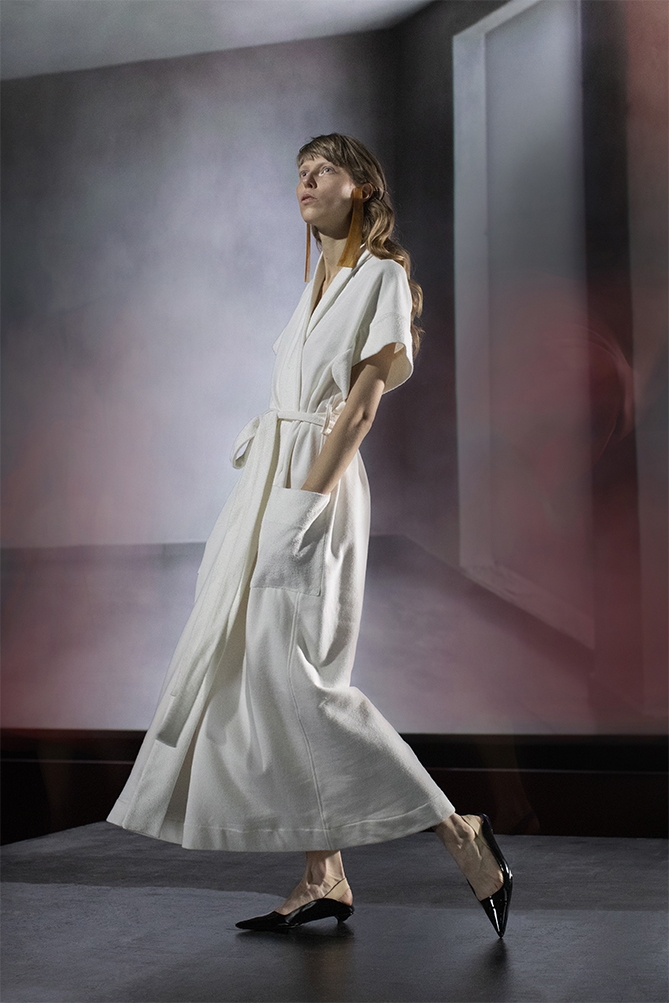
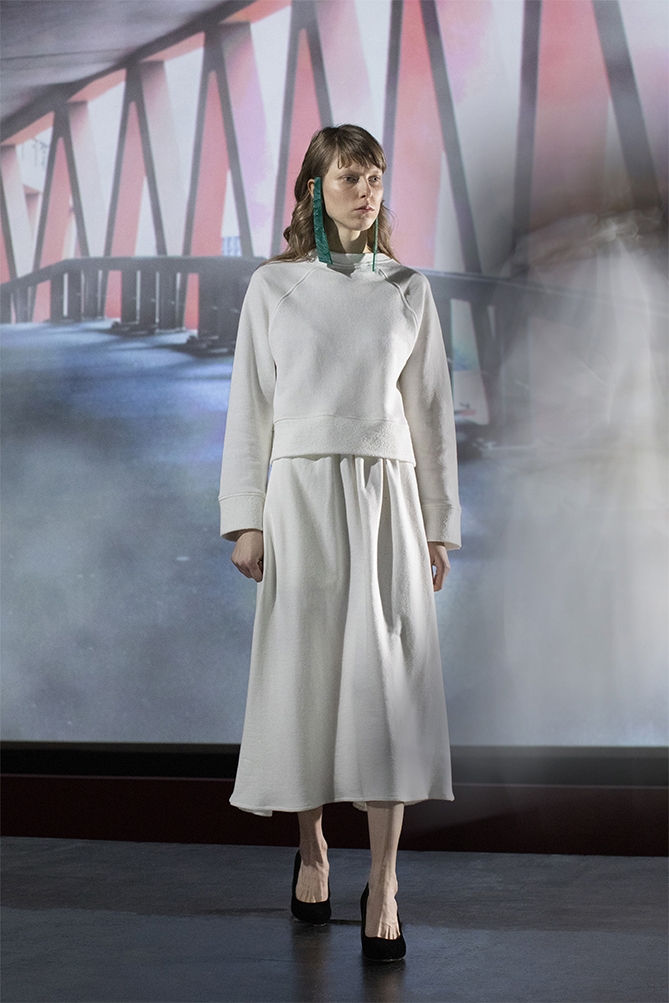
Edeline Lee presented her 2021 autumn-winter collection through a podcast called Memory of a Dress. The 15-minute podcast is in collaboration with veteran podcaster Paul Bae and focused on a woman named Georgia. She reminisces in the memory of her mother, who twirled in front of the mirror in her favourite dress. She was supposed to wear it to her daughter’s wedding; however, she was buried in it when she passed away.
Throughout this collection, earthy colours such as green, brown, yellow, black and white are present. The silhouette has a lot of flounces formulating lots of movements in the body of the fabrics. Talking about the collection Edeline said, “I wanted to make some luxurious, sustainable staples that one could wear out but also sleep in. You can roll out of bed and take a Zoom call in these pieces!”
February 2021 saw the release of the music video for Chelsea Wolfe‘s Anhedonia, directed by Cressa Maeve Beer. The track, which speaks to grief and rebirth, is accompanied by a poignant set of visuals from Beer. Her skill for communicating powerful emotions was on full display in her 2020 short film, Coming Out, and returns with quiet melancholy for Anhedonia.
In her artist’s statement, Cressa said,
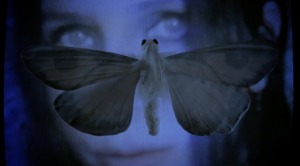
“The core idea of the video came from an artist Chelsea and I both love – Jess Schnabel from Bloodmilk – who created a “grief moth” inspired by real moths that drink the tears of sleeping birds. It’s an idea I’ve wanted to animate for a while. So that become the backbone: the lifecycle of a moth literally born from overwhelming sadness. During quarantine, I found myself confronting my own grief and deeply rooted trauma. I suffer from PTSD that envelops me like a black void. I wanted to visually articulate how that feels, as well as feelings like disassociation and loneliness; the way that trauma can physically alter your body and mentally reshape the world around you. But still, the moth can fight its way out, can fly, can follow the light; just like the comfort in the final verse of the song, I wanted to still show that healing is possible.“
Last year, Our Culture had the pleasure of interviewing Cressa about Coming Out, and we’re delighted to talk with her again about how she approached Wolfe’s track.
Thank you so much for talking with us again, Cressa. How have you been?
I’m always unsure how to answer that question without oversharing or sounding forced, ha!
Your new music video for Chelsea Wolfe is remarkable. How did you get involved?
Thank you! I’d had the pleasure of briefly working with Chelsea some years ago, and stayed in contact with her as well as her bandmate Ben Chisholm, and Cathy Pellow who runs Sargent House. They are all incredibly sweet people who actually paid attention to my stop motion when I would post it on my social media. I’ve been a big fan of Chelsea’s music probably for a good decade now, so I took a chance and reached out to them to see if they would be open to a music video pitch. I’m grateful for where that ended up leading.
Profound visuals abound in Cressa Maeve Beer’s video for Chelsea Wolfe’s Anhedonia.
The song is moving and poignant, and that’s communicated beautifully in your video. How did you approach it?
I hoped I would do the song justice. When Chelsea first sent it to me, I cried – it really struck a nerve, and I think part of what makes her so special is her ability to really transmute emotions into her music. I honestly try really hard to do the same thing with my art; I want to be less about ‘getting it’ and more about ‘feeling it.’ And what I heard in this song was that special mixture of ache and hope, it’s so hard to put into words what that specific feeling is. I love moths, and have wanted to animate a moth life cycle after I was inspired by Bloodmilk Jewel’s “grief moth” which is based on real moths that drink tears of sleeping birds. So before I’d even heard Anhedonia I’d sent this idea to Chelsea, and it ended up blossoming into what we have now. Some kind of cosmic timing. The rest of the visuals are expressions of my relationship with my own grief and trauma; things I have trouble articulating in any other form, I try to purge through art.
From your statement, much of the song’s themes echo your own experience. That idea of trauma enveloping you like a black void is brilliantly depicted in the amorphous clay surrounding the figure. Was there a catharsis in making this?
When I watched the finished cut for the first time, I felt a sort of release, like letting go of a breath you’ve been holding for a long time.
Obviously, you’re no stranger to stop motion. What made you want to use it for this video?
Stop motion is my chosen medium for all work. The look for Anhedonia was very much inspired by Allison Schulnik’s stop motion.
Grief and rebirth in Chelsea Wolfe’s Anhedonia.
The animation of the moths is just gorgeous. Did you construct the models as well as animating them?
I wish I had the craft skills for that. I had the basis for what I wanted, but my dearest friend and collaborator, Phoebe Jane Hart, who also has made most of the sets and props you may have seen in my Godzilla videos, took my very vague outline and ran with it really beautifully to design the moth and chrysalis. She made a handful of them, different sizes even. My other fabricating partner in crime is Megan Barbour, who’s also been making sets and characters for recent and upcoming commissioned work I’m doing. She did the final moth construction based on Phoebe’s design, and that’s the moth you see in the video.
If you were to direct another music video (and we hope you do!), are there any artists or genres you’d like to work with?
I’ve done a couple stop motion music videos now but the two artists I would die to make a stop motion video for would be FKA Twigs and Arca. I would love to make something really experimental and challenging (both to make and to watch). I like getting outside my comfort zone with each new project.
Finally, what’s next for you?
I’m in the planning stages of a very personal short film that will be a mixture of different animation styles (stop motion, papercraft, 2D, etc). Hopefully by writing it down here and putting it out into the universe, I can hold myself to this plan.
We can’t thank Cressa enough for this latest interview. You can keep up to date with her latest work on Twitter.
This interview’s header image was taken by Julia Durr.
Dan Griffith, or better known as Gryffin, is one of the most listened to artists in the world of electronic music today. Gryffin’s success climaxed in 2019 with the album Gravity, which towered at number one in the US Top Dance/Electronic Albums (Billboard). With millions of plays across his discography and numerous unforgettable collaborations, he released his latest song with Two Feet named ‘I Want Love’ — just a few weeks ago. To talk about his latest release and music in general, Gryffin joined us for an interview.
Hi, how are you, and how is your 2021 going?
2021 is going OK so far. I’m feeling like there is generally more optimism and things are starting to turn the corner so that’s been nice.
You’ve recently released your song ‘I Want Love’ with Two Feet, how did the idea for the song and the collaboration come about?
We’ve been fans of each other’s music for quite some time, and we finally got connected last summer and began working on ideas. He sent over the idea for ‘I Want Love’ which I thought was super cool. I took his vocals and flipped the production around into my world and sound, and then we finished the record together over e-mail.
Did you use any new techniques to write the song, or explore something fresh with it?
I explored different vocal textures with Two Feet that I hadn’t done before. Used a lot of new bass and brass sounds which I hadn’t used before in my music.
With the song released, have you got any more releases lined up for 2021?
I’ve got a ton of music coming, which I hope to begin releasing with increased frequency very soon.
Looking back over your widely successful discography, is there a song you personally love the most?
One of my all-time favorites is ‘Nobody Compares To You.’ That is probably my favorite of all of them, but I am proud of each and every track I have released.
Many of your songs have millions of plays worldwide, with music being such a universal language, why do you think your music clicks with people so well?
I focus so much on the emotional aspect of the songs. The topline and lyrics, the
production elements, and the lead melodies. If each and every one of those aspects of my music are giving me an emotional reaction or response, then I feel I’m on the right track with a song. Also, I spend a LOT of time working on these songs.
Are there any upcoming artists you are currently listening to and are hoping to collaborate with?
I really am digging SG Lewis’ music at the moment. There are so many artists I’d love to collaborate with in the future.
Finally, if you could give one piece of advice for aspiring musicians, what would it be?
One of the best pieces of advice I ever got was to FINISH your songs/ideas. It’s a really important process to go from an idea to finishing the concept and being done with a song. A lot of people just get stuck in the idea stage forever, and never actually get to the finish line of a song. To take the next step as a producer/artist, you must learn to finish your songs.
Also, don’t be afraid to upload your music and send it out. You will learn a lot, and gain valuable feedback and insight from others who are able to hear your music.
Though rooted in the poetry of the everyday, Lael Neale’s songwriting has a way of unearthing feelings that are both sacred and timeless. Following the release of her 2015 debut I’ll Be Your Man, the Virginia-bred, Los Angeles-based singer-songwriter struggled with figuring out where to take her sound next, completing full albums only to shelve them. “Every time I reached the end of recording, I felt the songs had been stripped of their vitality in the process of layering drums, bass, guitar, violin and organ over them,” she explains. “They felt weighed down.” For her new album and Sub Pop debut, Acquainted with Night, she’s pared things back, harnessing the lush intimacy of a vintage Omnichord and a 4-track cassette recorder to create a series of vignettes that feel at once ethereal and down-to-earth, as if drifting through the mists of time. Spilling over with wistful, sun-soaked melodies and subtle production flourishes, the album captures a kind of longing that can’t be contained but finds a home in the solitary splendor of Neale’s spectral compositions, which echo Sybille Baier’s reel-to-reel tape recordings or Adrianne Lenker’s songs and instrumentals. “I’m never lonesome,” goes the refrain of ‘Sliding Doors’, letting us in on the simple pleasures of an introverted life.
We caught up with Lael Neale for the latest edition of our Artist Spotlight interview series to talk about her new album, nature, and dealing with the fear of death.
Are you in Virginia right now?
Yeah, I am. I’ve been here since last April, so it’s been a bit of time.
How has it been there during these months?
It’s been really nice, because this area of Virginia and our farm in particular is really isolated. You kind of step outside of time and everything that’s happening in the world. I mean, everyone’s being asked to, but you can kind of just exist in your own imagination out here.
Something that a lot of people talk about right is how their relationship to their hometowns has changed during the pandemic. Has being back in Virginia made you think about your upbringing in a different way, or brought back memories that you realise have gone on to shape who you are now?
Yeah, definitely. That’s been a huge realization in coming back, is that I had kind of forsaken the town I’m from because it was so small and there was no culture, and not really anything happening. And I kind of felt like I didn’t really belong; I had friends, but I didn’t really find my people until I moved to Los Angeles. That’s kind of how it felt. But throughout my life in the city, I was always yearning for nature. That was a part of me that was so intrinsic to who I am that I really always felt that there was something missing, being in the city. And I feel like maybe that’s what’s happening with people now, is that living life in the city doesn’t have any of the sparkle or magic because you’re not going out, you’re not engaging with people, you’re not going to cafes or to clubs to hear music or anything. So it’s kind of like, well, what’s the point and living in this concrete mess? And obviously, some cities are kind of beautiful and nature, too. But Los Angeles especially is kind of like, why would you stay here if you can’t even have any of the benefits of the culture of that place? And so, I think reconnecting with my rootedness in the earth and in nature, that’s been really enriching this year.
Do you remember feeling connected to nature in that way at an early age?
Yeah, definitely. And I kind of thought that that was what I was going to do with my life. Because I really was an environmental activist from when I was very little – I was really worked up about the environment and humans’ interaction with nature and what we were doing to it. So I kind of always had a very strong passion to reframe the way that humans interact in the natural world and trying to to a place where we could be in harmony again. That’s definitely been a huge part of my identity and sense of self. And I think that through writing songs and making music, I felt that I could have more of more of an impact in the way that poets and writers have influenced and inspired me. So I thought, instead of shaming people or yelling at people in a Greenpeace boat outside of a ship or whatever, that it would be much more fun and probably more effective to broadcast my ideas about nature and the environment through songs. I kind of do it in extremely subtle ways. But I think if you listen, it’s kind of there throughout the songs; I’m definitely referencing nature often, and a more idealized version how we live in the world.
I think it definitely comes through; I’m thinking of songs like ‘White Wings’, for example, or ‘Sliding Doors & Warm Summer Roses’. And and you mentioned songs, but I’m curious – because I read that at first, it was more just writing or reading writers who were close to nature. You used the word “broadcasting”, but to what extent was it also just a way of processing your surroundings?
It was probably more about processing it. And I think that’s the conclusion that I came to, which is what most teenagers come to – because teenagers are so fervently enthusiastic, and think they know everything about everything, and that’s how I was. And I think that I came to a little bit of humility, in terms of my ideas of what was right and wrong, and being much less black-and-white in my thinking. So I think that through reading poetry and works about nature and the environment and humanity, I just realized, I don’t really know anything, but I can offer my perception of it. And songs are kind of the best way that I could find to invite people into my own process of figuring things out.
When did music and songwriting become an active part of that process?
Probably when I was 19 or 20, and I moved out to San Francisco. I was living with a boyfriend who was a musician out there, and I kind of was dropped into his world. I really didn’t have a place or a vision for what I wanted to do. I was really frustrated and depressed at that time. But through living with him, I guess through osmosis, I was like, “Oh, I can live this life.” You’re completely free from any kind of really structured life, you can be floating around in this like, realm of art and music. So I became enthralled by that lifestyle, and the life of someone who’s interested in thought and philosophy and art. I didn’t have to have a really strong career decision, I could be fluid, and so I guess it kind of came from that. And then, moving to Los Angeles, it solidified my idea that the music scene was probably the one that I wanted to live in. The people I was meeting in that in there were inspiring and exciting to me.
During those years, how do you feel that experimenting with different sounds and meeting different people affected your outlook or process? How did that evolve over time?
I went through a pretty rapid growth period in the space of meeting the guy who actually produced my first album, which came out six years ago. But I think through meeting him and his friends, who were all art school students, that kind of introduced me to a whole other realm of making music in a pretty specific way, with a very clear vision of how you’re going to write and how you’re going to present yourself. I was kind of all over the place, and this helped streamline my writing and realize this is what I am. It still took years to kind of hone that and I think that’s a big part of why it’s taken so long for another album to come out, because I knew that I was still needing to shed some extraneous parts of myself or my process of writing. So, I think the exciting thing about this album coming out is that it really does feel like it’s been stripped away of anything unnecessary. And I feel like the point I needed to reach now, and then it can flesh out as I go on, but it’s exciting to start at the skeleton.
And from what I understand, a big part of that was the Omnichord. Was it kind of like a revelation, almost, discovering the instrument and the raw intimacy it has? Or was it more of a process, arriving at that point?
I think it was a little bit of both. But the great thing about the Omnichord was that it kind of contained everything that I needed in one in one machine. On one hand, I didn’t need that much, but on the other hand, it kind of had a lot because like you said, the record, though it’s sparse, it still is kind of lush. Because of that organ sound and the drum tracks, it fills in space, without really needing to be too much. So the Omnichord was a huge part of that revelation, like I can be totally contained in this and still create something that’s big enough.
What was it like learning how to construct songs with it?
It was like being a kid again. Because I think we forget how to be beginners at things, you know. It takes so many years to learn the guitar or to learn the piano or to learn any instrument, and by the time you’ve mastered it, a little bit of the excitement has been drained away. And with the Omnichord, because it’s so simple, and it really is kind of made for a child, you can play chords on it having no clue how to play music. And because of that simplicity, it kind of opened up this whole new realm of creativity. I was also excited by it in a way that the guitar and piano had kind of lost their luster a little bit.
I know you worked with Guy Blakeslee on the album. What do you feel he brought to these recordings?
He and I started talking a couple years ago about the best way to record the songs, because he was coming to my shows and was frustrated that I hadn’t been able to make recordings. I was like, “I’m frustrated, too.” [laughs] And so, he and I kind of spent a lot of time drinking coffee and talking and having meetings together, and then eventually, he was like, “I’m just gonna bring over my four-track to your house. I’m going to set up the microphone, and I’m going to leave it, and you just kind of play around with it.” And the four-track machine was something I finally understood, I was like, “Oh, you just press record and play.” There’s nothing complex or technical you need to know. So he gifted me with this whole safe space to make the record, and then would drop in and mix the song. He was a huge part of making it all happen, largely because he created a protective bubble around me and kind of kept his hands off, which I think is actually a really difficult and rare thing for a producer to do. He was just so kind of supportive and had faith that the thing that I was going to do would be the right thing.
My favorite song right now on the record is ‘Every Star Shivers in the Dark’; I just feel like the lyrics of that song have a resonance that’s very universal. And I love how, towards the end of the song, the line goes from, “I’d like to love someone” to “God made man to love someone.” Which, regardless of religion, I think captures how that longing for connection is something that’s ingrained in us, like it’s part of our nature.
I’m glad it struck you, because that was the intention with that line. When I wrote that song, I was really feeling this longing to experience love, and then I was trying to figure out where that comes from, why are we always reaching for it, and no one is going to satisfy it. No one person. So I think I come around to something that we all know, but that it’s just the experience of itself and it doesn’t matter, the object of your love. My idea is that that kind of is why we’re here. And there’s something powerful about the archetypal idea of Adam and Eve being made by clay, and what are they made of, you know? What is the clay? Is it clay, or are they made of love? I just like thinking about all that stuff and our own mythologies and archetypes, and why they have such resonance with people. And using those words is intentionally trying to touch on that common, universal experience that we all have.
I have one more question, but it’s kind of grim. It has to do with something you mentioned in the notes for ‘How Far Is It to the Grave’, this practice called Jeopardy. And I hadn’t heard of it – to be honest, I couldn’t even find anything about it online. But it seems rooted in this very common idea of like, living every day it’s your last, which sounds cliché but is actually really hard to put into practice. So I’m just wondering where you how you came across that.
Well, I really like grim questions, first of all. I came across that in this weird self-help book called The Tools, and I must have found that in some library book sale or something and I got drawn in. And there were, I think, four tools to living a better life. But that was one of them that really stuck with me. Another one was about the pain wall and how we don’t do things because we come against the pain wall. And so part of the tool was saying, “I love pain, pain sets me free.” And that sounded so crazy to me. But at the same time, I could kind of understand why that works, because you’re like, “I don’t want to get out of bed in the morning because it’s too cold out or whatever,” you know. But you need to do all these things, you have to break through that pain wall. So that’s a minor one that we all do. But it ratchets up to like, big things that we’re afraid of, or that are painful.
And so then, part of getting through the pain wall included this Jeopardy, which was part of the motivation to do the thing that was difficult to do would be to envision yourself on your deathbed, every morning. And then having that instilled in your consciousness from the minute you wake up makes everything in your day more precious and more vital. And you don’t want to waste any moment because you’re like, “Well, this is going to be me someday.” And, you know, “Maybe I won’t even be lucky enough to have a deathbed, I might just, you know, be knocked out by a bus or some—” you know, anything could happen. I don’t mean to take death lightly at all, it’s not that. And it’s also not instilling fear of death, it’s more of an appreciation, like you said, it’s become so cliché, but living every day like it’s your last. But it has worked, because it kind of sticks with me. And as you make decisions through the day, you kind of have that in your mind, like, “Is this important enough to get all freaked out and worried about?”
Is that something that you’ve found a way of integrating into your life?
Yeah. And I think that song is kind of my integration of that, my processing of it. I don’t know, it’s also a weird time to talk death and stuff with everything that’s going on, so I really don’t mean to take anything lightly. But I think it’s something we’re all going to experience someday and the fear of it, to kind of acknowledge it and look at it is actually a really helpful thing, because the fear of it is what causes so many problems in our own personal lives and with each other.
This interview has been edited and condensed for clarity and length.
Simone Bramante is an Italian photographer and creative director based in Bologna. Known as @brahmino on Instagram, the creator has 1 million followers, and with good reason. Simone interweaves the human form with impressive natural landscapes, and his works are made all the more powerful by subtle positioning, balance and vivid colours. Simone calls himself a visual storyteller, and each photograph of his certainly evokes an emotional response.
Simone’s journey of visual communication started with work at communications agencies and classical advertising agencies. Having discovered his passion for photography more than 20 years ago, the artist first began capturing images with an old fashioned Canon 300 film camera. Simone explains: “Humans are my subject, natural landscapes are the context, how people move or interact with nature, with the world”.His photography has been exhibited all over the world, including Los Angeles, San Francisco, Paris, Minsk and lately in Milan.
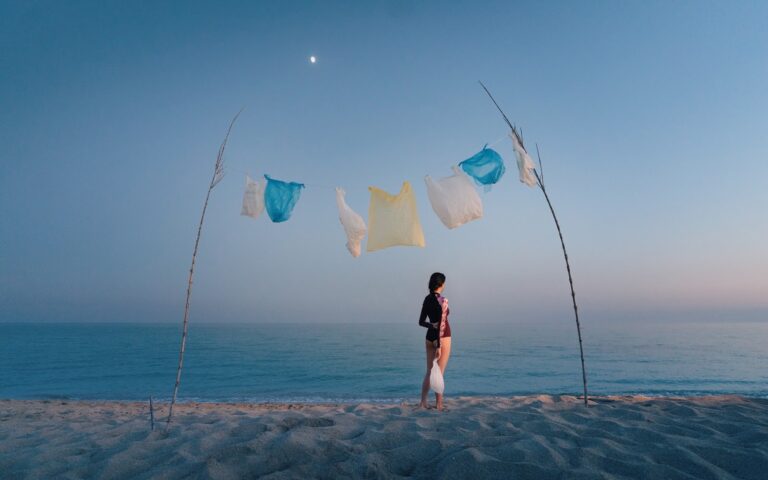
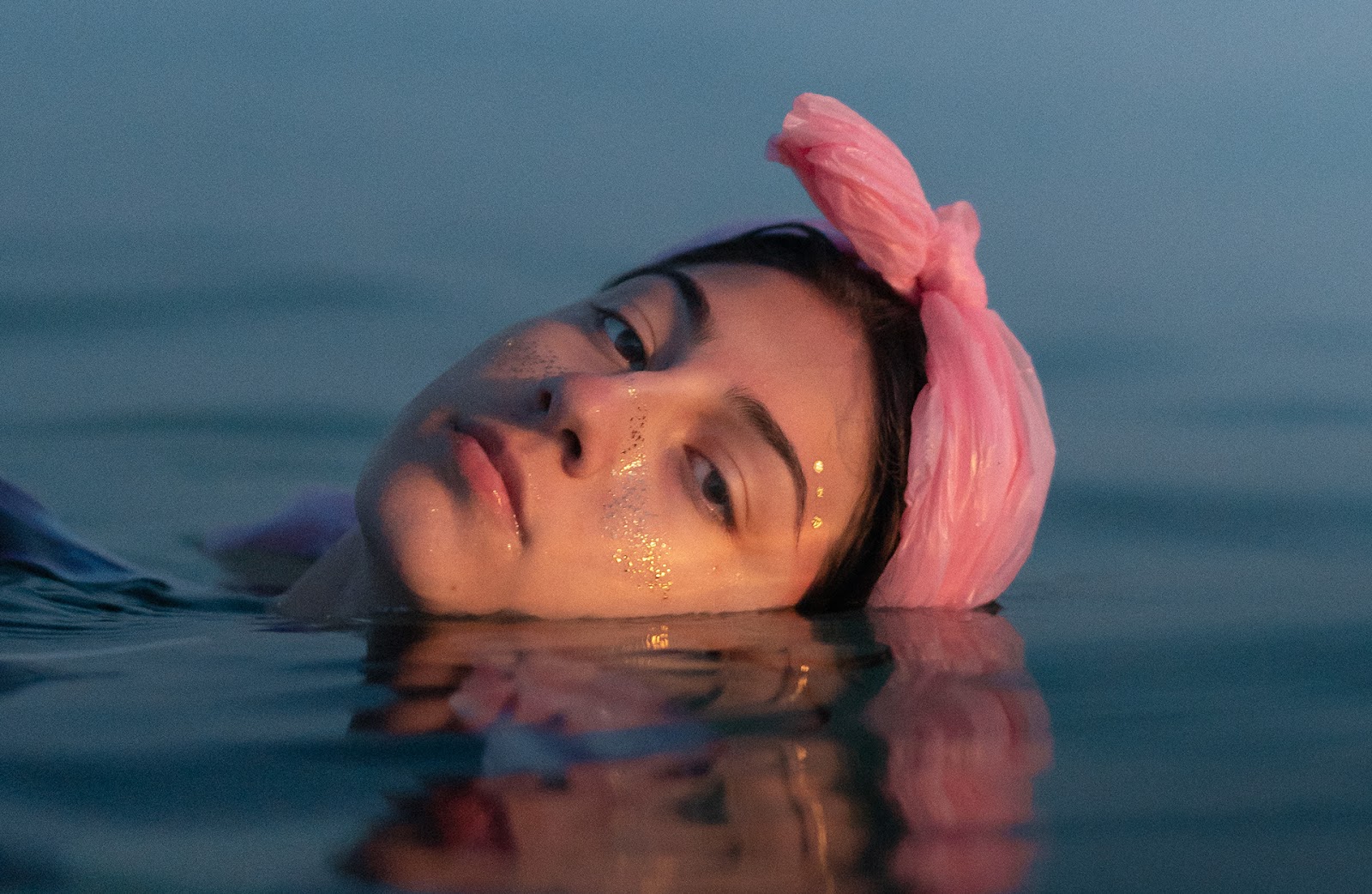
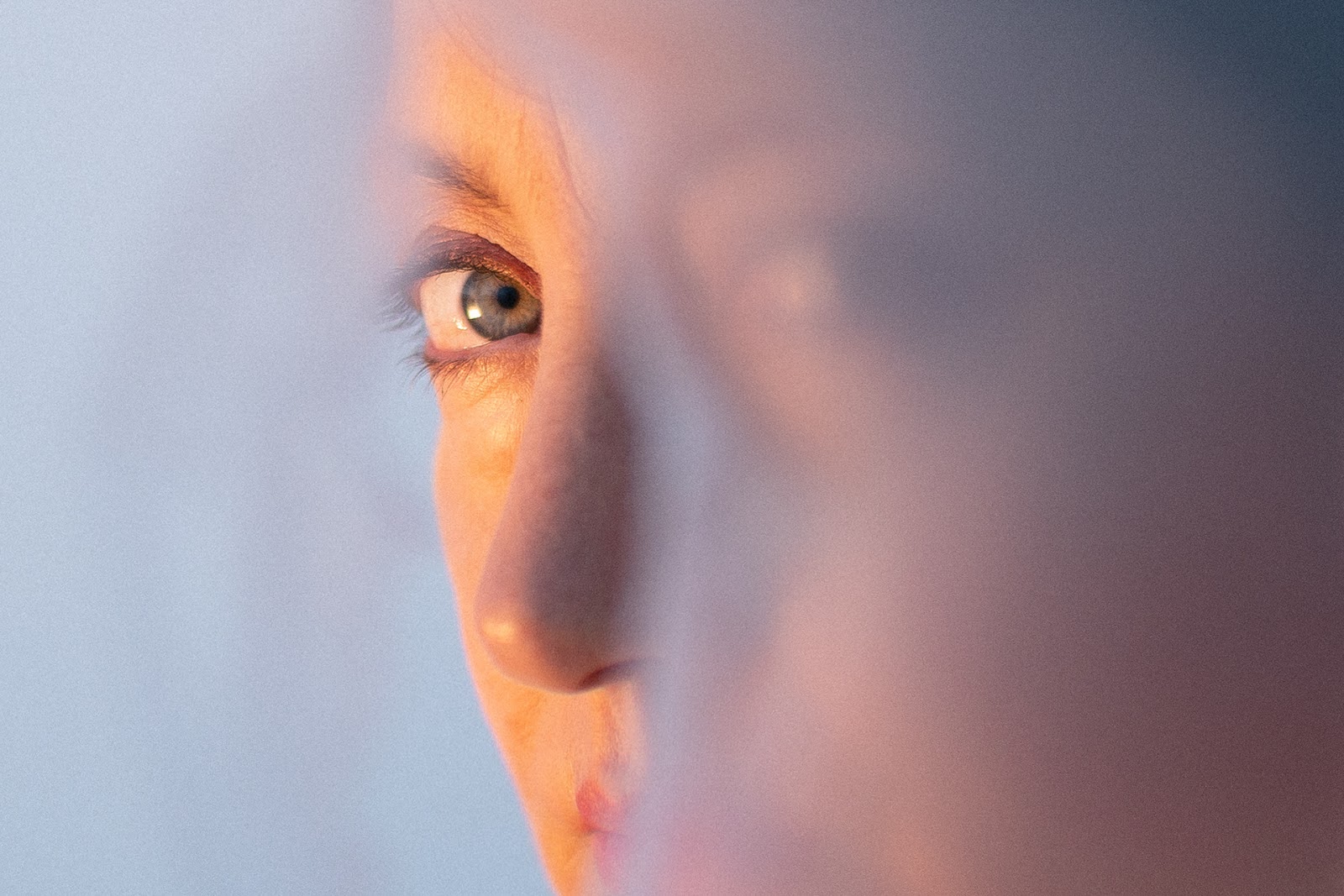
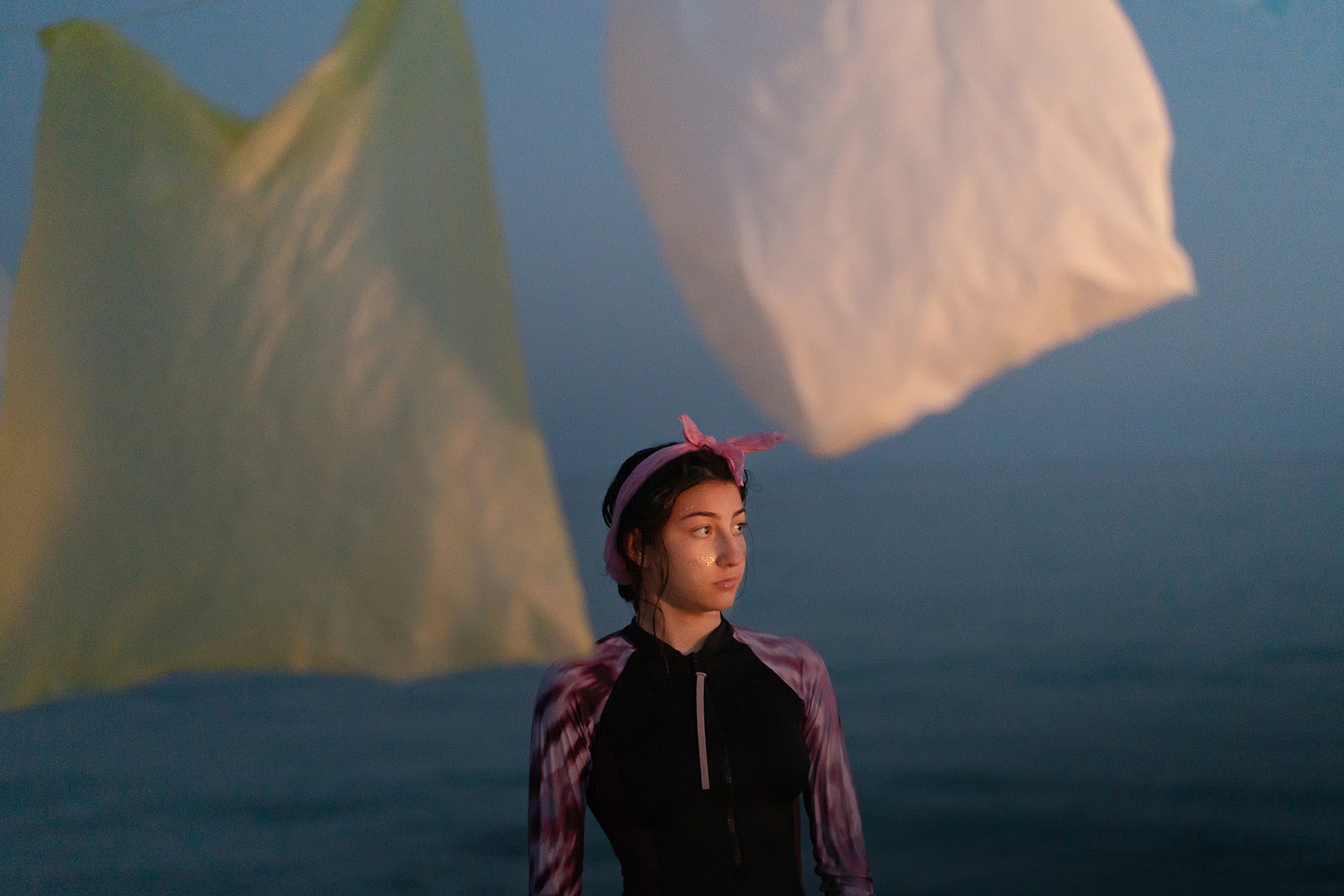
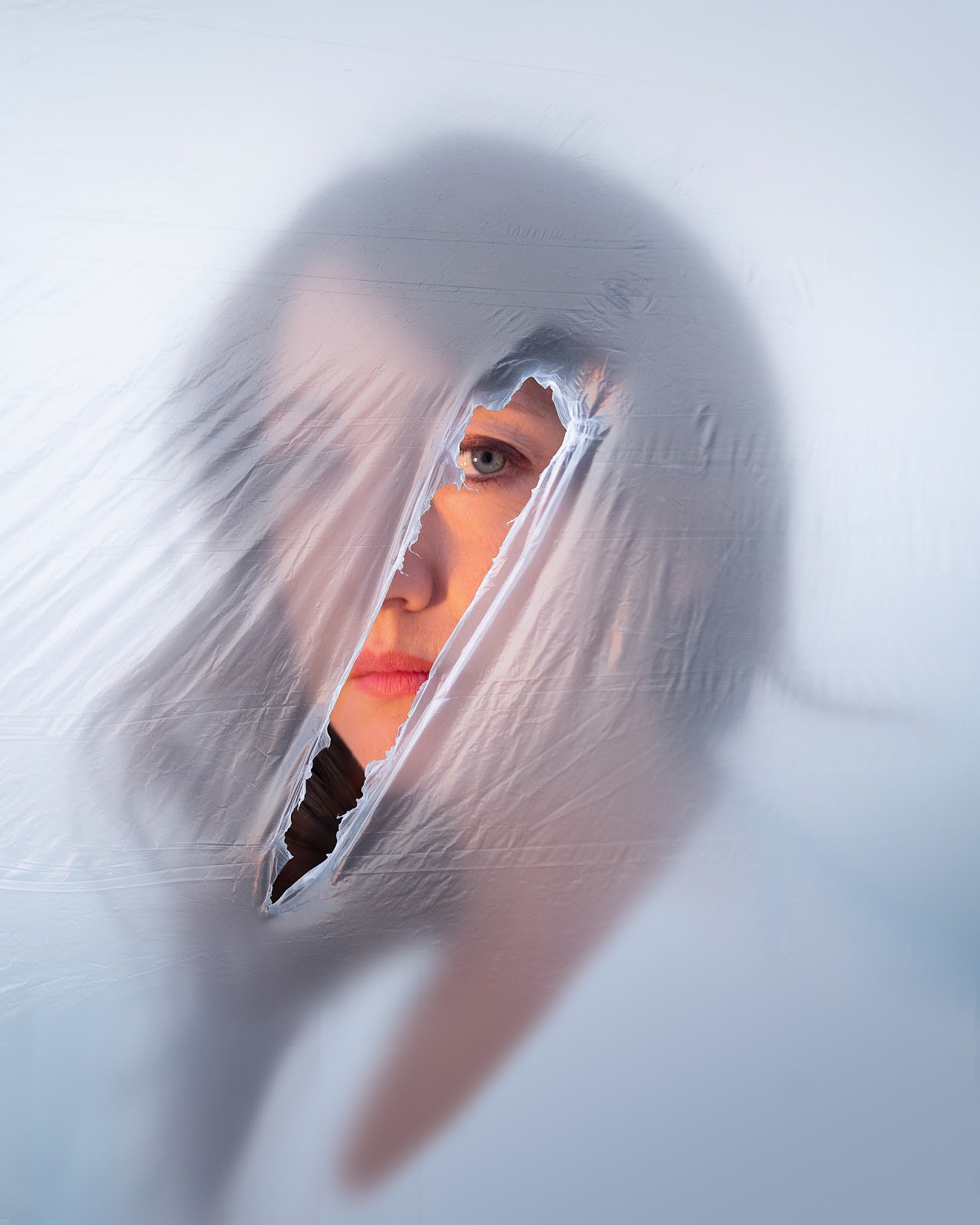
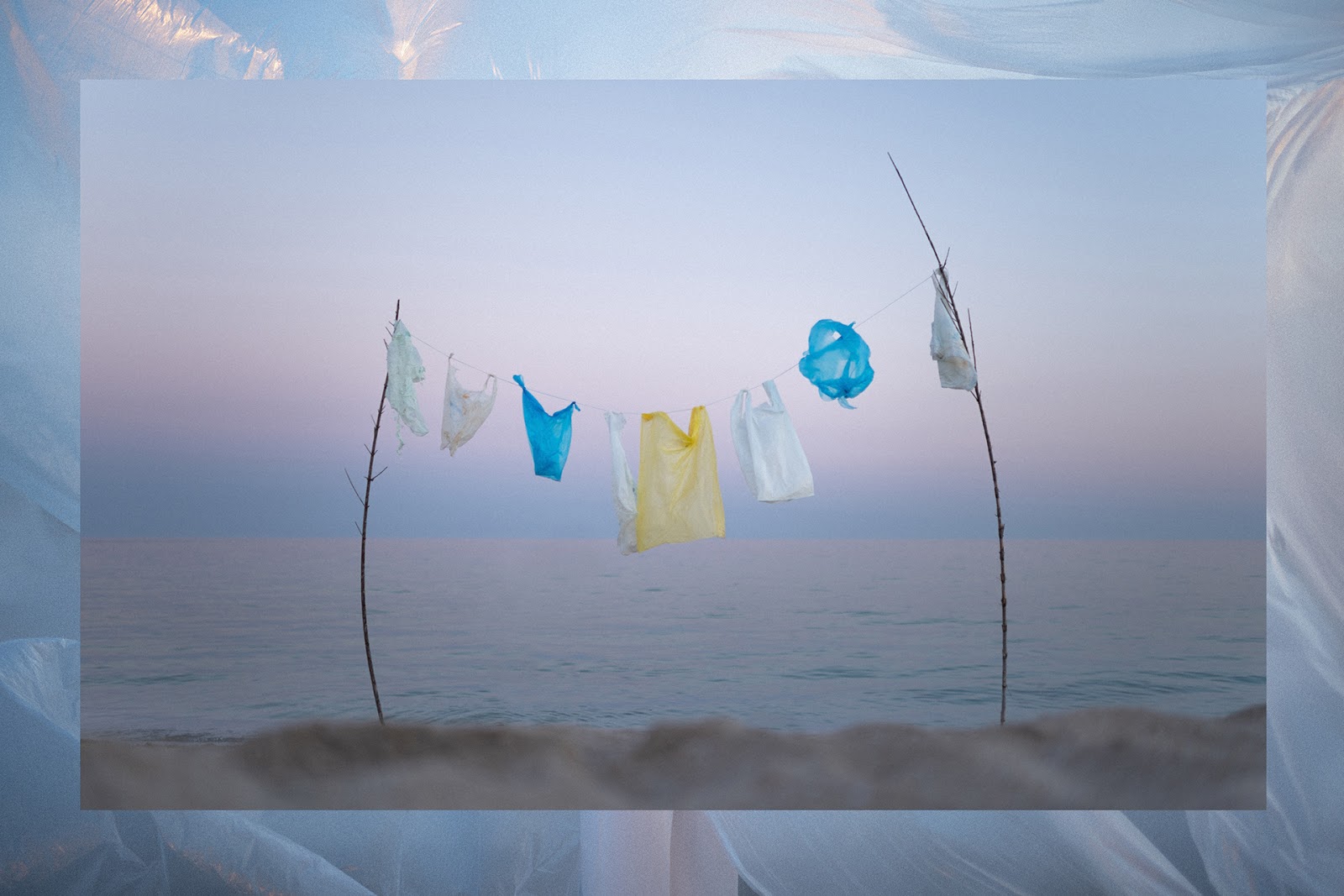
Shot in Puglia, Simone Bramante’s photo series Plastic by the Sea was created for a campaign run by Oikos, an Italian non-profit organisation which seeks to raise awareness about the use and reuse of plastic, a material that Simone claims must be sustainable so as not to become the only ‘creature’ of our seas.
The photographer warns: “Will there be more plastic than fish in 2050 in the oceans? Take actions to make sure there won’t be.”
If like many others you don’t have any plans for this weekend, then you may end up having a cozy night in front of the TV. With so many movies and TV shows available to stream instantly across a multitude of platforms, it can be an overwhelming decision when it comes to what to watch. Fortunately, there is plenty to start binge-watching – so start taking note!
Netflix
Arguably the most popular streaming service boasts some seriously good TV and film. Series 2 of Sex Education is a must! If you couldn’t get enough of Glee or Gossip Girl, then you are bound to enjoy this raunchy series, which has already been renewed for a second season.
Did you know, Netflix uses an Intimacy Coordinator on set when filming its Netflix Originals content? This helps to make intimate scenes such as those in Sex Education much safer for actors, protecting them from the terrors of sexual harassment as highlighted by the Me Too movement in Hollywood.
Another top Netflix pick is Lupin – a brand-new French drama series. This one is subbed over in English but don’t let that put you off because it is definitely worth a watch. This series consists of five episodes that depict the main protagonist, Assane Diop, attempting to steal a prized necklace from The Louvre in Paris.
Amazon Prime
If you order plenty of parcels online and hate waiting for slow deliveries, then upgrading to Amazon Prime is absolutely worthwhile. The content on this still relatively nascent streaming service is second-to-none and comes bundled with the service at no extra cost.
Firstly, there is the entire back catalogue of The Grand Tour to binge through. The Top Gear successor, starring Jeremy Clarkson, James May, and Richard Hammond is popular among both petrol heads and those whose car is just to get them from A to B. The trio embark on some incredible road trips across all corners of the globe, making for particularly aesthetic viewing – especially in 4K!
Amazon’s offering also boasts some brilliant blockbuster films too. Baz Luhrmann’s classic Moulin Rouge! starring Ewan McGregor and Nicole Kidman has been available to stream from February 2021 which is worth setting aside a dedicated evening for!
Apple TV+
The newest entrant to the streaming service market is Apple TV+ and if you’ve bought a new Apple product recently – such as a Mac, iPad, or iPhone – you may have been fortunate enough to receive a free trial. It’s definitely worth claiming because the California-based company has some real gems on its service.
Ted Lasso is a great place to start. Starring the brilliant Jason Sudeikis, a college football coach somehow ends up in charge of a top-flight team in England. Already renewed for Season 2, this hilarious sports series even features a cameo from real-life football manager José Mourinho.
Other must-watch shows include The Morning Show with Jennifer Anniston and musical comedy Central Park.
Hopefully, this brief overview of what to watch has inspired your binge-watching for this weekend.
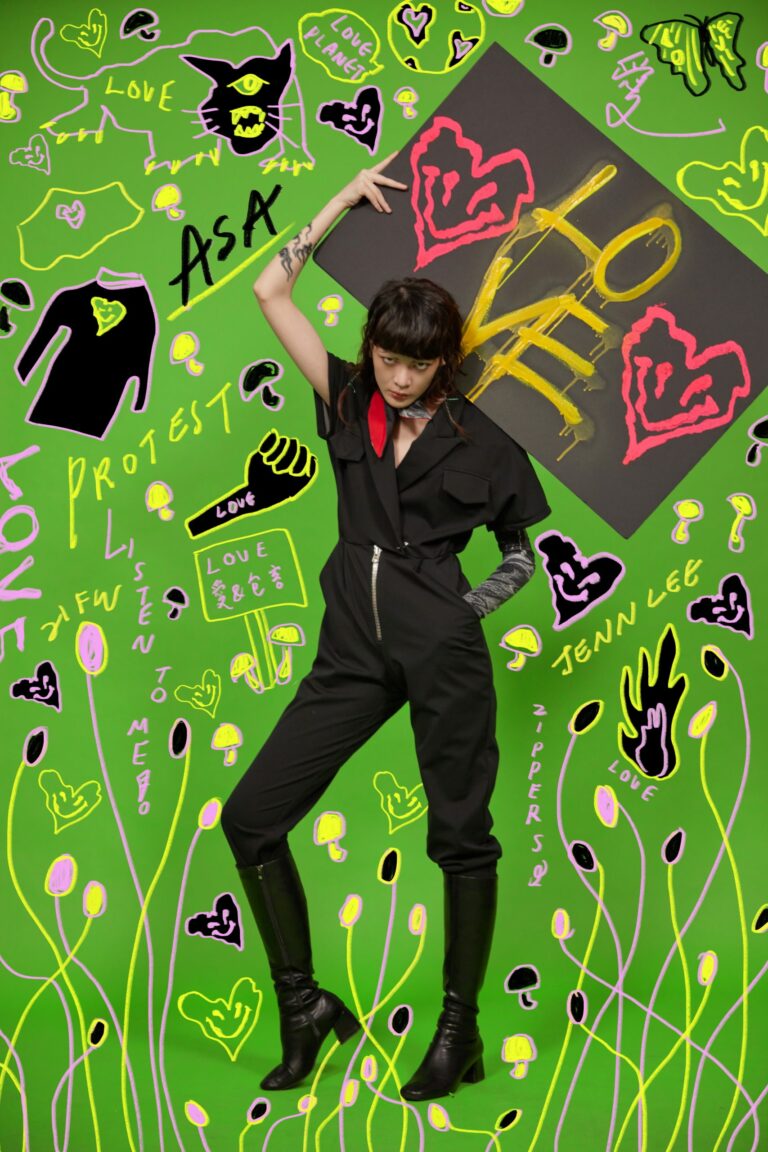
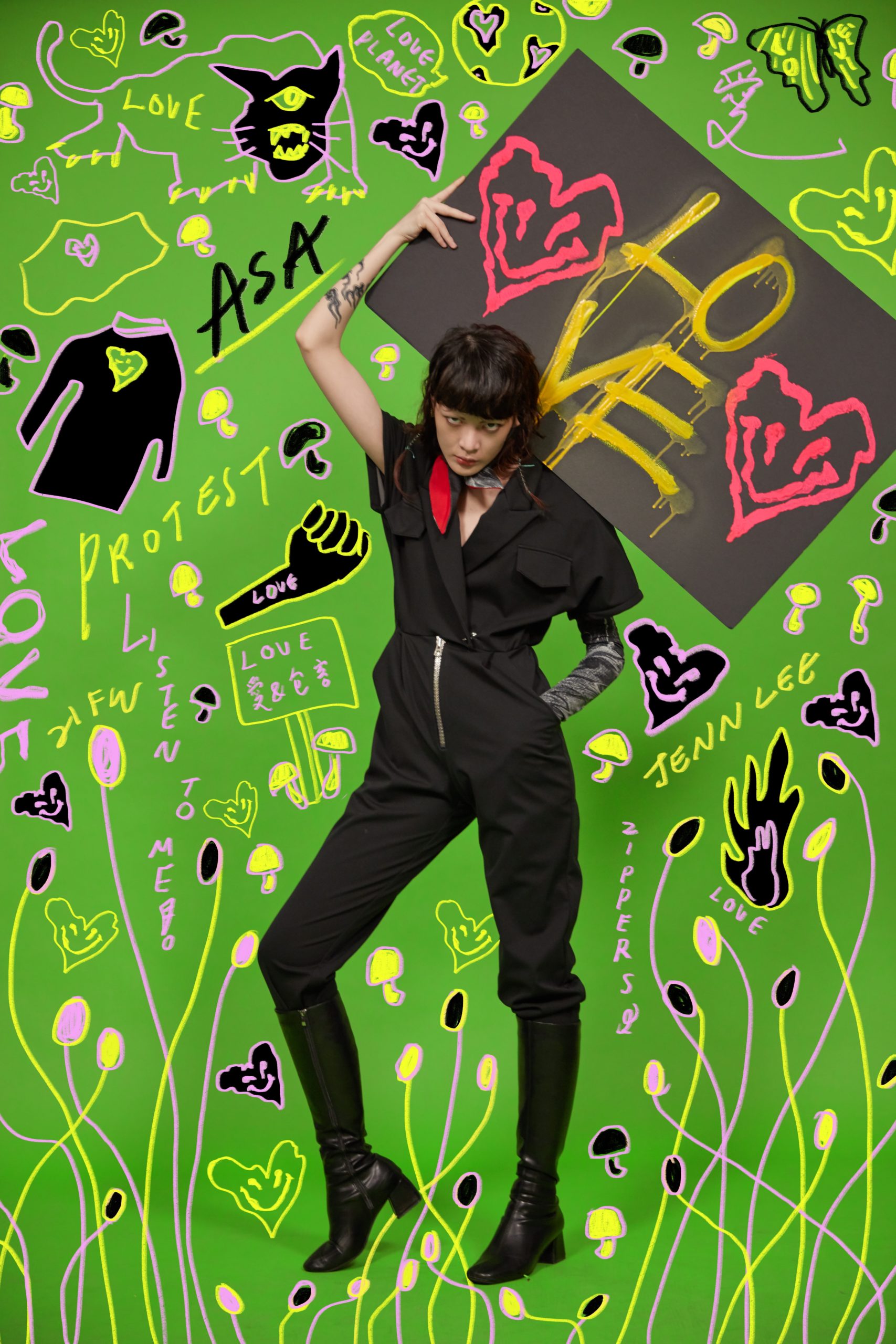
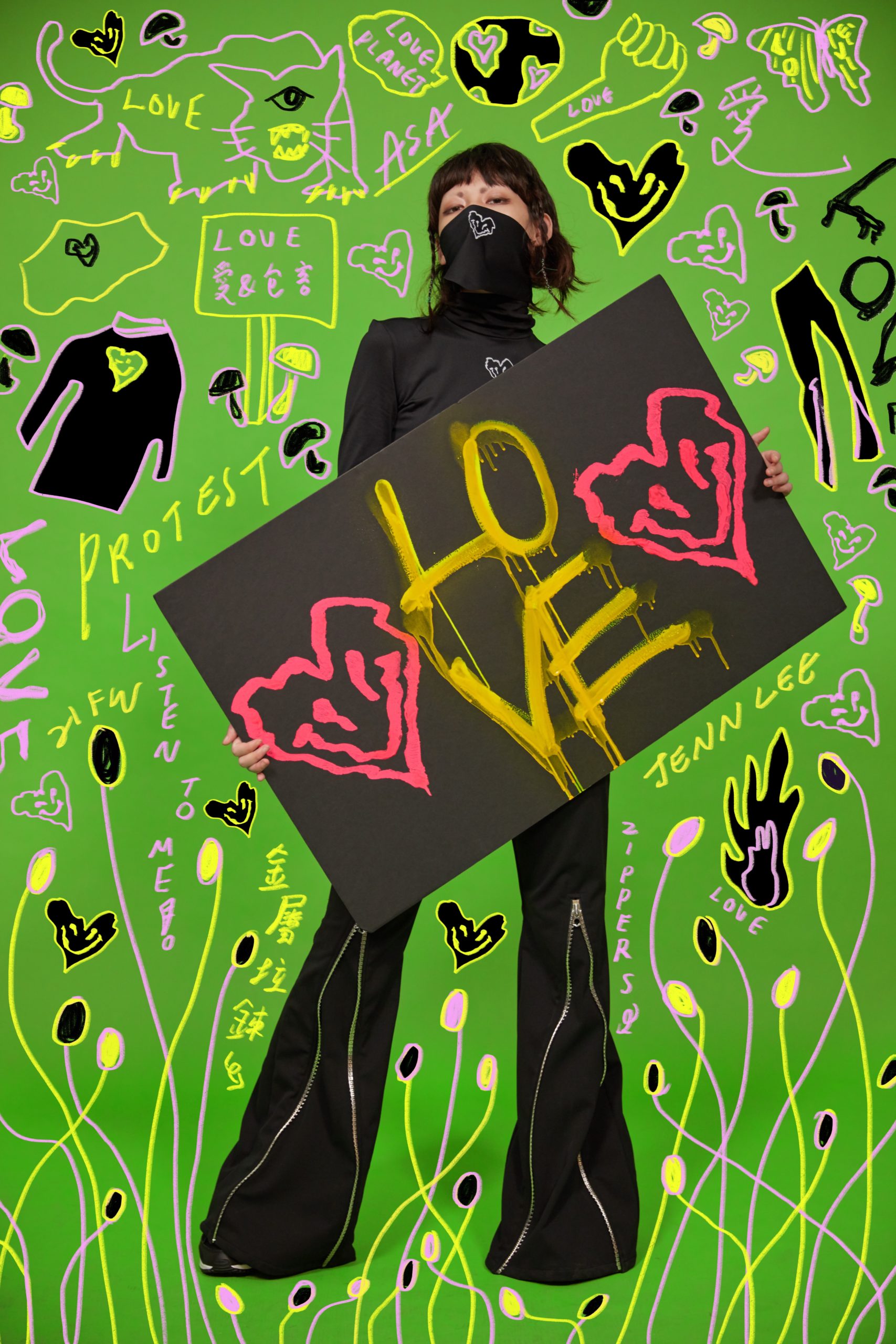
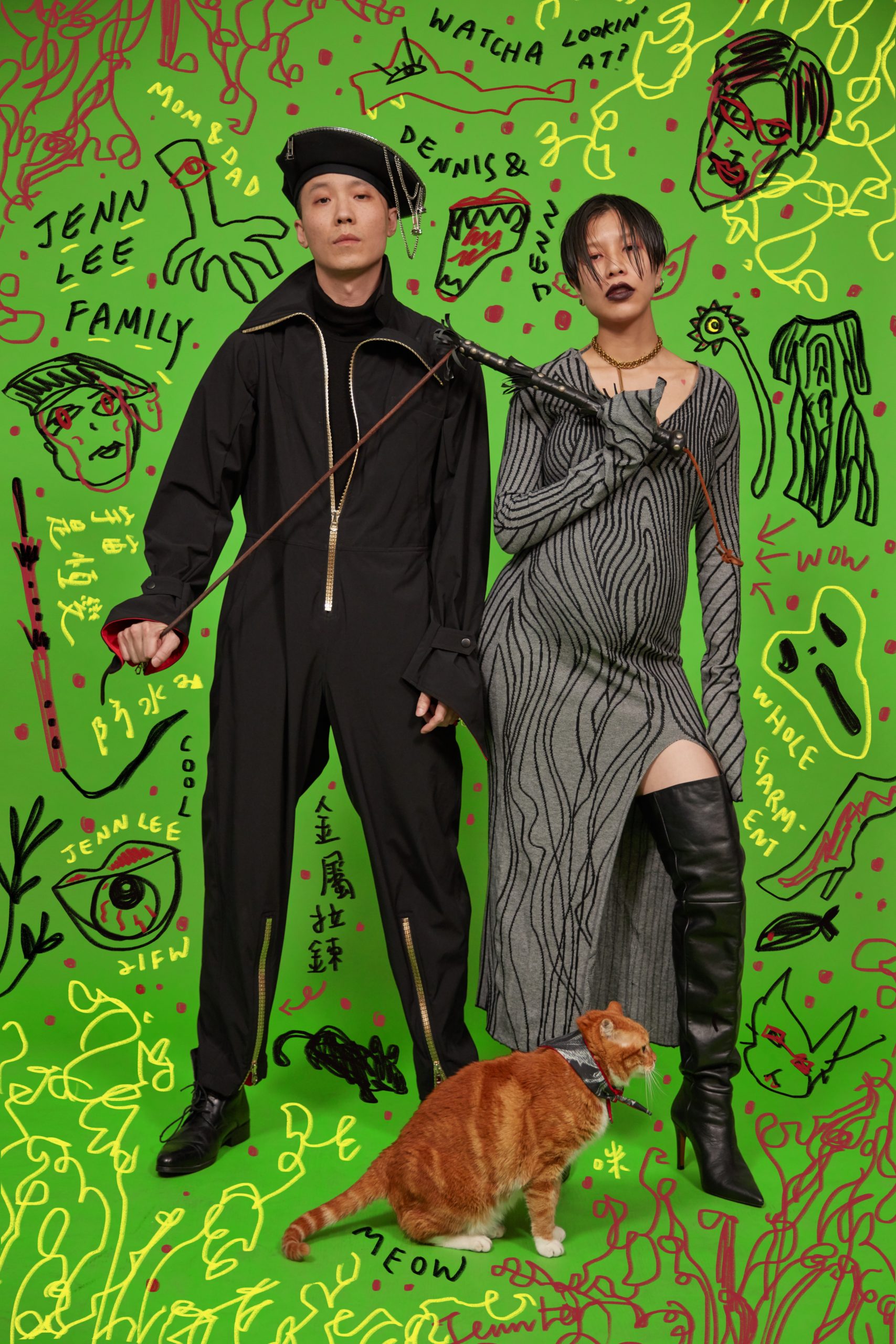
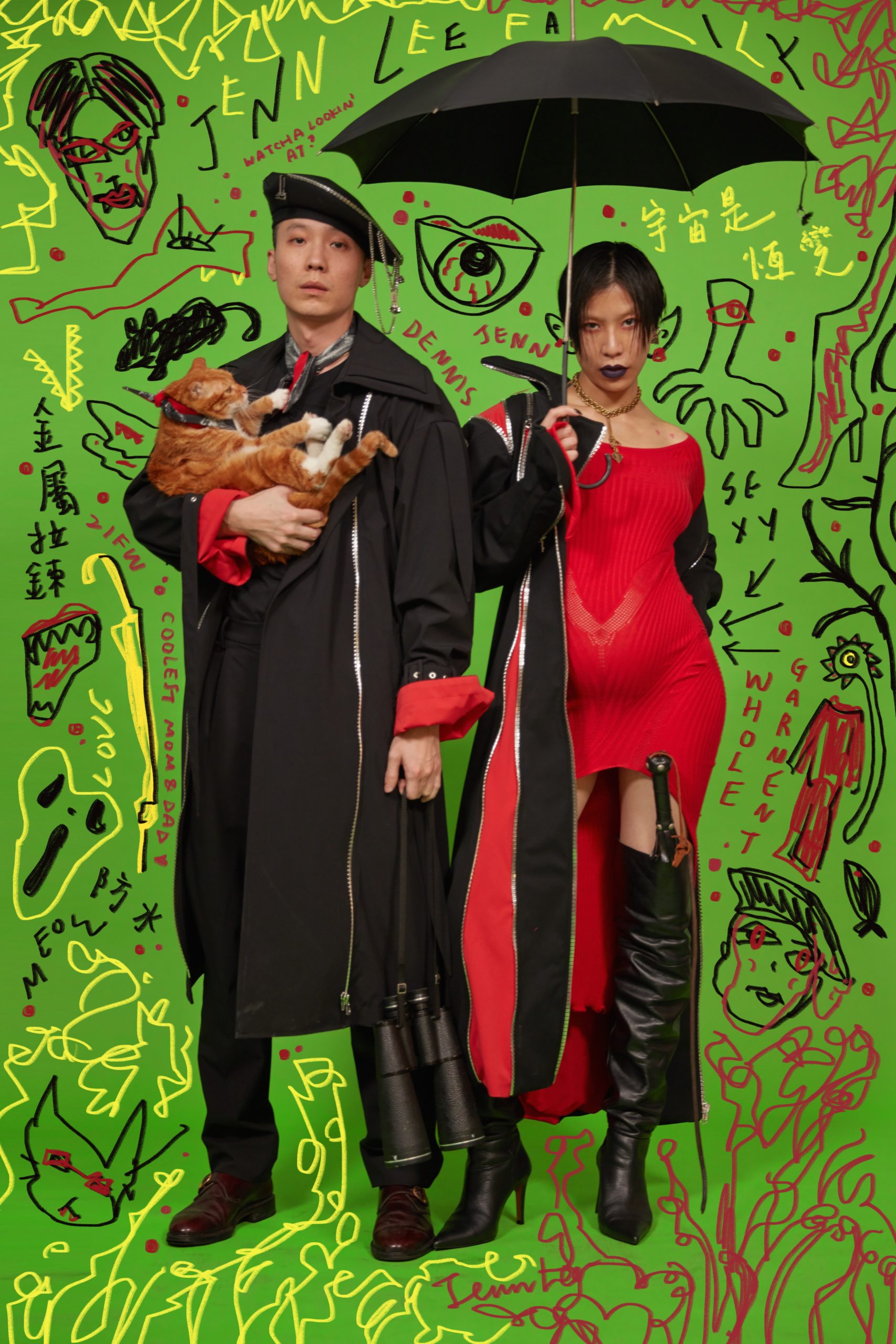
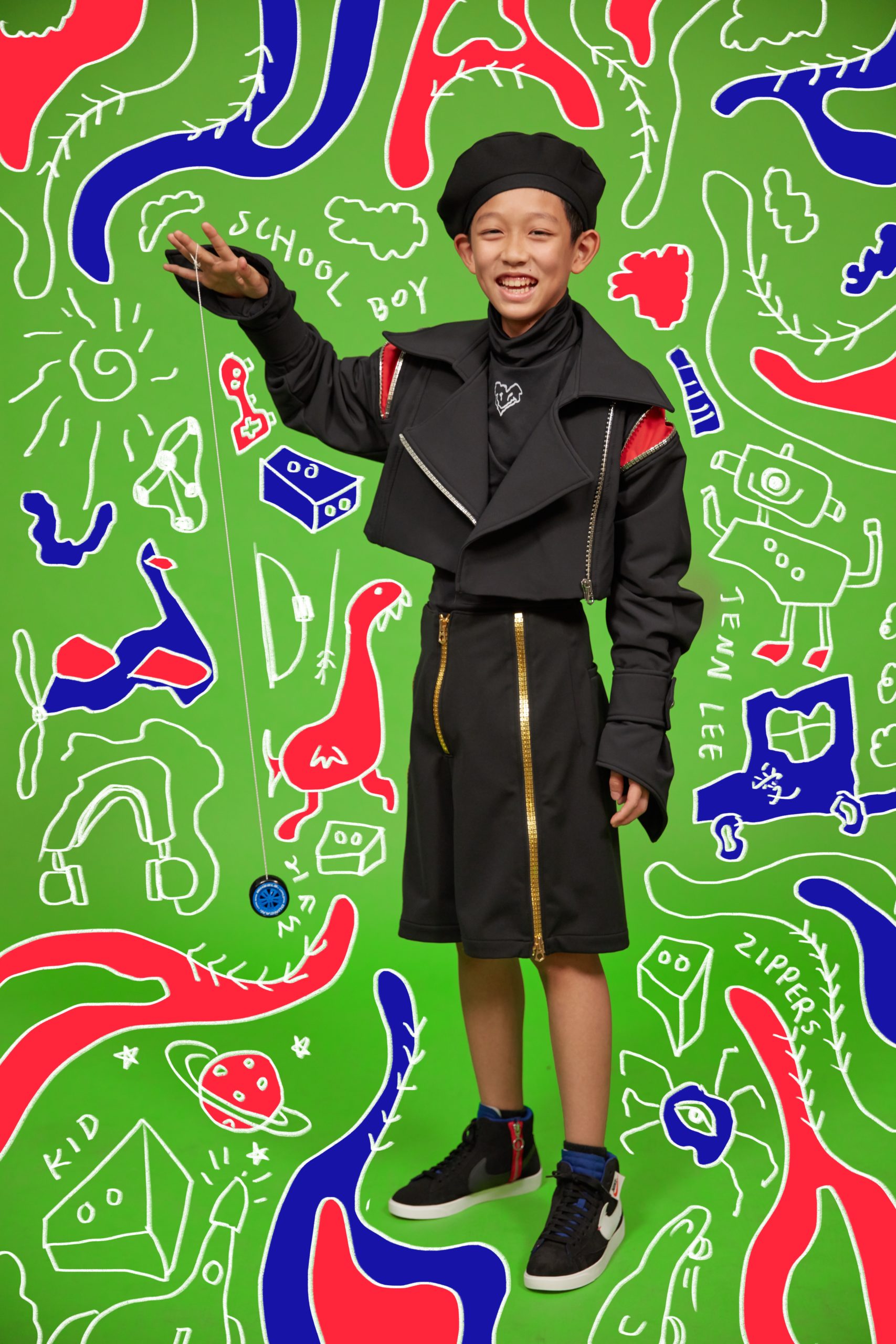
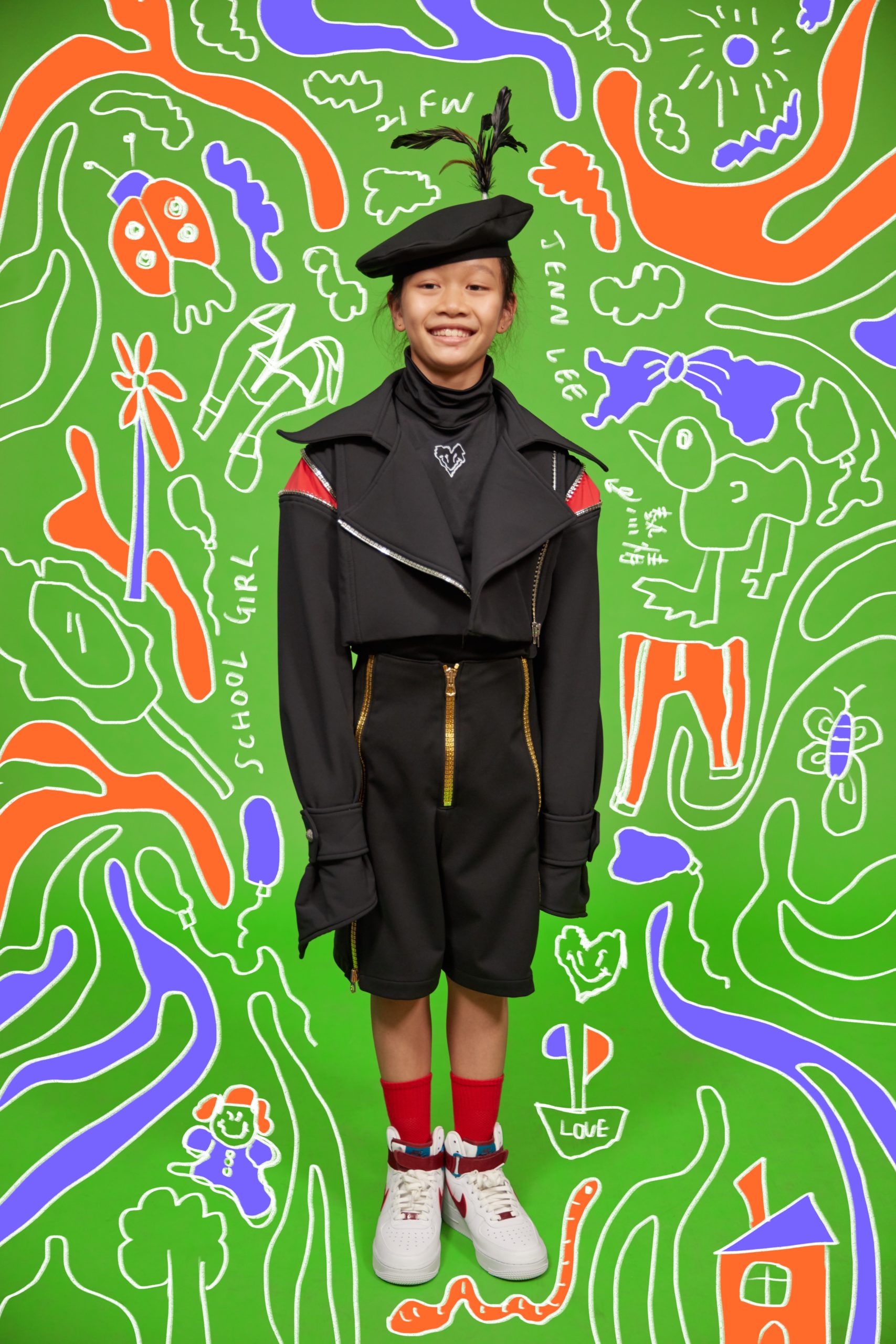
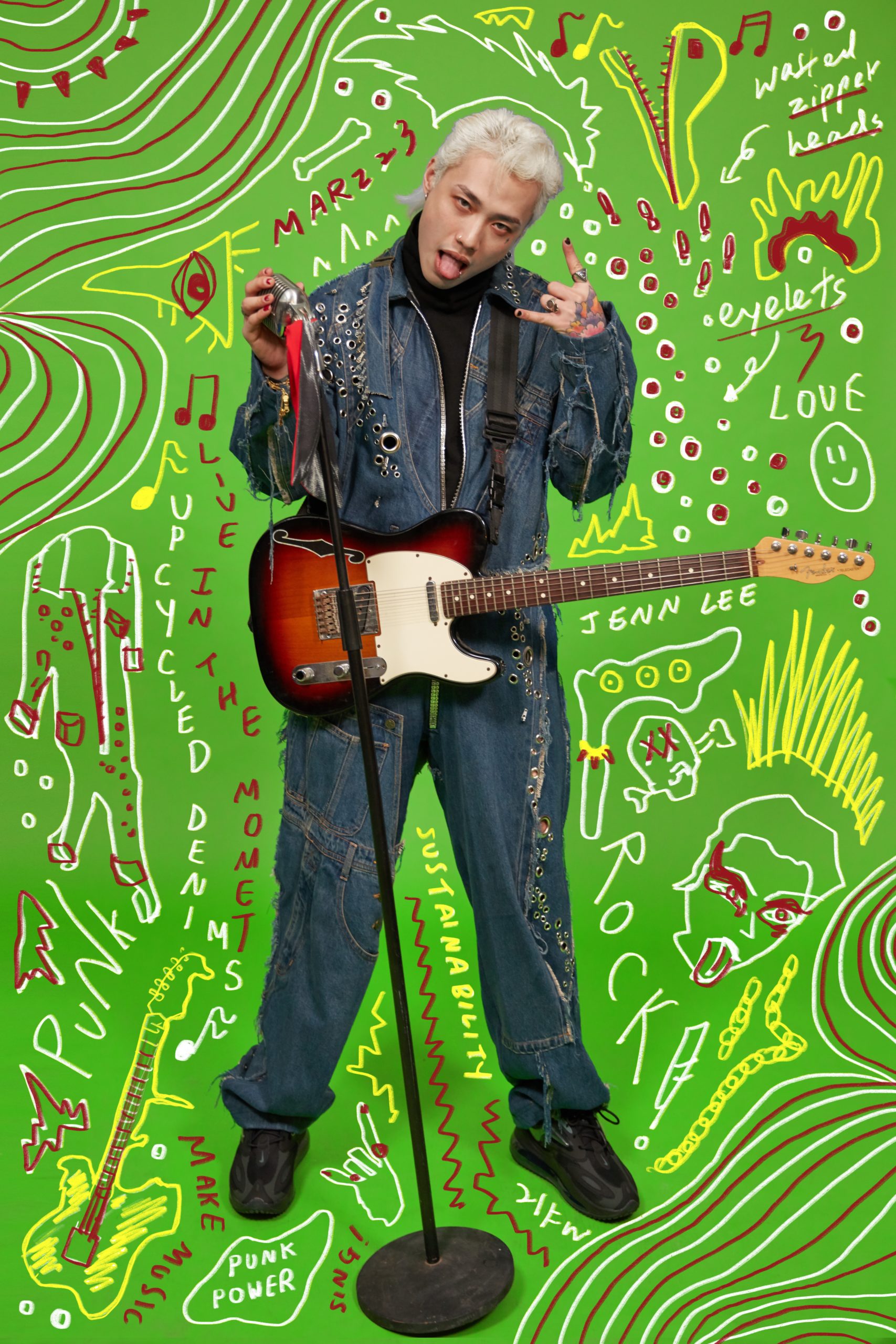
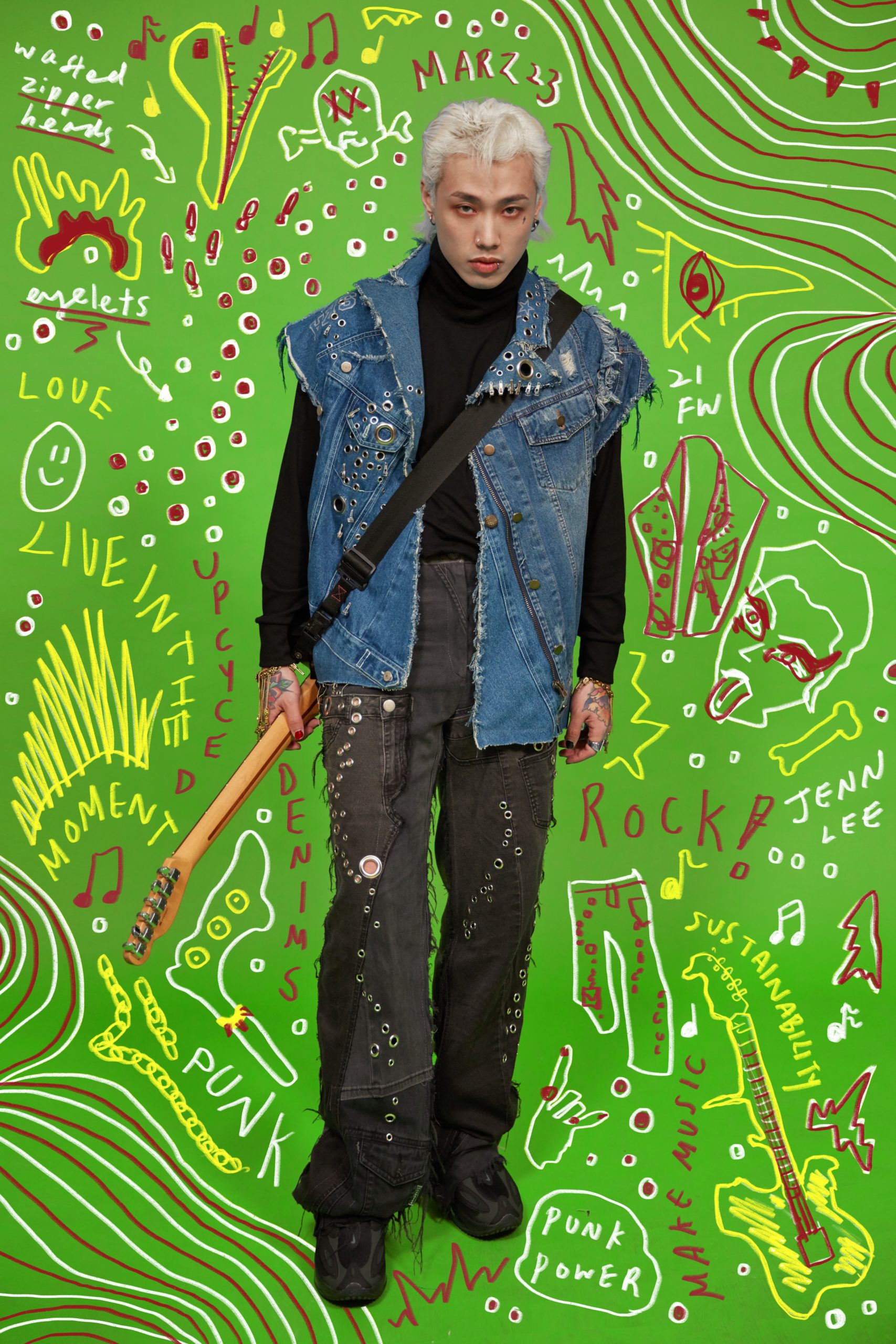
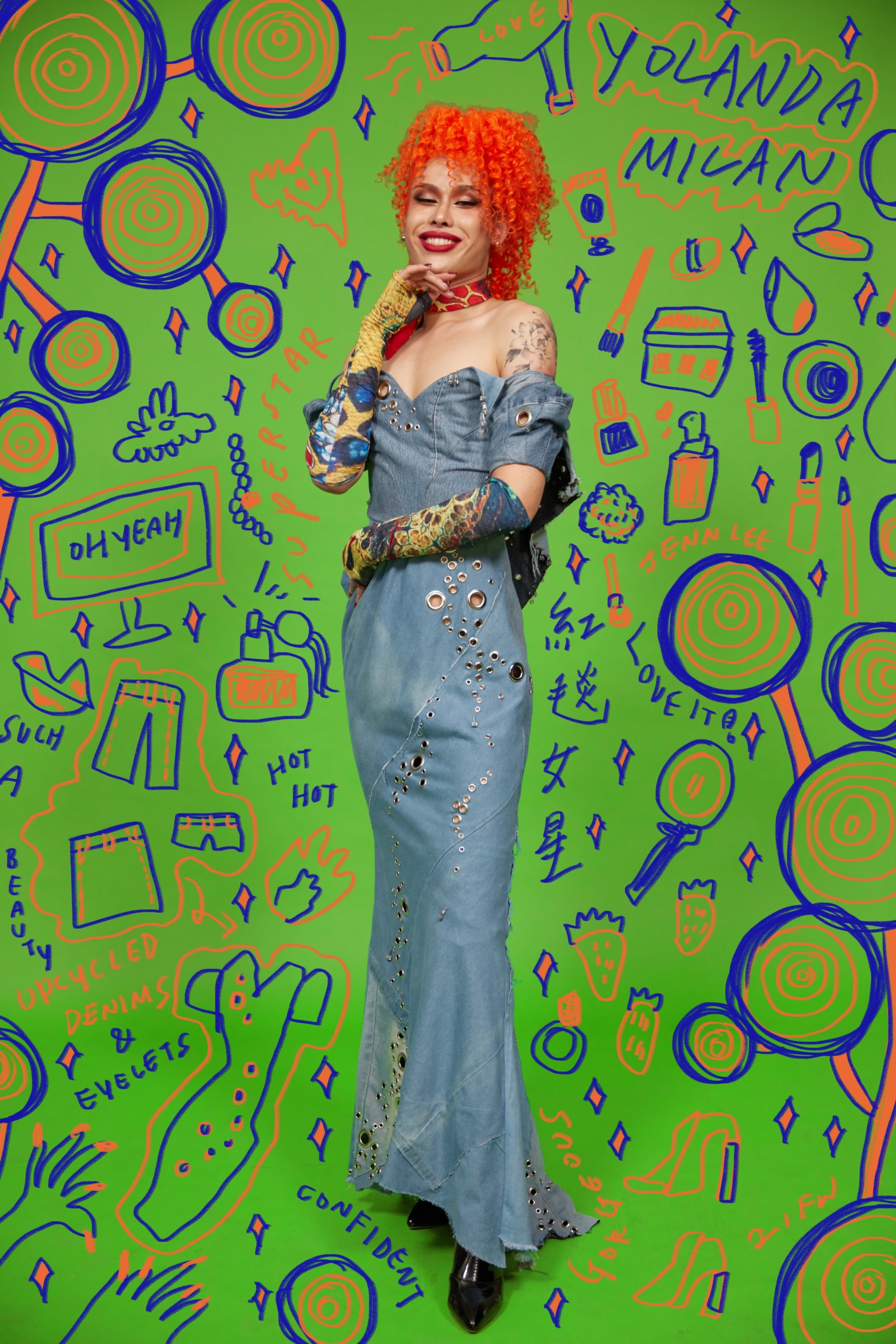
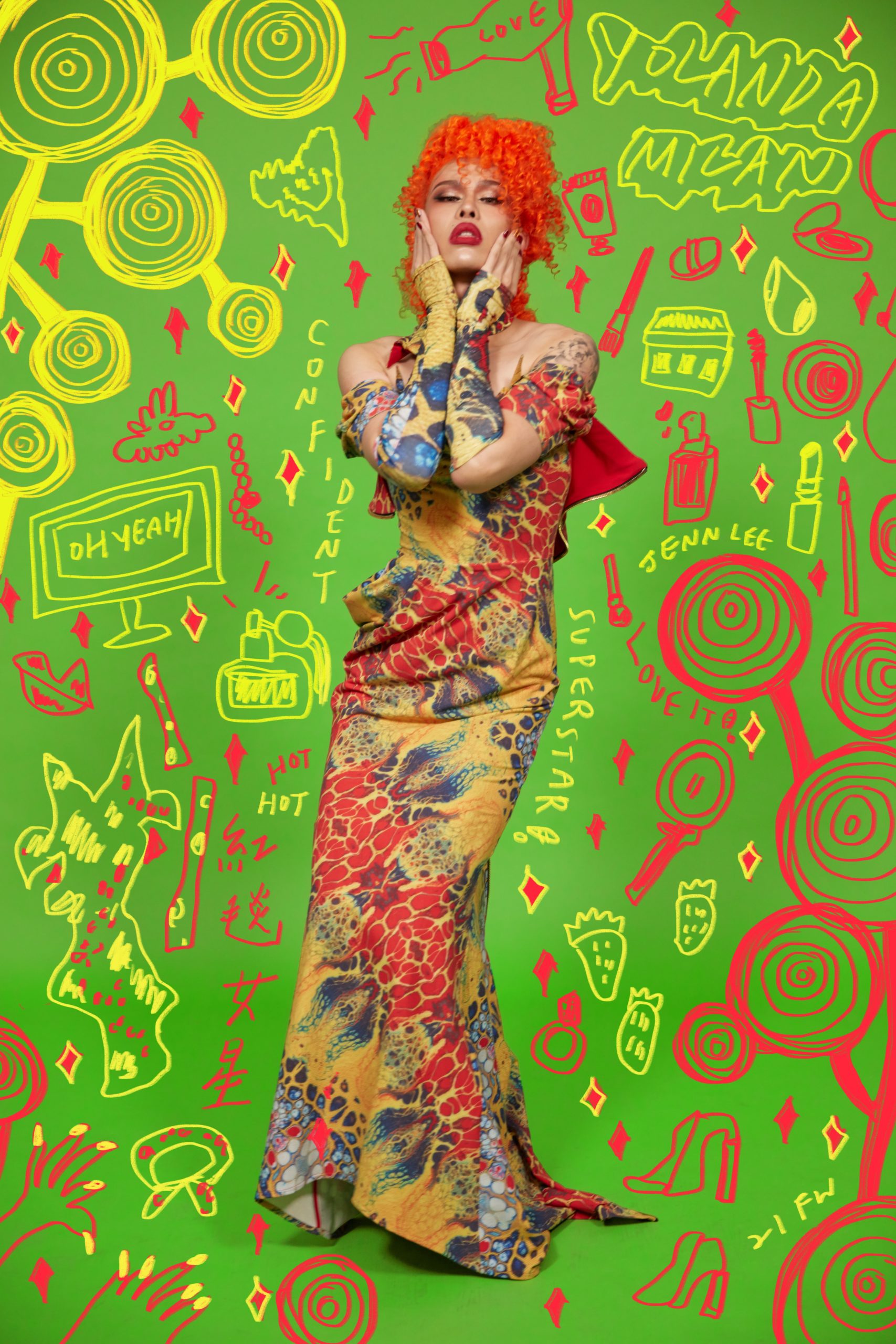
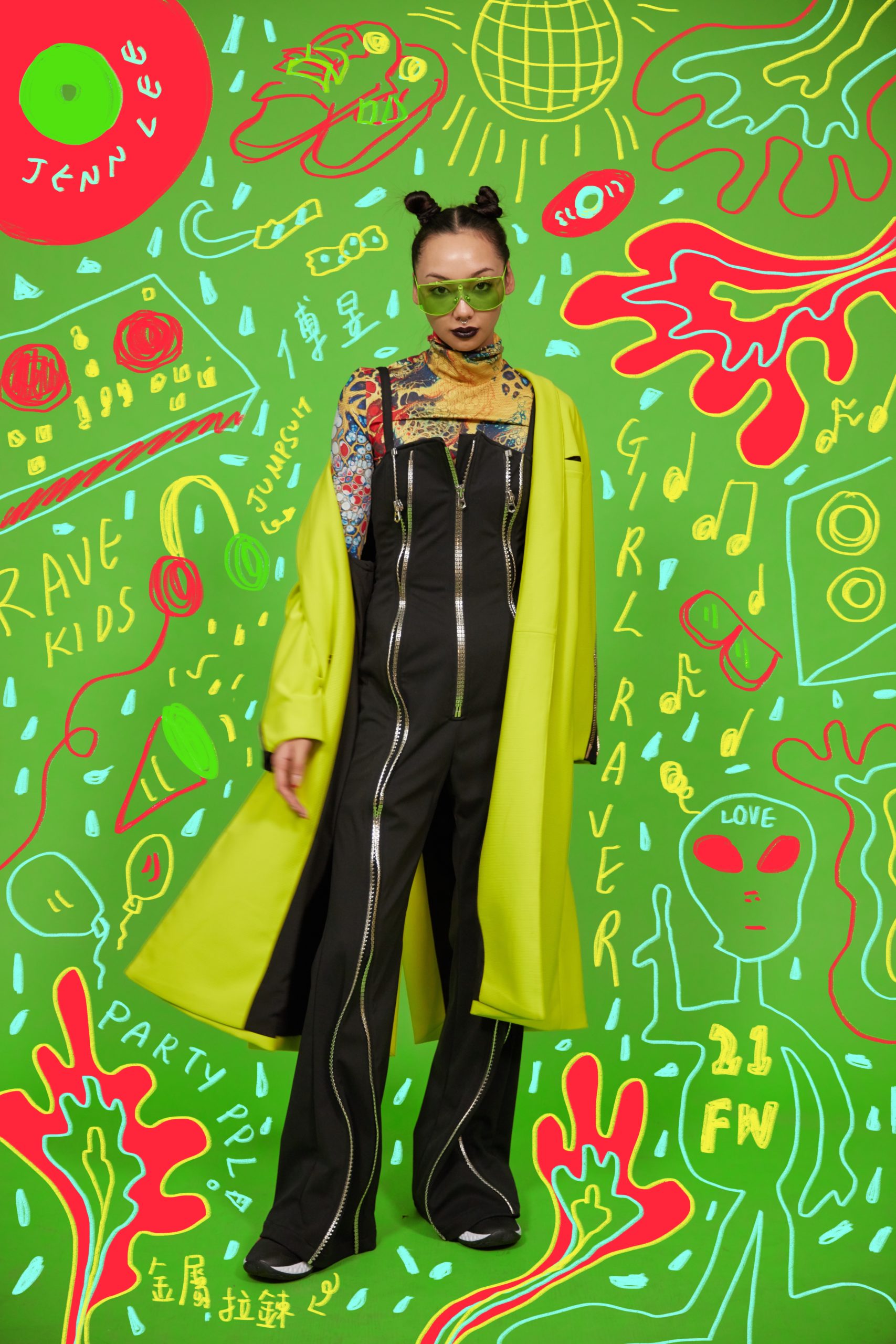
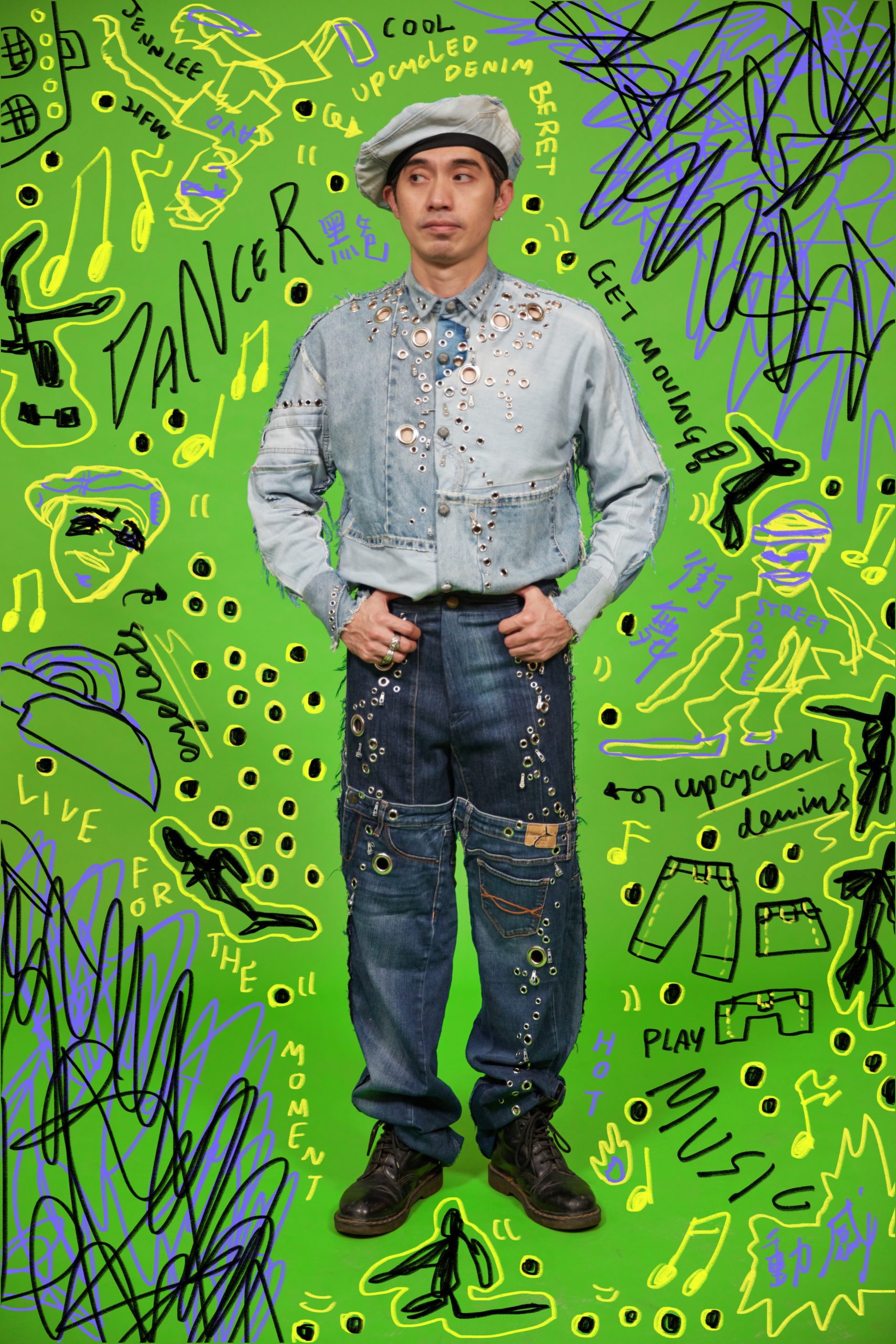
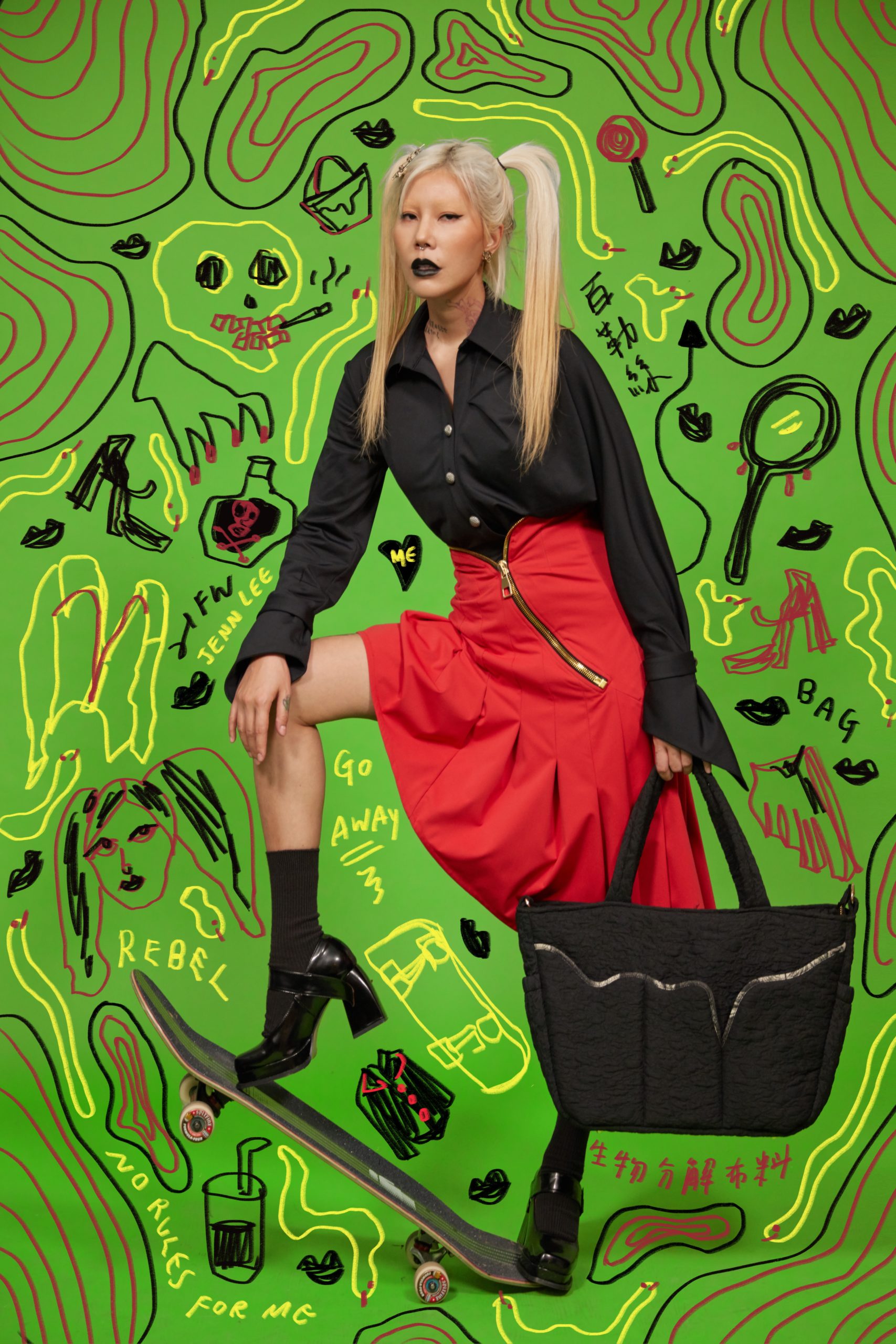
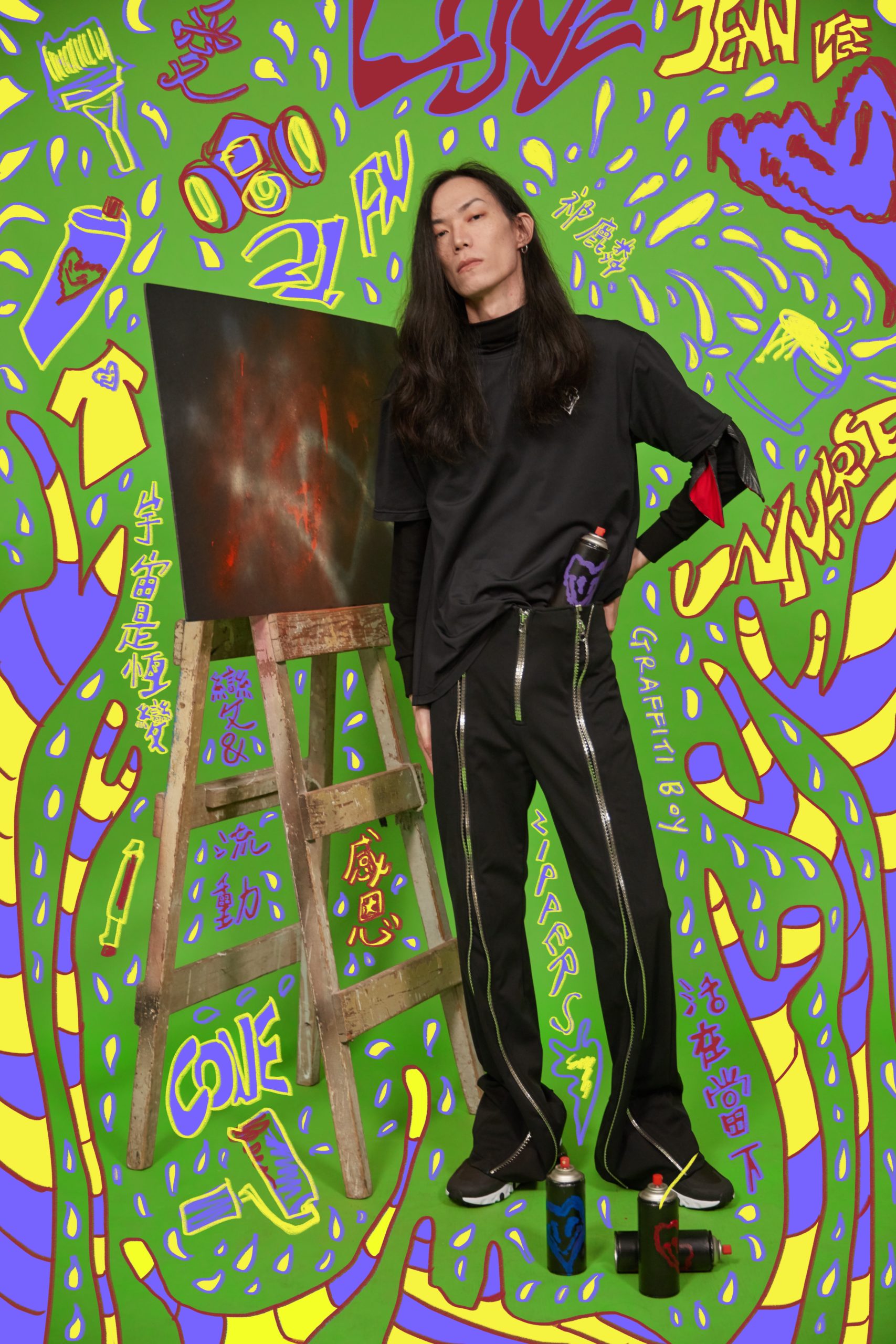
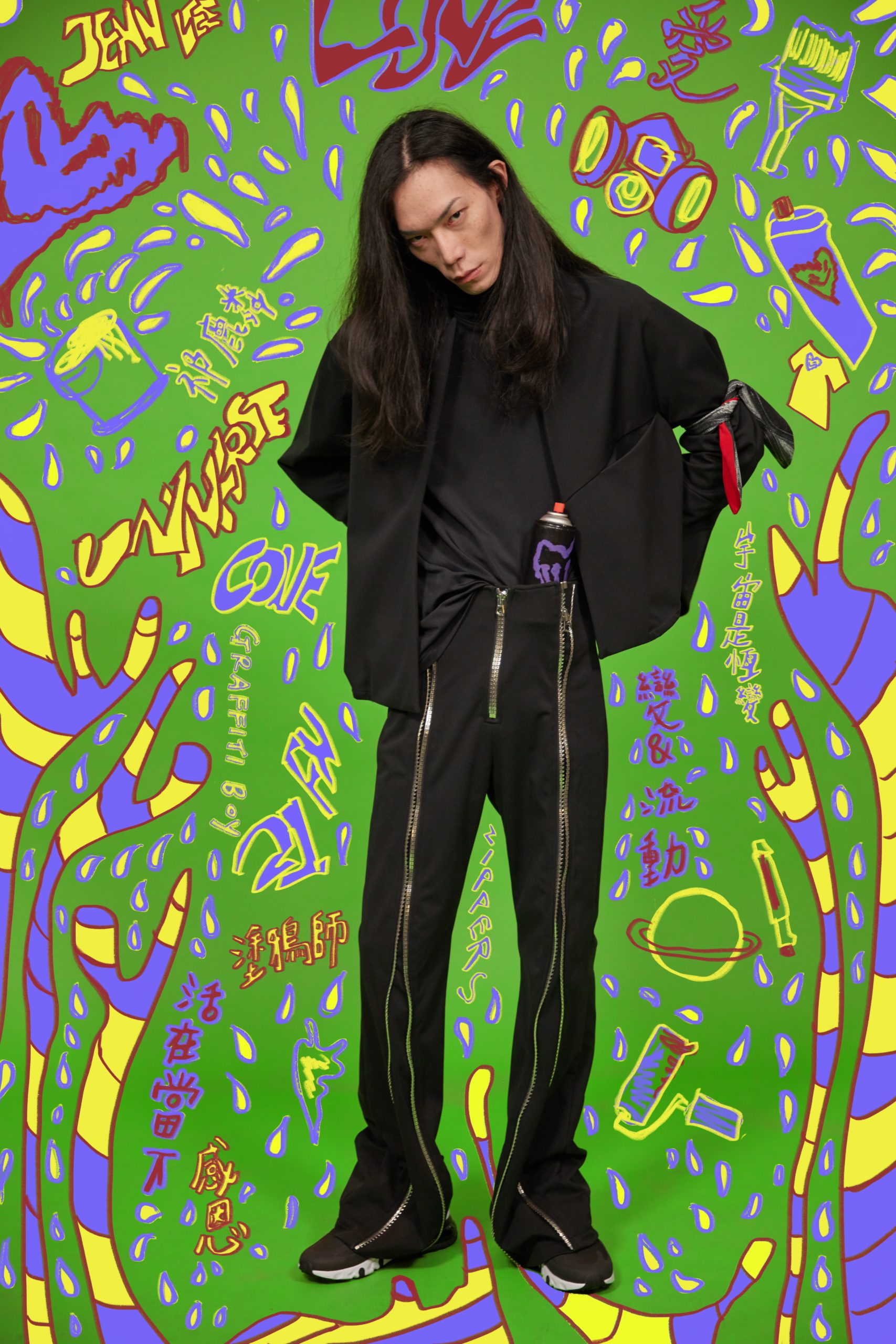
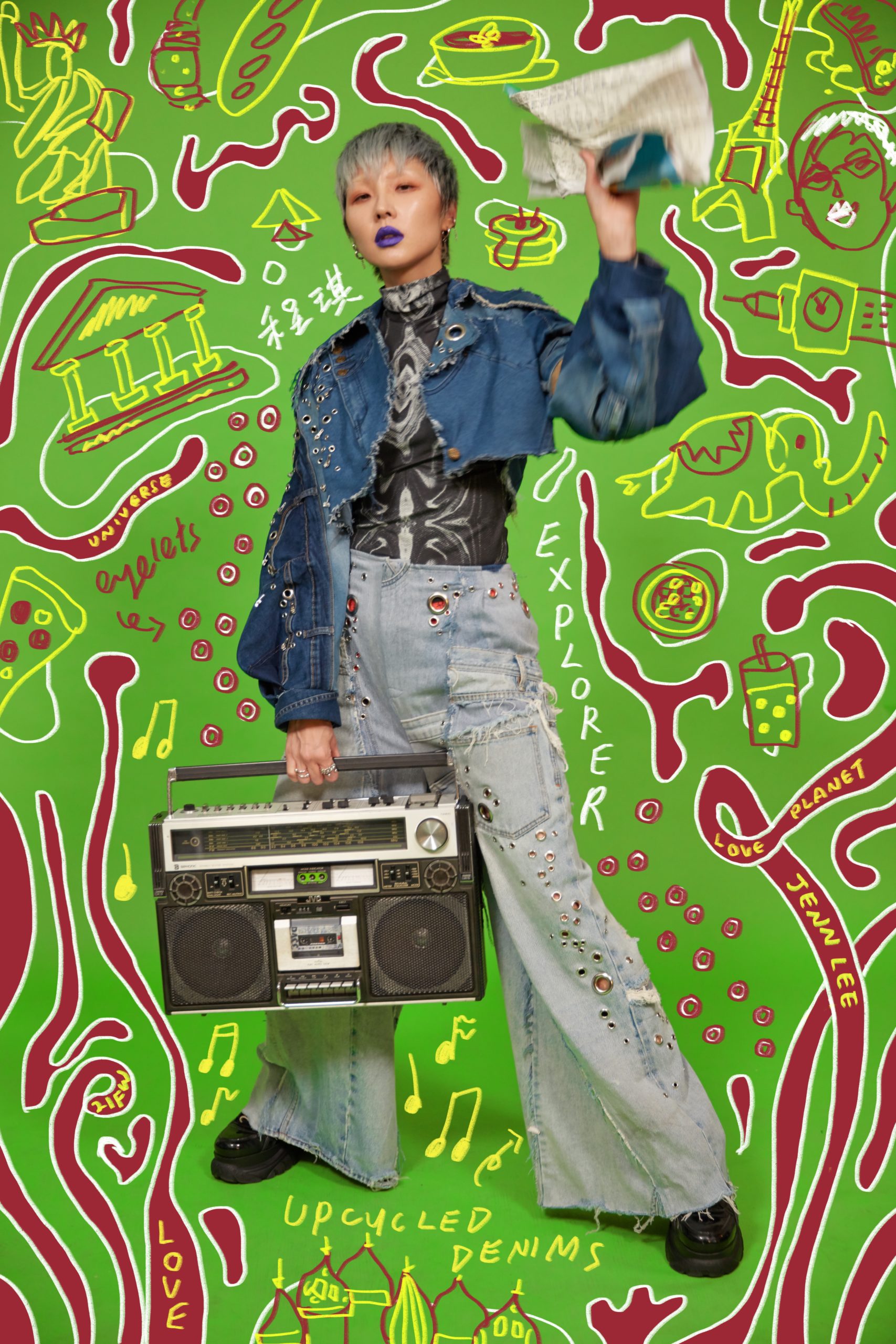
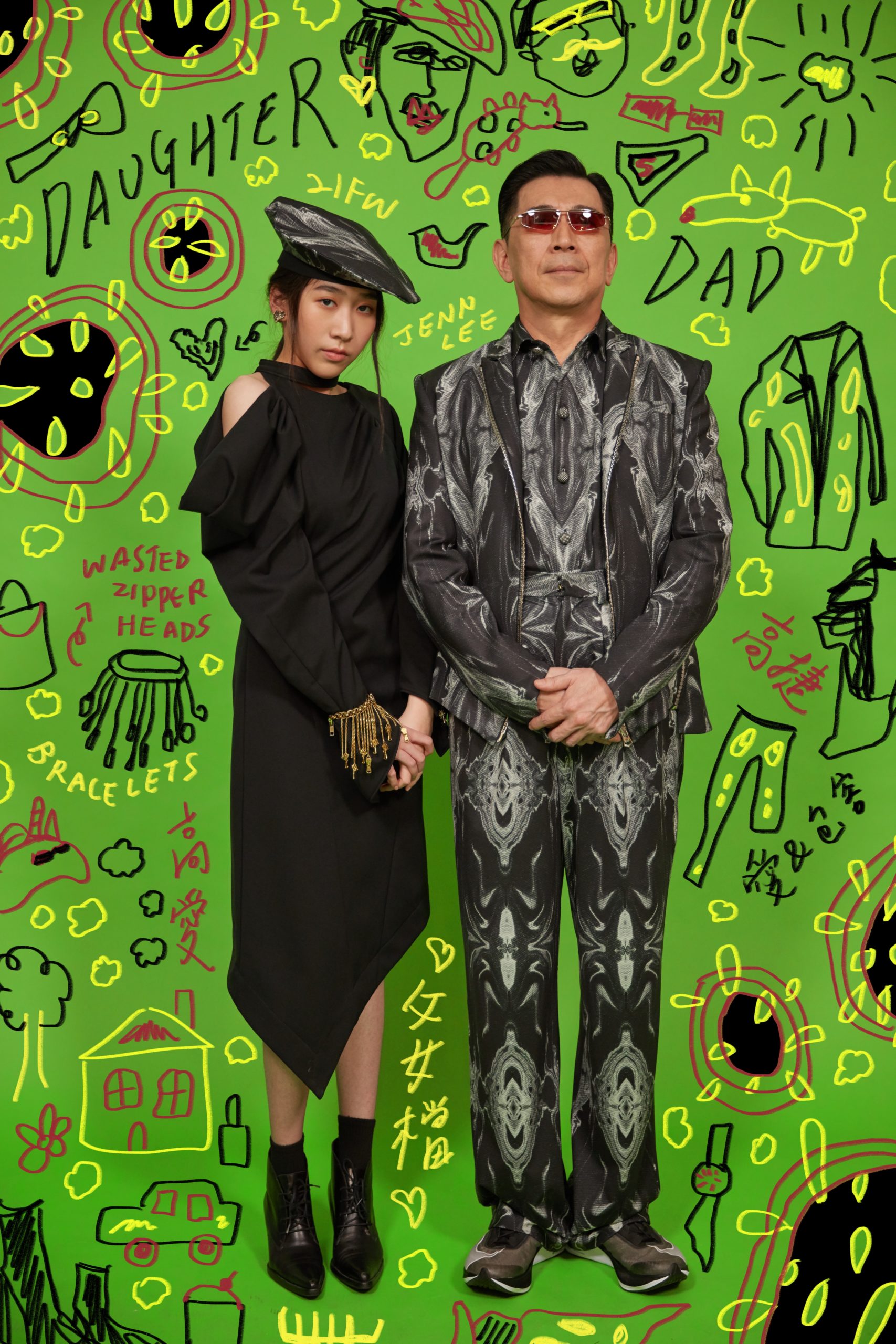
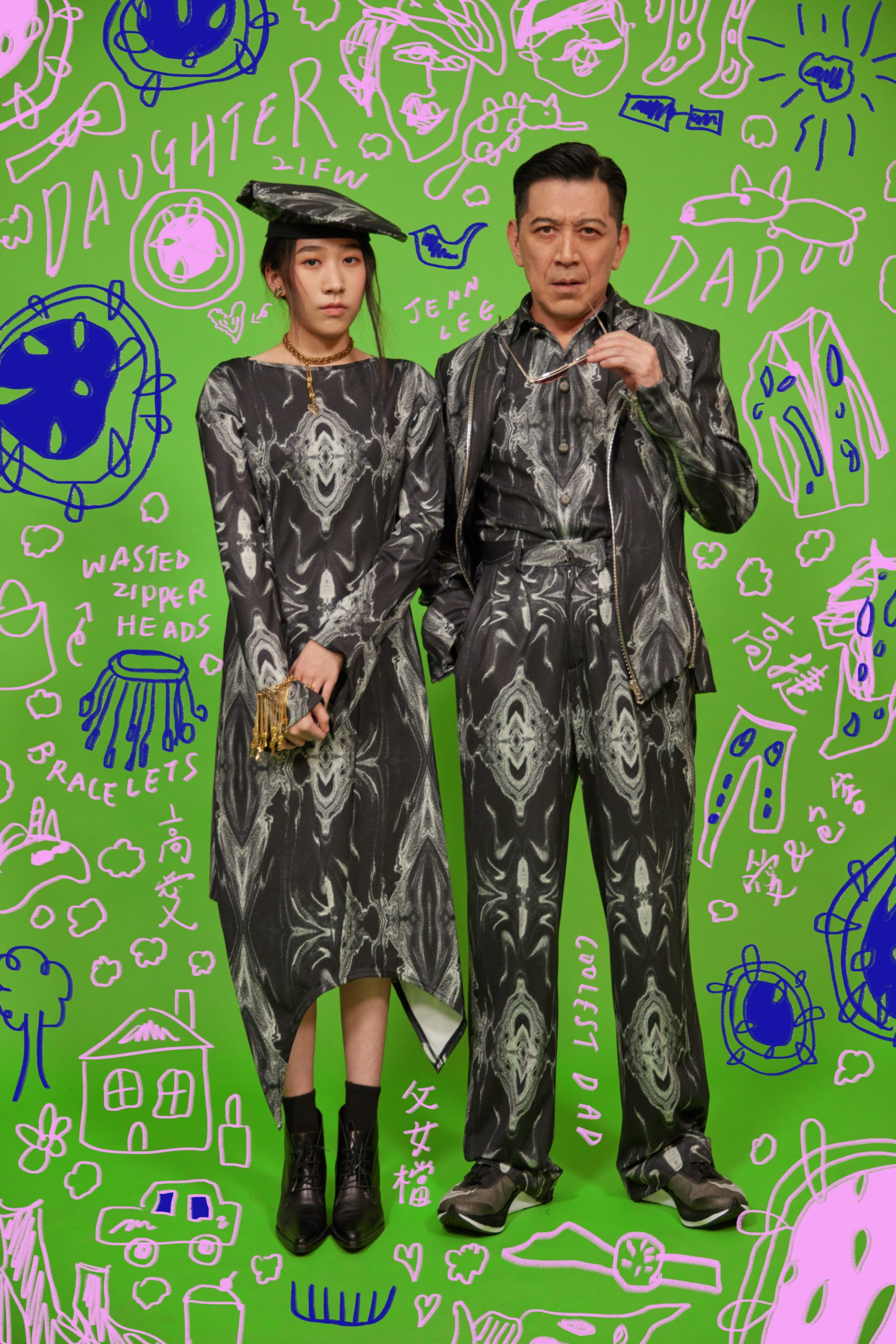
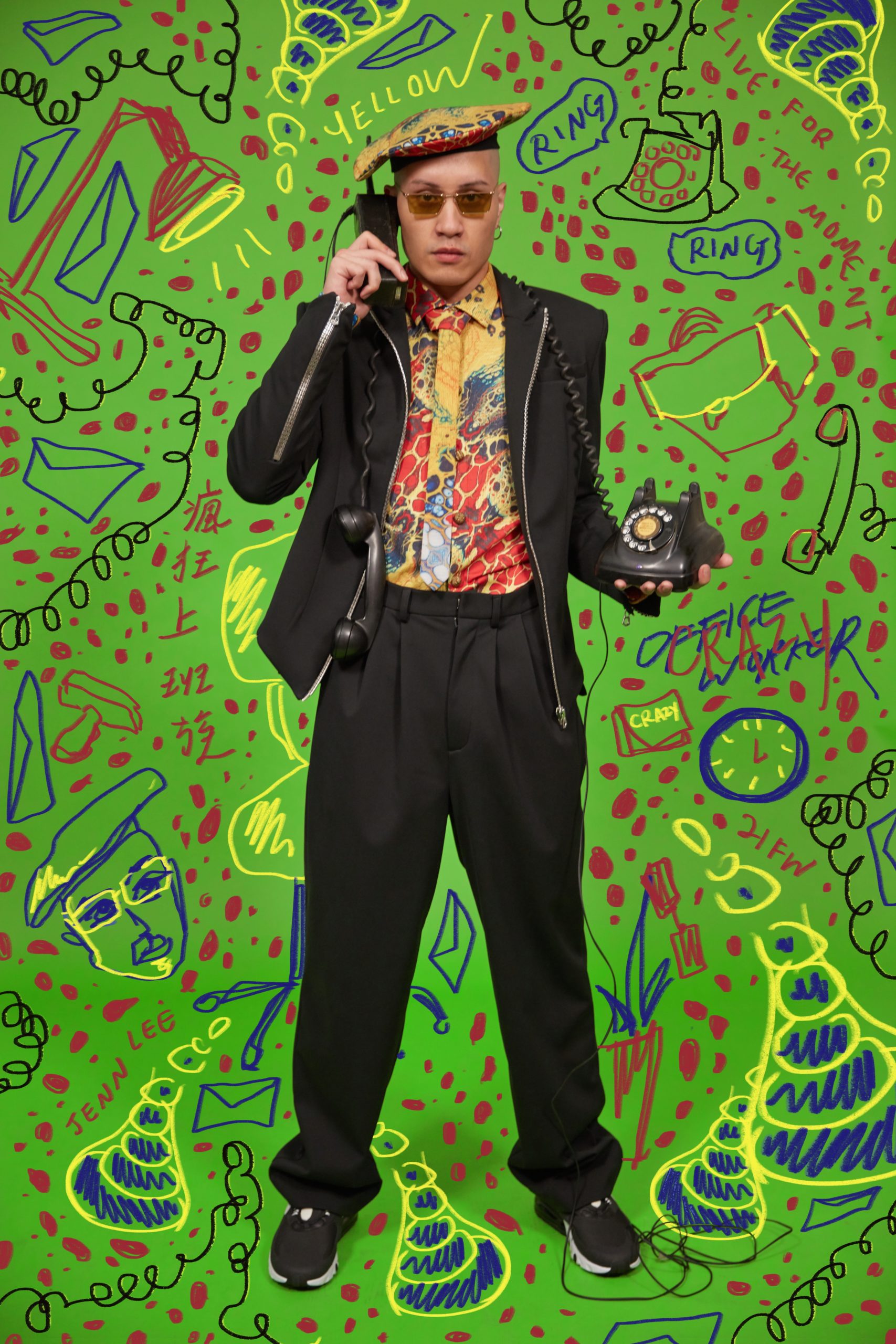
Jenn Lee presented an astounding 360 VR show during London Fashion Week for her fall-winter collection.
The VR showcase aimed to bring together the ideas of transformation and dissipation. In this film, a chaotic VR world is juxtaposed with real characters from our everyday life. For this project, Jenn Lee and Renovatio Pictures, Inc. set about to invite a group of Taiwanese celebrities, actors, musicians, influencers, make-up artists and designers to participate in seeking utopia via virtual reality.
For the collection itself, details such as metal eyelets and metal zips are utilized as a critical design element to create a sense of fluidity and maintain Lee’s usual Sports lux style. The upcycled denim series are paired with technical waterproof trench coats and suiting for an ultra-modern look. Accessories provided by Nike and Gentle Monster are placed alongside some additional pieces such as Jenn Lee’s scarves which have been created using fabrics developed from discarded Oyster shells; as well as knitwear done in seamless ecovero viscose to avoid yarn wastage and bring the whole collection close to complete sustainability.
The global pandemic has changed the way we live, work, and create. The fashion industry has been affected in ways we could have never expected. With this in mind, Jenn Lee wants to use this collection to channel her positive feelings and encourage us to look towards a brighter future.
The soundtrack of the show ‘Hermitage Bliss’ was created by Taiwanese born musician and DJ Cloudy Ku.
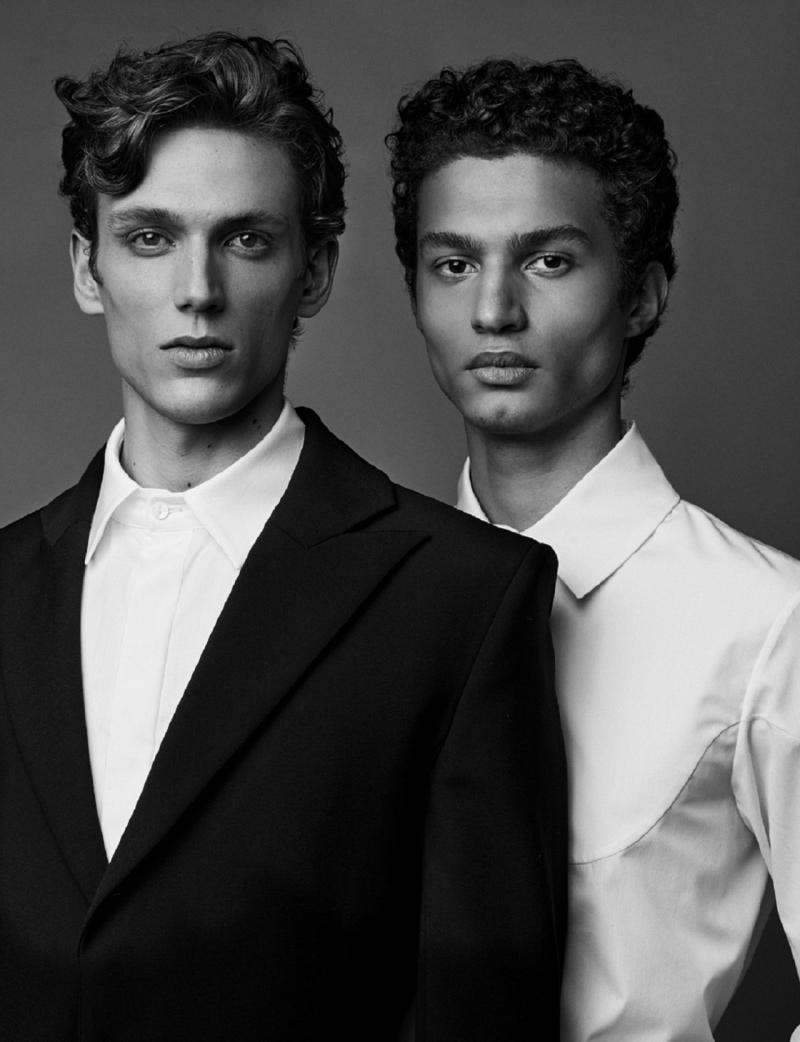
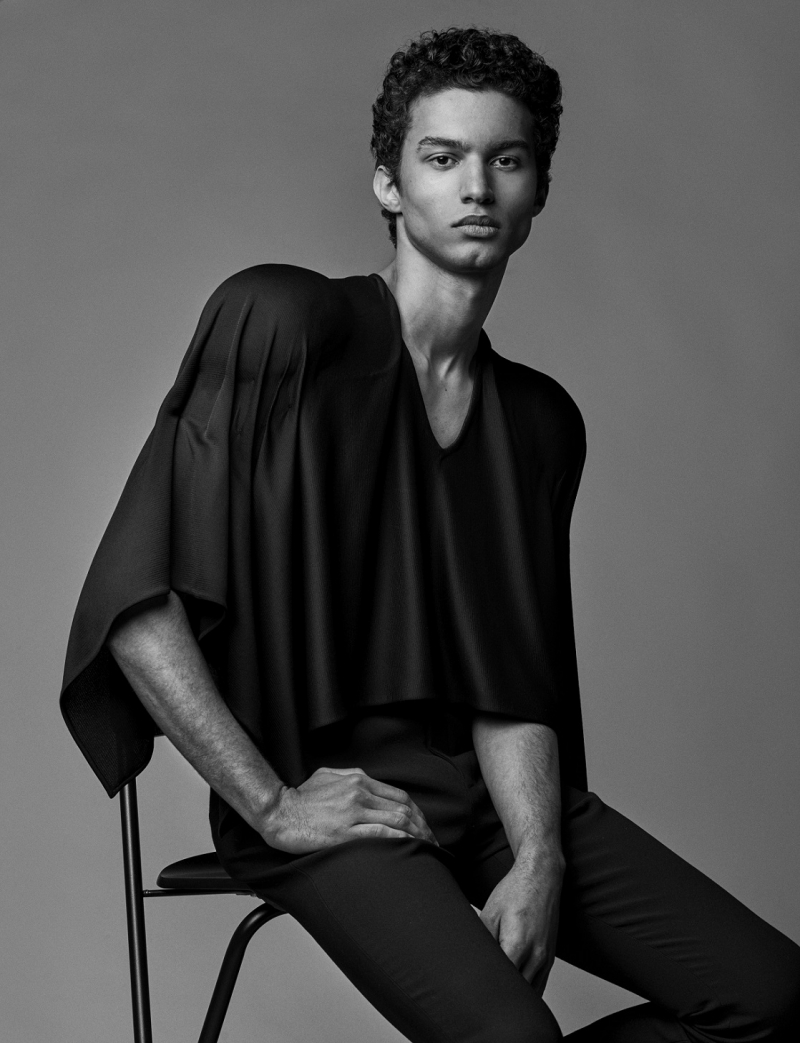
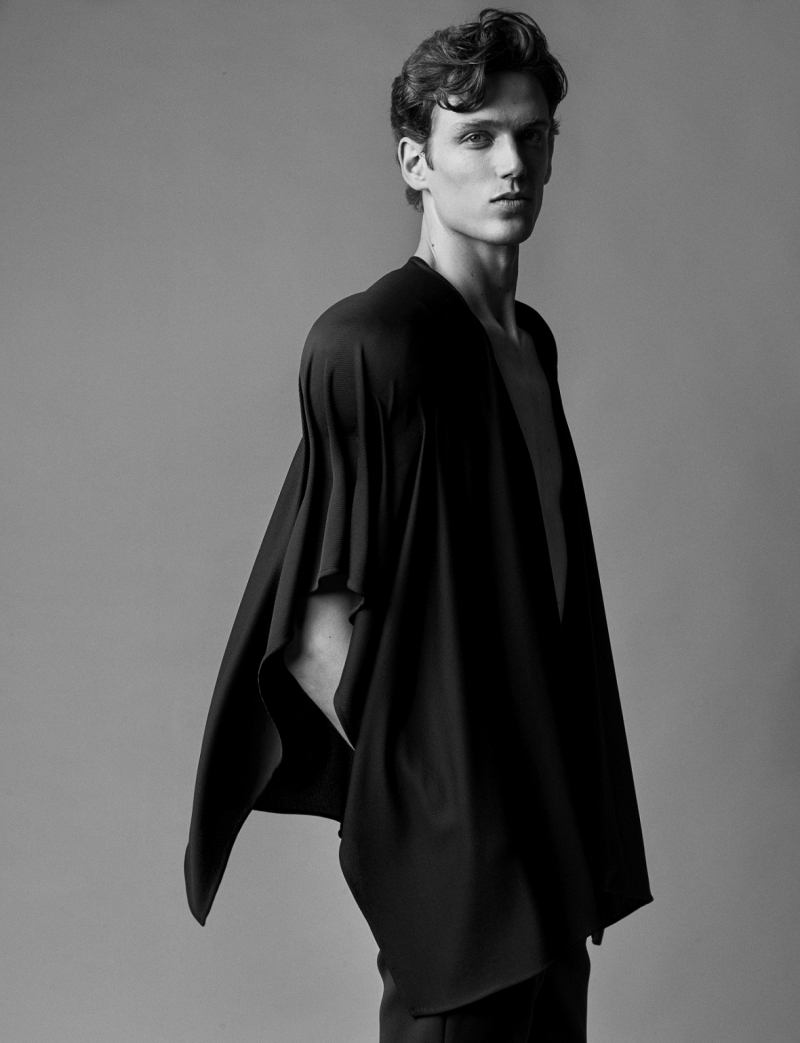
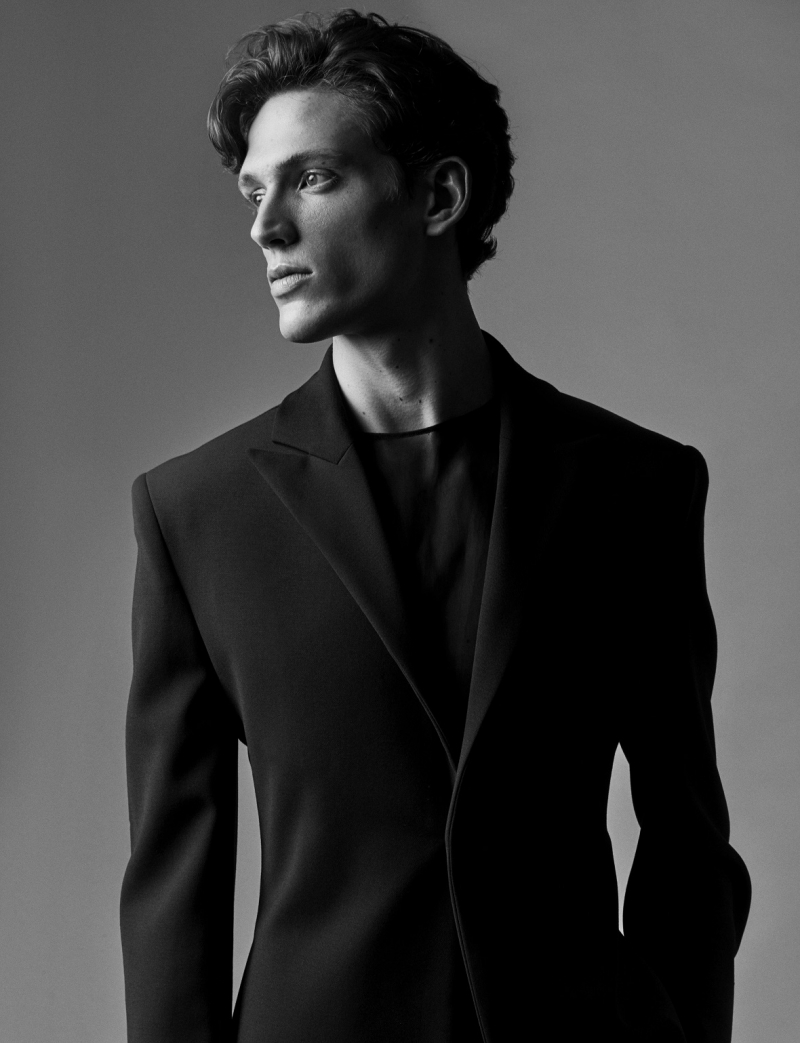
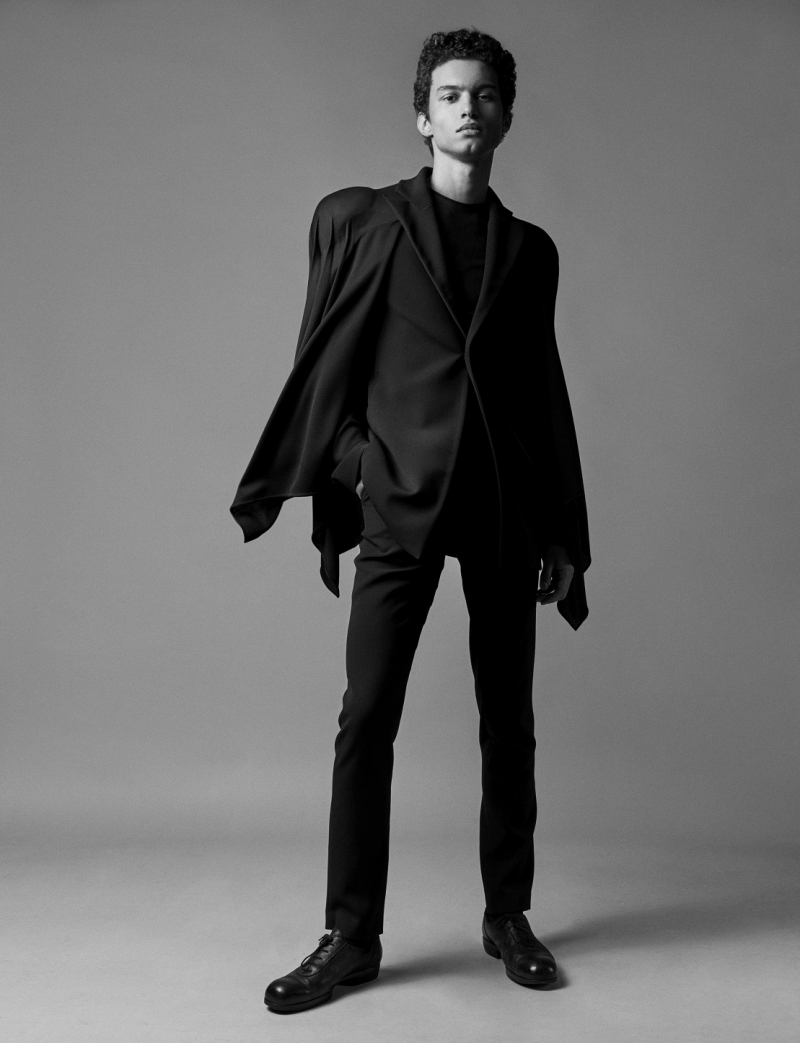
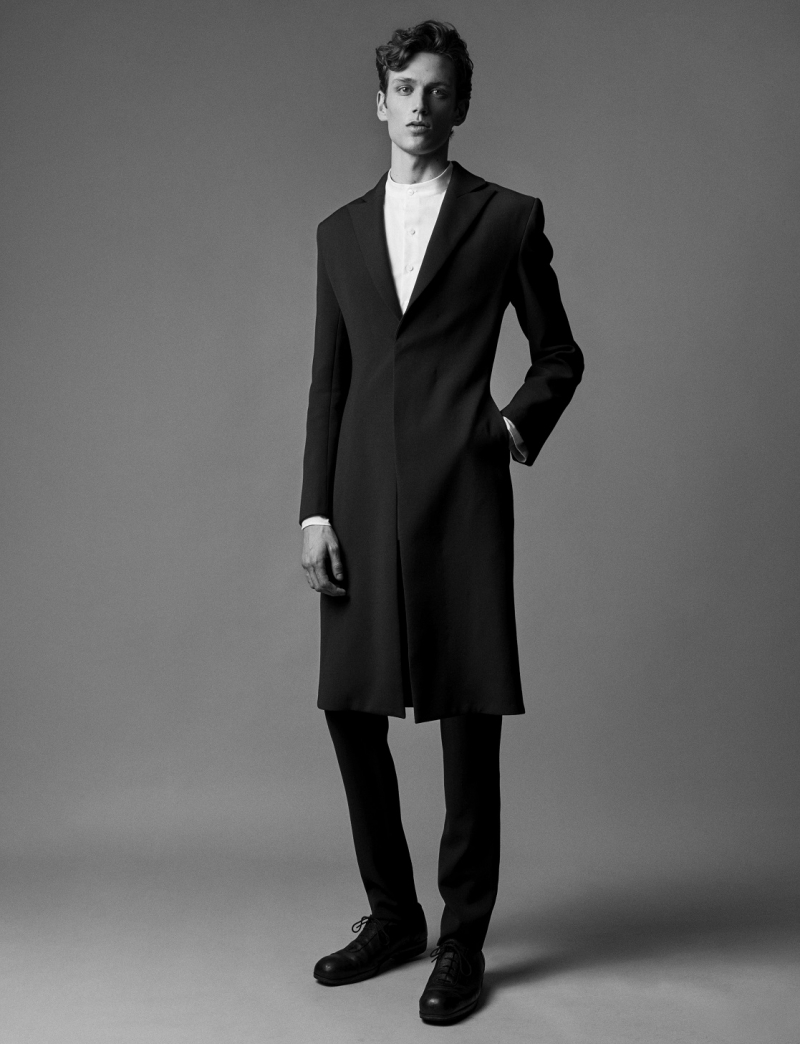
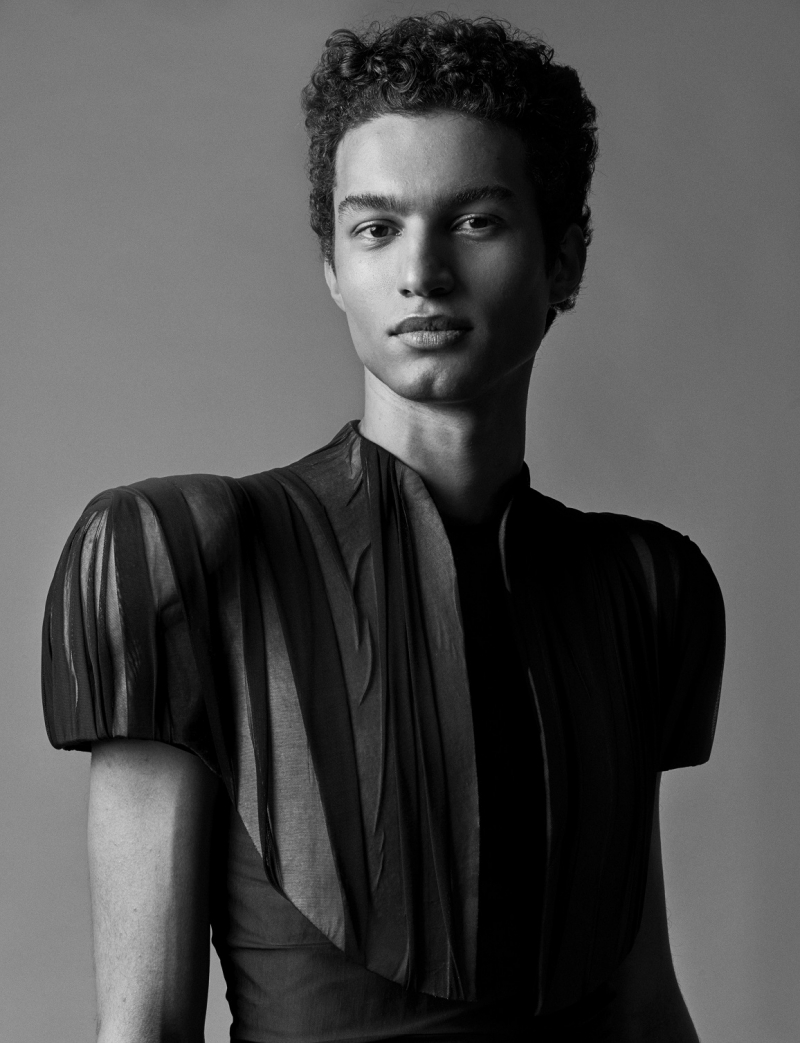
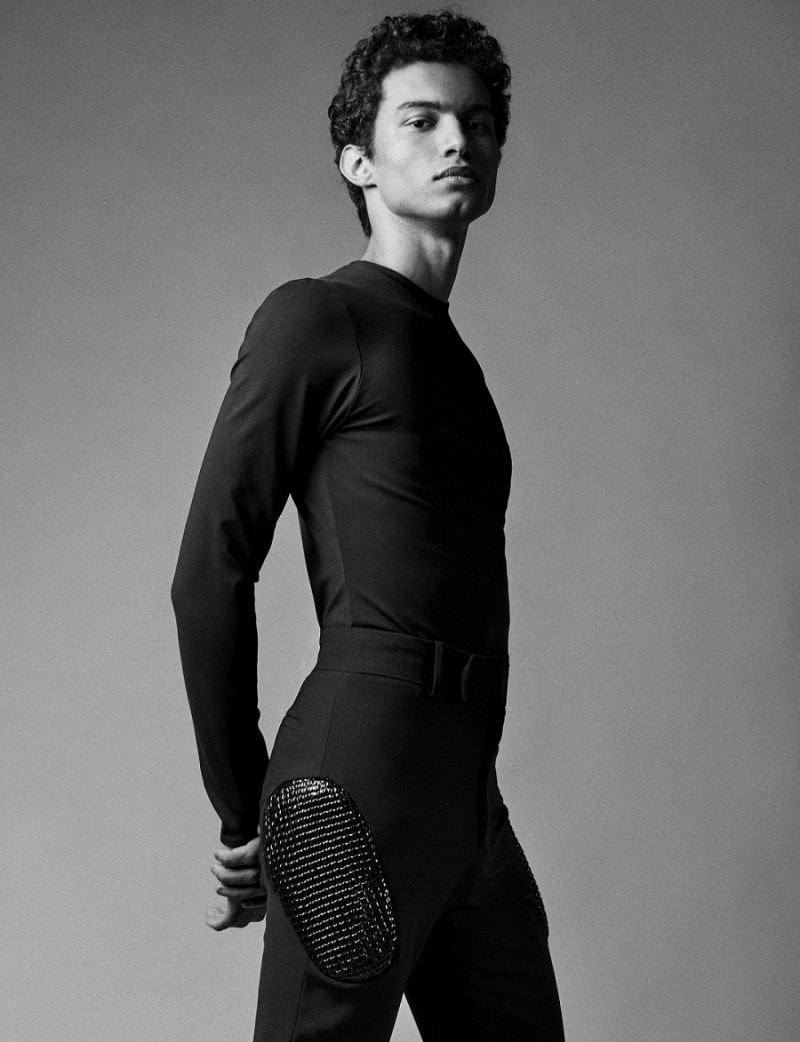
Kaushik Velendra, a London-based menswear designer, released an eye-opening fashion film at London Fashion Week. “Power dressing for men and tailoring for the future” is how Velendra describes his brand’s DNA as he works to reshape and redefine menswear. The film The Power of Fashion and Its Influence across our Self-Empowerment is a series of interviews looking at various artists’ opinions on fashion and gender. In the film, Velendra interviews artists such as Kelly Rutherford, Layton Williams, River Viiperi, Billy Langdon, Bobby Brazier, and Daniel Lismore. According to Velendra, the film and the collection were made “to capture the importance of dressing in the current situation and the purpose it plays supporting fashion designers and the creative community.”The collection itself reshapes some of the standard tailorings we have become to know. The sleeves are asymmetrical, loose-fitted with pleating, and have exaggerated shoulder padding. There is a charming juxtaposition of materials used in the garments, where lightweight fabrics are pleated and mixed with materials that hold more shape and structure.