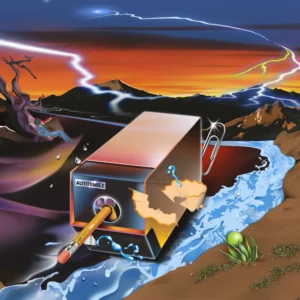
YHWH Nailgun have announced a new album that clocks in at – you read that right – 11 minutes. Marking the experimental band’s 4AD debut and the follow-up to last year’s 45 Pounds, it’s called Magazine, and it’s out June 11. There’s no single to accompany the news, but you can check out the LP’s cover art and tracklist below.
Magazine Cover Artwork:
Magazine Tracklist:
1. Ghost of Love
2. Stillness Blues
3. Innocent Sigh
4. Hips on a Wheel
5. Ballerina
6. Give Blood
7. Magazine
8. Sewer Tree
9. Burns
10. To The Devil
Every week, we update our Best New Songs playlist with several tracks that catch our attention, then round up the best songs of each month in this segment. Here, in alphabetical order, are the best songs of May 2026.
Ariana Grande, ‘hate that i made you love me’
Ariana Grande isn’t keen on flexing her vocals on ‘hate that i made you love me’. Her low-key delivery sounds like it’s actively reining in Max Martin and ILYA’s production – all those bubbly flourishes can barely distract from how mid-tempo it is. If she wants a hit out of it, Grande will have to make it look like she stumbled over it, keying in the “I I I” to access a secretly infectious chorus. ‘hate that i made you love me’ may be downcast, but it’s pointedly steeped in regret, at one point twisting its intimacy to hold a mirror up to her audience: “Is it really my fault you all gave me your hearts of your own accord?” she sings, making a case for the lead single to petal as her own ‘Anti-Hero’. Nothing about it is half-ironic or even rhetorical, though, as she answers bluntly, “I don’t really think so.”
Charli XCX, ‘SS26’
As a mission statement, ‘Rock Music’ was an interesting point of conversation that was bound to be divisive. But whether ‘SS26’ is genuine, satirical, or a bit of both has little to do with whether the second single from Music, Fashion, Film is actually enjoyable. Knowing the title of the album, ‘SS26’ scans more like a mission statement than its predecessor, dryly despairing over the artistic facade of any industry while having at least some fun walking the “runway to hell.” Though subdued, the instrumentation offers more layers of distortion to chew on, and the hook brings out the vulnerability in her filtered voice. If BRAT still clings to its relevance wherever you spend your summer this year, ‘SS26’ might be the tune stuck in your mind and really expressing how you feel.
Kim Petras, ‘Jeep’
Can the booming alt-country scene make some space for Kim Petras? ‘Jeep’ may be the best song the genre produces this year, charmed by the same simple pleasures that animated Kevin Morby’s Little Wide Open this past month – in Petras’ words, “the middle America shit.” In the music video, her boyfriend is played by Porches’ Aaron Maine, who is at least partly responsible for sending the song to the stratosphere as a producer. As the song’s cynicism gives way to fantasy, a puddle of synths reanimates a brain on amphetamines, Four Lokos, and Monster – the white one. Your friends are right: they’re bad for you. But sometimes, this strange mixture of nostlagia is better than the real thing.
Olivia Rodrigo, ‘the cure’
If ‘drop dead’, the first single from Olivia Rodrigo’s new album, was about the joyful rush of infatuation, ‘the cure’ might trick you into thinking it’s about heartbreak. Instead, it finds the pop star burrowing inward to unravel the insecurities that no amount of romantic affirmations can drown out. Strummed acoustic guitar and lush strings soundtrack her intrusive thoughts, lending credence to the title you seem pretty sad for a girl so in love. There’s no enemy or even a real object of jealousy here; Rodrigo is struggling against herself, and ‘the cure’ beautifully externalizes that battle.
Rostam, ‘Hardy’ [feat. Clairo]
There’s a part of ‘Hardy’ that feels like an outlier on Rostam’s new album American Stories, and there’s a part that seems to epitomize his sound. Maybe it has something to do with the song’s own ambivalent perspective, the way it oscillates – over a sweeping sample to the score to Truffaut’s 1973 film Day for Night, no less – between believing in fate and numbing out on oblivion, observing how it affects not just his own art but the ones around him. And so he reunites with Clairo, taking a break from the dizziness of the arrangement to let her spiritual affirmations seep through. But it’s these lines he sings himself that feel most potent: “Maybe the greatest art is never completed/ We only have to leave it knowing we tried.” The effort leaves the song feeling anything but hardened.
Wild Pink, ‘Round of Applause at the End of the World’
“I don’t know what my idea of fun is anymore,” John Ross sighs on ‘Round of Applause at the End of the World’, the lead single from his forthcoming Wild Pink album Still Coming Down. The personal confession cuts through a string of hyper-specific references that seem to amount to a grand conspiracy but only serve to underline the narrator’s disaffection. Yet Ross’ post-apocalyptic vision is buoyed by an accordion riff that should instantly make any crowd cheer, not to mention Xandy Chelmis’ always-inviting pedal steel. Some fun is being had, even as it appears distant and undefinable.
Currently, artificial intelligence, wearable devices, and spatial computing technologies are accelerating their implementation, driving a new transformation in human-computer interaction toward ubiquitous, and integrated experiences. Traditional interaction paradigms are gradually being disrupted, and digital technology is no longer confined to device interfaces; instead, it deeply penetrates human perception, everyday behavior, and life scenarios, reconstructing the way humans connect with intelligent devices.
Amidst this industry transformation, the core logic of design is also undergoing a fundamental shift. The industry is moving away from mere visual upgrades of interfaces, toward creating experiences that are more context-aware, and integrated into everyday life. How technology can better understand human behavior, support wellbeing, and integrate naturally into daily routines across devices and environments has become a central theme in contemporary digital experience design.
Yue Fan, a designer working at the intersection of merging technologies and human-centered experience design, exemplifies this transformation. exemplifies this trend.Currently working on digital health and wearable experiences at Samsung, she designs cross-device experiences that make complex information more intuitive for users worldwide. Her broader practice spans AI, spatial computing, and multimodal interaction. Her leading work, the URSA concept design project, has been recognized with prestigious international awards, including the Muse Design Award, the New York Product Design Award, and the Indigo Design Award, for its innovative design philosophy and practical value.
At the 2026 Indigo Design Awards, in addition to receiving a Gold Winner distinction, URSA was also selected as a finalist for “Digital Design of the Year” alongside internationally recognized projects such as the Samsung Galaxy S26 Ultra website and the Oura Ring app. The Digital Design category included 55 winning projects in total, but only five advanced to the final shortlist. Other finalists came from globally recognized design organizations including Cheil, The Barbarian Group, and Instrument, while URSA was the only finalist focused on future human-computer interaction.
URSA is not simply about interaction in futuristic space environments, but a far more immediate question: how intelligent systems should support people in high-pressure environments without constantly interrupting them.
Its hands-free interaction model, adaptive guidance system, and non-intrusive information design all address a larger challenge facing future intelligent systems: how technology can help people perform complex tasks more safely and efficiently in demanding environments.
These principles also extend beyond space exploration into fields such as healthcare, emergency response, industrial maintenance, and digital health, where users are often required to process large amounts of information under conditions of limited attention and mobility. In these contexts, reducing cognitive burden and minimizing unnecessary distractions are becoming increasingly important aspects of human-AI collaboration.
In Yue Fan’s view, the future of human-computer interaction will gradually shift away from simply operating interfaces toward understanding people — their cognition, behavior, and how attention shifts in real-world environments.
That perspective is deeply connected to her background.
Before entering the fields of user experience and emerging technologies, Yue Fan studied landscape architecture before later pursuing design at the University of California, Berkeley, where her work focused on human-computer interaction and emerging technologies. Rather than viewing interfaces purely as visual layouts and information structures, she became increasingly interested in how information exists within human environments, and how technology relates to human behavior, perception, and attention.
“Many digital systems are still designed around constantly competing for people’s attention, even though human attention is fundamentally limited,” Yue Fan explains. “Effective interaction is not simply about making systems more powerful. It’s about understanding what people actually need in different situations.”
That line of thinking eventually became the conceptual foundation for URSA.
In high-pressure environments such as space exploration, astronauts must simultaneously manage navigation, environmental hazards, procedural tasks, and team communication, even as human attention remains limited. Under these conditions, increasingly complex interfaces do not necessarily improve performance. In many cases, they become an additional source of cognitive strain.
URSA attempts to address this challenge by exploring how critical information can appear at the right moment while minimizing unnecessary interruptions.
Unlike traditional interfaces that continuously compete for user attention, URSA explores a more contextual interaction model in which systems dynamically adapt how information is presented based on user tasks and environmental conditions. Its spatial guidance system, multimodal interaction approach, and AI-driven contextual awareness are not isolated features, but part of a broader approach to interaction design focused on reducing unnecessary cognitive load while allowing users to remain engaged with the real environment around them.
From AI systems to wearable devices, technology is gradually shifting from being a tool people actively operate into something increasingly integrated into everyday life. Yue Fan’s design practice continues to revolve around a central question: how intelligent systems can provide meaningful support while still respecting human cognition, attention, and the rhythms of everyday life.
Plantar fascia pain often shows up as a sharp, first-step sting near the heel, then lingers as a deep ache with walking. Shoes will not fix tissue irritation alone, yet smart footwear can lower impact and steady the foot during long days. For 2026, the strongest picks share a secure rearfoot, true arch support, and cushioning that keeps its shape. The list below covers errands, runs, shift work, and indoor wear.
What Matters Most in 2026
Pain often flares after foam packs down, the rearfoot drifts, or arch support collapses under body weight. Any list of best shoes for plantar fasciitis should prioritize mechanics over appearance. Look for a firm heel cup, controlled midfoot stiffness, and forefoot room for natural toe spread. Removable liners also help fit orthotics without crowding.
1) Hoka Bondi 9
High-stack cushioning can soften ground reaction forces on concrete. A rockered sole encourages a smoother roll, limiting abrupt loading under the arch. Broad platform width improves balance during fatigue, which helps later in the day.
2) Brooks Adrenaline GTS 25
Stability elements can limit inward roll that strains the fascia. Guide-style support feels structured without harsh rigidity for many walkers. A firm rearfoot counter helps keep alignment steady during longer outings.
3) ASICS Gel-Kayano 31 (or newer current model)
Controlled motion support suits feet that drift inward under load. Gel cushioning reduces peak impact, while midfoot structure resists torsion. Secure heel shaping can help reduce tugging near the calcaneus during push-off.
4) ASICS Gel-Nimbus 26
A plush underfoot feel can ease tenderness during the early steps after rest. Smooth transitions reduce abrupt pressure changes across the arch. Neutral alignment works well for many people who need shock absorption without extra guidance.
5) New Balance Fresh Foam X 1080 (current version)
Soft foam helps when it stays consistent across weeks of wear. Fit options, including wider builds, can prevent toe gripping that alters gait. A stable rear section also supports a steady walking pace during errands. a steady
6) New Balance 990v6
A structured platform often feels better than overly compressible cushioning for persistent symptoms. This model tends to hold shape, reducing the “bottomed out” feel that can reignite soreness. Daily use fits well for people who want support without a running-only look.
7) Brooks Ghost 16
Balanced cushioning supports neutral mechanics without feeling unstable. Predictable flex can reduce compensatory limping that loads the opposite side. Many choose it for mixed days with light jogs plus plenty of walking.
8) Saucony Triumph (current version)
Cushioning stays protective for longer walks, yet the base remains steady. A supportive rearfoot fit limits side motion that can irritate tender tissue. Comfort tends to work well for people who prefer a softer ride.
9) Saucony Omni (current version)
Extra guidance can help with a pronounced inward roll during standing shifts. Underfoot support reduces strain across the arch during slow, repetitive steps. The heel area stays structured, which often feels better during first steps in the morning.
10) Kuru Quantum
Deep heel containment can reduce focal pressure at the sore spot by stabilizing the calcaneus. Arch support is pronounced, which may help limit excessive foot flattening. Everyday wear is a common use case, especially for routine walks.
11) OOFOS Ooahh (or similar recovery slide)
Hard floors at home can quietly trigger flares between outdoor outings. A recovery slide with real arch contour supports the foot during short household trips. Keeping a pair near the bed can reduce painful first-contact steps.
12) Birkenstock Arizona (or similar cork footbed sandal)
Firm cork contour supports the arch better than flat sandals for many feet. The footbed molds gradually while staying supportive rather than collapsing. Secure fit matters, since loose sandals encourage gripping and altered stride.
Quick Fit Checks Before Buying
A helpful pair twists minimally through the midfoot and bends mainly at the forefoot. Press the back counter; it should feel firm rather than pliable. Check toe room since cramped spacing changes push-off mechanics. Try shoes later in the day to account for swelling. Rotating two pairs can let midsoles rebound between wears.
Conclusion
Better shoes reduce stress on irritated tissue, yet long-term relief usually needs a wider plan. Calf flexibility, intrinsic foot strength, and gradual step volume changes can lower recurrence risk. Indoor support matters, since barefoot walking on hard surfaces loads the fascia repeatedly. If sharp pain persists beyond several weeks, or function drops, a clinician can check gait and rule out other diagnoses. With proper fit and steady habits, comfortable walking is realistic again.
Fenne Lily is back. The Brooklyn-based singer-songwriter will release her fourth album, Win Win, on October 23 via Nettwerk. Today’s announcement comes with the release of the tenderly affirming new song ‘Uh Huh’. Check it out below.
“It follows the end of one love and the start of another, when you meet someone new but the residual pain from the time before is holding you back,” Lily said in a statement about ‘Uh Huh’. “Every breakup has felt like it’ll hurt forever but it’s always led me to something different, often better, never nothing.”
“If I only have this one life it should take the shape I’m in,” Lily sings on track. “I was in a good place when I wrote ‘Uh Huh’ and writing this line particularly proved that to me,” she added. “I was shocked that I meant it, shocked at how much had changed. It needed to be solid, sound strong and sure of itself. From the start this one leaned more country than the songs I’d been writing, though. Like I’d absorbed some of the America I live in now. British country music…”
In the seamless world of filmmaking, the film editor acts as both a screen surgeon and a storyteller. While the role lacks the overt glamour of directing or acting, it is where a film’s emotional heartbeat is truly found. For Yuntong “Hazel” Dai, an accomplished editor with an MFA from the American Film Institute, cutting film is less about technical assembly and more about the psychological mapping of human behavior.
With an educational foundation from New York University and AFI, Dai’s approach has been shaped by mentorship under industry veterans like Anne Goursaud, ACE, a highly regarded editor who collaborated closely with Francis Ford Coppola. Today, her work spans international festivals like Riga and Moscow, defined by a singular ability: turning hyper-local, culturally specific stories into narratives that resonate universally.
Discovering the Language of the Edit
Dai realized editing was her calling when she saw it transcended technical software. Her career took a definitive turn when she was selected for the FIRST International Film Festival Talents Training Camp in Xining, China—an intensive 10-day incubator where emerging filmmakers produce short films under the mentorship of world-renowned directors like Lou Ye, a leading figure of China’s Sixth Generation of directors.
“I began to understand that editing was the place where my instincts were most useful—listening to people, reading behavior, and shaping emotional rhythm,” Dai says. “I wanted a career where I could listen closely to human behavior and shape stories with both precision and empathy. Editing gave me that language.”
Her camp project, Taste of Tea, went on to screen at the Moscow International Film Festival. The short paired acclaimed Chinese actor Jian Li with an elderly, non-professional Hui man, using a traditional tea ceremony as a narrative anchor.
“In the film, the tea tradition is not just a cultural symbol; it is a way of holding human relationships,” Dai explains. “The contrast between the actors helped preserve the rawness of Xining and the Hui community. My role was to let those two performance rhythms meet while balancing a documentary-like shooting style. The ceremony became a quiet language for things people cannot easily say.”
Finding History in the Unspoken
Dai’s post-production philosophy is rooted in a fascination with the unspoken. She treats film not merely as a record of events, but as a window into the psyche. “I am drawn to that space where history is not explained from above, but felt through memory, silence, misunderstanding, and desire,” she says.
This approach anchors her work on Hi, Marilyn. Set in Macau during the volatile pre-1999 transition period before its return to China, the film filters massive political shifts through the private reality of a young boy whose imagination is stirred by a rumor of a mysterious girlfriend.
“As the editor, my role was to make sure the historical setting never overwhelmed the boy’s emotional journey,” Dai says. “I wanted the audience to first feel his loneliness, fantasy, and desire to be seen. Social and political issues become meaningful in cinema when they are experienced through human behavior. The politics and geography are there, but they live through the character.”
Screenshot
Transcending Labels and Formats
Dai’s filmography moves fluidly across genres and constraints. In Song of Silence, a sci-fi drama set in a post-war future, a mother in a hidden village of women must choose between protecting her son or safeguarding her community. Performed by an all-deaf female cast, the film relied entirely on gesture, gaze, and spatial tension rather than spoken dialogue.
“The emotional question reaches beyond identity alone: what do we owe to the people we love, and what do we owe to the people who depend on us?” Dai notes. “I worked closely with the director to shape the film beyond its labels—not only as a feminist or deaf-led story, but as a deeply human dilemma.”
That ability to protect a director’s vision under intense pressure was tested on Drifting, South, which follows several marginalized lives intersecting in Guangzhou’s Xiaobei area. Shot on 16mm on a micro-budget, the project arrived in post-production facing major practical hurdles, including missing narrative footage and out-of-focus imagery.
Instead of viewing these as flaws, Dai used montage and rhythmic cutting to reconstruct the film’s “emotional logic,” preserving its gritty, authentic texture. The solution paid off: the film won Best International Short Film at the Riga International Film Festival.
“Winning at Riga was meaningful because it showed that a very local, independent Chinese film could resonate internationally,” Dai says. “For me, the work was about helping the film keep its raw texture while finding a structure strong enough for audiences outside its immediate context.”
With a portfolio that includes award-winning films like Between the Moon and the Son and Non-stop Station, alongside a commitment to shaping the next generation of filmmakers as a teaching assistant at AFI, Dai continues to prove that editing is far more than a post-production step. “I knew this was my path when I realized that editing was not simply technical,” she notes. “It is where psychology, rhythm, and structure meet.”
At Diane Von Furstenberg, Henry Zankov enters the building, literally. The brand’s new artistic director, who founded his namesake label in 2020, is now bringing his Crayola-colored patterns back to the DVF headquarters. Along, of course, with his own studio, which has just taken the grueling trip from Brooklyn to the Meatpacking District. It might be his studio’s first time inside the headquarters, but it certainly isn’t his. Zankov was appointed design director of knitwear around the mid 2010s, under the creative direction of Jonathan Saunders. Which must have been a good time, given he reunited with the brand just last September for an exclusive capsule collection (debuted at Bergdorf Goodman).
Zankov’s debut lands in September, during New York Fashion Week. You can thank CEO Graziano de Boni’s restructuring for all of this, who has been pulling control back in-house and re-centering the identity of a brand that had drifted between versions of itself. “Henry brings fresh energy, a strong point of view, and cultural relevance for a new generation to discover DVF,” he noted in a statement. 80-year-old Von Furstenberg, takes comfort in Zankov’s earlier stint at the brand too. “He and I, we come from the same tribe,” she told Vogue, connecting to Chișinău, once in the Kingdom of Romania, now the capital of Moldova.
Von Furstenberg will always be tied to that 1974 wrap dress (which you’ve also probably seen in the 2024 documentary Diane von Furstenberg: Woman in Charge), jersey dresses, bold prints, and strong, feminine, easy silhouettes. Zankov, on the other hand, would love “ someone to come in and buy a cotton T-shirt, or a trench coat.” He shares his ideas with Vogue: “The thing about DVF is that the pieces all have to be made and designed in a way where they feel really effortless. The garments have to feel substantial, but also light. [..] I don’t think about this brand as necessarily just a fashion brand, I think it’s a brand about women. I mean, they come first. The person comes first.” September might as well be colorful.
Diesel just turned its longstanding manifesto of For Successful Living into For Successful Loving, and you can blame Tinder for that. Both brands like to operate in worlds built around visibility, attraction and the strange performance of modern desire, where intimacy exists somewhere between genuine connection and genuine leather. Landing just in time for Pride 2026, the collaboration packages the ever-evolving concept of love, dating app vulnerability, and devoré denim into something you can emotionally relate to and, ideally, purchase immediately after.
Courtesy of Diesel
Filmed in a lo-fi VHS style, the campaign follows drag star and fashion darling Gigi Goode, who sits down with queer individuals and couples for open conversations. “Working with Tinder on ‘For Successful Loving’ felt like tapping into the same mindset. It’s not about idealizing love, but defending it and giving it a voice, one that creates space for all its forms, and above all, for something real,” Glenn Martens, Creative Director of Diesel, said in a statement.
Courtesy of Diesel
As the emotional confessions and off-the-cuff talks go on, the 17-piece capsule sits at the center. Spanning men’s, women’s and unisex ready-to-wear, the collection moves between ribbed jersey T-shirts, tanks, polo dresses, burnout devoré, trompe l’oeil lace, and of course, a whole lot of denim. Separate from the fashion release sits a $200,000 joint donation from the two brands to Outright International, which will be directed toward employment and entrepreneurship programs for LGBTQIA+ communities in Colombia, South Africa, Ukraine and the Philippines under Outright’s International Inclusive Solutions initiative. Love, still unfolding.
There’s a particular kind of person who plans their calendar around exhibition openings, knows the next three films they want to see before finishing the one they’re currently watching, and has strong opinions about which era of a band’s discography is most underappreciated. You probably recognise the type. You might be the type.
But even the most culturally voracious person runs into Tuesday evenings. The exhibition you want to see doesn’t open until Friday. The gig sold out before you got to it. The film you’re anticipating isn’t released for another three weeks. What then?
It’s a question worth taking seriously, because how creative people spend their unstructured time says something interesting about what entertainment actually is, and why we reach for it.
The Myth of the Permanently Cultured Evening
There’s a romanticised image of the culture enthusiast whose every free hour is spent in enlightened engagement. Rereading Borges, attending an arthouse screening, discovering new music on a dedicated listening session. This person exists, probably, somewhere, a small percentage of the time.
The rest of the time, even the most dedicated culture lovers are watching something slightly trashy on a streaming platform, doomscrolling through social media, or playing some game on their phone that they’d be mildly embarrassed to mention at a dinner party.
This isn’t a failure. It’s human. The need for stimulation doesn’t always align with the availability of high culture. And there’s a real argument that the mental mode required for genuine cultural engagement, the focused, attentive, interpretive state required to really watch a film or absorb an album, actually needs to be rested before it can be engaged.
What People Actually Reach For
Speak to film enthusiasts, music obsessives, or regular gallery visitors and a few leisure patterns emerge outside their primary cultural interests.
Podcasts fill a lot of gaps. They’re low-commitment, absorb well during other activities, and for culture lovers, the available library is vast. Long-form interviews with directors, deep dives into specific albums, conversations between writers. It scratches the intellectual itch without requiring full attention.
Board games and puzzle-based entertainment have seen a genuine renaissance among this demographic. The success of games like Codenames, Wingspan, and the enduring appeal of crosswords and cryptic puzzles isn’t accidental. People who engage seriously with narrative and meaning in culture tend to enjoy systems with internal logic and satisfying resolution.
Then there’s online leisure, in its various forms. This is where things get interesting. The assumption that cultural engagement and digital entertainment are opposed doesn’t really hold up. Many of the people most enthusiastic about experimental cinema or contemporary art are equally willing to spend a casual evening on a gaming platform, a casual online quiz, or even an online casino. The appeal of non GamStop casino bonus offers for a low-stakes leisure session is precisely that they don’t demand anything from you aesthetically or intellectually. After a week of serious cultural consumption, there’s genuine pleasure in something that’s purely about the moment.
The Cognitive Value of “Unserious” Entertainment
This is worth examining further. There’s a tendency in culturally engaged circles to rank leisure activities, to treat a film by a celebrated director as more valuable than an evening of online gaming. But this hierarchy doesn’t survive scrutiny.
Cognitive rest is real. The brain regions activated during deep cultural engagement need recovery time. Entertainment that asks little of you, that doesn’t require interpretation or sustained attention, serves a restorative function that high culture actively cannot. The thriller you read purely for plot. The silly reality show. The casual game. These aren’t indulgences that distract from more worthy pursuits. They’re what makes the more worthy pursuits possible.
Research into creative productivity consistently finds that people who allow themselves genuine mental rest, not just physical stillness while mentally continuing to process, produce better work. For writers, musicians, directors, and artists, this isn’t a trivial point.
Serendipity and the Unexpected Leisure Choice
Some of the most interesting things in culture came from unexpected encounters. A song on a radio station you don’t usually listen to. A film you watched on a whim because it was the only one starting at the right time. A book picked up in a charity shop with no prior knowledge of the author.
There’s something to be said for leisure choices that don’t fit your established taste profile, that fall outside the curated algorithm that’s learned your preferences and serves them back at you. Trying something genuinely different, even something you’d consider beneath your usual standard, sometimes produces unexpected delight. And even when it doesn’t, it sharpens your sense of what you actually value and why.
The Tuesday Evening Problem, Solved
So what do culture lovers do when the curtain comes down and there’s nothing specific on the cultural calendar? Mostly, they do whatever they feel like, and they’ve stopped feeling guilty about it.
The most culturally engaged people tend to hold their leisure choices lightly. They’ve made peace with the fact that genuine enthusiasm for art, film, music, and literature coexists comfortably with occasional evenings of completely undemanding entertainment. The two aren’t in competition. They’re part of the same life.
And honestly, the culture that most resonates with us as audiences is usually the work made by people who understand this. The filmmakers, musicians and writers who create the most compelling things are often the same ones who’ll happily admit they spent last Tuesday watching something terrible and enjoying every minute of it.
Whether you’re drawn to literary fiction, dark sports comedy or psychological thrillers, May’s book cover round-up has got something in store for you. Here are six designs that I found particularly outstanding.
Offseason by Avigayl Sharp Cover design by Chloe Scheffe (Astra House, 5 May)
I’m suddenly aching to know how a ladybird, cigarette and glistening pearl might inhabit the same narrative. Unconventional, earthy-toned and curiosity-inducing.
A gothic psychological thriller, indeed. The font and fly illustration work wonderfully together, but the subject’s vacant stare is what will have me reaching for this in a bookshop.
Dad Had a Bad Day by Ashton Politanoff Design by Rodrigo Corral (Astra House, 19 May)
Dad Had a Bad Day is described as ‘darkly funny’, and it’s fair to say the cover image does this justice. I adore the drooping tennis racket.
Inheritance by Jane Park Design by Elisha Zapeda (21 May 2026)
With its intricate (Chekhov’s?) knife set against the prairies and its echoes of Wyeth’s Christina’s World, the cover of Inheritance raises all the right questions.
The cover of the intellectually charged campus novel is haunting, not least thanks to the delicate strings ominously connecting various letters. I can practically hear the violins playing in the background.
Pixie by Jill Dawson Design by Carmen R. Balit (Bloomsbury Publishing, 26 May)
With 30% of Americans now consulting tarot regularly, Pixie’s cover is a smart move as well as an aesthetically alluring one. Bound to sit perfectly next to my Rider-Waite-Smith deck.