Berlin is welcoming early autumn with plenty to explore across visual art and sound. Here are four exhibitions worth your time this September:
Hallen 07 at Wilhelm Hallen (5–13 September 2026)
If you’d like to experience the scale of Berlin’s contemporary art scene in one place, head to the vast former industrial complex of Wilhelm Hallen. Returning during Berlin Art Week, group exhibition Hallen 07 brings galleries and private collections together across the historic site, with contemporary works showcased in its cavernous halls and interconnected spaces.
Maurizio Cattelan: NIGHTat Neue Nationalgalerie (10 September 2026 – 7 March 2027)
As part of Berlin Art Week, Maurizio Cattelan is welcomed to the Neue Nationalgalerie for his first major solo exhibition in Germany, following his selection for the 2026 Preis der Nationalgalerie. NIGHT brings together earlier works and new commissions within Mies van der Rohe’s glass-walled building, offering a particular focus on a site-specific work conceived for the Neue Nationalgalerie.
Ryuichi Sakamoto: seeing sound, hearing timeat Hamburger Bahnhof (11 September 2026 – 20 June 2027)
Recognised widely as a pioneering composer, Ryuichi Sakamoto spent decades exploring the possibilities of sound as a visual and spatial experience. The composer’s first major retrospective in Europe focuses on this side of his practice, filling Hamburger Bahnhof with immersive sound environments and installations, including collaborations with artists and filmmakers such as Shiro Takatani and Apichatpong Weerasethakul.
Arash Nassiri: A Bug’s Lifeat Fluentum (10 September – 12 December 2026)
Marking his first institutional solo exhibition in Germany, Berlin-based artist Arash Nassiri presents A Bug’s Life at Fluentum. Working mainly with moving image, Nassiri plays with the ways architecture and urban environments can be transformed through cinema, fascinated by the way architecture is able to carry memory.
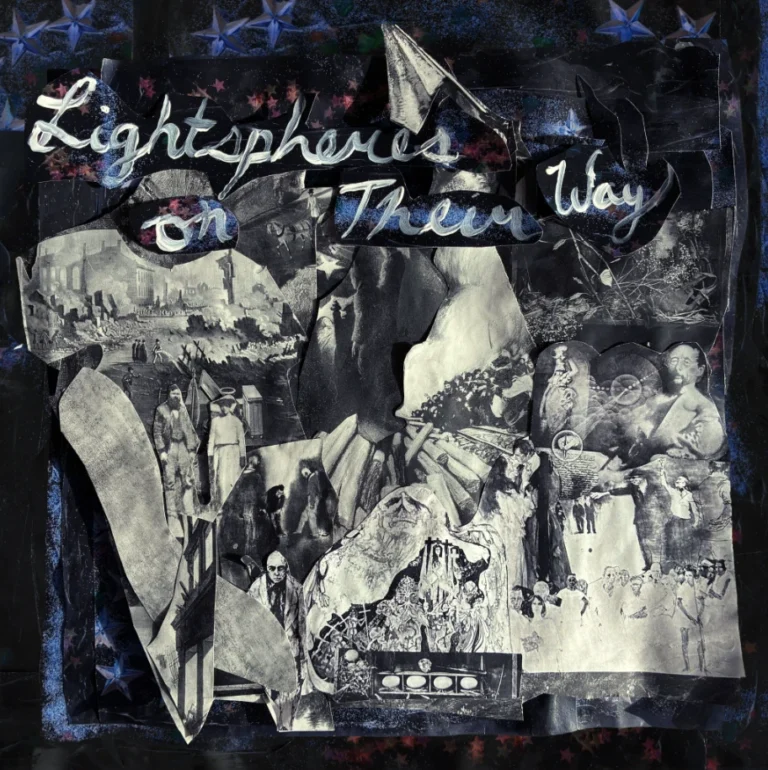
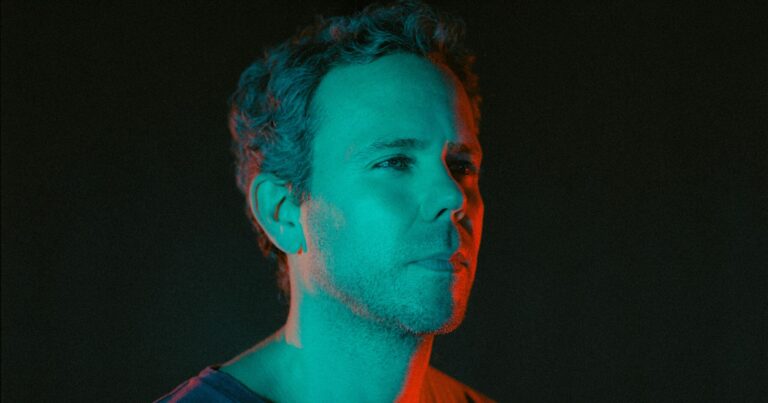
Lily Seabird zooms all the way out on Lightspheres on Their Way. Though revolving around many of the same themes, it stands in almost striking contrast to the rough-hewn intimacy of last year’s Trash Mountain, transposing its emotional volatility to a tangibly spiritual realm. The Vermont singer-songwriter is thinking less about a period of time, or a place in time, than the very nature of it: “Time’s a vortex coming in all directions/ Where I could live in memories for days,” she sings on the fittingly sprawling ‘Portal to the Past’, memory being the engine her music runs on to move through trauma; “Time it’s just like an arrow, and when the winds of change come it’s just like a sparrow,” goes the Adrianne Lenker-indebted ‘Slipswitch’; “Time’s an interval strange and contradictory, how we keep it’s never made too much sense to me,” she admits on ‘Bindlestiff’. To title her most illuminating and dynamic record to date, she invents a word that encompasses it and every other catalyzing force in our lives. Her performances retain an awe-inspiring physicality even as her lyrics flirt with the metaphysical; by the end, you feel like she’s homing in on a universe all her own.
1. The Pulley
While inspired by Leonard Cohen’s Beautiful Losers, the opening track seems to also be in direct conversation with George Herbert’s metaphysical poem ‘The Pulley’, which describes the creation story as a kind of divine generosity towards man: “‘Let us,’ said he, ‘pour on him all we can./ Let the world’s riches, which dispersèd lie,/ Contract into a span.’” Over nothing more than a couple of guitars and gentle harmonium, Seabird brings personal grief into this religious context, wondering, “Am I still allowed to pray even if I don’t believe anymore/ To beg in your morning, to drink from the cup that you pour?” Full of questions that naturally flow into each other, the song is indeed more prayerful than simply contemplative, her voice unusually high as if she’s testing the very limits of its materiality. Life’s richness and restlessness both seem to flow from the same cup, it seems to suggest – and then what?
2. Bindlestiff
“Restless men they search the earth for something that never stays,” Seabird sings, going on to describe them as a kind of endangered species. Then her target becomes singular, not just an allusion to the archetypical wandering man in Steinbeck’s East of Eden but a direct address to the one who’ll someday announce he’s coming home, only to never show. Speeding through ten verses, she hardly catches her breath, but Rick Soszynski’s mournful pedal steel diffuses her tumble of words into pure feeling.
3. Election Day
If the record finds its groove on the second track, you could simply say it builds in intensity with ‘Election Day’, its riotous lead single. But the track takes an almost antithetical approach: Seabird must take a sharp inhale as she stretches out the final syllable of each verse to convey her full emotional force, while Soszynski’s contribution isn’t subtle but torrential guitar, pummeling alongside Daniel Snyder’s drums like waves crashing against rocks.
4. Pennsy
On ‘Pennsy’, Seabird tries to find the language for stories etched in our minds but hardly ever brought up, not in conversation and certainly not in any kind of popular medium. The best way she can imagine this story – ambiguous in detail, but detailed still – is as a film with no heroes or villains, “just a shitty world.” She instructs: “Hold the camera to my eye, make a movie of the madness of the big beautiful lie.” Eliza Niemi’s cello, then, takes on an almost filmic quality, turning up the saturation in what Seabird describes as “watercolor dreams.” It makes for a slightly surreal yet searingly honest journey.
5. Portal to the Past
The bittersweet cello remains Seabird’s companion as her dreamlike introspection simmers down to the dull loneliness of heartbreak. There’s a sense of grandeur in the arrangement, which scans almost like Seabird’s take on a power ballad, but her lyrics are at times achingly plain, ending with an unequivocal declaration: “Know I loved you more than anything and I’d never take that back.” More than halfway through the record, we’ve heard her hit those high notes a dozen times over, but this might be her most spine-tingling performance.
6. Blackstar
Written on a paper napkin in the back of a tour van, ‘Blackstar’ chronicles life on the road, searching for truth in the adage that there’s beauty in everything. But where there’s “fifteen water bottles,” she’s “looking for a smoke/ Ending my life all for the joke.” In the context of a record that begins with ‘The Pulley’, but also a discography marked by the death of a close friend by suicide, it’s a piercing line. In contrast to the previous track, though, Seabird’s singing is tenderly measured, the music lumbering in the moonlight, more Daughter than Crazy Horse.
7. Slipswitch
The album’s invented word may get all the attention, but the most potent one might be that which gives ‘Slipswitch’ its title, inviting the metaphor that makes it stand apart from any other breakup ballad. Struck by burnout, Seabird slows and strips things down again, this time choosing Wurlitzer over harmonium. But the snarl in her voice has dissipated, even as they tell her, “We’re gonna get up on that stage and play some rock’n’roll tonight.” She’s not in the mood for any of that, not here, where the fiery end of a relationship has given way to lonesome serenity. And the sky will open up again for the band to play, and the road will go on forever, even as it builds a portal to the past.
8. The Afterglow
Leaning on a swirlier twanginess, ‘The Afterglow’ is the most easygoing track on Lightspheres as Seabird’s slightly melancholic vocals is blanketed by the return of Niemi’s cello, and even some trumpet courtesy of Sam Atallah. It ends by quietly affirming that inspiration will continue to strike, even if it’s only a reshuffling of old ideas around the same, unshakable feelings; the same skies, the same ghosts. “They came running,” she sings, “They said, ‘We have one more song.’”
9. Lightspheres on Their Way
So Seabird brings back the combination of guitar, vocals, and harmonium from the first track, and as that last instrument drones on and she imagines the wake of her mother’s passing, I can’t help but align Lightspheres on Their Way with the cosmic grief – and strange optimism – of Phoebe Bridgers’ Lost Weekend. Given how viscerally has written about real death – or, more precisely, deaths that belong to the past – it’s no wonder her writing is as vivid as ever here. What’s more surprising is how the band erupts out of nowhere, making good on Seabird’s promise to blow it all into the stratosphere.
A Chinese romantic drama is winning over international audiences. The Early Spring, available on Netflix, explores attraction and ambition, tracking a complicated relationship with plenty of spark.
The show premiered in late August and is currently among the most-watched titles on the streaming platform. With 2.4 million views this week, it’s also #1 in four countries. Could another installment be on the way? Here’s what we know so far.
The Early Spring Season 2 Release Date
At the time of writing, there’s no news available about a potential The Early Spring season 2.
That said, the story seems to be designed as a complete romance based on a web novel by Gu Niang Bie Ku. Depending on how the show wraps up, a follow-up might not be in the cards.
The Early Spring Cast
Jing Boran as Luan Nian / Luke
Sun Qian as Shang Zhitao / Flora
Liu Xiaobei as Sun Yuanchu
Qi Tianqing as Sun Yu
Zhang Yezi as Lu Mi
Ning Xin as Kitty
What Is The Early Spring About?
The Early Spring is the ideal watch for viewers who enjoy slow-burn romances and workplace dramas. It follows Flora, a young woman who moves to Beijing to build a career. She lands a job at a prestigious advertising agency where she clashes with Luke, a demanding creative director.
As the two spend more time together, attraction blooms, but a relationship could endanger their professional future.
“I wanted to create something different from a conventional romance drama, from its visual style and character dynamics to its portrayal of intimacy, and explore love from a more mature perspective,” director Chiang Chi-cheng said.
One of the best things about the series is that the main couple have great chemistry. If you’re looking for a show that will sweep you off your feet, this might just fit the bill.
While The Early Spring season 2 is unlikely, more episodes will arrive on Netflix over the next few days. Fingers crossed that these two will work it out by the time the final end credits roll.
Are There Other Shows Like The Early Spring?
If you enjoy The Early Spring, check out some of the other romance series streaming on Netflix.
M83 have shared the details of their tenth studio album, I Wrote You a Letter, along with its first single, ‘Blister Sunrise’. The follow-up to 2023’s Fantasy is set to arrive on September 25 via Other Suns. Check out the expansive, otherworldly new track below.
“This record reflects my state of mind over the past few years,” Anthony Gonzalez explained in a statement. “I’m deeply disillusioned by the world we’re living in. I wanted something less calculated, more spontaneous. More punk, in a way.” The album also marks the return of Benoît de Villeneuve, whose history with the project dates back to 2003’s Dead Cities, Red Seas & Lost Ghosts.
In this segment, we showcase the most notable albums out each week. Here are the albums out on September 4, 2026.
Lily Seabird, Lightspheres on Their Way
Lily Seabird has returned with a new album called Lightspheres on Their Way. The follow-up to 2025’s Trash Mountain was previewed by ‘Election Day’ and the title track. “A lightsphere can be so many things,” Seabird explained in press materials. “An actual light like a star, the sun, a UFO; headlights, a flashlight in the night; but also life, living things, people, relationships.” She tracked and co-produced the record with collaborator Garrett Linck at his home in rural Maine over the first few days of 2026. “Sometimes life gets so dark, it starts to feel like a bad trip,” she remarked of the seasons that led to its creation.
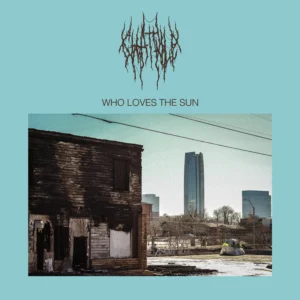
Chat Pile are back with another visceral, uncompromising album, Who Loves the Sun, one that also softens some of the band’s rougher edges. “This record focuses on my grievances with the modern world,” vocalist Ray B explained. “AI, genocide, climate change, the power elite, $$$$ hoarding pigs – all that shit fucks up your life and mine. The band is definitely stretching out their abilities on the album and I too felt inspired to go further- as a huge fan of Boston, I like to think Brad Delp is somewhere up there, smiling down, as I take the layering to new heights, but who can say? We have fun with it.” Bassist Stin added: “This album contains a healthy dose of the usual Chat Pile airing of grievances against the state of the world, but deeper at it’s heart I feel Who Loves the Sun is grappling with the challenges of trying to keep one’s humanity in a time of extreme anti-humanity.”
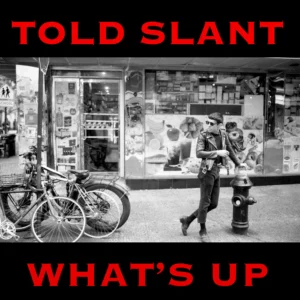
What’s Up is Felix Walworth’s first Told Slant album in six years. Out now via Mtn. Laurel Recording Co., the album was recorded with with Hannah Pruzinsky and Jonnie Baker, their bandmates in the groups Sister. and Florist, respectively. Ceci Sturman, Hellen Ballentine, Emily Sprague, Mari Rubio, and Elijah Wolf also contributed to the LP, which follows 2020’s Point the Flashlight and Walk. Billed as their “New York record,” it’s a delicately sprawling collection about what happens when you invest “somewhat maniacally to the project of self expression and subculture in one of the most hostile environments on earth,” according to Walworth.
Following a series of EPs, Hannah Cole has come through with her mesmerizing debut LP, Switchbacks. The Nashville-based artist and her longtime collaborator and partner Josef Kuhn laid down the album in their home studio between 2024 and 2025, performing nearly every instrument themselves, with Sonny Diperri handling the mixing. On highlight ‘Mosquito Hawk’, Cole recalls a trip the pair once took to Asheville to record in a cabin. “It was just so sweet and pure,” she reflected. “We were falling in love, and I was falling in love with music again. I came to realize that in the same way a romantic relationship changes and develops challenges over time, so does my relationship to music. Neither is perfect, but love is at the core. That’s the point of the whole thing.”
Arab Strap’s new album may be called Half-Told Tales, but it’s full of detailed, ambitious storytelling. “This time we put everything on it,” the band’s Aidan Moffat remarked in press materials. “We normally have three or four songs left over from a session but with this one, it was like, fuck it.” Groovy and often surprising, it marks their third effort since reforming in 2016. “The album title sounds like a fairy tale book, until you get to the end of the record and you realise that I’m talking about lives that have ended too early,” Moffat added. “That’s something that just seems to be part of your life when you get to your fifties. You become acutely aware that you’re in that final third of your life. I think every single song has some element of time or some discussion of its passing and how to use it as best you can while you have it.”
Ellie Goulding, I Know Too Much; Rebecca Black, Age of the Exhibitionist; Diary, Spiral Bound; Carmen Villain, Memoria; Hollow Hand, Wish Road South; Sofie Royer, before/after; Sibille Attar, Sibille Attar; Medium Build, King of Having Fun; Sleep, Hemispheres; Mykki Blanco, Little Feet; Noah Hill, Ok ok now; Personal Trainer, Human Assholes; Klara Lewis, Opening; Gilroy Mere, Furlongs; Black Bananas, Bad Bunch; Behemoth, I, Scvlptor; Lille & rsn, The diversity of nature.
The latest addition to Netflix’s collection of buzzy true-crime content immediately stands out. Death of the Pastor’s Wife goes beyond the mystery surrounding Mica Miller’s death to examine the disturbing dynamics of her marriage.
That approach proves effective. With 19 million views this week, the docuseries is the most-watched show on Netflix globally and the #1 show in 16 countries. Could this mean that a follow-up is on the way? Here’s what we know so far.
Death of the Pastor’s Wife Season 2 Release Date
At the time of writing, there’s no news on a potential Death of the Pastor’s Wife season 2.
Since they’re based on true events, docuseries tend to be a one-and-done affair. That said, Mica Miller’s loved ones are still looking for answers. If new information comes to light, a sequel isn’t out of the question.
Death of the Pastor’s Wife Cast
Mica Miller
John Paul Miller
Charlotte Korn
Bruna Pabon
Sierra Francis
Pam Muise
Abigail Francis
Anna Francis
Nate Francis
What Is Death of the Pastor’s Wife About?
The three-part docuseries looks into the life and death of Mica Miller. She was a charismatic worship leader, but her seemingly idyllic exterior concealed a troubled marriage.
Mica met John-Paul “JP” Miller, a pastor, when she was 13. Years later, the two began an affair and eventually married. According to Mica’s loved ones, what began as a relationship wrapped in faith gradually became a marriage marked by coercive control.
The series follows Mica’s attempts to escape the relationship while also examining the power dynamics between the pastor and his wife. The final episode turns to Mica’s death in April 2024 and the many questions that came up after authorities ruled it a suicide.
“The broad thing that JP was doing was trying to strip away her freedom, her independence, her self-esteem. Not through one single event, but through years and years of continuous micro-events that trapped her in a state of dependence on him,” executive producer Alana Goldstein told Tudum.
While Death of the Pastor’s Wife season 2 is unlikely to happen anytime soon, the episodes available offer a compelling look at Mica’s life and marriage. They make for an infuriating watch.
Are There Other Shows Like Death of the Pastor’s Wife?
If you found Death of the Pastor’s Wife gripping, check out some of the other true crime content streaming on Netflix.
Miley has dropped ‘Bass Persuades’, the title track and lead single from her recently announced album. The post-punk-inflected dance track comes paired with a Mert Alas-directed video. Check it out below.
Bass Persuades, the follow-up to 2025’s Something Beautiful, is due September 18. On Instagram, Miley wrote: “Music takes hold of us. We feel it, sing it, sometimes dance to it, let it out and carry on. It is powerful, vulnerable, sweet and strong. Heart full, heartache, every part of life in between.”
The Three Little Pigs. Peter Pan. The Ugly Duckling.Popular bedtime stories are part of many kids’ lives. And they don’t just put a smile on their faces. A parenting resource explains thatreading and storytelling support children’s cognitive development. The only problem? Stories end. And you can’t always have the time or imagination to invent a new adventure every night. Plus, the challenge of improvising when a kid asks, “Can I be in the story?” on the fly. But as luck would have it, AI tools for children’s stories can help you pull these off.
Looking closer, theseAI tools turn a photo, a name, and a vague idea into a real (even illustrated) story in minutes. And to save you from poor picks, this guide lists the best choices that deliver a story that flows, illustrations that stay consistent, and a finished product that’s worth reading to children.
Top Five Best AI Tools for Children’s Stories
Lullaby
Image Credit: Lullaby.ink
Lullaby is built around personalized stories featuring children as the main characters. And no, it doesn’t just use book templates and swap in names. The most popular offering is photo uploads, which allow personalization of characters and locations. A child can be the hero of the story. If photos are not available, descriptions do the job well, too. Users can also generate a new story from an idea or paste one they already have. In short, Lullaby delivers an original story, with character designs, page illustrations, and text.
Key Features:
Supports multiple characters and custom locations
Character outfits that match every moment and overall story
Photo-to-cartoon characters with seven art styles
Pricing:
Free Preview
Digital Book Package – $14.99 per story
Printed Book Package – $29.99 per story
Real Use Case:
Lullaby excels in multi-character family stories. As such, parents preparing a birthday surprise can create an adventure starring their child, their pet, and the family home.
LoveToRead
Image Credit: LoveToRead
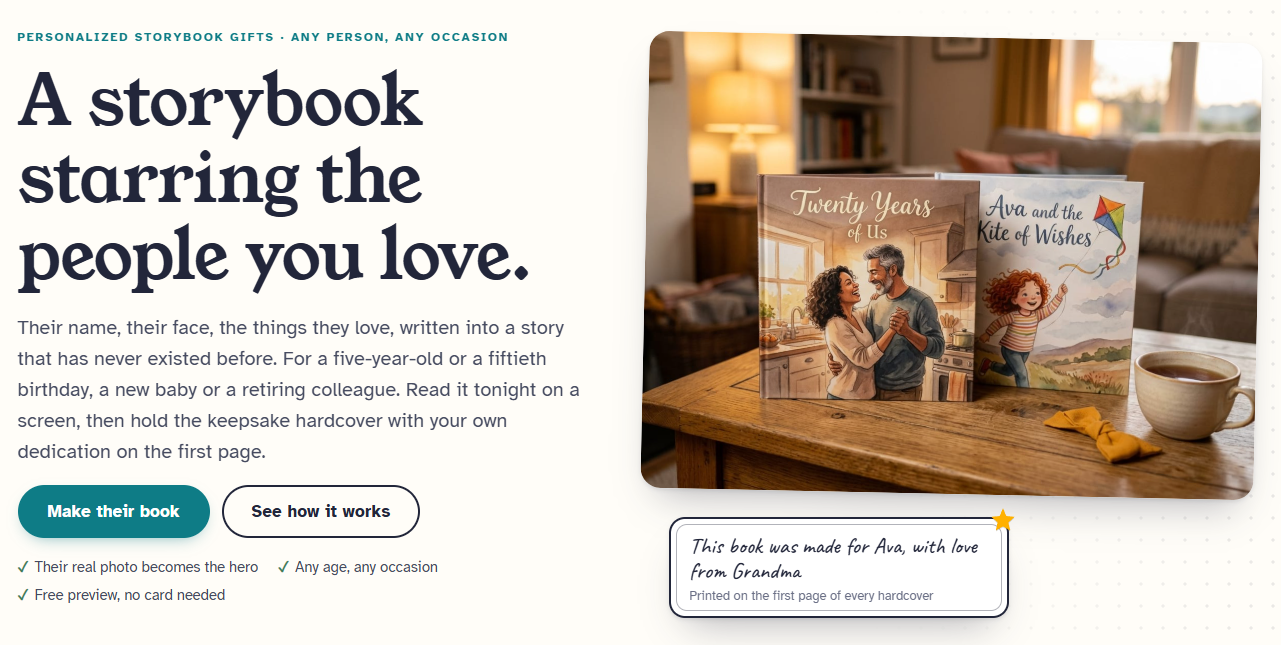
LoveToRead offers personalized storytelling with early reading support. Users describe the reader or listener’s age, name, and interests. Defining the occasion also helps make the story more personal. When it comes to generating the story, users have two ways to go about it. They could either give a story idea or let the AI do the heavy lifting. Uploading a photo or text description lets users personalize characters. They can even customize the designs in 8 different art styles. But that’s not all. The tool can tailor the story based on different reading levels.
Key Features:
Dedicated free story library for quick reads
Character library for reusing visuals in future stories
Optional keepsake hardcover with dedication
Pricing:
Free Preview
Storyteller Package – $9.99 for 100 credits (about 14 stories)
Dreamer Package – $19.99 for 225 credits (about 32 stories)
Creator Package – $49.99 for 650 credits (about 93 stories)
Real Use Case:
Pre-K teachers can rely on LoveToRead to generate individualized stories for the class. Each one gives a student a story where they’re the main character, built around their own reading capabilities.
ToonyStory
ToonyStory brings so much to the table when it comes to children’s stories. The standout feature is its AI Story generator that offers an approachable process. Users upload a photo, and the AI transforms it into a story character. Then, they can choose from themes, genres, and reading levels to fully customize the story. What’s great about ToonyStory is that it still gives users control. Dedicated tools allow them to tweak illustrations and scenes using natural language prompts. What’s more, the tool carries these over to an illustrated book and a short animated video.
Key Features:
Supports age-appropriate writing and multi-character stories
Full scene-level control
Consistent AI characters across story pages
Pricing:
Free Trial
Story Starter Package – $9.99 per month
Family Unlimited Package – $19.99 per month
Real Use Case:
ToonyStory’s library of themes and genres allows parents to personalize a story around a kid’s interests. Like making the child the central character, where he meets dinosaurs and solves a problem.
KidzTale
Image Credit: KidzTale
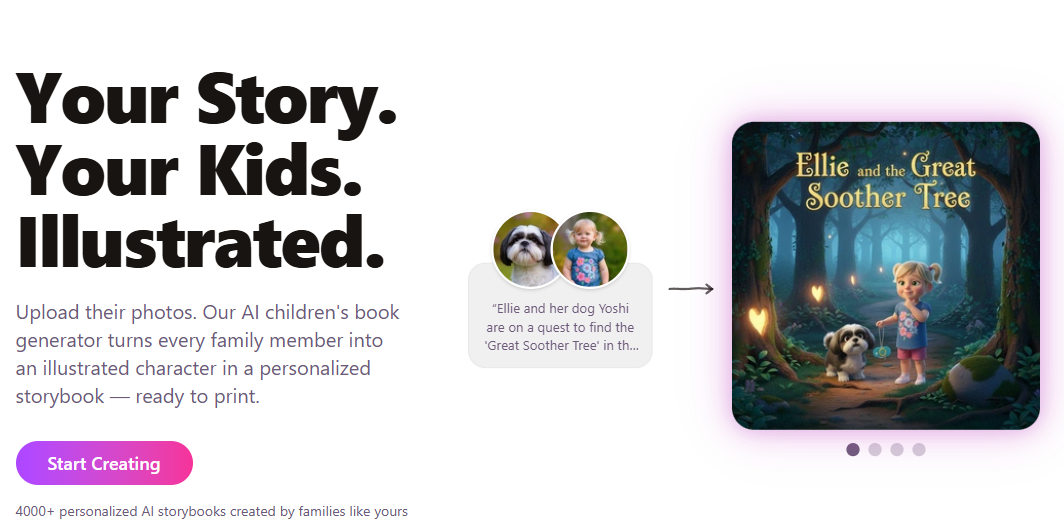
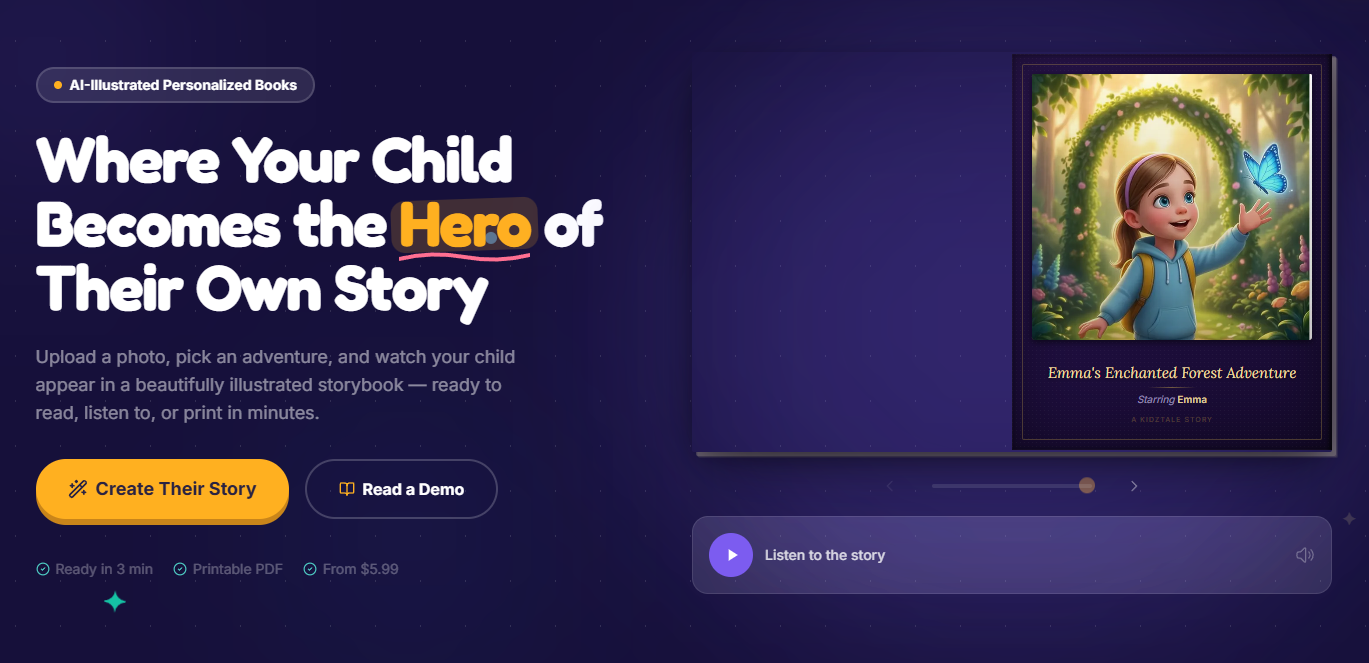
KidzTale is another tool that takes a personalized approach. However, it keeps the process particularly simple. Upload a child’s photo, select a theme, and pick an art style. In detail, KidzTale includes animal friends, dinosaur quests, fairy tales, magical forests, underwater worlds, and more. Beyond that, users can enter prompts to add additional story ideas. As for the visuals, they have the option to go for a Pixar, anime, cartoon, realistic, watercolor, or realistic look. To top it off, KidzTale’s stories can include audio narration and a printable PDF.
Key Features:
Generate stories for children up to 8 years old
Library of child-friendly story themes
Customizable narrator voice
Pricing:
No Free Package/Trial
Single Story Package – $5.99 for 1 story
Story Pack Package – $19.99 for 5 stories
Story Lover Package – $34.99 for 10 stories
Real Use Case:
The first day of school can be intimidating for young children. But in an instant, KidzTale can help parents use its ready-made themes to make a personalized story about their own character facing the first day with confidence.
MyStoryBot
Image Credit: MyStoryBot
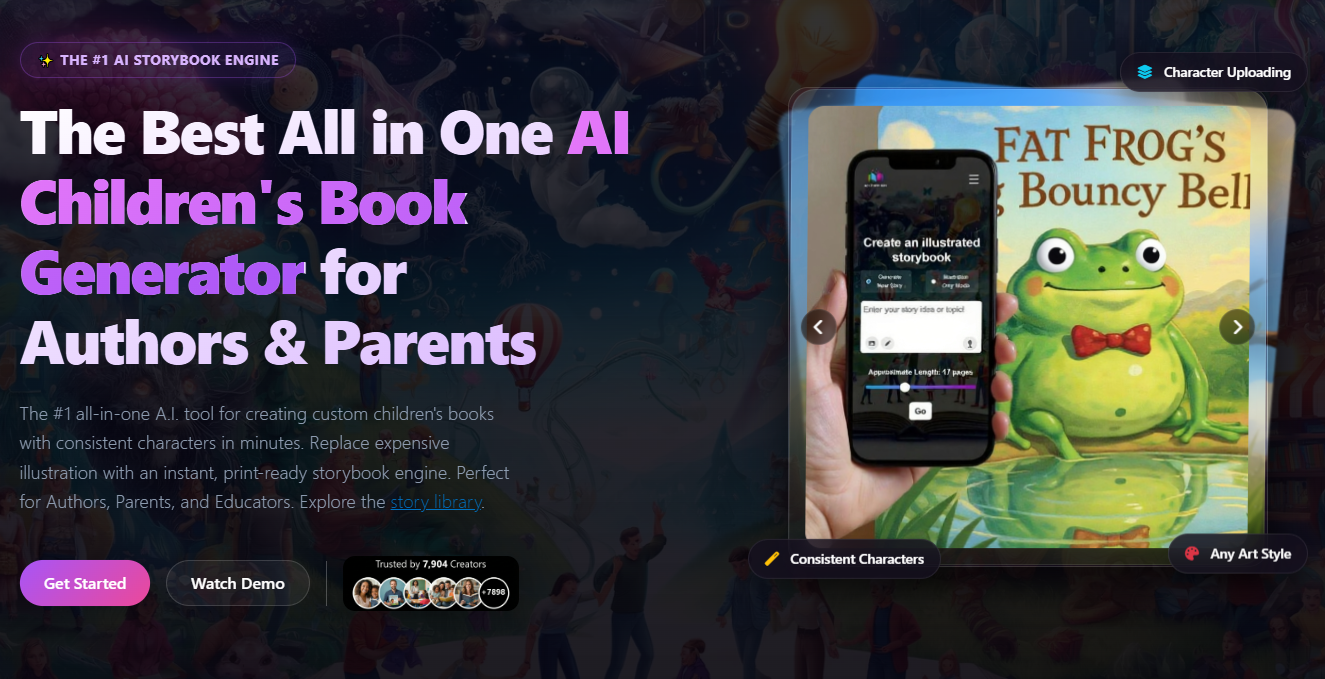
MyStoryBot positions itself as an all-in-one AI tool for children’s stories. The workflow starts with a prompt. Users specify the characters, plot, and setting. It also supports photo uploads to ensure character concept consistency. At the same time, they can set their desired story length. Afterward, MyStoryBot lets them head over to its AI illustrator to produce visuals that match the text. On top of these, it lets users polish the output to their liking. Tools are available to adjust the layout, enhance the illustrations, and edit the text.
Key Features:
One-click export to PDF, EPUB, and video formats
Art style switching to fit a story’s mood
Royalty-free commercial use
Pricing:
No Free Package/Trial
Reader Package – $29 per month
Author Package – $39 per month
Pro Author Package – $115 per month
Real Use Case:
MyStoryBot helps parents with several children build recurring adventures featuring the same characters. This makes it easier to solve the “What happens next?” dilemma because now the story can be endless.
Choosing the Top AI Tools for Children’s Stories in 2026
Children’s stories don’t always have to come from a bookshelf. Sometimes, kids appreciate and benefit more when it’s tailored to them. That’s how AI tools for children’s stories are changing the narrative.
Some focus heavily on personalization. Others add educational features, narration, or even physical printing. The best choice depends on what you’re creating. Are you an author trying to publish a children’s book? Or are you a loving parent looking for something to level up bedtime stories? Either way, Lullaby, LoveToRead, ToonyStory, KidzTale, and MyStoryBot can help. One note before diving in: check each platform’s data and photo-retention policy, child safety and content filtering, and privacy policy.
There’s so much music coming out all the time that it’s hard to keep track. On those days when the influx of new tracks is particularly overwhelming, we sift through the noise to bring you a curated list of the most interesting new releases (the best of which will be added to our Best New Songs playlist). Below, check out our track roundup for Thursday, September 3, 2026.
Sam Gendel – ‘Pattern Dance’
After a series of ambient jazz and experimental records, Sam Gendel is dipping his toes into art-pop with his next record, Advanced White Trash, arriving November 6. It’s led by the glitchy, abrasive ‘Pattern Dance’. “People think of me as a saxophonist, and I get that,” Gendel said in a press release. “But a large portion of my music has nothing to do with that instrument.” He added of the album-making process, “I recorded all the instruments first, improvising the arrangements in real time, without a concept of the vocals. I recorded the vocals about six months later, in essentially one sitting.”
DIIV – ‘Kid’
DIIV’s A. G. Cook-produced album ZIRP! comes out next month, and today they’ve shared a new single, ‘Kid’. More tender than previous offering ‘The Fountain’, the track comes paired with a video filmed by frontman Zachary Cole Smith’s son Roy and Roy’s friend Julian.
Emma Ruth Rundle – ‘God’s Picture’
Emma Ruth Rundle has unveiled ‘God’s Picture’, a delicately gorgeous track that’s billed as the thesis statement of her upcoming album, These Killing Times. “‘God’s Picture’ is a meditation on the state of the world, particularly climate disaster, global conflict and class,” she explained. “Musically this song feels like a segue from Engine of Hell, with its gentle piano and guitar, to These Killing Times, with its more lush arrangements and message. This song is also a plea for the demolition of Western hegemony. Accompanied by a music video collaboration with many friends and for which I painstakingly constructed the sets for in the winter of 2025/26, ‘God’s Picture’ is the thesis statement at the core of my new album These Killing Times.”
Son Lux – ‘No God Like a King’
Son Lux have previewed their forthcoming LP Out Into with ‘No God Like a King’, a wonky cut that was stretched out of a one-take performance. “We’re all fans of hip-hop — the boom-bap era in particular,” drummer Ian Chang remarked. “Stuff that has that gridded-but-not-gridded kind of feel. With our love for liquidy beats, we’ve always been drawn to the humanity in it. And with AI changing the music industry so much, we’re interested in making stuff where you hear the hand.”
Simple Minds – ‘Beginner Boys’
Simple Minds have announced a new album, Sacrosanct, with the lead single ‘Beginner Boys’. “We called the album Sacrosanct because after a lifetime of doing this — nearly fifty years of writing songs together — it’s stopped feeling like a career and started feeling like something closer to faith,” frontman Jim Kerr commented. “Calling the record Sacrosanct isn’t an exaggeration. It’s just honest.”
Living Hour – ‘Magnet’
Living Hour have announced a new EP, Magnet, to be released September 24 on Keeled Scales. It features two new songs and two demos of tracks from their latest album Internal Drone Infinity, and the wondrously sparse titled track is out today.
Growing Pains – ‘Bottle Rocket’
Growing Pains have announced a new album, Daniel Loves Mandy Forever, arriving through their new label home Photo Finish on October 9. Lead single ‘Bottle Rocket’ is equal parts soaring and ethereal. “This song was inspired by a childhood memory of trying to send a toy rocket afar,” Carl Taylor explained. “An act of reaching for something that can never be grasped. I don’t know if this was a real memory or a dream.”
The Mary Wallopers – ‘The Big Mixers’
The Mary Wallopers have shared an anthemic new single, ‘The Big Mixer’, taken from their forthcoming album Paddywhackery. “This is a song for all the labourers, the nurses, the shelf fillers, the train drivers, the truck drivers, the Deliveroo drivers, the SNAs, the miners, the factory workers… all the people doing a hard day’s work and forced back to the Big Mixer to make profits for someone else,” the group commented. “When the ganger man Concrete Bob (aka Robert McAlpine, whose construction company once employed 200,000 Irish men) was on his deathbed, he responded to the suggestions that work on site should halted as a mark of respect when he passed with ‘No – keep the Big Mixer going, and keep Paddy behind it.’”
Armlock – ‘Half-Time’
Australia’s Armlock have returned with a lovely new song, ‘Half Time’. “‘Half Time’ is mostly trying to describe the gap between existing and feeling,” the band expounded. “‘Tell me how to hear it’ became a central lyric, treating emotion as an elusive frequency I’m trying to hear but can’t quite tap into. It’s not meant to be a sad song, it’s more anchored in the frustration of trying to extract more from every passing moment and wanting to feel what’s under the surface.” They added, “We recorded the song in our usual way in our own studios, chopping and changing as we go. Pieces recorded in different tempos and sometimes different keys. You’re listening to version 1 and version 50 at the same time. Demo memos and final takes live together in the master. Once again we got Geography and Juice Webster to jump in on the backing vocals. The video for “Half Time” was made with Tom Dunphy and Bridgette Winten. It was important to us that the video had a lot of color, in reference to the lyric “just another rainbow.” We shot everything in double time with quite a lot of over-the-top energy, though when we play it back in half time it looks pretty subdued, which is kind of perfect for the meaning of the track.”
otta – ‘MEZZANINE’
British-Finnish songwriter otta is launching her new album, ASTRA, with an eight-and-a-half-minute meditation called ‘MEZZANINE’. “It gets a bit abstract, but it’s also pop music…” she remarked. “There are multiple narratives occurring – the instrumentation is kind of a whole story in itself. It was really addictive to work on, I played around with it for ages, mainly just because it was so much fun, every sound was something I played and considered right till the very end. It is sort of like a big painting, nothing is just surface level or as it seems, different narratives, textures, magic etc… I just wanted it to feel like you’re in the song when you’re listening to it.”
Fall routines have a particular quality in America. They arrive with the school year and the end of summer, carrying a sense of structure and intention that the warmer months tend to soften. New planners get purchased. Morning routines get revised. The home, recently used for vacations and irregular schedules, gets reconfigured for the demands of the next several months. And somewhere in this annual reset, the workspace tends to get attention it does not always receive at other times of year.
This fall, the workspace conversation is worth taking further than usual. Not just reorganising the desk or buying a new chair mat, but asking whether the workspace itself, the furniture and the spatial arrangement, is actually set up to support an inspiring fall routine or whether it is simply a static environment that work happens to occur in.
What Makes a Workspace Inspiring
The word inspiring, applied to a workspace, tends to make people reach for aesthetic solutions: better lighting, a cleaner desk, a plant that actually thrives indoors. These are not wrong, but they address the surface rather than the structure. The workspace that is genuinely inspiring is one that creates the physical and spatial conditions for good work, not just one that looks like it should.
Physical comfort is the foundation. A workspace where the body is fighting its position rather than supported by it is a workspace that drains energy rather than enabling it. Getting the desk height right, having the monitor at the correct level, and being able to move between different postures during a long working day are the conditions that make sustained, quality work possible.
Beyond comfort, though, there is something else that the most effective workspaces share: a degree of spatial flexibility that allows the working environment to respond to the task at hand rather than imposing a fixed arrangement on every kind of work.
This is where the 360-Degree Rotating Desk from Hulala Home makes a genuinely distinctive contribution. The ability to rotate the working surface, changing the spatial orientation of the workspace without moving the desk, introduces a flexibility that most workspace setups do not have and that turns out to matter more than it initially seems.
The Fall Routine, Supported by Flexible Furniture
The Morning Setup
Fall morning routines tend to be more structured than summer ones, with earlier starts and more defined sequences of tasks. A workspace that can be quickly configured for the first task of the day, whether that is a focused writing session, a series of early calls, or a planning review, supports these routines rather than creating friction at their start. A rotating desk surface allows this configuration to happen in seconds, without moving equipment or rearranging the room.
The Mid-Day Shift
The mid-day hours of a fall working day often involve a shift in the type of work being done, from the more focused, generative work of the morning to the more responsive, collaborative work of the afternoon. A workspace that can physically shift to accommodate this change, by rotating toward a different light source for video calls or orienting differently for tasks that benefit from a changed spatial relationship, supports this transition in a way that a fixed desk cannot.
The Late Afternoon Recovery
The late afternoon hours of fall are when the shortening days are felt most acutely in the quality of natural light and the body’s energy levels. A workspace that allows for postural change and spatial reorientation during these hours, rather than fixing the body in a single position in relation to a static environment, provides the kind of gentle environmental stimulus that helps extend the productive part of the afternoon.
For American home workers building a fall routine they actually want to sustain, the 360-Degree Rotating Desk from Hulala Home offers a starting point that goes beyond the seasonal decoration refresh and addresses the structural flexibility that an inspiring workspace actually requires.
The Investment That Shapes the Season
The fall workspace investment, made thoughtfully, shapes not just the season but the working year that follows it. A desk that introduces genuine spatial flexibility, that supports the full range of working modes that a professional fall calendar demands, and that looks considered rather than generic in the home it occupies, is a desk that pays dividends every working day.
The fall routine that is supported by the right workspace is a fall routine that is easier to maintain, more enjoyable to inhabit, and more productive than one that relies on willpower to compensate for environmental friction. Getting the workspace right is not a luxury addition to a fall reset. For most American home workers, it is the most impactful thing the reset can include.
For anyone ready to make that investment, the workspace furniture range at Hulala Home is worth exploring as a genuinely considered starting point for a more inspiring fall routine.




 Lily Seabird


 Chat Pile are back with another visceral, uncompromising album,
  What’s Up
 Following a series of EPs, Hannah Cole has come through with her mesmerizing debut LP,
  Arab Strap’s new album may be called