Apple TV has been churning out banger after banger. The streaming platform’s latest offering, Lucky, is a thriller that revolves around a former con artist played by Anya Taylor-Joy. In other words, it’s sure to draw in viewers who like their entertainment of the pulse-pounding variety.
With an intriguing premise and appealing cast, the show starts strong and promises to keep fans entertained from week to week. Could it return with even more episodes somewhere down the line? Here’s what we know so far.
Lucky Season 2 Release Date
At the time of writing, there’s no official news available about a potential Lucky season 2.
That said, Apple TV is promoting the title as a limited series, so chances of a follow-up are slim. Plus, the show is based on a novel written by Marissa Stapley, which doesn’t have a sequel. So far, everything points to a single installment.
Lucky Cast
Anya Taylor-Joy as Luciana “Lucky” Armstrong
Annette Bening as Priscilla Masterson
Clifton Collins Jr. as Harris Dutch
Aunjanue Ellis-Taylor as Agent Billie Rand
Timothy Olyphant as John Armstrong
Mo McRae as Agent Eli Gates
Dean Jagger as Agent Tom Mason
Artur Zai Barrera as Agent Diego Cruz
What Is Lucky About?
Lucky revolves around Luciana “Lucky” Armstrong, a former con artist. She has built a new life for herself and is determined to stay out of the world that shaped her. However, that plan collapses after a multi-million-dollar heist goes terribly wrong.
Forced back on the run, Lucky finds herself pursued by both the authorities and dangerous criminals. With nowhere safe to turn, she must rely on the very skills she has been trying to leave behind. She knows how to deceive people and stay one step ahead. The thing is, the people hunting her know the criminal world just as well.
While Lucky season 2 seems unlikely, the first season is currently unfolding weekly on Apple TV, with the finale scheduled for August 19. Will Lucky manage to survive long enough to reclaim control of her life? You’ll have to tune in to find out.
Are There Other Shows Like Lucky?
If you’ve been enjoying Lucky and are now looking for shows with similar vibes, we recommend checking out Ponies, Steal, Killing Eve, The Flight Attendant, Poker Face, Big Mistakes, and Inventing Anna.
There’s so much music coming out all the time that it’s hard to keep track. On those days when the influx of new tracks is particularly overwhelming, we sift through the noise to bring you a curated list of the most interesting new releases (the best of which will be added to our Best New Songs playlist). Below, check out our track roundup for Tuesday, July 21, 2026.
Greg Freeman – ‘Indu’
A little over a year since his last album, Burnover, Greg Freeman has announced a double LP. All Set the Bone, produced by John Congleton, is slated to arrive on October 2 via Transgressive/Canvasback. It features longtime collaborators Garrett Linck and Sam Atallah, as well as new ones including Florry’s Joey Sullivan, The Rockin Worms’ Carney Hemler, Anna McClellan, and Trinity Ace. Freeman describes the LP as a “reflection of a lot of change, and a lot of tension,” and you can hear a bit of that on the striking, straightforward lead single ‘Indu’.
Sylvan Esso – ‘Concrete Glen’
Sylvan Esson have announced a new album, Ow ∞, with the new single ‘Concrete Glen’. The groovy track, which follows the hard-hitting ‘Hot Slob’, weaves in an instantly mesmerizing sample of Sigur Rós’ ‘Svefn-g-englar’.
Boy Harsher – ‘Hard Beat’
Boy Harsher have signed to Atlantic and announced their first album for the label, GET MEAN, out September 18. It’s led by the aptly titled ‘Hard Beat’, which arrives with a self-directed video. The duo’s Jae Matthews describes the record as “what I had to give during the most extreme period of my life.”
Chelsea Wolfe – ‘Cold’
Chelsea Wolfe’s just-announced album is called The Dark, and her new single is titled ‘Cold’. The singer-songwriter isn’t exactly upending expectations, but she doesn’t have to. After all, no one captures this mood quite like her.
Lambchop – ‘The New World Wave’
The latest single from Lambchop’s new album, Punching the Clown, is the kind you have to lean into, especially for its storytelling. In the span of five minutes, Kurt Wagner relays an entire family saga set during the Great Depression. It follows ‘Weakened’ and ‘Stella’.
John Glacier – ‘Bond Girl’
John Glacier has dropped a sleek new single, ‘Bond Girl’, which was co-produced with Take a Daytrip. It comes paired with a music video directed by Léa Ceheivi.
Duffy x Uhlmann – ‘Public Life’
Los Angeles guitarists and improvisors Meg Duffy (Hand Habits) and Gregory Uhlmann (SML, Extra Stars) will follow up their 2023 collaborative debut, Doubles, with a new LP called Hot Creek. It’s out August 14 via Orindal Records, and the subtly gorgeous ‘Public Life’ is out now.
Gloria de Oliveira – ‘Fading Faces’
German-Brazilian musician and visual artist Gloria de Oliveira has announced a new LP, The Lying Swans, arriving October 30 via La Double Vie. It’s led by the ethereal single ‘Fading Faces’, which finds her singing, “I numb my hurt one last time.” In a statement, de Oliveira said: “This is not only the first single, but also the very first piece of music I wrote when I started working on the album. It was also the first song that Randall Dunn and I later recorded together in Iceland. In many ways, it’s the reason the album even exists – ‘Fading Faces’ required me to allow myself this degree of vulnerability that permeates The Lying Swans. Musically, it still follows the tradition of my previous albums to some extent, while simultaneously drawing on new modes of expression.”
Grace Cummings – ‘Fake’
Australian singer-songwriter Grace Cummings has shared ‘Fake’, a haunting piano ballad that serves as the final preview of her upcoming album Bloodhorse!. “Sometimes, being called a ‘good girl’ is a form of abuse,” she said. “And you internalise it. You spend your whole life acting out this role, even though it makes you feel sick. Even though you know it is a form of control. I hate those words, ‘good girl’. So in this song, I just choke on the first letter. The second half of the song is about the other person’s remorse.”
“This song was really difficult for me to write, to perform, to confess,” Cummings added. “But, the themes in ‘FAKE’ are painfully ordinary for so many women. Musically, I wanted this to begin up in the clouds, then drag you right underneath the water, viscerally. Then, you crawl out into a little tunnel. Dark. Maybe you’re falling through the rabbit hole, the vortex…you fly, you drown, and then you run.”
Self Defense Family – ‘Reclusion’
Self Defense Family, the ever-evolving project helmed by Drug Church vocalist Patrick Kindlon, is back. Their first new music in six years is the gruelling ‘Reclusion’, about which Kindlon said: “I’ve been trying to write lyrics about family and animals instead of songs about being atomized and thinking everyone is crazy. But it turns out even my love songs are about being atomized and thinking everyone is crazy. Call it a creative throughline, I guess.”
Alice Barlow – ‘Behind’
On the heels of an Australian tour supporting Hana Stretton and Cate Le Bon, Alice Barlow has unveiled a poignant, hypnotic track called ‘Behind’. It’s “about trying to escape yourself, the impulse to go anywhere to leave behind the difficult stuff, but the reality that those feelings will persist wherever you go, until you face them,” according to the South London songwriter/producer. Dilip Harris (Mica Levi, Sons of Kemet, King Krule) contributed additional production.
Living Weapon – ‘Interspecies Quality Assessment’
Living Weapon have previewed their upcoming LP Death in the Family with a galvanizing new single, ‘Interspecies Quality Assessment’. It’s accompanied by a video filmed and produced by the band, Eric Richter, and Anthony Didio.
Katherine Perkins – ‘Phoenix’
Maine-based singer-songwriter Katherine Perkins has announced a new record, Helpless Love, out September 25. Today, you can catch a taste of its lush Americana via the new single ‘Phoenix’. Explaining the origins of the track, Perkins said: “I imagined, not entirely unseriously, that on election day we’d have all of history’s good witches behind us, a steady presence from the spirit realm to help us topple the evil forces of this one. Of course it’s clear to me in retrospect that I wasn’t exactly ‘well’ in that stretch –– who among us was? But in the aftermath, having been abandoned by the witches that I’d only recently willed into existence in my mind, I found myself at my piano in a new cold clear reality; ‘Phoenix’ poured itself out into the desolation I was feeling. It was the closest brush I ever had with finding – and losing – religion.”
Warmhearted comedy Trying is back, with episodes rolling out weekly on Apple TV. Nikki and Jason have come a long way since we first met them, and catching up with them feels like catching up with old friends.
So much so that the series keeps racking up positive reviews, and currently boasts a 97% critic score on Rotten Tomatoes. Does that mean it could continue for years? Here’s what we know about a potential follow-up.
Trying Season 6 Release Date
At the time of writing, Apple TV hasn’t announced whether Trying season 6 is in the works. That said, the current installment is in full swing, so it may be a while before we hear any news.
Given that the show is still popular, we’re cautiously optimistic. If all goes well, new episodes could arrive in late 2027 or 2028.
Trying Cast
Esther Smith as Nikki Newman
Rafe Spall as Jason Ross
Scarlett Rayner as Princess
Cooper Turner as Tyler
Sian Brooke as Karen
Darren Boyd as Scott
Phil Davis as Vic Ross
What Is Trying About?
A British comedy-drama, Trying centres on Nikki and Jason, a couple who desperately want to become parents. When they discover that having a biological child may not be possible, they turn to adoption.
Easier said than done. The process proves far more complex than they anticipated. It doesn’t just test their relationship, but introduces them to a colourful cast of friends, relatives, social workers, and prospective children.
After eventually adopting siblings Princess and Tyler, Nikki and Jason discover that building a family is only the beginning. The series follows their efforts to raise the children and keep their relationship intact through the chaos of everyday life.
In season 5, the family is about to face its biggest challenge yet. Kat, Princess and Tyler’s biological mother, suddenly reappears at their doorstep. Her arrival forces everyone to confront questions about identity and parenthood.
Given the show’s premise, it could easily stretch its story over subsequent installments, so we’re keeping our fingers crossed that Trying season 6 will become reality. Until then, you can catch new episodes weekly on Apple TV. The season finale arrives on August 26.
Are There Other Shows Like Trying?
If you enjoy Trying, shows with similar vibes include Breeders, Catastrophe, Raising Hope, Parenthood, and Modern Family.
Luxury in home design has changed dramatically over the past decade.
There was a time when oversized kitchens, grand staircases, and elaborate finishes defined an upscale home. Today, many homeowners are looking for something less obvious but arguably more valuable: abundant natural light.
Bright interiors have become one of the most sought-after features in modern homes. Designers, architects, and homeowners increasingly recognize that sunlight can completely change how a space feels, making even modest rooms appear larger, calmer, and more inviting.
More Than a Design Trend
Natural light does far more than brighten a room.
Research has linked daylight exposure to improved mood, better sleep, and increased productivity. A home filled with sunlight often feels more welcoming without requiring expensive furniture or elaborate décor.
This shift has influenced everything from floor plans to window placement. New homes frequently feature larger windows, open living spaces, and glass doors that blur the line between indoor and outdoor living.
The goal isn’t simply to let more light inside. It’s to create spaces where people genuinely enjoy spending time.
The Rise of Everyday Wellness
The home has become much more than a place to sleep.
For many people, it now functions as an office, gym, classroom, and gathering place all at once. As homeowners spend more time indoors, qualities like daylight, fresh air, and visual connection to the outdoors have taken on greater importance.
Instead of focusing only on aesthetics, many renovations now prioritize comfort and well-being. A brighter living room, a sun-filled kitchen, or a home office with expansive windows can have a noticeable impact on daily life.
Windows Have Become a Design Feature
Windows were once viewed primarily as functional elements.
Today, they’re often central to a home’s architectural identity.
Picture windows frame landscapes like artwork. Floor-to-ceiling glass creates a stronger connection with nature. Sliding patio doors help outdoor living spaces feel like a natural extension of the home.
Even small changes, such as enlarging a window in a dining room or replacing an aging patio door, can dramatically change how a space looks and feels throughout the day.
Renovating With Light in Mind
Many homeowners planning renovations now begin by asking how they can improve the experience of living in their home rather than simply increasing its resale value.
That may mean opening a wall to create better sightlines, replacing older windows, or redesigning a room to capture more morning or afternoon sunlight.
As these larger projects come together, homeowners often spend time comparing contractors, establishing renovation priorities, and understanding the financial side of the work before construction begins. Learning about available contractor financing options can simply become another part of the planning process. More information is available at https://www.pashafunding.com/
When It Makes Sense to Replace Windows and Doors
Natural light depends on more than window size.
Older windows may have deteriorated seals, outdated glass technology, or frames that reduce energy efficiency and comfort. Likewise, replacing a solid exterior door with a glass entry door or upgrading to modern sliding patio doors can significantly increase the amount of daylight entering a home.
When evaluating these improvements, it’s important to consider factors such as energy performance, local climate, installation quality, and long-term durability alongside the visual impact.
Modern luxury isn’t always defined by square footage or expensive finishes.
Often, it’s the feeling of walking into a room filled with natural light, opening wide glass doors onto a patio, or watching the changing daylight move through a home over the course of the day.
As design continues to emphasize comfort, wellness, and everyday living, natural light has become one of the most valuable features a home can offer. It’s a reminder that sometimes the most meaningful upgrades aren’t the most extravagant. They’re the ones that quietly improve how we experience our homes every single day.
Wolfe worked on the new album with longtime collaborator Ben Chisholm as well as a new co-writer, Jennifer Decilveo. The Dark also features Robin Finck (Nine Inch Nails), Matt Chamberlain (Pearl Jam), Troy Van Leeuwen (Queens of the Stone Age), Stella Mozgawa (Warpaint), and Justin Meldal-Johnsen (Nine Inch Nails, St Vincent). It’s already been previewed by the double single ‘The Dark / Death Is Not The End’.
The Dark Cover Artwork:
The Dark Tracklist:
1. Cold
2. Seethe
3. Humours
4. Swallower
5. Halo
6. The Dark
7. Turn The Key
8. I’m Not There
9. Death is Not The End
10. Dancer In The Sky
Sylvan Esso have announce their first new album in four years. Ow ∞ will be released on September 11 via their own label Psychic Hotline. It includes the previously released single ‘Hot Slob’ – one of their very best – as well as the new track ‘Concrete Glen’, which samples ‘Svefn-g-englar’ by Sigur Rós (“a band that soundtracked much of [Amelia] Meath’s teenage makeouts,” according to a press release). Check out a video for it below, and scroll down for the album cover and tracklist.
Ow ∞ marks not only the longest time the duo has spent on a record, but the largest community of musicians they’ve assembled for one. The list of collaborators includes Daniel Aged (Frank Ocean, Dijon), BJ Burton (Bon Iver, Charli XCX), Matt Douglas (the Mountain Goats), Glenn Kotche (Wilco), Jake Luppen (Hippo Campus, Samia), TJ Maiani (Weyes Blood, Neneh Cherry), James Mapley-Brittle (GRRL), Buddy Ross (Frank Ocean, Bon Iver), Jenn Wasner (Wye Oak, Flock of Dimes), and Joe Westerlund (Megafaun).
“One of my favourite ways of producing in general is to come up with an idea and then take out a third of it,” Meath explained. “One, it makes things interesting and exciting, but also it makes your ear ask a question. And it kind of forces the listener to be creative as well. To try to fill that space with something, which I find as a listener to be really exciting and interesting. Particularly with pop music, because it’s all about fulfilling a promise. You know this melodic structure, you know, we’re going to the four here. Not doing it is always the thing that makes people fall in love with a song or a person.
She continued: “Living hurts forever, and then it stops. But also it’s a little silly. And that’s how I feel. If you’re going to keep participating in the world, and in your life, you have to commit to being hurt. And if you aren’t putting yourself in the way of potential hurt, you miss out on a lot of potential opportunities. So in some ways it’s like a rallying cry, saying ‘I’m gonna get hurt forever, and that’s okay.’”
Ow ∞ Cover Artwork:
Ow ∞ Tracklist:
1. Entertainment & Coca-Cola
2. Flood Season
3. Hot Slob
4. Concrete Glen
5. Back Again
6. Ribbon
7. Sledge
8. Right to Left
9. Good at Pain
10. Jessica
11. On & On
12. Plastic Sword
The Kiran Nadar Museum of Art (KNMA) and Christie’sLondon will present The Meeting Ground: Scenes from the KNMA Collection from 16 July to 21 August 2026 at Christie’s King Street. The free exhibition marks the first time Christie’s London has dedicated its annual summer exhibition to a single institution from South Asia, showcasing works from KNMA’s renowned collection as part of the museum’s mission to bring South Asian artistic histories to international audiences.
Curated by Akansha Rastogi alongside Preeti Bahadur, Avijna Bhattacharya, Premjish Achari and Srinivas Aditya Mopidevi, the exhibition showcases modern and contemporary art with folk and indigenous artistic traditions from across South Asia. Featuring artists including M.F. Husain, S.H. Raza, F.N. Souza, Zarina Hashmi, Jangarh Singh Shyam, Jivya Soma Mashe and Gauri Gill with Rajesh Vangad, the exhibition explores themes of identity, memory, migration and belonging through an intergenerational dialogue spanning the early 20th century to the present day.
The exhibition coincides with KNMA’s ongoing expansion in New Delhi, where a new one-million-square-foot museum complex is under development. KNMA and Christie’s Education will also host a three-day course on South Asian art from 28 to 30 July, offering visitors further insight into the ideas and artists featured in The Meeting Ground.
The National Gallery has unveiled three notable additions to its collection following a major gift from Dallas-based collectors Richard and Luba Barrett, with the works on display from 2 July 2026. The donation includes paintings by three celebrated Swiss artists – Angelica Kauffmann, Ferdinand Hodler and Alexandre Calame – and marks an important expansion of the Gallery’s holdings. Kauffmann’s Achilles Discovered among the Daughters of Lycomedes is especially significant as the first of her history paintings in oils to enter a UK national collection and the first work by the artist to join the National Gallery’s collection in more than a century.
Painted between 1777 and 1778 at the height of Kauffmann’s success in Europe, the large preparatory work depicts the Greek myth of Achilles being discovered while disguised among the daughters of King Lycomedes. Kauffmann, one of only two female founding members of the Royal Academy of Arts in 1768, enjoyed a successful career in London before moving to Rome – there, she created the painting as a study for a commission by Catherine the Great. The Gallery has also acquired Hodler’s Portrait of Louis Montchal, the first portrait by the influential Swiss modernist to enter its collection, alongside Calame’s Four Large Trees, bolstering its renowned collection of 19th century Swiss landscapes.
National Gallery Director Sir Gabriele Finaldi has described the donation as a “generous gift of three outstanding pictures” that enriches the Gallery’s representation of Swiss art from the 18th and 19th centuries. Visitors can view Kauffmann’s Achilles Discovered among the Daughters of Lycomedes in Room 37, Hodler’s Portrait of Louis Montchal in Room 44, and Calame’s Four Large Trees in Room 39.
Off days are real. No matter how talented and hardworking you are, there will be days when you’re not able to perform at the usual standard. It happens to the best of us. And when it comes to work, giving in is the fastest route to failure or losing a job. But how do people overcome this, and why does it seem that others get more work done in the same number of hours? The answer is AI tools for productivity.
Research. Writing. Calendar management. Editing. Administrative work. These can easily result in busy hours and endless stress. That’s why more professionals are turning toAI tools. A recent survey even showed that smart technology saves up to5 hours a week.
With hundreds of options in the market, using them all isn’t advisable. Besides, more tools don’t necessarily lead to better productivity. So this guide explores a curated selection that addresses different aspects of productivity.
Top Five Best AI Tools for Productivity
ChatGPT
OpenAI’s ChatGPT has become one of the most well-rounded AI tools for productivity. This chatbot is the usual go-to for brainstorming, coding, data analysis, image generation, planning, summarization, research, and writing. It’s essentially a powerhouse for all productivity needs. Users can tap to ChatGPT to ask questions, generate ideas, or automate repetitive tasks. The secret is entering good prompts. Once users manage to do that, the tool can understand context across conversations. Then it’s easier to handle different responsibilities.
Key Features:
Regularly updated models for more advanced reasoning
Custom GPTs for specialized workflows
Accessing an AI assistant with a wide range of features
Pricing:
Free Plan
Go Package – $8 per month
Plus Package – $20 per month
Pro Package – $100 per month
Real Use Case:
Cutting manual work and speeding up project turnarounds is made easy with ChatGPT. Marketing managers can use it to draft campaign ideas, summarize competitor research, create social media copy, and refine client proposals.
Zapier Agents
Image Credit: Zapier Agents
Automating every workflow? That’s what Zapier Agents is for. Other AI tools for productivity bring the power of AI to the table. This platform lets AI agents complete multi-step tasks across thousands of connected apps. That means they don’t just respond to prompts. They can automatically retrieve information, trigger workflows, update records, and perform actions. Analyzing data. Drafting emails. Handling requests. Preparing reports. Scoring leads. Zapier provides a faster, more efficient way to delegate work.
Key Features:
Built-in visibility monitoring to track every model call
Connecting any AI to more than 9,000 apps
No-code setup using natural language
Pricing:
Free Plan
Starter Package – $12 per month
Business Package – $18 per month
Enterprise Package – $22 per month (annual billing only)
Real Use Case:
Zapier Agents erase the need for tedious manual coordination. When a customer submits a website inquiry, sales teams can use it to automatically notify account managers, update CRM records, or prepare follow-up emails.
Reclaim AI
Reclaim AI hands calendar work to AI agents. With 12 powerful products, teams go from reactive scheduling to proactive time optimization. Users can benefit from its features that intelligently protect focus time, optimize meetings, and prevent disruptions during the workweek. No more manual planning. Reclaim also offers recommendations and allows previews before taking action. Plus, it can automatically adjust events to maintain productivity as schedules change.
Key Features:
Previewing every action before it goes live
Automatic focus time and habit planning
Work syncing from Asana, ClickUp, Google Calendar, and more
Pricing:
Free Plan
Professional Package – $29.99 per month
Team Package – $103.50 per month
Enterprise Package – Custom Pricing
Real Use Case:
Freelance consultants can benefit from Reclaim’s AI scheduling, Focus time protection, and Team OOO Calendars. These tools, alongside many others, can automatically reserve uninterrupted work sessions while still accommodating client meetings. It makes it easier to balance multiple clients.
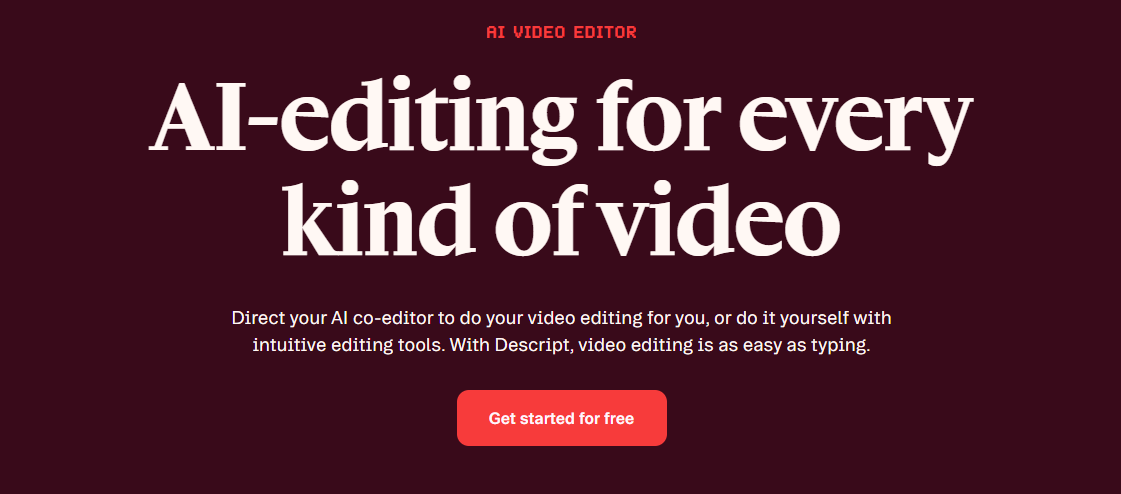
Descript
Image Credit: Descript
Editing audio and video content is Descript’s specialty. Featuring a text-based workflow, creators can just tweak the text script. No need to learn complex traditional software. Beyond this, it’s also packed with AI tools for transcribing, generating AI voices, screen recording, and creating subtitles. All inside one platform. Its standout offering is the AI agent called Underlord. Creators can use it to basically automate anything Descript can do that would otherwise require heavy human intervention.
Key Features:
Automatic audio cleanup and filler word removal
Precise control over every audio and visual detail
Intuitive and beginner-friendly timeline editing
Pricing:
Free Package
Hobbyist Package – $24 per month
Creator Package – $35 per month
Business Package – $65 per month
Enterprise Package – Custom Pricing
Real Use Case:
Editors bombarded with several editing backlogs can speed things up with Descript. For instance, they can use the transcript editing feature to quickly remove filler words, update incorrect statements, and generate captions. Publishing episodes would then be on time since there’s no need to manually adjust audio waveforms.
Otter
Otter focuses on one of the biggest workplace productivity challenges — meetings. It offers an advanced feature called OtterPilot. This allows users to let AI record conversations, produce searchable transcripts, identify speakers, summarize discussions, and capture action items. Employees would also find the chat layer extremely helpful. They can ask about anything, and it pulls in information from actual data. That means content, follow-ups, and reports remain factual.
Key Features:
Automatic meeting transcription and summaries
Zoom, Teams, Google Meet, and Slack integration
Real-time transcription with speaker diarization
Pricing:
Free Package
Pro Package – $16.99 per month
Business Package – $30 per month
Enterprise Package – Custom Pricing
Real Use Case:
Product development teams can automatically document brainstorming sessions with Otter. It makes it easier to revisit feature discussions, assign responsibilities, and track decisions. That often leads to faster production stages.
Choosing the Smartest AI Tools for Productivity in 2026
Everyone gets the same 24 hours in a day. So the question comes down to how much you can do and how you do it. Even during off days. That’s what the AI tools for productivity on this list address. It’s not just about doing more work. They make sure you spend less time on repetitive tasks.
However, it’s worth noting that they won’t do your job. They’re designed to let you do them more efficiently and better. ChatGPT speeds up knowledge work and content creation. Zapier Agents automate repetitive business processes. Reclaim AI offers intelligent scheduling. Descript accelerates multimedia production. Otter eliminates manual note-taking.
Know your goals. Pick the tool. When doing so, prioritize ease of use and proven track record. That way, you’re sure to land on the best pick that helps users save time, stay organized, and accomplish more every day.
Script. Visuals. Editing. Music. Narration. Each stage contributes to successful content creation. But it’s the voiceover that often brings everything together. And many creators recognize that. When they need to produce audio from written text, they turn toAI text-to-speech tools. When a consistent, distinctive voice is required, many rely onAI voice cloning software. But sometimes, producing narrations calls for both. And it would be impractical and inefficient to jump from one tool to another. Luckily, the market is now filled with powerful AI tools for voiceovers.
With a study revealing thathuman voice-over reduces consumers’ cognitive load better than AI ones, it’s crucial that you choose the one that blurs the line between AI-generated and human narration. And you don’t have to worry about testing several tools yourself. This article already gives you the list of the leading AI tools for voiceovers that help creators produce professional voiceovers while reducing production time and costs.
Top Five Best AI Tools for Voiceovers
ElevenLabs
ElevenLabs is easily one of the must-try platforms in the field. It offers everything a creator needs for doing voice-overs. There are tools for text-to-speech, voice cloning, and voice changing. What makes it even more impressive is its massive voice library, covering everything from advertising to animation projects and everything in between. If that isn’t enough, users can design a voice from scratch by just entering prompts. It captures emphasis, emotional delivery, and pacing to create narration that sounds remarkably human.
Key Features:
More than 1000 preset voices for all kinds of content
Controlling action, emotional direction, and tone
Supports diverse languages and accents
Pricing:
Free Package
Starter Package – $6 per month
Creator Package – $22 per month
Pro Package – $99 per month
Scale Package – $299 per month
Business Package – $990 per month
Enterprise Package – Custom Pricing
Real Use Case:
Educational YouTube channels producing documentary-style videos can use ElevenLabs. Its well-rounded AI tools for voiceovers help maintain a consistent narrator throughout an entire content series. So there’s no need to record voice-overs again and again.
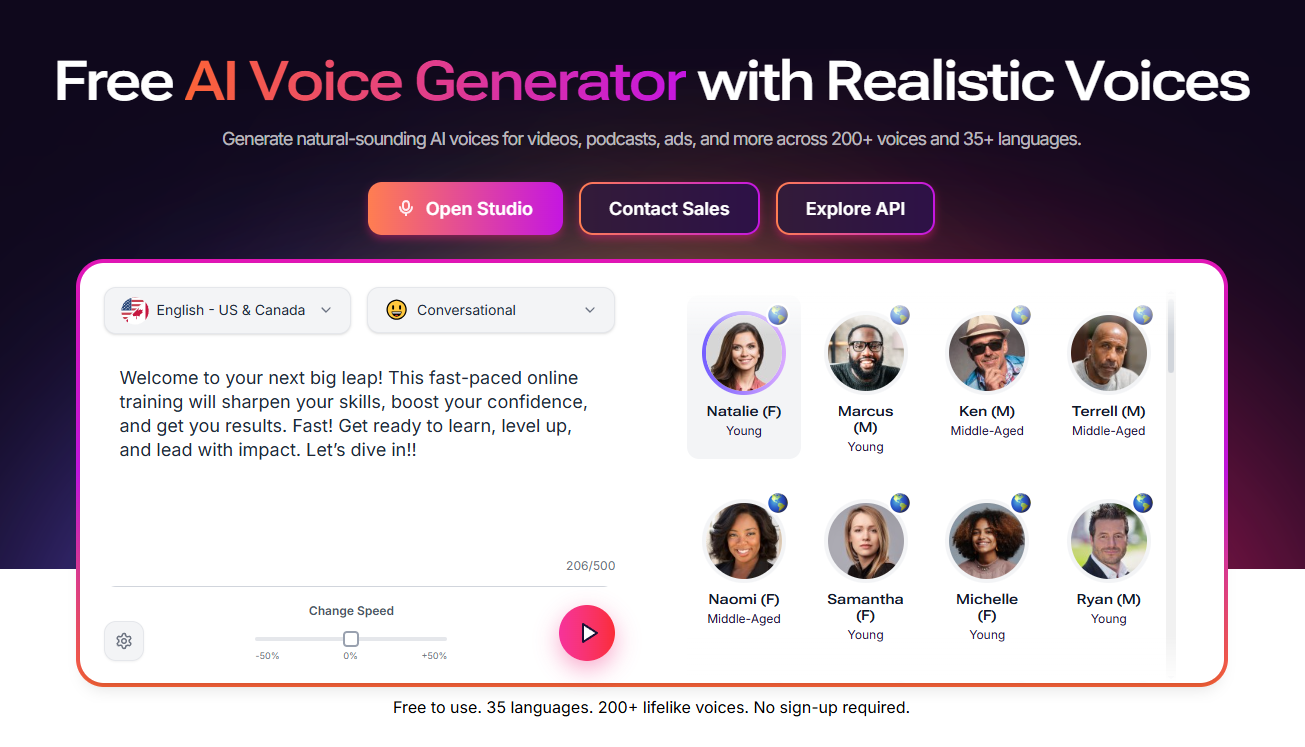
Murf AI
Image Credit: Murf AI
Another option built around professional narration workflows is Murf AI. It’s packed with tools all intended for realistic voice-overs. It offers an AI voice generator, voice changer, and voice cloning. Murf AI is also popular for giving users control over intonation, pitch, and speed. To ensure the highest-quality output, this tool includes a custom pronunciation library. It makes it easier to get words right every time. What’s more, it offers customization features to guide AI in simulating human nuances for natural, precise speech.
Key Features:
Offers over 200 voices across more than 35 languages
Adding voice-over features inside tools like Canva, Captivate, and PowerPoint
Dedicated video and presentation sync editor for immersive presentations
Pricing:
Free Package
Creator Package – $19 per month
Business Package – $66 per month
Enterprise Package – Custom Pricing
Real Use Case:
Multinational corporations likeNestlé use Murf AI to create high-quality training and internal communication content for their global workforce. Murf’s suite of tools allowed them to streamline production and support multilingual, natural-sounding voiceovers.
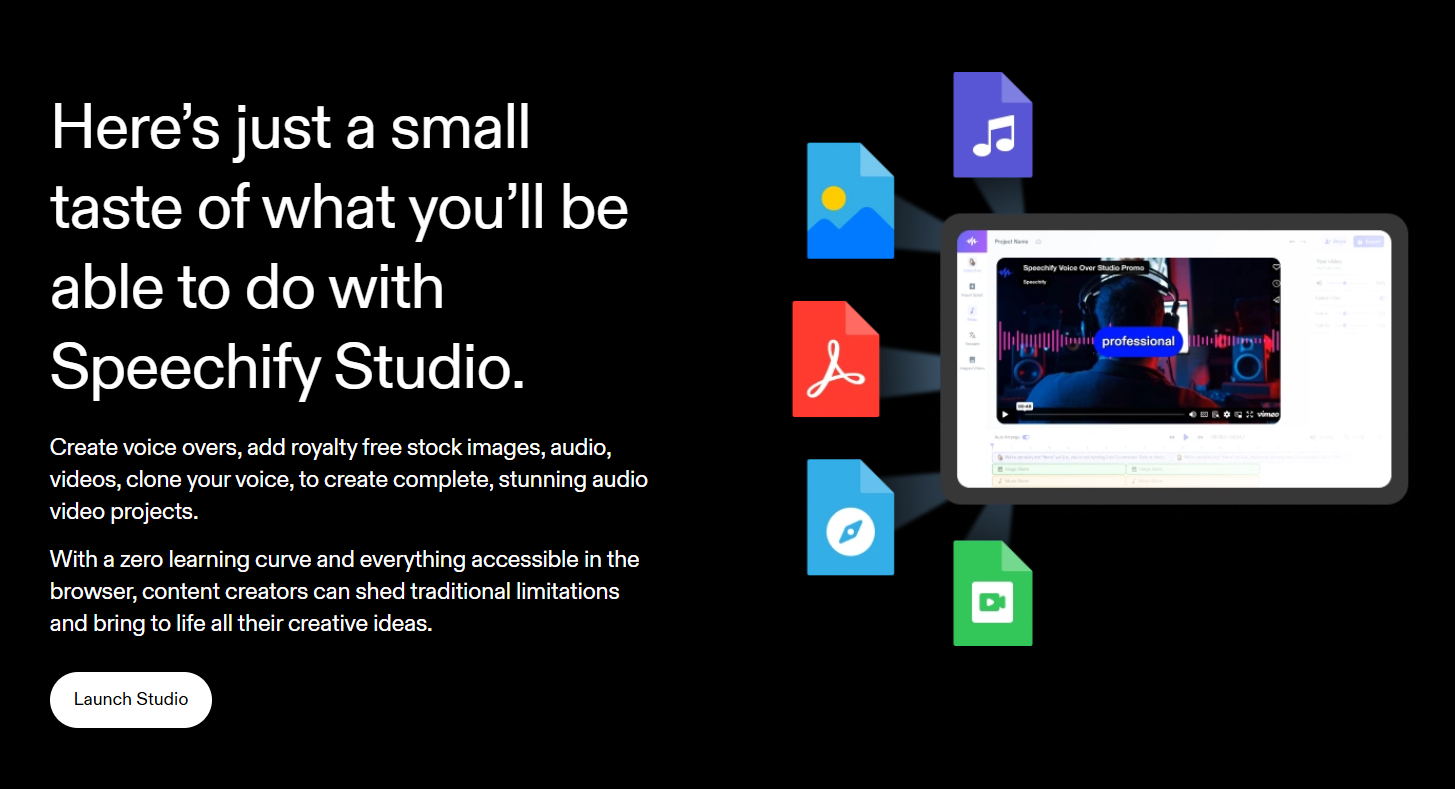
Speechify Studio
Image Credit: Speechify Studio
Speechify is no longer just for reading text out loud. It has evolved into a complete workflow solution that delivers tools for AI voiceovers, dubbing, and voice cloning. This option is particularly made for creators who need professional narration. All without investing in complex audio production software. It even gives users full control over emotional tone, pauses, pitch, pronunciation, and speed. Speechify is also the only platform that has licensed celebrity voices.
Key Features:
Accessing more than 1,000 realistic AI voices in over 60 languages, dialects, and accents
13 wide-range emotions for more compelling narrations
Integrated tools for creating videos and presentations
Pricing:
Free Package
Studio Starter Package – $19 per month
Studio Creator Package – $49 per month
Enterprise Package – Custom Pricing
Real Use Case:
Course creators can achieve uniform narration across training modules with Speechify Studio. This tool allows them to update lessons without worrying about maintaining a consistent instructor voice throughout the curriculum.
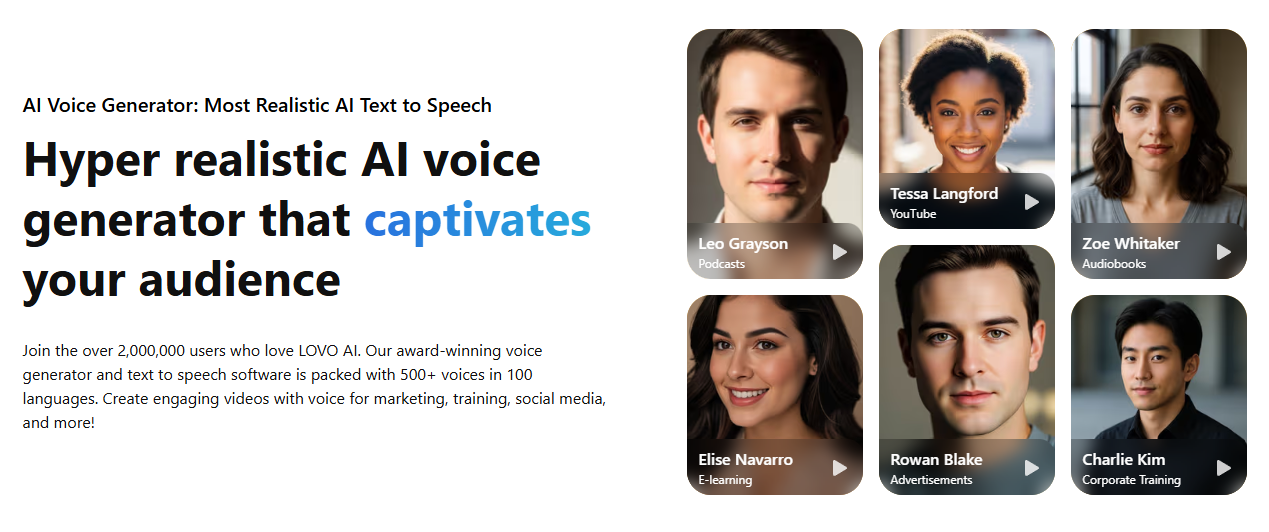
Lovo AI
Image Credit: Lovo AI
Also known for its Genny platform, Lovo AI combines professional narration with multimedia production. At its core, it allows users to easily create voiceovers with its text-to-speech and voice-cloning tools. Creators are sure to find the right voice for any content need, with over 500 on-demand voices. Alongside voice generation, Lovo AI lets users handle both narration and production from a single platform. It has an online video editor, subtitle generator, and more.
Key Features:
Supports AI voices in more than 100 languages
Built-in AI writer for scriptwriting with ease and speed
Setting the character’s age, emotions, pauses, and pitch
Pricing:
Free Trial
Basic Package – $29 per month
Pro Package – $48 per month
Enterprise Package – Custom Pricing
Real Use Case:
Video production companies likeGriffin Productions are able to meet client standards faster with Lovo AI. It largely automates their entire pipeline, from scriptwriting to generating voice-overs. The library of voices and styles was also advantageous.
WellSaid Labs
WellSaid Labs is a dedicated platform for making voiceovers. Users can expect human-quality outputs. Each voice is modeled after real voice actors. It prioritizes consistency, clarity, and studio-quality narration. Control over emphasis, pacing, pauses, pronunciation, tone, and volume is also made easy with the tool’s built-in AI director. There are also extra customization features for voice types and styles. That means word-by-word control.
Key Features:
Accessing more than 20 AI voices that simulate realism
Supports multiple file formats for hassle-free exports
Create natural-sounding and localized voiceovers
Pricing:
Free Trial
Starter Package – $19 per month
Pro Package – $49 per month
Business Package – $160 per month
Enterprise Package – Custom Pricing
Real Use Case:
Marketing teams can use WellSaid Labs to make on-brand demos or campaign-ready outputs. It gives professional-grade voice quality and the flexibility to scale audio production effortlessly.
Choosing the Top AI Tools for Voiceovers in 2026
Shaping how audiences see a brand. Explaining complex ideas. Keeping viewers engaged from beginning to end. Voiceover is a critical part of moderncontent creation.
That said, always choose AI tools for voiceovers that put an end to many production problems. Like costly revisions, consistency challenges, localization barriers, accessibility gaps, and scaling limits. Consider also your production needs. But overall, with ElevenLabs, Murf AI, Speechify Studio, Lovo AI, and WellSaid Labs, creators no longer need to rely on traditional recording studios or lengthy production schedules.