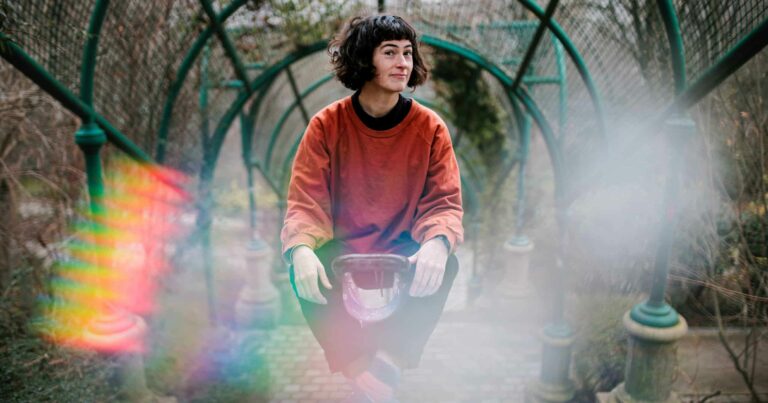
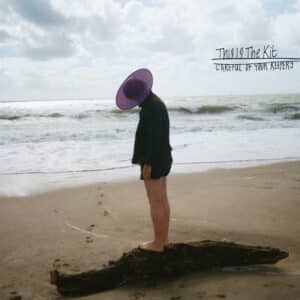
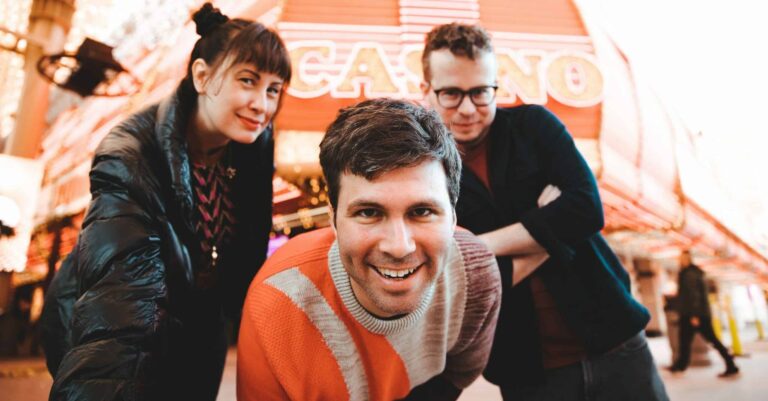
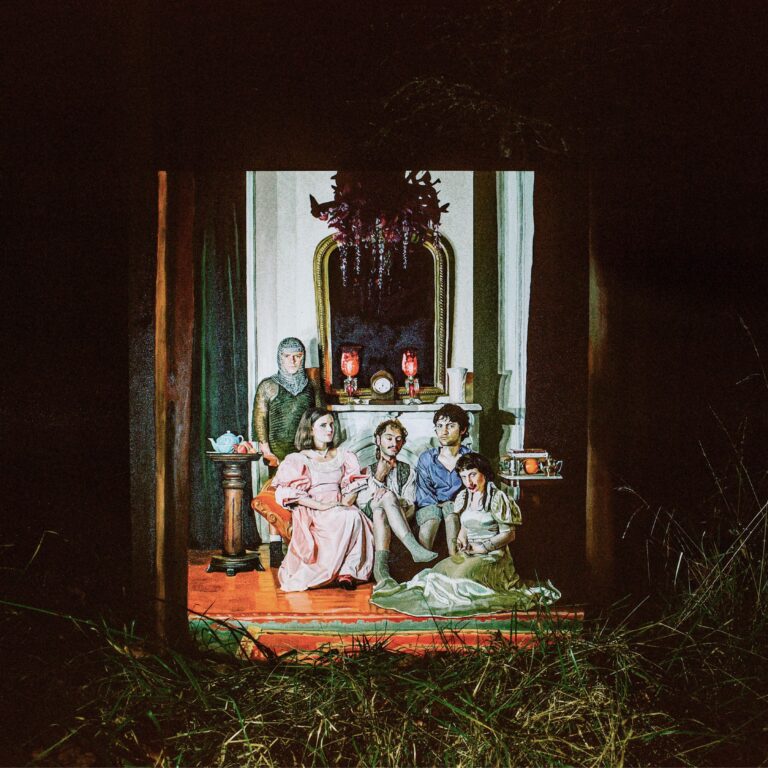
This Is the Kit have announced a new album titled Careful of Your Keepers. Produced by Gruff Rhys of Super Furry Animals, the follow-up to 2020’s Off Off On will arrive June 9 via Rough Trade. On the lead single ‘Inside Outside’, out today, singer-songwriter Kate Stables is joined by her band of Rozi Plain (on bass and vocals), guitarist Neil Smith, and drummer Jamie Whitby-Coles, with a horn quartet arrangement by Jesse Vernon. Check out its Hannah Owen-directed video below, and scroll down for the album cover and tracklist.
Discussing the song’s lyrics, Stables reflected in a press release:
What makes things happen? How much choice do we have? Electricity and chemistry that is out of our control? Chewing. Choosing. Internal forces or external ones? Do we just behave the way people expect us to behave?
Or do they pre-empt what’s happening? Before it’s happened? Because they can see it in us before we know it ourselves? Big change that has been brewing for longer than we realise. Were we just ignoring it? Was it so deeply buried? Or did we see it all along but chose to ignore it? How much does anything change? Or is it just the way we see it that changes?
Of the new LP, she added: “The album was nearly called Goodbye Bite. And in a way it still is. I went for Careful of Your Keepers in the end. It’s one of my favourite songs on the album, a song that for me holds the general feeling of the album as a whole. The fragility of things. Of situations. Of relationships. Of humans. What we do to look after each other and ourselves. The passing of time and what that does to us, and how we live our lives going forward.”
Careful of Your Keepers Cover Artwork:
Careful of Your Keepers Tracklist:
1. Goodbye Bite
2. Inside Outside
3. Take You To Sleep
4. More Change
5. This is When The Sky Gets Big
6. Scabby Head and Legs
7. Careful of Your Keepers
8. Doomed Or More Doomed
9. Stuck in a Room
10. Dibs
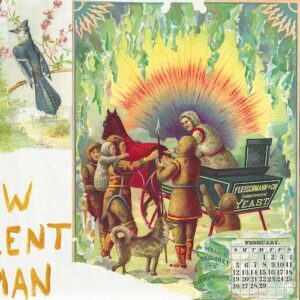
Asher White has announced a new LP, NewExcellent Woman, which comes out May 26 via Ba Da Bing. The 22-year-old Rhode Island artist has today shared the first preview of the record, ‘Skate Park Anthem’. Check it out along with the cover artwork and tracklist below.
Speaking about the new track, White explained in a statement:
It’s a slapstick take on some very specific dynamics that take place between the locals of Providence, RI and the often exploitative and naive college students. The East Side of Providence has a pretty intense “town vs. gown” dynamic wherein the locals are constantly negotiating with this hoard of elite ivy-league students. Brown and RISD are two enormously wealthy institutions with a pretty extractive and irresponsible history with the city. This song honors a group of Providence skater boys I knew who resented the rich RISD kids but would also go to RISD parties to hang out and get laid and stuff. It was this kind of romeo-juliet lustful hatefucking (hence the everclear reference) that I saw as mutual exploitation: it gave the RISD kids clout to hang with locals, but we were ultimately very naive tourists to people who actually belong there. I plopped in the random virtuosic jazz guitar solos by my friend Maya Polsky to drive this home and charge the track with a manic pulse.
New Excellent Woman Cover Artwork:
New Excellent Woman Tracklist:
1. Ptolemy
2. Skate Park Anthem
3. Saturday Morning
4. Mare
5. Tresemme Instrumental
6. Modern Guilt
7. Garden
8. Bedsong
9. New Excellent World
SBTRKT has teamed up with Toro y Moi for the new single ‘Days Go By’. It’s the latest offering from his upcoming album The Rat Road, following ‘Waiting’ and ‘Forward’. Check it out below.
“A lot of my prior press coverage was as a masked, elusive character,” SBTRKT’s Aaron Jerome remarked in a statement. “My storyline became attached to the mask. A lot has been projected onto or written for me, diluting what I actually created and then, that being attributed to others around me.”
“There were many aspects to the music business which sat opposed to this and I realised it was time to re-evaluate who I worked with or what I was wanting to achieve or create,” he continued. “The point was that I was resetting. I’ve never felt comfortable having to chase the herd. I have always followed my own instinct and independence in what I’m creating and how and where to release music.”
The Rat Road, SBTRKT’s first new LP in seven years, is out on May 5.
Chvrches stopped by The Tonight Show Starring Jimmy Fallon last night (April 3) to perform their recent single ‘Over’. Watch it happen below.
Released in February, ‘Over’ marked Chvrches’ first new music since their 2021 album Screen Violence. The band is set to embark on a brief UK tour this June.
Ahead of the release of her new album Labyrinth this Friday (April 7), Heather Woods Broderick has offered one more preview. It’s called ‘Wherever I Go’, and it follows previous cuts ‘Blood Run Through Me’, ‘Crashing Against the Sun’, and ‘Admiration’. The track arrives with an accompanying Jeremy Johnstone-directed video, which you can check out below.
“The video for ‘Wherever I Go’ is about the juxtaposition of having some fun, and letting go against the repetitive nature of daily life,” Broderick explained in a statement. “The song has both a lot of irony and energy in it, and we wanted to reflect this visually. The duality in the lyrics is paralleled inside the day that takes place in the video. The repetitions in daily life are playfully represented in the suburban scenes decorated by glitchy/GIF companions, and the wide open landscape shots reflect the free, pure joy that exists inside each day if you go find it. The video was conceptualized and directed by Jeremy Johnstone. Movement direction by Kacie Boblitt. It features Juliet Johnstone, Erick Eiser, Elke Shari Van den Broeck, Daniel Sparks, and Corrina Repp.”
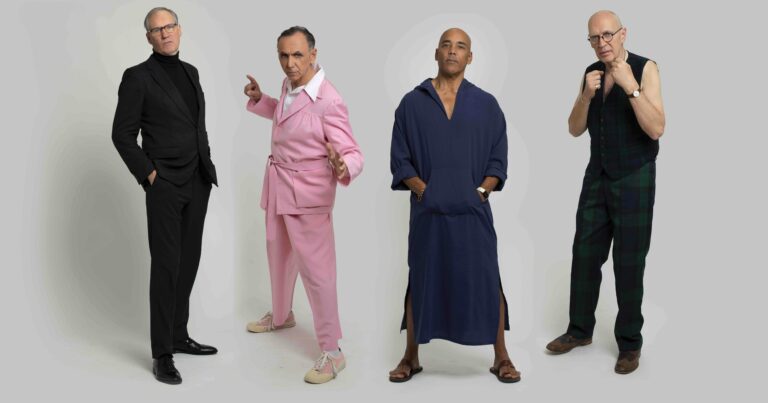
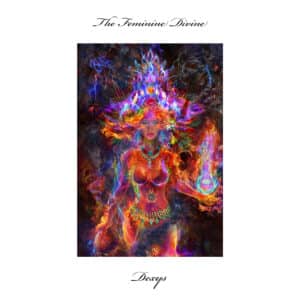
Dexys, the group formerly known as Dexys Midnight Runners, have announced their first album of original material in 11 years. The Feminine Divine will be out July 28. To celebrate the news, they’ve shared a new single called ‘I’m Going to Get Free’. “The character is optimistically breaking free from internalised trauma, depression and guilt,” Kevin Rowland said of the track. Check out its Guy Myhill-directed video and find the album’s cover art and tracklist below.
“It’s always just natural with me,” Rowland remarked in a press release. “The inspiration comes first, I think about what I can do, what songs I’ve got, then approach the band.”
The Feminine Divine Cover Artwork:
The Feminine Divine Tracklist:
1. The One That Loves You
2. It’s Alright Kevin (Manhood 2023)
3. I’m Going To Get Free
4. Coming Home
5. The Feminine Divine
6. My Goddess Is
7. Goddess Rules
8. My Submission
9. Dance With Me
Cheekface have dropped a new song called ‘Popular 2’. It’s the Los Angeles band’s second single of 2023, following January’s ‘The Fringe’. Check out a lyric video for it below.
“Even though I’m worried about the surveillance state that the government has set up, and many of us rightly think it’s a tool of state oppression, we still spy on our own friends and neighbors and total strangers through our own means that we’ve set up ourselves,” singer/guitarist Greg Katz said of the track in a statement. “And just like the government, we develop our own paranoiac theories about what those people are doing, but we’re really maybe just reflecting our own loneliness. Me and [bassist] Mandy Tannen wrote this little power pop tune about that little contradiction. Also, the guitar line in the verse is a little inspired by the verse guitar part in Van Halen’s ‘Panama.’ RIP Eddie.”
Mura Masa has shared a new single, ‘Whenever I Want’, via his own Pond Recordings. It arrives ahead of his scheduled performance at both weekends of Coachella later this month. Check it out via the accompanying video below.
Mura Masa’s latest album, Demon Time, was released last fall.
It’s easy to talk about pain and trauma when you’re making music. These days, it’s about as essential on the road to acclaim as pushing the boundaries of genre and having a sense of humour. You’ll see artists discussing these concepts abstractly, and then you hear the music and it’s just boilerplate; none of it feels particularly real, even if it comes from an honest place. Then there’s music that sounds raw but keeps its vulnerability perfectly obscured. It takes time and guts to pierce through that veil, and I’m impressed by any songwriter who reaches that threshold. But there’s a line between pain as an experience and tragedy as a story that still so few are willing to traverse. “Memory always twists the knife/ Nothing will ever be as vivid as the darkest time of my life,” Karly Hartzman, who leads the Asheville, North Carolina band Wednesday, sings wearily on ‘What’s So Funny’, almost as if admitting defeat. Yet their music – in the past more poised to amble through the darkness – now zones in on that blurry space in ways that are immediate, glorious, and totally arresting.
Rat Saw God, the follow-up to Twin Plagues and Wednesday’s Dead Oceans debut, is a triumph of razor-sharp focus, churning intensity, and natural ambition. By this point, the group – rounded out by guitarist Jake Lenderman, lap steel player Xandy Chelmis, and drummer Alan Miller – is so in sync that it sounds like they’re carrying stimuli through the same nervous system while eliciting different responses. In the ten seconds before we first hear Hartzman’s voice on opener ‘Hot Rotten Grass Smell’, all sensory receptors are activated, the loud signal waking the body into alertness. The first half-minute of ‘Got Shocked’ is spent reorienting after the shock and queasiness left over from the mind-melting catharsis of ‘Bull Believer’, the 8-minute single in which Hartzman delivers one of the most tortured and thunderous performances you’ll probably ever hear. “I’m told that I screamed and looked up/ Then I sat down and wept after the amp got unplugged,” she recounts.
Passed down from person to person: that’s one way a memory gets registered. Some of the ones on Rat Saw God are sourced from people in Hartzman’s life, yet she has a unique penchant for combining fact and fiction. ‘Quarry’ cruises through several households on a cul-de-sac, describing an imagined world that fits real stories like that of her dad accidentally burning an entire field of cotton and keeping it secret. ‘Bath County’ relays the scene of an overdose and distills it to its barest ingredients: “Drunken laughter/ Violence after/ Killing the heat/ Salt strips the pain.” No matter where they come from, these scraps add up to, if not a full picture, then a life lived on the edges – not just before and after the worst kicks in, but right in the thick of it.
Hartzman doesn’t shy away from memories that run closer to her core, but they spill out in more than one form. She offers fragments that are enough to provoke a reaction but negate any speculation about details; on ‘Hot Rotten Grass Smell’ they’re fairly isolated, ‘Formula One’ gets a little hazier, while on ‘Bull Believer’ they curdle into an epic, astonishingly heavy whole. Befitting its anthemic presentation, ‘Chosen to Deserve’ structures them into a rather straightforward account of her past – not for the listener’s sake, of course, but as a show of commitment to a romantic relationship. It’s the most grounded, life-affirming moment on the record, and its placement right in the middle could indicate a turning point.
Yet there’s no clear-cut division between past and present on Rat Saw God, and that’s perhaps Hartzman’s greatest achievement as a writer. Pieces of them both are scattered across songs, stirred up by some random occurrence and connected through basic instinct – often smell. “I ran like hell into the burning house/ It’d been too long since I had felt the sting,” she sings on ‘Got Shocked’. The song’s lyrics may seem muddled and disjointed, but the band consoles by summoning an electric current more uplifting than paralyzing (just listen to Lenderman’s leads, which seem to warp and weep alongside her). That weightless sensation culminates in ‘Turkey Vultures’, which spirals upward until her past is “a minefield beneath me.” As distant as it might seem, the damage cannot be erased: “At night I don’t count stars/ I count the dark.” After documenting all the unspeakable ways trauma continues to imprint itself, the broadness of the statement feels revelatory.
For all the darkness – the blurriness – that Rat Saw God digs into, what it drags along with it is never a lack of clarity. On the contrary, these mostly coming-of-age tales, lived or otherwise absorbed, have sharpened so many other senses. Throughout the album, Hartzman is acutely aware of irony, especially as it pertains to religion (“There’s a sex shop off the highway/ With a biblical name”), aligns humans with other animals (“Bird flies into the window every day at the same time/ It’ll never learn but it also wouldn’t die”), and, on songs like ‘Bull Believer’, fuses allegory and truth to striking effect. Hartzman’s descriptions never feel overbearing or exaggerated, but heightened in their reality. The blood stays fresh on the page but the pain takes on different dimensions. Comedy is an unintended consequence, not an antidote. It all blends together. It’s all real.
And in the strangest contradiction, it fosters an appreciation for the kind of beauty that remains undetectable by most. ‘TV in the Gas Pump’, the album’s closing track, is made up of images from life on the road that should induce anxiety, mirrored in the distorted, screeching guitars. They blare and brush past, but Hartzman keeps them behind, not beside her, as she retains a kind of wistful tenderness. She won’t get swept up in the debris, standing there to lay witness and remember, as if to say: What else could one possibly have asked for?
Throughout the week, we update our Best New Songs playlist with the new releases that caught our attention the most, be it a single leading up to the release of an album or a newly unveiled deep cut. And each Monday, we round up the best new songs released over the past week (the eligibility period begins on Monday and ends Sunday night) in this best new music segment.
This week’s list includes ’Hunter’, the lead single from Jess Williamson’s new album, an anthem of true yearning; Tyler, the Creator’s ‘DOGTOOTH’, a song from the deluxe edition Call Me If You Get Lost that’s both effortlessly boisterous and hopelessly romantic; Jason Isbell and the 400 Unit’s ‘Middle of the Morning’, a somber, introspective track written during lockdown; Hand Habits’ ‘Something Wrong’, which is musically playful and emotionally intimate yet full of heft; ‘Big Songbirds Don’t Cry’, a wonderfully melancholic track from Steve Ciolek’s debut LP as superviolet; Hannah Georgas’ pensive yet driving new song ’This Too Shall Pass’; The Beths’ ‘Watching the Credits’, an excellent one-off track recorded during the sessions for their last album; and ‘We’re in Love’, a heart-wrenching highlight from boygenius’ debut full-length.