Tyler Perry’s addictive series Beauty in Black shows no signs of slowing down. In fact, it only gets more scandalous. Season 3, now streaming on Netflix, raises the stakes to new shades of twisty, and no one seems safe as the show’s plot escalates.
By the time the final end credits roll, there’s a good chance you’ll be screaming at your screen, craving more. Is another installment on the way? Here’s what we know so far.
Beauty in Black Season 4 Release Date
Back in December, Netflix renewed the series for a third and “final” season. Turns out, that’s no longer the case. The platform reversed the decision and recently announced that Beauty in Black season 4 is a go.
“Beauty in Black is back for season 4, and the Bellarie family’s story is far from finished. There was so much more I wanted to explore, and I’m grateful I get to keep telling this story. To the audience that has been on this ride with us from day one, thank you for watching and sharing it with the world. More episodes are on the way!” Tyler Perry told Tudum.
As to when those episodes might drop, we don’t know just yet. Perhaps in early 2027?
Beauty in Black Cast
Taylor Polidore Williams as Kimmie
Crystle Stewart as Mallory
Ricco Ross as Horace
Amber Reign Smith as Rain
Xavier Smalls as Angel
Julian Horton as Roy
Steven G. Norfleet as Charles
Richard Lawson as Norman
Terrell Carter as Varney
What Could Happen in Beauty in Black Season 4?
Beauty in Black revolves around Kimmie, whose life turns complicated when she becomes entangled with the wealthy Bellarie family, owners of a successful beauty empire.
Behind their polished public image, the Bellaries are involved in some nefarious things. Before long, Kimmie finds herself caught up in family power struggles and dealing with criminal secrets. Her determination to escape poverty, however, fuels her as she navigates her new circumstances.
In season 3, Kimmie is in a good place, yet far from safe. In fact, several characters go through it over the course of the fresh batch of episodes. By the time the finale rolls around, the fate of major players is left uncertain. Without going into spoiler territory, it’s the kind of finale you immediately want to dissect with your friends.
As for Beauty in Black season 4, it will likely pick up from there, revealing who is still standing and what happens to the Bellarie empire moving forward. We can hardly wait.
Are There Other Shows Like Beauty in Black?
If you like Beauty in Black, shows with similar vibes include Empire, Scandal, Dynasty, and Claws.
In this segment, we round up the best albums released each month. From Phoebe Bridgers to L’Rain, here are, in alphabetical order, the best albums of August 2026.
Brennan Wedl, Brennan Wedl
Brennan Wedl has been putting out solo music since 2012, releasing two strikingly confessional records, Jersey Devil and Holy Water Branch, after relocating to Nashville. It was Snail Mail’s Lindsey Jordan who introduced the Minnesota-raised singer-songwriter music to Waxahatchee’s Katie Crutchfield, who would go on to produce Brennan Wedl with Brad Cook. Retaining the earnestness of her early outings, Wedl’s ANTI- debut is bolstered by sharp humour, dynamic instrumentation (including Jordan’s guitar playing on a couple of tracks), and no-holds-barred storytelling that make for a definitive musical statement. “This burning turns me into someone else,” she sings on ‘High Priestess’, yet firing up the record paints a picture of an artist who couldn’t sound more like herself. Read our Artist Spotlight interview with Brennan Wedl.
tiarn eels like waking up to the unsurety of dusk and treating its porous boundaries like a fresh start, not a natural conclusion: bountiful in its subtlety, ambient folk with an emphasis on folk, open to reinterpretation. Weaving in field recordings alongside contributions from an opera singer, a string quartet, and Forest Creek Folk, a local 60-person choir Stretton has since joined, it threads the needle between Hana Stretton’s nature-bound lonerism and a more community-oriented existence. Or maybe it simply blurs the line between the human and the non-human, careful with it all. Read our Artist Spotlight interview with Hana Stretton.
On her latest LP, Julia Holter lingers in the fluid, wondrous space of her previous record, Something in the Room She Moves, taking its bones and making something new out of them. In finding its way to the final recordings, the improvisational quality of these songs, some of which date back to lockdown, makes day-to-day survival feel like a daydream, suspended between domestic bliss and nationwide horror, homebound experiments and full-band production, a life at once sequestered, well-travelled, and twinned in that of your neighbour. Rearranging melodies, stretching out ideas, and conceiving fresh ones out of the well that produced Something in the Room She Moves, the new album is not only Holter’s most obvious but subtly illuminating effort in weaving magic out of the familiar, visions of abundance through minimalism. Read our inspirations interview with Julia Holter.
The Rose of Jericho, also known as the resurrection plant, is a spike moss that grows in dry deserts, surviving through adaptations that protect its cells during long spells of dehydration. Taja Cheek doesn’t often rely on physiological language in her music, which tends to be elliptical in its introspection, but she is palpably inspired by such natural phenomena, metaphors of resilience in an increasingly dreary world. Working once again with longtime collaborators Ben Chapoteau-Katz and Andrew Lappin, her new album feels like an extension of the shapeshifting musical world the singer-songwriter has built over the past decade while also prodding at its extremes. Between songs that dissolve in or rise from the ether, that assault or delight the senses, Cheek achieves a strange kind of equilibrium, thriving in an environment that should be hostile to any kind of creative endeavour, let alone such brilliance. Read the full review.
A couple of years ago, Kurt Wagner heard a simple song on the radio – a banjo playing a single chord, accompanied by a few voices – that would calibrate his next album, Punching the Clown. In a way, it sounds like a radical reconfiguration of the band, the kind of record that seems to wipe the slate clean. Yet Wagner’s approach, his tendency to vanish into the ether, hasn’t changed, nor has his close circle of collaborators. And if the AutoTune of previous years scanned as little more than a buddy of his, you could say the same about the choirs accompanying him on the new record. Yet for all its apparent naturalism, Wagner and company still find subtle ways to lend the songs a touch of the surreal, disrupting the embrace of sincerity, and offsetting its obvious reverence with a bit of humour at an age where it seems reserved for other forms of entertainment rather than people. In the mundane yet magical process of stringing it all together, Lambchop make the struggle feel a little more than personal. Read our inspirations interview with Lambchop.
One of the most gut-wrenching moments on Phoebe Bridgers’ first album in six years arrives when she finds herself walking early in the morning, awake before her significant other. “I don’t know why I’m crying/ Until we’re dead or die trying,” she sings. We know why we get into and out of bed; we have to. Why tears well up in our eyes is harder to rationalize, but there’s a reason “crying” is the first word on the album, and Bridgers keeps stirring us to the edge of it, just as she’s forced to reckon with our proximity to death. With Ethan Gruska, Jack Antonoff, Tony Berg, and Alex G splitting production duties alongside her, Lost Weekend is by far her dreamiest album, a miracle of sound design and imaginative world-building. In a way, these are songs she wrote while hiding off from the world, sleeping in, with “too much money and nothing to lose.” But they are also the mark of a great songwriter who, in grief and in love, wakes to the double-edged sword of existing unalone, and can’t help but brave through the thought of oblivion: forthrightly, ambitiously, and right before our eyes. Read the full review.
Squirrel Flower, Say a Prayer to the Gods of Getting Going
Ella Williams is not the only artist for whom songwriting feels like divine intervention. The way she infuses it in her work as Squirrel Flower, though, is singular, and no album in her discography is more striking in its reverence than her latest, Say a Prayer to the Gods of Getting Going. Instead of amplifying the muscular sound of 2023’s Tomorrow’s Fire, her previous record with producer Alex Farrar, the new album draws ethereal textures out of both its heavier and acoustic moments. After all, the spiritual worldview she outlines on the title track is not exactly dualistic: there are the gods of getting going and the gods of standing still, and growth requires sacrifices to both. The record speeds up and slows down with no cohesive logic, yet it bleeds together into a dynamic, heavenly portrait of a wandering heart. Read the full review.
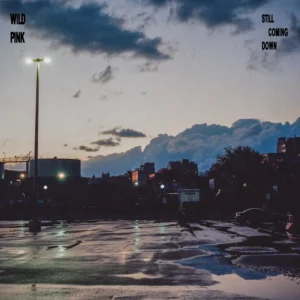
There’s at least one song on Still Coming Down that allows us to infer that John Ross has become a father, and it gives his latest Wild Pink album its title. “I used to be pure/ I just try to be good,” he sings, hinting at a quiet collapse of ego. There’s a natural weightiness marking the follow-up to 2024’s Dulling the Horns, whose embrace of baritone guitars steered the band’s sound in a gnarlier direction, but not an ounce of self-importance. Ross is keeping things simple: promoting the engineer who mixed the last LP, Alex Farrar, to the production role, and collaborating with a cast of friends he’s mostly met on the road. Fatherhood did end up having an impact on his process, if not much of the record’s lyrics: he’d stay up an hour or two after his wife and son went to bed and settle into a songwriting routine, putting on a beloved movie in the background. On Still Coming Down, he lets his weary mind drift off yet sounds more grounded and determined than ever. Read the full review.
Gen Z finally has a hangout sitcom that gets the formula right. Adults, which premiered in 2025 to positive reviews, just dropped its second season. Turns out, the growing pains are mostly gone, and the new batch of episodes scored a perfect 100% critic score on Rotten Tomatoes.
Even better, the audience seems smitten, too. If you’re into funny ensemble comedies about friends who genuinely care for each other, there’s plenty here to love. But is a third installment on the way? Here’s what we know so far.
Adults Season 3 Release Date
At the time of writing, there’s no official news about a potential Adults season 3. That said, a renewal might be just around the corner.
Critical acclaim aside, the show is getting a fair amount of online buzz, and season 2 leaves plenty of story threads open. We’re cautiously optimistic. If all goes well, new episodes could arrive sometime in mid-2027.
Adults Cast
Malik Elassal as Samir Rahman
Lucy Freyer as Billie Schaeffer
Jack Innanen as Paul Baker
Amita Rao as Issa Damani
Owen Thiele as Anton Evans
What Is Adults About?
Adults revolves around five twenty-somethings: Samir, Billie, Paul Baker, Issa, and Anton. They all live together in Samir’s childhood home and attempt to figure out how to become functioning adults. Naturally, they possess few of the skills required to do so.
As the show progresses, the friends deal with jobs, money, dating, sex, family, healthcare, social media, friendship, and the many ups and downs life throws their way. Luckily, they have each other to rely on.
The show is funny and timely, so there’s a good chance it will appeal to viewers of all ages. In its second season, the friends go through another series of mishaps, while relationships are put through the wringer. By the time the eight episodes come to a close, a new romance is blossoming, and an unexpected hook-up is sure to affect the group dynamic moving forward.
If it happens, Adults season 3 will likely pick up from there and explore whether these five people can remain best friends as their lives start moving in different directions. In the UK, the show is available to stream on Disney+.
Are There Other Shows Like Adults?
Fell in love with Adults? Shows with similar vibes include Not Suitable for Work, Friends, How I Met Your Mother, Broad City, New Girl, and Overcompensating.
On the opening track of her latest album Materia, Julia Holter delivers a quietly revelatory line about needing to “learn to make the sweetness stay.” Instead of trying to preserve the sensation by abstracting it, the artist lingers in the fluid, wondrous space of her previous record, Something in the Room She Moves, taking its bones and making something new out of them. In finding its way to the final recordings, the improvisational quality of these songs, some of which date back to lockdown, makes day-to-day survival feel like a daydream, suspended between domestic bliss and nationwide horror, homebound experiments and full-band production, a life at once sequestered, well-travelled, and twinned in that of your neighbour. Rearranging melodies, stretching out ideas, and conceiving fresh ones out of the well that produced Something in the Room She Moves, the new album is not only Holter’s most obvious but subtly illuminating effort in weaving magic out of the familiar, visions of abundance through minimalism. Whether you call it a companion piece or a sister record, it’s one of today’s most fantastically inventive musicians putting faith in the work of reimagination. Love it enough, and the sweetness hardly feels ephemeral.
We caught up with Julia Holter to talk about touring, the domestic setting, freeways, and other inspirations behind Materia.
The touring band
I was reading about how you were making ‘The Laugh Is in the Eyes’ in the middle of touring, which inspired you to make something new with your current lineup. I’m curious how the thought of being able to play these songs live factored into the process in a way that wasn’t so prominent before.
I was just in between tours, and I was like, “We should make another song. It would be cool to make a song.” I didn’t think a lot about it. I was just making something, and something that would work with the group and was fun to make. When I say I didn’t think a lot about it, I just mean I didn’t come to it with a lot of intention or put pressure on it. But I decided to record it and make more songs. I’ve always loved the bands that I’ve worked with. They’ve always been full of musicians that are great, and there’s, of course, also a lot of overlap – various people have been playing together for a long time with them. In this particular band, it was just four of us, but also Kenny [Gilmore], so it was really five – Kenny, who co-produced the record with me, doing sound. It was much more performance-oriented in some ways on this record – even in the solo tracks. The performance of ‘My Lost One’ is maybe one and a half takes. We just didn’t have time, but it also was great as it was. Usually, if I’m doing a record, I would have the time and do lots of takes, and then I would overthink.
I think that focus on performance is pretty important here, because if you compare it to Something in the Room She Moves – even though I didn’t have a lot of time on Something in the Room She Moves compared to Aviary, I think that record is very typical of my records. ‘Sun Girl’ is the most extreme of all the songs in terms of it not being a performance so much as a collage of sounds that we captured and that I put together and did heavy production. There’s heavy production on this material, too – I’m realizing something while I’m talking: Materia has this focus on the performance maybe more than usual, but there are actually elements of that with Something in the Room She Moves, too, because there’s ‘Talking to the Whisper’, and there are songs that we did record in that similar way where it was the rhythm section and myself, and that became the foundation of the song. But we had more time, and it created this slightly different focus than I usually have, which was a lot more about capturing an improvisation or performance on Materia. I guess it’s just more extreme on Materia.
I should name the people who performed on it: Beth Goodfellow on percussion, Devra Hoff on fretless bass, Tashi Wada on analog synths, and me playing a lot of Yamaha CS-60 and keyboards generally. And then there’s Maia, who plays flute on ‘My Lost One’, and Chris Speed, who is all over this record with both saxophone and clarinet. My friend Jessika Kenney sings on ‘Materia 2’. All of these people were a huge part of the sound on the record. Kenny was doing sound for the live shows, so because he knew the record, he was bringing it out live. We don’t have backing tracks live – sometimes Beth is playing samples, but it’s very much live.
What I’m getting at is this in-between space between performance and recording. Because we were doing this live, Kenny was doing the things we would normally do in production for the record, but applying those effects live. There becomes a blur between live performance and recording. In the past, I used to have a lot of separation between those things; I thought of live shows as completely different than a recording in energy and experience. But it became this connection between what was happening live and what we were doing on the record. It didn’t feel crazy to be like, “We recorded this, and tomorrow we’ll perform it.” I know that’s what everyone does, but sometimes to me, the difference between recording and live can be so vast. I guess for me it wasn’t so vast, but I’m not sure what the significance of that revelation is.
Trains and freeways
My mind went to ‘My Twin’ and that image of drifting to sleep while driving. Do you tend to come up with ideas when you’re literally on the road, or was it a part of the process in a different way?
It’s not very profound, but when we made the video for ‘Fantasy’ with Dicky [Bahto], for some reason ‘Fantasy’ needed to have a train in it. It just felt like a train song. I don’t think Dicky thought that way, but he obliged – looking out the window on a train, that image felt like how I wrote that song. I do spend a lot of time driving because I’ve been teaching music lessons – a class or two – at CalArts, which is about 30 to 40 minutes from where I live. Taking the freeway became really helpful for Materia, because I was listening to it in the car. I was really struggling with Materia, especially with the song ‘Fantasy’, and almost gave up on it many times.
It really helped to listen to it in the car. I tell my students to do this all the time now – if you live in New York City or don’t have a car, listen on the train or subway, just something moving. It helps contextualize the music. It helped a lot to listen to ‘Fantasy’ in particular, but generally Materia overall. Both ‘Fantasy’ and ‘My Twin’ were ones that I fussed with and struggled with a lot. ‘Fantasy’ is more complicated in terms of the content of what I was dealing with, while with ‘My Twin’, I was just trying to realize what it wanted to be production-wise. Listening to both of those songs on the freeway was helpful during those 35-minute drives. I’m not stuck in traffic, that’s the thing – if you’re stuck in traffic, it’s not fun. [laughs] But that kind of movement does something that helps you zoom out. It was helpful for me in making Materia because it kept me from getting frustrated and helped me realize what was working and what wasn’t. Driving up the freeway was kind of a guide for me.
Corrupt federal government
Again, my mind went to a specific line: “Blink at the light and hope to survive.” You singled that line out in talking about the song ‘Fantasy’ when it came out, and I was wondering if you could elaborate on that sentiment of “daydreams being scary in a fascist state.”
It was just what was going on when I was making something. This record was a specific thing, so it’s sort of hard to talk about the inspirations, and I’m just talking about what was going on in my head. A lot of people probably hate what I’m saying right now, but I feel like there’s always this question of whether your record is personal or political. I feel like it always is both. Art is always personal and political; it’s all in there. There is work that is explicitly political that is trying to send out a message, and I realize that, but we all come from a certain context and have certain experiences, and that makes it political in a way. And personal as well – we make choices out of our own personal experiences. So I don’t think there’s more personal music and less personal music. It might be that there’s more political music, but I think it’s all connected.
When I was finishing up Materia, it was the height of the ICE raids in LA, which are terrible now, too. I saw some things – there are lots of different ways to be involved, but one thing is observing, seeing what’s happening, and alerting neighbors to try to help people stay safe. It was very upsetting to see people being kidnapped by federal agents. It’s very disturbing, and our government just keeps pouring money into this.
I know this isn’t explicitly in my record, but that was happening while I was making it, and it’s sort of in there for me. In ‘My Twin’, the poetic idea behind it was not present in the original improvisation; that was developed over the past year when I was making it. I usually don’t talk about things in this way because I don’t want to impose on the listeners, but you can think of it as a duality of experience: my privileged experience of not being targeted and someone else’s experience of being targeted for their race, where their family came from, or the color of their skin. That’s an example of how you could experience that song, that split where people just have very different experiences, and it’s all kind of chance. Watching what’s going on in Gaza for the past three years has been really unbearable, just seeing my government dropping bombs on people. It’s hard for people to process when there’s this duality of experience, knowing that it could be you – why not?
It was an inescapable thing that was on my mind when I working on this record. Definitely the line that you mentioned from ‘Fantasy’ has an element of that: the feeling that no one’s safe when there’s an armed agent with a gun and innocent people are just standing there being shot. That human vulnerability in front of that kind of force is something we all should be aware of.
Touring
How do you differentiate the touring experience from the band as having an impact on the record?
I’ll be honest, I’m kind of a homebody and I get stressed about the idea of touring. But then once I’m on tour, it’s amazing. One of the things that’s special about touring is that you really learn the songs so well. You get so good at playing them because you’re playing them all the time. That’s something people who haven’t had the privilege to tour are really jealous of, and I get it – it’s really a luxury to be able to play so much and get really good at playing stuff. I’ve appreciated that on every tour, and my bands are always so great. This band was cool because it was smaller than my last band. The Aviary band was kind of my fantasy band; it was incredible, like having an orchestra on stage. It was really massive; for an artist my size, it was very ambitious to bring that many people on tour.
This band feels like a contrast. It’s much more focused. There were only four of us, but if you say there were five of us because of Kenny, there were seven of us in the Aviary band. This time around, it felt very tightly knit. Everyone in the band expressed that it felt focused in a nice way, solid, and fun in that tightness. Something about it being a smaller group made the sound production of the live show more of a thing than ever. And our kid was with us, which obviously makes certain things a little harder, but it was really fun, and she really enjoyed it.
Domestic setting
We mentioned daydreams, and I feel like the domestic setting is where they materialize on the record. Part of what struck me about your interpretation of ‘My Twin’ is domestic bliss feeling like a dream in that song. But I wanted to zero in on ‘Clepsydra’, which we haven’t talked about, because there’s something in there, too, about how home messes with your understanding of time.
Yeah, well, there’s the song ‘Something in the Room She Moves’ from that record, and that whole thing started in 2020 during the pandemic. I was very at home, like everyone else. The imagery there was actually me imagining being right where I’m sitting right now in my house, right by the window. I always think of this part of the house when I think of that song – it’s weird, I never realized that. There’s something about a green screen and a scene on the beach, so it’s like you’re transposing the beach into your room. That’s sort of what the pandemic was like – this constant bringing of the outside into the inside. That comes through a little on Materia as well. On ‘My Lost One’ I talk about that, but ‘Clepsydra’ and ‘My Twin’ are also from that same time period.
It’s kind of boring to talk about COVID now, and no one really wants to, but because parts of Materia date from 2020, it’s part of it. And yeah, time moves in different ways when you’re just at home, and the measuring of time, in terms of the lyrics in ‘Clepsydra’. I actually have another song from 2008 that is about this, too, called ‘Measure What More’. I just have a funny relationship with time as a person who’s late a lot.
Children’s books
You mentioned your child being on this tour, and I read about how reading children’s books at night specifically inspired ‘My Lost One’ lyrically. I’m curious if you could talk about that song, but also whether you find inspiration in that period of time after your kid falls asleep. I’ve talked to artists who really treasure that little pocket of time.
It was more extreme when my child was younger. Now I have a bit more time to work, but when you have a really young child – it depends on your situation, but this was the pandemic. But that time at night, it’s precious to have some time for yourself and to have space to think. There’s something funny about that time of night when I’m reading to Simone, my child. I’m a little delirious because I’m really tired, and I’m reading these really weird stories. [laughs] Then I go to sleep next to my child – not intentionally, but we fall asleep together afterward – and there’s weird stuff floating in my brain because children’s books can be very strange.
It’s really that simple, but also them being sometimes stories that I read as a kid – often not, but sometimes. There’s this thing of anthropomorphism, I guess that’s the word. It’s a big part of children’s stories, along with the superimposition of fantastical places onto the familiar. Where the Wild Things Are is a really good example, like trees growing inside houses. There’s a specific thing about children’s books that I’ve noticed and tried to bring out in ‘My Lost One’, which is that sing-songy element with nonsense syllables like a “do-we-do” or “la-la-la.” It has this kind of creepy quality.
Love
With love, there’s a parallel I can think of from the abstract to the more technical things, coming back to the performance focus of the record. Having my first long relationship with my partner, Tashi – we’ve been together as romantic partners for over 10 years now – and also having a child, you learn that in any long-term love, there’s a constant level of zooming in and zooming out. We change as people, and how our love can exist through change – we change in different ways as individuals, but we still love each other. Families are so fraught, people have horrible family relations – I love my family, but I’m 41, and I know a lot of family dynamics. Love is so hard, and having a child comes with a lot of challenges.
To me, having a sense of improvisation is actually a useful skill that musicians have to live their lives. To be able to accommodate change, or the struggles of having a newborn; postpartum depression that people have after they give birth, all these things that are really hard on relationships, and also make it hard for your relationship with your baby at first. All those challenges in love are so much a part of love. To me, it’s similar to music with improvisation: you learn to work with what’s there and engage with it. I think that’s why I’m appreciating Materia so much. I feel like I put a lot of love into it. It’s not really a qualitative statement; I’m not saying I think it’s a brilliant piece of art – it’s just something I made. I’m not building it up, but I feel love for it because I think it was at a place where I wasn’t happy with it, and then I worked with it and found a way. Like, “Oh wow, there’s something new here. I’m making something meaningful.”
Sometimes people ask me, “How do you know a song is worth keeping and working with?” It’s a really hard thing. I talk about this with students a lot; it is hard. I had this with ‘Fantasy’. I had these conversations with a friend who’s a writer, and she hadn’t heard the song, but she was like, “What you’re describing to me sounds kind of like this thing where I call it ‘polishing a turd.’ [laughs] You keep trying with something, but it’s not working.” There was a point with ‘Fantasy’ where I was like, “I don’t think this is working.” But I had this feeling every time I’d hear the riff, and I was like, “I do believe in it, though. I think this is special.” It sounds really cheesy, but it’s true. I realized I needed to process it a certain way, so I did some reverb stuff with it, and I sent it through just the right thing that made it sound just the right way, and it finally worked. Technically, it was a timbral thing that was bugging me. Sometimes it’s a compositional thing for people. There can be a lot of structural issues with a song.
Sometimes it’s not worth doing, and sometimes it is. I feel like it’s a good thing to have in life, too, where it’s like, do I want to be with this person, or do I want to maintain my relationship with my difficult cousin? Maybe I’m just trying to connect life and art a little too much, but I think it’s true that with deep love, you enjoy trying new things with it and working with it. Learning from each other, like in the case of my relationship with Tashi – he and I are both artists, so we’re always talking. We work together a lot in music and we grew from a similar time period in LA. He also has a whole back history with art, even from childhood, growing up around it, which is separate from me. But as adults, we grew up in LA as artists, and I can’t help but connect those things with our relationship.
Simone Forti, who I know through Tashi, is an artist who just passed away, who we were close with. Maybe she brings out this thing I’m trying to explain, connecting improvisation with love somehow. Not forcing it, not trying to impose abstract ideas onto movement, in her case, or art in general, but this elemental connection between improvisation and life and love is really well articulated in her work. That’s been on my mind a lot as I’m reading her biography right now, and there are elements of what I’m talking about on that record that are why I appreciate it.
This interview has been edited and condensed for clarity and length.
The world has gotten noisier. Family problems. Work stress. Societal concerns. Personal dilemmas. Many factors make our minds restless. And in one way or another, we’ve all heard about meditation. TheAmerican Psychological Association even notes that it helps improve mental and physical health. Unfortunately, many still don’t practice meditation – either due to lack of time or skepticism. Because meditation sounds simple until you actually sit down, close your eyes, and breathe. That’s where AI tools for meditation are making a shift.
But with so manyAI tools on the market, finding the best ones can just be another reason for your headache. So this article saves you from trial and error. It lists the essential picks that either generate a meditation for your exact moment or make it easier to find the right practice among thousands of existing options.
Top Five Best AI Tools for Meditation
Aura
Aura dubs itself as the Spotify for mental health and wellness. Why so? It houses an expansive library of tracks that people can use for mindfulness meditation. And it doesn’t only offer expert-led resources. The app also brings AI-driven personalization. Users describe their personal needs, and Aura provides tailored plans based on expert insights. Beyond that, the tool learns user patterns over time through adaptable sessions. What’s more, it offers content for hypnosis, sleep, therapy, and other wellness resources.
Key Features:
Extensive community hosting live sessions with coaches and therapists
Guided sessions for stress, sleep, and relaxation
Preference-learning personalization
Pricing:
Free Package
Individual Premium Package – $69.99 per month
Family Premium Package – $129.99 per year
Real Use Case:
Filmmakers dealing with a stressful shoot can open Aura during a lunch break. With personalized recommendations that narrow down an appropriate option, they can get a short meditation designed around relaxation.
Vital AI
Image Credit: Vital AI
Vital AI generates a brand-new, spoken meditation session in real time. And the process is straightforward. The app works with whatever the user enters through a prompt. Specific worries. Tough conversations coming up. Sleep troubles. Another offering that gives it an edge over similar tools is customization. People get to pick among several voices, meditation techniques, background music, and duration. In other words, Vital AI gives users a session built around their exact situation. Not the closest pre-made match.
Key Features:
Personalized wellness guidance through meditation and exercises
Conversational approach to wellness support with automated suggestions
Save sessions for later replay
Pricing:
Free Trial
Monthly Package – $9.99 per month
Real Use Case:
Employees dreading a difficult conversation with their manager the next morning can rely on Vital AI. They can type the exact situation and get a session built around that specific scenario.
Headspace
Headspace is one of the most established names in meditation. Its strong reputation comes from its huge meditation library. It covers beginners and experienced users, with sessions focused on stress, sleep, focus, and everyday mindfulness. But in 2024, Headspace introduced Ebb. An empathetic AI companion that offers reflective prompts and can point people to relevant Headspace activities and content in real time. As an added benefit, Ebb can also be used for meditative conversations.
Key Features:
More than 1000 guided meditations
Dedicated CBT Mood and Anxiety program
Built-in AI conversational support
Pricing:
Free Trial
Monthly Package – $12.99 per month
Real Use Case:
College students coming home after a long day can use Headspace to decompress. They could ask Ebb for support and follow a short stress-relief meditation. All without committing to a complicated routine.
Wellness AI
Image Credit: Wellness AI
Wellness AI allows people to interact with its AI assistant. This provides 24/7 support grounded in ACT, CBT, DBT, and mindfulness. Through conversations, users can talk through what’s bothering them. The AI then generates a fresh meditation session that covers the exact issue. Not just a relevant, pre-recorded track. Customization is also possible. Wellness AI lets users pick the voice, background audio, and length. Another highlight is that it remembers conversations and adapts suggestions to learned preferences and needs.
Key Features:
Broad library of evidence-based guides for mental wellness
Bridging conversation and practice in one place
Personalized AI wellness recommendations
Pricing:
Free Trial
Premium Membership Package – $7.99 to $14.99 per month
Real Use Case:
Although fulfilling, taking care of the kids can be stressful. With Wellness AI, parents can find a quick meditation after putting their children to bed. Describe the situation and get a recommendation that turns a busy evening into a calmer night.
Insight Timer
Insight Timer holds one of the largest meditation libraries in the category. We’re talking about hundreds of thousands of tracks from psychologists. Users can find everything they need for wellness, from meditations, courses, and breathwork to sleep content and mindfulness exercises. One feature worth noting is its AI-powered conversation partner called Reflect. It allows Insight Timer to explore people’s thoughts and feelings. Plus, an AI recommendation that acts as a digital librarian, suggesting content based on user-set intentions.
Key Features:
Guided meditations with 350,000 tracks
Dedicated AI companion that helps surface relevant content
AI-powered filtering based on stress, focus, and time
Pricing:
Free Trial
MemberPlus Package – $9.99 per month
Real Use Case:
Beginners can turn to Insight Timer when they’re unsure which approach is right for them. The app lets them experiment with mindfulness meditation, breathing exercises, or body scans to discover what works.
Choosing the Top AI Tools for Meditation in 2026
No. Meditation doesn’t have to be demanding. In 2026, starting your practice can be as simple as spending a few minutes with the right apps. AI tools for meditation that provide sessions that better match your mood, schedule, experience, and goals. They help a restless mind slow down.
Vital AI and Wellness AI generate sessions around your specific situation. Aura, Headspace, and Insight Timer use AI to guide you through a massive library. The bottom line: the smartest choice depends on whether you want something built for your exact moment or a smarter way through an existing library. But at the end of the day, none of these replace professional care.
Jonathan Ryan (b. 1989, Buffalo, NY; lives in Los Angeles, CA) received his BFA from Louisiana State University and MFA from the Tyler School of Art at Temple University. Ryan has exhibited across the US and Europe, including solo shows at Megan Mulrooney (Los Angeles, CA), the Landing (Los Angeles, CA) and Hesse Flatow (New York, NY). He has also been in group exhibitions at Monti8 (Latina, Italy), Andrea Festa Fine Art (Rome, Italy), Gerhard Hofland (Amsterdam), Hesse Flatow East (Amagansett, NY), la BEAST gallery (Los Angeles, CA), Ekru Project (Kansas City, MO), Good Mother (Los Angeles, CA), Tiger Strikes Asteroid (Los Angeles, CA), The Brand Library (Glendale, CA), Field Projects (New York, NY), and the Woodmere Art Museum (Philadelphia, PA). His work was recently included in “Altered States in the Acid West” at the Utah Museum of Contemporary Art. Ryan has received fellowships and awards from Woodmere Museum of Art, Tyler School of Art, Vermont Studio Center, and LSU School of Art.
Jonathan Ryan: The Hour of the Pearl will be on view from September 12 – October 24, 2026 at Megan Mulrooney Gallery, Los Angeles.
Could you start by telling us a little about your background and how you first found your way into painting?
I’ve been drawing and painting since middle school, starting out by copying cartoon characters and artworks from books. I grew up in a low-income household in rural Louisiana, without access to museums or anyone who could introduce me to contemporary art. But my parents and teachers noticed and supported my interest, and I went on to study painting in college. I was always drawn to art, but it wasn’t until my senior year of undergrad that I truly identified as a painter and committed to it as a career — before that, I was weighing art-adjacent paths like museum studies or animation. I continued on to graduate school for painting, but the real turning point came after graduating in 2014, when I moved to Los Angeles and rented my first real studio. I’d identified as a painter in grad school, but this was the moment I felt truly independent — no institution behind me, just me figuring out how to build a life and career as an artist.
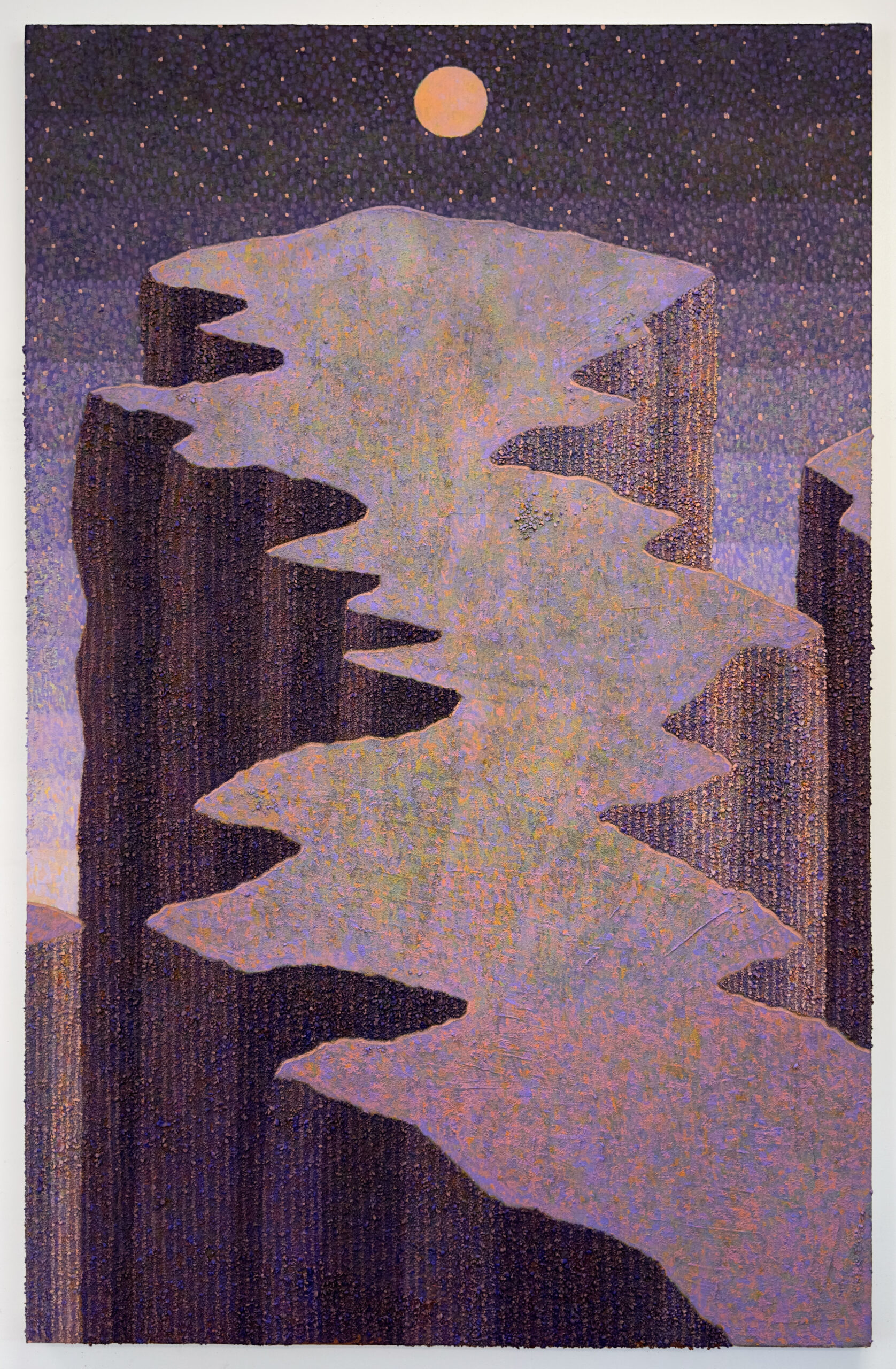
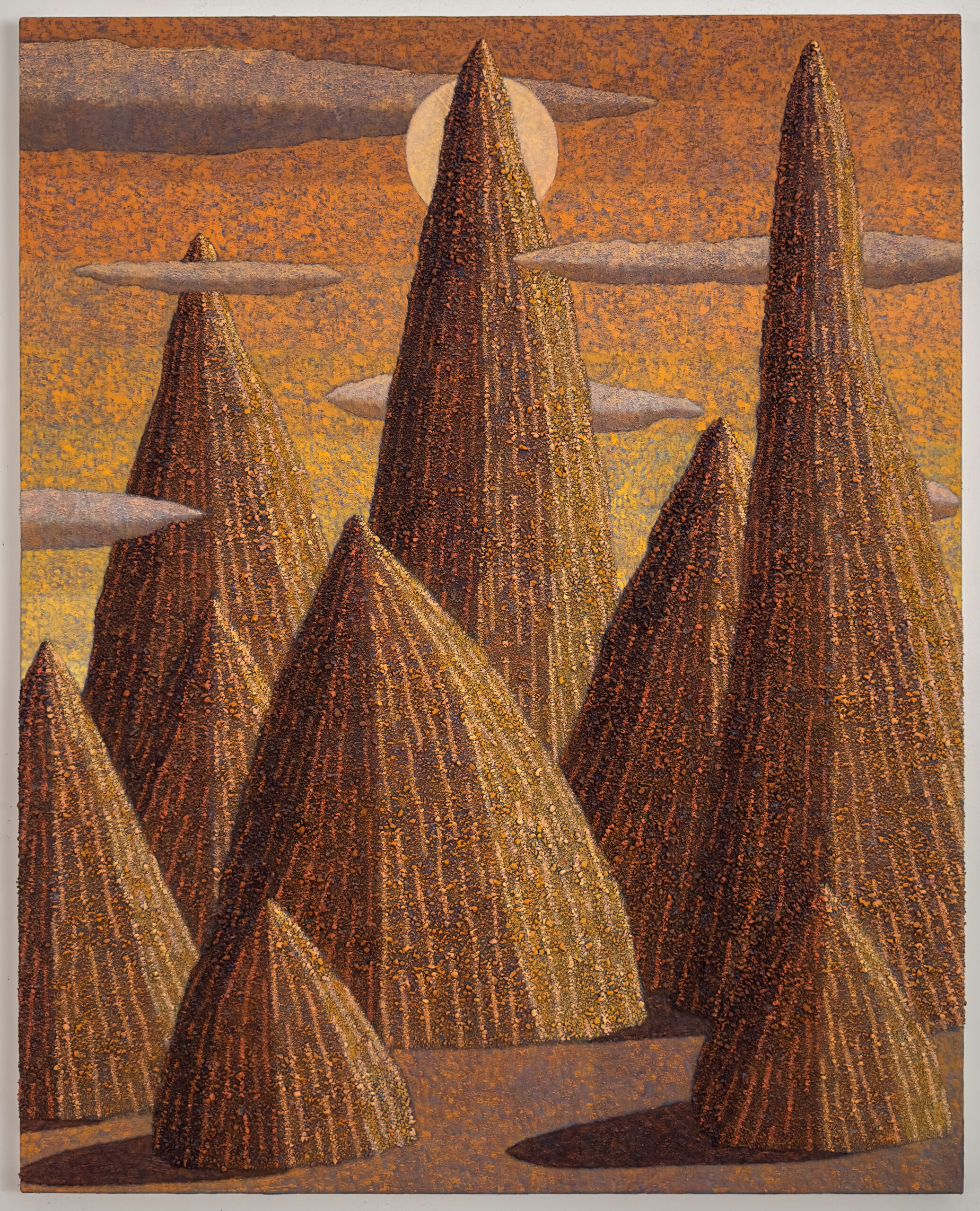
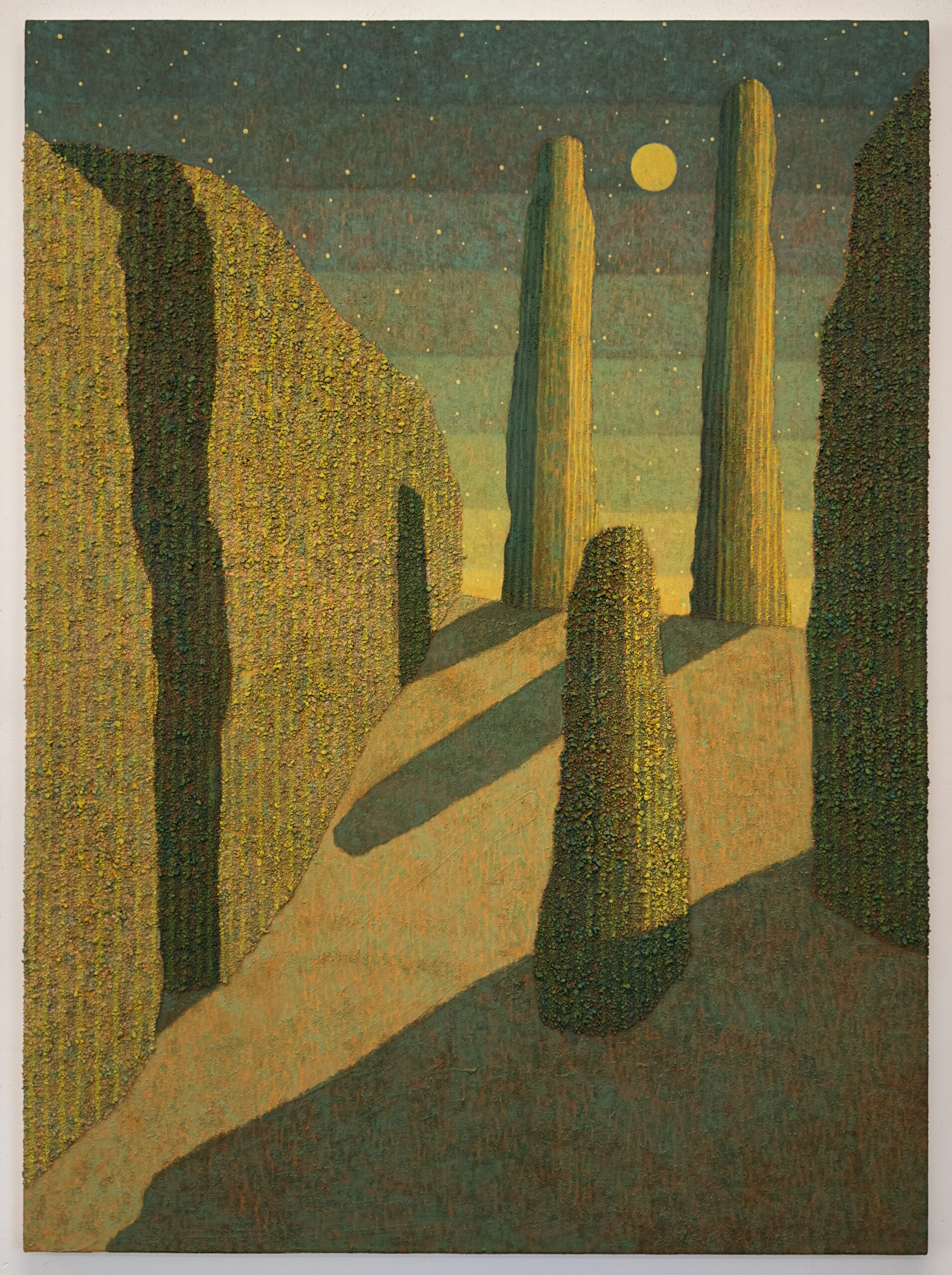
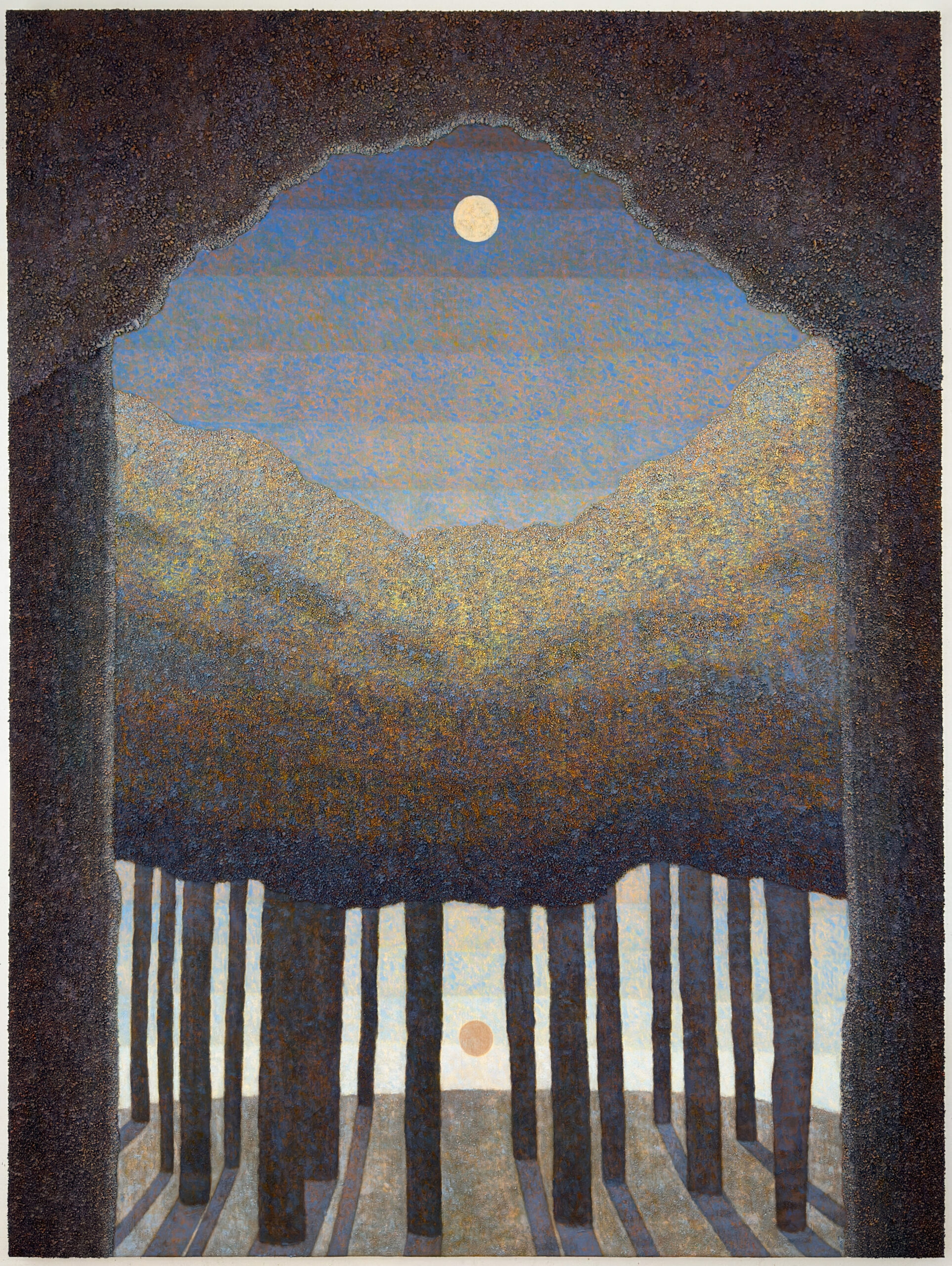
Jonathan Ryan Beacon, 2026 Oil, sand, and decomposed granite on canvas 78 x 50 in 198.1 x 127 cm Courtesy of the artist and Megan Mulrooney Gallery, Los Angeles.
How has living in LA affected the way you think about landscape?
I arrived in Los Angeles on a motorcycle, after a road trip from Philadelphia through the southwest and beyond. The landscapes and coastal light had a deep impact on me, and I immediately began making drawings and paintings of my surroundings. But LA is also full of great artists who’ve had some version of that same experience, and that made me feel like a very small fish. It was a tough realization — after about a year in, I had to admit I wasn’t excited by the work I was making, even with all that inspiration around me. So I reset my practice and started making major shifts in how I worked, which pushed me in new and exciting directions that eventually led me to where my work is today.
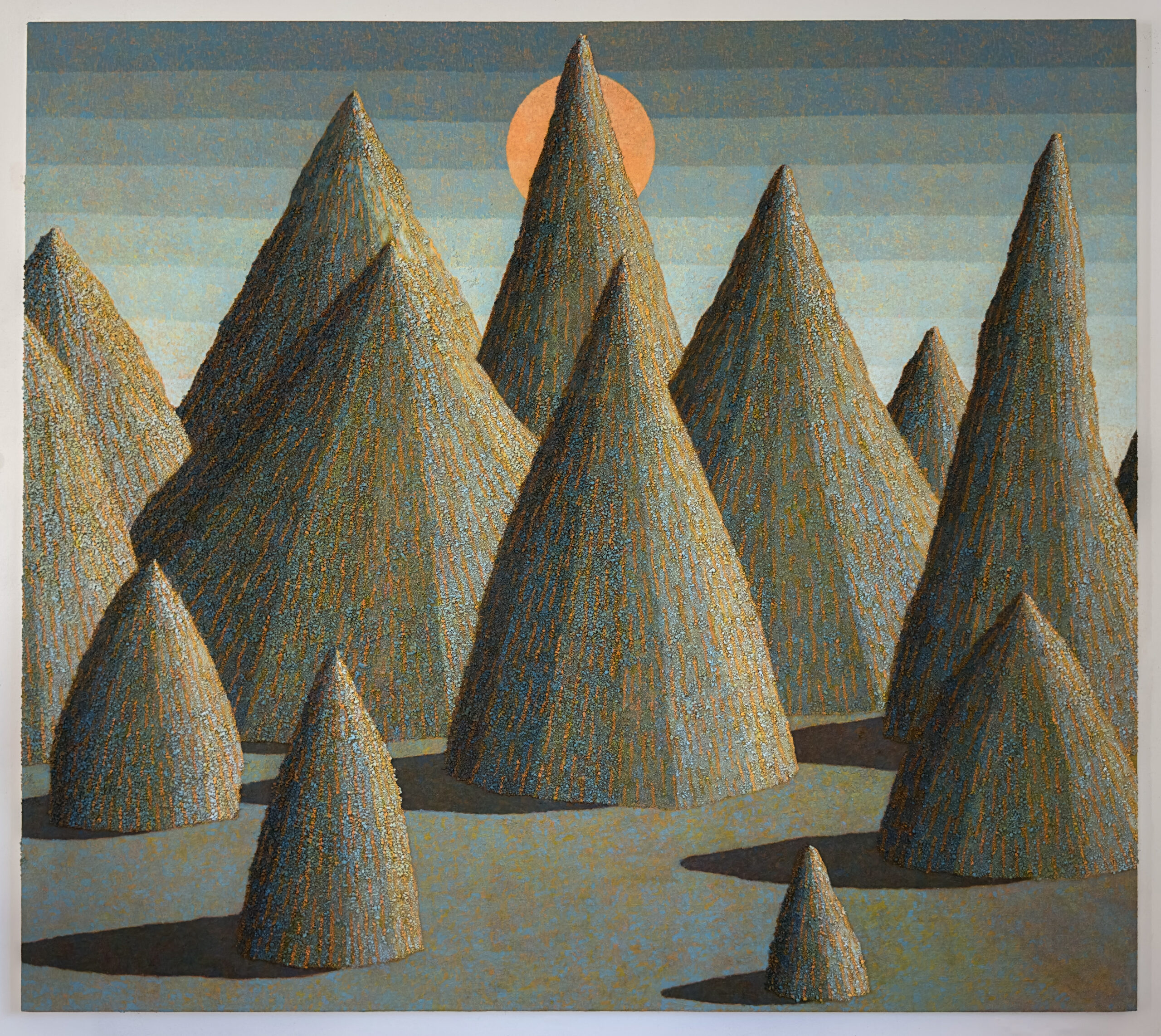
Jonathan Ryan Citadel, 2026 Oil, sand, and decomposed granite on canvas 80 x 90 in 203.2 x 228.6 cm Courtesy of the artist and Megan Mulrooney Gallery, Los Angeles.
You incorporate sand and pulverised granite directly into your paintings. How did you first arrive at this process and what does it allow you to achieve that conventional painting doesn’t?
During that “reset,” I started experimenting with all kinds of new materials on the surface of my paintings. Nothing quite worked until I poured some sand from my garden onto a piece I was struggling with. I liked the texture and quality to the surface it added without overtaking the image. That was about ten years ago, and now every painting I make starts with layers of sand and small rock adhered to the surface. This surface dramatically slows me down, forcing a more methodical approach — I have to paint slowly in thin layers, each one influencing the next. Over the past decade, I’ve developed my own language for working with these materials, which has been an important step in finding my voice and confidence as an artist.
Jonathan Ryan Gilded Spires, 2026 Oil, sand, and decomposed granite on canvas 60 x 48 in 152.4 x 121.9 cm Courtesy of the artist and Megan Mulrooney Gallery, Los Angeles.
Early Atari games seem to have influenced the visual language of your landscapes. What initially attracted you to those digital environments, and what do you think they share with painting?
Not quite Atari — those graphics are a bit too basic — but a few years back, I made a body of work looking at landscape imagery from early-90s arcade and video games, among other source material. I was drawn to how the designers built these functional, explorable worlds, and I had fun bringing some of that into my own landscapes for a time.
Your recent work also draws on German Romanticism, which seems worlds apart from 90s video games. How do those two influences meet in your practice?
One of the things I love about painting is how relevant historical examples can feel to a contemporary artist and audience. I often begin drawing studies by sitting down with a stack of artist monographs and history books — lately I’ve found myself returning most to Giorgio de Chirico and Monet. I wouldn’t say German Romanticism is a defining reference for this work, though there’s certainly some compositional influence from Caspar David Friedrich in some of these paintings. As for the video game imagery, that’s not something I’m looking at for the paintings I’m making now, but I’ll absorb any image into my practice if it connects with me, whether it comes from a museum, film, photograph, or anywhere else.
Jonathan Ryan Enigma of a Night, 2026 Oil, sand, and decomposed granite on canvas 60 x 44 in 152.4 x 111.8 cm Courtesy of the artist and Megan Mulrooney Gallery, Los Angeles
Your exhibition takes its title from John Steinbeck’s Cannery Row and its description of the “hour of the pearl”. What resonated with you about that particular passage?
This passage describes a time in the early morning, before the sun has risen. Light has begun to illuminate the landscape, but the atmosphere is hazy, still, and quiet. It’s a time of reflection but also quick and fleeting. I connected with the tension in that passage and the visual depiction it conjures. The Hour of the Pearl is a haunting, beautiful phrase that resonated with me the moment I first read it in the studio, and the closer I looked at the whole passage, the more it felt like a perfect fit for the work I made for this show.
Jonathan Ryan Hour of the Pearl, 2026 Oil, sand, and decomposed granite on canvas 80 x 60 in 203.2 x 152.4 cm Courtesy of the artist and Megan Mulrooney Gallery, Los Angeles.
Are there any artists or artworks that have felt particularly inspiring to you lately?
The artists I’ve felt a close connection to lately are Giorgio de Chirico, Ken Price (his drawings of Southern California landscapes in particular), Monet (especially the Rouen Cathedral series), and Caspar David Friedrich.
Early in his career, Peter Dinklage made a point of avoiding the stereotypical roles often offered to actors with dwarfism. The move proved wise. While Dinklage struggled a bit to break through, he now has a diverse filmography and a solid reputation as a dramatic performer.
Additionally, thanks to the massive success of Game of Thrones, he is a household name. His net worth should be considerable, right? Here’s what we know about the actor’s earnings.
Most of it is thanks to his acting career. Dinklage fell in love with the craft at a young age. His screen debut came in 1995 in independent comedy Living in Oblivion. It was followed by roles in films like Bullet, Safe Men, Human Nature, and 13 Moons. The actor caught a break in 2003, after being cast in The Station Agent. That same year, he showed his comedic side as a children’s author in Elf.
During the 2000s, Dinklage moved between independent dramas, comedy, and fantasy. You might have seen him in Find Me Guilty, Death at a Funeral, Underdog, Penelope, or The Chronicles of Narnia: Prince Caspian. He also appeared in several TV episodes.
His career changed dramatically in 2011, when he started playing Tyrion Lannister in HBO’s Game of Thrones. The character became a fan favourite, and Dinklage won four Emmys for the role.
Thanks to Game of Thrones becoming a global phenomenon, Dinklage’s star also began to rise, and he became a Hollywood fixture. He voiced characters in Ice Age: Continental Drift and The Angry Birds Movie, had roles in X-Men: Days of Future Past and Pixels. He also earned acclaim for more serious work, like Three Billboards Outside Ebbing, Missouri.
In 2018, Dinklage joined the Marvel Cinematic Universe as Eitri, the giant dwarf blacksmith in Avengers: Infinity War. That same year, he starred in HBO’s My Dinner with Hervé, a project he also helped develop and produce.
More recently, the actor continued to mix mainstream films with character-driven work. His credits include I Think We’re Alone Now, I Care a Lot, Cyrano, She Came to Me, Transformers: Rise of the Beasts, The Hunger Games: The Ballad of Songbirds & Snakes, The Toxic Avenger, The Thicket, Brothers,Wicked, and Roofman.
Additionally, Dinklage appeared in plays and in TV series Dexter: Resurrection. Besides acting, the actor co-founded a production company, Estuary Films.
Peter Dinklage Salary
Actor salaries are typically kept under wraps. That said, five Game of Thrones actors, including Dinklage, made headlines when they negotiated a fee of around $1.2 million per episode for the final season of the series.
While independent movies offer smaller paychecks, Dinklage also appeared in massive franchises. It’s safe to assume that hiring him doesn’t come cheap.
This year, fans can catch Dinklage in comedy Idiots, currently in cinemas. He will also appear in upcoming fantasy rom-com Wicker. Next up, he’ll play The Fool in Lear Rex, a drama adapting William Shakespeare’s King Lear.
Taylor Sheridan is a household name at this point. After the massive success of Yellowstone, he created hit after hit, focusing on high-stakes stories and morally complex characters. Lioness, available on Paramount+, is no exception.
Currently in its third season, the series opened with 7.1 million viewers in seven days, outperforming the previous installment. Does that mean more episodes are on the way? Here’s what we know so far.
Lioness Season 4 Release Date
At the time of writing, no official news is available about Lioness season 4. That said, we’re cautiously optimistic.
Viewership numbers are solid, and all signs point to a renewal. “We’re going to get a season 4. We will, we will. When people see what [Sheridan] wrote for the finale, we are getting a season 4. Or I will pay you $100,” actress and producer Jill Wagner said in an interview.
It looks like season 3 will end on a cliffhanger. As long as the actors continue to be available, the show won’t end anytime soon. New episodes could arrive in 2027 or 2028.
Lioness Cast
Zoe Saldaña as Joe McNamara
Laysla De Oliveira as Cruz Manuelos
Dave Annable as Dr. Neal McNamara
Jill Wagner as “Bobby”
LaMonica Garrett as “Tucker”
James Jordan as “Two Cups”
Austin Hébert as “Randy”
Jonah Wharton as “Tex”
Hannah Love Lanier as Kate McNamara
Genesis Rodriguez as Josephina Carrillo
Nicole Kidman as Kaitlyn Meade
Morgan Freeman as Edwin Mullins
What Is Lioness About?
Originally titled Special Ops: Lioness, the espionage thriller follows CIA agent Joe McNamara. She runs an elite program that uses female operatives to infiltrate terrorist organisations and other dangerous targets. In short, Joe and her superiors recruit women able to get close to powerful figures.
Each season revolves around a Lioness mission while continuing Joe’s story. The first follows a Marine who targets the family of a terrorist financier. The second introduces an Army helicopter pilot recruited for an operation involving a Mexican cartel.
Season 3 ups the ante and turns Joe herself into the target. Split into two timelines, it kicks off with Joe being kidnapped and only becomes tenser from then on.
While it’s a bit early to speculate about Lioness season 4, there are still a few more season 3 episodes to look forward to. The finale is scheduled for September 20. Depending on what the cliffhanger is, we hope we get to find out how Joe’s story continues.
In cinema, visual imagery usually grabs the immediate spotlight, but it is sound that quietly dictates the emotional truth of a scene.
This audio craft is the heart of the work of Minjia Du, a Los Angeles-based sound engineer whose technical skill and story instincts have earned her work recognition in the film industry. Working across location recording, sound design, dialogue editing and re-recording mixing for films and vertical drama TV series, Du belongs to a group of audio professionals who manage the complete acoustic pipeline from set to final mix.
Her work has earned official selections at key film festivals, including the 30th LA Shorts International Film Festival and the Glendale International Film Festival. Du served as the Supervising Sound Editor on The Last Coin—selected by both LA Shorts and Glendale—and as the Production Sound Mixer on Fortune House, an official LA Shorts selection.
Alongside her festival work, her audio design supports major commercial hits, from viral serialized dramas on DramaBox and DramaWave that have drawn over 211 million views to ad campaigns for international brands like EcoFlow.
For Du, sound engineering goes well beyond basic technical setup; it acts as a direct extension of a film’s perspective. “I often think of sonic texture as production design for the ear,” Du says. “Just as a production designer chooses materials, colors, and objects to reveal the history of a space, sound can tell us what a place is made of, how it has been used, and how it feels to the person entering it.”
Her approach treats physical sets like living parts of the story. Rather than filling scenes with generic background noise, she picks specific physical details, the distant hum of an elevator, air pulling through an old vent, or footsteps changing across different floor materials.
When characters go through intense moments, Du shifts the spatial perspective to match their internal state. “Two characters may occupy the same room but experience it very differently,” she notes. “If one character is anxious, the surrounding ambience might gradually recede while a small repetitive sound becomes unusually prominent. The physical location has not changed, but the audience has moved into that character’s attention.”
Protecting the actors’ performances remains her top priority during production and editing. In dialogue-heavy or noisy environments, Du makes sure technical convenience never gets in the way of a genuine delivery.
“My first principle is that an actor should not have to sacrifice a truthful performance simply to solve a technical sound problem,” she explains.
On set, she records isolated tracks and room tones so intimate, whispered moments stay natural without having to rely on automated dialogue replacement (ADR) later. “During dialogue editing, I begin with the take that contains the most truthful performance, not automatically the cleanest one,” adds Du. “Excessive noise reduction can remove breath and vocal texture, making an emotionally vulnerable performance feel artificial.”
Having two films selected for LA Shorts points to how easily her workflow spans both on-set production and post-production studios. “These selections are meaningful because they recognize two different sides of my work,” Du says. “One began with protecting the performances on set; the other continued through the construction of the film’s final sonic world. Seeing both recognized reinforces my belief that production sound and post-production should be treated as one continuous storytelling process.”
When working on films that blend reality with stylized sequences, Du alters reverberation, shifts Foley timing, or bends environmental sounds to signal psychological changes before the camera cut even happens.
“I do not treat reverb as a button labeled ‘dream,’” says Du. “It represents space, memory, isolation, or time, depending on how it is shaped.”
With an international career in film making her mark in a field where women have long been underrepresented. Du stays focused on how the industry is changing. Alongside her own projects, she speaks openly about the need for clearer paths and mentorship for women entering audio departments.
“Improving the situation requires more than celebrating a few successful women; it means providing early access to equipment, paid entry-level opportunities, meaningful mentorship, safer working environments, transparent hiring practices, and a genuine path toward leadership,” Du notes. “I do not want to be hired only because I am a woman, but I also do not want competence to be assumed male by default. My hope is that being visible in this field makes the next woman entering a sound department feel less like an exception.”
Looking ahead to future director collaborations, Du is drawn to complex, cross-cultural, and psychological stories where sound carries what characters leave unsaid. “The directors I most want to collaborate with are those who invite sound into the conversation early,” Du says. “Ultimately, I am looking for collaborators who are curious—people who do not ask only whether a scene sounds clean, but what sound can reveal that the image cannot.”
What happened in the years before Star Trek: The Original Series? Star Trek: Strange New Worlds provides some answers.
The show, which premiered in 2022, starts roughly a decade before the original. It follows Captain Christopher Pike and the crew of the starship Enterprise as they make their way through the galaxy.
The series has gotten positive reviews so far, with veteran fans also excited about the storylines and overall tone. Season 4 is currently streaming on Paramount+, with episodes arriving weekly. Are there more installments on the way? Here’s what we know about the show’s future.
Star Trek: Strange New Worlds Season 5 Release Date
The good news is that Star Trek: Strange New Worlds season 5 is on the way. The bad news is that it will be the show’s last, and will only consist of six episodes.
That said, the advance notice likely allowed the behind-the-scenes team to craft a satisfying ending. If all goes well, the final episodes will arrive in 2027.
Star Trek: Strange New Worlds Cast
Anson Mount as Christopher Pike
Ethan Peck as Spock
Jess Bush as Christine Chapel
Christina Chong as La’An Noonien-Singh
Celia Rose Gooding as Nyota Uhura
Melissa Navia as Erica Ortegas
Babs Olusanmokun as Joseph M’Benga
Bruce Horak as Hemmer
Rebecca Romijn as Una Chin-Riley / Number One
Martin Quinn as Montgomery “Scotty” Scott
What Could Happen in Star Trek: Strange New Worlds Season 5?
The action follows Captain Christopher Pike and his crew in the years before James T. Kirk takes command. Alongside Pike are future Star Trek legends like Spock, Number One, Uhura, and Dr. M’Benga. Newer characters such as La’an Noonien-Singh and Erica Ortegas are also part of the mix.
As for format, the show largely adheres to Star Trek’s classic episodic take. In other words, you tune in as the crew encounters strange planets and alien civilisations, facing moral dilemmas aplenty along the way. One of the best things about the series is that it’s not afraid to get strange and try on different genres.
In season 4, episodes touch on horror, light comedy, and noir. The crew is even turned into puppets at one point. As we’ve said, strange. Star Trek: Strange New Worlds season 5 will probably continue in the same vein, while also bringing the story right up to Kirk’s first day in command of the Enterprise.
“I would say they’re a suite. They’re a set of episodes. I think they are tonally more singular than is typical for us. I think they’re driving towards the obligation that we felt from the beginning of the show, which is how do we deliver the characters that have been with us to their known future, and how do we deliver those characters that we know less or don’t know at all to their futures?” co-showrunner Akiva Goldsman said when asked about the final six chapters in the story.
Until then, season 4 is still ongoing, with episodes arriving weekly on Paramount+. The finale will drop on September 24.
Are There Other Shows Like Star Trek: Strange New Worlds?
If you enjoy Star Trek: Strange New Worlds, check out the other series in the Star Trek franchise. Star Trek: Starfleet Academy came out earlier this year.





 tiarn eels like waking up to the unsurety of dusk and treating its porous boundaries like a fresh start, not a natural conclusion: bountiful in its subtlety, ambient folk with an emphasis on folk, open to reinterpretation. Weaving in field recordings alongside contributions from an opera singer, a string quartet, and Forest Creek Folk, a local 60-person choir Stretton has since joined, it threads the needle between
  On her latest LP,
 One of the most gut-wrenching moments on Phoebe Bridgers’ first album in six years arrives when she finds herself walking early in the morning, awake before her significant other. “I don’t know why I’m crying/ Until we’re dead or die trying,” she sings. We know why we get into and out of bed; we have to. Why tears well up in our eyes is harder to rationalize, but there’s a reason “crying” is the first word on the album, and Bridgers keeps stirring us to the edge of it, just as she’s forced to reckon with our proximity to death. With Ethan Gruska, Jack Antonoff, Tony Berg, and Alex G splitting production duties alongside her, Lost Weekend is by far her dreamiest album, a miracle of sound design and imaginative world-building. In a way, these are songs she wrote while hiding off from the world, sleeping in, with “too much money and nothing to lose.” But they are also the mark of a great songwriter who, in grief and in love, wakes to the double-edged sword of existing unalone, and can’t help but brave through the thought of oblivion: forthrightly, ambitiously, and right before our eyes.