The Ruling Class (1972) is one of the strangest films I have ever seen. ‘Strange’ is a word with several meanings. A ‘strange film’ may be disturbing, unorthodox, or just totally insane. The Ruling Class possesses all three of these qualities, with a lot of confused laughter in-between. It is, as are many of the strange films I see, inexplicably logical and undeniably praiseworthy. Friends, do allow me to share it with you now.
It’s the classic anarchical satire. And by classic, I mean ‘not classic at all and in fact totally bonkers’. I first discovered The Ruling Class several years ago, having been led to the dark corners of the Internet by an adolescent love for Peter O’Toole. The late, lovely O’Toole captivated me with performances like that of the dashing crime expert in How to Steal a Million (1966), co-starring Audrey Hepburn, and, of course, that of Lawrence of Arabia (1962). He was so handsome, so charming, so passionate! And those big blue eyes! I scoured the Internet for all the footage I could find.
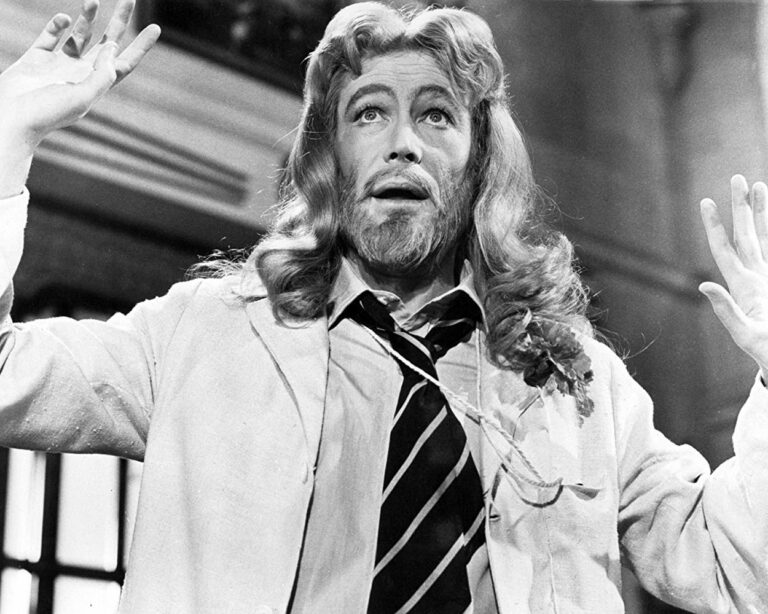
That’s when I found this scream.
…Never in my life have I been more taken aback. I couldn’t help but laugh. (Could you?) And I had to know more. I found the film, skimmed it, and my young brain exploded at the images that passed briefly before me. Peter O’Toole standing on a cross, dancing the “Varsity Drag”, peeping like a love bird, and getting thrown down a flight of stairs by a gorilla in top hat and tails. (Yes, this all actually happens in the film.) Why? At the time, I didn’t stay long enough to find out. I enjoyed glimpses of Peter O’Toole as a singing, screaming lunatic, then tucked The Ruling Class into the recesses of my memory.
Leaping back to the present day, I can proudly say that I have seen this film in its entirety. It takes godlike endurance to watch The Ruling Class, and I by no means recommend it to those of you who are sensitive to sacrilege, vulgarity, or vulgar sacrilege. I myself dislike all three and got through without a scrape – but, the Brits gave it an X-rating for a reason. For myself, I find The Ruling Class enlightening and highly impressive. In order to succeed with a story so scrambled, so perverse, you need a really stellar cast and crew. Luckily, this film has the advantage of both.
Adapted from the Peter Barnes play of the same name, by Barnes himself, The Ruling Class is a taunting depiction of English peers and all their illusions of grandeur. Jack Gurney, played by O’Toole is a ‘paranoid schizophrenic’, who has inherited the earldom after the death of his father, the thirteenth Earl of Gurney. (Cause of death? Strangulation in a tutu. No further details necessary.) The trouble is, Jack copes with being a lonely member of a family of peers by declaring himself the sun and the moon, the divine mover and remover, the God of Love, the Christ.

How did Jack discover his godliness? The voices of St. Francis, Socrates, General Gordon and Timothy O’Leary told him he was God. So, Jack – but you must never call him that. You’re restricted to “any of the nine billion names for God.” So, “your lordship, J.C., Eric, Bert, Barney Entwistle,” goes about declaring the message of love. He chases society matrons calling himself the Resurrection and the Life, blesses grasshoppers, and lifts tables ten feet in the air (or, rather, tries). And maddest of all, in the eyes of the Gurney family, J.C. believes “Love makes all men equal.”
Jack’s uncle Sir Charles (William Mervyn), seeks to rectify this lunacy by plotting against his newly enlightened nephew. If they can’t control this delusional earl, they can control his son. The family suggests he marry and produce an heir, but J.C. insists he is already married to la dame aux camelias, the consumption-victim courtesan from the Alexandre Dumas novel and the opera La traviata. This detail appears to be utterly random, but it’s all a part of Barney Entwistle’s plan. Author Peter Barnes’ brings love of a prostitute to an ironical conclusion later on.
Sir Charles rectifies the problem of J.C.’s marriage by producing the Lady of the Camellias. His own mistress, Grace (Carolyn Seymour), plays the part to perfection. They have a second wedding and common Grace happens to fall in love with the God of Love. That’s when the family and Jack’s psychiatrist decide to play hardball. They try several methods of treatment before bringing in another psychiatric patient: the High Voltage Messiah. “The Electric Christ. The AC/DC God.” After a little God showdown, in which Jack is conflicted by the presence of two God’s in the same room, the High Voltage Messiah shoots him with ten million watts of electricity (apparently). When Jack wakes up from his traumatised stupor, he is seemingly recovered.
Little do they know that when he says “I am Jack,” he means Jack the Ripper. And still God. But the vengeful, punishing Old Testament God who, in accordance with the changing times, has come to the world as Jack the Ripper. He’s out to destroy the immoral flesh of loose women – first his aunt, then his wife – and rid the world of all evil through corporeal punishment. Luckily, this suits the ruling class just fine! His family and peers see nothing wrong with him. Even a court-appointed psychiatrist finds him absolutely normal.
The rest of the plot I’ll leave for your own viewing or, if you won’t view the film, your own bewildered speculation. However, I will tell you all, brave and bewildered alike, that it is hilariously, inappropriately well-done. As an amalgam of irreverent social slander and far-and-wide cultural references – it’s unique and startling. As a black comedy crossed with a ragtime musical crossed with a horrific scream fest – it’s an unsettling, oddly compelling delight.
The success of this everything-in-the-cupboard-pressure-cooked-stew is easily attributed to Barnes’ script, full of witty delights, the innovations of Peter Medak and Ken Hodges, and an all-around brilliant cast. If delusory images of a cobweb-embossed House of skeleton Lords, or an effortless cinematographic transition from manor house to Ripper London, do not serve to enlighten or impress, Peter O’Toole will arrive on the wings of thespian angels. You will be astounded by his total embodiment of the pained lunatic. The artless, gibbering stutters, the gentle and crazed physicality, the mad, miserable motives that are unidentifiable and yet tangible. O’Toole gracefully delivers both the short laugh-burster lines and the sick man’s panoramic rhapsodies. Oh, and he drops the f-bomb on a rabbit.
The Ruling Class is, without doubt, one of the strangest films I’ve ever seen. One through which I am forever changed, and by which we should all endeavour to satirise our world – in the most brilliantly psychotic way possible.













 On i,i, all the different sounds Bon Iver have dipped their toes in come together, from the intimate, staggeringly gorgeous folk of 2008’s break-out For Emma, Forever Ago, all the way to 2016’s equally magnificent 22, A Million, which saw Justin Vernon manipulating his voice and experimenting heavily with electronics. That said, i,i is barely if at all experimental; in fact, it’s Bon Iver at their most accessible, as Vernon delves into the pop sensibilities he’s demonstrated as a producer on other projects, including Kanye West’s Yeezus and Chance the Rapper’s new album, especially on tracks like the joyful ’U (Man Like)’. But it does combine the electronics and jazzy instrumentation of 22, A Million with a more straightforward vocal delivery and strong hooks to often stunning effect, as in the stand-out ‘Holyfields,’ which features Vernon impressively reaching for the highest note he can hit as he sings “If it’s all that you don’t do”. Throughout the album, his delivery is more front and center than ever, bringing joy and life to these tracks. ‘Hey, Ma’ is simultaneously the most radio-friendly and the most transcendent cut, while the James Blake collaboration, ‘iMi’, sticks to you with its soaring, utterly magnificent chorus. “Living in a lonesome way/ Had me looking other ways,” he sings in the post-chorus over an acoustic guitar, and you realize this Justin Vernon is not that different from the guy whose music we fell in love with eleven years ago.
 As far as nu-metal half-masquerading as extreme metal goes, it doesn’t get much better than this. Slipknot’s sixth full-length album is arguably their best: an unexpected combination of everything fans have been asking for, and more importantly, just enough experimentation to sway skeptics who might roll their eyes at Slipknot’s instantly recognizable brand of heavy metal. The catchy ‘Unsainted’ is the perfect single to kickstart the album and grab the listener’s attention, which follow-up ‘Birth of the Cruel’ retains with its pounding rhythm, ominous guitars, and career-defining lyrics: “We are the bitter, the maladjusted and wise/ Fighting off a generation too uptight/ We’re all dressed up with nobody to kill”. We Are Not Your Kind is filled with Slipknot’s signature blend of singing and screaming, roaring guitars and memorable hooks (there’s even a ‘Snuff’-reminiscent ballad, ‘Liar’s Funeral’). But what elevates this from just a decent Slipknot release to a great album worth listening to from start to finish is the extra effort the band have put in to embellish their sound, be it with ambient noise or unpredictable genre experimentation (‘Spiders’ stands out in that regard), and the growth they show conceptually. It is an album about maturing and learning to live with the depression that’s been plaguing you for years, having learned its tricks and trying your best not to give into it. It’s Slipknot at their darkest and most focused.
 Were it not for the somewhat scuzzy echo of the guitar chords, ‘wanderlust’, the intimate acoustic track that opens Marika Hackman’s new album, would not sound all that different from the atmospheric, airy, and wonderfully melodic brand of indie folk the artist started out with on her debut, We Sleep at Last (in fact, it sounds eerily similar to the stand-out single ’Skin’). But soon enough, it’s clear that Hackman is not the same artist. With 2017’s I’m Not Your Man, she not only expanded her musical horizons by delving into different genres, but also displayed a refreshingly bold and often playful face that had been lurking under the surface. Co-produced by David Wrench (Frank Ocean, The xx, Let’s Eat Grandma), who gives a welcome pop edge to the album (especially on ‘the one’), Any Human Friend is yet another step forward for the London-based singer-songwriter, as it finds her at her most brazenly confident and focused. As she did on ‘Boyfriend’ off I Am Not Your Man, Hackman tries to break the taboos around homosexual relationships, this time by drawing attention to her unabashedly sexual lyrics: “Eating, moaning/ We go down on one another,” she sings on ‘all night’, while ‘hand solo’, a song about female masturbation, includes the caustic line: “I gave it all/But under patriarchal law/ I’m gonna die a virgin”. But as the album unfolds, it becomes clear that there are more emotional layers to the album that are deeply universal: “Lately I’ve been trying to find/ The point in human contact/ I get bored like that,” she sings on ‘i’m not where you are’, evoking a relatable kind of millennial malaise.
 Like their UK counterpart, Honeyblood, Los Angeles-based punk band The Regrettes take their riot grrrl influences and utilize them to create infectious, sharp pop-punk music with a feminist twist. Frontwoman Lydia Knight is just 18 years old, and yet the band is already two albums into their career, has signed to Warner, and lost four members in as many years. Their sophomore effort, How Do You Love?, opens with a lovely spoken-word piece by Knight: “Are in love?” she says. “Do you feel it in your stomach? Does it twist and turn and scream and burn/ And start to make you cry, but you like it?”. Before you know it, you’re thrown into the infectious ‘California Friends’, which playfully explores the insecurities that may come with same-sex relationships in modern society. Right after it we get yet another fun and catchy single, ‘I Dare You’; like many moments on the album, it does sound suspiciously familiar (in this case, the guitars sound as if they’re taken straight out of The Strokes playbook), but the youthful energy is so palpable and captivating that there’s really nothing to complain about. You can say the same about ‘Pumpkin’, whose chorus I’m sure someone will point out sounds like another song I can’t make myself remember, but it’s just as enjoyable regardless. Unfortunately, the album doesn’t hook you from front to back; the formula does grow stale towards the end, and you might find yourself tuning in and out around ‘More than a Month’. But the highlights make it well worth a listen, and the attempt to capture the complexities of modern love is admirable if not fully convincing.