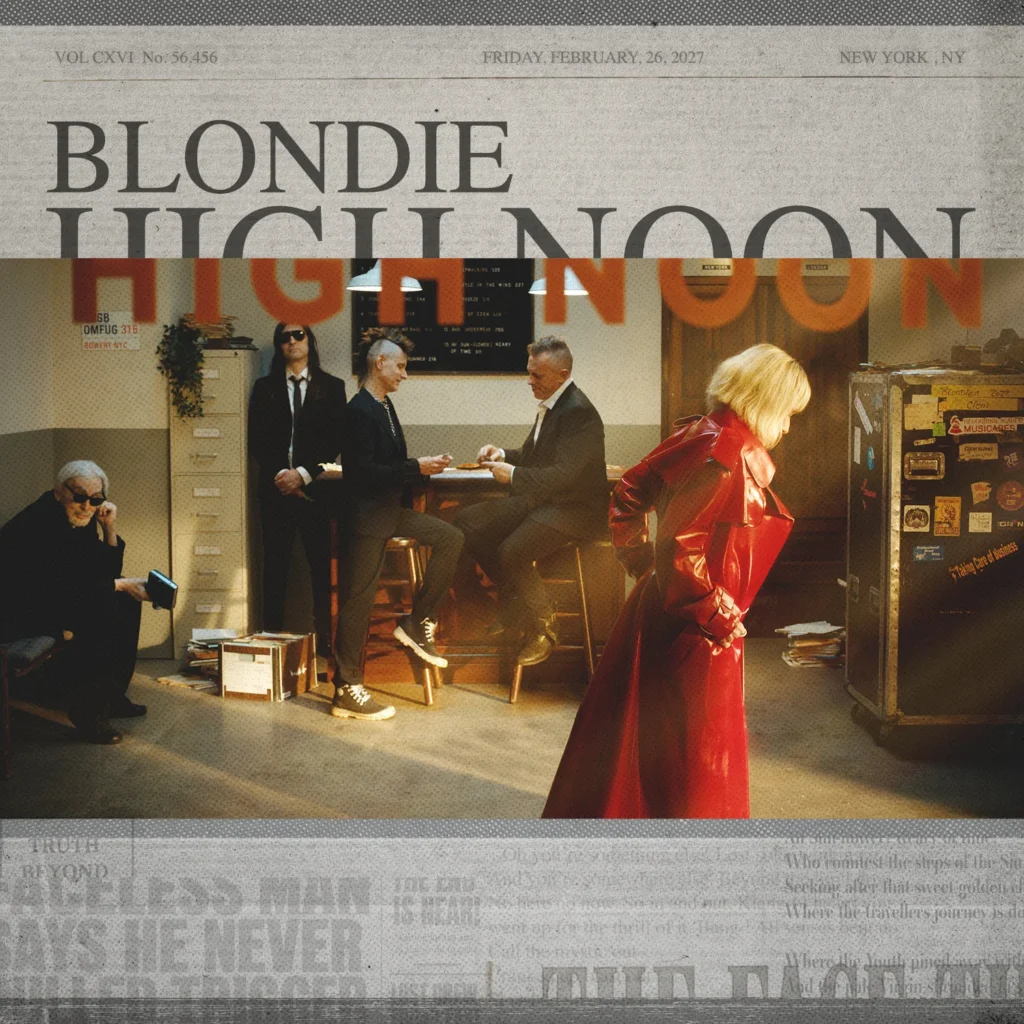
Blondie have announced High Noon, their long-awaited twelfth studio album and first collection of new material in nine years. It’s set for release on February 26, 2027 via BMG. Featuring the final recordings from co-founding drummer Clem Burke, it also includes contributions from Johnny Marr, Glen Matlock, Zach Condon of Beirut, Lucius, and more. Listen to the propulsive, glistening new single ‘Spectral Eyes’ below, and scroll down for the album cover and tracklist.
Sessions for the album started back in 2022, with the original trio recording in New York City alongside producer John Congleton, who previously worked on 2017’s Pollinator. “This album is classic Blondie — an amalgamation of all our different influences and eras into something new,” Debbie Harry said in a press release. “This music feels grounded in the present, shaped by who we are and how we’re living now.”
Chris Stein added, “It’s been a long, strange ride, and somehow here we are with another Blondie album. I’m not sure what the fuck I’m supposed to say at this point, except that we’re incredibly grateful for all your support over the years.”
High Noon‘s visual world was conceived by artist and director Rob Roth, who has been collaborating with the band for over 25 years. “I wanted to create something unexpected, but something that still feels quintessentially Blondie,” Roth commented. “High Noon exists in its own world — somewhere between the past, present and future. There are references to different eras and the band’s history, all mixed together to create something that feels both familiar and new.”
High Noon Cover Artwork:
High Noon Tracklist:
1. Spectral Eyes
2. Heartbreak Kid
3. Come Back Home
4. Tambo Tambo
5. Man Who Had No Face
6. The End
7. Little Metal Drummer
8. Sleepwalking
9. Whistle Into The Wind
10. Antifreeze
11. East of Eden
12. Bad Underwear
13. Ah, Sunflower, Weary of Time
On Saturday, Geordie Greep cancelled several stops of his US tour following an anonymous accusation of sexual misconduct made against the former Black Midi frontman. Outside his show in Vancouver last week, a man handed out flyers calling the singer a “rapist” and adding, “You know what you did this morning Oct 8th.” Taking the stage an hour and 40 minutes late, and without his backing band, Greep made a statement about the allegations before performing a solo set.
“Essentially, what happened last night, me and some of the band, we went out to some bars, we went out, we met people, and it ended up in a situation where, really late at a house party, I got the wrong end of the stick with someone who was there, and I made a move, and it didn’t come off,” Greep told the crowd, continuing, “I really quickly apologized, and it was a complete misunderstanding on my part, and I felt extremely bad, I feel extremely sorry, and extremely upset about the situation. I would never rape a woman. I’m not a rapist. It’s not how that went down.”
In a new, extensive report by Paste, Greep’s alleged victim, who goes by the pseudonym “Laura” in the article, spoke out for the first time about what happened. Laura told the publication that she met Greep and his touring keyboardist, Cameron Campbell, at a bar, where they befriended a woman named Katherine (a pseudonym). Laura claimed she mentioned being in an exclusive relationship multiple times and specifically recalls “saying it to [Greep] directly.” After the bar closed, Katherine suggested the group move to her apartment. During the walk, Greep “made inappropriate comments about homeless people,” according to Laura, and Campbell added that he also said off-putting things about “his opinion on race or gender or things like that,” which made the group uncomfortable.
“It got very late, I was very drunk, and I fell asleep on the couch,” Laura told Paste contributing news editor Tatiana Tenreyro. “I then woke up to him kissing me, and no, not just a peck. When I realized what was happening, I pushed him off of me and called him out on what he was doing. If I’d had a couple more drinks and didn’t wake up when I did, I don’t know what would have happened.”
Laura’s allegations were corroborated by Campbell, who immediately decided to leave the tour. Although he was not in the room when it happened, he heard Laura yell at Greep to “get off” her and rushed in along with her friends. After being kicked out of the apartment, Greep kept trying to return, at one point saying he was looking for his phone. “He tried to start downplaying it right there, saying that he only tried to give her a kiss on the cheek — which, again, if she’s asleep, that doesn’t really make it OK either way,” Campbell said.
Campbell added that he didn’t hear about the flyers until he was on his way to the airport. In her statement, Laura clarified that the male acquaintance distributed the flyers without her consent. She said, “To the person I trusted who distributed those flyers, to the guys that night who asked me many times if I was sure I was exclusive, to the man who kept calling me hot after I made it clear I wasn’t interested, to the men defending Geordie, to the ones saying I’m making stuff up for attention, to Geordie Greep who assaulted me – none of that was rape, but it was all rooted in misogyny.”
Paste‘s story includes long statements from both Laura and Campbell, and you can read it in full here. Following its publication, Greep posted the following statement on Instagram:
There have been articles in the press following my show in Vancouver on October 8 and I want to be very clear about what happened.
On the evening of October 7 a group of us were out in Vancouver. At some point in the evening, we met a group of people and continued the night with them. We ended up going to one of their apartments and were there until the early hours.
I fell asleep in an armchair and, at around 6am, woke up. One of the women in the group was on a sofa opposite me alongside three other people who were with us that night. Throughout the night I had – I now realise mistakenly and stupidly – believed that she was interested in me. I went over to her and leaned down to kiss her. I kissed her once and she immediately responded negatively and pushed me away. I apologised and stepped away. She was understandably upset and told me to leave. She told me she had been asleep, which to my great regret, I honestly did not realise. I left the apartment but returned a few minutes later as I realised I had not taken my phone. After collecting my phone I left.
I want to unreservedly apologise to her for what I did and for the distress and hurt I caused that night. It was a huge mistake. I feel awful about it and I am very sorry. I got it all wrong that night and I accept that. I understand the impact of my actions and take full accountability. I’m not trying to minimise what happened in any way and, again, all I can say is how sorry I am.
Greep’s bassist Dave Straw also responded to the story, writing in an Instagram story:
My heart breaks for Laura. I can’t even begin to express my disappointment and anger with Geordie for violating her bodily autonomy — there is no excuse for this, it should never have happened. And with the unnamed man who robbed her of her right to share her story on her terms.
Proud of Cameron for doing the right thing that night. Hopefully one day we won’t exist in a world where this is considered exemplary.
Drinking is no excuse. We have to be better.
Greep is still scheduled to embark on a European tour, which kicks off November 1 in the Netherlands, followed by shows in France, Spain, and Portugal.
There’s so much music coming out all the time that it’s hard to keep track. On those days when the influx of new tracks is particularly overwhelming, we sift through the noise to bring you a curated list of the most interesting new releases (the best of which will be added to our Best New Songs playlist). Below, check out our track roundup for Wednesday, October 14, 2026.
Shygirl – ‘Mantra’
Shygirl has offered another taste of her new album Swallow!, which comes out next month. Following ‘Alyse’ and ‘Lucky (Hymn)’, the clubby yet otherworldly ‘Mantra’ was co-produced with Clams Casino, Jd. Reid, and Karma Kid. The track comes paired with a music video directed by Austen Taylor Pease.
Jonah Yano – ‘Spin’ and ‘Holding On’
Jonah Yano has announced a new album, Spin, arriving January 29 via Innovative Leisure. Along with the news, he’s shared the short but delicately gorgeous title track, along with the more imposing ‘Holding On’.
Deer park – ‘Feathers’
New York-based artist and producer Deer park has announced a new LP, Matinee, out March 26. Ivy Knight and Astrid Sonne contributed to the album, which is led by the hazily pleasant ‘Feathers’. “One of the last songs finished for the album, it’s an introspective celebration of its themes- interlaced melodies washed in green,” he explained.
Marika Hackman – ’33’
Marika Hackman has a new album on the way called False Dogs, which is preceded today by the contemplative ’33’. The song “grapples with the dull ache of nostalgia, the apprehension of the future and the celebration of the moments in between,” the singer-songwriter explained. “Keep pushing, it’s worth it.”
Bleachers – ‘Blood Brothers’
A few months after the release of their fifth album, Bleachers are back with a stirring new song, ‘Blood Brothers’. It arrives ahead of a run of European shows kicking off next month.
June McDoom – ‘Human Angel’
June McDoom, our latest Artist Spotlight subject, has shared the final single from her debut album Follow the Light ahead of its release on Friday. Though originally written as a folk song, the track developed into one of the singer-songwriter’s first experiments blending folk with reggae instrumentation.
Catherine Elicson – ‘I’m on Fire’ and ‘All Sound’
Empath’s Catherine Elicson has previewed her debut solo album, River of Fat, with a pair of tracks. Equally bleary and loud, “‘I’m On Fire’ is a song about feeling trapped in your internal world and the void that creates. It has a meditative quality to it; I like to get lost in the repetitive heaviness,” according to Elicson. “The video was shot on a friend’s cedar tree farm in New Jersey by my girlfriend Halle Ballard and bandmate Johnny Costa. I rented a generator from Home Depot and played the song as the sun set. Shaun Sutkus, who also recorded the album, captured the live sound.” Of ‘All Sound’, Elicson added: “‘All Sound’ is built entirely on improvised guitar and vocals. I wanted to preserve the song’s intuitive, unedited energy, so I deliberately kept the little imperfections in. It has a levity that breaks up some of the heavier moments on the album.”
Gwenifer Raymond – ‘Bird Songs for Atomic Skies’
Welsh fingerstyle wizard Gwenifer Raymond, freshly signed to Fat Possum, has released a raucous new track titled ‘Bird Songs for Atomic Skies’. “’Bird Songs for Atomic Skies’ is a mutant rag, a blues gone awry,” she explained. “Lyrebirds are perched in irradiated nests and have grown new heads. Foxes bark in the night, but the barks are all wrong. This song is an assembly of sounds run through the wringer of an atomic age; New limbs are springing up by the hour.”
Land of Talk – ‘Dogs’ and ‘Cats’
Land of Talk – the Montreal-based project of Lizzie Powell – has shared a pair of songs, ‘Dogs’ and ‘Cats’. They’re consecutively sequenced on their forthcoming album LASTS, which arrives next month. ‘Dogs’ finds Powell attempting “to write a song that sounds the way listening to The Cure makes them feel,” according to a press release. They commented, “I wasn’t sure exactly what that meant, but was thinking it would lend itself to looking back on loves lost, yearning, regret. What came out was a simmering rage borne from living under the patriarchy.” About ‘Cats’, Powell added: “When I listened back to the finished track, I found those parts unintentionally sounded not unlike mischievous cats breaking into our studio after hours and jumping all over the instruments.”
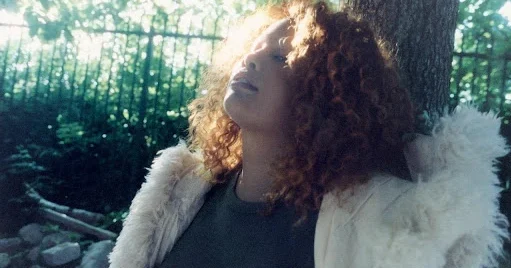
June McDoom is a New York-based singer-songwriter who grew up in South Florida in a Jamaican household. Though a love of reggae music was ingrained in her from an early age, she developed a fascination for ‘60s and ‘70s folk music in high school, when she also started getting into into jazz singing. After moving to NYC for a degree in Jazz Performance, she honed her songwriting and recording skills, releasing her self-titled EP, which she tracked with her partner and longtime collaborator Evan Wright, four years ago. 2024’s With Strings EP saw McDoom incorporate luscious harp and string arrangements, which also introduce her debut album, Follow the Light, out Friday via her new label home, Jagjaguwar. Conjuring a dreamworld with technical precision, the record is meticulously layered, a seamless blend – or rather, careful diffusion – of reggae, dub, and folk elements that manages to be both spacey and tactile in its intimacy. “Be my human angel,” she pleads on its latest single, finding ways to sound grounded and ethereal in the same breath.
We caught up with June McDoom for this edition of our Artist Spotlight interview series to talk about her upbringing, studying jazz, the process behind her debut album, and more.
I was struck by the opening lines on ‘Forever’ about the innocence of childhood, and I was wondering if you could start by sharing some early memories of growing up.
Generally, a lot of the songs on the album talk about family and family relationships. I grew up in a really large extended family. I had so many cousins around me, so many aunts and uncles. Every Christmas it was at least 50 people, and I was really, really close with all of them. So that was a really formative part of my early life. We all got along in this really close way. I would talk to them often; it wasn’t like I would see my family once a year. I grew up in this really wholesome, really supportive family structure. My whole family were immigrants, too. I grew up in America, but my whole family moved from Jamaica individually on their own, and then we all reconnected in South Florida when I was growing up there in the ’90s. I’ve realized as an adult that’s shaped a huge part of who I am. I’m a really big family person.
In ‘Forever’, I’m talking about those relationships that you grow together with – family members, but also I kind of wrote the record and the message of Follow the the Light to remind people of general relationships like that in life that feel so pure. The record feels full circle, because my family’s Jamaican, I grew up in Jamaican culture, but I would go to school and feel pretty different from my peers. I never really fit in with anyone. I didn’t have that many friends basically throughout my entire period in school, but it never really bothered me that much because my family was really supportive.
My mom, growing up and even now, is the type of person where every other week – because we have so many family members – would be like, “Call your aunt, wish her a happy birthday.” It’s a huge thing my mom’s instilled in me, just remembering to appreciate your family members, which is a skill that you need to work on as you get older. I grew up with that as a kid, but as I’ve gotten older, I’m realizing that I’m growing away from it. It’s a special thing that I feel really grateful for that my family has taught me, and that’s mostly what I’m talking about in those songs.
I know you grew up around reggae music, but obviously, as a kid, you’re not engaging in any kind of genre conversation. You were exposed to different kinds of music without necessarily labeling them. What comes to mind when you think about music entering your life in a significant way?
I got into music more professionally later than some of my peers. I started singing jazz when I was in high school, and that’s why I ended up going to music school. But a lot of my peers that I was singing jazz with had been playing on a professional level since they were kids – they were really, really high-level technical musicians. For me, I never really considered music as a true part of my identity, like I do now, until I was older, and I never even considered it as a career until I was 17 or 18.
I never really thought about genres like that. I didn’t have a community of friends that were musicians, and I also didn’t really start singing until I was older. My grandpa was a musician – he made Jamaican folk music, and I grew up seeing his guitars and his banjos, but it just never really processed for me to think about music in that way until I was older. It’s really interesting because I think we don’t realize, until you start making art, how compartmentalized so much of our society is. Now that I’m an artist and people are asking me, “What genre are you?”, you’re forced to think of yourself in these labels.
But when I was a kid, I found folk music on my own kind of randomly because I was watching a lot of old movies. I was watching The Graduate, and that’s how I found out about Simon & Garfunkel. I just loved it for some reason, and that became the music I really loved. I never thought, “Oh, folk music is typically listened to by a certain type of person, and I should be associated with that type.” And with the music my parents listened to, I never thought, “This is a certain type of music that a certain type of person listens to,” until I got older and realized a lot of music spaces are so separated.
I think the cool thing about my experience growing up in America is that I grew up in a family that pretty much only listened to Jamaican music – reggae music, early Jamaican music, rocksteady and stuff. But I was always encouraged to make and listen to whatever I wanted to, and that is really special because I feel like I’ve found my own things, and I feel really grounded in that and with who I am. It’s tricky, because I think they label my music, like, a folk fusion sort of thing. But I feel like the beauty of a lot of music is the spaces in between genres.
Do you remember a sense of excitement in discovering music that was separate from what your parents enjoyed?
Yeah. I remember being in my room, listening to these things on my own. I guess I never really thought, “Oh, I’m going against my family. But for some reason, I think it’s fascinating because it is kind of random to find ’60s folk music, since no one around me was listening to it. I look back on my younger self, and I think there’s just something really sweet about me finding something like that randomly, and even though none of my friends were listening to it, really feeling this strong sense of self, to identify with that music and keep loving and listening to it. Because high school is a weird time to like something that’s different from other people. You want to fit in with people. But I guess by high school, I kind of gave up on fitting in with people because I didn’t. [laughs] so I was just like, “Whatever.” I also really liked a lot of ’90s grunge. That’s a really random one, too, but a lot of people, I guess, like that too. I loved Kurt Cobain.
I listened to the record a couple times before reading any of the press materials, and I was struck by the duet on the album, ‘Grandpa’, before realizing it was your actual grandfather, Colin Smith. What have you learned from him, not just growing up, but with a more adult curiosity in recent years about his musical background?
I’m glad you asked like that because I think a lot of people ask how he shaped me as a kid, but actually I feel like as a kid I never really thought that much about him and his music as much as I do now. My grandpa’s been making music since the ’60s. He started playing guitar when he was a kid, and then also banjo. He grew up in the countryside of Jamaica, and then he moved eventually to the city, which is where all the musicians move. But he is in the folk scene in Jamaica, which I find now such an interesting thing, because I love American folk music, and we have this correlation where it’s very similar instrumentation. Every time we had parties, his band would play. He has a band that has violin and flute – it’s like a 10-person band. That was another fabric of my childhood: always hearing my grandpa sing or play. I feel like as a kid, I almost took that for granted, because it’s so special to have a family member like that who makes traditional music from your culture.
When I realized I wanted to first start playing guitar, my grandpa was one of the first people I told, and he gave me some advice on the type of guitar to get. I kind of went against him, actually, and got more of the classic American-style guitar, which is so funny, because the guitar that I play now is the guitar he recommended to me at the time. He’s just always been there, giving advice throughout the years. Then, when I was in college, I re-discovered a lot of earlier Jamaican music, and I was just, “Oh my gosh, my grandpa’s basically a music historian when it comes to Jamaican music.” He knows a lot of really important Jamaican artists. The community’s so small, so he’s met a lot of them, and he also knows so much about the history of Jamaican music. He was actually just honored by the Jamaican government for keeping folk music alive.
Now, one of the most amazing things that inspires me about him is that he’s been making this very specific music his entire life, and he’s so dedicated to it. He’s so knowledgeable about music, and he’s basically a community leader. He just retired from the day job that he was doing most of his life – he was a contractor – and now he’s doing music full-time. It’s insane. He’s so busy, more than ever now, and I’m so inspired by that. I’m in the early part of my career, and it’s really hard to be passionate about something and stay true to it and continue to create. He’s been doing it for decades, and I feel a deeper appreciation now more than ever, pursuing music, seeing him.
With the record, I knew I wanted him to be a part in some way for sure. I was like, “Should I do a cover or something of an older Jamaican song?” But then I thought it would be special to write something. So that song is the only song that I wrote in the studio, kind of on the spot. I had my dad voice-memo-record my grandpa from Florida and then send it to me on my phone. But I want to do more with him. I want to find a way to do something else, for sure. That was just a quick way to get him on the record. And he has an incredible bass vocal. His voice is insane.
You talked about pursuing music in a more serious way after moving to New York for your jazz studies. How did your relationship to music change as a result of both your degree and the move to New York?
I hadn’t really been singing in a way where it felt like it was my identity at the time when I found jazz. My parents didn’t listen to any jazz. I didn’t really know who John Coltrane was until I went to this summer program at Berklee College of Music. I think it was the summer of 10th grade. My grandma encouraged my mom to let me go, and then when I got there, it was basically high schoolers from around the country who were, a lot of them, coming from music high schools, and they were all singing jazz really seriously. I was like, “Whoa, this is so cool!”
I went home from that program and just intensely started learning jazz standards every day, because I was like, “Wow, that’s really cool that all these kids know for a fact they want to pursue music.” That really inspired me, and I became friends with someone who told me to audition for this program that was associated with the Grammy Foundation. I got into it somehow, and it was a really selective program, so from the minute I made that program, my life kind of shifted, and then I became a jazz musician. That became my identity, basically.
It was interesting, because when I did that, it was basically a program of 30 kids across the country, and a lot of them had been playing for many years, and a lot of them were going to Juilliard, and they already knew their route. Their whole families were very invested, and I kind of had major imposter syndrome, where I was trying to pretend that I’d been singing jazz for a long time when I kind of hadn’t been, to be honest. I was definitely intimidated by how serious everyone was, so that made me try and accelerate my technique. I just spent the years from 11th grade till college just trying to get really great at learning how to improvise and learning jazz harmony, which I love. I’m so grateful for the fact that I just randomly found it like that, because I didn’t know any jazz musicians in Florida.
I ended up going to school for jazz, and I chose The New School because I knew that eventually I would want to start writing music. I hadn’t been really writing – I wrote an occasional song every once in a while, but at the time, my focus was, “I’m a singer, and I want to become a technically proficient singer,” because that was what all my peers were doing, and I also just wanted to improve my voice. I did that for a while in college, but I think I quickly realized that I was feeling technical burnout, and I was kind of tired of thinking of music in such a technical way. Also, I felt like sometimes I was just singing things that maybe I just didn’t really want to sing, but I felt like I should be. So a year into college, I was like, “I kind of just want to start thinking about what my own space in music is, and what that would look like.”
Then I started thinking a lot about folk music again, and I started being more selective about the jazz things that I wanted to sing. I think the thing about college in that period is that it made me a really technical creator. Even now, when I make my records, I’m super technical about stuff. I think my brain has officially been changed by studying music in the institution, just because I think about things in a way that I wish sometimes felt a little bit more natural. That was the period when I started writing the songs for my first EP, and towards the end of college, I started realizing I really loved recording. I started listening to a lot of old music, and I started getting into the technical side of making a record, which we don’t really talk about in music school.
My partner that I met that I’ve been making music with, Evan [Wright], comes from a similar background where he played jazz guitar. We both kind of at the same time in school realized we wanted to write music, and then we both found that we loved recording, so we both had each other to springboard off of. I think we’re really grateful that we met each other for that reason, too. And then I started recording my EP. We recorded it at Evan’s parents’ place. They have a barn kind of thing, and we just recorded it at home. After the period of being in school, I wanted to just try and see what would happen if I made something completely on my own without going and studying in a studio and learning how to record properly. There’s no rulebook for the perfect-sounding thing, so I’ve been trying to remind myself of that with making my records.
‘Outside the Window’, from Follow the Light, kind of reminded me of Evan’s song, ‘Sound from Out the Window’ – they have a similar kind of dreamlike warmth. I thought it was a good excuse to ask about the flow of ideas between the two of you, how that has developed over the past few years, and whether it’s become more subconscious or unspoken.
I would say at this point, we definitely have an unspoken flow that is really special. I can’t really see myself creating without him. We’ve known each other for 10 years, and we started making stuff together like this about five or six years ago. We listen to the same things. If he shows me a song, I know I’m gonna love it. If I show him a song, I kind of know he’s gonna love it. We know exactly what each other likes, and we know the elements in music that we love. Because we’ve spent so much time learning what each other loves, it’s so easy to create together. Evan plays most of the instruments, so we do them one at a time. We’ll spend a whole day just working on the bass, getting really particular about the bassline melody. When Evan’s playing the bass, I’ll sing the melody to him, and he knows generally how I want the bassline to sound based on all the music he knows I love, which is super special.
I do that a bit with his music too – I don’t play the instruments, but we know how to guide each other to the thing we’re looking for. That’s basically how we work: we write our songs separately, and then once the songs are finished, we bring them to each other and figure out how we want to make them. Then it becomes this intertwined process. With my project, I’m leading and Evan is following and helping me figure it out, and it’s the same with his. It’s been special to form that language that we have, and we found that we really like recording completely on our own. We really like recording at home, because our process is really slow. We’ll spend a good amount of hours just on a bassline, which is crazy. [laughs] I don’t want to do that anymore, but we do nerd out. He’s a very technical creator like me, because he studied jazz for many years, so we do think about things more technically. I was in another interview, and because he’s my partner, someone asked, “Oh, when you guys make stuff, is it super romantic and emotional?” And I was like, “No, it’s not. [laughs] It’s super nerdy.”
I can hear that sort of nerdiness on a song like ‘Dream Dub’ – the synth, Preet Patel’s bass, they’re so particular. The record is easy to enjoy as a whole, but if you want to dig into those details, it opens itself up to that kind of listening, too.
Yeah, I’m just a huge “parts” person – I love little details. Even trying to figure out how to play the music live, I’m really trying to hold onto all the little parts and play them exactly, because I feel like they all play a role in supporting something.
You mentioned having real harp and string arrangements as a new thing on Follow the Light, though you also tested them out on the With Strings EP. At the same time, you don’t over-rely on them. There are songs deeper into the record that retain that sparser quality.
For sure. The weird thing was that when I first started making the whole record, I wanted it to be more like the minimal songs, because I was thinking it’d be nice to see what I could make if I really limited myself with the instrumentation. But some of the songs, I just felt like – I think from listening to classical music – I wanted some depth that only comes from adding more instrumentation. But I was actually really trying to keep it as minimal as possible, so I think that’s why on certain songs, I was like, “This only needs this thing.” With why I love classical music so much, it’s the dynamics in the music – there are those really heavy moments, and then there are those intimate moments where there’s like one instrument playing and you can barely hear it. I wanted to mirror that, because I love that in music when there are those dips and valleys.
I think that’s also been my thing with drums. Most of the folk records that I love, none of them have drums. But I also love so much music with percussion and drums, so I always add drums, but sometimes I feel like drums are a tricky one to mix with delicate guitars. I’m always really trying to find space for drums, and that’s challenging, because I feel like maybe sometimes you don’t need that, too.
A lot of that comes down to the drum engineering, too; I know Evan does some of that on the record, along with Victor Axelrod.
Yeah, the Victor Axelrod collaboration was super intentional, because we had never worked with another engineer before. But I reached out to Victor because he’s amazing at engineering drum sounds that sound like that ’60s era of reggae drums. He makes the most amazing records with that, and I was really curious about his process. He lives in Brooklyn, so that was super fun because we recorded in his basement, and he has such an interesting process of recording drums that was really cool to see. There are a couple of songs where we have those.
Tell me about playing the flute on a couple of songs.
Oh, yeah! On ‘Get Out of My Life’ and on ‘Weaver’, I’m playing these recorder flutes that I never really planned on doing. I was in Brussels for a gig, and I was walking around and stumbled on this flea market where I found this vintage wooden recorder. So when I got back, I really wanted to add it to the record. I can’t play very well, but I basically made those melodies for the record and practiced them a ton before we recorded it. My friend Kana [Miyamoto], who’s a traditional flute player, plays on the record too.
I read an older interview, around the EP, where you said you’d been reading more and trying to improve your lyric writing. I’m curious what was helpful to you in that regard over the past couple of years.
When I did that interview, I was probably working on the lyrics of the record at the time, trying to be really intentional about them. I think that’s the biggest difference between my first project, the EP and record. When I made my EP, it was my first time writing songs, and I was more naive. I was just so excited to make a project. When the record was finished, there were some lyrics that I felt like I wished I had spent more time on. So with the album, I knew that I really wanted to be intentional about everything I was saying, and so I started reading as references, and I was reading a lot of Zora Neale Hurston books. Her books are amazing because she’s constantly referencing nature to explain things in life that are so difficult. I think I was reading her before I had started really writing, and I was kind of blown away by how she would say something so simple, but there were so many layers of what she meant.
The book that I was reading at the time was about a girl who’s finding herself as a woman and how hard it is in society, and there was a part of the book talking about a tree. The way that she referenced the tree ended up becoming a really big inspiration for how I can try and use nature in my writing, because I’m really inspired by nature as a metaphor for life. A lot of times I’m kind of hard on myself as a lyricist, because I feel like I’m not the most poetic – you can probably tell I’m not the most poetic in the way that I speak. I guess everyone’s kind of hard on themselves as writers – I’m sure you, too. So I’ve never really hyped myself up as a lyricist, but I just wanted the lyrics to be simple to understand. A lot of the time, for some reason, when I write songs, it always ends up being a lot about finding yourself. I really identify with writers who can write about that so simply.
My favorite line on the record [from ‘Searching to Find’] has that sort of simplicity: “Dream like a girl as I grow old.”
I think that’s one of my favorites, too, actually. I just felt like as I’m getting older, I’m realizing how much, as an adult, you’re pushed into this work-grind lifestyle that you have to really work against the flow to try and preserve things that are childlike – ways of living that feel more natural. I think the record in general inspires you to be more free to explore the things that you’re not encouraged to on the daily, whatever that is, in a loose way. I was telling someone else that I feel like we’re just living in a weird, echo-chamber period with a lot of things being put out, and we’re inundated with so much that we can consume. Stepping in, if the record can act as a space to step back and reflect, like, “What are the things that I really love, how can I explore them deeper, and how can I honor them?” – if I do that at all with the music, that’s really cool and special. That’s what the record kind of did for me.
This interview has been edited and condensed for clarity and length.
Weekend escapes do not restore you — they train you to tolerate an environment you should probably fix. That is the uncomfortable pattern emerging by 2026, as the escape industry has expanded into a multi-billion dollar ecosystem built on one recurring premise: that geographical distance is the antidote to burnout. It is not. The evidence points in a sharply different direction, and the numbers are worth sitting with before you book another train ticket. However, there are more ways to have a chill weekend with less stress, using online casino payment methods, including online games home alone and with friends.
Weekend Escape Myth Has a Measurable Cost
By 2026, 73% of remote workers reported taking monthly escapes compared to just 31% in 2020. That near-doubling did not coincide with a decline in reported burnout — it coincided with an increase. Workers who take four or more weekend trips yearly score 41% higher on standardised burnout measures than those who take one or two. The escape culture is not healing the people who most enthusiastically adopt it. It is, in many cases, reinforcing the cycle it claims to interrupt.
Cortisol levels spike in the 48 hours before travel begins. It means the supposed recovery window is already compromised before the trip starts. The anticipation phase, which many people describe as excitement, carries a physiological stress signature nearly identical to deadline pressure. Planning a weekend at a coastal resort and preparing a Monday morning presentation activate overlapping stress responses.
Travel Planning Quietly Drains the Energy It Promises to Restore
Travel planning consumes an average of 8.5 hours per month in active decision-making — accommodation comparisons, transport logistics, packing calculations, restaurant bookings. None of that is passive. It demands the same executive function that work depletes. When you spend your Thursday evening comparing rental options, you are managing a parallel project with a Friday deadline and no clear success metric.
Post-escape productivity also dips for three to five days after return as circadian disruption extends beyond the journey itself. Even a two-night trip to a neighbouring city shifts sleep timing enough to impair concentration into midweek. The escape, then, does not simply fail to improve your work week — it actively compromises the first half of the next one. The net effect on a monthly basis is close to neutral, and for frequent travellers, it turns negative.
Inequality Hidden Inside Escape Culture
Escape culture positions rest as a product you purchase rather than a condition you create. That framing benefits an industry, not the people consuming it. When rest requires a booking confirmation, it becomes accessible only to those with disposable income, flexible schedules and the social currency to curate the trip visually for an audience. The pressure to document and perform a “recharging” experience on social platforms adds a layer of performance fatigue that compounds rather than offsets work stress.
This is not a minor observation about aesthetics. It describes a structural inequality where burnout recovery has been quietly privatised. Workers at high-engagement platforms increasingly frame leisure as optimised performance, which means even time off gets evaluated against productivity metrics. The people who most need genuine rest — those in financially precarious, high-demand roles — are the least able to afford the escape model and the most likely to feel guilty for not pursuing it.
What Actually Outperforms the Escape Pattern
Daily micro-rest integrated into actual working hours consistently outperforms occasional travel across engagement, mood stability and sustained output measures. Reduced hours, hard stop times and genuine offline periods — not travel, not scenic locations — produce the circadian consistency that allows deep rest to accumulate. The body does not distinguish between “I am in a mountain cabin” and “I am in my living room with my phone in another room.” It responds to nervous system state, not postcode.
The redesign argument is straightforward: if you require a monthly escape to make your work week survivable, the work week is the variable that needs adjusting. Escapes address the symptom while the structure that generates burnout continues operating unchanged five days a week. Boundary-setting inside the work week — concrete, enforced limits on availability, asynchronous communication norms, actual reduced hours — addresses the cause directly.
Signs the Escape Pattern Masks a Deeper Problem
Certain patterns reveal when escapes function as avoidance rather than recovery. Watch for these specific indicators:
You feel dread on the final morning of a trip before work resumes
You check work messages during escapes despite planning not to
Planning the next escape begins before the current one ends
You return more exhausted than you left after trips longer than one night
What Genuine Restructuring Looks Like in Practice
Restructuring work around rest rather than escaping from work requires concrete changes, not intentions. A practical starting point includes:
Hard calendar stops at a fixed daily hour with no exceptions for “quick checks”
At least two full offline days per month — at home, not in transit
Asynchronous-first communication policies that eliminate urgency theatre
Quarterly reviews of workload rather than quarterly bookings of retreats
Some Escapes Do Deliver Value
It would be dishonest to argue that travel never helps. Some people genuinely benefit from environmental change, and the case against escapes is strongest for high-frequency patterns rather than occasional departures. The counterarguments deserve direct engagement:
The case for escapes
The case against escapes
Environmental novelty can interrupt rumination cycles
Novelty fades within hours; rumination resumes
Social bonding during travel builds resilience
Social bonding does not require travel logistics
Breaks from routine restore creative thinking
Circadian disruption impairs the cognition creativity depends on
Time away clarifies perspective on workplace problems
Clarity without structural change produces insight without relief
One or two escapes per year, taken with genuine offline discipline, likely do deliver value. The problem is not the escape itself — it is the volume, the planning burden and the myth that frequency scales the benefit. Comparable engagement platforms actively incentivise frequency, because repeat usage drives revenue regardless of whether it serves the user’s actual recovery needs.
Weekend Escapes as a Recharge Strategy
Weekend escapes, taken four or more times yearly, do not recharge the work week — they defer the discomfort of confronting why the work week needs recharging at all. The workers most likely to benefit are those who take escapes rarely, stay offline completely and use the distance not to avoid work problems but to observe them clearly before returning to change them. The 41% higher burnout score among frequent travellers is the outcome of treating geography as therapy.
Two people can wear the same navy suit. One has a slim dress watch. The other has a big chronograph.
You’d read them differently, right? This is why you need to understand three popular watch styles and what each one tells people, so you can pick one that fits your own style.
Why People Notice Your Watch
Your clothes get the first look. Your watch gets the second. People take in the size, the shape of the case, the dial, and the strap in a couple of seconds.
Then they make a quick guess about your taste. You’ve probably done it yourself, glancing at someone’s wrist during a meeting or at a wedding.
Some people like simple and clean. Some like lots of dials and details. Others just want a brand everyone knows.
That’s a big part of why luxury watches are fun to look at. Each maker has its own idea of good design.
If you want to discover leading luxury watch brands, you’ll see how different those ideas can be.
The Minimalist Watch
A minimalist watch has a slim case and a clean dial. Often it has just two hands. That’s it.
The style draws on the Bauhaus school, a German design school that dropped fancy decoration and focused on function. Nomos Glashütte follows that idea closely. Cartier’s rectangular Tank goes back to the First World War era and still looks sharp.
Here’s what this style usually says about the wearer:
They like things simple.
They don’t need to show off.
They pick pieces that won’t go out of style.
It slides under a shirt cuff and works at the office or a dinner out. Try one on a brown leather strap for a warm look, or a steel bracelet for something a bit sharper. It also won’t look dated in ten years, since it never followed a trend.
The Chronograph Watch
A chronograph has small dials and buttons on the side. It works like a built-in stopwatch.
People who wear one often like gadgets, machines, or a bit of adventure. The Omega Speedmaster is a good example.
Astronauts wore it on NASA missions. The Rolex Daytona is another. It’s tied to car racing and named after the Daytona speedway in Florida.
A chronograph usually says the wearer:
Likes to know how things work.
Enjoys a busy, detailed look.
Has a soft spot for racing, flying, or exploring.
It also works with jeans or a suit. Just be ready for questions. People love asking what all those little dials do.
The Prestige Watch
Some watches need no introduction. A Rolex says success before you open your mouth.
For many owners, that’s the point. But prestige isn’t always about status.
Patek Philippe has long sold its watches as something you take care of and pass down. The Audemars Piguet Royal Oak took a different path. Its bold octagon-shaped bezel broke the rules when it launched in 1972, and it still looks daring.
A prestige watch might say the wearer:
Values craft and history.
Wants something that lasts for generations.
Isn’t afraid of a little attention.
Not everyone wants that. Some owners buy one just because they love how it’s made.
Watches have always been more than time tools. The first ones showed up shortly after 1500.
The history of the watch shows how a practical gadget became a way to show who you are. Today, a vintage-style dress watch and a sleek modern one send very different messages.
How to Pick Yours
No style is the right one. A minimalist, a chronograph fan, and a collector of prestige pieces are all telling the truth about themselves. What matters is that the watch feels like you.
Try this before you buy:
Think about what you wear most days.
Picture wearing it to work and to the weekend barbecue.
Ask which one you’d grab without thinking.
Your Wrist, Your Rules
No watch style is the right one. A minimalist, a chronograph fan, and a collector of prestige pieces are all telling the truth about themselves. What matters is that the watch feels like you, so think about what you wear most days and which one you’d grab without thinking.
Want more style ideas like this one? Keep exploring Our Culture Mag for more lifestyle, fashion, and culture reads.
From independent publishing to national television, Brazilian-born illustrator Ana Graça is challenging the conventions of children’s literature by bringing overlooked childhood experiences into the spotlight.
In May 2026, Natalie Cassidy read an independently published children’s book on CBeebies Bedtime Stories. Young Carers in Space, written and illustrated by Brazilian-born, London-based artist Ana Graça, was selected for BBC’s CBeebies Bedtime Stories, where actress Natalie Cassidy introduced its characters to families across the United Kingdom. It was the programme’s first story about young carers.
Rather than coming from an established publishing house, Young Carers in Space was developed through an independent initiative involving children who care for family members. Its appearance on national television brought the experiences of young carers to families who might never have encountered them in a picture book. Her illustrations helped make the story approachable for children unfamiliar with young carers.
Giving Invisible Children a Place in Literature
Across the UK, children help relatives with everyday tasks while keeping up with school. Some care for a parent; others help a brother or sister, as Honey does in Graça’s books. Teachers and classmates may know little about what happens at home.
Graça addresses this gap through her Young Carers series, beginning with Young Carers in Bunnyland in 2024 and continuing with Young Carers in Space in 2025. Both books follow Honey, a six-year-old girl who helps care for her autistic older brother, Pip.
What distinguishes the series is its refusal to define childhood caring exclusively through hardship. But Honey has adventures of her own, too. The books leave plenty of room for play.
In Young Carers in Space, Honey embarks on an extraordinary journey beyond Earth, discovering other children who share similar experiences. She meets children who know what her days at home are like.
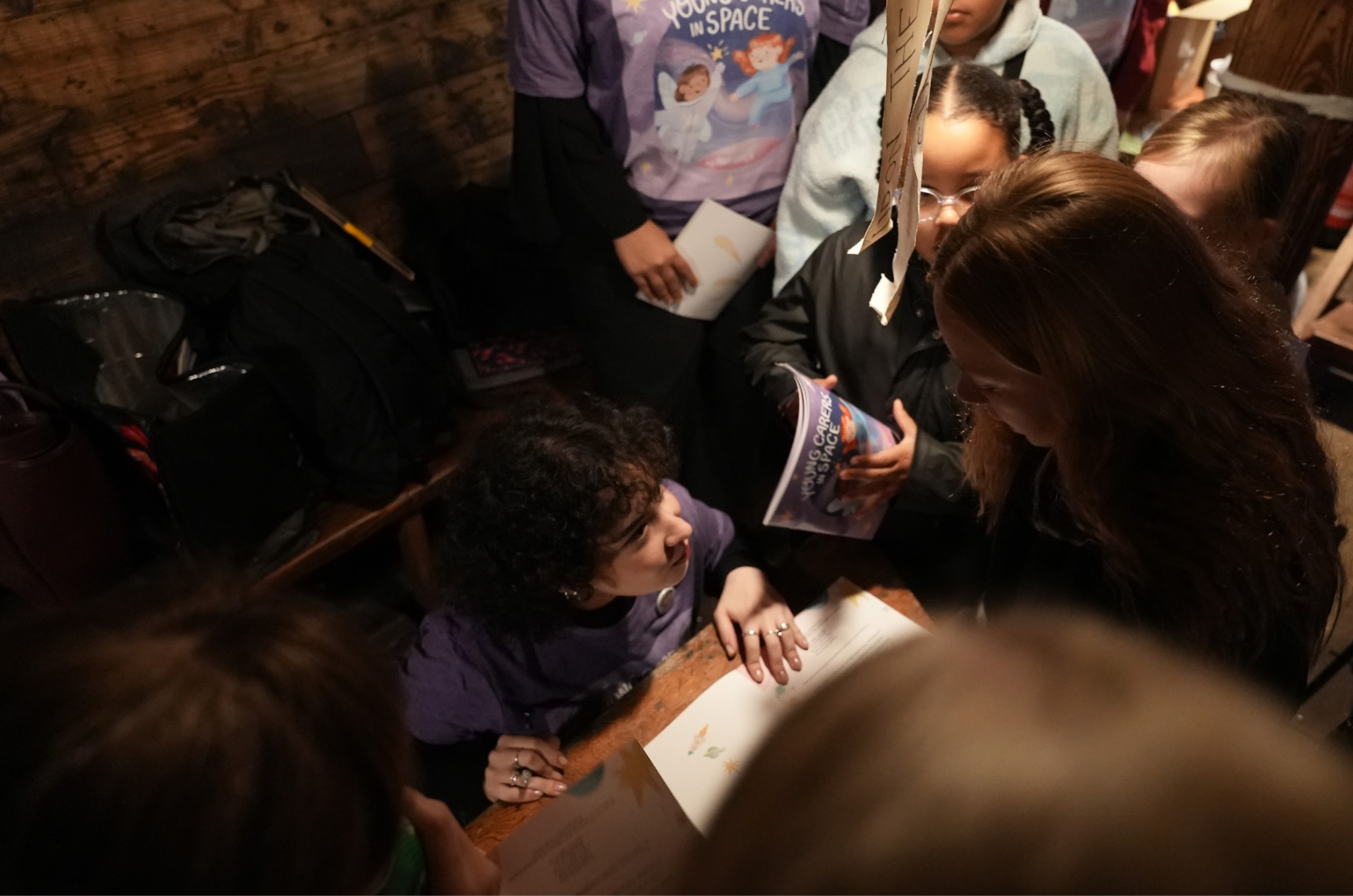
Graça developed the book through workshops with the Young Carers Illustration Project and organisations including Kingston Carers Network, where young carers helped develop the characters and story.
The children had a hand in the finished story
In a 2026 feature published by Kingston Carers Network, young participants described the significance of recognising their own experiences in the finished book. For some, the book was a rare chance to recognise their own lives on the page.
Most children’s books are written by adults, even when they deal with experiences unfamiliar to those adults. Graça approached this project differently. She invited young carers into the creative process and used their suggestions to develop the story.
The Art of Making Difficult Subjects Accessible
The illustrations are central to how Graça tells these stories. Soft textures and rounded, expressive characters give her illustrations an inviting quality even when the subject is difficult.
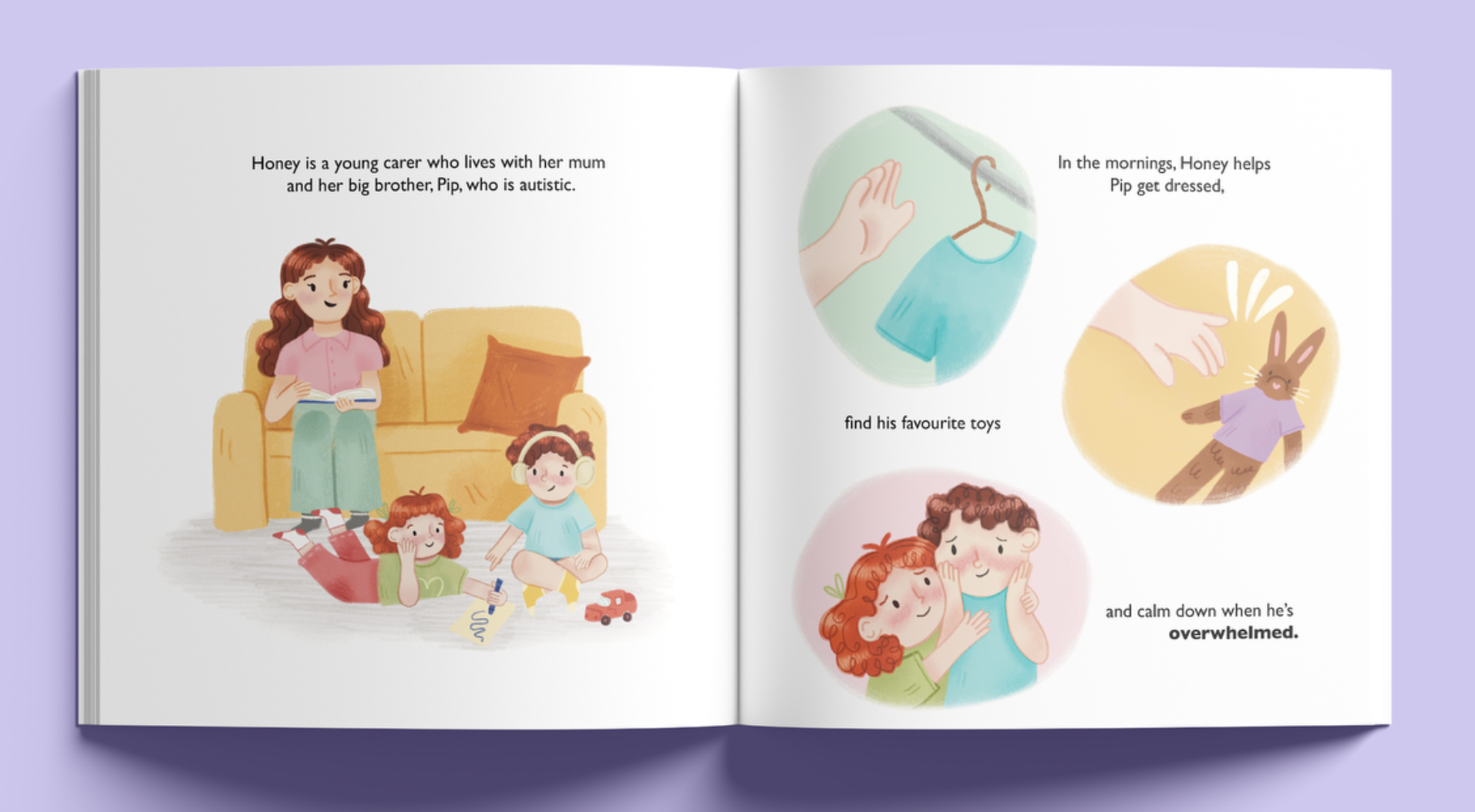
One spread from the Young Carers series depicts Honey helping Pip through ordinary daily activities. She assists him with dressing, finds his favourite toys and comforts him when he feels overwhelmed. The composition divides these moments into small, intimate scenes, letting readers pause over each gesture.
Graça gives these ordinary gestures weight without making the scene melodramatic. A reassuring touch between siblings conveys more than an explicit explanation of their relationship could. The restrained visual approach is particularly effective for younger readers. The illustrations acknowledge the responsibilities Honey carries without making her world appear frightening or hopeless. The characters feel familiar, rather than distant or pitiable.
Elsewhere, Graça embraces fantasy on a much larger scale. Enormous pastel-coloured creatures inhabit rolling green landscapes, while children encounter magical figures and fantastical environments. Characters with different physical abilities occupy the same imaginative universe, with disability presented as one aspect of human diversity rather than an exceptional condition requiring explanation.
In these scenes, children with different abilities share the same fantastical landscape. The scene needs no explanatory caption about disability. Although the Young Carers books are digitally illustrated, they retain the softness and tactile quality often associated with traditional children’s book art. Irregular outlines and soft, grainy textures keep the digital images close to the feel of drawings made by hand.
The books leave room for playfulness even as they introduce readers to the responsibilities young carers carry.
From Community Project to Cultural Recognition
The books soon began to circulate beyond the groups involved in making them.
Following its publication in November 2024, Young Carers in Bunnyland attracted sufficient demand to require a reprint within just 19 days. It also reached organisations working directly with children and families. The Local Government Association subsequently identified the project as a source of free educational materials for primary school-aged children who may have caring responsibilities. The books also appear among resources shared by Carers Trust. The project’s impact resonated far beyond its initial community, earning powerful endorsements from the NHS and acclaimed actor Colin Farrell, further cementing its cultural significance.
Schools and organisations supporting young carers could use the books to begin conversations that children might otherwise struggle to start. In May 2026, Young Carers in Space appeared on CBeebies Bedtime Stories as part of the BBC’s Caring Matters Week. For many viewers, it may have been their first introduction to the idea of a young carer.
As BBC coverage of the special broadcast demonstrates, the book formed part of a wider effort to increase public awareness of unpaid caring responsibilities, including those undertaken by children. For a book developed through community workshops outside mainstream publishing, the broadcast was a considerable breakthrough. Its use by schools and support organisations is as telling as its publishing history.
An Artistic Practice Beyond a Single Medium
For Archie’s New Neighbours, Graça has put aside her digital tools.
Originally from Brazil, she draws inspiration from the natural environments of both her home country and the United Kingdom. Animals, plants and fantastical creatures recur throughout her work, often appearing in playful compositions that blur the boundaries between everyday reality and imagined worlds.
Her artistic development has also been informed by postgraduate studies in Children’s Literature: Children’s Book Illustration at Goldsmiths, University of London. One of her current projects, Archie’s New Neighbours, demonstrates a different side of her practice. Unlike the digitally illustrated Young Carers series, the unpublished picture book explores mixed-media techniques, incorporating acrylic paint, gouache, pastels and pencils.
The illustrations are busier, with looser lines and thicker layers of colour. Birds and animals move through lively street scenes.
The contrast with the quiet scenes in Young Carers is striking. Visible marks and layered colours bring movement to its scenes of birds, animals and children. The book is still in development and seeking a publisher. The change in materials suits the livelier pace of the new story.
Illustration as a Language of Social Change
For Graça, drawing can help people communicate what they struggle to put into words.
She traces that impulse back to early image-making, when people used drawings to share what they saw around them. A picture book can give a child and an adult something concrete to look at together when a subject is hard to discuss.
The Young Carers books show what she means. Their gentle scenes and flights of fantasy make space for children’s caring responsibilities without turning the stories into instructions or warnings. The BBC broadcast brought a story shaped by young carers into homes across Britain. Those children could now see their story reach viewers well beyond their own communities.
Every holiday season, someone brings a bottle of wine to dinner, picks up whisky for a family member, or chooses bourbon for a friend who appreciates a good drink. It’s a familiar choice, but there’s a history behind it.
Wine has long been part of festive meals, whisky has its place in Scottish New Year traditions, and champagne is closely tied to celebrations and toasts. Over time, these traditions helped turn bottles of alcohol into popular holiday gifts. But how did that happen, and what makes these drinks such a lasting part of the season?
It Started at the Holiday Table
Long before gift boxes existed, drinks were already part of winter celebrations. People gathered, shared food, and raised a glass to mark the end of the year.
Wine in Winter Traditions
Warm, spiced wine has been enjoyed in Europe since Roman times. In England, people took part in wassailing, an old custom of drinking to good health and a good harvest. Wine became a normal part of festive meals, so it never felt out of place at Christmas.
Whisky and the Scottish New Year
The word whisky comes from the Gaelic uisge beatha, which means “water of life.” In Scotland, offering a drink was a way to welcome guests. At Hogmanay, the Scottish New Year, there is a custom called first-footing, where the first visitor of the year brings small gifts to the house. A bottle of whisky has long been one of them. It is one of the oldest examples of whisky as a gift.
From the Table to the Gift Box
Once people were used to sharing drinks at gatherings, bringing a bottle along was the natural next step. It became a simple way to say thank you to the host.
A few reasons it caught on:
It is easy. You do not need to know anyone’s size or style.
It suits most budgets, from small gestures to special treats.
It is made to be shared, so the gift becomes part of the evening.
It keeps well, so the host can open it that night or save it for later.
Gift Boxes and Special Editions
Producers noticed this habit and started selling bottles in gift boxes, sets, and seasonal editions. A bottle that once sat on a shelf now came wrapped and ready to give. That is a big reason these drinks show up in every holiday gift guide today.
You can see this idea in action in collections like theseChristmas wine gift baskets, where bottles come paired with chocolates, cheese, and other treats.
How Bourbon Found Its Place
Bourbon is an American whiskey, and it is closely tied to Kentucky. It earned a reputation as a proud national drink, and that pride made it an easy gift to give.
What Makes Bourbon, Bourbon
There are a few simple rules behind the name:
It must be made in the United States.
The grain mix must be at least 51 percent corn.
It is aged in new, charred oak barrels.
In 1964, the US Congress officially recognised bourbon as a distinctive product of the United States. That helped make it a symbol of American tradition.
Why It Works as a Gift
Bourbon often comes with a story: a small distillery, a limited release, a single barrel. A bottle with a story feels more personal to give. If you want to see the range of bourbons and whiskies that suit gifting,BourbonandWhisky is a good place to browse.
Wine and Champagne at the Celebration Table
Wine and champagne gained their place in holiday gifting in a slightly different way. They are tied to the meals and the toasts that make a celebration feel complete.
Wine at Christmas Dinner
For many families, a Christmas dinner without wine on the table feels unfinished. Bringing a bottle to a dinner is also an idea people understand in almost every culture, so wine became the safe, polite gift for hosts.
Picking a gift bottle can feel overwhelming when there are too many choices and too little time. A single place that groups wines and spirits by occasion makes it easier, so feel free to visit DC Wine and Spirits
Champagne at New Year
Champagne belongs to the midnight toast, and to weddings, engagements, and promotions. The name also carries weight: only sparkling wine from the Champagne region of France can legally use it, which is part of why it feels like a treat. For ready-made celebration gifts, you can explore Wine and Champagne Gifts for more options.
Music and Film Made It Look Special
Part of the reason these drinks feel like a treat is that music and film keep showing them that way.
On the Stage
Jazz and blues clubs built their mood around low lights, live music, and a glass of whisky on the table. Country music has returned to whiskey so often that it has become part of the style itself.
On the Screen
In classic noir films, the detective with a drink on his desk became a shortcut for a tired but thoughtful character. Champagne became the language of glamour, and James Bond is the best-known example. Holiday films lean on the family dinner and the shared toast to show warmth.
When people see these drinks linked to good moments again and again, they start to feel like part of the occasion. That feeling carries over when it is time to pick a gift.
Quality, Design and the Personal Touch
Quality is a big part of why these bottles keep winning. A good whisky, bourbon, or wine looks premium before anyone opens it: heavy glass, a clean label, sometimes a wooden box or a metal tin. Many are aged for years, and that care shows in the finish and the packaging. A bottle like this already looks like a proper gift.
Then there is the personal touch. More and more people now add engraving, a custom label or a hand-painted design, with a name, a date or a short message. It turns a shop-bought bottle into something made for one person, and the receiver usually loves that. An engraved bottle or a set of flutes often stays on display long after the drink is gone. That is why personalised gifts feel so thoughtful. They show you thought about the person, not just the occasion. If you would like more ideas on personalising a bottle, feel free to visit this collection of Personalised gifts.
A Bottle for Almost Everyone on the List
Part of the reason these gifts are so popular is how easily they fit different people. Whatever the taste or the budget, there is usually a bottle that suits the person and the moment.
Drink
Good for
Best occasion
Why it works
Bourbon
Friends who like warm, rich flavours
Christmas Eve, housewarming
Often has a story and gift packaging
Scotch whisky
Dads, bosses, lovers of classics
Christmas, Hogmanay
Long tradition, made for slow sipping
Red or white wine
Hosts and family dinners
Christmas dinner
Easy to share at the table
Champagne or sparkling wine
Couples, party hosts
New Year’s Eve
Made for toasting
That range is a big reason bottles keep turning up on holiday gift lists year after year.
A Few Tips for Choosing Well
Think about the person first: smoky or smooth, sweet or dry? – Read the label for the age statement, region, or vintage. These hint at the style. – Set a budget before you start browsing, so the choice stays easy. – If you are unsure, a dependable mid-range bottle beats a risky expensive one. Choosing a bottle gets easier once you know what the person likes, and this wine gift guide covers the basics well.
Final Thoughts
Whisky, bourbon and wine did not become holiday favourites by accident. They were part of the celebrations first, then became easy gifts, and then music and film made them feel special. This season, a well-chosen bottle says something a gift card cannot: that you thought about the moment you will share.
As always, please enjoy responsibly, and only gift alcohol to adults of legal drinking age.
Big Thief have launched the Big Thief Live Archive, with 10 fully mixed shows already uploaded to the platform today. Inspired by drummer James Krivchenia’s love of the Grateful Dead’s extensive catalog of live recordings, the collection includes sets from “the recent and distant past.” A new one will be added on the second Tuesday of every month, and the site allows fans to sort their favorite versions of songs into personalized playlists.
“Every show we play holds a different energy,” the band explained in a press release. “The songs are always changing and sound different every night, and we spend so much more time on the road than in studios, and so we felt a desire to create something that captures the ever-undulating aliveness of our music through time.”
The initial shows were recorded by the band’s front-of-house engineer Alice Wilder and monitor engineer Aleda Deroche and mixed by 4AD’s in-house engineer Fabian Prynn. Below, take a listen to a live take of Double Infinity‘s ‘Incomprehensible’, performed at 3Arena in Dublin on April 29 (and also a highlight of their Primavera Sound 2026 set a few weeks later).
There’s more to Netflix’s latest sea monster story than meets the eye. Below, which recently dropped on the streaming service, is an engrossing tale of family and community. The fact that it also sends a powerful message about climate change is the cherry on top.
With 17 million views this week, the Canadian thriller is the most-watched show on the platform, globally. It’s also #1 in 53 countries. Does that mean a follow-up is on the way? Here’s what we know so far.
Below Season 2 Release Date
At the time of writing, there’s no news about a potential Below season 2.
The thriller is listed as a limited series, and the people involved seem satisfied with the ending.
“The story works very well on its own. I don’t think there are any plans [for more seasons]. I know [creator Jesse McKeown] has moved on to something else. All the actors have moved on to other things. I’ve moved on to other things,” star Josh Hartnett told Men’s Health.
That said, viewership numbers are strong. If people keep tuning in and Below becomes a global phenomenon, anything is possible. For now, the six available episodes will have to do.
Below Cast
Josh Hartnett as Calvin Penney
Mackenzie Davis as Dr. Fonda Howander
Charlie Heaton as Wade Penney
Ruby Stokes as Mary Penney
Kaleb Horn as Noah Townsend
Rohan Campbell as Jay Penney
Willow Kean as Ruth Penney
What Is Below About?
Below is set in a remote fishing village called Snook’s Arm. At the centre of the story is Calvin, a fisherman trying to keep his struggling community together. The town faces an uncertain future as a wealthy clan pushes for a controversial resettlement deal.
Calvin has his own painful history to contend with. Decades earlier, his family was forced out of their original home. During the journey, a force dragged their floating house beneath the water, killing Calvin’s father. Calvin cut the rope connecting the house to the boat to save the rest of his family, but he has spent his life believing he was responsible for his father’s death.
Now, strange events are unfolding once again. An iceberg appears in the harbor, and a sea creature attacks people and boats. At the same time, residents experience disturbing symptoms, including an unbearable thirst and a weird urge to plunge into the ocean.
When a marine researcher arrives to investigate, she joins forces with Calvin to understand what lurks beneath the surface. Unfortunately, the creature is only part of the problem, as the community is about to find out.
By the time the six episodes wrap up, viewers get closure about the main mystery and learn the town’s fate. Still, the final moments hint there are more horrors to come. This could simply act like a warning or create the basis for a follow-up. Whether or not Below season 2 happens, we’ll have to wait and see.